“U.S., Spain, Morocco collaborate to conduct rescue at sea” –LANT AREA News Release

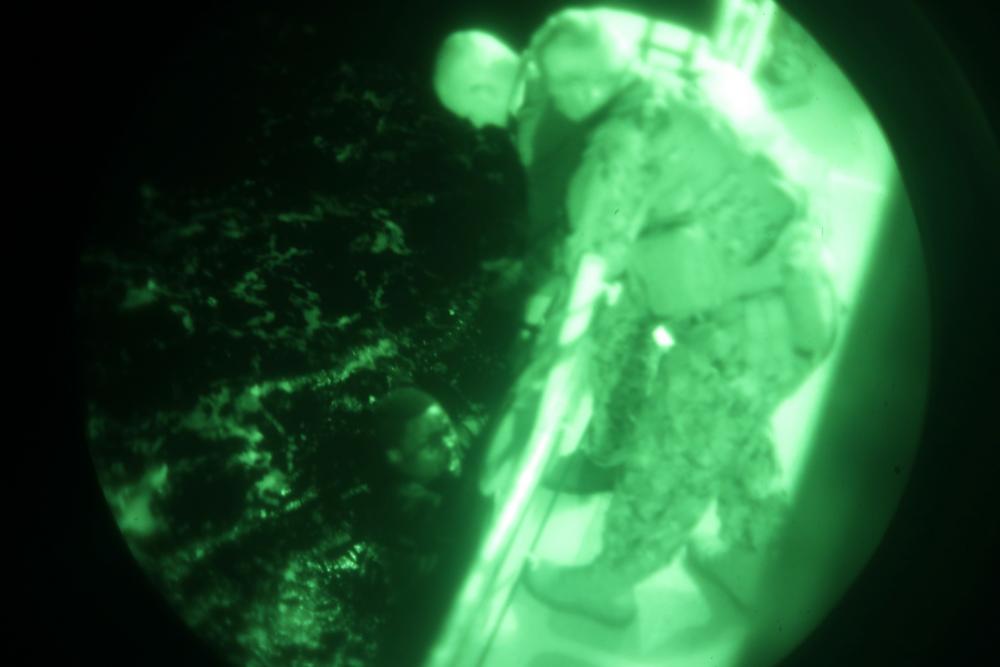
“The crew of the Sentinel-class USCGC Glen Harris (WPC 1144) prepares to receive migrants rescued from the water in the Atlantic Ocean on Jan. 4, 2021. The Glen Harris, with USCGC Emlen Tunnell (WPC 1145) and the USCGC Thetis (WMEC 901) are conducting a routine patrol in the U.S. Sixth Fleet area of responsibility while the Sentinel-class cutters transit from the U.S. to their new homeport of Manama, Bahrain. U.S. Sixth Fleet, headquartered in Naples, Italy, conducts the full spectrum of joint and naval operations, often in concert with allied and interagency partners, to advance U.S. national interests, security, and stability in Europe and Africa.” (U.S. Coast Guard photo by Petty Officer 2nd Class Ade Gills)

Earlier, we saw this from CG-9,

“Coast Guard cutters Glen Harris and Emlen Tunnell departed Sector Key West, Florida, for their new homeport in Manama, Bahrain, Nov. 18. They are the second pair of fast response cutters (FRCs) to be assigned to Patrol Forces Southwest Asia (PATFORSWA) as part of the Coast Guard’s effort to replace the region’s six existing 110-foot Island-class patrol boats. Glen Harris and Emlen Tunnell, accompanied by Coast Guard Cutter Thetis, arrived in San Juan, Puerto Rico, Nov. 24 and 25, respectively. The cutters are expected to complete their journey to PATFORSWA in late January 2022.”

Now we have this Atlantic Area news release below, regarding a rescue off the Moroccan coast.

Despite what the news release says, this is anything but routine, if not the mission, at least the location. They certainly were not on a “routine patrol.”

Here is a sample of a media report, this one from CNN.

Morocco has both an Atlantic and a Mediterranean coast. According to the CNN report, this occurred in the Atlantic.

The Moroccan warship would have been the Lieutenant-Colonel Errahmani, a Descubierta class corvette.

News Release

U.S. Coast Guard Atlantic Area

U.S., Spain, Morocco collaborate to conduct rescue at sea

migrants in the Atlantic  U.S. Coast Guard, partners conduct joint rescue of migrants in Atlantic USCGC Thetis (WMEC 910) and a Royal Moroccan Navy vessel are seen during the joint rescue of migrants in the Atlantic Ocean

Editors’ Note: To view more photos or download high-resolution imagery, click on the images above.

ATLANTIC OCEAN — On Jan. 5, 2022, the United States, Spain, and Morocco collaborated to rescue 103 migrants 40 nautical miles west of the Moroccan coast.

Late Tuesday evening, Spain’s Las Palmas Rescue Coordination Center received reports of two migrant rafts taking on water with people possibly in the water.

The Spanish center coordinated rescue efforts with the vessels closest to the reported location of the rafts. Three U.S. Coast Guard ships, Famous-class USCGC Thetis (WMEC 910), Sentinel-class USCGC Glen Harris (WPC 1144), and USCGC Emlen Tunnell (WPC 1145), and a nearby Royal Moroccan Navy frigate answered the call.

Working together, the crews rescued 103 migrants and recovered two deceased migrants by early Wednesday morning. Once safely aboard and stabilized, the U.S. Coast Guard crews transferred all migrants to the Moroccan Navy.

“While we are on an escort currently, the U.S. Coast Guard will always conduct our core mission of search and rescue and observe the international law of the sea and maritime custom to assist any mariners in distress,” said Cmdr. Justin Nadolny, commanding officer, USCGC Thetis (WMEC 910). “This demonstrates the capability of Thetis to work with partners and our ability to respond rapidly to any situation. I’m very proud of the team.”

The U.S. Coast Guard is conducting a routine deployment in the U.S. Sixth Fleet area of operations, working alongside Allies, building maritime domain awareness, and sharing best practices with partner nation navies and coast guards. These operations coincide with the escort of the Sentinel-class cutters across the Atlantic en route to their new homeport of Manama, Bahrain, and the cutters’ work for U.S. Patrol Forces Southwest Asia under U.S. Navy 5th Fleet and U.S. Central Command.

“The rescue of over 100 persons in the Atlantic demonstrates the agility and reach of U.S. Naval Forces throughout Africa and Europe,” said Capt. Kyle Gantt, Commander, Task Force 65. “U.S. Coast Guard’s timely coordination with Spanish authorities and the Moroccan Navy showcases the power of integration with our international partners at sea.”

The U.S. Coast Guard remains operational during COVID-19, following all COVID-19 safety precautions and regulations.

U.S. Sixth Fleet, headquartered in Naples, Italy, conducts the full spectrum of joint and naval operations, often in concert with allied and interagency partners, to advance U.S. national interests and security and stability in Europe and Africa. Based in Portsmouth, Virginia, U.S. Coast Guard Atlantic Area oversees all Coast Guard operations east of the Rocky Mountains to the Arabian Gulf. In addition to surge operations, they also allocate ships to work with partner commands.
At Least for This Blog, 2021 Was a Good Year, Thanks

Thanks to all of you who have come by and made the writing worthwhile. Special thanks to those who have contributed by your comments or by simply pointing me to articles of interest.

2021

In 2021, the blog had 244,089 views and 83,692 individual visits. This year we had 465 posts, totaling 165,836 words (both the most ever). There were 1250 comments (comments seem to have dropped off a bit). That is 2.86% more views than last year (237,298) and 16.9% more individual visits, more than any previous year with the exception of 2019 (255,335 views). Posts averaged only 357 words, (I am trying to be economical of your time.)

2019 was something of an anomaly, driven a couple of unusually popular posts. “Navy, this is Coast Guard, we need to talk,” had 18,245 views in 2019, making it the second most viewed post in the history of the blog. “An Offshore Patrol Vessel with Teeth” had 4,935 views in August alone. They made August, September, and October of 2019 the most viewed months so far. Sept. 30, 2019 alone, there were 7,302 views, the most ever in a single day.

29.7% of our readers were non-US. Aside from the US, 45 countries had 200 or more views. After the US, the five countries with the most views were the UK, Canada, Finland (Tups must have had something to do with this), Philippines, and Australia. All had more than 4200 views.

The top ten posts in 2021 were:

  1. 50mm Chain Gun, More Detail (2019)
  2. What Does It Take to Sink a Ship? (2011)
  3. Perhaps the Most Well Armed Cutter Sized Corvette in the World (2021)
  4. The Hamilton Class 378 foot WHECs, an Appreciation (2021)
  5. Guided Rounds for the 57mm Mk110, ALaMO and MAD-FIRES, an Update (2019)
  6. “Weapons Effectiveness Testing–25 vs 30mm” Revisited (2021)
  7. Philippines’ New 94 Meter Cutter and the Japanese Kunigami Class Cutters (2020)
  8. Norway’s Coast Guard Jan Mayen-class vessel (2021)
  9. Bahrain Bound FRC gets Upgrades, LRAD and Short-Range Air Search (2021)
  10. “Here Is What…Missiles Actually Costs” –The Drive (2020)

Blog History

The blog began in July 2012, after Dan Trimble decided to close down his “CGBlog” where I had contributed for a bit over two years. With Dan’s help, all the content I wrote during that period has been transplanted here along with the associated comments. That is why the archive includes posts dated before July 2012.

To date we have had 3,386 posts, 19,445 comments, and 1,996,169 views.

The top ten posts ever published on his blog, updated through the end of 2021 were:

  1. What Does It Take to Sink a Ship? (2011)
  2. Navy this is Coast Guard, we need to talk (2019)
  3. OPV to OPC (2012) (Since the OPC has been selected, now only of historical interest)
  4. The Navy’s New Patrol Boat (2012)
  5. Three Nations Share German OPV Design (2014)
  6. Case for the Five Inch Gun (2012)
  7. What Might Coast Guard Cutters Do in Wartime, Part 2, Coast Guard Roles (2012)
  8. Alternate Weapons for New Large Cutters? (2012)
  9. 50mm Chain Gun, More Detail (2019)
  10. An Offshore Patrol Vessel with Teeth (2019)

Top Ten Navies by Aggregate Displacement, 1 January 2022. Analysis and diagram by u/Phoenix_jz

You may need to click on this to make it readable. 

(There is an updated 2024 version of this post here)

Ran across this on Facebook, posted by Buddy Stewart, an administrator at the “Navy General Board” page. He found it here. Thought it might be of interest. I can’t vouch for the accuracy, but it looks credible to me.

The creator’s notes are below. 

I figured with all the discussion flying around over the past year over the sizes of various navies – particularly with regards to the greater-than-ever attention being paid to the growth of the PLAN – I would ‘publish’ some of the data from my own navy tracking spreadsheet to give everyone an idea of the relative sizes of the top ten navies, by aggregate displacement of commissioned ships, which I tend to find is a better way of measuring the sizes of navies than my mere ship counts. Figures are aggregates of full load displacement in metric tonnes.

To break down what each of these categories mean;

  • Surface Warships is an aggregate of all above-water warships and major aviation and amphibious assault platforms. This category includes CVNs, CVs, CVLs, LHDs, LHAs, LPDs, CGs, DDGs, FFGs, corvettes, OPVs, CPVs, lighter patrol craft, and MCM vessels.

  • Submarines is what it says on the tin – SSBNs, SSGNs, SSNs, SSKs, and for select nations where applicable (and where information is available), special purpose submarines.

  • AORs includes all major fleet replenishment vessels (coastal vessels do not count, however).

  • Other Auxiliaries is a very wide net that essentially captures everything else. Special mission ships, support vessels, minor amphibious assault vessels (LSDs, LSTs, LCAC’s, LCM’s, LCU’s), training vessels, tugs, coastal support vessels, hydrography ships – all essential parts of navies, but generally stuff that isn’t paid too much attention to as its far less flashy than the warships proper.

Interesting trends in data that I thought I would share for various navies;

Though much has been said about the PLAN ‘overtaking’ the USN in number of ships, the actual data is not so friendly. A large part of the PLAN’s numerical ‘edge’ comes from the larger number of smaller platforms they operate, be it corvettes like the Type 056/56A (50+22), or missile boats like the Type 22 (83). Much of this numerical strength was pre-existing relative to the last few years – what is really notable is the fact much of the PLAN’s growth is now driven by larger warships – such as the two LHDs, eight DDGs, and SSBN commissioned in 2021 (but nine Type 056A corvettes were still commissioned), as the PLAN is finding its pace with constructing large numbers of major surface combatants. However, they still have a long way to go in all categories before they really match the USN in size, if they ever do – as it stands the 22 cruisers and 69 destroyers of the American escort fleet clock in at 870,000 tons to the aggregate 474,000 tons of the PLAN’s destroyers and frigates – many of which are still older types of limited utility compared to even something as old as a Flight I Burke.

That said, the USN will see some notable contraction in tonnage over the next few years as many older Ticonderoga-class cruisers and several LCS’s are retired, while new frigates are still about five years away from seeing service. That said, given the availability issues of the Ticonderoga’s, this isn’t really much of a practical reduction in strength.

The VMF remains comfortably as the third largest navy. Though its surface fleet has seen better days, things are slowly improving as new frigates commission and older surface combatants get through their refits. It is worth noting that the VMF is still disproportionately powerful underwater with its large fleet of SSGNs, SSNs, and SSKs, though still somewhat smaller than the USN’s fleet in displacement (it appears larger here because of the significant special purpose submarine fleet). The PLAN may be the world’s second largest navy, but underwater, the VMF is on deck and the PLAN is in the hold.

The British Royal Navy remains in the number four spot, as we step down from the ‘million plus’ club of the top three navies. British aggregate displacement remains notable with regards to its low ratio of combatant tonnage to support fleet, a testament to the size of the RFA. This, combined with the large displacement of the Queen Elizabeth-class carriers (about 140,000t of carriers, temporarily second only to the USN’s 1.14 million tons of carriers) puts the British ahead of the JMSDF, which otherwise still has a significantly larger surface fleet, but is much shallower in terms of support ships (reflective of the different environments the two navies operate in).

There’s not much to say about the Indian Navy, other than to expect a significant increase this year when Vikrant commissions. Steady, if slow, construction has seen them replace older destroyers and frigates, though the true long-term challenge will be their SSN program. The Marine Nationale still comfortably holds its seventh-place position, though it is somewhat at an ebb given its AOR fleet is at an all-time low with just two Durance-class tankers in commission. This trend will continue through 2022, as the first Vulcano-class LSS for the Marine Nationale will not enter service until 2023. The MN can, however, boast of having one of the most modern surface combatant fleets anywhere – by the end of 2022, when the last Georges Leygues-class frigate leaves service and the new Lorraine commissions, it will have not a single ship commissioned before 2000 in its front-line escort fleet of Horizon and FREMM.

The ROKN is something of a rising star, though this year they’ve poked their head into the top eight briefly thanks to stagnation in the displacement of the normal number eight, the Marina Militare – the latter is down two frigates from a sale to Egypt, and a new ‘OPV’ due to delays brought on by Covid. The ROKN is an example of another navy heavy in combatant displacement but shallow in support ships, reflective of its operating environment. Though the Korean carrier program has so far stolen much of the attention of the ROKN’s development, that remains a long way off and for now the more notable areas of growth are the steady frigate program, and indigenous submarine program.

The Marina Militare, as mentioned before, is at something of a low ebb, though they will likely regain the number eight position as a new LHD and two OPVs will net them about 35,000 tons in 2022 (as the carrier Giuseppe Garibaldi will leave service this year). The first half of the 2020s will see the delivery of a significant number of surface combatants – two FREMM and six ‘OPVs’ of the PPA type – as well as another LSS of the Vulcano-class.

The Indonesian Navy is an unlikely tenth, but they are still very much present – albeit this is primarily the responsibility of their five Makassar-class LPDs that net them the 57,000 tons that, in combination with an unusually large fleet of LSTs and LSMs, puts them over the Turkish Navy (which just misses our list at 258,048 tonnes). That said, even if they were to fall out of their current ‘position’ in the short term, they are likely to remain in the top ten in the long term, due the large expansion planned for their surface fleet of at least ten frigates by the end of the decade.

ALCOAST 464/21 SUBJ: WINNER ANNOUNCEMENT – 2021 HOPLEY YEATON CUTTER EXCELLENCE

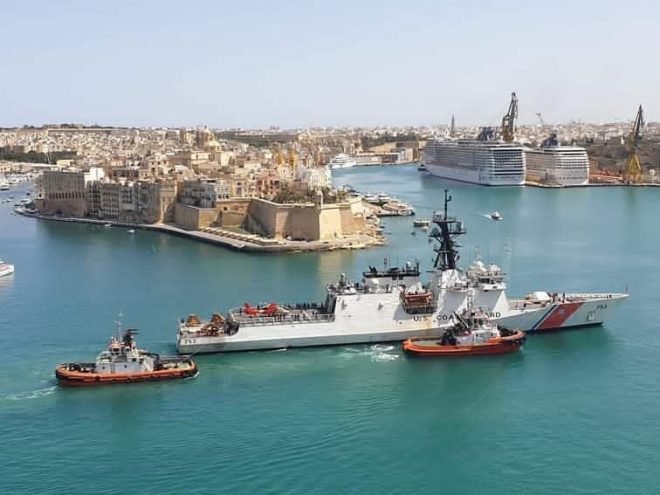
USCGC Hamilton (WMSL-753) conducting port visit in Valletta, Malta on May 17, 2021. Coast Guard Photo

Just passing this along. I have added pictures and a link to a previous post. 

R 202101Z DEC 21
FM COMDT COGARD WASHINGTON DC
TO ALCOAST
BT
UNCLAS
ALCOAST 464/21
SSIC 1650
SUBJ: WINNER ANNOUNCEMENT – 2021 HOPLEY YEATON CUTTER EXCELLENCE
AND SUPERIOR CUTTERMAN AWARDS
A. COMDT COGARD WASHINGTON DC 141626Z SEP 21/ALCOAST 336/21

1. The Douglas Munro Chapter of the Surface Navy Association (SNA) is honored to announce and congratulate the recipients of the 2021 Hopley Yeaton Cutter Excellence and Superior Cutterman Awards. The winners were selected from an incredibly competitive pool of nominees.

2. The winners of the Hopley Yeaton Awards for 2021 are:

a. Cutter Excellence Awards

  • 1. Large Cutter: CGC HAMILTON (WMSL 753)
  • 2. Medium Cutter: CGC RESOLUTE (WMEC 620)
  • 3. Small Cutter: CGC ISAAC MAYO (WPC 1112)

b. Superior Cuttermen Awards

  • 1. Officer: LTJG Lauren Kowalski – CGC POLAR STAR (WAGB 10)
  • 2. Enlisted: YN1 Joseph DeVito – CGC RELIANCE (WMEC 615)

3. Cutter Excellence Award (Large) – CGC HAMILTON (WMSL 753):

a. Following her trans-Atlantic escort of the first Fast Response Cutters bound for service at PATFORSWA, CGC HAMILTON transited the Bosporus into the Black Sea where she conducted freedom of navigation patrols and operated and trained with Turkish and Romanian Naval Forces, the Georgian Coast Guard, and Ukrainian Maritime Forces. While deployed in the U.S. European Command AOR, HAMILTON conducted at-sea exercises and port visit engagements with the navies and coast guard of seven total international allies and partners; bolstering freedom of navigation in international waters of the Black Sea and building maritime domain awareness, cooperation, and interoperability with partner nation navies and coast guards. As Caribbean maritime migration levels increased to the highest levels in more than seven years, HAMILTON assumed command of surface operations in the Windward Pass, directing the employment of three major and four fast response cutters that successfully resulted in a dramatic decline in attempts by migrants to attempt the extremely hazardous voyage at sea.

b. Honorable Mentions for the Large Cutter Award are:

  • 1. CGC MUNRO (WMSL 755)
  • 2. CGC BERTHOLF (WMSL 750)

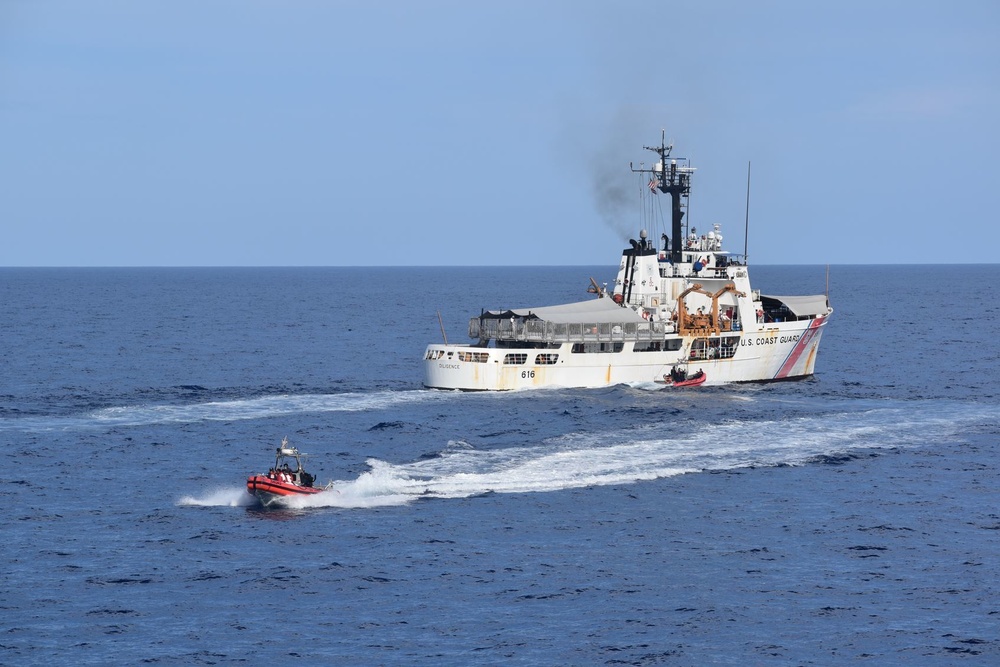
RESOLUTE conducts an at-sea transfer with CGC DILIGENCE. The transfer included a 77 Haitian migrants, their personal belongings, and a Creole interpreter. In total, RESOLUTE cared for 260 Haitian migrants. All migrants are given food, water, and medical attention once onboard a Coast Guard cutter. During a 56-day patrol, RESOLUTE provided overt presence in Northern Haiti to deter illegal and dangerous migration voyages. Photo by ENS Alex Cordes.

4. Hopley Yeaton Cutter Excellence Award (Medium) – CGC RESOLUTE (WMEC 620):

a. In 2021, CGC RESOLUTE safely conducted the largest single-unit, at-sea migration case in more than a decade (183 migrants, including 17 children and infants). RESOLUTE led rigorous dockside and underway trials for the new Cutter Boat-Large acquisition and delivered expert analysis of safety, compatibility, and suitability for a wide range of Coast Guard missions. RESOLUTE’s superb engagement with headquarters program sponsors and naval engineers supported successful acceptance and roll-out across the entire 210′ WMEC fleet. Highlighting a year with multiple SAR cases, RESOLUTE’s lookout detected people in the water, leading to the rescue of 8 migrants who had been treading water for 24 hours following the capsizing of their makeshift vessel.

b. Honorable Mentions for the Medium Cutter Award are:

  • 1. CGC LEGARE (WMEC 912)
  • 2. CGC HICKORY (WLB 212)

USCGC Isaac Mayo, Key West, Fla., Jan. 29, 2015. (U.S. Coast Guard photo by Petty Officer 3rd Class Mark Barney

5. Hopley Yeaton Cutter Excellence Award (Small) – CGC ISAAC MAYO (WPC 1112):

a. In 2021, CGC ISAAC MAYO conducted 108 at-sea boardings resulting in the disruption of 3,000 kgs of cocaine valued at $75 million. ISAAC MAYO conducted joint operations with Customs and Border Protection and Homeland Security Investigations during an operation to deter, detect, interdict, and inspect, targets of interest in the northern portion of Sector Key West’s area of responsibility. ISAAC MAYO led the way during Operation CHOKE POINT, an intradepartmental partnership with Customs and Border Patrol and Homeland Security Investigations, to board and inspect vessels operating in the Gulf of Mexico. Additionally, ISAAC MAYO developed a first-ever Tactics, Techniques, and Procedures for operating with a Customs and Border Patrol 45-ft Coastal Intercept Vessel, laying the foundation for sustained multi-agency asset employment far beyond historical operating limitations.

b. Honorable Mentions for the Small Cutter Award are:

  • 1. CGC RICHARD ETHERIDGE (WPC 1102)
  • 2. CGC CHARLES MOULTHROPE (WPC 1141)

6. Hopley Yeaton Superior Cutterman Award (Officer) – LTJG Lauren Kowalski – CGC POLAR STAR (WAGB 10):

a. LTJG Kowalski completed the USCG’s Afloat Icebreaker Training program and demonstrated outstanding professionalism in her role as USCG liaison officer and ice pilot for three months aboard the HMS PROTECTOR. In her capacity as ice pilot, she led the ship to set a new Royal Navy latitude record for surface ships. She managed operations and tracklines for the nation’s only heavy icebreaker, planning and navigating the 10,000 nm voyage for the Arctic Winter West 2021 deployment, through treacherous ice windrows, howling gales, and 10 days of perpetual winter darkness.

b. Honorable Mentions for the Superior Cutterman Award (Officer) are:

  • 1. LTJG William Stephens – CGC MAUI (WPB 1304)
  • 2. ENS Matthew Hall – CGC ANACAPA (WPB 1335)

7. Hopley Yeaton Superior Cutterman Award (Enlisted) – YN1 Joseph Devito – CGC RELIANCE (WMEC 615):

a. YN1 DeVito went beyond the normal duties of a Yeoman afloat by qualifying as an underway officer of the deck. In addition, YN1 DeVito qualified as boat deck safety, helm and lookout, boatswain mate of the watch, quartermaster of the watch, on scene leader for flight operations, detainee watch stander, boarding team member, force protection officer, .50 cal mount captain, .50 cal gunner, repair party leader, and inport officer of the deck. As the vice chairperson of the cutter’s newly formed Leadership and Diversity Advisory Council, he helped organize multiple events that improved the unit’s investment in the professional and personal development of its junior officers and enlisted members. As a Damage Control Training Team member leading training for Repair III, he trained more than 100 crew members in damage control. His superb expertise as a Yeoman resulted in zero discrepancies across 50 line items during the cutter’s Finance and Administration inspection.

b. Honorable Mentions for the Superior Cutterman Award (Enlisted) are:

  • 1. BMC Brian Cleversey – CGC RESOLUTE (WMEC 620)
  • 2. BM2 Nancy Worley – CGC HOLLYHOCK (WLB 214)

8. The winners will be recognized at the 2022 SNA National Symposium.

9. Bravo Zulu and great work to this year’s Hopley Yeaton Award recipients and nominees. This year’s nominees were selected by panels comprised of 61 active duty and retired permanent cuttermen from the rank of E6 to O8, with a collective 604 years of sea time. The sheer volume of praiseworthy nominees and high-quality award write-ups continue to impress. Thank you to all commands that submitted and reviewed nominations.

10. POC: LT Luke Trautwein at John.L.Trautwein@uscg.mil.

11. RDML Todd C. Wiemers, Assistant Commandant for Capability
(CG-7), sends.

12. Internet release is authorized.

“Coast Guard’s Schultz gives ‘full-throated’ support for UN sea law treaty” –Breaking Defense

Vice Adm. Karl L. Schultz, commander, Coast Guard Atlantic Area, speaks at the Coast Guard Cutter Benjamin Dailey commissioning ceremony in Pascagoula, Miss. Coast Guard Photo

Breaking Defense reports the Commandant’s remarks regarding the United Nations Convention on the Law of the Sea (UNCLOS) at a Navy League event.

Also reported were vice chairman of the Joint Chiefs of Staff nominee, Adm. Christopher Grady’s expressions of support for ratification.

“Shultz: Two FRCs Soon to Depart for Basing in Persian Gulf” –Seapower

U.S. Coast Guard Cutter THETIS (WMEC-910) will be providing escort. US Navy photo ID:J3103SPT95001725 / DNST9800595

The Navy Leagues on-line magazine, Seapower, reports two two FRCs, USCGC Glenn Harris (WPC 1144) and USCGC Emlen Tunnell (WPC 1145), will soon be on their way to Bahrain to join PATFORSWA.

“Coast Guard Commandant Karl Schultz, speaking Dec. 8 at a Navy League Special Topic Breakfast, said the two 154-foot-long FRCs will be escorted across the ocean by the USCGC Thetis (WMEC 910), a Famous-class medium-endurance cutter that was topping off with fuel in Puerto Rico. Schultz said that after the escort mission the Thetis will be operating off Africa.”

I am a bit surprised the escort will be a medium endurance cutter instead of a Bertholf class National Security Cutter.

Also interesting is the report that Island-class patrol boats USCGC Adak (WPB 1333) and USCGC Aquidneck (WPB 1309), were transfered to Indonesia.

“Coast Guard conducts 78 lancha interdictions in fiscal year 2021 along Texas coast” –News Release

A launch crew is interdicted by Coast Guard law enforcement crews for engaging in illegal fishing in federal waters off the coast of southern Texas April 6, 2020. Coast Guard crews consisting of air support, a small boat crew, and a cutter stopped three lanchas approximately 50 miles north of the Maritime Boundary Line, with a total of thirteen lanchamen were engaged in illegal fishing. Twelve miles of longline gear, illegal fishing equipment, as well as 2,020 lbs of illegally-caught Red Snapper were seized. (U.S. Coast Guard photo)

Below is a news release. Thought it was significant because it provides a summary of an operation that does not get a lot of attention.

The videos that accompanied the release did not transfer over when I cut and pasted the news release. You can see them here. 

I would note that while the news release mentions lanchas “…entering the United States Exclusive Economic Zone near the U.S.-Mexico border in the Gulf of Mexico with the intent to smuggle people, drugs, or poach the United State’s natural resources.” There is no information about any people smuggled or drugs seized. 

Coast Guard conducts 78 lancha interdictions in fiscal year 2021 along Texas coast

CORPUS CHRISTI, Texas — Coast Guard law enforcement crews interdicted 78 lanchas, seized 15,484 lbs of catch, and detained 208 fishermen during fiscal year 2021 along the Texas coast.

Since the first recorded lancha interdiction in the late 1980s, the Coast Guard has seen a significant uptick in the detection of the vessels, recording close to 300 lancha interdictions in the past three fiscal years combined.

A noteworthy case from this year was on Aug. 4, 2021, when Coast Guard Station South Padre Island worked with Coast Guard Sector/Air Station Corpus Christi, Texas Parks and Wildlife and the Coast Guard Cutter Pelican to interdict four lanchas with a total of 320 lbs of red snapper and 1,160 lbs of shark in one day.

In cooperation with other law enforcement agencies, the Coast Guard utilizes a layered approach to combat illegal, unreported, and unregulated fishing through aircraft, small boats, and cutters, as well as improved technology on those assets, resulting in the drastic increase in lancha interdictions.

“The crew at Station South Padre Island takes their role of protecting our natural resources from poaching along the Maritime Boundary Line very seriously,” said Lt. Cmdr. Daniel Ippolito, commanding officer of Coast Guard Station South Padre Island. “The last few years of record-breaking lancha interdictions speak to the steadfast commitment, professionalism, and teamwork of the Coast Guard crews and our partners at Texas Parks and Wildlife to this mission. We ask that the public continue to stay vigilant and report any instances of illegal fishing to the Coast Guard or Texas Parks and Wildlife.”

A lancha is a fishing boat used by Mexican fishermen that is approximately 20-30 feet long with a slender profile. They typically have one outboard motor and are capable of traveling at speeds exceeding 30 mph. Lanchas pose a major threat, usually entering the United States Exclusive Economic Zone near the U.S.-Mexico border in the Gulf of Mexico with the intent to smuggle people, drugs, or poach the United State’s natural resources.

If you witness suspicious activity or illegal fishing in state waters (out to 9 miles offshore), please contact the Texas Parks and Wildlife Department’s “Operation Game Thief” at 1-800-792-GAME (4263). For all suspicious activity or illegal fishing occurring in federal waters (out to 200 miles offshore), please contact the U.S. Coast Guard at 361-939-0450.