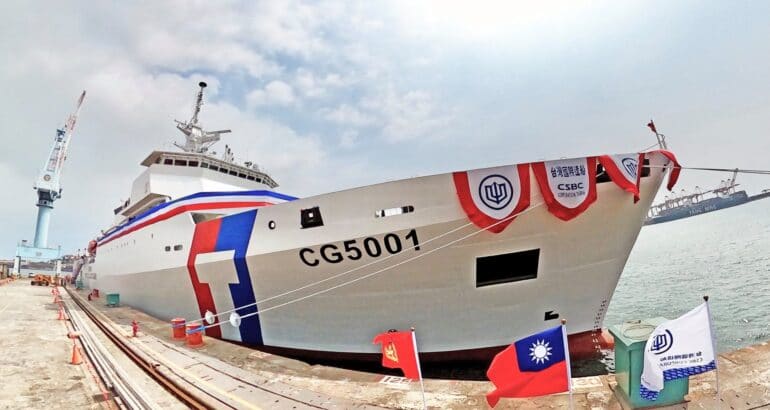
Taiwan Coast Guard Administration (CGA) commissioned it largest ship to date: The 4000-ton class “Chiayi” (CG5001). CGA picture.
Like many South East Asian countries, Taiwan is rapidly expanding its Coast Guard fleet. Naval News reports progress on their ambitious program. The same day the first of this new class of cutters was delivered, the second of the planned class of four was named and launched.
The class is nominally 4000 tons, but as is frequently the case in Asia, the displacement is understated. These ships are over 5000 tons full load and consequently larger than the Bertholf class National Security Cutters.
The use of a rocket launcher as main armament is unusual. They also have provision for mounting anti-ship cruise missiles. I have more information on these ships in an earlier post.
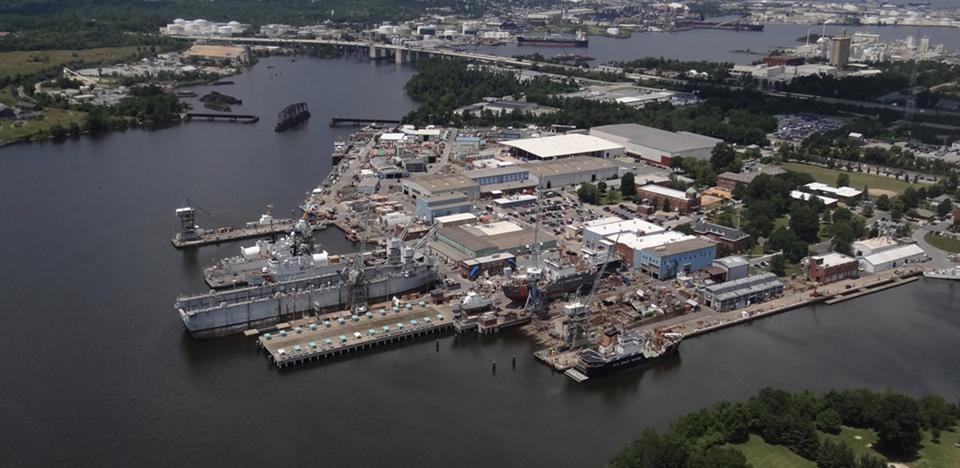
“As Navy backers in Congress introduce the “SHIPYARD” Act, legislation to fully fund a 20-year, $21 billion plan that recapitalizes the Navy’s four public shipyards, America’s fifth taxpayer-owned shipyard, the low-profile Coast Guard Yard, risks being left out in the cold, with no extra funding. Operated by the Department of Homeland Security in Maryland’s 2nd Congressional District, the shipyard supports the U.S. Navy fleet, consistently completing high quality repair work, and, unlike the four Navy yards, the Coast Guard Yard is getting their repair projects done on time and on budget.”
I think their next major refit project will be the service life extension program for six 270s.
The CG Yard has done construction work in the past including five of the 210 foot WMECs. Would be nice to see them building Offshore Patrol Cutters in parallel with the private yard chosen for the second phase of the OPC program. We really need to build this class faster than currently planned.
Crewmembers aboard the U.S. Coast Guard cutter USCGC Adak (WPB-1333) raise the American flag. Adak is assigned to CTF 55, supporting maritime security operations and theater security cooperation in the U.S. 5th Fleet area of responsibility. U.S. Coast Guard photo by Seaman Frank Iannazzo-Simmons
Two bits of news about USCGC Adak, one of the 110s currently assigned to Bahrain as part of PATFORSWA.
First, it is to be sold to Indonesia in three days. Not surprising considering the first two of six Webber class intended to replace the six Island class cutters should be there any time now.
Second, there is a move afoot to try to retain Adak as a museum ship because of her role in the evacuation of Manhattan following the attack on 9/11.
Have to say I have mixed feelings about this. At this late date, if we back out of the deal with Indonesia, it might be viewed badly by a nation we want to help and maintain good relations with. Substituting one of the other cutters might suffice, but ultimately all these boats are probably going to allies in the Pacific. There they can continue to do good work.
I have also seen too many attempts to keep museum ships that have foundered leaving the ship derelict. There is also the fact that the evacuation was such a massive effort by mariners of all kinds that I almost feel focusing on the Coast Guard’s efforts diminishes recognition of the scope of the effort.
On the other hand, if any 110 should be preserved, Adak is an excellent choice, given her role in 9/11, the Gulf War, and PATFORSWA.
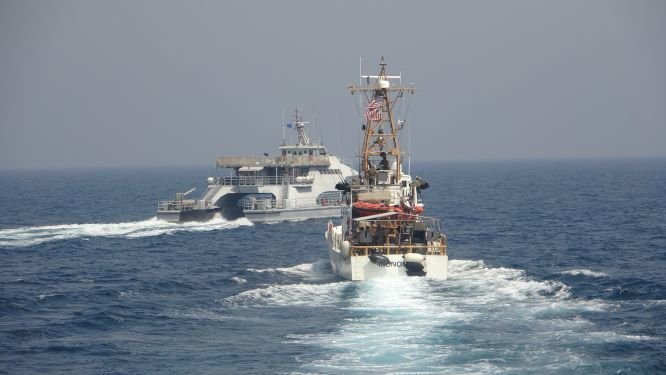
Photo from the previous incident: Iran’s Islamic Revolutionary Guard Corps Navy (IRGCN) Harth 55, left, conducted an unsafe and unprofessional action by crossing the bow of the Coast Guard patrol boat USCGC Monomoy (WPB-1326) on April 2, 2021. US Navy Photo
At 8 p.m. local time on Monday, a trio of fast inshore attack craft belonging to the Islamic Revolutionary Guard Corps Navy (IRGCN) quickly approached Cyclone-class patrol coastal ship USS Firebolt (PC-10) and U.S. Coast Guard patrol boat USCGC Baranoff (WPB-1318), coming within 70 yards of the U.S. vessels operating in international waters, according to a statement from U.S. 5th Fleet.
“The U.S. crews issued multiple warnings via bridge-to-bridge radio and loud-hailer devices, but the IRGCN vessels continued their close-range maneuvers. The crew of Firebolt then fired warning shots, and the IRGCN vessels moved away to a safe distance from the U.S. vessels,” reads a Tuesday statement from U.S. 5th Fleet.
Unlike the earlier day light incident, this one happened in the early evening.
The following is copied from MyCG. Looks like this my be a very important change in the long run.
Reserve aviation workforce roll-out
By Cmdr. Marc McDonnell, Office of Aviation Forces
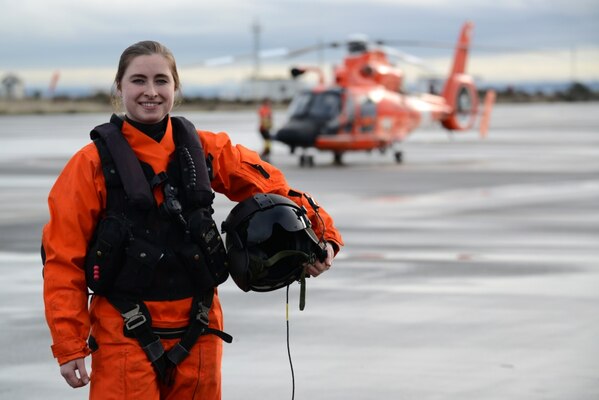
Coast Guard Petty Officer 3rd Class Amber Brewer, an aviation maintenance technician, Air Station Port Angeles, Wash., poses for a picture on the the flight line in front of an MH-65 Dolphin Helicopter, Jan. 26, 2018. Brewer not only maintains the readiness of the aircraft, but is also a qualified flight mechanic responsible for overseeing the mechanical safety of the helicopter and conducting the essential hoisting operations conducted during rescue swimmer deployments. U.S. Coast Guard photo by Chief Petty Officer David Mosley
April 27, 2021 —
The reserve component delivers tremendous value to the Coast Guard and is, without question, key to the Coast Guard’s long history of operational success. Yet, Coast Guard aviation, one of our service’s largest communities, is not represented in the reserve. With over 4,000 enlisted personnel and over 1,000 officers in aviation, there is a tremendous opportunity for the Coast Guard to develop a new capability in the reserve that directly supports our missions and our people.
To remedy this capability gap, the Office of Aviation Forces and the Coast Guard reserve are working to develop the reserve aviation workforce. With a target start date of Summer 2021, the initiative will start by making 50 billets available to enlisted aviation personnel (E-4 to E-6) who are separating from active duty. The motivation for developing this workforce is simple: enable our aviation personnel to continue their chosen career path in the reserve, retain aviation technical expertise, and develop an aviation surge and mobilization capability.
Capability and Integration
The new reserve aviation workforce will focus on providing ground-based aviation maintenance and support equipment maintenance. The reservists will drill under traditional SELRES drilling requirements and be available for mobilization. Flight status designation will remain under the authority of the local air station’s commanding officer, but this is envisioned only as long-term support mechanism. Historically, aviation mobilization has been 100% supported by our active-duty members and multi-day surge operations required duty-grid shuffles to both support the surge op and sustain the unit’s search and rescue readiness requirements. In the future, aviation reservists will help meet the surge mobilization request by either responding directly or backfilling home units. The key to the successful implementation of the workforce is already part of the Coast Guard’s DNA with aviation’s commitment to standardization and the reserve’s philosophy of integration. In aviation, integrating mixed crews from multiple air stations is already normal ops for surge events; mobilizing reservists to integrate with active duty maintenance teams will become a welcomed and standard practice.
Delivering Value and Next Steps
This will be a culture shift for our hangar decks and wardrooms. To aid in the workforce’s rollout, Aviation Forces and the Deputy Commandant for Mission Support will schedule training events to ensure our new reserve personnel and air stations are well prepared. We believe that the workforce will retain valuable aviation expertise, deliver on our duty to people commitment, and increase the flexibility of aviation to overcome future challenges.
Author’s note: The Office of Aviation Forces is also working to establish reserve aviator (pilot) billets in FY22. These aviator positions will require SELRES drilling requirements of 60 to 72 days. Locations for these billets have not been finalized, but they will support flight training at Naval Flight School and operational missions at Coast Guard air stations.
—-Late Addition: I have added a news release below—-
News Release
U.S. Coast Guard Atlantic Area Contact: Coast Guard Atlantic Area Public Affairs Office: (757) 398-6521 After Hours: (757) 641-0763 Atlantic Area online newsroom
U.S. Coast Guard cutter enters Black Sea
Editors note: To view more or download high-resolution photos click on the images above.
Story courtesy U.S. Naval Forces Europe and Africa / U.S. Sixth Fleet Public Affairs
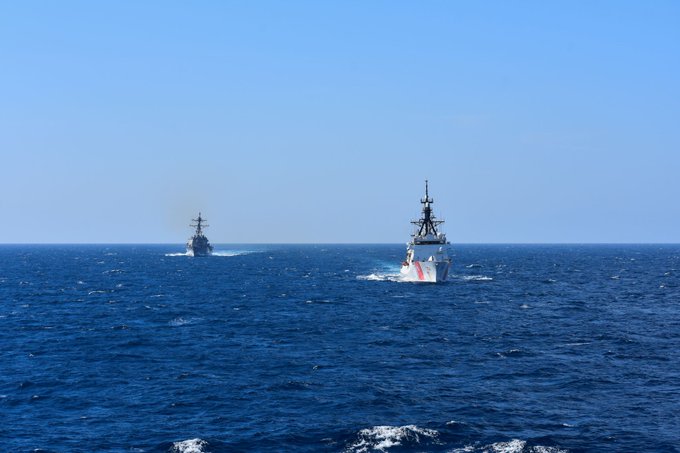
BLACK SEA — The Legend-class national security cutter USCGC Hamilton (WMSL 753) transited into the Black Sea to support NATO Allies and partners, April 27, 2021.
Hamilton is the first U.S. Coast Guard cutter to visit the Black Sea since 2008. The last U.S. Coast Guard cutter to visit the Black Sea, USCGC Dallas (WHEC 716), sailed to the Black Sea twice, in 2008 and 1995.
The Ticonderoga-class guided-missile cruiser USS Monterey (CG 61) and Arleigh Burke-class guided-missile destroyer USS Thomas Hudner (DDG 116) conducted Black Sea operations on a routine patrol to maintain maritime security alongside other NATO Allies and partners in March 2021.
This patrol comes after Hamilton conducted logistics visits to Naples, Italy, and Rota, Spain. The U.S. Coast Guard is conducting a routine deployment in U.S. Sixth Fleet, working alongside Allies, building maritime domain awareness, and sharing best practices with partner nation navies and coast guards.
The U.S. Navy and U.S. Coast Guard operate forward, from the littoral to the open ocean, ensuring stability and open sea lanes across all maritime domains. U.S Sixth Fleet routinely conducts operations in the Black Sea.
Hamilton is the fourth national security cutter and is the fifth named for the father of the U.S. Coast Guard – Alexander Hamilton, the first Secretary of the Treasury and advocate for creating the U.S. Revenue Cutter Service.
The U.S. Coast Guard remains operational during COVID-19, following all COVID-19 safety precautions and regulations.
U.S. Sixth Fleet, headquartered in Naples, Italy, conducts the full spectrum of joint and naval operations, often in concert with allied and interagency partners, to advance U.S. national interests and security and stability in Europe and Africa.
180201-N-TB177-0211
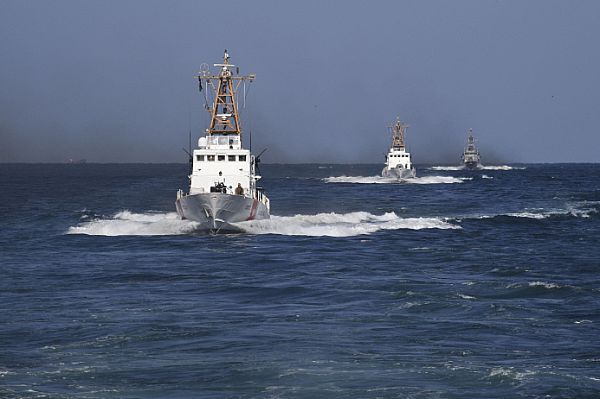
U.S. 5TH FLEET AREA OF OPERATIONS (Feb. 1, 2018) Island-class patrol boats USCGC Wrangell (WPB 1332), left, USCGC Aquidneck (WPB 1309), middle, and coastal patrol ship USS Firebolt (PC 10) patrol the open seas. Wrangell, Aquidneck and Firebolt are forward deployed to the U.S. 5th Fleet area of operations in support of maritime security operations to reassure allies and partners and preserve the freedom of navigation and the free flow of commerce in the region. (U.S. Navy photo by Mass Communication Specialist 2nd Class Kevin J. Steinberg/Released)
Business Insider reports that Cutters Wrangell and Monomoy were harassed for three hours by units of the Iran’s Islamic Revolutionary Guard Corps.
“Three IRGC fast-attack boats and a larger support vessel swarmed the US Coast Guard cutters Monomoy and Wrangell while they were on patrol in international waters on April 2.”
Sounds like the IRGC units may have been operating without government authority and attempting to create an incident.
The IRGC is a bit like Nazi Germany’s Waffen SS or China’s People’s Liberation Army, in that it is not a national armed force. It is an armed force of a political faction.
It was almost exactly a year earlier when the last such incident occurred. This time there were fewer Iranian units and they do not seem to have acted quite as aggressively.
This was more than three weeks ago and we are only hearing about it now. No photos or videos of the incident accompanied the story. It is always a good idea to get video–I am willing to bet photos and videos exist, but for some reason they were were not made public. Perhaps for the same reason it took three weeks for the news to surface.
A Japan Coast Guard helicopter approaches an Indian Coast Guard patrol vessel during a joint exercise off Chennai, India, January 2018 (Photo: The Asahi Shimbun via Getty)
MEDITERRANEAN SEA (April 23, 2021) The crews of the U.S. Coast Guard Legend-class national security cutter Hamilton (WMSL 753) and the Italian coast guard Dattilo-class offshore patrol vessel Ubaldo Diciotti (CP 941) conduct simulated search and rescue exercises and helicopter hoist operations in the Mediterranean Sea, April 23, 2021. Hamilton is on a routine deployment in the U.S. Sixth Fleet area of operations in support of U.S. national interests and security in Europe and Africa. (U.S. Coast Guard photo by Lt. Andrew Breen)
USCGC Hamilton is having an unusual deployment. Below is a news release. More photos here.
News Release, U.S. Coast Guard Atlantic Area
U.S. Coast Guard strengthens Trans-Atlantic ties with Italy NAPLES, Italy — The Legend-class national security cutter USCGC Hamilton (WMSL 753) conducted operations in the Mediterranean Sea with the Italian coast guard and Italian navy Friday.
The operations were designed to increase interoperability as part of a regional effort to bolster maritime partnerships with NATO allies.
“Working with the Italian coast guard and Italian navy strengthens our maritime partnership and reinforces our shared values,” said Capt. Timothy Cronin, commanding officer of USCGC Hamilton. “Our engagements with Italy this week bring unity of effort in the maritime domain through interoperable capabilities and combined operations.
“More than half of regional economic activity relies on the safe and lawful use of maritime space, making maritime security essential to economic development and sustainment. To further this objective, Hamilton participated in search and rescue exercises with the Italian coast guard in the Tyrrhenian Sea.
“Today, this meeting has represented an important and useful opportunity to improve our already strong relationship between the Italian and U.S. coast guards,” said Vice Adm. Antonio Basile, vice commandant of the Italian coast guard.
Afterward, Hamilton transitioned to the Ionian Sea, conducting cross deck flight operations with the Italian navy to practice daylight landing at sea. Exercises like these strengthen alliance interoperability, combined operations, theater security cooperation, and capacity-building efforts.
These operations follow a logistics visit to Naples, Italy, where the crew met with Italian coast guard leadership to enhance the U.S. and Italian military relationship further.
“It was a pleasure to work alongside one of our strongest allies and share best practices to improve safety at sea,” said Petty Officer 1st Class Thomas Hatfield. “We all learned a lot from each other, and we welcome the opportunity to do it again in the future.
”The U.S. Coast Guard brings unique capabilities thanks to a wide suite of specialized maritime capabilities, competencies, and authorities. Their mission set capabilities to include search and rescue operations, counter-drug enforcement, living marine preservation and ports, waterway, and coastal security. As a law enforcement agency, regulatory agency, and a branch of the military, the service’s multi-mission mandate gives the Coast Guard a unique and unparalleled opportunity.
“Our organizations share several competencies in the strategic environment that are important in both the national and international realm. These include: search and rescue operations, marine environmental protection, and control of the sea.” Basile said. “Soon we will usher in a new basis for our strong maritime bond, a “memorandum of understanding” that will highlight the mutual willingness to cooperate and to improve our expertise, through the development of combined operations and interoperable capabilities.
”The U.S. Coast Guard is conducting a routine deployment in the U.S. Sixth Fleet area of operations, working alongside allies, building maritime domain awareness, and sharing best practices with partner nation navies and coast guards.
Hamilton is the fourth Legend-class national security cutter and is the fifth named for the father of the U.S. Coast Guard – Alexander Hamilton, the first Secretary of the Treasury and advocate for the creation of the U.S. Revenue Cutter Service.
The U.S. Coast Guard remains operational during COVID-19, following all COVID-19 safety precautions and regulations.
U.S. Sixth Fleet, headquartered in Naples, Italy, conducts the full spectrum of joint and naval operations, often in concert with allied and interagency partners, in order to advance U.S. national interests and security and stability in Europe and Africa.
Naval News reports that the French Navy has ordered a helicopter style Unmanned Air System (UAS) similar in concept to the US Navy’s MQ-8 Fire Scout, but considerably smaller. It is expected to be used on a number of French Navy vessels including 16 new offshore patrol vessels (here) some of which have flight decks too small for conventional naval helicopters (here, and here)
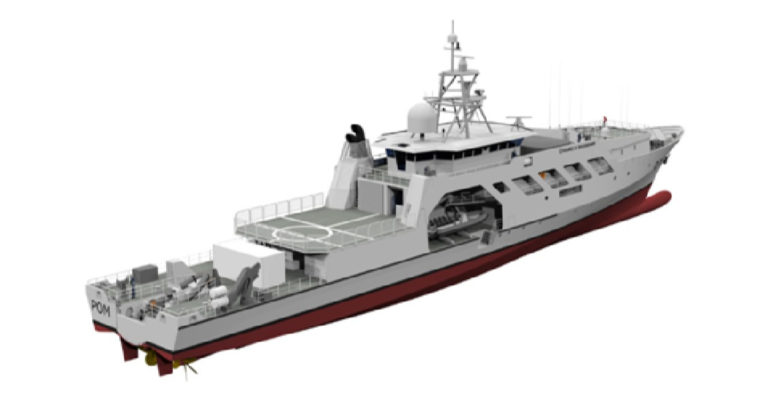
Rendering of the future “POM” OPV of the French Navy
This new Airbus UAS, the VSR700, has a max take off weight of 700 kg (1,543 lb). That is less than half the max take off weight of the smaller Fire Scout MQ-8B (3,150 lb/1,430 kg) and about a quarter of that of the larger MQ-8C (6,000 lb/2,721 kg).
Unlike the Fire Scouts, which use different versions of the same Rolls-Royce (formerly Allison) M250 turboshaft gas turbine, the VSR700 is powered by a four cylinder inline diesel of 1.991 liter/121.5 ci (Ø83 x 92 mm), the Thielert Centurion 2.0, derived from a modified Mercedes-Benz automobile engine. It is, however, capable of operating on either diesel or jet fuel.
Reportedly the VSR700 has greater endurance (10 hours) than the MQ-8B (8 hours) but less than the MQ-8C (15 hours)
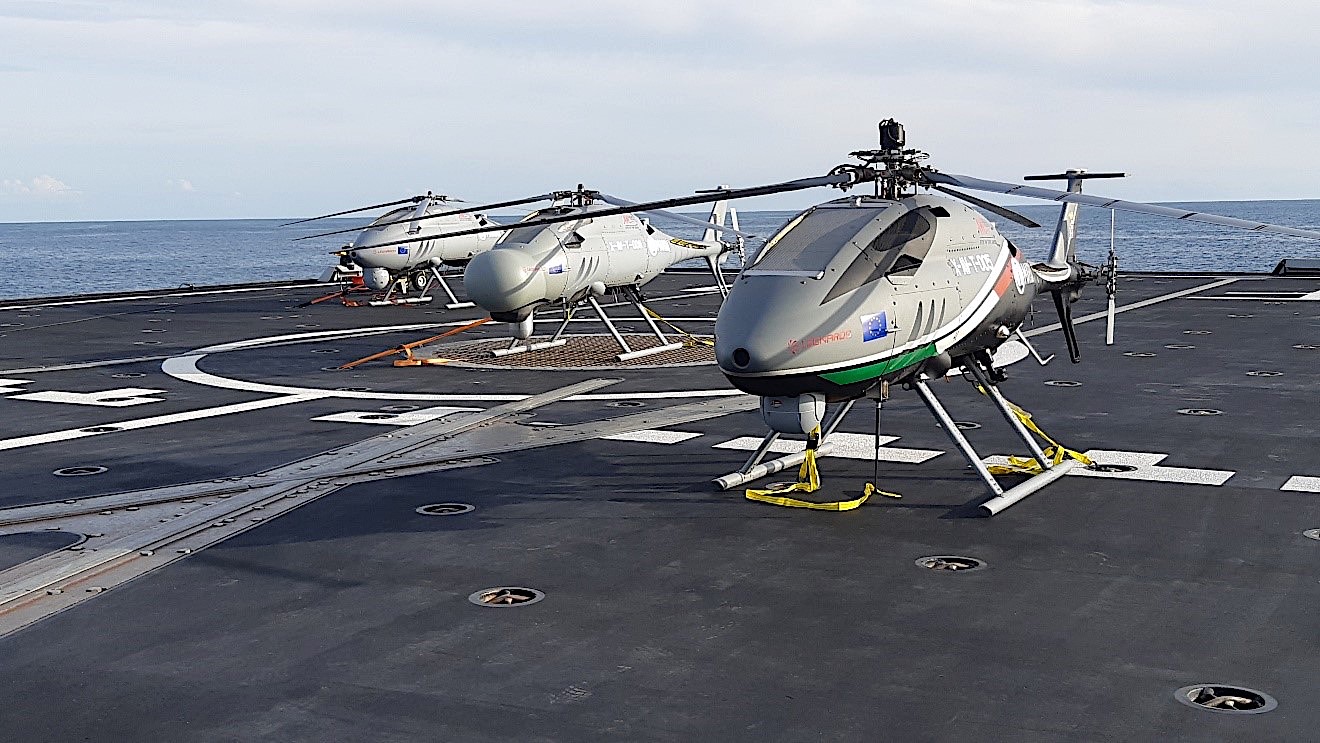
The VSR700 is unique it its size, smaller than the Fire Scout, but larger than the very popular Schiebel Camcopter S-100 (use by about 20 countries) and the relatively new Leonardo AWHero, in contention for use on Australia’s 12 new OPVs, both in the 200 kg class. Both of which have a smaller payload and approximately six hour endurance.










 Chuck Hill's CG Blog