“Coast Guard awards Polar Star service life extension contract” –CG-9

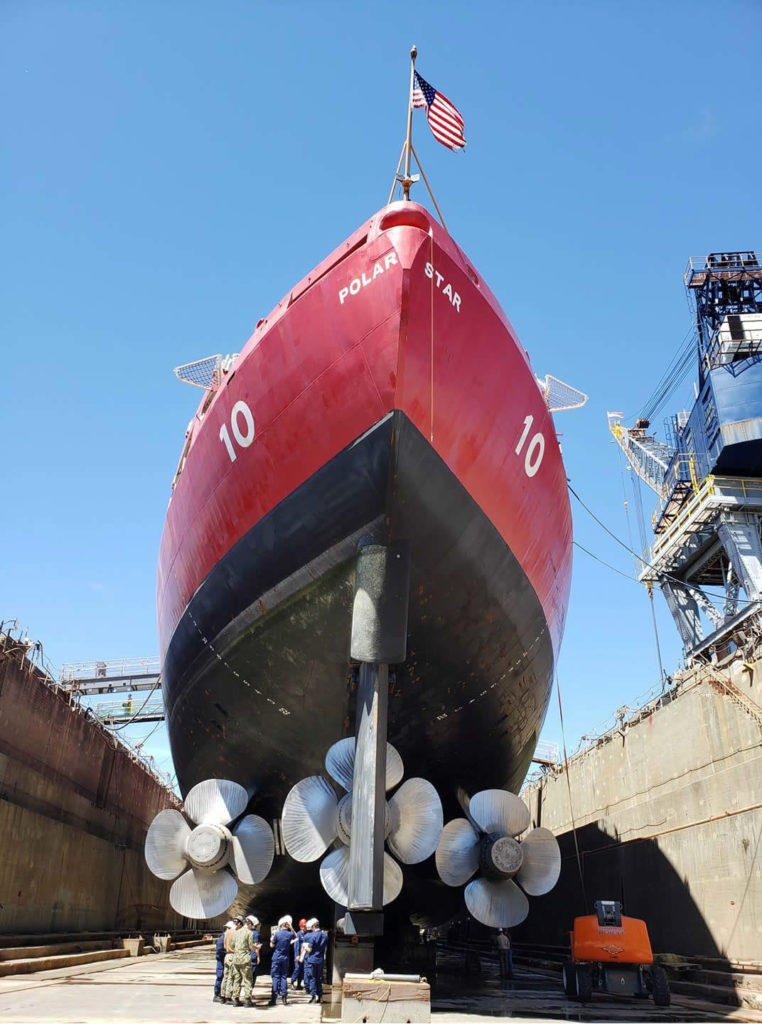
As with previous Dry Docks, the three pitch propellers were removed, overhauled, and reinstalled. Photo: Official USCG Polar Star Facebook

The Acquisitions Directorate published the announcement below. This will guarantee that the crew of Polar Star will continue to spend much of their inport time for the next five years, away from their homeport. Again, perhaps it is time to change her homeport. The SLEP will extend from 2021 to 2025 and the ship will likely be decommissioned by the end of 2027. 


The Coast Guard today awarded an indefinite quantity, indefinite delivery contract to Mare Island Dry Dock LLC of Vallejo, California, for the Coast Guard Cutter Polar Star service life extension project (SLEP), as part of the In-Service Vessel Sustainment program. The project will recapitalize a number of major systems and extend the service life of the cutter by approximately four years, helping maintain the Coast Guard’s required heavy icebreaking capability while the service transitions heavy icebreaking operations to the new polar security cutter (PSC). The total potential value of all resulting orders is $119.6 million.

The Polar Star SLEP will address targeted systems such as propulsion, communication and machinery control systems for recapitalization and conduct major maintenance to extend the service life of Polar Star beyond the original design service life. By replacing obsolete, unsupportable or maintenance-intensive equipment, the Coast Guard will mitigate the risk of lost operational days due to unplanned maintenance or system failures. The contracted SLEP work items and recurring maintenance will take place within a five-year, annually phased production schedule running from 2021 through 2025. Each phase will be coordinated so that operational commitments such as Operation Deep Freeze will still be met.

Polar Star is the Coast Guard’s only active heavy icebreaker. The 399-foot cutter, commissioned in 1976, supports nine of the 11 Coast Guard statutory missions. The first PSC, currently under design, is on contract for delivery in 2024.

For more information: In-Service Vessel Sustainment program page and Polar Security Cutter program page
“SNA NEWS: Coast Guard Wants Budget ‘Booster Shot’” –National Defense

Polar Security Cutter. Image credit VT Halter Marine.

National Defense reports on the Commandant’s comments during the Surface Navy Association’s annual symposium.

The pitch is that the Coast Guard is playing catch-up and needs an infusion of money (“$900 million to $1 billion dollars”) to deal with the current demands, and continued growth of 3 to 5% per year for the next five years. Really, I think he is saying the budget needs a new higher base which would then be built upon, so the $900M to $1B addition would not be a one time thing.

There are some particular statements that caught my attention.

The U.S. Coast Guard will soon have 103 cutters of various types in its inventory, but is looking to add more to boost its capacity and capabilities. It is also pursuing upgrades to its information technology systems and other assets, as well as looking to bring on more personnel.

That 103 figure refers only to recent and ongoing construction projects. We already have many more cutters than that. It appears to refer to 3 PSCs,11 NSCs, 25 OPCs, and 64 FRCs, but he is saying we need more than that.

What are these additional ships?

  • Arctic Security Cutters (ASC): Certainly it includes the three Arctic Security Cutter medium icebreakers. These were among the recommendations of the High Latitude Study. There seems to be general agreement about the need for at least a total of six icebreakers. There have been suggestions that one or more of these might be replaced by additional polar security cutters, but that suggestion has been mentioned but has not been strongly seconded by the Commandant. These may be intended for the Atlantic side.
  • Fast Response Cutters (FRC): It probably means more Webber class FRCs as well. There is already talk of homeporting some in Palau (probably two or three) and of replicating the PATFORSWA type organization (six ships) in support of PACOM. These raise the possibility of up to eight additional FRCs.
  • Offshore Patrol Cutters (OPC): For the OPCs, I think it is more a matter of needing them sooner than currently planned. They are well behind in their delivery schedule. Moving to four ships a year, from two different yards, would dovetail nicely with the perceived need to maintain and build up US shipbuilding capacity. Even going to four per year would mean it will be many years before the Coast Guard could ask for the budget to build more than the 25 ship Program of Record.
  • Cutter X: Certainly no indication yet that the Coast Guard is considering an additional type of patrol cutter, but something of 1,500 to 2,500 tons, between the size of the OPC and the FRC would offer a way to procure a larger number of cutters with greater range, endurance, and seakeeping than the FRCs at perhaps half the cost of a similar number of OPCs. Building annually two in addition to one or two OPCs could speed the recapitalization process.
  • Polar Security Cutters (PSC): The quotation below suggest the Coast Guard may ultimately seek seek six PSCs as well as three ASCs.

“If resources were less constrained, the Coast Guard would like to have a fleet of nine icebreakers including potentially six polar security cutters and three Arctic security cutters, he noted.”

Sounds like we might continue building Polar Security Cutters beyond the three currently planned, but nuclear powered icebreakers are out.

“We have moved off the nuclear-powered” icebreaker, Schultz said. “The ability to operate that in the Coast Guard — that just doesn’t exist, and nor could we build out to that with all the demands on our plate.”

“Virtual Coast Guard art exhibit highlights service, missions” –News Release

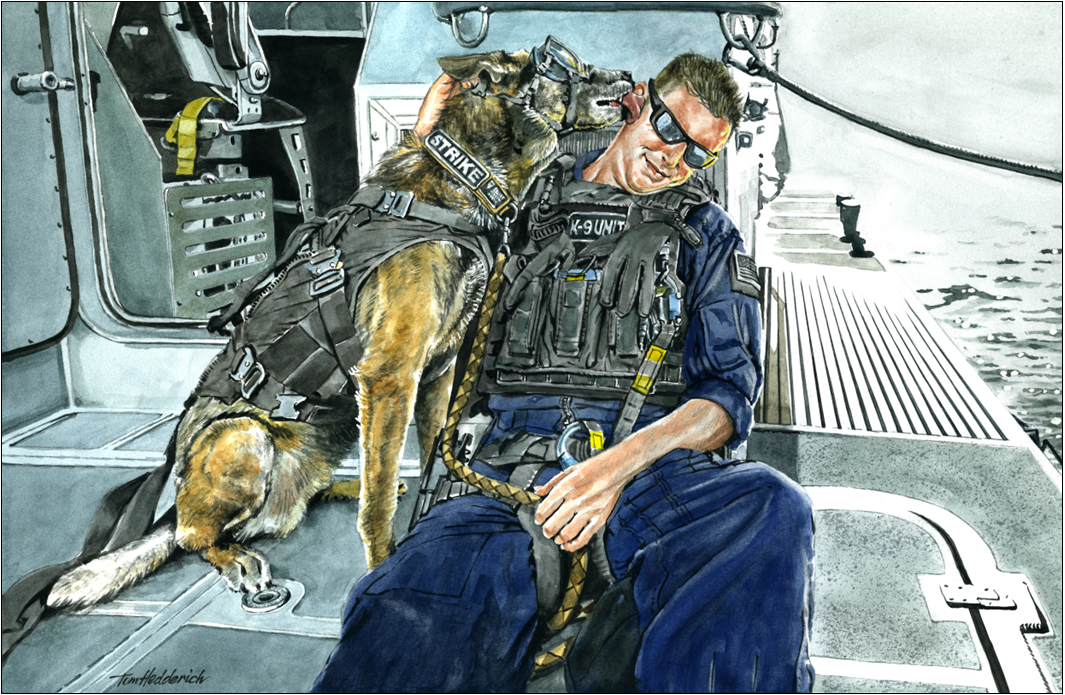
Perfect Trust, Watercolor by Tom Hedderich

Below is a 8th District news release. Follow the link to four years of Coast Guard art. The four Coast Guard exhibits (2017, 2018, 2019, and 2020) are there along with other exhibits. You may have to page right, but once you enter one, at the bottom of the page you can link to the next or previous year, or use my individual links above. 

united states coast guard

 News Release

U.S. Coast Guard 8th District Public Affairs Detachment Texas
Contact: 8th District Public Affairs Detachment Texas
Office: 281-464-4810
After Hours: 832-293-1293
PA Detachment Texas online newsroom

Virtual Coast Guard art exhibit highlights service, missions

HOUSTON — The United States Coast Guard’s art collection now appears as an online exhibit at the Houston Maritime Education Center and Museum. The virtual exhibit offers the public the opportunity to explore four years of Coast Guard art and provides a fascinating look at the many ways in which the Coast Guard contributes to this nation. This is the largest exhibition of Coast Guard art ever to appear in one museum.

The full collection is available on the museum’s website and is publicly accessible at www.houstonmaritime.org/exhibits/.

The Coast Guard’s 11 statutory missions are highlighted in more than 130 works by nearly 60 Coast Guard Art Program (COGAP) member artists from around the country. Although the words “U.S. Coast Guard” often conjure images of rescue swimmers and orange helicopters or aid given to distressed boaters and fisherman, the missions and duties of this military service are far more numerous and versatile. They range from national defense to environmental protection, and from search and rescue to maintaining aids to navigation and port security.

“If a picture is worth a thousand words, this exhibit is a volume that tells the Coast Guard story as seen through the artists’ brushes and paints. COGAP art gives visual testimony to the unique contribution the Service makes to the nation in its multifaceted roles as a military, humanitarian and law enforcement organization,” said Rear Admiral Jon Hickey, director of Governmental and Public Affairs at Coast Guard Headquarters in Washington.

“This marks the first time ever we have been able to provide such an extensive body of work on the role of a military service virtually to our visitors,” said Leslie Bowlin, the Houston Maritime Museum’s CEO. “We were delighted to work with the Coast Guard in bringing this exhibition to our members and internet visitors safely, especially during this time of the pandemic.”

Coast Guard Art is exhibited at museums around the country. It is also displayed in offices of members of Congress, Cabinet Secretaries, senior government officials and other military services and Coast Guard locations nationwide. Coast Guard artists—a talented cadre of professional artists—donate their work to the program. Today, the collection comprises over 2,000 works showing the missions performed by the service’s force of 43,330 active duty members. This year marks the program’s 40th anniversary.

For more information about the Coast Guard Art Program, visit: www.uscg.mil/Community/Art-Program

For more information about the Houston Maritime Museum, visit: www.houstonmaritime.org.

USCG

“Check out the 13 best military photos of 2020” –Task and Purpose

Feco, a single-purpose bomb dog assigned to a Coast Guard maritime safety and security team, wears protective eye and ear gear and a hoisting vest for hoist operation training at Moffett Air National Guard Base, Calif., June 15, 2020. (Air National Guard photo / Master Sgt. Ray Aquino)

Task and Purpose provides their pick of 13 best military photos of 2020 and provides a link to 72 more. Turns out, two are US Coast Guard related. The one above was presumably taken by an Air National Guard or Air Force Master Sargent, but the other was taken by Seaman Kate Kilroy, one of several from her coverage of the Campbell’s trip into Arctic waters here and here.

Thanks to a formerdirtdart for bringing this to my attention. 

“Minotaur – Creating a connected Coast Guard” –MyCG

New Minotaur operator workstations are being installed on all HC-144Bs. Minotaur provides dramatically improved data fusion and integrates installed sensors and radar. U.S. Coast Guard photo by Aviation Engineering Warrant Officer 3 Randy Jopp.

MyCG has a post about Minotaur (broken link, no longer available–Chuck). We have talked about this system before in relationship to installations on fixed wing aircraft, but the system apparently is more than I had previously understood. The links sited in the story are not all up to date. There is more current information below.

“Coast Guard delivers ninth Minotaur-missionized HC-144 to fleet” –CG-9 | Chuck Hill’s CG Blog

Coast Guard accepts missionized HC-130J aircraft > United States Coast Guard > Latest Acquisition News (uscg.mil)

“Navy to Field First New Torpedo in Decades” –National Defense

Very Light Weight Torpedo

National Defense reports,

The Navy in January is expected to release a request for proposals to field its first completely new torpedo since the 1990s.

Northrop Grumman has announced its intention to enter the compact rapid attack weapon program, which will seek to find a manufacturer for the prototype of a lightweight torpedo developed at Pennsylvania State University’s Applied Research Laboratory.

This is a weapon we talked about earlier. In that report we learned that the Navy had a program of record to develop the weapon under the name Compact Rapid Attack Weapon (CRAW) in the FY2021 budget. The earlier post also includes a full description of the weapon.

In this new report we learn there is interest in the use of this weapon by the submarine community, the aviation community, and as a weapon for unmanned systems.

It can be used offensively or defensively as a countermeasure anti-torpedo (CAT).

Operators will be able to instantly load software into the weapon, giving it defensive or offensive capabilities shortly before being fired, he said.

“The only difference fundamentally between the defensive capability of the very lightweight torpedo, which is CAT and the offensive capability, which is CRAW, is the software that gets loaded onto the weapon at time of launch.”

If these can be used to destroy incoming torpedoes, we are going to want them on virtually every ship.

Might be helpful if the Coast Guard told the Navy they were interested in these as well.