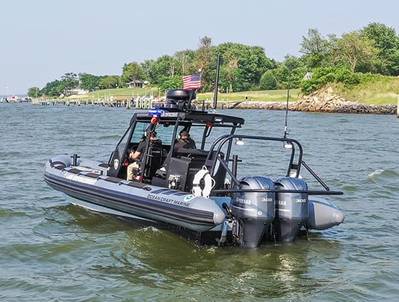
Marine Link reports on the imminent delivery of a 9.5 meter, “custom-designed high-performance boat to the National Oceanic and Atmospheric Administration (NOAA) Office of Law Enforcement (OLE), Pacific Islands Division headquartered in Hawaii.”
The feature that caught my attention and distinguishes this RHIB from many others is the console.
“OCM partnered with the design team at Shockwave Seats to design and then build a five-man fully shock-mitigating operator-console. The console is known as an Integrated Control Environment or “ICE-Console” and is fully-free-floating with three-axis of movement while suspended on 12 inches of travel supported by six pneumatic Fox Racing shock-absorbers. The ICE Console’s purpose is to insulate the boat’s operators and equipment from the jarring impacts caused by wave action at sea.”
MyCG reports availability of what appears to be an important report. I have reproduced the story below.
I would have liked to have read the report but it requires a CAC (Common Access Card), so I can’t tell you what it says, but if any of you who do have want to share, it would be welcomed.
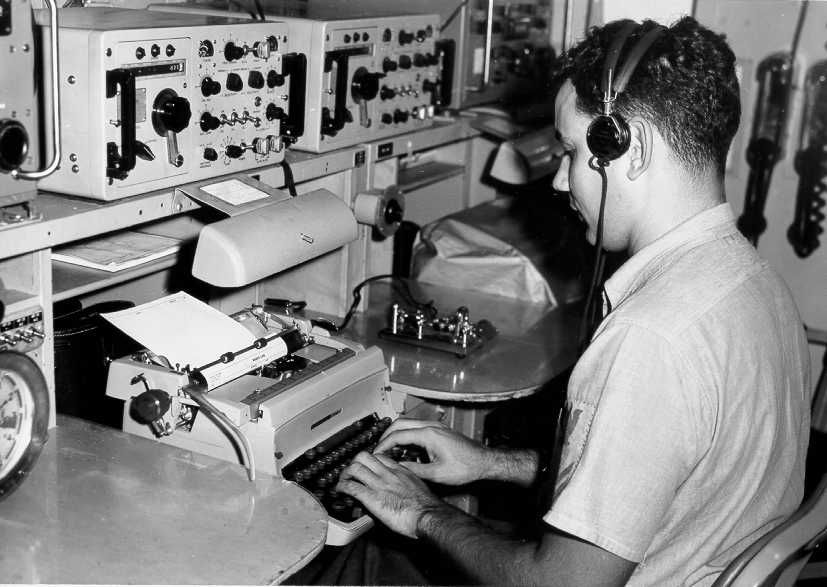
My continuing impression is that we could benefit from wider availability of DOD standard data links like Link16. We have these on National Security Cutters already. These systems should be particularly applicable to all fixed wing aircraft and larger patrol cutters.
July 13, 2021
State of the Capabilities Reports is available now
By Shana Brouder, MyCG Wrtier
This year’s State of the Capabilities Report have been released. These reports highlight what capabilities are working across the Coast Guard and which could be improved. The reports are instrumental in guiding budgetary decisions about where to invest in C5I technology.
There are 396 C5I capabilities in the Coast Guard—from closed circuit television to cutter systems like Sea Commander—that must undergo a yearly operational analysis (OA). Each analysis feeds into the annual State of the Capability Report (SoCR). The process of reviewing all 396 C5I capabilities is vital to ensuring that the Coast Guard remains Semper Paratus and that funding be allocated to where it is most needed.
“[Through the operational analysis process] we are answering the question—are users happy with the C5I capabilities they use daily?” explained Lt. Benjamin Milne, the C5I surveillance sponsor representative in the office of C5I capabilities (CG-761).
Milne and his peers in CG-761 assess capabilities, such as radars to long-range communications, to see if they are working as expected. Sponsor representatives like Milne perform site visits and interview the deck plate operators who use these systems to make sure all capabilities are meeting operators’ needs.
“Through the OA or operational analysis process, we resolve the gap between what we thought a capability would provide and what is actually provided to the field,” said Milne. “When something isn’t working as it should, we can go back to the other stakeholders across the service and say ‘hey, this is what’s being reported out in the field; how can we get this need met?’”
Individuals at units and sectors across the enterprise can interact with the OA process in two ways. They can submit any concerns they have about the C5I technology through the C5I requirements intake process (CAC required) or they can work with the sponsor’s representative to conduct an OA on a specific C5I capability.
“We want people to be the squeaky wheel on the issues they see in the field,” said Milne. “If the sponsor’s representatives are unable to visit your unit in person, we can always send you a survey where your concerns can be flagged and brought to the attention of leadership.”
The OA process is unique in the fact that it provides a way for anyone of any rank at the Coast Guard to get their concerns to the offices that can help them. While changes may not always be possible, this is where innovation within the C5I community begins.
“We talk to everyone—from seamen to captains,” said Milne. “It doesn’t matter who the person is, they can elevate gap that they experience in the field through either the C5I requirements intake process or the OA process to get the ear of those at headquarters to help real change happen.”
The 2021 SoCR can be found on the portal (CAC required) now. Individual OA reports for 2021, as well as previous years’ reports, are available to anyone in the workforce to view here (CAC required). To learn more about the operational analysis process generally, please visit CG-761’s portal page (CAC required) for more information.
July 8, 2021, 47s in for the long haul, By Shana Brouder, MyCG Writer
Vice Adm. Charles Ray, Coast Guard Vice Commandant, approved the motor lifeboat service life extension project. The process of completely revamping the 107 motor lifeboats in service and in storage will take eight to 10years, giving the boats another 20 years of service.
Discontinued parts for existing boats and budgetary constraints on buying brand new vessels made it necessary to find creative solutions to ensure coxswains could carry out their duties safely.
Motor lifeboats (MLBs) operate in heavy surf and harsh weather conditions and are used for search and rescue missions in some of the most dangerous conditions in which Coast Guard’s men and women operate. Their reliability is key to the safety of the crew aboard, as well as that of the American citizens who rely on them in their most vulnerable moments.
“The equipment onboard [the MLBs] was becoming obsolete,” explained Chief Warrant Officer Thomas Molloy, commanding officer at the National Motor Lifeboat School (NMLBS). “This was especially true of MLB engines.”
The catalyst for the motor lifeboat service life extension project (MLB-SLEP) was in fact their engines, which are no longer manufactured by Detroit Diesel, the company who had originally made the engines. This made the maintenance of the engines extremely difficult, as parts were hard to come by.
“The engines were getting harder and harder to fix,” explained the 47 MLB Platform Manager for the existing fleet David Shepard, (Office of Boat Forces, CG-731). “We didn’t have the budget to purchase completely new boats, so we started to think creatively how to fix this problem. The engine maintenance problems and lack of resources for a completely new fleet of boats was the nexus for the decision to move forward with the MLB SLEP.”
While addressing the MLB’s engine design was the most pressing problem, the Coast Guard took this opportunity to critically look at the design and functionality of the MLB and adjust several other features in this revitalization effort as well.
“Human performance [ability] and crew safety was essential in the redesign,” explained Molloy. “We went a long way to think of the crew’s comfort and safety for this because of the nature of the missions [MLBs are used for.]”
With this in mind, a total of 20 items associated with the design and function of the MLB are being overhauled through the SLEP.
The engine is seeing the biggest change in the new design. Not only is it a newer engine that will be supported by the manufacturer for many years, but it is also smaller, stronger, and quieter.
This is key in increasing the functionality of the space aboard the MLB. The smaller engine size allows engineers to maneuver safely around the engine while aboard. The additional horsepower allows the boat to accelerate faster, which can be a make-or-break factor when operating in heavy surf conditions. The engine is quieter and produces less exhaust which address longstanding concerns about crew health.
“We’ve noticed a steady decrease in performance on these old engines.” said Molloy. “The new design will be more reliable and accelerates much faster, which anyone trying to outrun breaking waves will appreciate.”
The new MLBs will also have five shock mitigating seats on the open bridge, rather than the previous two seats. This, in combination with modern navigation systems on both the port and starboard side will ensure that the redesigned MLB will be safer to operate and more capable than ever before.
Engineers will also have an easier job, as modernizing the boats will ensure the parts to maintain the MLBs are easier to find.
“For every coxswain out there, there’s an engineer that’s backing them up,” said Shepard. “Ensuring their job is easier was another goal of the MLB-SLEP.”
The contract to start the MLB-SLEP was awarded in August 2020 and has been successfully underway since. Operators were given the opportunity to provide feedback on the current MLB design, as well as the proposed redesign. With the operational assessment complete on the first boat which was delivered to the NMLBS in the fall of 2020, two additional hulls are going through the SLEP for the next phase of operational testing at Station Yaquina Bay in Newport, Oregon and Station Barnegat Light in New Jersey. Those two boats incorporate changes identified in the testing of the first boat.
Most coxswains and engineers will, however, need to wait a few years to use the revamped MLBs.
The MLB-SLEP—a partnership between the Office of Boat Forces, the Acquisitions Directorate (CG-9), and the NMLBS—is a crucial step in modernizing Coast Guard assets, infrastructure, and mission platforms, and is an essential part of the Coast Guard Strategic Plan.
“Monica Cisternelli, project manager at the Coast Guard Research and Development Center, said the equipment should weigh less than 100 pounds and have a footprint of less than 7 cubic feet. The capability will be single-use and should be deployable from most Coast Guard platforms, including the smallest aircraft in the inventory, the MH-65 Dolphin and MH-60 Seahawk.”
The report also mentions a desire to protect “…from dangers suchas hypothermia.” That could make design much more difficult. In fact I doubt their is a single solution to all our needs. The requirements to save 500 from a sinking passenger ship in the Arctic are far different from the requirements to save a hundred migrants in the warm waters of the Caribbean.
Time until help arrives and effects of exposure vary dramatically.
Hopefully anyone abandoning ship in the Arctic will have an exposure suit and access to sound lifeboats, because rescue units are likely to be long delayed. If they do not abandon with reasonable protection from the environment, rescue units will never reach them in time. Nothing that will fit inside seven cubic feet is going to be effective in protecting large numbers of people from that environment.
An over loaded alien migrant boat, with far to many people aboard, at least some of them unable to swim, and no lifesaving equipment, is a very different problem. Crowding and panic amplify the danger. Help is likely to be relatively close, but the transition from boat to the relative safety of floating unmolested in the warm water until help arrives, is very different challenge.
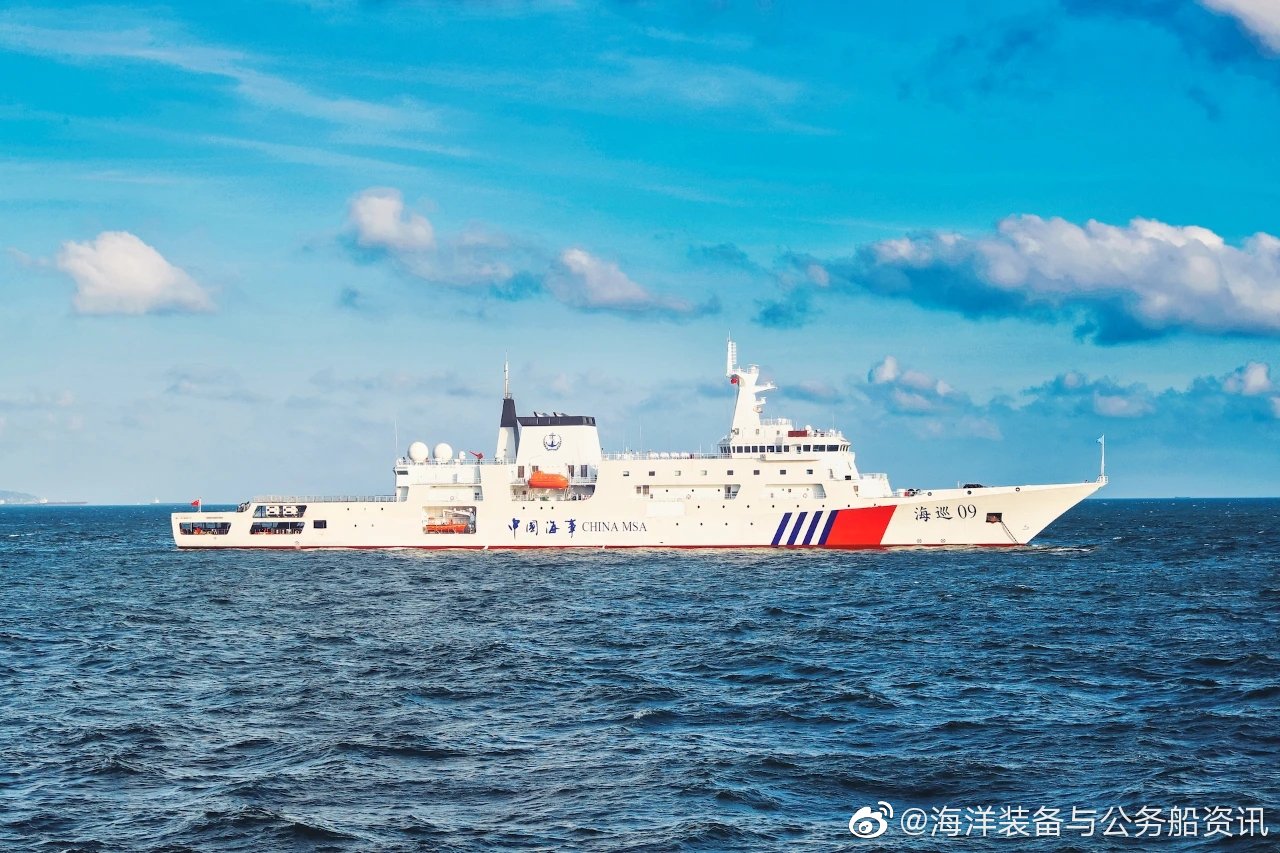
SNAFU provides photos of China’s new cutter built for their Maritime Safety Agency. We talked about this very large cutter earlier, here and here.
Significant dimensions are length,165 meters (540 feet), Beam, 20.6 meters (67.6 feet). Speed is over 25 knots. A range of 10,000 nautical miles and endurance of 90 days, suggest these may not be built just to hang around China’s coast. 10,000 or 10,700 ton displacement may well be a light displacement rather than full load, so it may well be much more than twice as large as the 4500 ton full load Bertholf class NSCs.
While very large, this cutter does not carry much of the military style equipment found on the Bertholfs, no airsearch radar, no medium caliber gun, no radar firecontrol, probably no ESM or electronic countermeasures. It also looks like it is only expected to operate one helicopter.
A reminder this blog is about Coast Guard operations and issues. It is not about politics. Support or neglect of the US Coast Guard has been nonpartisan. We have seen both from both parties. Generally the administrations have been parsimonious and the Congress has been more generous, regardless of party.
The wisdom of individual decisions is certainly fair game for discussion, but recently I have had to delete some comments that contained gross generalizations.
New Orleans, September 5, 2005 – A Disaster Medical Assistance Team member (left) assures a rescued man that the trip to the airport will be safe. Thousands of people were airlifted from the Ernest N. Morial Convention Center pickup site to the New Orleans Airport every day. Photo by Win Henderson / FEMA photo.
Sea Technology discusses a cooperative effort to use small Unmanned Air Systems to facilitate Disaster response.
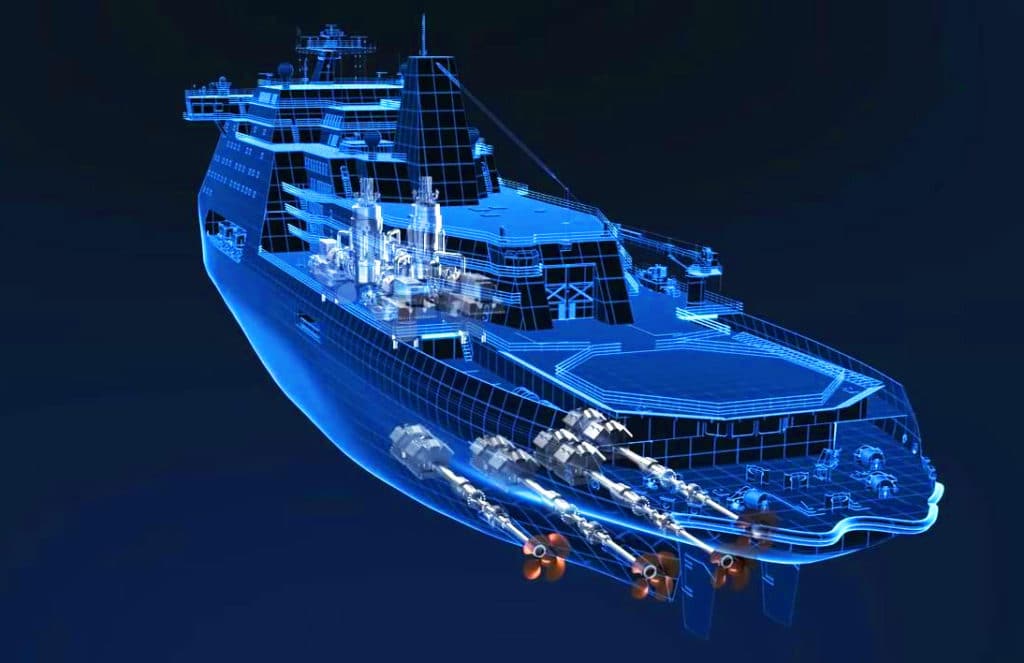
Note the two nuclear reactors are located high in the ship.
Naval News reports the first of the Russian Project 10510 Leader-class Nuclear-powered Icebreakers has been laid down. These ships dwarf the Polar Security Cutters. But perhaps of equal significance is that the new commercial shipyard where they are being built is on Russia’s Pacific coast.
Compared to the Polar Security Cutters (PSC), they are truly monsters, built with an eye to keeping the Northern Sea Route open year round. Not only are they far larger than any Coast Guard icebreaker, they are about twice as large and twice as powerful as the largest icebreakers currently in service, the nuclear powered Project 22220 Arktika class icebreakers.
The Leader class, Project 10510 icebreakers are 209 metres (686 ft) long and have a beam of 47.7 metres (156 ft). They draw 13 metres (43 ft) of water and have a displacement of about 69,700 tonnes (68,600 long tons). Their four electric motors will provide 120 MW (160,923 HP)
The PSCs are 460 ft (140 m) long and have a beam of 88 ft (27 m). PSCs will displace 22,900 long tons (23,300 t). The PSCs’ two Azipods and diesel electric center shaft will provide just over 45,000 HP.
While the PSCs should be able to break through ice of 6.5 feet (2.0 m) at a continuous speed of 3 knots, the Leader class will reportedly be able to maintain ten to eleven knots in the same conditions.
Zvezda-DSME shipyard. Photo from Russian.dissident via Wikipedia.
Significantly the shipyard in Bolshoi Kamen, on the Sea of Japan, near the Chinese and North Korea borders, where the Leader class are being built, is the Zvezda-DSME shipyard. DSME, Daewoo Shipbuilding Marine Engineering, is a South Korean company and one of the largest shipbuilding firms in the world. They are also a major defense contractor, building not only ships for the South Korean Navy but also submarines for Indonesia and underway replenishment vessels for the United Kingdom and Norway. They also built 15 LNG icebreaker/tanker ships for the Russians to use in the Arctic.
Real Clear Defense provides a look at the increasing likelihood that Antarctica will become a region of great power competition. Their conclusion,
“Antarctica can no longer rely on its distance to protect itself from the calculus of states. Trends including great power competition, expansion both of and into the grey zone by many actors, the fragility of international law, and mounting resource crises all mean that long-held assumptions around Antarctic geopolitics are being challenged. Meanwhile, its harshness and physical distance are posing less and less of an obstacle to interested parties. After centuries of international neglect, Antarctica’s isolation may have set the stage for a hard pivot in global interest. Discarding these holdover assumptions will be important to recalibrate our understanding of the region’s strategic relevance. Without reform to the Antarctic Treaty system, and great powers assuming collective responsibility, Antarctica could even become a potential catalyst for outright conflict.”
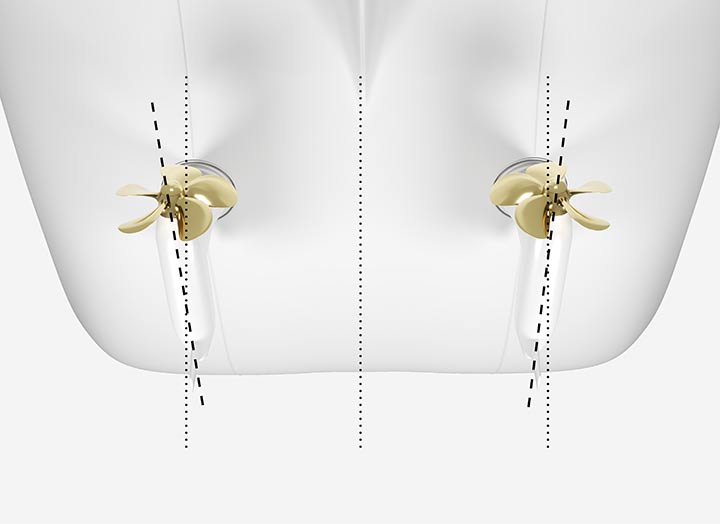
OptimE automatically selects the optimal steering angle for Azipod propulsion [Image: ABB]
Marine Log reports an additional refinement that is being applied to the software control for Azipods. Sounds a bit like toe-in on your car. And its something you can’t adjust dynamically with conventional shafts.
“Called ABB Ability OptimE – Toe Angle Optimization for Propulsion, the solution automatically selects the optimal steering angle for the Azipod system. ABB says that with OptimE, further fuel savings of up to 1.5 percent can be achieved depending on a ship’s operating profile. These savings are in addition to Azipod propulsion’s ability to cut fuel consumption by up to 20 percent when compared with a traditional shaftline setup.”
I would add that conventional propeller shafts are a weak point in ship damage survivability as well, in that, when damaged, they can open up avenues for progressive flooding that may extend half the length of the ship.