“Ukraine hits Russian Buyan cruise missile carrier and Pavel Derzhavin vessel with drones” –Ukrainska Pravda

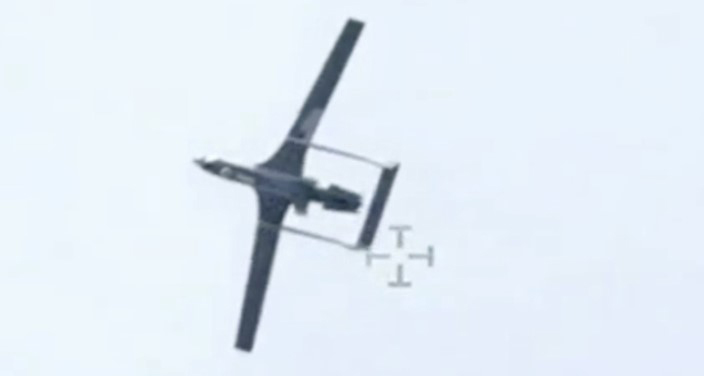
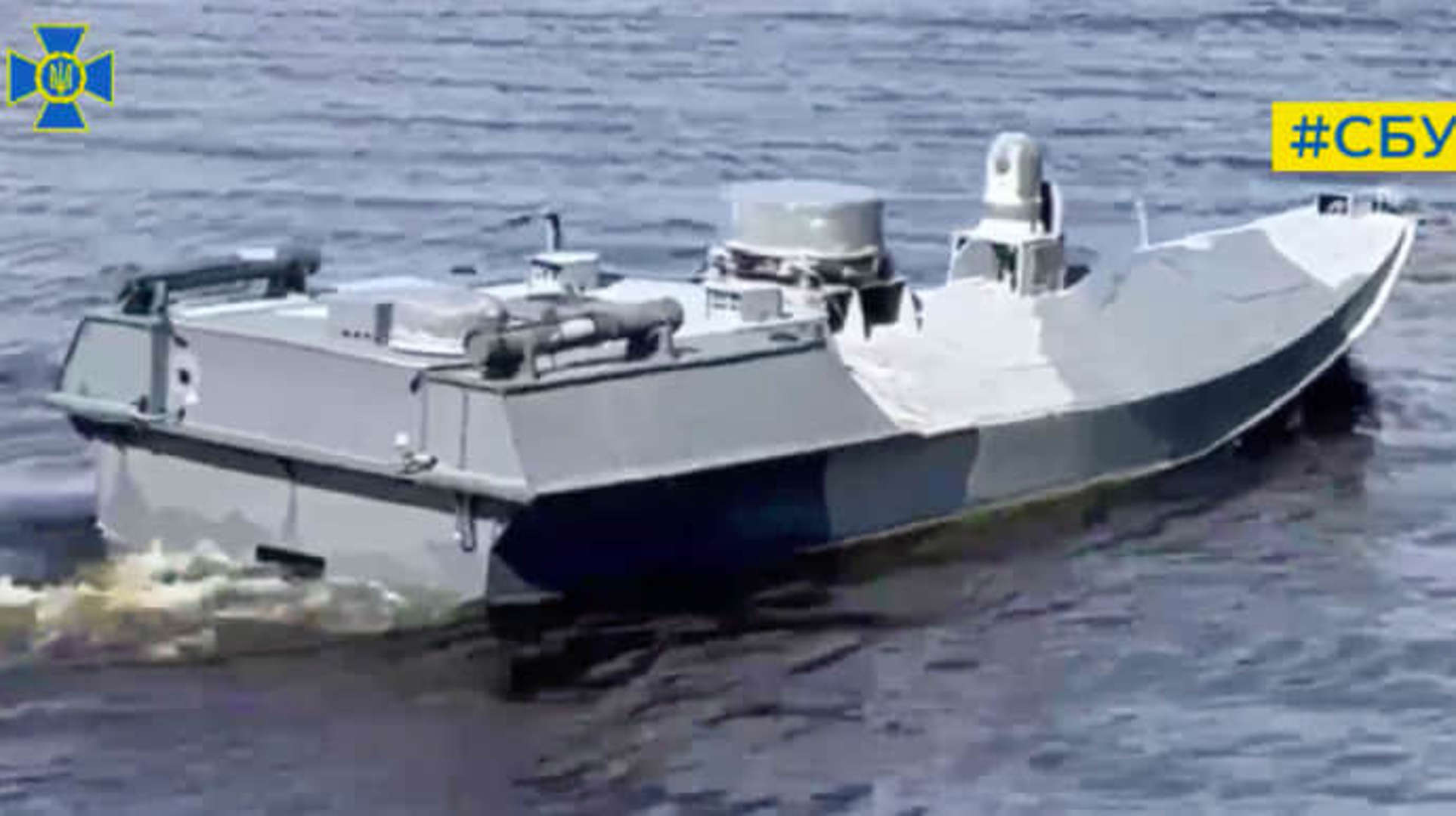
©Sea Baby dron. screenshot.
© Ukrainska Pravda

Ukrainska Pravda reports,

The Security Service of Ukraine, together with the Ukrainian Navy, has attacked the Buyan cruise missile carrier and the ship Pavel Derzhavin using experimental weapons on uncrewed surface vessels…both vessels were hit by Sea Baby drones with experimental weapons.

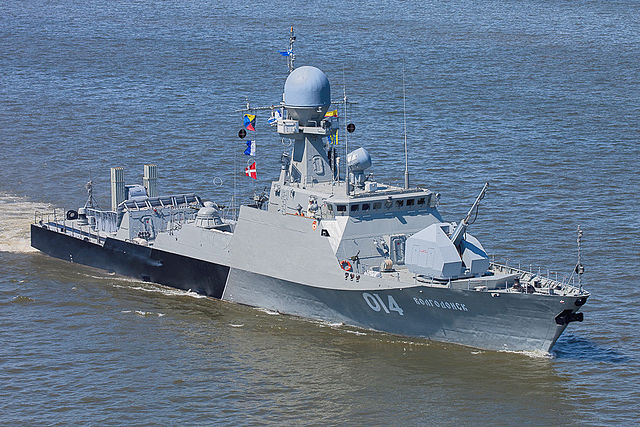
The Buyan cruise missile carrier or Buyan-M (that is the name of the class, not a specific ship) is a small, 949 ton full load, 75 meter (246′) corvette armed with up to eight cruise missiles similar in capability to the American Tomahawk.

Buyan-M class corvette, Volgodonsk in Astrakhan. Author Anton Blinov, via Wikipedia.

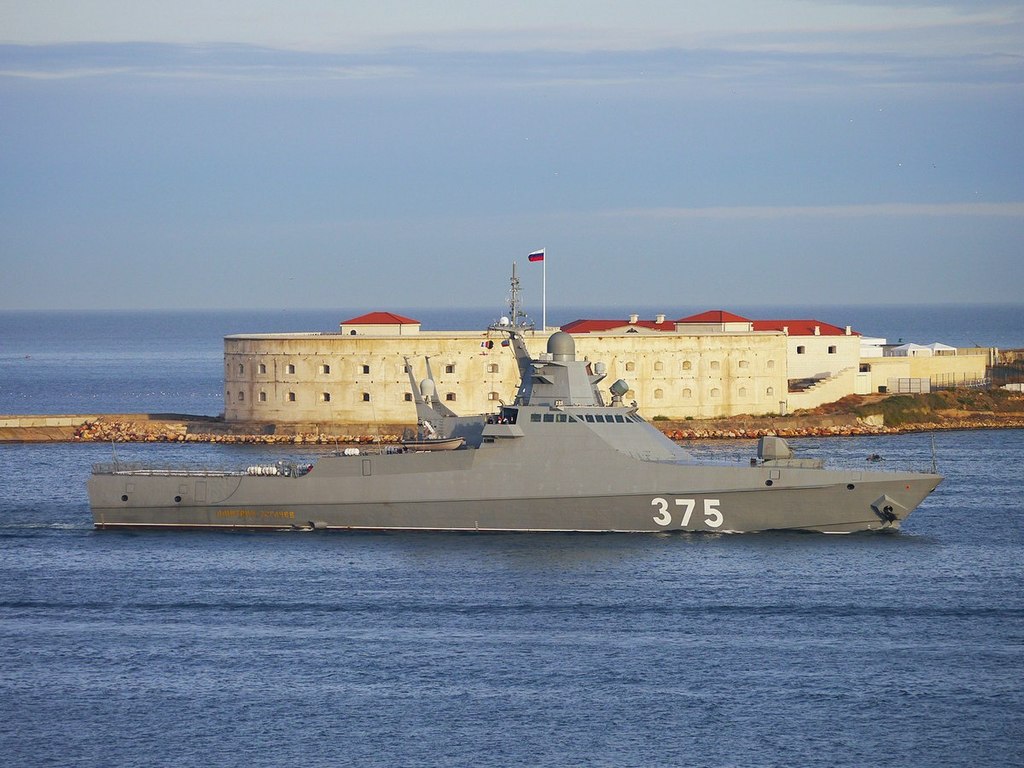
Pavel Derzhavin is a Project 22160 class patrol ship, a bit bigger than the Buyan-M at 94 meters (308 ft) in length, but not as heavily armed.

Russian Project 22160 Patrol Ship Dmitriy Rogachyov in Sevastopol, 12 April 2019. Photo from Ministry of Defence of the Russian Federation.

I found the reference to “Sea Baby drones with experimental weapons” interesting, not that the Sea Baby drone was experimental, so I presume the warhead was experimental. Various reports seem to indicate the explosion was extremely loud and created a great deal of smoke. This could have been the result of secondary explosions.

It is not clear if the two ships were sunk.

Information about the source here.

“Inside the U.S. Navy’s Cutting-Edge Drone Boat Tech”–WSJ

A reader brought the video above to my attention, recognizing the significant Coast Guard participation in the program. 

Below I have reproduced the text that accompanied the video on YouTube. 


Drone boats appear to be on the cusp of a revolution. The U.S. Navy’s Task Force 59 has been pairing cutting-edge unmanned surface vehicles with artificial intelligence to expand the military’s eyes and ears in the Middle East. Now, similar efforts will be rolled out in the Pacific and Central and South America. The military’s objective is to leverage machine learning to detect and anticipate threats before they occur. Experts say the U.S. is currently the leader in this field, but competitors like China and Russia are racing to catch up. I traveled to Manama, Bahrain to see the high-tech drones in action and speak to officials about how they’re preparing for a future with robots in the world’s waters. 0:00 A rare look at the U.S. Navy’s drone boat operation 0:30 Meet the Navy’s Task Force 59 2:14 Drone boat capabilities 4:05 How artificial intelligence is layered with the drone boats 5:11 The global race to advance unmanned marine vehicles 7:23 What’s next for the U.S. military? Check out more from my exclusive interview with Vice Admiral Brad Cooper, commander of U.S. Naval forces in the Middle East, about unmanned vessels and the Navy’s future fleet:    • Drone Boats, AI and the Future of Mar…   I’m Shelby Holliday, a reporter for WSJ. Subscribe to join me as I explain some of today’s most pressing geopolitical events, from superpower showdowns and conflicts to supply chain snarls and natural resource struggles.


The link embedded above was to this video. 

Thanks to David for bringing this to my attention.

“U.S. 5th Fleet Enhances Middle East Maritime Security with Unmanned Capabilities” –NAVCENT

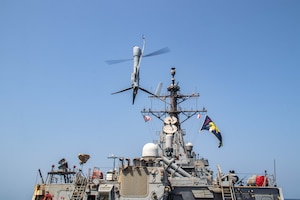
GULF OF OMAN, An Aerovel Flexrotor unmanned aerial vehicle launches from the deck of the Arleigh Burke-class guided-missile destroyer USS McFaul (DDG 74) in the Gulf of Oman, in an image released Oct. 6. US Navy photo.

Below is a 6 October news release from U.S. Naval Forces Central Command Public Affairs. It notes Coast Guardsmen were involved, presumably PATFORSWA, but no details of how. All the photo here accompanied the release.


MANAMA, Bahrain —

Last month, naval forces in the Middle East region successfully integrated unmanned platforms with traditionally crewed ships and aircraft to conduct enhanced maritime security operations in the waters surrounding the Arabian Peninsula.

Seven task forces falling under U.S. 5th Fleet integrated 12 different unmanned platforms with manned ships for “manned-unmanned teaming” operations, tracking Iranian Navy and Islamic Revolutionary Guard Corps Navy (IRGCN) ships and small boats over several days during routine patrols in and around the Strait of Hormuz.

This operation bolstered presence in and around a critical chokepoint that in recent months has seen Iran unlawfully seize internationally flagged merchant ships.

Unmanned underwater vehicles (UUVs), unmanned surface vehicles (USVs) and unmanned aerial vehicles (UAVs) were involved in the operation.

“We have been operating UAVs and UUVs in the region for years,” said Capt. Joe Baggett, Director of Maritime Operations for U.S. Naval Forces Central Command and U.S. 5th Fleet. “Adding our new USVs, and then integrating all of these platforms into fleet operations, is how we expect to fly and sail well into the future.”

Sailors, Marines, Coast Guardsmen, ships and aircraft from Task Force 51/5 (Amphibious/Marine), Task Force 52 (Mine Countermeasures), Task Force 53 (Logistics), Task Force 55 (Surface Warfare), Task Force 56 (Expeditionary), Task Force 57 (Patrol/Reconnaissance) and Task Force 59 (Unmanned/Artificial Intelligence) conducted the operations.

“The integration of new, multidomain unmanned platforms into routine fleet operations provides more ‘eyes on the water,’ enhancing maritime domain awareness and increasing deterrence in the region,” said Vice Adm. Brad Cooper, Commander, U.S. Naval Forces Central Command and U.S. 5th Fleet.

Cooper added that collectively, these platforms support the safe navigation and free flow of commerce through vital regional chokepoints, particularly around the Strait of Hormuz.

“This enhanced maritime security serves as a deterrent against malign activity and strengthens regional stability, which is good for everybody,” he said.

U.S. Naval Forces Central Command/U.S. 5th Fleet’s area of operations encompasses about 2.5 million square miles of water area and includes the Arabian Gulf, Red Sea, Gulf of Oman, Gulf of Aden, Arabian Sea and parts of the Indian Ocean. This expanse, comprising 21 nations, includes three critical choke points at the Strait of Hormuz, the Suez Canal and the Strait of Bab al Mandeb.
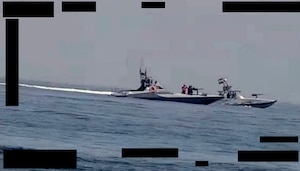
STRAIT OF HORMUZ (Oct. 6, 2023) An undated still image released on Oct. 6 from video taken by an Arabian Fox MAST-13 unmanned surface vessel of two Islamic Revolutionary Guard Corps Navy patrol speedboats in the Strait of Hormuz.
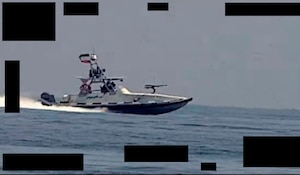
STRAIT OF HORMUZ (Oct. 6, 2023) An undated still image released on Oct. 6 from video taken by an Arabian Fox MAST-13 of an Islamic Revolutionary Guard Corps Navy patrol speedboat in the Strait of Hormuz.
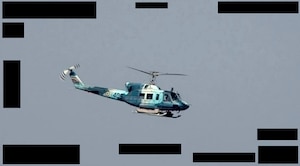
STRAIT OF HORMUZ (Oct. 6, 2023) An undated still image released on Oct. 6 from video taken by an Arabian Fox MAST-13 unmanned surface vessel of an Iranian Navy AB-212 helicopter in the Strait of Hormuz.
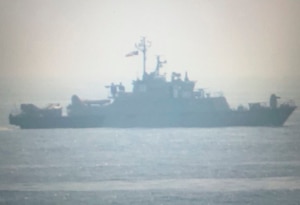
STRAIT OF HORMUZ (Oct. 6, 2023) A undated still image released on Oct. 6 from video taken by a MARTAC T-38 Devil Ray unmanned surface vessel of an Islamic Revolutionary Guard Corps Navy warship in the Strait of Hormuz.
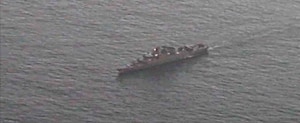
STRAIT OF HORMUZ (Oct. 6, 2023) An undated still image released on Oct. 6 from video of an Iranian Navy frigate taken by an Aerovel Flexrotor unmanned aerial vehicle (AAV) in the Strait of Hormuz.(U.S. Navy photo)
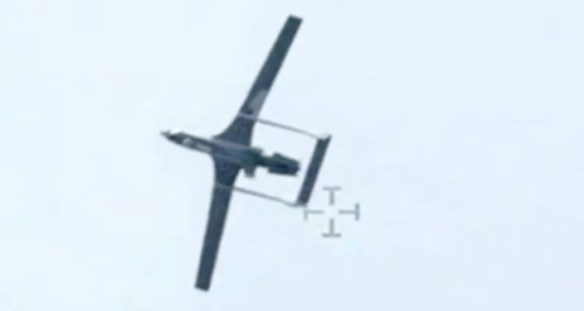
STRAIT OF HORMUZ (Oct. 6, 2023) An undated still image released on Oct. 6 from video taken by an Arabian Fox MAST-13 unmanned surface vessel of an Iranian unmanned aerial vehicle in the Strait of Hormuz.

Saildrones Set Sail in Support of U.S. 4th Fleet’s Operation Windward Stack” –4th Fleet

Below is a 4th Fleet News Release. Ten Saildrones will be operating in the Caribbean.

NEWS | Sept. 13, 2023

Saildrones Set Sail in Support of U.S. 4th Fleet’s Operation Windward Stack

By U.S. Naval Forces Southern Command/U.S. 4th Fleet Public Affairs

Commercial operators began deploying 10 Saildrone Voyager Unmanned Surface Vessels (USVs) out to sea today, a critical first step in U.S. 4th Fleet’s Operation Windward Stack.

Launched from Naval Air Station Key West’s Mole Pier and Truman Harbor, the Saildrones’ mission once on station is to improve maritime domain awareness, or MDA, by detecting and quantifying targets that pass within range of the Saildrones’ sensors.

Operation Windward Stack is a long-term operation of unmanned and manned forces working together, also known as a hybrid fleet, as envisioned by the Secretary of the Navy and the Chief of Naval Operations. Windward Stack is part of 4th Fleet’s unmanned integration campaign, which provides the Navy a region to experiment with and operate unmanned systems in a permissive environment, develop Tactics, Techniques, and Procedures (TTPs) against near-peer competitors, and refine manned and unmanned Command and Control (C2) infrastructure, all designed to move the Navy to the hybrid fleet.

First, operators and watchstanders at U.S. 4th Fleet will conduct tests and coordinate information flow as the solar-powered Saildrones sail into the Caribbean. “Operation Windward Stack begins with testing as we integrate the information we receive from the Saildrones into our fleet command center to further increase maritime domain awareness in the U.S. Southern Command Area of Responsibility (AOR),” said Lt. Cmdr. John Clark, U.S. 4th Fleet’s Current Operations (COPS) Director. “We will eventually have the opportunity to work through the command and control of both manned and unmanned forces operating throughout our region.”

The 10 Saildrones will serve as the initial unmanned vessels in the operation. Plans are to add additional USVs, unmanned aerial vehicles (UAVs) and manned maritime forces over the next few months to further challenge C2 integration and to expand the MDA coverage.

“We were able to demonstrate coordinated operations of manned and unmanned forces during UNITAS LXIV, a multinational maritime exercise, but that was for a relatively short time,” said Capt. David Fowler, U.S. 4th Fleet Maritime Operations Center (MOC) Director. “With Windward Stack, we’re going to coordinate these operations for many months. That is how we will truly learn what these unmanned vessels can do for us on a day-to-day basis.”

U.S. Naval Forces Southern Command/U.S. 4th Fleet supports USSOUTHCOM’s joint and combined military operations by employing maritime forces in cooperative maritime security operations to maintain access, enhance interoperability, and build enduring partnerships in order to enhance regional security and promote peace, stability and prosperity in the Caribbean, Central and South American region.

Damage Resulting from Ukrainian USV Attacks –The Drive

The Drive provides information showing the results of Ukrainian Unmanned Surface Vessel (USV) attacks on a small Russian tanker and a Russian Navy LST. Reportedly the USVs were equipped with 450 kg of explosives (about 1000 pounds). The explosions occurred essentially at the waterline. Had the explosions occurred well below the waterline, or particularly below the keel, the effect would have been greater. Even in the photo above, it appears the explosion cause more damage below the waterline than above. Had it been well above the waterline, the effect on the ship would probably have been less, but similar sized bomb or missile hits on the superstructure would likely have caused more personnel casualties.

Our First Look At Hole Blasted Into Russian Tanker By Ukrainian Drone Boat

“Ukraine Situation Report: Photos Show Damage To Russian Tanker After Drone Boat Strike” –The Drive

The Drive has an excellent report on the sea drone attack on Russian Tanker Sig, including photos of the damage.

Looking at the video above, it is apparent that it starts with the unmanned surface vessel alongside ship or structure which might have been a point of reference. It makes a sharp high-speed turn until about time 0:19, when the target came clearly into view at a relatively short distance. This is a 37 second video, assuming 40 knots the UAS could go 4,000 yards in three minutes or only about 822 yards in the 37 seconds. The last 18 seconds when the UAS is pointed at the target would be a distance of about 400 yards.

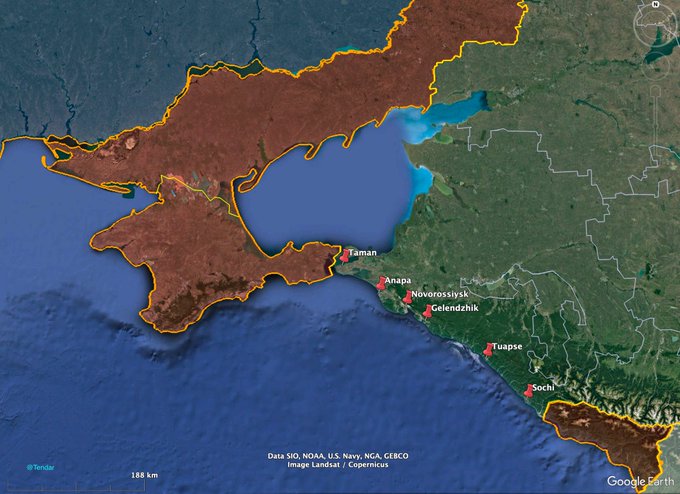
The post also notes that Ukraine has declared six Russian Black Sea ports subject to “War-Risk.”

“Northern Fleet ship seriously damaged in drone attack” –The Barents Observer

The Barents Observer provides the most complete report I have seen on a recent attack on a Russian Landing ship (LST). It identifies the ship as the Olenegorsky Gornyak, a Ropucha-class landing ship. It was in serious danger of sinking because a vehicle deck stretches the length of the hull.

I think this type of threat may be something the Coast Guard may want to seriously consider since the Coast Guard is the likely agency to defend against it.

A few comments on the conduct of the attack. It was a night attack. It would be interesting to know if the moon was down when the attack was made. It appears there was a lot of light coming from the bridge of the target ship that may have adversely effected night vision. The UAS appears to have used a slow approach, which would have been less likely to attract attention than a high-speed approach, which would have left a phosphorous wake. The target vessel appears to have been unaware of the approach. I see no defensive fire from the target vessel. The target vessel appears to be stopped or moving very slowly because, when the USV steadies up, there is little or no bearing drift.

“Ukraine’s New Maritime Drone Is A Jet Ski” –Covert Shores

Click to enlarge. Photo credit: hisutton.com

Covert Shores reports,

Both Ukraine and Russia have developed ‘maritime drones’ (USVs – uncrewed surface vessels) with explosive charges. These one-way attack USVs, aka ‘kamikaze’ drones, have been used to attack ships and bridges. The initial design, first seen in September 2022, already employed jet ski parts. However the hull was bespoke. This latest USV is a minimally modified commercial jet ski.

Based on the blurred imagery, the jet ski used appears to be a Kawasaki STX type. The seats, handlebars and some unnecessary casings have been stripped off. Then some communication and control devices have been added.

This seems to show how easy it would be for terrorists to field an offensive unmanned surface kamikaze drone.

“Our Best Look Yet at the Marines’ New Loitering Munition Toting Drone Boat” –MSN

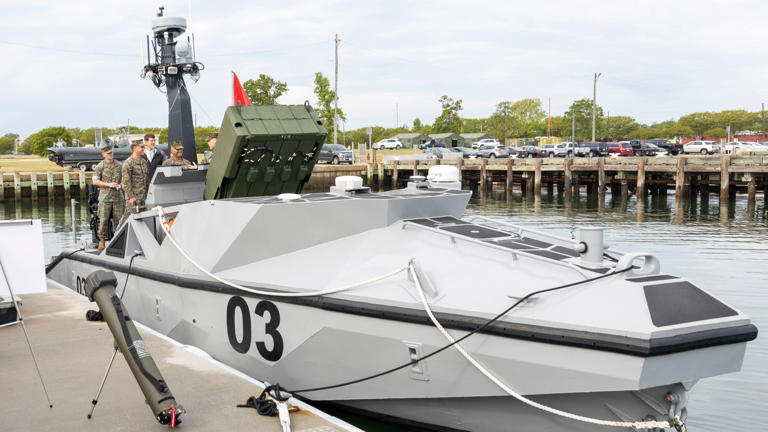
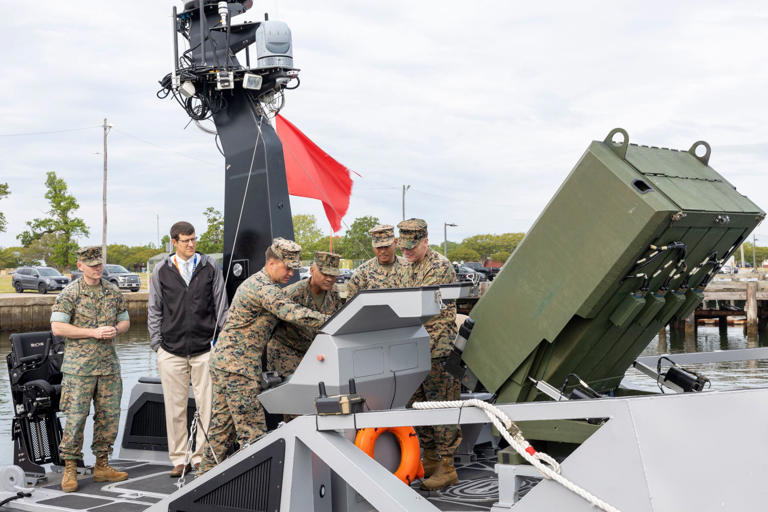
HERO 120 launcher on Long Range Unmanned Surface Vessel (LRUSV)

We talked about the HERO 120 loitering munition before. I noted it might be just what the Coast Guard needs to deal with the potential threat of small, fast, highly maneuverable craft.

While man portable single round launchers are probably all Coast Guard units might need (other than perhaps Bahrain based PATFORSWA Webber class cutters), we now have photos of an eight-cell launcher mounted on a Metal Shark optionally manned 40-foot, Long Range Unmanned Surface Vessel (LRUSV).

The Hero 120 is the largest offering in UVision’s “tactical” line of loitering munitions, weighing around 27 and a half pounds, including a 10-pound warhead. It uses an electric motor to drive a propeller at the rear and has a maximum endurance of around 60 minutes.

U.S. Marine Corps Lt. Gen. Brian W. Cavanaugh, the commanding general of Fleet Marine Force, Atlantic, Marine Forces Command, Marine Forces Northern Command, and Marines with 3d Marine Littoral Regiment, 3rd Marine Division, examine the manual controls to the Long Range Unmanned Surface Vessel, Joint Expeditionary Base Little Creek-Fort Story, Virginia, April 27, 2023. A LRUSV is an optionally manned vessel capable of extended travel and transporting loitering munitions that accurately track and destroy targets on sea or land. Metal Shark is designing, building, testing and implementing the LRUSV system under another transaction authority agreement with Marine Corps Systems Command to primarily serve as an intelligence, surveillance, and reconnaissance platform.
© Provided by The Drive

While it looks increasingly likely this system will become common in the Navy/Marine Corps inventory, it is perhaps important to remember that this eight-round launcher is not necessary to launch these. Loaded single round launchers are small enough to be man portable and would impose no heavy loads on the platform at launch. Certainly, some training would be required, but they could be stored in a group, station, or ship’s armory and be issued when needed.

“Video: Interview With VADM Cooper On TF 59 Milestones, US 5th Fleet” –Naval News

Naval News provides a video of an interview with 5th Fleet/NAVCENT commander VAdm Charles Bradford (Brad) Cooper II. In addition to the video above, the Naval News post provides a transcript of the interview (always appreciated).

The video provides more than talking heads. There are snippets of video showing the operation of unmanned systems and the people mentioned.

PATFORSWA Webber class cutters show up in the video three times.

Task Force 59 is an exciting development. It appears likely this model will be replicated in other areas including with the 4th Fleet in the Drug Transit Zone. Hopefully the Coast Guard is taking the opportunity to learn as much as possible from these operations. If the Coast Guard does not have a Coast Guard R&D liaison to Task Force 59 we are missing a good bet.

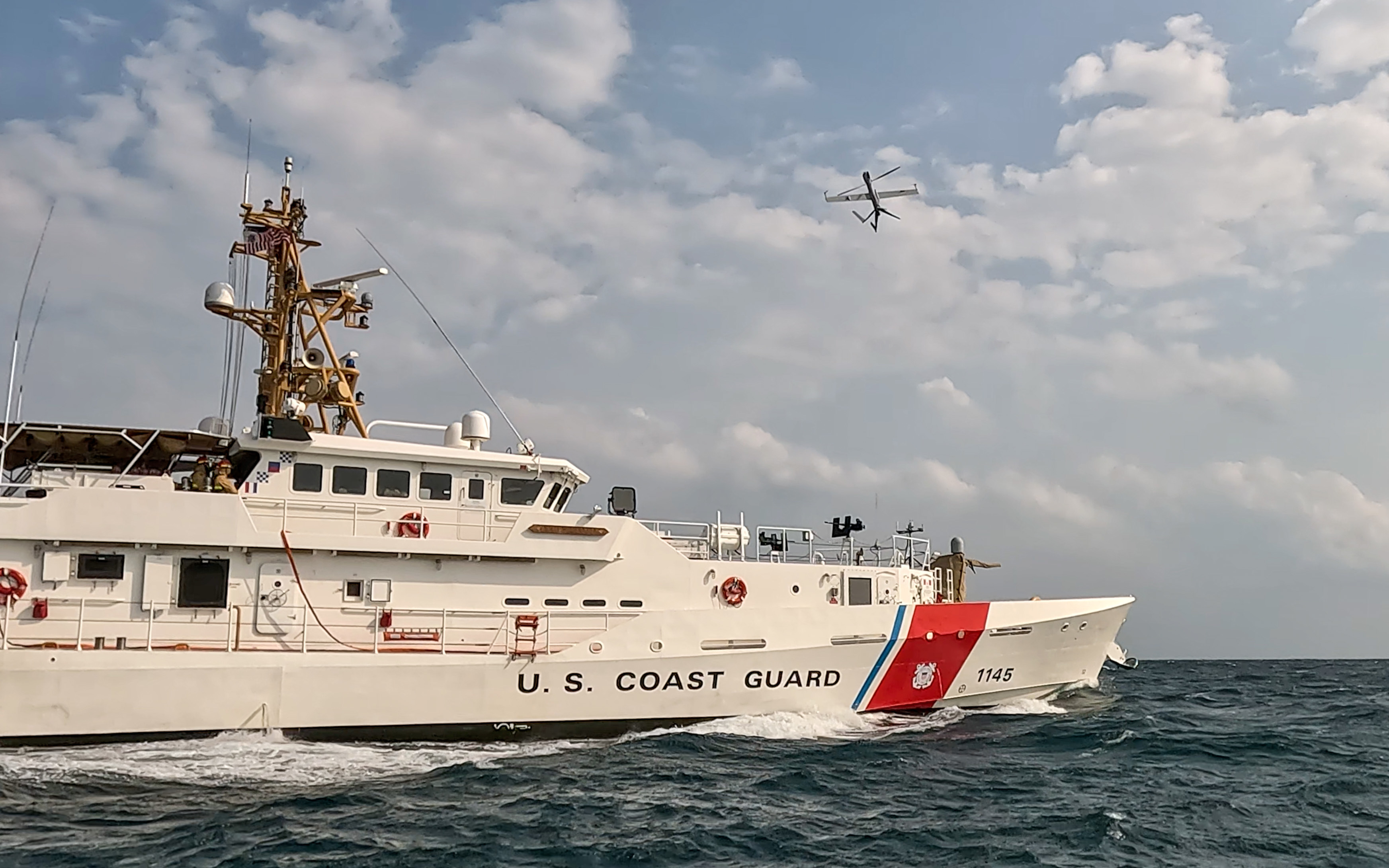
221207-N-NO146-1001 ARABIAN GULF (Dec. 7, 2022) An Aerovel Flexrotor unmanned aerial vehicle (UAV) takes off from U.S. Coast Guard fast response cutter USCGC Emlen Tunnell (WPC 1145) transiting the Arabian Gulf, Dec. 7. U.S. 5th Fleet’s Task Force 59 launched the UAV during Digital Horizon, a three-week event focused on integrating new unmanned and artificial intelligence platforms, including 10 that are in the region for the first time. (U.S. Navy photo)

Related: