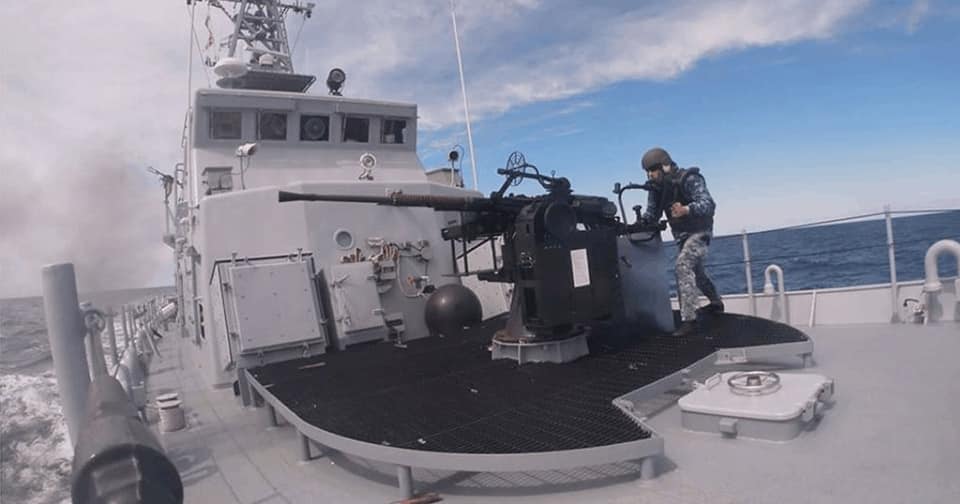
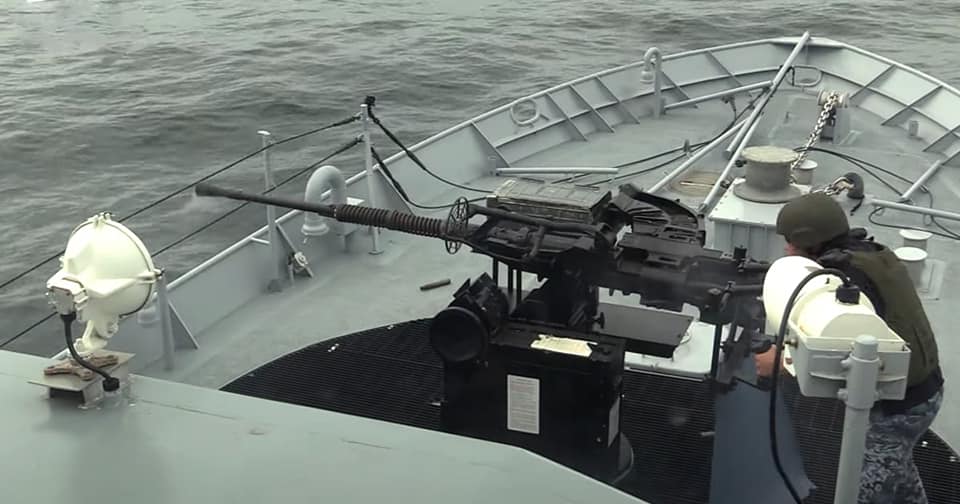
Via Facebook I obtained some photos, from a Ukranian friend, of how a couple of the five Ukranian 110 foot Island class cutters have been rearmed.
The intention was to rearm the ships with the MSI Seahawk 30mm, which reportedly will be the new USN Mk38 Mod4, but apparently it is not yet available, so instead, the ships have been armed with a Soviet era 25mm gun, the 110 PM. As can be seen, control is entirely manual and lacks stabilization, sensors, electro-optics, or any kind of firecontrol computer.
It’s not much, for a Navy facing off the Russian Black Sea Fleet, but at least it essentially restores the capability they had before the transfer. In some respects, it may be superior with a higher rate of fire and a heavier projectile.
After publishing my initial post about this stabilized gun mounting system, a comment from Secundius provided much better, more detailed photos of the system and gave me the manufacturer’s name, FlexForce. The FlexForce website told me they were headquartered in Portland, Oregon, and that the system is available on GSA schedule.
Their “News” page indicates the mount will be at the Work Boat Show in New Orleans,Booth 3877 aboard Lake Assault Custom Boats FP-M boat (33 foot US Navy Force Protection, Medium) December 1-3. If this becomes a standard USN system, it would make it more readily available, perhaps at Navy expense.
Below is their data sheet for maritime applications. The Coast Guard obviously knows about this mount. The first photo below is obviously of the system mounted on a Webber class WPC.
There is another better photo of the mount on a Webber class here and a photo of it mounted on a Coast Guard 25 foot boat here.
The Coast Guard has been looking for ways to make their weapons more accurate for some time. Unfortunately some of the links are broken, but I did this report back in 2014. Back in 2017, when I was able to do a tour of the Bailey Barco, the gunners mate told me they had done some weapons testing with Navy and Marine as well as Coast Guard observers aboard.
The Electro-Optic options should also help with targeting, especially at night. The remote option essentially makes this a remote weapon station meaning the operator need not be an obvious target. Significantly FlexForce claims the system is effective against UAS.
Hopefully this system or something like it will start showing up on Coast Guard cutters, most immediately those assigned to PATFORSWA.
(I wonder if it might be possible to mount the Fletcher APKWS launcher on this (with the remote option)?
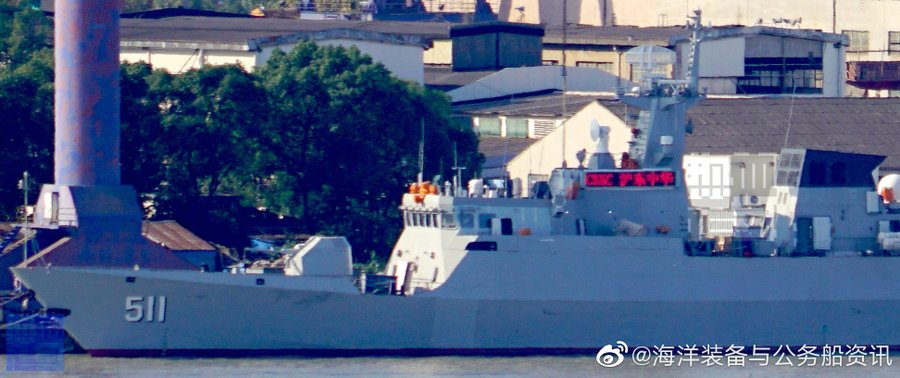
We have a report from Defence.PK, that 22 PLAN Type 056 corvettes are being transferred to the China Coast Guard. These ships are the early models that were completed without the more sophisticated anti-submarine warfare capabilities of the Type 056A. Rather than upgrade them, the Chinese Navy will build 22 additional Type 054A Frigates.
Reportedly they are adding a LED billboard and the missiles are being removed. Probably the torpedoes as well. But that still leaves a 120 round/minute 76 mm gun and a pair of 30mm Guns.
The China Coast Guard already has more large cutters than the US Coast Guard, despite of the fact that their EEZ is less than 20% that of the US, even if all their outrageous claims were accepted. But most of these cutters have no guns of 20mm or larger. 22 AK-176 76mm guns and 44 30mm Guns will substantially increase the China Coast Guard’s firepower.
These 1500 ton 25 knot ships are a handy size for an area like the South China Sea.
Unlike the US Coast Guard, the China Coast Guard tends to operate their cutters in groups. Three of these, snuggled up to you, at close range, could be very intimidating even to a DDG like those the US Navy uses for Freedom of Navigation Exercises. For relatively unarmed Asian Coast Guard cutters, it would be much more so.
Chinese Naval Forces don’t have a lot of naval victories in their past so the Battle of Paracel Islands, where they defeated the Vietnamese by opening fire at very close range, must assume outsized importance in their imagination.
British navy sailor fires burst using gun mounting system ASP (Agile, Small-deflection, Precision) armed with a .50 heavy machine gun. (Picture source British Royal Navy)
Over a week of trials, the team put down nearly 5,000 .5 caliber rounds – 3,500 fired using the new mounting, 1,450 from a heavy machine-gun on a traditional ‘soft’ mounting to allow for comparisons. They conducted more than three dozen gunnery shoots in different scenarios and weather conditions to give both mountings a comprehensive workout.
Seven of Argyll’s ship’s companies were taught how to fire a .50 cal loaded onto the new mount. They found it easy to use – and their gunnery improved as the trials went on.
I would at least be curious about their test results.
I am resurfacing this old post from 2017, because our weapons effectiveness is still an issue. I also reformatted a couple of sentences to bold type face, so the points would be harder to miss. Hopefully the Mk38 Mod4 will have at least the 30mm gun, if they don’t decide to recycle 25mm guns, as seemed to have been the case when the Mod3 changes were minimized compared to the Mod2. We really need to upgrade the older mounts to a more effective weapon, otherwise we are planning to fail. Either replace the 25mm with a more effective gun or add APKWS or Hellfire/JAGM small missile systems. Better yet, do both.
This is old. It goes back to 1992, but if they knew the results here, it raises a question, why are we still equipping the Mk38s with 25mm guns instead of 30mm (or 35mm or 40mm) guns which also fit the same mount? The results are discussed beginning at time 8:00. The 30mm does nine times the damage to the hull and five times the damage inside the hull.
At the very least we need to make sure we have available rounds that do not detonate on impact. The 25mm rounds, exploding on impact, failed to even penetrate the 1/4 inch aluminum hull of the Mk3 target boat.
The U.S. Navy littoral combat ship USS Gabrielle Giffords (LCS-10) launches a Naval Strike Missile (NSM) during exercise “Pacific Griffin” on 2 October 2019. The NSM is a long-range, precision strike weapon that is designed to find and destroy enemy ships. Pacific Griffin is a biennial exercise conducted in the waters near Guam aimed at enhancing combined proficiency at sea while strengthening relationships between the U.S. and Republic of Singapore navies. U.S. Navy photo by Mass Communication Specialist 2nd Class Kenneth Rodriguez Santiago
“Demand is not an issue. If they suddenly come out and they say we need 200 a year, 300 a year, 500 a year, we can do that,” Schreiber added.
So, should the Navy and Coast Guard see a need to add NSM to Coast Guard vessels, it could be done relatively quickly. NSM is a relatively small cruise missile, 13 feet long and about 900 pounds.
On the other hand, the Navy has been relatively slow to add them to their own vessels, limiting NSM to LCS as they go through regularly scheduled yard periods.
Most of us are familiar with the M2 .50 cal. machine gun. It is found on most Coast Guard Cutters. Its familiar. Its simple. It is a stand alone weapon that requires no external power. It is frequently a Coast Guard vessel’s primary weapon, as on the 87 foot patrol boats, buoy tenders, and icebreakers. It is the secondary as on the FRCs and WMECs.
Modern-day air-cooled 0.50″ (12.7 mm) Browning Machine Gun. US Navy Photograph No. 020704-N-0156B-002.
Nominally it has an effective range of 2,200 yards, but I suspect that is only against advancing infantry formations. It is certainly not accurate at that range after the first round in full auto.
Aside from firing warning shots at close range, it is frankly not a very good weapon for use in the naval environment. The gunner is largely exposed, where he can be picked off by a sniper. Even terrorists or criminals can easily obtain weapons that equal or overmatch it range and hitting power. The damage it can do to anything beyond the smallest vessels is very limited.
When used in a crowded harbor, its range, combined with its inaccuracy, and the lack of a self-destruct feature for it projectiles, mean it may cause collateral damage.
It is almost totally useless against aircraft. During World War II, Navy experience was that it required an average of 11,285 rounds for a .50 caliber machine gun to bring down an aircraft. The .50 caliber weapons on ships were credited with 14.5 aircraft kills for 163,630 rounds expended, so it probably not going to be very useful against drones.
We should not expect it to provide an effective self defense capability.
Northrop Grumman seems to think they have a replacement, perhaps two. Most recent is the 20mm Sky Viper proposed to equip the Army’s planned Future Attack Reconnaissance Aircraft (FARA) seen in the video above.
As with General Dynamics’ offering, specialty munitions for use against troops, unmanned aerial vehicles, ground vehicles and other helicopters, can be integrated with Sky Viper, flexibility which naturally suggests other applications.
While emphasizing that Sky Viper is a FARA-focused effort (with DEVCOM funding), Canole acknowledges that Northrop Grumman is looking beyond the platform to where it might offer a solution “with a lot more firepower than a .50 caliber”. That could include the Army’s new Mobile Protected Firepower light tank prototypes for which .50 caliber (12.7mm) auxiliary guns are already spec-ed.
“The low recoil and a relatively lightweight system really opens the door for [applications] where .50 calibers tend to be the mainstay,” Canole says.
The Sky Viper, which uses the same 20x102mm round as the 20mm Vulcan Gatling gun, that equips the Phalanx CIWS, is evolved from the 30mm M230 that fires the 30x113mm. You can see in the photo above that the 20x102mm is a much smaller round than either the 30x113mm or the 25x137mm used by our current 25mm MK38 mounts, but it is substantially more powerful than the .50 caliber.
As the newest member of the chain gun family, we can expect some improvements. Compared to the M230 it has much lower recoil forces, a higher rate of fire, and is lighter, lighter in fact, than the .50 caliber M2.
It is in service with the Marine Corps, so it is already in the Navy inventory and ammunition supply system. It is actually smaller, more compact, lighter, and has far less recoil than the 25mm M242 in the Mk38 mounts.
Compared to the .50 caliber, the 30x113mm projectile is far more effective against larger targets and is effective at a greater range.
Used in a remote weapon station, it is far more accurate than a .50 caliber M2, and anytime you add a remote weapon station, the ship benefits from the high quality optics that come with it.
Plus there is a programable air burst fuse already available for the 30x113mm round that is apparently effective against drones.
I would not suggest replacing the 25mm Mk38s with either of these, unless the remote weapon station also incorporated missiles like Hellfire/JAGM and/or Stinger, but as replacements for .50 caliber they offer great advantage.
An artist’s conception of an APKWS strike against an unmanned aircraft. BAE SYSTEMS
The Navy League’s on line magazine, Seapower, report the successful test of a new alternative for countering Unmanned Air Systems.
BAE Systems Inc. has successfully tested APKWS laser-guided rockets in precision strike tests against Class 2 unmanned aircraft systems at Yuma Proving Grounds, Arizona, the company said Oct. 11.
The 2.75-inch test rockets combined standard M151 warheads and Mk66 motors with APKWS precision guidance kits and a newly developed proximity fuze, enabling them to engage and destroy airborne drones at a fraction of the cost of traditional counter-UAS strike capabilities.
(A Class 2 UAS is 21 to 55 pounds, operates at 3500 ft or lower, and has a maximum speed of 250 knots, so its pretty small. ScanEagle is an example.)
As important as this cUAS capability may be, adding this capability to Coast Guard Units would also have the bonus of providing both a capability against a range of surface targets from small, fast, highly maneuverable craft to small ships, and at least a basic anti-aircraft capability.
Adding a launcher and the required laser designator to vessels with Mk 38 mod2/3 gun mounts should not be too difficult. The PATFORSWASIA Webber class FRCs would a good place to prototype an installation.
The video above has a segment, beginning about time 4:55 to 5:25, that may be of particular interest to the Coast Guard. It appears that the Navy may finally be moving from the 25mm gun to the 30mm in their next iteration of the Mk38 mount.
We have known all along that the 30mm is more effective for Coast Guard type missions. Apparently the Mk38 mod2 was adaptable enough to accept the 30mm but the Navy did not seem interested. Despite earlier indications the Mk38 mod 3 would be significantly different, including use of the 30mm, when it emerged, it retained the 25mm.
I suspect the combination of the UAS threat and the availability of a programable air burst round may be what has gotten the Navy’s attention.
For our purposes, in addition to the air burst round, the 30mm does have a greater selection of projectile type including “swimmer round” designed specifically to counter Fast Inshore Attack Craft (FIAC).
We have talked about “Switchblade” loitering munition before. I will not repeat the earlier discussion, but recently found this video and wanted to pass it along.






 Chuck Hill's CG Blog