Cutter William Hart returned to Honolulu after completing a 42-day patrol in Oceania

USCGC WILLIAM HART (WPC 1134)

Below is a District 14 news release.

Feb. 27, 2023

Coast Guard cutter completes Operation Aiga ’23

HONOLULU — The crew of the Coast Guard Cutter William Hart returned to Honolulu after completing a 42-day patrol in Oceania in support of Operation ‘Aiga on Monday.

During the 8,616 nautical-mile patrol, the cutter’s crew conducted operations to counter illegal, unreported, and unregulated fishing (IUU) and strengthened relations with foreign allies while promoting the collective maritime sovereignty and resource security of partner nations in the Blue Pacific.

Operation “Aiga,” the Samoan word for family, is designed to integrate Coast Guard capabilities and operations with our Pacific Island Country partners in order to effectively and efficiently protect shared national interests, combat IUU fishing, and strengthen maritime governance on the high seas.

“During our deployment in the Blue Pacific, we supported efforts to counter and deter illegal fishing activities in the exclusive economic zones of Kiribati, French Polynesia, the Cook Islands, Samoa, the United States, and on the high seas,” said Cmdr Cynthia Travers, commanding officer of the William Hart.

During the first port call of the patrol at Kiritimati Island, Kiribati, the William Hart’s crew delivered COVID-19 personal protective equipment (PPE) donated by the U.S. Indo-Pacific Command. The PPE supplies included face masks, gloves, and other protective gear to assist the island in their COVID-19 readiness and ensure the safety of its 7,000 citizens.

While in Avatiu, Rarotonga, Cook Islands, the crew conducted two bilateral shiprider boardings. One crew member from the William Hart was sent shore side to work with the Ministry of Maritime Resources for Rarotonga to assist in directing the cutter towards targets of interest.

Additionally, the crew executed a law enforcement subject matter expert exchange with the crew of Te Kukupa II, a maritime police patrol boat for Rarotonga, followed by cross ship tours for vital information and best practices sharing.

“It was a privilege to work alongside fellow maritime professionals in the region, and we look forward to future opportunities to strengthen maritime governance and preserve maritime sovereignty by working with our Pacific Island partners,” said Travers.

During the William Hart’s port visit in Apia, Samoa, the crew conducted two bilateral shiprider boardings and investigations of targets within the Samoa EEZ. While the cutter was underway with Samoan ship riders, two crew members went ashore to work with the U.S. Embassy in Samoa and assist with shore side logistics.

Additionally, the crew participated in community engagement and outreach events, including ship tours for partner maritime organizations and students from the School of Maritime Training, and a beach clean-up with staff from the U.S. Embassy in Samoa. The crew conducted an under-way tour for members from the Deputy Prime Minister office, the U.S. Embassy Charge d’Affaires office, the Australian and British High Commissioners, and others.

The William Hart is one of six highly capable FRCs stationed throughout District 14. Their crews provide year-round search and rescue and maritime law enforcement coverage across a 15 million square mile area of responsibility, demonstrating the Coast Guard’s commitment to our partner nations across the Blue Pacific.

“Coast Guard to hold decommissioning ceremony for USCGC Decisive Thursday” –LANTAREA

The Reliance-class medium endurance cutter USCGC Decisive (WMEC 629) conduct at sea engagements with the navy of Guatemala in the territorial seas of Guatemala on Oct. 25 – 26, 2021. The U.S. Coast Guard conducts routine deployments in the Southern Command area of responsibility, works alongside partners, builds maritime domain awareness, and shares best practices with partner nation navies and coast guards. (U.S. Coast Guard photo)

Below is a news release from Atlantic Area. 

Feb. 27, 2023

Coast Guard to hold decommissioning ceremony for USCGC Decisive Thursday

PENSACOLA, Fla— The Coast Guard is scheduled to decommission USCGC Decisive (WMEC 629), a 210-foot, Reliance-class medium endurance cutter during a ceremony 10 a.m. Thursday, March 2, 2023, at Naval Air Station Pensacola.

WHO: Vice Adm. Kevin Lunday, commander, Coast Guard Atlantic Area; Cmdr. Aaron W. Delano-Johnson, commanding officer of Decisive; and the Decisive crew.

WHAT: A decommissioning ceremony to honor the legacy of Decisive and the Coast Guard members who served as part of its crew during its 55 years of service.

WHEN: Thursday, March 2, at 10 a.m. Media must arrive at the front gate no later than 9:00 a.m.

WHERE: Naval Air Station Pensacola, 211 South Ave, Pensacola, Florida 32508.

Media must RSVP no later than 12 p.m. Wednesday by calling (757) 202-3448 or emailing uscglantarea@gmail.com.

Decisive is the third Coast Guard 210-foot, Reliance-class medium endurance cutter to be decommissioned since 2001 as part of modernization efforts across the fleet. Decisive has primarily performed fishery patrols, search and rescue, law enforcement and migrant interdiction operations. Notably, the cutter assumed tactical command of Mississippi Coastal Recovery Base Gulfport after Hurricane Katrina and responded to the largest oil spill in American history— Deepwater Horizon.

“Philippine Coast Guard Set For Personnel Boost” –Naval News

BRP Teresa Magbanua during sea trials off Japan (Photo: Philippine Coast Guard)

Naval News reports,

“The Philippine Coast Guard (PCG) is set to receive an additional 4,000 personnel this year, in order to reach a total of 30,000 by year-end.”

Some things to note:

That is almost 75% the size of the US Coast Guard, while the Philippine EEZ is less than 20% of the US.

The Philippine Coast Guard will be considerably larger than the Philippine Navy which has 24,500 active-duty members including 8,300 Marines.

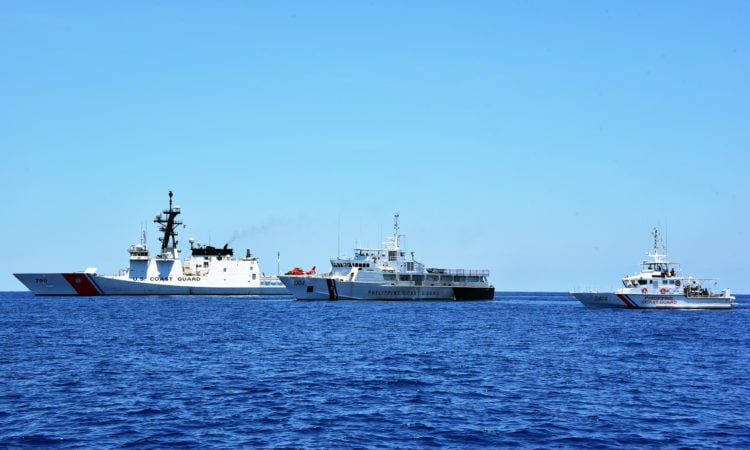
BRP Batangas (SARV-004) in between USCGC Bertholf (WMSL 750) and BRP Kalanggaman (FPB-2404) in an Exericse held in 2019. For many years, the Australian San Juan and Ilocos Norte vessels were the only major patrol assets in PCG service.
(U.S. Coast Guard photo by Chief Petty Officer John Masson)

Until 2020 the Philippine Coast Guard had no large patrol cutters. Their largest ships were two buoy tenders including the former USCGC Redbud, first commissioned in 1944. In fact, they mark the founding of their Coast Guard Fleet only as of 2007.

Beginning in 2020 the Philippine Coast Guard has obtained their first large patrol cutter, the 83 meter BRP Gabriela Silang. In 2022 they obtained two Japanese built 97 meter cutters of the Teresa Magbanua-class (see lead photo). They hope to get many more.

This build-up is obviously in response to Chinese intrusions into the Philippines’ Exclusive Economic Zone.

It appears the Philippine Coast Guard still has no weapons larger than .50 caliber machine guns. It will be interesting to see if this changes.

“ARCIMS SeaSense: An Autonomous Anti-Submarine Warfare Solution” –Naval News

Naval News (sponsored content) reports,

ATLAS ELEKTRONIK UK (AEUK) have added an underwater surveillance system to their already established fleet of ARCIMS Uncrewed Surface Vessels (USVs). Integrated with a compact Variable Depth Sonar (VDS) ‘SeaSense’, this underwater threat detection capability has been designed to operate within confined and shallow waters, offering an alternative to the traditional ASW platform.

What we have here is a combination of two systems, both of which may be of interest, a lightweight sonar system and an optionally manned 11 meter boat that is essentially a maritime pickup truck that can handle alternative mission loads. Apparently, there is also a mine countermeasures system based on the same 11 meter uncrewed surface vessel.

ATLAS ELEKTRONIK is a long established, very experienced German electronics and defense company with subsidiaries worldwide, including the US. Among other products, they make the Sea Fox mine disposal system for the US Navy.

That the ARCIMS platform is an 11meter boat immediately piqued my interest because it is the same size as the Long Range Interceptor carried by National Security Cutters (NSC), suggesting the craft might be operated from NSC with minimal changes.

A couple of NSCs with MH-60R ASW helicopters and four of these sonar equipped optionally manned boats might make a pretty robust deployable ASW screen for an Amphibious Objective Area or a port of debarkation without major changes to the NSCs.

“Proceedings Podcast Ep. 314: USCG Vice Commandant Admiral Poulin on Force Structure and Strategy”

ADM Steven D. Poulin, Vice Commandant, U.S. Coast Guard

The U. S. Naval Institute has issued a podcast, a wide-ranging interview with the Vice Commandant, Admiral Steven D. Poulin. If you are a regular reader here, I don’t think you will be surprised by any of it.

I have to admit a dislike for podcasts as a medium. They take longer than reading. Comprehension is probably less. If you miss something and want to check what was said, it is difficult. Frankly, people talking off the cuff probably don’t give as good, or as complete an answer, as they would with written media. At the very least I wish a transcript accompanied the oral version. I might feel differently if I still had a long commute when I might want something useful to do while stuck in traffic. 

Since this podcast was a part of a regular US Naval Institute podcast series, I would think most of the listeners were not Coast Guard and were likely more familiar with the Navy and/or Marine Corps. It may have been a missed opportunity to explain the Coast Guard’s place as an element of seapower to a naval audience, whereas the answers seemed more oriented toward a Coast Guard audience.

Also, during this podcast, we hear the frequently sighted similarity in size of the Coast Guard and the New York City Police Department. While there is some truth to this, both have about 50,000 full time employees, over 35,000 NYPD uniformed officers and over 40,000 active-duty Coast Guard’s men, Admiral Poulin did push back on this a bit sighting Coast Guard Reserves and Auxiliary.

I don’t think it is helpful to say we are small, which leads to the assumption we are unimportant as a military service. A comparison with other naval services is more relevant.

Since the 1950s the US Navy has shrunk considerably, while the Coast Guard has grown. When I entered the Academy in 1965, in terms of personnel, the Navy was about 22 times larger than the Coast Guard. The Marine Corps was about 8 time larger. Now the Navy is less than nine times larger, and the Marine Corps is about 4.5 times larger.

I would point out that the US Coast Guard has more active uniformed personnel (40,000), more aircraft (200), more ships (243), and certainly more boats, than the Royal Navy (34,130 active uniformed personnel, 160 aircraft, and 85 ships) or the French Navy (37,000 active uniformed personnel, 178 aircraft, and 180 ships). That is not to say the Coast Guard is a more powerful than these highly professional mid-sized navies, that include nuclear submarines and aircraft carriers, but the Coast Guard is not insignificant. We have a large pool of highly trained mariners and aircrewmen. If we ever again have a major non-nuclear war against a near peer adversary, the Coast Guard will make a substantial contribution, perhaps even more so than it did during WWII.

“How Lockheed Doubled The Range Of Its Joint Air-To-Ground Missile” –The Drive

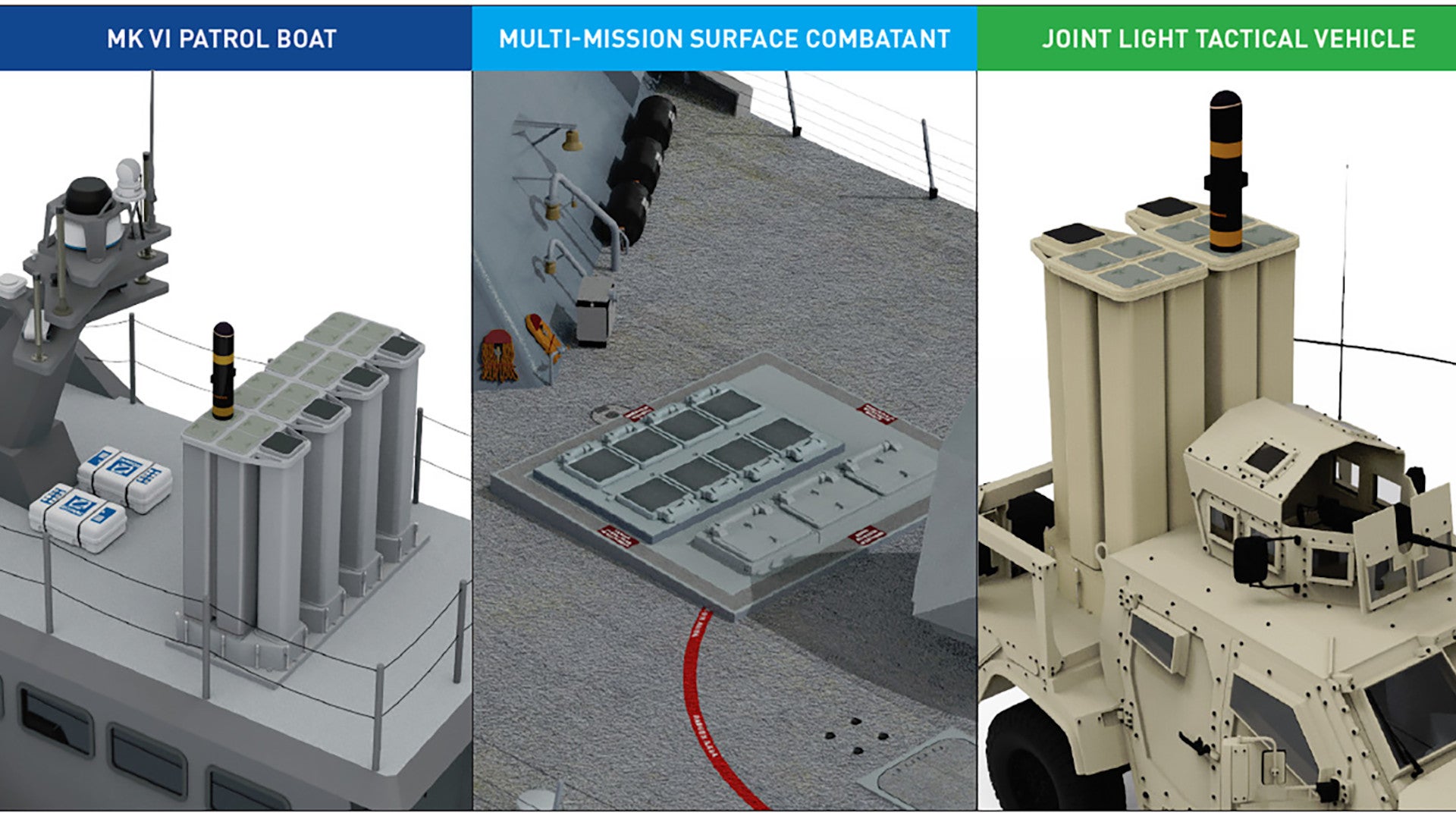
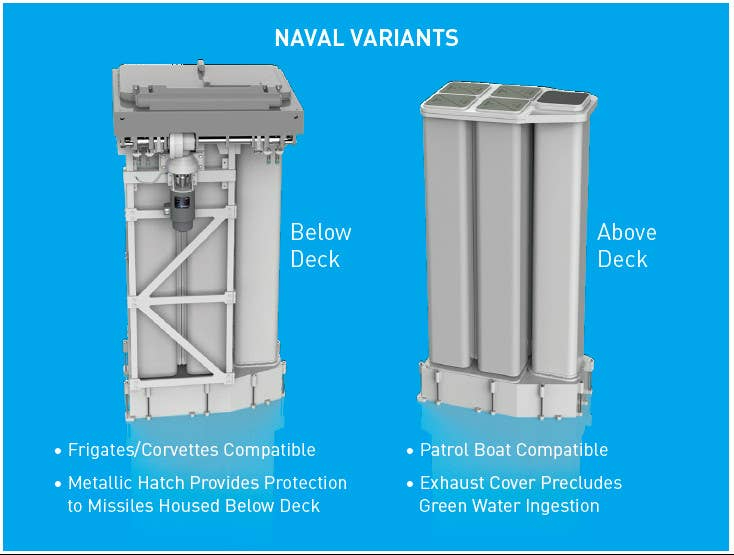
16 tube patrol boat installation. 32 tube surface vessel installation. Eight tube vehicle installation.

(I meant to post this weeks ago, but I must have been distracted)

The Drive reports on tests of an upgraded Joint Air Ground Missile (JAGM) that will be replacing the Hellfire. While originally conceived as an air launched anti-surface weapon, both Hellfire and JAGM have proven more flexible, being launched from the surface and being used against low altitude air targets. I found these comments particularly relevant to possible Coast Guard use.

As to the platforms that could potentially fire JAGM-MR, the fact that early tests have been from ground launchers reflects the fact that the initial priority is to field it in a land-based form.

“We’re looking at various ground-based capabilities and looking to demonstrate vertical launch in the 2023 timeframe, although I don’t have specific dates,” Drake adds. “That could naturally transition into, you know, launch from an LCS [Littoral Combat Ship], as an example. And then other unique ideas that I really can’t speak to today.”

There is good information here about both Hellfire improvements and JAGM.

I must admit, I think these weapons would be a good fit for the Coast Guard, allowing even relatively small Patrol Boats (WPBs) to have the punch of a medium caliber gun, and with the range improvements coming, even greater effective range, at far less total cost. They should be particularly effective against small, fast, highly maneuverable surface threats and might be useful against larger vessels as well, all while minimizing the possibility of collateral damage. Importantly, these weapons are already in the Navy’s inventory.

Some previous discussion of Hellfire and JAGM:


“Coast Guard to Triple Western-Pacific Deployments, Policy Chief Says” –Defense One

Defense One has an interview with Rear Adm. Michael Ryan, the Coast Guard’s deputy commandant for operations policy and capabilities.

The reference to tripling Western-Pacific Deployments seems to reflect the planned deployment of three National Security Cutters to the Western Pacific in 2023, but that is not explicitly stated and there is also reference to homeporting a WMEC in the Western Pacific, topics we discussed here.

Most of the interview is really about connectivity, data collection, and analysis. Hopefully we will see some data used for a new Fleet Mix Study, that will determine our needs and be able to justify them to Congress.

It was interesting to me that the interview was a result of Admiral Ryan’s attendance at the National Defense Industrial Association’s Expeditionary Warfare conference in Arlington, Va.

After Prototype SLEP USCGC Seneca still has her 76mm

USCGC Seneca’s (WMEC 906) crew pulls into home port in Portsmouth, Virginia, Feb. 17, 2023, following a 24-day patrol in the Caribbean Sea. Seneca’s crew worked with Joint Interagency Task Force South and the U.S. Air Force to disrupt nearly 1,350 kilograms of narcotics from two law enforcement cases in the Caribbean Sea. (U.S. Coast Guard photo by Petty Officer 3rd Class Kate Kilroy)

Not a big thing, but since we have been told USCGC Seneca was the prototype for the WMEC 270 SLEP,

“Coast Guard Cutter SENECA arrived in the summer of 2021 for the prototype Service Life Extension. Both SSDG and Emergency Generators replaced which included electrical upgrades to SSDG and emergency switchboards. SENECA was utilized as the prototype vessel for ISVS to the 270’ fleet that begins in 2022 with CGC HARRIET LANE.

and we have heard that the 76mm Mk75 gun and presumably the Mk92 Fire Control System are being removed during the SLEP, I wondered if the gun and firecorntrol had been removed?

A recent photo (above) accompanying a Navy League Seapower Magazine report of the return to homeport of USCGC Seneca after 24 day Caribbean Patrol clearly shows both the Mk75 and the Mk92 in place.

“Pakistan’s New OPV – PNS Yarmook – Is At NAVDEX 2023” –Naval News

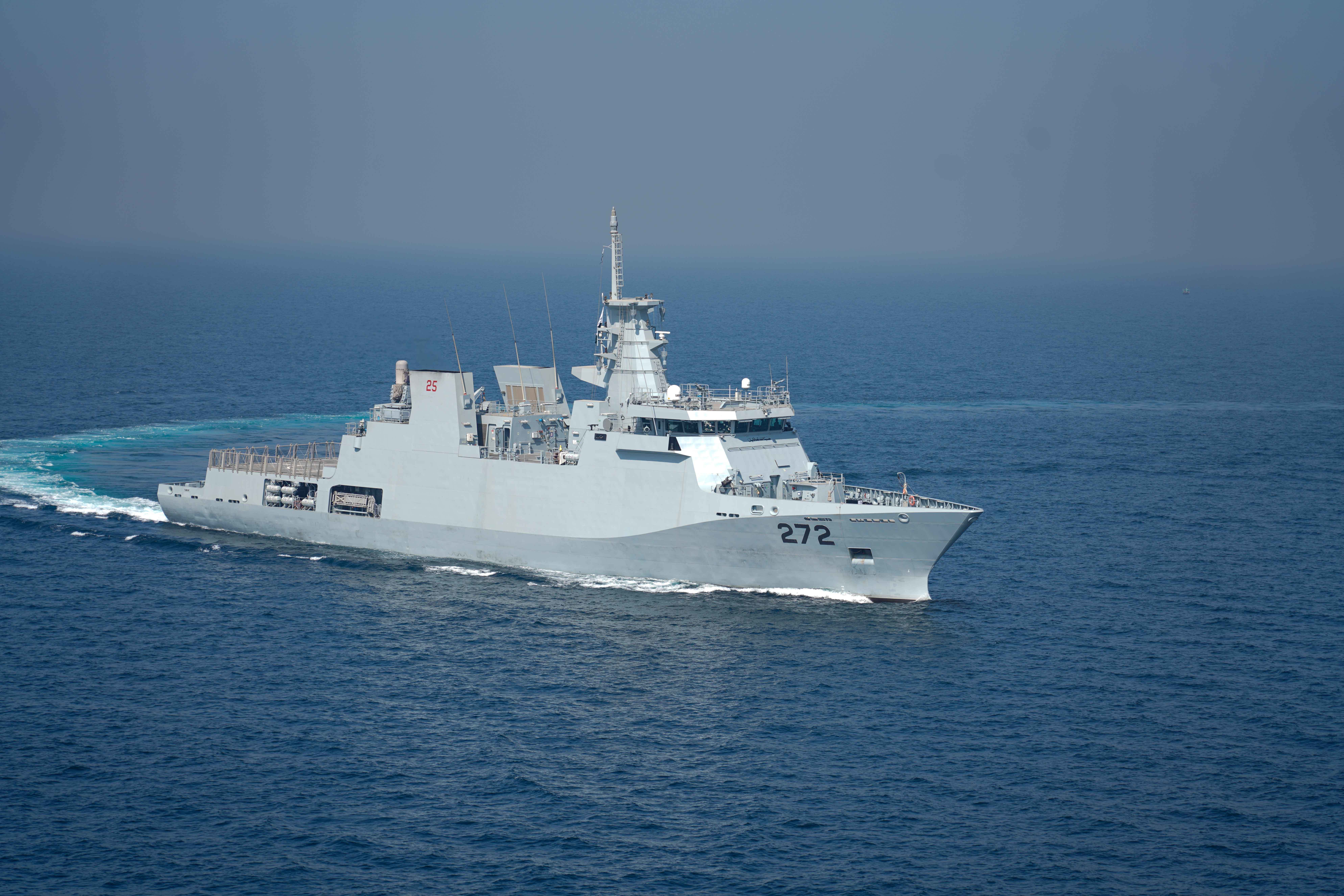
Sister ship: GULF OF OMAN (Nov. 11, 2021) Pakistani corvette PNS Tabuk sails alongside amphibious dock landing ship USS Pearl Harbor (LSD 52) during a passing exercise in the Gulf of Oman, Nov. 11, 2021. (U.S. Navy photo by Mass Communication Specialist 3rd Class Sang Kim)

Naval News reports on a tour of a recently completed Damen designed Offshore Patrol Vessel. The vessel itself, PNS Yarmook (271), is a very typical modern OPV. What is not typical is the way it is being armed.

A medium caliber gun (57-76mm) and a pair of auto-cannon (20-30mm) seems to be the norm. Instead, it is to be a 30 mm Aselsan SMASH remote weapon station, two Aselsan STAMP remote weapon systems, (presumably with .50 cal. machine guns) and a Phalanx Block 1B close-in weapon system, and eight Harbah sub-sonic, anti-ship cruise missiles (ASCM) with land attack capability. This missile, at 1350 kg, is about twice as large as Harpoon (1523 lbs / 691 kg) and 50 kg or 110 pounds heavier than the Tomahawk. It is more than three times larger than Naval Strike Missile.

Pakistan is building another, slightly larger class of OPVs. Presumably, they will also be armed with ASCM. These, like the Yarmook class, are being built by the Damen yard in Galati, Romania.