“Boost Coast Guard Fleet For Pacific Partnerships” –Breaking Defense

The crew of USCGC Joseph Gerczak (WPC 1126) prepare to moor at the port of Pago Pago, American Samoa, Aug. 3, 2019. They will conduct a joint fisheries patrol with NOAA Fisheries and American Samoa Marine Police members. (U.S. Coast Guard photo by Chief Petty Officer Sara Muir/Released)

Breaking Defense has an oped from Bollinger President and CEO Ben Bordelon, who also serves as chairman of the Shipbuilders Council of America. We all know, he has a financial interest in additional cutter construction, but that does not mean he is not right. After decades of neglect, the Coast Guard can use some influential support, and the mission is important. With permission from Bollinger, I am publishing it in full below.


Boost Coast Guard Fleet For Pacific Partnerships

By: Ben Bordelon

For decades, China has deployed its fishing fleet – the largest in the world – as a maritime militia, systematically asserting and expanding Beijing’s influence throughout the Indo-Pacific.

The fleet routinely operates in areas where there is little to no enforcement and willfully engages in aggressive, predatory practices to intimidate lawful local fishermen, undermine maritime governance, and destabilizing the global blue economy.

China is not alone in these actions. Illegal, Unreported and Unregulated (IUU) fishing occurs under a number of flags. The practice is so pervasive, in fact, that one in five fish caught around the world –  between 11 million and 26 million metric tons of fish – is done illegally, robbing legal fishermen of tens of billions of dollars every year. But IUU is first and foremost a maritime and national security threat. The erosion of global norms and standards by the Chinese is a direct affront to global stability and threatens the ability of sovereign nations to manage and defend their resources. (One of the most easily understood examples for Americans would be the predations that occur in Bahamian waters by fishermen from the Dominican Republic and other countries.)

The Coast Guard is uniquely positioned for this and similar missions, not just in the Pacific, but across the globe. The Coast Guard occupies the sweet spot on the diplomatic spectrum between the State Department on one end and the Department of Defense on the other. The distinctive white hulls and red racing stripe of the Coast Guard are able to move through international waters and Exclusive Economic Zones without being viewed as overly aggressive or provocative, making them a prime candidate for cooperative policing and security. They can deescalate and mitigate, without their simple presence escalating the situation. They symbolize safety, maritime order and the protection of economic and environmental resources.

Across Asia, as China continues to grow economically and militarily, we’ve seen countries shy away from traditional joint naval operations in the region for fear of drawing Beijing’s ire – or worse armed conflict. White hulls, however, have been embraced as a much better alternative with an intrinsic freedom for positive cooperation that cannot be confused or conflated with aggression.

IUU fishing has replaced piracy as the leading global maritime threat and often is connected with other illegal activities, including human trafficking, forced labor and narcotics trafficking. Last year, U.S. Coast Guard Pacific Area Commander Vice Admiral Linda Fagan stated that Washington intends to engage in “law enforcement and capacity-building in the fisheries enforcement realm.” Earlier this month, the Coast Guard made good on its commitment and released its first IUU Fishing Strategic Outlook, which outlines its efforts to combat IUU fishing over the next decade.

The Coast Guard identifies enhanced enforcement operations and expanded multilateral cooperation as the keys to countering IUU. To successfully conduct this mission, the Coast Guard will be relying heavily on its growing fleet of small and medium high-endurance vessels.

Earlier this year, the first of three 154’ Sentinel Class Fast Response Cutters were sent to Santa Rita, Guam where they will be stationed in support of Operation Aiga in an effort to strengthen island nations in Oceania, including through fishery patrols and enforcement. Commandant of the Coast Guard Adm. Karl Schultz has acknowledged the importance of this homeporting, saying, “by placing an ocean-going Coast Guard buoy tender and FRCs, we will promote ‘rules-based order,’ build capacity and affirm the United States’ positive and enduring role in the region.” Schultz has also said that “you’re going to see more of those vessels in those parts of the world.” This is in line with and affirms the emphasis the United States set in its 2018 National Defense Strategy on countering U.S. strategic competitors and adversaries.

The Coast Guard has the opportunity to establish itself as the preferred partner in the region. Already it has successfully embarked on a number of joint initiatives, such as its Theater Security Cooperation effort and Shiprider program, that combine efforts with partner nations to build cooperation and goodwill with defense and security capacity building, while simultaneously meeting development goals and furthering the strategic objectives of the United States and its allies. In a dynamic global arena, the Coast Guard continues to successfully demonstrate that white hull diplomacy should be looked to more and more as a complementary arrow in the whole-of-government quiver.

Should the Coast Guard’s mission continue to expand, the maritime defense industrial base stands ready to construct and deliver the high-quality and high-endurance vessels necessary to carry out and perform the mission at hand. This community is dedicated and available to modernize, maintain and expand the U.S. fleet.

Patrolling the vast reaches of the Pacific, as well as patrolling its home waters, may require a larger fleet as the expanded presence of white hulls around the globe helps further the regional partnerships and alliances necessary to curb the creeping influence of America’s strategic competitors and adversaries and reaffirm its leadership and commitment to rules-based order and maritime governance around the world.

“Explosive-Laden Boat Strikes Oil Tanker In Saudi Arabian Port” –The Drive

The Drive reports a gasoline tanker moored in the Saudi port of Jeddah has been attacked by a remote controlled motor boat packed with explosives. Presumably this attack was done by Yemeni Houthi Rebels. Jeddah is about 707 km or about 382 nautical miles from the Yemeni border, about half way up the Red Sea, on the Eastern side.

The resulting fire was extinguished and there were no personnel casualties.

“Cooling procedures and inerting of cargo space have been initiated to avoid reignition of fire,” it continued. “Ship stability is being assessed before proceeding with any further operations.”

I have to wonder, did they detect the in coming threat? Did they attempt to engage?

I would also note this is another example of how hard it it to seriously damage a large ship, particularly a tanker.

More on Houthi naval activities here, here, here, and here.

Topographic map in English of the Red Sea, UTM projection (WGS84 datum). Author: Eric Gaba – Wikimedia Commons user: Sting

Safer Seas Digest, 2019. Lessons Learned from Marine Accident Investigations

USS John S. McCain

The National Transportation Safety Board has published the results of their marine accident investigations completed in 2019. Included are USS McCain’s collision and the Duck Boat sinking.

Its long. You might want to start by skipping to page 86 for the lessons learned.

Thanks to Lee for bringing this to my attention. 


“US Coast Guard won’t ‘close the door’ on hunting submarines again in the future” –Business Insider

US Coast Guard crew of cutter Spencer watched as a depth charge exploded near U-175, North Atlantic, 500 nautical miles WSW of Ireland, 17 Apr 1943. Photo by Jack January

Business Insider reports on the Commandant’s response to a question posed at a Navy League event. It was hardly a ringing commitment, but the Commandant did say,

“If there was a requirement that was at the joint Coast Guard-Navy-[Department of Defense] level that said, ‘Hey, there’s an urgent need to bring that capability back in Coast Guard,’ I’m not saying we couldn’t revisit that,”

“I’m not so sure I see an immediate return to that mission space here, but again, I don’t close the door on anything since we live in an increasingly complicated world … and requirements change,” Schultz added

We have had an almost 30 year period when the Coast Guard’s Defense Readiness mission has been limited to low level requirements that had little impact on the majority of Coast Guard members. It happened because of the virtual disappearance of any significant naval threat after the collapse of the Soviet Union, but there has always been the possibility that a more active role might reemerge in the future.

If we have no defense readiness mission, there is no reason the Coast Guard should be military. There would be no reason for our ships to have sophisticated fire control systems, electronic warfare systems, or Phalanx CIWS. There would be no reason for defensive systems, because if we were irrelevant in a military conflict, why would an enemy bother wasting ammunition on us.

Many countries have no coast guard or their coast guards are limited to coastal SAR. In many nations their regular navies and air forces, that do have war time missions, also do fisheries protection, drug enforcement, migrant interdiction, coastal security, and SAR.

If our large cutters do not have a wartime defense readiness mission, it is illogical for us to build ships that are 80 to 90% of a frigate or corvette, with 80 to 90% of the crew of those types, when more numerous, much less capable ships could do the non-defense related missions much more economically.

Schultz and other officials have also said new Coast Guard ships will be able to adapt for future missions.

“We’re putting in what we call space, weight, and power to be able to plug and play for all kinds of mission support,” Shannon Jenkins, senior Arctic advisor at the Coast Guard’s Office of Arctic Policy, said at an event in August when asked about arming icebreakers. “It certainly will have the capacity and the abilities to add in whatever we need to execute our national missions, not just Coast Guard missions.”

( I think you mean Coast Guard non-defense related missions, because defense is a Coast Guard mission?)

If conditions are favorable and no conflict appears likely for a long period, then it may make sense to adopt a policy of “fitted for but not with” or a more open weight, space and power reservation approach, but at some point we are going to need leadership in the mold of Admiral Wasche to recognize the need for the Coast Guard to again step up and fill its military role.

Adding an ASW capability will take time. It has become more complex than it was in WWII and we no longer have a lot of ship building and repair facilities capable of quickly upgrading our ships. How good are we at predicting the future?

Even in WWII we began the war terribly unprepared. Cutters were assigned to escort convoys that had neither sonar nor radar. Some ships that got sonars had no trained operators. Although more U-boats were sunk by aircraft than by ships, our air assets failed to sink any submarines (although one sinking was credited, it turned out not to have been the case).

The Navy may be hesitant to ask that the Coast Guard start preparing for possible armed conflict. There are many in the US Navy who might see asking the Coast Guard to shoulder some of the responsibility for naval defense as a diversion of attention from the Navy’s needs. But the Navy has several communities that compete for dollars. If the Coast Guard can provide some surface escorts it may mean more Navy money available for submarines or aircraft, so we may also have support from within the Navy. We really need to talk about the Coast Guard’s role in a major conflict when our non-defense related missions will have a lower priority.

The international environment is starting to take on an ominous resemblance to the late 1930s. The US needs to deter aggressive action. The Coast Guard can play a part in providing a credible naval deterrent, but only if it is seen as capable in the near term. We really need to start thinking about this before the need becomes urgent.


How Spencer Became the Coast Guard’s Top U-Boat Killer, Thank You Royal Navy

US Coast Guard crew of cutter Spencer watched as a depth charge exploded near U-175, North Atlantic, 500 nautical miles WSW of Ireland, 17 Apr 1943. Photo by Jack January

Wanted to pass along a bit of Coast Guard history I found on Uboat.net. Below is their list of “Notable Events involving Spencer.”

It really looks like Spencer got a lot of her ASW training from the British Royal Navy, operating in company with British, Canadian, and USN escorts, against small World War I vintage British H class submarines.


23 Mar 1942
HMS H 50 (Lt. H.B. Turner, RN) conducted A/S exercises off Lough Foyle with USCGC Spencer and USS Gleaves. (1)

26 Aug 1942
HMS H 32 (Lt. J.R. Drummond, RN) conducted A/S exercises off Lough Foyle with HMS Yestor (Lt. R.C. Holt, RNVR), HMS Beverley (Lt. R.A. Price, RN), USS BabbittUSS SpencerHMCS Collingwood (T/A/Lt.Cdr. W. Woods, RCNR) and HMCS Trillium (T/Lt. P.C. Evans, RCNR). (2)

22 Dec 1942
HMS H 34 (Lt. G.M. Noll, RN) conducted A/S exercises off Lough Foyle with HMS Fowey (Cdr.(Retd.) L.B.A. Majendie, RN), HMS Carnation (Lt. A. Branson, RNR), HMS Black Swan (Cdr. T.A.C. Pakenham, RN), HMS Tango (T/Lt. J. Hunter, RNR), USS SpencerUSS Badger and HMCS Trillium (T/Lt. P.C. Evans, RCNR). (3)

23 Dec 1942
HMS H 34 (Lt. G.M. Noll, RN) conducted A/S exercises off Lough Foyle with USS SpencerHMCS Dauphin (T/Lt. R.A.S. MacNeil, RCNR) and HMS Tango (T/Lt. J. Hunter, RNR) plus ships from the 37th Escort Group. (3)

9 Feb 1943
HMS H 33 (Lt. M.H. Jupp, DSC, RN) conducted A/S exercises off Lough Foyle with HMS Poppy (Lt. N.K. Boyd, RNR), HMS Dianella (T/Lt. J.F. Tognola, RNR) and USS Spencer. (4)

10 Feb 1943
HMS H 28 (Lt. K.H. Martin, RN) conducted A/S exercises off Lough Foyle with USS Spencer. (5)

10 Feb 1943
HMS H 44 (Lt. I.S. McIntosh, RN) conducted A/S exercises off Lough Foyle with HMCS Dauphin (T/Lt. M.H. Wallace, RCNR), HMCS Trillium (T/Lt. P.C. Evans, RCNR), HMS Ness (Lt.Cdr. T.G.P. Crick, DSC, RN), HMS Philante (Capt. A.J. Baker-Cresswell, DSO, RN), HMS Folkestone (Cdr.(Retd.) J.G.C. Gibson, OBE, RN), USS SpencerUSS Campbell and HMCS Rosthern (T/Lt. R.J.G. Johnson, RCNVR). (6)

8 Mar 1943
German U-boat U-633 was sunk in the North Atlantic south-west of Iceland, in position 58.21N, 31.00W, by depth charges from the US Coast Guard cutter USCGC Spencer.

23 Mar 1943
HMS H 28 (Lt. K.H. Martin, RN) conducted A/S exercises off Lough Foyle with HMS Mallow (T/A/Lt.Cdr. H.T.S. Clouston, RNVR), HMS Myosotis (T/Lt. R. Lugg, RNR), HMS La Malouine (T/Lt. V.D.H. Bidwell, RNR), HMS Dianthus (T/A/Lt.Cdr. N.F. Israel, RNR) and USS Spencer. (7)

17 Apr 1943
German U-boat U-175 was sunk in the North Atlantic south-west of Ireland, in position 47.53N, 22.04W, by depth charges and gunfire from the US Coast Guard cutter USCGC Spencer.

“Biggest Iranian flotilla yet en route to Venezuela with fuel” –Stars and Stripes

The Iranian-flagged oil tanker Fortune is docked at the El Palito refinery after its arrival to Puerto Cabello in the northern state of Carabobo, Venezuela, on May 25, 2020.
AFP/GETTY IMAGES/TNS

Stars and Stripes reports,

“(Tribune News Service) — Iran is sending its biggest fleet yet of tankers to Venezuela in defiance of U.S. sanctions to help the isolated nation weather a crippling fuel shortage, according to people with knowledge of the matter.

Some of the flotilla of about 10 Iranian vessels will also help export Venezuelan crude after discharging fuel, the people said, asking not to be named because the transaction is not public.”

Given the US previous seizure of tankers employed in the trade, it would not be surprising to see the US move against them. Coast Guard involvement possible.

Increased Sea Pay

The following is from MyCG. The only amount listed is $55/month but then it references a tiered system, apparently with five levels.

There was a bit of a surprise in the announcement.

“The studies found that the 270-foot medium endurance cutters had more days away from homeport than any other class of cutter for the period reviewed.”

Apparently the Bear class is still pulling its weight.


Pay increase for members assigned to cutters

By Shana Brouder, MyCG Writer

Coast Guard members assigned to cutters received a pay increase in October 2020. For the first time in 20 years, sea pay increased by $55 per month for afloat assignments. In addition to this pay increase, the Office of Cutter Forces updated the tiered sea pay table to reflect the nature of duty aboard cutters.

“It took a full court press to make this happen,” said Lt. Cmdr. Keith Blevins, the Afloat Workforce Recruitment and Retention Manager in the Office of Cutter Forces. “We used a multitude of sources including a RAND study, a junior afloat officer survey…, and a follow-on analysis in partnership with a cohort at Boise State University…to get the quantitative data needed to make this change an organizational priority.”

This strategic, multi-year effort analyzed many factors that make up life aboard cutters to include: time underway, maintenance requirements, living quarters arrangements, and nature of missions.

Prior to this change, the sea pay budget was approximately $22 million annually for 8,900 members who are assigned to cutters. This increase provides an additional $6 million, which is more than a 25% increase to the sea duty pay account.

“We understand that an extra $55 dollars per month certainly isn’t life-changing, but the significant budgetary commitment it is a testament to how the service values its cuttermen,” said Lt. Cmdr. Paul Ledbetter with the Office of Cutter Forces.

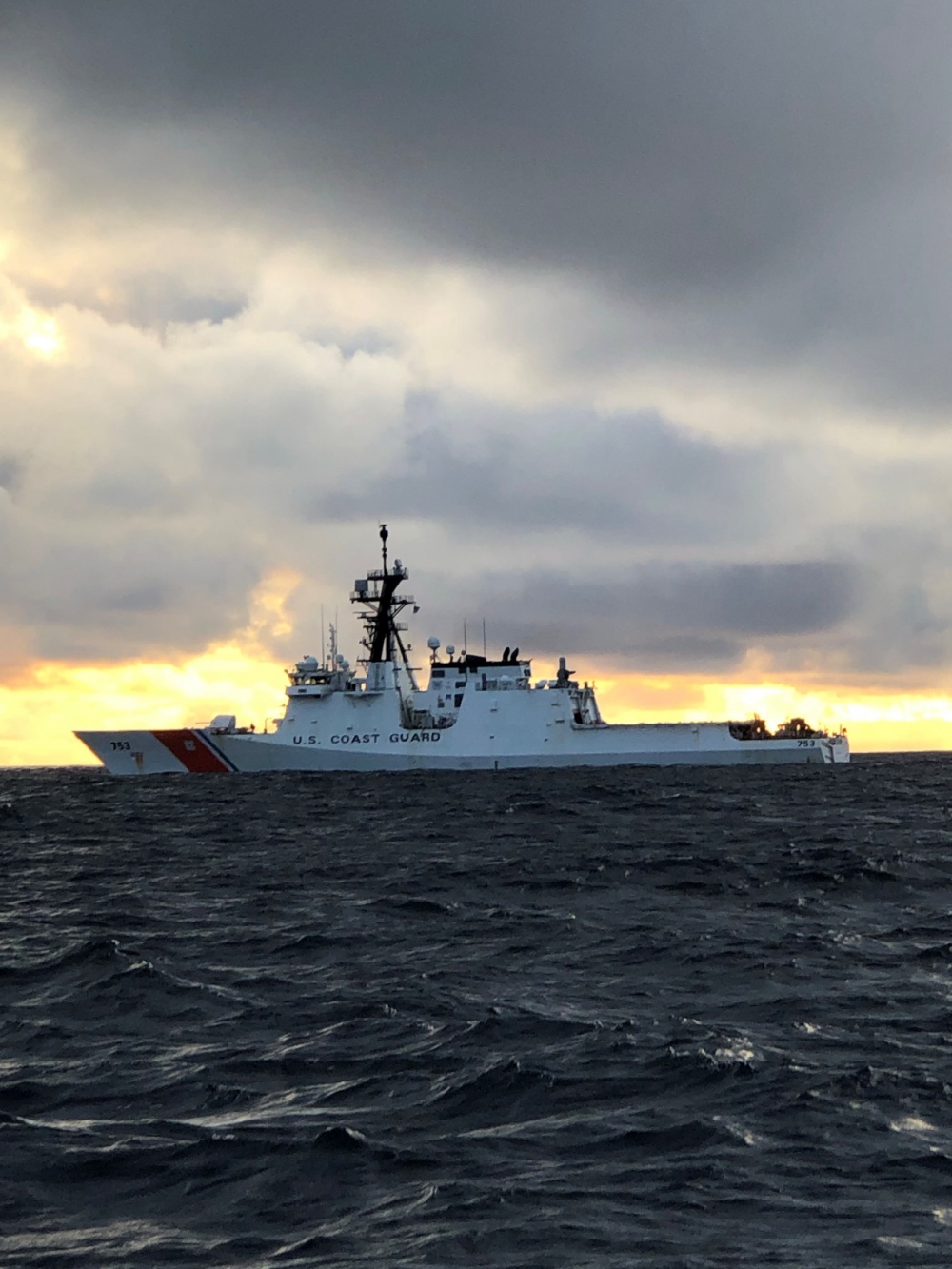
The U.S. Coast Guard Cutter Hamilton (WMSL-753) underway in the Eastern Pacific Ocean, August 19, 2020. The Coast Guard Cutter Hamilton is one of two 418-foot National Security Cutters homeported in Charleston. (U.S. Coast Guard Photo)

The Coast Guard sea pay model differs from other sea-going military service branches. “Other services have a rate for sea pay that increases with sea time, but it does not vary between platforms or mission areas,” explained Blevins. “Our tiered approach takes into consideration a variety of factors designed to reward those who go to sea and incentivize them to come back.”

The analyses on sea-going missions provided insight into these three factors. The studies found that the 270-foot medium endurance cutters had more days away from homeport than any other class of cutter for the period reviewed. Further, most 270-foot cutters are over 30 years old. While the work may be similar to the National Security Cutters (NSC), the living quarters and maintenance requirements are vastly different on the 270-foot cutters.

The U.S. Coast Guard Cutter Bear, a 270-foot medium endurance cutter, transits the Atlantic Ocean off the west coast of Africa. During its deployment, Bear’s teams strengthened the Coast Guard’s partnership with Cabo Verde and trained in countering illicit maritime activity, including counter-narcotics and illegal, unregulated, and unreported fishing. (U.S. Coast Guard Photo by Ensign Connor Brown)As a result, the 270-foot medium endurance cutters were assigned to a tier five on the sea pay table which is the highest tier. This change was made to ensure those members working aboard the 270-foot medium endurance cutters are appropriately compensated.

During patrols in the eastern pacific, cutters are conducting law enforcement missions, drug seizures, and migrant interdiction on a variety of vessels. The increase in sea pay is important because all members assigned to cutters receive the increase. The updated considerations ensure that all members aboard ships receive additional compensation.

“Cutter Forces will continue to advocate for future increases to adjust for inflation,” said Blevins. “However, we are pleased to see this $55 increase and hope the members feel their time at sea is valued.”

White Alder Sinking, 52 Years Later

The caption above is two years out of date. Below is a news release from D8.

united states coast guard


News Release

U.S. Coast Guard 8th District Heartland
Contact: 8th District Public Affairs
Office: 504-671-2020
After Hours: 618-225-9008
Eighth District online newsroom

PHOTOS: Coast Guard holds 52nd annual White Alder ceremony

Memorial ceremony for Coast Guard Cutter White Alder Memorial ceremony for Coast Guard Cutter White Alder

Memorial ceremony for Coast Guard Cutter White Alder Memorial ceremony for Coast Guard Cutter White Alder Memorial ceremony for Coast Guard Cutter White Alder

Editors’ Note: Click on images to download high-resolution version.

NEW ORLEANS – Members of Marine Safety Unit Baton Rouge held a memorial and wreath laying ceremony Monday for the 52nd anniversary of the sinking of the Coast Guard Cutter White Alder at USS Kidd Veterans Museum in Baton Rouge.

The White Alder and the Motor Vessel Helena, a 455-foot Taiwanese flagged freighter, collided in the Mississippi River near Bayou Goula Bend Dec. 7, 1968. The cutter sank in 75 feet of water. Three of its 20-person crew were rescued, while the other 17 perished. The remaining crew members are entombed in the sunken cutter at the bottom of the Mississippi to this day.

White Alder was homeported in New Orleans from 1947 until 1968. The cutter’s primary responsibility was to tend river aids to navigation and to conduct search and rescue and law enforcement duties, when required.

A special aids to navigation structure was built in honor of the crew and marks the location of the sunken vessel near White Castle, Louisiana. December 7 every year, Coast Guardsmen and surviving family members gather at the site in remembrance of those who lost their lives.

For more information follow us on Facebook and Twitter.