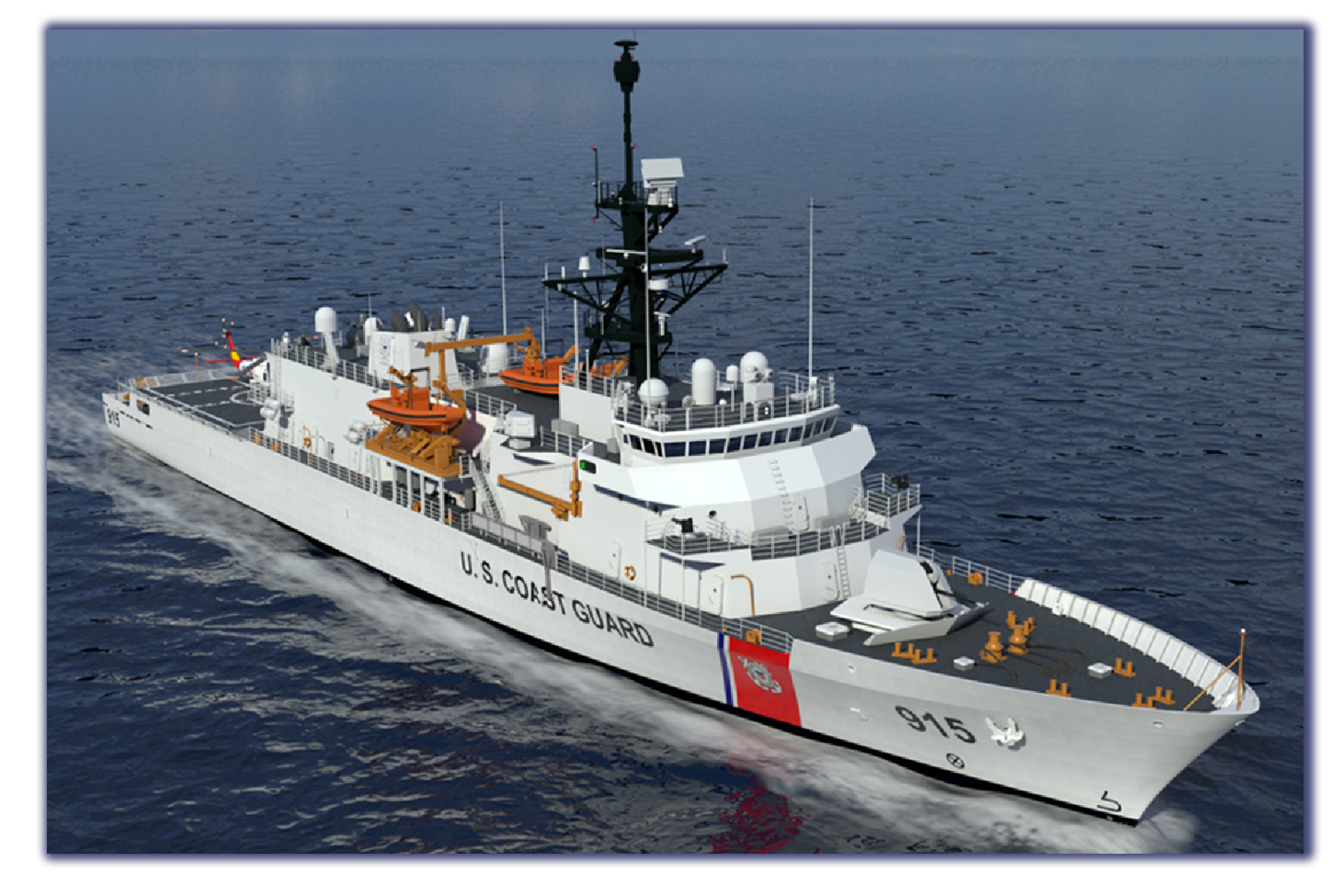
“DHS, Coast Guard extend limited contract relief for Offshore Patrol Cutter” –CG News Release

Below is a news release in full. It reports that “contract relief” will be granted to Eastern Shipyard for construction of the first four ships but that the Coast Guard will reopen bidding for the follow on ships. The Coast Guard always had this option although it seemed unlikely before. The statement that this relief will be granted, “in parallel with immediate recompete” probably means we will see a request for proposal in the near future. 

It seems unlikely that the follow-on ships would be of a different design. The Coast Guard now owns the detail design (correction, I am told the CG does not own all the design details yet but has the option to purchase them) and a different design would introduce additional delays and expense for design development. 

A recompete once again opens the possibility of using a block buy which could result in substantial savings. The recompete could easily provide a block buy for ten ships over five years. A block buy, rather than a contract for two with options, would tend to level the playing field between Eastern, that has the advantage of already building this class, and other shipyards. 

From a historical perspective, the 270 program was also completed by two different shipyards, the first four being built by Tacoma Boat, the other nine by Derecktor Shipyard in Rode Island. The change did result in an 18 month gap between the fourth and fifth ship. 

united states coast guard

 News Release

U.S. Coast Guard Headquarters
Contact: Coast Guard Acquisitions
(202) 475-3069/5532
Headquarters Media Relations (202) 372-4630
mediarelations@uscg.mil
Headquarters online newsroom


DHS, Coast Guard extend limited contract relief for Offshore Patrol Cutter

WASHINGTON – The Department of Homeland Security, in close coordination with the U.S. Coast Guard, granted extraordinary relief to the Eastern Shipbuilding Group (ESG) for the Offshore Patrol Cutter (OPC) under the authority of Public Law (P.L.) 85-804.

ESG submitted a request June 30, 2019, for extraordinary relief after their shipbuilding facilities sustained significant damages from Hurricane Michael, a Category 5 storm, in October 2018.

Acting Secretary of Homeland Security Kevin K. McAleenan made the decision to grant extraordinary contract relief limited to the first four hulls on the basis that ESG’s performance on the OPC contract is vital to the national defense. The Coast Guard will immediately transition to a follow-on competitive contract for the remaining OPC program of record.

P.L. 85-804 was enacted in 1958 and extended to DHS through Presidential Executive Order in 2003. Under this law, an existing contract may be amended or modified when such actions are necessary to facilitate the national defense.

The Coast Guard, supported by DHS and the Navy, conducted an extensive analysis of ESG’s request guided by law and Federal Acquisition Regulation. This review included an assessment of the cost, schedule, and performance impacts on the existing contract. The review was overseen by a Contract Adjustment Board chaired by the DHS Deputy Under Secretary for Management.

“Eastern Shipbuilding’s request for extraordinary relief was carefully considered,” said Coast Guard Vice Commandant, Admiral Charles W. Ray. “This review validated the essential contributions the OPC will provide to our national security and determined that limited relief, in parallel with immediate recompete, is the best option in this exceptional situation. Doing so is consistent with the law, fiscally responsible, and the most expeditious means to deliver this essential national capability.”

The Coast Guard intends to release a Request for Information to gauge industry interest in re-competing the remainder of the OPC program of record. This information will inform the acquisition strategy for the follow-on procurement.

The OPC will replace the fleet of Medium Endurance Cutters, commissioned between 1964 and 1991, providing a critical capability between the National Security Cutter and the Fast Response Cutter. OPC acquisition will expand the Coast Guard’s capability to secure the U.S. border and approaches, disrupt drug cartels and other illicit actors, prevent unlawful immigration, and enhance national preparedness. This decision will ensure critical capabilities are delivered to the fleet as expeditiously and responsibly as possible.

-USCG-

Australian OPV and VTOL UAS

The video above is part of Naval News‘ continuing coverage of the “Pacific 2019” Defense Industry show taking place in Sydney, Australia. The topics of the video are listed below. At least two may be of interest, (1) the new Australian Offshore Patrol Vessel (OPV) being built to a Luerssen design which we discussed  here earlier, and (2) the SAAB UMS Skeldar V200 VTOL Unmanned Air System. This is one of a growing number of vertical takeoff “drones.” This one is the first I have seen with ViDAR included in its list of possible payloads. VIDAR was tested by the Coast Guard in 2016.

Video content:

  • Hunter-class Frigate (SEA5000) with BAE Systems
  • Safran Optronic masts for Attack-class submarine (SEA1000)
  • Luerssen Arafura-class offshore patrol vessel (SEA1180) (time 4:30 to 6:00)
  • Saab UMS Skeldar V200 VTOL UAV (SEA129 Phase 5) (time 6:00 to 7:35)
  • Australian Naval Infrastructure / Osborne Naval Shipyard

There is reference to the fact that the German Navy has also purchased the SAAB UMS Skeldar. Apparently they ordered two, but are not yet decided if it will become a their standard.

Fatal RHIB Accident


Ens. Sarah Mitchell, 23, of Feasterville, Penn., died from injuries sustained during small boat operations July 8, 2018. (Navy)

Navy Times reports the results of a fatal RHIB accident. There are a whole string of potential lessons to be learned from the accident and how the aftermath was handled, such as how to recover injured personnel from the water.

Will Guest on Midrats Podcast Sunday

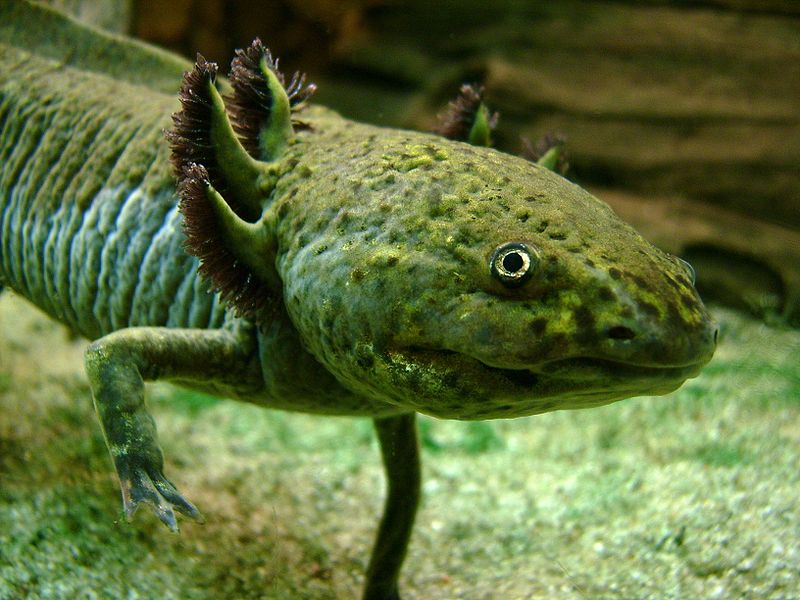
Axolotl. A type of Salamander that may retain gills
Photo credit: LoKiLeCh

I am scheduled to be the guest on the “Midrats” podcast this Sunday. This is where you will find the Podcast.

https://www.blogtalkradio.com/midrats/2019/10/06/episode-509-larger-navy-how-about-better-uscg-instead

For those of you unfamiliar with the blog, here is the description:

Navy Milbloggers Sal from “CDR Salamander” and EagleOne from “EagleSpeak” discuss leading issues and developments for the Navy, Marine Corps, Coast Guard and related national security issues.

Sal, also has this tongue in cheek description of his blog, so you have a hint what he is like.

Proactively “From the Sea”; an agent of change leveraging the littoral best practices for a paradigm breaking six-sigma best business case to synergize a consistent design in the global commons, rightsizing the core values supporting our mission statement via the 5-vector model through cultural diversity.

Let’s just say, he finds buzzwords less than useful.

It will be broadcast live from 5 to 6 PM Eastern, 2 to 3 Pacific, Sunday, Oct. 6. If you sign in, you can make comments that the host can choose to respond to. It will also be available in recorded form on iTunes.

This will be a Coast Guard centric episode. “Cdr. Salamander” saw the “Navy, this is Coast Guard, we need to talk” post and mentioned it on his blog.

We will probably start with that, but discussion will not be limited to that.


Looking for Vounteers to Evaluate Candidates for Hopley Yeaton Awards

I am just passing this along:

The USCG Office of Cutter Forces (CG-751) is seeking the names and contact information of both Active duty and Retired cuttermen for this year’s Annual Hopley Yeaton Awards, which recognize the two best cutters and two best sailors in our fleet.  Cuttermen will be asked to read anywhere from 5 to 15 separate nominations from the fleet during the weeks of 4-8 November, ranking each nomination according to a pre-determined method.

Please contact LT Paul Ledbetter, 202-372-2324, Paul.A.Ledbetter@uscg.mil with the information below if you are able to assist in choosing the top ships and sailors in our fleet.  See ALCOAST 281/19 for more details.

1)  Full Name of Active Duty/Retired Cutterman (EMPLID if avail)
2)  Email of Active Duty/Retired Cutterman
3)  Rate/Rank today or at retirement
4) Years of Seatime
5) Desired category: All, Major Cutter, Minor Cutter, Superior Officer, Superior Enlisted

Thank you

Awards Coordinator
SURFACE NAVY ASSOCIATION
6564 Loisdale Court, Suite
Springfield, VA 22150
Phone: 703-960-6800
www.navysna.org
awards@navysna.org

Navy, this is Coast Guard, we need to talk

Look, I know you are in trouble. As much as we might kid each other, when it is time to fight, I’m your best friend, and I want to help. But you seem in denial, or maybe you are just up to your ass in alligators, and too preoccupied to think about how I might help. 

Numbers of ships is way down. You don’t even have enough escorts to protect the highest priority merchant shipping. You have had trouble bringing new classes on line. You are having trouble keeping the ships you have properly maintained, and you are having trouble manning the ships you have. Our shipbuilding industry has lost the ability to surge production of complex vessels. We don’t have enough trained mariners to man the shipping needed for a prolonged conflict. 

It hasn’t mattered much since there has not been much competition, but that is changing. 

The Chinese Navy is adding ships faster than you are. Their ships are starting to look very impressive. They have a robust ship building industry, and huge merchant marine and fishing fleets to backstop their Navy. They even have more Coast Guard ships than we do. 

It that were not enough, the Russian Navy is rebuilding, although they are a long way from as capable as the old Soviet Navy, but, worst case, we might have to fight them both, along with some minor hangers-on who have their own scores to settle. 

Meanwhile most of our allies, who may or may not help, have been coasting, letting their capabilities decline.

I know you are trying to fix this, but maybe I can help at least a little bit, if you will tell me what we can do.  

——

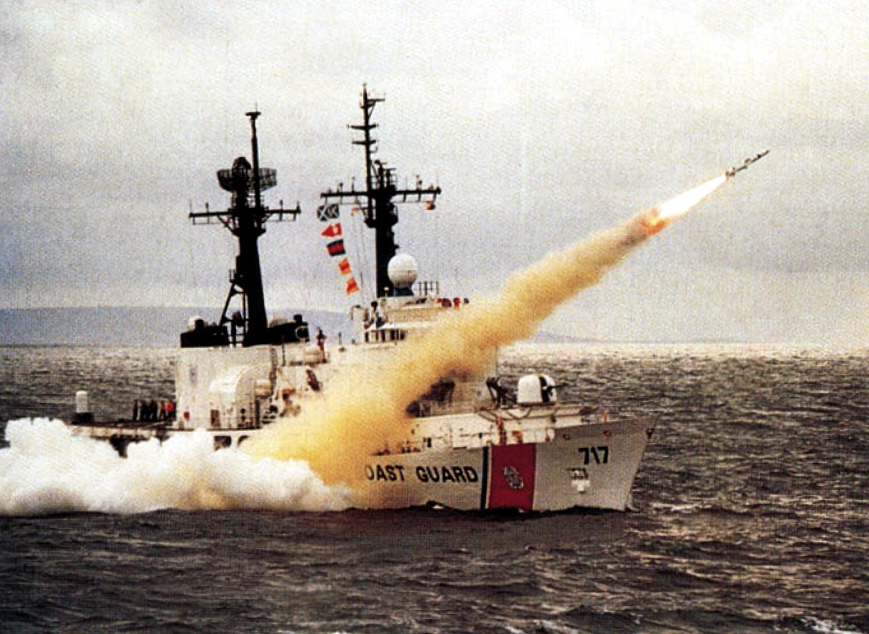
USCGC Mellon seen here launching a Harpoon anti-ship cruise missile in 1990.

The Coast Guard used to be an armed naval force prepared for war. We came out of World War II with an ASW mission, and while our assets got older, the mission continued. In the late 80s we cut the number of ASW assets, but modernized the best of our ships, upgrading their ASW equipment and adding anti-ship cruise missiles.

Then, we all got a break. The Soviet Union collapsed and the need for ASW escorts pretty much disappeared. The Navy downsized and the Coast Guard removed all ASW equipment and the anti-ship missile.

We had almost 30 years without a major naval threat, but it looks like that is changing.

The US Coast Guard is the US Navy’s closest ally, but it seems there is little coordination between the two in defining Coast Guard roles in a major conflict. We certainly don’t see any evidence in the way the cutters are currently being equipped.

In terms of personnel, the Coast Guard is larger than the UK’s Royal Navy or the French Navy. The new cutters are comparable in many respects to frigates or corvettes. Looks like we are going to have 64 Webber class patrol craft similar in capabilities to the Navy’s Cyclone class. Plus we have over 200 aircraft.

A U.S. Coast Guard C-130 participates in forward arming and refueling point (FARP) operations during Arctic Expeditionary Capabilities Exercise (AECE) in Adak, Alaska on Sept. 18, 2019. US Marine Corps Photo

Being combat ready is one of the Coast Guard’s eleven missions, but obviously we are not.

Though there has been some thought regarding the use of Coast Guard assets for limited wars in the tradition of their use in Vietnam and the Gulf Wars, consideration of the possibility of a larger conflict is nowhere evident in the way these assets are currently equipped. They may not even be adequately armed to deal with the full range of terrorist threats.

Upgrading the Bertholf class NSCs and the Offshore Patrol Cutters could add up to 36 light frigates to the national fleet. The Navy would need to provide some additional equipment, but that cost would be far less than the cost of adding similar ships to the Navy, and the difference in operating costs between ships with or without the upgrades is very small.

The Bertholf class National Security Cutters and the Offshore Patrol Cutters share systems with the Littoral Combat ships and the planned FFG(X). Exploitation of some of the additional systems developed for the LCS should be possible. Huntington Ingalls has already done basic design work on upgrades to the National Security Cutter class as part of a marketing effort.

There are opportunities for synergy between the Coast Guard and the Navy reserve such as flying Navy ASW helicopters from Coast Guard ships.

The first of the Offshore Patrol Cutters has yet to be completed. Significant upgrades should be possible. The program is just getting started with the first of a projected 25 expected to be delivered in 2021. It may be possible to develop a more capable, better armed “B”class.

OPC “Placemat”

Potential Missions: 

  • Upgraded NSCs and OPCs could escort priority shipping from the US coasts to the theater of operations. They may not be ideal, but they are ships we will have.
  • They and the Webber class supported by Coast Guard aviation assets could sweep the seas of hostile merchant shipping and fishing vessels that might be used to provide intelligence, land agents, or lay mines.
  • Those same assets could help enforce a blockade.
  • We can do Combat SAR and provide rescue services for when vital supply ships are inevitably lost. We can’t afford to loose trained mariners.
  • We can protect bases from unconventional attacks.
  • Buoy tenders can place sensors on the sea floor to detect enemy activity or lay something like captor mines.
  • Some of our ships can support unmanned systems for mine countermeasures.

If we go to war, “If it floats, it fights” will apply to Coast Guard vessels as well as Navy. They need to be ready. We need to be equipped and trained for whatever the Navy wants us to do.

49 Foot Ice Capable Self-Righting Boat

Estonian builder Baltic Workboats has delivered a newbuild vessel to Szczecin Pilot, a Polish harbour pilots’ association that operates primarily in the Szczecin-Swinoujscie region.

Baird Maritime brings us a report on a boat with characteristics very similar to a Motor Lifeboat, but with an additional capability I had not even thought about for this type vessel until now. It is ice capable.

“The hull is reinforced to withstand light ice conditions relevant to the southern Baltic and Danish waters, a necessity for the vessel’s operational area of Poland’s Świnoujście and Szczecin harbours. She can handle 30 centimetres (about 12 inches–Chuck) of broken ice or five centimetres (about 2 inches–Chuck) solid ice at up to five knots.”

The boat’s surface piercing bow design is claimed to reduce vertical acceleration 40% and improve fuel economy up to 30%.

Dimensions are:

  • Length: 14.95 m (49′)
  • Beam: 4.5 m (14’9″)
  • Draft: 1.33 m (4’4″)

Max Speed: 27 knots

The wheelhouse offers nearly 360-degree visibility. The captain has a center position with uninterrupted views of the deck and boarding areas with additional skylight windows.

“French Navy to Test SOFRESUD’s IPD aboard its PAG Ships” –Naval News

Naval News reports,

An Intuitive Pointing Device (IPD) will be installed and tested aboard one of the French Navy’s PAG type patrol vessels.

We talked about this device earlier, I thought it might be used for more than just its designed purpose, perhaps even replacing our alidades.

I wanted to provide the video above, that explains some of the features of the device and better shows how it is installed.

The PAG vessels referred to in the report all operate in the Western Hemisphere, based in Martinique and French Guyana, so there is a good chance Coasties will have an opportunity to see this system, and discuss their use with their French counterparts.

According to the video the device is currently used by nine different navies, those of the UK, France, Italy, Saudi Arabia, Egypt, Malaysia, Morocco, Korea, and Norway, so we might have other opportunities to take a look at it.

French Navy Guyana-based Light Patrol Vessel PLG La Confiance is Now on Active Duty

French Navy PLG light patrol vessel La Confiance in combined anti-drug training with US Coast Guard Cutter Winslow Griesser. French Navy picture.


“Vestdavit to equip Norwegian Coast Guard’s Next Gen Polar Vessels” –News Release

Earlier we talked about the Norwegian Coast Guard’s new large (9,800 ton) ice strengthened patrol vessels.

(These will be very large, about twice the size of a Bertholf class National Security Cutter and about three times the size of the ships they will replace. Because the Norwegian Coast Guard is structured as part of their Navy, other than a single logistics ship, these will be the largest ships in the Norwegian Navy.)

Now we have a report on their choice of boat handling equipment, in the form of a news release from Vestdavit. Not surprisingly they are using Vestdavit equipment, as they have consistently used equipment from this manufacturer, but it also appears, they, like many recent designs, will provide a multiple boat hangar or garage amidships, and for this they will employ Vestdavit’s MissionEase multi-boat transfer system

Vestdavit “MissionEase” launch and recovery system

Each vessel will come complete with one telescopic TBD-10000L davit system plus two PLR-5003KV units, built to Vestdavit standards for minimum availability of 330 days a year up to upper Sea State 5, based on actual North Sea conditions 1958-2018. In line with the areas of operation envisaged, the davits will be winterized for full functionality in temperatures as low as -25deg C, as required in the Polar Code.

These systems should also permit launching of unmanned surface and sub-surface systems.

In addition,

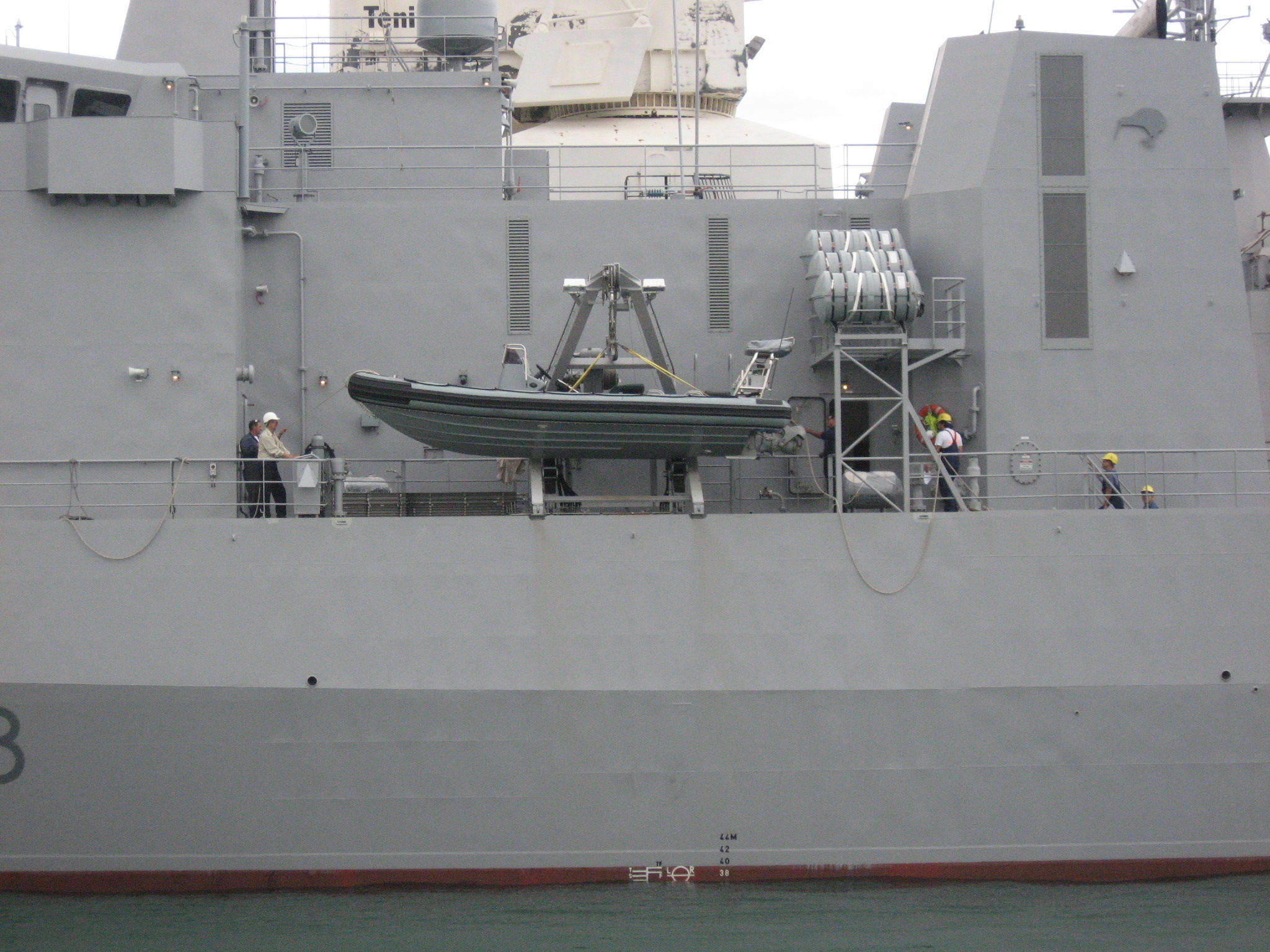
The Vestdavit PLR-5003KV units also specified within the contract are A-frame, all-steel davits with a 5 ton SWL, which will feature Vestdavit’s wave-compensation system and shock absorber system. The solution will feature 50m/min lifting and lowering speeds. The units installed are designed to handle FRBs of up to 8.5m in length..

Vestdavit A-Frame All-Steel Davit seen here on HMNZS OTAGO (P-148)

Thanks to Lee for bringing this to my attention. 

“EIGHT BELLS – A SEA SERVICE CELEBRATION ON 18 OCTOBER 2019” –COMDTNOTE 1710

Below is a Commandant Note published in full. Normally I would not publish these, but there is a good summary of the status of the cutter recapitalization effort in paragraph 3. Have to say I am still a bit uncomfortable with “completely paperless navigation.” I have had too many computer problems for mind not to revolt over the idea of total dependency on electrons.

united states coast guard

R 191425 SEP 19
FM COMDT COGARD WASHINGTON DC//CG-7//
TO ALCOAST
UNCLAS //N01710// ;
ALCOAST 298/19
COMDTNOTE 1710
SUBJ:  EIGHT BELLS – A SEA SERVICE CELEBRATION ON 18 OCTOBER 2019
1. The Coast Guard Office of Cutter Forces (CG-751), the Heart of the Service, is
sponsoring a Sea Service Celebration centered around 18 October 2019 that honors
the sacrifices of the men and women serving aboard Coast Guard cutters, and
highlights the hard work of the thousands of shoreside administrative, training,
and engineering personnel who enable our fleet to operate. On 18 October 1974,
the Office of Personnel promulgated the Coast Guard Cutterman Insignia program,
to “recognize the contributions and qualifications of our personnel.”
2. This year, we celebrate more than 229 years of our sea-going traditions,
currently upheld by over 8,000 active duty personnel aboard our 255 cutters. The
theme of this year’s Celebration is “Cutter Art.” There are countless examples of
artistic creations by Cuttermen who take pride in their work and we want to
recognize their abilities and the time they dedicated to creating this wide array
of art.
3. These are exciting times to be a Cutterman – The 7th and 8th National Security
Cutters (NSC) were commissioned in August, NSC #9-11 are under construction and 25
Offshore Patrol Cutters (OPC) are planned. There are 33 commissioned Fast Response
Cutters (FRC) of the 56 planned for the domestic program of record. An additional
six are scheduled for commissioning in FY 2020 alone; we are also preparing to
transition FRCs to PATFORSWA, with the first two tentatively arriving in 2020.
The Waterways Commerce Cutter (WCC) received funding for expedited development of
plans for a replacement of the WLIC/WLI/WLR cutters. The Polar Security Cutter
(PSC) contract was awarded with funding approved for PSC #1 and long lead time
materials for PSC #2. To outfit our cutters, the new Cutter Boat Large 210/225
(CB-L) is in production and OTH-V and LRI-III are in initial acquisition stages.
All boats and cutters are scheduled to be furnished or retro-fitted with SINS-II
systems as we continue on our trackline to completely paperless navigation.
These substantial national investments are clear evidence of the great value
American leadership places in the hard work of our professional mariners and
support personnel fleetwide.
4. As part of this year’s Sea Service Celebration, COMDT (CG-751) is hosting a
Cutter Art contest and encourages participation by all current, past and aspiring
future professional mariners. Digital submissions of Cutter Art are due by 15
October 2019 and should follow the below guidelines:
    a. Potential artworks and examples of Cutter Art include, but are not limited
to; unofficial cutter seals or logos, pictures of artfully painted equipment, images
of fancy work, pictures of unit murals, and digital renderings of hand drawn images.
    b. Submissions will be judged on creativity, quality and ability to inspire
esprit de corps. Entries are limited to 5MB, formats that can be viewed and opened
on a standard CG workstation, and three submissions per unit. Photographers and
artists retain ownership and copyright of their submitted images. In consideration
of the contest, artists and photographers grant the use of their submissions to the
Coast Guard for use in various media starting from submission for a duration of one
year.
    c. All submissions should be of good taste, professional in nature, and with due
regard to what is considered acceptable in 2019 versus historic examples of
military art containing what is now widely held as inappropriate.
    d. Chain of command approved contest submissions should be sent via email to the
two POCs listed below. The top three winning entries will be posted on the COMDT
(CG-751) portal page and social media platforms, and shared with Surface Naval
Association Presidents, Rating Force Master Chiefs, and Operational Commanders
for distribution within the cutter community.
5. COMDT (CG-751) further encourages all Cuttermen and operational commanders to
participate in the following events:
    a. Cutter Public Affairs Officers (PAO) are encouraged to utilize their Official
Facebook pages to post CO/OIC-approved photos and media under the hashtag #CutterArt
throughout the year.
    b. Local events: All commands are encouraged to host appropriate functions that
celebrate sea service traditions during the month of October, particularly on 18 October.
Suggestions include: local Cuttermen’s Calls, Dining-Ins, or cutter round-ups with
friendly competitions (DC Olympics, shiphandling challenge, etc.).
    c. For a concurrent annual Surface Naval Association (SNA) competition, submit photos
and videos by 01 October 2019 at: http://navysna.org/awards/komorowski-photo/ and at:
http://navysna.org/awards/video-competition.html (Won by USCGC BAILEY BARCO in 2018).
6. POCs: LT Keith Blevins at Keith.A.Blevins@uscg.mil and LT Micah Howell at
Micah.D.Howell@uscg.mil.
7. RDML Matthew W. Sibley, Assistant Commandant for Capability, sends.
8. Internet release is authorized.