U.S. Coast Guard releases new Arctic Strategic Outlook

The Arctic, note the US includes the Aleutians and the Bearing Sea as part of the Arctic

The following is a Coast Guard news release quoted in full. (the full 48 page document is here)

Release Date: April 22, 2019

WASHINGTON – The U.S. Coast Guard, today released its newest strategy to address its expanding role in the Polar Regions.

As the Arctic region continues to open, and strategic competition drives more actors to look to the Arctic for economic and geopolitical advantages, the demand for Coast Guard leadership and presence will continue to grow.

As the Nation’s primary maritime presence in the Polar Regions, the Coast Guard advances national interests through a unique blend of polar operational capability, regulatory authority, and international leadership across the full spectrum of maritime governance. The Coast Guard will continue to work with our allies and partners on the mutual goal of ensuring a safe, secure, and cooperative Arctic, even as our aspiring near-peer competitors maneuver for strategic advantage in the area.

“The Arctic Strategic Outlook reaffirms the Coast Guard’s commitment to American leadership in the region through partnership, unity of effort, and continuous innovation.

We understand the significant investment required to secure the Arctic, and we appreciate and embrace the trust the American people have placed in the U.S. Coast Guard. We will remain vigilant in protecting our national interests in the Polar Regions,” said Admiral Karl L. Schultz, Commandant of the U.S. Coast Guard.

Since the release of the Coast Guard Arctic Strategy in 2013, the resurgence of nation-state competition has coincided with dramatic changes in the physical environment of the Arctic, which has elevated the region’s prominence as a strategically competitive space. The United States is an Arctic Nation, and the U.S. Coast Guard has served as the lead federal agency for homeland security, safety, and environmental stewardship in the Arctic region for more than 150 years.

Click here to see the full strategic outlook.

Below is the ALCOAST on the same subject. 

R 221114 APR 19
FM COMDT COGARD WASHINGTON DC//DCO//
TO ALCOAST
UNCLAS //N16000//
ALCOAST 128/19
COMDTNOTE 16000
SUBJ:  RELEASE OF THE CG ARCTIC STRATEGIC OUTLOOK
1. Today the Commandant announced the promulgation of the Coast Guard’s Arctic Strategic
Outlook, which emphasizes the region’s integral role in U.S. National Security. Since the
release of the Coast Guard Arctic Strategy in 2013, the resurgence of nation-state competition
has coincided with dramatic changes in the physical environment of the Arctic, which has
elevated the region’s prominence as a strategically competitive space. In recognition of
the U.S. Coast Guard’s long history as America’s leader in the region, the strategic outlook
updates the Service’s vision to ensure safe, secure, and environmentally responsible maritime
activity with the following Lines of Effort:
   a. LOE 1 Enhance Capability to Operate Effectively in a Dynamic Arctic: The Service has
ample authorities and a robust network of strong and resilient partnerships, but there are
critical gaps in capability and capacity that must be filled in order to uphold American
sovereignty and deliver mission excellence.
   b. LOE 2 Strengthen the Rules-Based Order: The Coast Guard will lead institutions and
cooperate with partners to promote rule of law and prevent malign influence in the Arctic.
   c. LOE 3 Innovate and Adapt to Promote Resilience and Prosperity: The Service will
collaborate with partners and stakeholders to develop innovative ways to deliver
mission-critical services, including search and rescue, incident management, law enforcement,
and marine safety, to this remote region.
2. Each line of effort depends on Partnership, Unity of Effort, and a Culture of Innovation
to succeed.
3. The Coast Guard’s mission in the Arctic is enduring, but the strategic context has changed.
The Nation needs a modern, flexible, innovative service to meet the challenge of providing
holistic security in the novel and dynamic Arctic maritime domain. Since 1867, the Coast Guard
has played a major role in protecting our Nation’s interest in this region, and will continue
to do so as the Arctic changes, adapting and innovating to be Always Ready for the missions
today and of the future.
4. More information and copies of the strategy can be found at: www.uscg.mil/arctic/.
5. POCs: Shannon Jenkins at (202) 372-1564 or Shannon.R.Jenkins@uscg.mil.
6. VADM Daniel B. Abel, Deputy Commandant for Operations, sends.
7. Internet release is authorized.

50mm Chain Gun, More Detail

Comparison of 50mm Bushmaster III with the 30mm Bushmaster II. By comparison the 25mm’s length over all is 105.2 in (2.672 m) and its barrel length is 85.6 in (2.175 m)

SNAFU has a discussion about what up-gunning Infantry Fighting Vehicles might mean to land warfare and included the graphical information above.

The dimensions provided give us some clues about the characteristics of the gun that were not available before. Length of the barrel in calibers (bore diameter) tells us something about the gun. You usually see it written as caliber/length in calibers, e.g. 5″/38 where 5″ is bore diameter and the barrel is 38 time 5″ in length. Length in calibers suggests other characteristics including muzzle velocity, time of flight, flatness of trajectory, accuracy, and penetration ability relative to other weapons of the same caliber. Greater length in calibers usually translates into higher muzzle velocity which imparts a flatter trajectory to a given range, which usually translates into greater accuracy and better penetration ability relative to other weapons of the same caliber. Larger caliber weapons might, and usually do, exceed these characteristics even using relatively shorter length calibers.

The Coast Guard uses or has used 5″/38s, 3″/50s, 76mm/62s, 57mm/70s, and 25mm/87s. In each case, greater length in calibers translated to higher muzzle velocities.

The barrel length for the 50mm indicated in the diagram above, 117.6″, translates to a length of 60 calibers, so we should expect a muzzle velocity similar to that of the 76mm/62 Mk75 (3,000 – 3,024 fps (914 – 925 mps)), perhaps slightly lower.

There are not a lot of contemporary weapons of similar characteristics. Perhaps the closest was a Soviet 45mm/78 anti-aircraft gun with a maximum ballistic range (firing at an elevation of 45 degrees) of 12,140 yards (11,100 m). Certainly the 50mm’s performance will exceed that of the Soviet 43mm/46 which had a max ballistic range of 10,060 yards (9,200 m).

On a more practical basis this probably means that, while the Army claims an effective range of 4000 meters (probably against another Infantry Fighting Vehicle), even without guided projectiles, it would start scoring hits against larger maritime targets at 7,000 yards, which was the maximum range we used to train 3″/50 crews for, using local control. In any case it would be able to engage from beyond 4000 yards which I believe would be the maximum effective range of any improvised armament available for use on even a terrorist vessel.

Looking at the two rounds mentioned above, Programable Air Burst Munition-tracer (PABM-T) and Armor Piercing Fin Stabilized Discarding Sabot-tracer (APFSDS-T).

  • The APFSDS-T is probably going to have a better chance of disabling a large marine diesel engine than any weapon we currently have in service.
  • The PABM-T should be effective against personnel in small fast highly maneuverable vessels and the programable feature means misses will detonate before going any great distance beyond the target, minimizing the possibility of collateral damage. It might also be effective against drones.

Thanks to Lee for pointing me to this information. 

More on China in the Arctic

Video: Russian nuclear powered icebreaker NS 50 Let Pobedy (Russian: 50 лет Победы), translated as 50 Years of Victory or Fiftieth Anniversary of Victory. The new Chinese Nuclear icebreaker will be similar in size.  

Some recent writings on China’s increasing interest in the Arctic caught my eye.

First there is this piece, “Opinion: China Is Joining the Rush for Arctic Riches.” by former NATO Supreme Allied Commander James Stavridis noting China’s apparent high level interest in the Arctic and its increasing military, political and economic alignment with Russia.

A wide ranging article from the Canadian Naval Review looks at “China’s Arctic Policy and its Potential Impact on Canada’s Arctic Security.” The author sees the roots of the Chinese policies in the Chinese Communist Party’s (CCP) quest for legitimacy. As a result China has asserted “rights in respect of scientific research, navigation, overflight, fishing, laying of submarine cables and pipelines, … and rights to resource exploration and exploitation in the Area,” The author also suggests the Chinese see the Northern Sea Route as a way to avoid the US Navy’s potential blockage of the Straits of Malacca, but I cannot see that as a possibility, given the US possession of the Eastern half of the Bering Strait.

Lastly, some details about the new Chinese icebreaker have been reported by NavyRecognition. It is going to be very large.

“Next, came the official announcement that China intends to build a nuclear icebreaker. It will be 152 meters in length, 30 meters wide, and will displace 30,000 tons.”

“H.R. 367/S.21 the Pay Our Coast Guard Parity Act” –Navy League

I am passing this along for our friends in the Navy League who are trying to help make sure we don’t have pay interruptions in the future. Thanks to Lee for bringing it to my attention. 

The Navy League is launching a campaign to support H.R. 367/S.21 the Pay Our Coast Guard Parity Act, which would ensure active-duty service members are paid during a government shutdown. For the first time in history the men and women of the Coast Guard worked without pay due to a lapse in appropriations during the partial shutdown earlier this year. This legislation would change that, and we support its passage. This bi-partisan, bi-cameral bill, sponsored by Chairman of the House Transportation Committee Peter DeFazio (D-OR) and Senate Majority Whip John Thune (R-SD) has 186 cosponsors in the House and 40 in the Senate. It passed the House Transportation and Infrastructure Committee last month, allowing it to be put on the calendar for a vote by the full House.

Take Action Now! Tell your Member of Congress to co-sponsor the Pay Our Coast Guard Parity Act.

40 and 50 mm Chain Guns

The 25mm guns (M242) in the Mk38 mounts that are the main armament on the Coast Guard’s 210 foot, Webber class, and Island class Cutters are part of a family of electrically powered guns marketed by Northrop Grumman, referred to collectively a “Bushmasters.” The 25mm is also used on the Bradley fighting vehicle and the Marine’s LAV 25 wheeled fighting vehicles. A slightly larger version, the Mk44 30mm is used on the San Antonio class LPDs, Littoral Combat Ships, and the DDG-1000 class.

Lately, the Army and Marines have become concerned that these guns are being out-ranged by adversary weapons. (I share this concern with the regard to a possible maritime terrorist attack.) This has lead to development of larger weapons of 40mm and most recently 50mm. The 50mm is claimed to have twice the effective range of the 25mm. These weapons were recently demonstrated at the “Bushmaster Users Conference,” 9-10 April, in Kingsman, AZ with a live fire demonstration at Big Sandy Range (video above). The Coast Guard may use one of these weapons in the future in place of the current 25mm.

Going from 25 to 30, 40 or 50mm may not sound like a big jump, but projectiles are three dimensional and the difference in weight and hitting power is striking.

Below are listed the maximum projectile weight in pounds associated with each caliber. I did not have this information for the 40 and 50mm chain guns, so I have used the weight of modern Bofors 40mm projectiles and an estimate based on a scaled up 30mm round for the 50mm to provide approximate values:

  • 25mm–0.406
  • 30mm–0.94
  • 40mm–2.16 (Bofors)
  • 50mm–4.38 (estimate)

As can be seen, the 40mm round is about five times as large as the 25mm and the 50mm is about ten times as large.

The larger caliber is not only more destructive, it also means it is easier to include smart fuses and possibly even guidance systems.

A Weapon to Consider –The Carl Gustaf Recoilless Rifle

The M3E1 is an updated M3, by using titanium, the weapon system is six pounds lighter, 2.5 inches shorter and has an improved carrying handle, extra shoulder padding and an improved sighting system that can be adjusted for better comfort.

When Argentina invaded the small South Atlantic island of South Georgia as part of the larger Falklands Campaign the small detachment of Royal Marines used a small portable weapon to damage the Corvette ARA Guerrico that was there to provide Naval Gun Fire Support. The weapon was a Carl Gustaf Recoilless Rifle.

We have at least some indication that the Israelis are equipping their Super Dvora MkIII patrol boats with these, or at least something similar.

The US Marine Corps apparently thinks very highly of this weapon because they plan to equip every squad with one. The US Army is only slightly less enthusiastic. The intend to equip every platoon with one.

Essentially it is a man portable shoulder fired artillery piece. The range is relatively short but there have been numerous improvements with more to come. There is already a new confined space round that minimizes the effect of backblast that has been a disadvantage of recoilless rifles.

A new guided round, expected to be demonstrated in 2020, should increase effective range to 2000 meters.


New Tech for Tracking “Dark Ships”

An illustration of HawkEye 360’s first satellite constellation, called Pathfinder, orbiting Earth. HawkEye 360/UTIAS Space Flight Laboratory

Back in November, SpaceX fired off a Falcon 9 Rocket with 64 satellites aboard. Among the 64, along with two for the Coast Guard to improve Arctic communications, were a cluster of three called Pathfinder, intended to look for emissions from vessels that would rather not have their location known, including pirates, smugglers, and particularly vessels engaged in Illegal, Unreported, and Unregulated fishing. According to Business Insider,

“The trio of spacecraft belong to a startup called HawkEye 360, and they’re designed to “see” radio signals from space. The company’s software will take unique radio signals coming from ships to “fingerprint” vessels, track them over time, and even forecast future movements.”

Reportedly the satellites can detect and locate radio frequency signals of at least one watt, including satellite phones, push-to-talk radios, and marine radars.

“In addition to fingerprinting such vessels, HawkEye 360’s machine-learning algorithms will also be able to determine typical activity patterns for a ship and flag any unusual deviation. ”

“In the future, they aim to launch five more three-satellite clusters, which will create a constellation that can map Earth’s radio signals once every 30 to 40 minutes.”

There is more background in a gCaptain report here.

Supposedly, the results will be available commercially. Since the same software will also find military vessels I have to wonder if that data will be scrubbed before release?

Meanwhile MarineLink reports the US Coast Guard is teaming up with Global Fishing Watch to track illegal, Unregulated, and Unreported (IUU) fishing.

There is getting to be a lot of intelligence available, but are there platforms enough to exploit it all?


29 Knots, RFP Hull, Man-Overboard Scoop

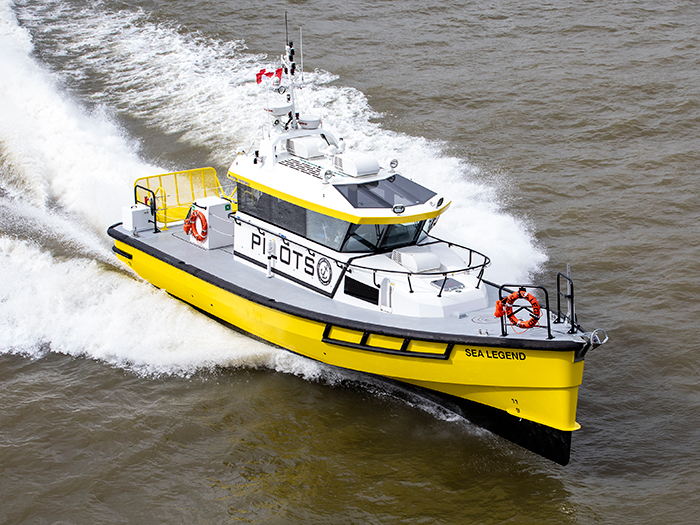
Canada’s Sea Legend Pilotage’s Damen composite FRP hulled Stan Pilot 1605

Another interesting, relatively fast heavy weather boat with an added feature, a man-overboard scoop, built for a Canadian pilot organization.

Plus it is built of composites.

After being built at Damen’s specialist in composite construction, Damen Shipyards Antalya, Turkey, the Stan Pilot 1605 FRP was outfitted at Damen Shipyards Gorinchem, the Netherlands, where Transport Canada was able to inspect the vessel.

According to Damen’s naming convention, the boat has a length of approximately 16 meters (52.5′) and a beam of approximately five meters (16.5′).

The man-overboard recovery system has got to be of interest to a SAR organization.

The scoop is a sophisticated piece of kit that retrieves people from the water and can be used even when the person has lost consciousness. The control for this function is located at the stern, from where the vessel can also be controlled during an emergency.

This reminded me of an earlier post that featured a man in the water recovery system.

“IMSAR’s NSP-5 Radar Moving Into Production for RQ-21 Unmanned System” –Seapower Magazine

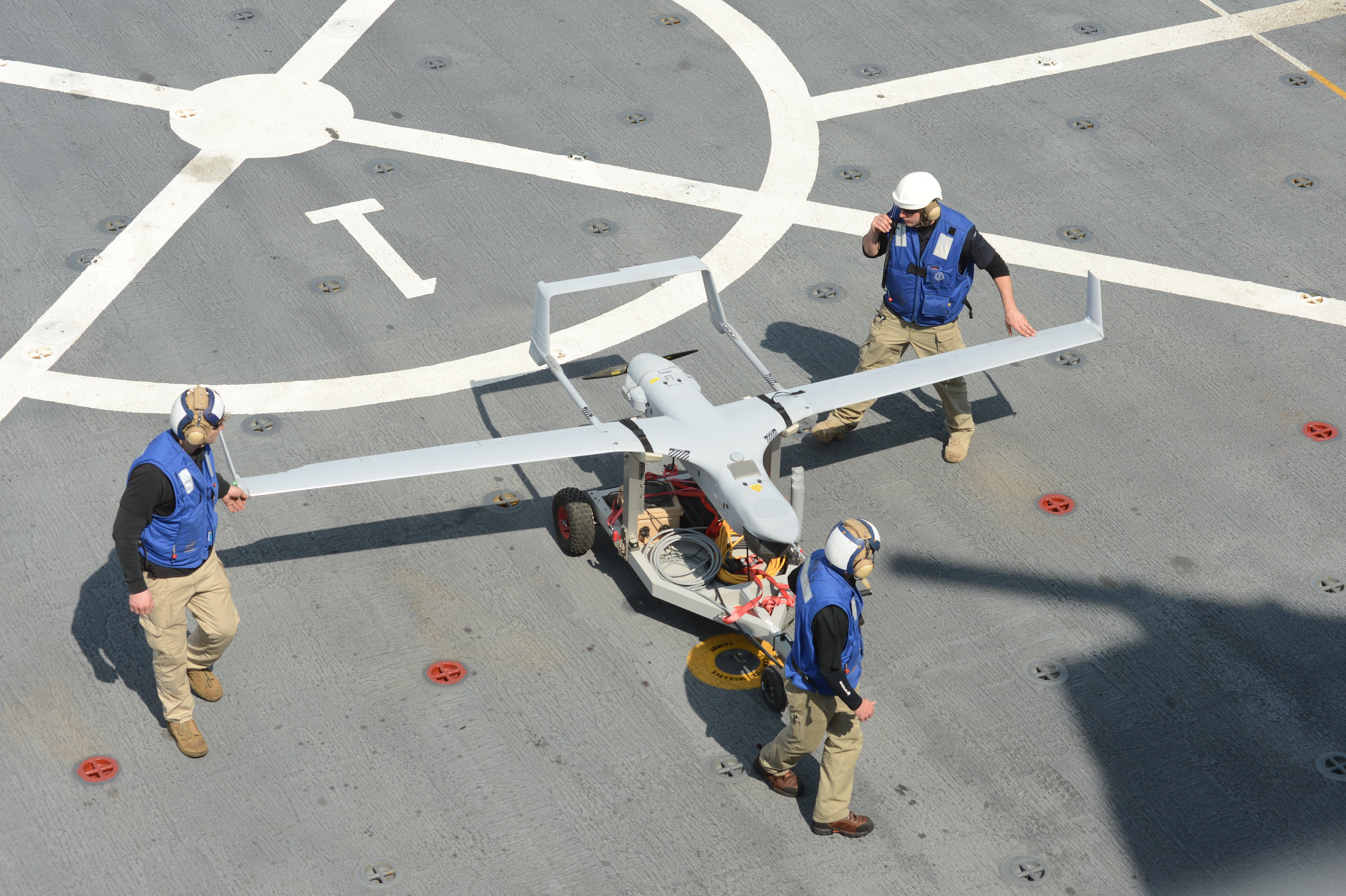
GULF OF MEXICO (Feb. 10, 2013) Members of the RQ-21A Small Tactical Unmanned Air System (STUAS) test team transport the RQ-21A across the flight deck of the amphibious transport dock USS Mesa Verde (LPD 19) after its first flight at sea. (U.S. Navy photo by Mass Communication Specialist 3rd Class Sabrina Fine/Released) 130210-N-NB538-195

The Navy League’s Magazine Seapower reports that “a synthetic aperture/ground moving target Indicator Radar Payload and has been given the prototype designation AN/DPY-2()” for the MQ-21 Blackjack.

The Coast Guard has always wanted their unmanned air system (UAS) to have a radar system and the Scan Eagle that the Coast Guard has contracted for has been tested with a radar from this manufacturer. I am not sure if Coast Guard Scan Eagles are radar equipped, but, if not, it appears that radar equipped small UAS are a definite possibility.

The RQ-21 Blackjack is, like the Scan Eagle, made by Boeing Insitu. It is heavier, 135 lb (61 kg) vs 48.5 lb (22 kg) max takeoff weight, with a correspondingly larger payload weight, but like the Scan Eagle it launches from the same launch and recovery systems.

The radar may be a bit large for Scan Eagle, but apparently not for the Blackjack.

The NSP-5 delivers high-performance capabilities despite its small size, weight and power characteristics. Commercially, the NSP-5 is available in a standard pod configuration that measures 5.4 inches (13.7 centimeters) in diameter and 45.3 inches (115 centimeters) in length, weighs 16 pounds (7.3 kilograms) and consumes 150 watts of power.

Bay Area SNA Elections

An announcement from the Bay Area Chapter of Surface Navy Association:

Bay Area SNA,
Welcome home to WAESCHE as they returned Monday and safe sailing to MUNRO as they just departed!
Much of the Bay Area chapter leadership will be transferring this summer –including me.  We will be hosting elections and would like to develop a roster of candidates who would be interested in serving in leadership roles.  You will find serving as a member of the Bay Area chapter leadership as a good way to network and impact the lives of the Coast Guard community in the Bay Area.  We are consistently one of the most active SNA chapters nationwide and a new leadership team will ensure that we continue to advocate and support the community.
LCDR Chris Klein will stay on as Vice President to support the transition, but we are seeking members to run for President (preferably an O-5 to O-6), Treasurer, Secretary, and Membership Coordinator.  We are very interested in bolstering our candidates with members of the enlisted work force in particular.  Please consider running for one of the positions and if you know of someone who would be a good addition to the team, please suggest they join the SNA and run for one of the positions as well.  Please direct them to the Surface Navy Association site at http://navysna.org/membership/whyjoin.html.   
To put your name in the hat for a leadership role in the Bay Area SNA, please just send an email to LCDR Chris Klein no later than 20 April.  He will compile an email for members to vote on nominated candidates and compile the results of our e-election.
Thanks very much,
RDML Moore
RDML Nate Moore
Deputy Commander Pacific Area
(510) 437-3522