Coast Guard: Actions Needed to Improve Data Quality and Transparency for Reporting on Mission Performance and Capital Planning–GAO

The GAO has issued a report, “Coast Guard: Actions Needed to Improve Data Quality and Transparency for Reporting on Mission Performance and Capital Planning.” This was Testimony  before the Subcommittee on Coast Guard and Maritime Transportation, Committee on Transportation and Infrastructure, House of Representatives. You can find summary versions of the report here.

There are other issues, but what appears most significant to me is that apparently the Department is obstructing publication of information that the Coast Guard could easily provide.

GAO’s prior work also identified areas where the Coast Guard could improve the transparency of the data it uses for reporting on its mission performance as well its capital planning purposes. For example, in an October 2017 report on performance goals, GAO found the Coast Guard’s Annual Performance Report (APR) has not been released publicly since 2011. (emphasis applied–Chuck) Consequently, there has not been full visibility over performance across all of the Coast Guard’s missions. Coast Guard officials stated that a decision by Department of Homeland Security (DHS) leadership to limit the number of performance goals shared publicly had deterred the Coast Guard from public release of its APR (emphasis applied–Chuck). GAO recommended that APRs be available on the Coast Guard’s website; the Coast Guard plans to publicly release future APRs. In addition, previous GAO reports found that the Coast Guard’s annual 5-year capital investment plan, which projects acquisition funding needs for the upcoming 5 years, did not consistently reflect current total cost estimates or the effects of tradeoffs made as part of the annual budget cycle. GAO made recommendations to help the Coast Guard plan for future acquisitions and the difficult trade off decisions it will face given funding constraints. The Coast Guard agreed, but it is unclear when it will complete the 20-year plan.

From what I have heard, it also seems likely that the 20 year plan is also tied up at the Department level.

I did a series on published measures of effectiveness back in 2010 and the discussion it developed is still relevant to future reporting. Unfortunately the report the posts are based on is no longer accessible. You can find the posts here:

It is not as if these reports are optional.

The Government Performance and Results Act of 1993 (GPRA), as updated and expanded by the GPRA Modernization Act of 2010 (GPRAMA), requires agencies to establish annual performance goals with target levels of performance to measure progress towards those goals. See Pub. L. No. 111-352, 124 Stat. 3866 (2011) (amending Pub. L. No. 103-62, 107 Stat. 285 (1993)). Although GPRA and GPRAMA requirements apply to those goals reported by departments (e.g., DHS), they can also serve as performance management leading practices at other organizational levels, such as for component agencies (e.g., Coast Guard). In addition, GPRA requires executive agencies to prepare an annual performance report (APR) on program performance for the previous fiscal year, including a discussion of why any performance goals were not met and plans to meet those goals in the future. (emphasis applied–Chuck)

It sounds like the Coast Guard is doing more than enough performance measuring based on footnote 21 on page 11, to provide a comprehensive report.

To measure mission performance, the Coast Guard uses three types of performance goals and measures established by DHS for performance reporting by the Coast Guard and other DHS components: Strategic goals are used to reflect achievement of missions that are publicly reported in the DHS APR. As part of DHS’s APR, these goals are subject to GPRA and GPRAMA requirements. Management goals are used to gauge program results and tie to resource requests that are reported to Congress and publicly available through the DHS Congressional Budget Justification, along with the strategic goals. Operational measures are additional DHS component measures not reported by DHS, but used internally by components to inform management of operations and activities. The Coast Guard has at least 150 additional internal performance measures used to inform management of operations and activities based on our analysis of the Coast Guard’s Strategic Performance Directive and Operational Performance Assessment Report. (emphasis applied–Chuck)

I can’t help but believe, the Coast Guard, the nation, and even DHS would benefit from more transparency.

PATFORSWA Serves Forward in the Arabian Gulf–Defense Media Network


Crewmembers aboard the U.S. Coast Guard cutter USCGC Adak (WPB-1333) raise the American flag. Adak is assigned to CTF 55, supporting maritime security operations and theater security cooperation in the U.S. 5th Fleet area of responsibility. U.S. Coast Guard photo by Seaman Frank Iannazzo-Simmons

Defense Media Network has a nice piece about the activities of the Coast Guard’s Patrol Forces South West Asia (PATFORSWA).

The article makes a single quick reference to the desirability of replacing the six Island class cutters with Webber class cutters.

“Although the patrol force desperately needs the increased operational capabilities that FRCs would provide in the CENTCOM AOR, the Island class will continue to serve for the foreseeable future.”

This issue has been raised in Congress by CENTCOM. As yet no plans to build replacements, but I expect we will see this possibility raised again. 

There is more information on PATFORSWA here.

China Coast Guard being further Militarized

Homeland Security Today is reporting that the Chinese Coast Guard has, you might say, “changed departments.”

At the annual National People’s Congress last week, delegates voted to put the China Coast Guard under the People’s Armed Police Force. Since January, this military police division has answered directly to the Central Military Commission, a body chaired by President Xi Jinping. According to the language authorizing the reorganization, the move is required “to fully implement the [Chinese Communist] Party’s absolute leadership over the PLA and other armed forces.”

This probably constitutes a recognition of the usefulness of the China Coast Guard in international affairs. It may also indicate a desire for closer cooperation with China’s armed forces.

New Side Arm

Compact XM18, above left, and the full-size XM17, lower right. (Army Photo)

We now have an indication that the Coast Guard may be following the Army and Marine Corps in replacing the M9, 9mm, made by Beretta USA. with the Sig Sauer Modular Handgun System.

“The U.S. Marine Corps, U.S. Air Force, U.S. Navy, and U.S. Coast Guard all have orders that will be fielded starting later this year and early next year.”

Unit cost is $180. We do not yet really know if this is a move to replace all the Coast Guard’s hand guns or only those for select units, but there may be reason to believe it will be a wholesale replacement. .

The Army’s 10-year MHS agreement calls for Sig Sauer to supply the service with full-size XM17 and compact XM18 versions of its 9mm pistol. The striker-fired pistols can be outfitted with suppressors and accommodate standard and extended-capacity magazines. There is also an accessory rail for mounting accessories such as weapon lights.


CG to begin SLEPing H-60s

The Acquisitions Directorate (CG-9) is reporting that a Service Life Extension Program (SLEP) has been approved for the service’s MH-60Ts. This is intended to add 10,000 hours to the life of the aircraft and keep it viable into the mid 2030s when they will be replaced by a product of the Army managed “Future Vertical Lift” program.

Features claimed for the updated aircraft by CG-9 are expected to include:

  • Common avionics architecture system of digital glass cockpit instruments similar to those installed on the Coast Guard’s fixed-wing aircraft
  • Surface search radar and electro-optical/infrared sensors
  • Engines standard with the Department of Defense’s H-60 fleet
  • Five multifunction display screens
  • Sensor and hoist cameras
  • Integrated traffic collision avoidance system
  • 7.62 mm machine gun for firing warning shots and a .50-caliber rifle for precise targeting, such as disabling engines on noncompliant go-fast vessels
  • Standardized mission system components complementing capabilities and equipment installed on the Coast Guard’s upgraded MH-65 short range recovery helicopter

Tropical Currents: SOUTHCOM’s 2018 Posture Statement–CIMSEC

SOUTHCOM Area of Responsibility

CIMSEC has a review of SOUTHCOM’s 2018 posture statement. Not surprisingly there is much discussion of the Coast Guard and drug interdiction.

Thanks to Lee for bringing this to my attention.


Alert Returns Home After a Disappointing Series of Casualties

USCGC Alert (WMEC-630), newest of the remaining 14 ships of its class.

The USCGC ALERT (WMEC-630), one of 14 remaining 210 foot cutters had what must have been a very frustrating cruise. The Navy League’s on-line magazine reports,

“The crew departed Astoria Feb. 5 to conduct a counter-narcotics patrol in the Eastern Pacific when the ship suffered more than 35 equipment casualties within the first 19 days of their patrol, including malfunctions in the ship’s radar, propulsion and fuel systems.

“The ship’s main diesel engine also suffered a crankcase explosion, resulting from a seized bearing on an oil pump, which caused a week-long delay in Panama while the crew inspected the engine. Following the inspection, a decision was made to end the patrol.”

The ship has returned to its homeport, March 16. 39 days away from homeport and nothing to show for it.

As disappointing as this may have been, I applaud the fact that the Coast Guard is making public the difficulties of operating units well past their “best if used by” date. Otherwise everyone just assumes everything is alright. Everything is not alright.


Navy, Coast Guard Divers Recover Torpedoes in Freezing Arctic

180316-N-KC128-269
BEAUFORT SEA(March 16, 2018) Chief Hospital Corpsman Kristopher Mandaro, assigned to Underwater Construction Team (UCT) 1, surfaces from a waterhole during a torpedo exercise in support of Ice Exercise (ICEX) 2018. ICEX is a five-week exercise that allows the U.S. Navy to assess its operational readiness in the Arctic, increase experience in the region, advance understanding of the Arctic environment and continue to develop relationships with other services, allies and partner organizations. (U.S. Navy photo by Mass Communication Specialist 1st Class Daniel Hinton/Released)

The following is a Navy news release, but it does show that the Coast Guard’s recently revived capability for diving in the Arctic ice is definitely making a strong come back. Includes information about the Coast Guard’s Cold Water Ice Diving course. 

Story Number: NNS180319-22Release Date: 3/19/2018 2:05:00 PM
By Lt. Courtney Callaghan, ICEX Public Affairs

ARCTIC CIRCLE (NNS) — Divers from U.S. Navy Mobile Diving and Salvage Unit (MDSU) Two, Underwater Construction Team (UCT) One and the U.S. Coast Guard braved harsh Arctic waters to play a critical role during a torpedo exercise as part of Ice Exercise (ICEX) 2018.

ICEX 2018 is a five-week biennial exercise that allows the Navy to assess its operational readiness in the Arctic, increase experience in the region, advance understanding of the Arctic environment, and continue to develop relationships with other services, allies and partner organizations.

During the exercise, the Seawolf-class fast-attack submarine USS Connecticut (SSN 22) and the Los Angeles-class fast-attack submarine USS Hartford (SSN 768) each fired several training torpedos under the ice. Training torpedoes have no warheads and carry minimal fuel.

“The primary objective of this year’s ICEX is to test new under-ice weapons systems and validate tactics for weapon employment,” said Ryan Dropek, Naval Undersea Warfare Center Division Newport, Rhode Island Weapons Test Director. “Once the divers recover these torpedoes, we can extract important data about how they perform and react in these conditions.”

After the submarines fire the torpedoes, helicopters transport gear and personnel to the location where the positively-buoyant torpedo is expected to run out of fuel. Each torpedo has a location device in order to assist in the search. Once found, a 3-4 person team will then drill a series of holes for the divers to enter and exit, as well as one hole for the torpedo to be lifted by helicopter.

“Once we know the location of the torpedo and drill holes, our divers slip into the water to begin placing weights on a line attached to the tail end of the torpedo,” Chief Warrant Officer Michael Johnson, officer-in-charge of MDSU-2 divers, explained. “The weights help shift the torpedo from a state of positive buoyancy to neutral buoyancy under the ice.”

Once the torpedo is neutral, the divers place brackets with cables to the top and bottom of the body of the torpedo. A helicopter then connects to the torpedo before lifting it vertically out of the hole.

The three dive teams completed additional training in preparation for diving in the unique environment of the Arctic Ocean.

“To prepare for ICEX, we completed training at the Coast Guard’s Cold Water Ice Diving (CWID) course and earned our ordnance handling certification from the Naval Undersea Warfare Center,” said Johnson. “Additionally, each unit completed MK48 Torpedo recovery training and Unit Level Training (ULT) classroom training on hypothermia, frostbite, ice camp operations, dry-suit, and cold-water ice diving.”

The USCG CWID course is a two-week course in Seattle, Washington hosted by the USCG instructors at Naval Diving and Salvage Training Center (NDSTC) which focuses on the use of equipment and diving operations in harsh Arctic waters. During the course, divers complete a diving practical in Loc de Roc, British Columbia at 5,000 ft. elevation to put environmental stresses on the divers and equipment to acclimate to the cold and altitude.

“Our underwater construction teams have always had the ice-diving capabilities, so it was awesome to be invited out to this exercise to make sure we’re keeping up with something that we say we can do,” said Builder 1st Class Khiaro Promise, assigned to Construction Dive Detachment Alfa.

During ICEX, the divers conducted dives using two different types of diving methods. UCT-1 and the USCG dove with SCUBA equipment, which provides divers with an air supply contained in tanks strapped to the backs of the divers. The divers equip themselves with a communication “smart rope” which is a protected communication cable to the surface that acts as a tending line so support personnel on the surface has positive control of the divers and so they can quickly return to the dive hole.

MDSU-2 divers used the diving system DP2 with configuration one, which provides voice communications and an air supply provided by the surface. This configuration allows the divers to swap the composite air bottles without the diver resurfacing and without interrupting their air supply.

“We decided to use the DP2 system because it performs in arctic conditions very well,” said Navy Diver 1st Class Davin Jameson, lead diving supervisor for MDSU-2. “The ability to change our air supply during the dive is critical and allows us to stay under the water a lot longer.”

Not only did the divers have an essential role in torpedo recovery, they were also essential to camp operations. “Prior to torpedo retrieval dives, all the divers on ice helped set up the camp and in the building of two runways (one 1,300 and one 2,500-ft),” Senior Chief Navy Diver Michael McInroy, master diver for MDSU-2. “In the camp, everyone has responsibilities to keep operations on track. The divers worked hard to do their part in and out of the water.”

MDSU-2 is an expeditionary mobile unit homeported at Joint Expeditionary Base Little Creek-Ft. Story (JEBLCFS) in Norfolk, Virginia. The unit deploys in support of diving and salvage operations and fleet exercises around the world. The primary mission is to direct highly-mobile, fully-trained and equipped mobile diving and salvage companies to perform combat harbor clearance, search and expeditionary salvage operations including diving, salvage, repair, assistance, and demolition in ports or harbors and at sea aboard Navy, Military Sealift Command, or commercial vessels of opportunity in wartime or peacetime.

UCT-1 is also homeported at JEBLCFS and is worldwide deployable to conduct underwater construction, inspection, repair and demolition operations. Seabees operated off the coast of Alaska for the first time in 1942 when they began building advanced bases on Adak, Amchitka and other principal islands in the Aleutian chain.

ICEX divers and their support elements are a proven and vital component to the success of this five-week exercise. The partnership between the Navy and Coast Guard builds on the foundation of increasing experience and operational readiness even in the one of the harshest regions of the world.

“The brotherhood in diving means we have a lot of trust in that other person when you go underwater, and you get close to your coworkers, it’s more of a family,” Promise said.

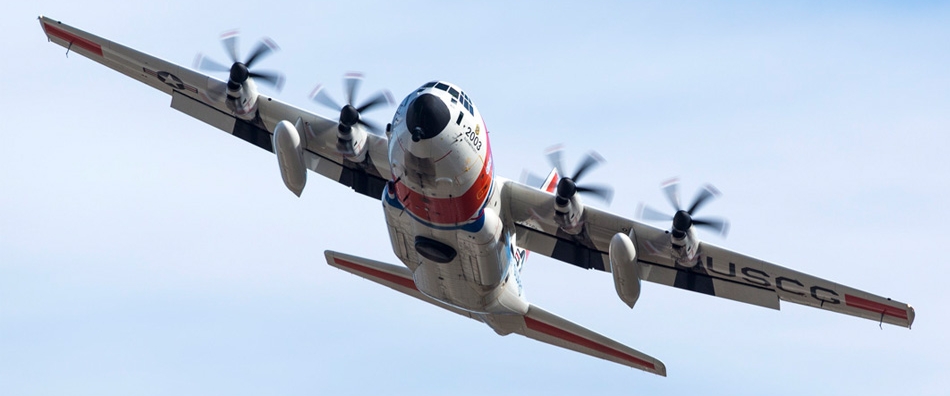
CGAS Kodiak C-130Hs to be Replaced by J Models

Navy Times is reporting that Coast Guard Air Station Kodiak C-130s will be replaced with more capable C-130Js by 2020.

This is a very welcome change. According to the Acquisitions directorate,

“The HC-130J has a more advanced engine and propellers, which provide a 20 percent increase in speed and altitude, and a 40 percent increase in range over the HC-130H. The new aircraft also features state-of-the-market avionics, including all-glass cockpit displays and improved navigation equipment. The HC-130J’s suite of command, control, communication, computers, intelligence, surveillance and reconnaissance (C4ISR) equipment – comparable to that of the HC-144 Ocean Sentry medium range surveillance aircraft – helps to extend the fleet’s mission capabilities.”

Higher speed, longer range, shorter take-off and landing, better climb rate, better sensors, more intuitive cockpit, better terrain avoidance. Not bad.