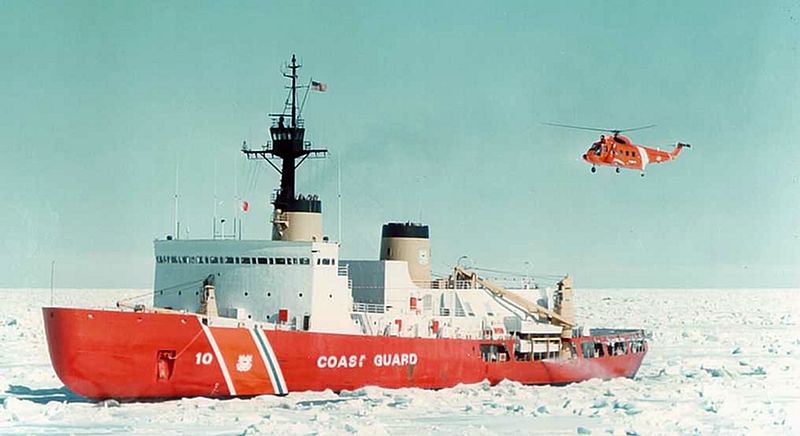
USCGC Polar Star will be 47 years old by the time we see a replacement. USCGC photo.
The Navy has issued a Request for Proposal with options for up to three heavy polar icebreakers. Its not a block buy, but it is a bit of a surprise. I have copied and pasted the brief summary below. (Thanks to Tups for bringing this to my attention.)
Solicitation Number:
N00024-18-R-2210
Notice Type:
Presolicitation
Synopsis:
Added: Feb 14, 2018 2:17 pm
The Naval Sea Systems Command plans to issue an unrestricted solicitation for the procurement of the Detail Design and Construction (DD&C) of up to three (3) Heavy Polar Icebreakers (HPIB) under a Fixed Price Incentive Firm (FPIF) Contract. This contract will award Advance Procurement and Detail Design, and include option line items to procure three (3) Heavy Polar Icebreakers. The contract will also include options for Provisioned Items orders to outfit the ships and purchase spares, repair parts, and other special equipment; Engineering and Industrial Services in support of Government systems installation and post-delivery activities; Special Studies for Government-directed engineering tasks; and Crew Familiarization. The HPIB will be procured utilizing full and open competition in accordance with the Federal Acquisition Regulation (FAR) Part 15, Contracting by Negotiation. Award is anticipated to be made to a single Offeror who offers the Best Value to the Government as determined by the tradeoff process as defined in Sections L and M of the Solicitation. The solicitation is anticipated to be posted within 30 days, this synopsis is provided as an advance notice.
This synopsis and any updates and/or changes for this planned procurement, the posting of the RFP, and any future Amendments to the RFP, will appear at the Federal Business Opportunities (FBO) website located at http://www.fbo.gov. Inquires/questions concerning this announcement may be e-mailed to the Naval Sea Systems Command, Shipbuilding Contracts Division representatives listed below.
The points of contact for this posting are Ms. Melissa Donnelly, Contract Specialist, e-mail Melissa.Donnelly@navy.mil AND Mr. James Platner, Contracting Officer, e mail, James.Platner@navy.mil. Please send inquiries via e-mail to both points of contact. No telephone inquiries will be accepted and requests for solicitation packages will not be honored, as a solicitation is not prepared at this time. This notice does not constitute an Invitation for Bid or Request for Proposal and is not to be construed as a commitment by the Government.
The contracting agency is: Naval Sea Systems Command, 1333 Isaac Hull Ave SE, Washington Navy Yard, DC. 20379-2020
Contracting Office Address:
SEA 02
1333 Isaac Hull Avenue SE
Washington Navy Yard, District of Columbia 20376
United States
The Coast Guard has issued a Request for Information for a solution to our inland cutter needs. I have copied and pasted the brief description below.
Solicitation Number:
RFI-USCG-WCC-2018-1
Notice Type:
Special Notice
Synopsis:
Added: Feb 14, 2018 3:52 pm
The Coast Guard has a statutory mission to establish, maintain, and operate maritime aids to navigation to serve the needs of the armed forces and commerce of the United States. This Request for Information (RFI) is the first of several planned industry engagements aimed at developing the data the Coast Guard needs to make informed decisions about potential solutions to carry out this mission. The Coast Guard has historically accomplished this mission via a fleet of Coast Guard inland vessels. However, this RFI does not presume a specific solution and is not a statement by the Coast Guard that a final solution has already been identified; it is only one part of an overall effort to better understand the decision space.
Responses to this RFI shall be submitted to Jennifer Sokolower at Jennifer.G.Sokolower@uscg.mil.
This special notice is for market research and planning purposes only. It does not constitute a solicitation and shall not be construed as a commitment by the Government to award a contract from responses to this announcement. Any information submitted by interested parties is strictly voluntary and no monetary compensation will be provided for response preparation.
The Navy has provided their 30 year Ship Acquisition Plan. Here is their news release.
WASHINGTON (NNS) — The Department of the Navy submitted the long-range ship acquisition plan to Congress Feb. 12.
The 30-Year Ship Acquisition Plan is a Congressionally-mandated report which describes the Department of the Navy’s long-range shipbuilding plans for 2019-2048. This year’s report focuses on meeting the Navy’s baseline acquisition requirements needed to build the Navy the Nation Needs (NNN) and sustaining the domestic industrial base to meet that aim.
In support of the National Defense Strategy’s stated goal of achieving a more lethal, resilient and agile force, the plan serves as a roadmap to reach a 355-ship fleet by the early FY2050s, potentially quicker with an aggressive investment of resources. The plan pursues acquisition strategies to build ships more quickly and affordably and places top priority on sustaining the industrial base now and for the future. Ultimately, the plan supports the Navy’s overall effort to build the Navy the Nation Needs to protect the homeland, defend the interests of America and its allies abroad, and preserve America’s strategic influence around the world.
This plan addresses the Navy’s most critical shipbuilding needs by:
* Building CVNs four years apart after CVN 82 instead of five to support a 12-ship CVN force.
* Building 12 Columbia-class SSBNs in support of the Nuclear Posture Review (NPR) and STRATCOM deterrence requirements.
* Establishing a stable profile of two per year Attack Submarines (SSN).
* Establishing a stable profile of 2.5 per year Large Surface Combatants (DDG), plus an additional ship in FY2022.
* Establishing a stable profile of two per year Small Surface Combatants (LCS, FFG) starting in FY2022, accommodating the transition to FFG(X).
* Increasing the pace for amphibious ship production to support a 12-ship LHD/LHA force and modernized lethality in FY2033, FY2036 and FY2039.
* Addresses the candidate long-term replacement for the NNN payload-based submarine, filled mid-term by Virginia Payload Module (VPM).
I have to ask, where is ours? Perhaps Congress should mandate one for us, but we don’t always respond to Congress anyway. There is a mandate for a 20 year plan, but I haven’t seen that yet either. Really Congress is trying to help us communicate our needs without having them filtered by DHS and GAO. Maybe it is DHS and GAO that are the roadblocks, but the Navy seems to find ways to get their needs to Congress.
An important part of the “Acquisition Plan” is really what they plan to decommission. Which constituencies are going to lose an asset? This is something we also need to pass to Congress, and we need to mean it. It is also where we have an advantage because our assets impact so many constituencies. We should not be operating 50-year-old ships.
The Navy does not always get everything they ask for, but at least they ask.
“Overall, the Coast Guard budgeted $7.8 billion for operating expenses, including pay; $1.9 billion to recapitalize equipment; and $1.9 billion in mandatory spending and fees.”
It includes $750M for the first new heavy icebreaker; $400M for the second OPC and long lead time items for the third; and $240M for four Webber class.
Seapower, a Navy League Magazine and web site, reports, the Coast Guard issued a Request for Proposal on February 7, for “Indefinite Delivery Indefinite Quantity Competitive and Unrestricted Commercial Services Combined Synopsis/Solicitation for Unmanned Aircraft Systems for National Security Cutters (NSCs) for the United States Coast Guard.” Proposals are due by March 9. (Pretty quick turn around.)
In particular they identify two competing systems, the Scan Eagle from Insitu and Textron Systems Aerosonde sUAS. We have been talking about the Scan Eagle for almost seven years. Also the Coast Guard has been using Scan Eagle operationally, but since we have not talked about the Aerosonde I thought, perhaps we should take a look.
For a rough comparison, Scan Eagle has a max Take Off Weight 44-48.5 lb. (22 kg), Aerosonde has a max TO weight of 80 lb (36.4 kg), and the RQ-21A Blackjack a max TO weight of 135 lb (61.4 kg).
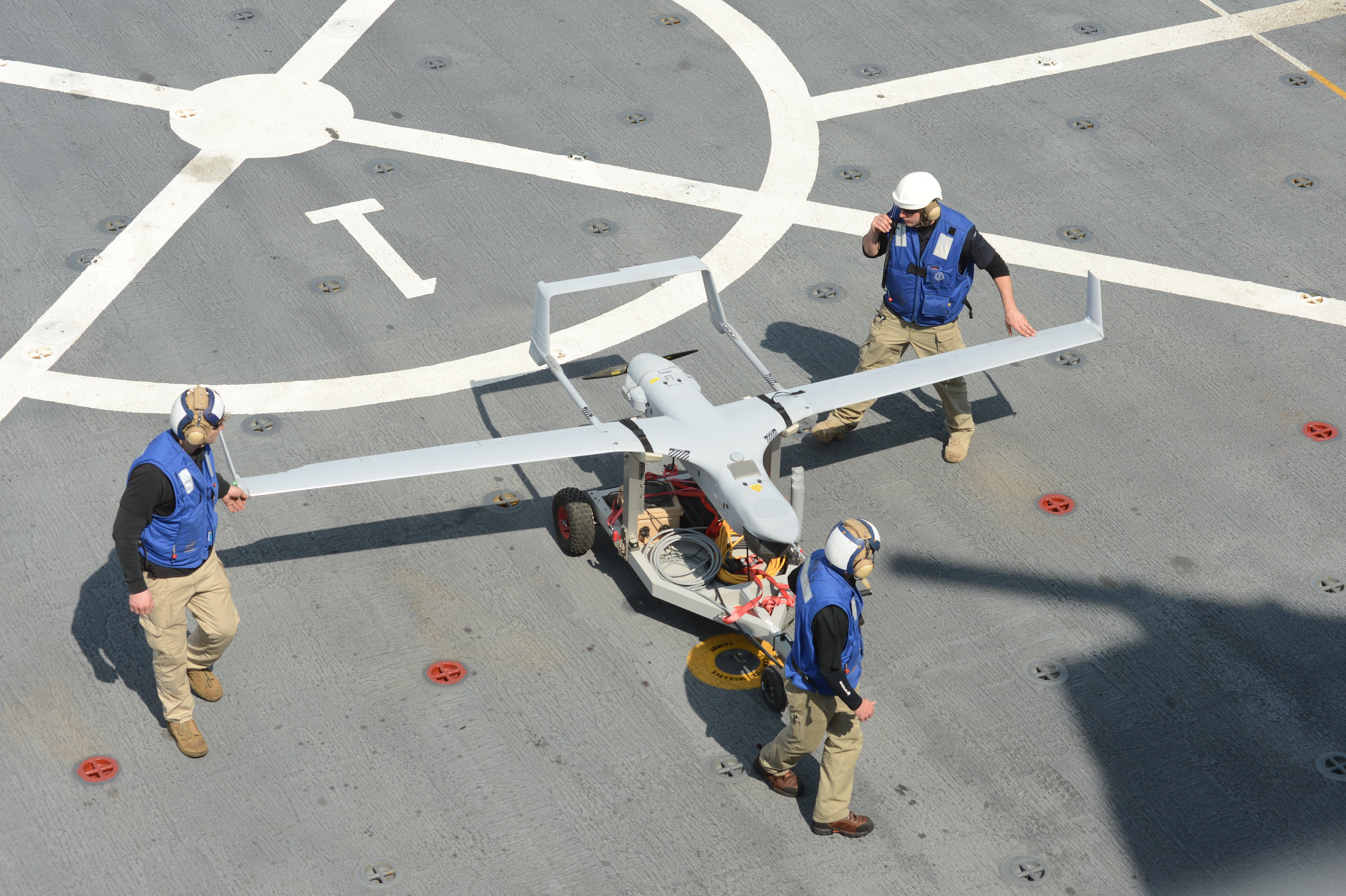
GULF OF MEXICO (Feb. 10, 2013) Members of the RQ-21A Small Tactical Unmanned Air System (STUAS) test team transport the RQ-21A across the flight deck of the amphibious transport dock USS Mesa Verde (LPD 19) after its first flight at sea. Mesa Verde is underway conducting exercises. (U.S. Navy photo by Mass Communication Specialist 3rd Class Sabrina Fine/Released) 130210-N-NB538-195
“The U.S. Coast Guard customer has expressed unique technology and operational requirements in its Small Unmanned Aircraft Systems (SUAS) RfP,” so we are not simply going to buy what the Navy already has. Using the usual optical systems is like looking through a straw. I expect the Coast Guard is going to want an area search capability, radar or perhaps ViDAR.
Figuring out how best to use these is going to be an interesting Operations Research problem. What search pattern? at what altitude? How far out can we fly these and still communicate and have the cutter provide sense and avoid to prevent a mid-air?
The following is a news release quoted in full. Frankly I think it is a good thing that we are reporting the problems rather than just happy news. The public and our law makers in particular need to understand that we are putting people, and the mission, in danger because we are making do with overage systems that should have been replaced long ago. Incidentally, USAP is apparently U.S. Antarctic Program.
This additional note was attached to the release, “Editor’s Note: All dates and times are in New Zealand Daylight Time, which is 21 hours ahead of Pacific Standard Time and 24 hours ahead of Eastern Standard Time. Video of the Cutter Polar Star’s operations are available by clicking the thumbnails above or clicking here and here. Photos from the cutter’s operations by clicking the thumbnails above or clicking here. ”
MCMURDO STATION, Antarctica – The crew of U.S. Coast Guard Cutter Polar Star completed their mission Tuesday in support of National Science Foundation (NSF) after cutting a resupply channel through 15 miles of Antarctic ice in the Ross Sea and escorting supply vessels to the continent.
The Polar Star sailed from Seattle to assist in the annual delivery of operating supplies and fuel for NSF research stations in Antarctica during Operation Deep Freeze by carving a navigable path through seasonal and multi-year ice sometimes as much as 10-feet thick. Operation Deep Freeze is the logistical support provided by the U.S. Armed Forces to the U.S. Antarctic Program.
“Although we had less ice this year than last year, we had several engineering challenges to overcome to get to the point where we could position ourselves to moor in McMurdo,” said Capt. Michael Davanzo, the commanding officer of the Polar Star. “Our arrival was delayed due to these challenges, but the crew and I are certainly excited to be here. It’s a unique opportunity for our crewmembers to visit the most remote continent in the world, and in many respects it makes the hard work worth it.”
On Jan. 16, Polar Star’s shaft seal failed causing flooding in the cutter’s engine room at a rate of approximately 20-gallons per minute. The crew responded quickly, using an emergency shaft seal to stop the flow of freezing, Antarctic water into the vessel. The crew was able dewater the engineering space and effect more permanent repairs to the seal to ensure the watertight integrity of the vessel. There were no injuries as a result of the malfunction.
Flooding was not the only engineering challenge the crew of Polar Star faced during their trek through the thick ice. On Jan. 11, their progress was slowed after the one of the cutter’s three main gas turbines failed. The crew uses the cutter’s main gas turbine power to breakup thick multi-year ice using its propellers. The crew was able to troubleshoot the turbine finding a programing issue between the engine and the cutter’s 1970s-era electrical system. The crew was able to continue their mission in the current ice conditions without the turbine.
“If the Polar Star were to suffer a catastrophic mechanical failure, the Nation would not be able to support heavy icebreaker missions like Operation Deep Freeze, and our Nation has no vessel capable of rescuing the crew if the icebreakers were to fail in the ice,” said Vice Adm. Fred Midgette, commander, U.S. Coast Guard Pacific Area in Alameda, California. “The crewmembers aboard Polar Star not only accomplished their mission, but they did so despite extreme weather and numerous engineering challenges. This is a testament to their dedication and devotion to duty.”
The cutter refueled at McMurdo Station Jan. 18 and continued to develop and maintain the ice channel in preparation for two resupply ships from U.S. Military Sealift Command, Ocean Giant and Maersk Peary. The crew of Polar Star escorted the vessels to the ice pier at McMurdo Station, an evolution that requires the cutter to travel about 300 yards in front of the supply ships to ensure they safely make it through the narrow ice channel. The crew escorted the Ocean Giant to the ice pier at McMurdo Jan. 27 and conducted their final escort of the Maersk Peary to Antarctica Feb. 2. The crew escorted Maersk Peary safely out of the ice Feb. 6 after supply vessel’s crew transferred their cargo.
The Polar Star departed their homeport in Seattle Nov. 30, 2017, and are expected to return to the U.S. in March 2018. The 399-foot Polar Star is the only operational heavy icebreaker in the U.S. fleet. The cutter, which was built more than 40 years ago, has a crew of nearly 150 people. It weighs (displaces–Chuck) 13,500 tons and uses 75,000 horsepower to break ice up to 21 feet thick.
The U.S. military is uniquely equipped to assist the National Science Foundation in accomplishing its USAP mission. This includes the coordination of strategic inter-theater airlift, tactical intra-theater airlift and airdrop, aeromedical evacuation support, search and rescue response, sealift, seaport access, bulk fuel supply, port cargo handling, and transportation requirements supporting the NSF, the lead agency for the USAP.
The Coast Guard has a rich military history, but we should recognize that, while we may be an “armed service,” we are not prepared for war.
We took the opportunity presented by the apparent end of the Cold War in the early ’90s to cut cost and overhead by removing recently installed anti-submarine warfare (ASW) and Harpoon launching equipment from the 378s and eliminating entire Sonar Tech (ST) rating.
Unfortunately, the holiday from worrying about a possible major conflict is over. China is challenging us, and Russia is resurgent. While it appears the Coast Guard has planned to provide some resources to address contingencies, it also appear we have no real direction as to what the Coast Guard will do if we have a major conflict. Certainly the new major cutters, the NSCs and OPCs, could be turned into credible escort vessels, but it would take months and their crews would need to be trained.
The development of modular systems for the Littoral Combat Ships (LCS) may provide a mechanism for rapidly upgrading our ships while Navy Reserves might provide the personnel and expertise to cut mobilization time from months to weeks.
The Navy currently has over 100,000 reservists, either Selected Reservists or Individual Ready Reservist, subject to recall. A number of them have expertise not resident in the Coast Guard, but useful upon mobilization. At one time these reservists might have gone to man Navy reserve frigates, but there are currently no navy combatants in reserve. As the number of LCSs increase the number of reservists with experience operating and maintaining the mission modules will increase. In addition all LCSs have two complete crews, so in wartime when they will presumably stop rotating crews, they will have an excess of active duty crews training in the mission module systems.
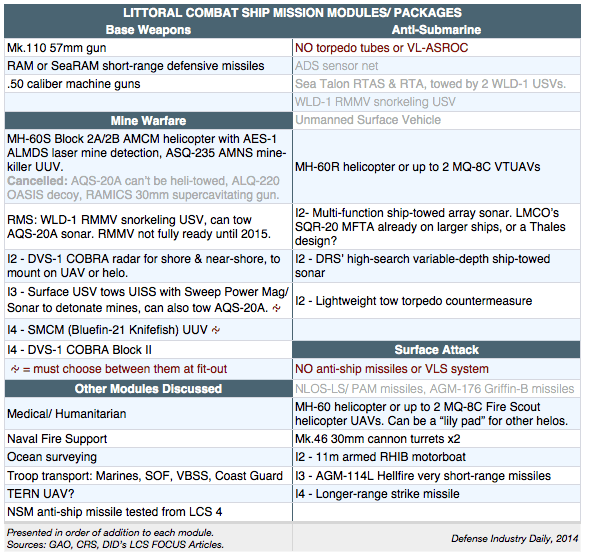
The primary mission modules planned for the LCSs are Anti-Submarine Warfare (ASW), Anti-Surface Warfare (SuW), and Mine Counter-Measures (MCM). It would not take much to make cutters capable of accepting all or parts of these mission modules, perhaps an OPC “B” class and during overhauls.
There is a very real possibility of inter-service synergy here.
A mission package of equipment, aircraft, sensors, and personnel could be loaded aboard for exercises, providing training for both the Navy and Coast Guard personnel.
The acoustic sensors from the ASW module might be deployed on a cutter bound for a drug interdiction mission in the Eastern Pacific, to help locate drug running semi-submersibles or if they are out there, submarines.
There are very few Navy mine counter measures assets in the US and those we have are not spread out geographically. If there were to be a peacetime mining incident in US waters, it might be possible to airlift an MCM module to the nearest cutter to allow the problem to be dealt with more quickly.
The Office of Cutter Forces, CG-751 has issued an updated edition of “The Coasties’ Guide to the Merchant Mariner Credentialing Process.” you can see it as a pdf here.
The February 2018 issue of US Naval Institute Proceedings has a couple of articles of interest. You can access the first on line, Coast Guard Defines “All Hands On Deck,” by Capt. Bruce Jones, USCG (retired)
Neither catastrophic disasters nor the national need for a Coast Guard with the capacity and capability to respond vigorously and effectively are going away. The next few decades likely will bring the challenge of multiple, simultaneous major events.
The Coast Guard repeatedly has demonstrated it has the unique skills, organizational culture, and legal authorities to move swiftly into a disaster zone and take effective action at the tactical, operational, and strategic levels, but no longer can it take disaster operations out of hide. It is time to recognize and fund disaster response as a core Coast Guard mission and build the bench strength—in people and assets as well as experience and qualifications—to sustain surge operations without degrading readiness and normal operations unacceptably.
I had an online discussion with Bill Wells in which he pointed out to me that Disaster Response may be a Department of Homeland Security mission through FEMA, but that it is not specifically a Coast Guard mission. Even the Navy has embraced this mission. They call it Humanitarian Assistance/Disaster Relief (HA/DR). Note the pdf linked here is probably out of date. It also does not mention the Coast Guard.
Milburn contends that the Coast Guard is missing opportunities both for training and operational employment of their EW systems and suggests several steps to make better use of the systems.
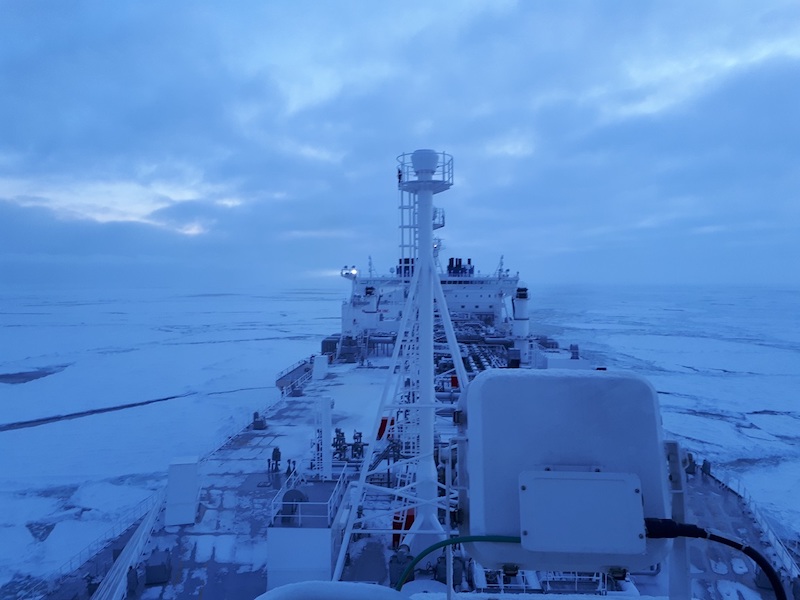
LNG transport vessel Eduard Toll transiting the Northern Sea route without icebreaker escort, December/January 2017/18
gCaptain provides proof we can expect to see merchant vessel transits of the Arctic Ocean even in Winter time.
“At times during the trip, the unescorted Eduard Toll broke ice 1.8 meters thick at speeds of five knots astern, arriving at Sabetta ahead of schedule sometime in early January. “
The Eduard Toll is one of a class of six being built in S. Korea for a Russian/Chinese joint venture.





 Chuck Hill's CG Blog