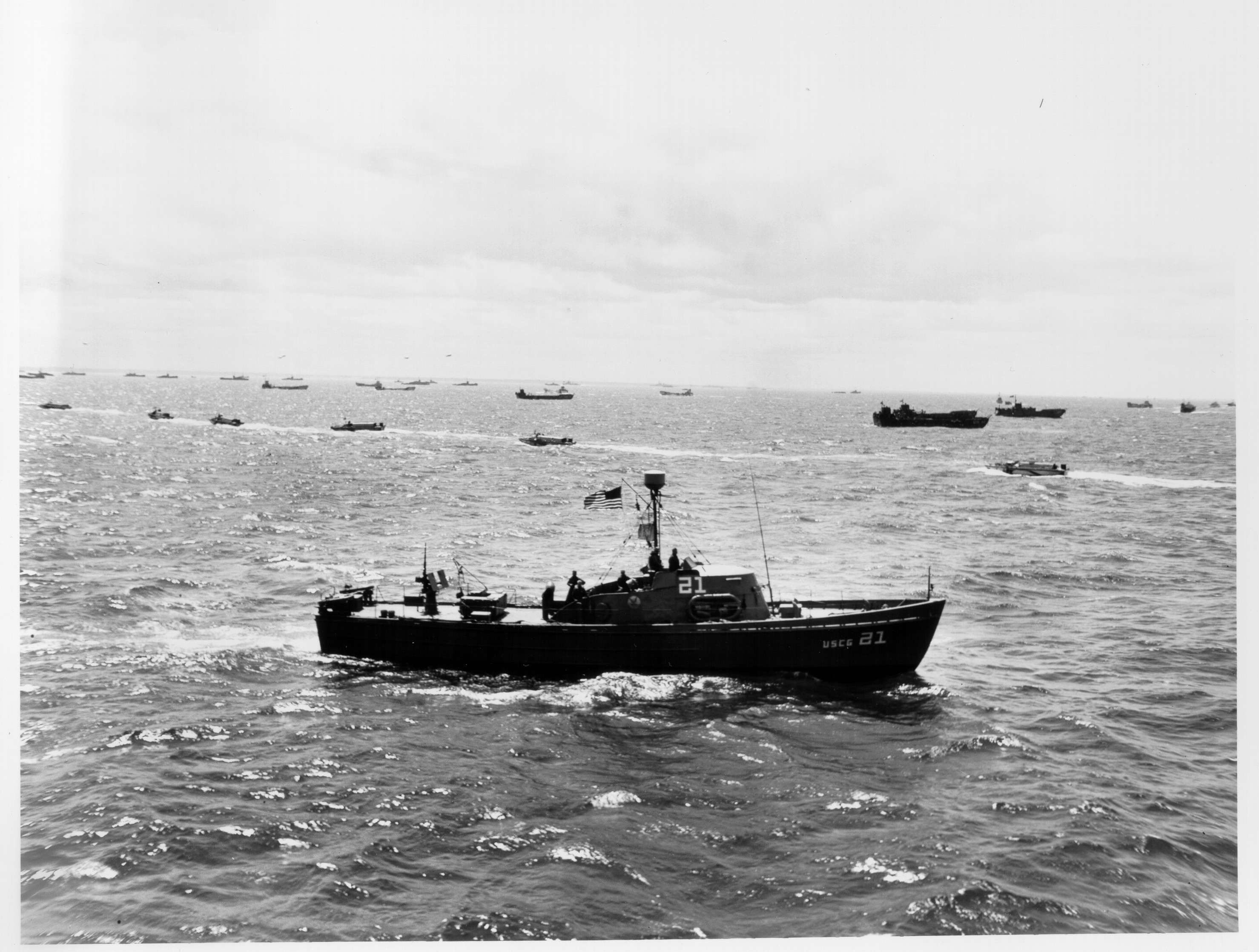
Navy’s New Patrol Boat, PB-X

The Navy has initiated a “request for information” (not a request for proposal yet) for a new maritime security/force protection patrol boats about 40 foot (12 meters) in length to replace about 100 existing 25 and 34 foot boats. You can read the solicitation here.

Can’t help but think there would be some benefit if they selected a hull in common with the Coast Guard.

To some extent this sounds a bit like the Coast Guard’s Response Boat Medium (RB-M), but in has some specific requirements for transportability that might rule out a version of the RB-M.

The other CG boat that might provide a basis is the Long Range Interceptor.

The solicitation does include some requirement I don’t think were part of the CG specifications that would require some modification. Here are the specifics:

Mobility & Operational Responsiveness –
Note: The Navy desires to meet boat speed and endurance requirements as specified below and will allow for flexibility in payload requirements. Payload may be varied in order to meet boat speed and endurance requirements.
• Cruise Speed of 25 knots
• Sprint Speed of 40 knots
• 12 hours endurance at patrol to cruise speed
• Range: 250 nautical miles
• Capable of carrying mission payload of at least 4,000 pounds and up to 8,000 pounds (desirable); mission payload includes weapons, ammunition, crew, passengers, and any portable/removable mission systems
• Length: 40 feet (nominal)
• Capable of operating in seas with a 3 feet significant wave height; shall have reduced operating capability in up to 5 feet significant wave heights
• Crew: 2-Operators and 3-Gunners/System Operators; Additional seats and space are desired for up to four additional mission personnel; Shock mitigating seats required for all crew and mission personnel

Propulsion –
• Boat must be powered by diesel fuel and be capable of operating on JP-5 and JP-8
• Propulsion equipment should be suitable for operating in shallow water with vegetation, debris and obstacles

Survivability (Ballistic Protection) –
• At a minimum the craft requires protection against 7.62 mm ball rounds for personnel and critical equipment (e.g., propulsion system and controls)

Lethality (Armament) –
• Space and weight needed for three weapons mounts suitable up to .50 caliber guns
• Space and weight needed for a single station Stabilized Small Arms Mount (SSAM), suitable for up to a .50 caliber gun or MK 49 or MK 50 Gun Weapon Systems

Sustainability (Reliability) –
• The craft will allow for affordable Total Ownership Costs by leveraging hull, mechanical and electrical systems that are already in use by the Navy; Leveraging systems that will allow for increased PB-X buying power commonality with other NECC boats is desired
• Innovative hull, mechanical and electrical systems are of interest provided that they can be fielded and supported within the next 2 to 4 years, employ non-developmental technologies, and have proven reliability

Transportability –
• Sea
– Capable of being transported as deck cargo on Naval Amphibious and Military Sealift Command ships; Specifically, the craft will be launched and recovered; floated-on and off well-deck Amphibious type ships; or transported on a Roll-On/Roll-Off cargo ship with own trailer
• Land
– Must be road transportable on U.S. and NATO roads/highways and comply with applicable oversize load restrictions without escort
– Road transportable also includes off-road (dirt, gravel without significant obstacles) with rough terrain capable trailer
– Capable of launch and recovery from a road transport trailer on a boat ramp
– Capable of being towed by existing NECC prime movers such as a Freightliner FL80 tow truck (40,000 pounds tow) or Medium Tactical Vehicle Replacement MK36 Wrecker truck (22,000 pounds tow)
– In preparation for land, air, or sea transport the craft must allow for removal and stowage of fendering, masts, arches and platforms and weapons; transportation preparation should take less than 4 hours
– The craft shall have hoist fittings that allow for crane launching and external airlift

• Air
– Internal air transportable in a C-5 or C-17 (see Department of the Army Field Manual Number 55-9, Chapter 2. Air Mobility Command Aircraft for space and weight restrictions)
– External air transportable by the CH-53 (34,700 pound weight limit)

Other Desired Characteristics:
• Minimum operating depth of no greater than 5 feet with a target vessel draft of 3 feet or less
• The hull draft structural design shall be compliant with ABS High Speed Craft (HSC) or Det Norske Veritas (DNV) that are appropriate for the construction material, hull form and speed of the PB-X
• The following stability standards are desired: US Navy Standards for single compartment flooding; and, US Navy Small Craft Beam winds and rolling; passenger crowding standards
• The following electronics/systems will be provided by the boat builder: Commercial AIS,
GPS Chart plotter, Radar, Marine VHF, Emergency Positioning Indicating Radio Beacon (EPIRB), Law Enforcement lights/siren
• The craft should be capable of launching, operating and recovering unmanned systems such as a MK18 Mine Countermeasures Underwater Vehicle System Mod MK 18 Mod 2 (approximate dimensions: 10 feet x 12 inches; weight 500 pounds)
• Construction standards should allow for a service life of 15 to 20 years
• The craft should be outfitted with heavy duty commercial grade fendering/rubrails or strakes, or foam filled sponsons preferred.

(Thanks to Lee for bringing this to my attention.)

The Coast Guard’s Missing Links–the Commandant

The Coast Guard Compass has published a post by the Coast Guard Commandant Adm. Paul Zukunft arguing for Offshore Patrol Cutter. This is obviously a topic close to my heart, and I don’t think anyone will mind if I quote it here whole cloth.

“Twenty miles east of the Dominican Republic, the Coast Guard Cutter Charles Sexton rescued 117 people from a dangerously overcrowded 30-foot makeshift craft. Hours later, the Coast Guard Cutter Stratton interdicted $14 million worth of cocaine and apprehended three suspected smugglers. In two days, on two coasts, two assets proved the multi-mission might of the U.S. Coast Guard as crews saved lives, secured our border and severed cash flows to a transnational criminal enterprise.

“The Charles Sexton, a 154-foot fast response cutter, and the Stratton, a 418-foot national security cutter, are part of the Coast Guard’s persistent presence, patrolling and protecting more than 95,000 miles of coastline and 4.5 million square miles of the U.S. Exclusive Economic Zone – home to our Nation’s precious resources, including our oil, natural gas, fish and mineral reserves. The vastness of this area, paired with our array of missions, requires a network of Coast Guard surface and air assets on shore and at sea to preserve America’s security and prosperity.

“Missing from this network – the necessary link between the national security cutter’s open ocean endurance and the fast response cutter’s littoral presence – is the offshore patrol cutter. The offshore patrol cutter will promote governance and provide capability on our oceans – the gateway for U.S. economic growth, opportunity and prosperity. It is here, beyond 50 nautical miles from U.S. shores, where national interests in the U.S. maritime domain require the Coast Guard’s unique blend of authorities. And, it is the offshore patrol cutter that will protect our sovereign interests, enforce laws, save lives, protect fisheries, secure offshore energy resources and provide command and control for major response and contingency operations.

“Currently, the 1960s-era 210-foot and the 1980s-era 270-foot medium endurance cutters are the link between the Coast Guard’s national security cutters and fast response cutters. However, this link is under untenable strain, characterized by decreasing readiness and skyrocketing maintenance costs. In the last two years, four of these aging ships had to be pulled out of service for emergency repairs, straining our ability to support and maintain other ships and aircraft, impacting crew safety and quality of life and diminishing the Coast Guard’s ability to project U.S. authorities and respond to crisis in the maritime domain. This past weekend, I went aboard our newest medium endurance cutter, Coast Guard Cutter Mohawk in Key West, Florida. Mohawk was commissioned in 1991 and will continue to serve our Nation until it is replaced with the next generation of offshore patrol cutters close to five decades after she began her service.

“I carried these thoughts with me as I set foot aboard the Coast Guard Cutter Robert Yered, one of our newest fast response cutters. Leaping forward nearly half a century from our oldest ships, the Robert Yered’s modern, high-tech systems are fully interoperable with our partners in the interagency and international community as it executes missions across our littorals. This nimble fast response cutter is not, however, without its limitations. It cannot launch and recover aircraft – a necessary capability in the Coast Guard’s operational network of assets – and has limited range and endurance relative to our major cutters. The Coast Guard must have flight deck capable ships with robust command and control capabilities exactly where we need them, from the farthest reaches of the transit zone off of Central America to our northernmost borders off of Alaska. The offshore patrol cutter is designed to fill this need.

“Our aging platforms do not suffer from neglect. Coast Guard men and women consistently demonstrate exceptional commitment and innovation to sustain a medium endurance cutter fleet that has served admirably for more than five decades. In fact, our first medium endurance cutter went to sea the very same year the first Mustang rolled off Ford’s assembly lines. Unlike antique cars, however, which are often restored at great expense and used for the occasional fair weather Sunday drive, the increasingly expensive ships of America’s Coast Guard are painstakingly maintained and regularly put to work in the harshest maritime conditions.

“Indeed, not having reliable use of these aged medium endurance cutters, the linchpin of our operational network, puts us at a disadvantage at a time when we are needed most. Given the complex threats facing the Nation today, we simply do not have the luxury of storing them in the garage.

“The U.S. Coast Guard has a proud history spanning nearly 225 years. We have won federal acquisition awards, maintained clean financial audits and earned a reputation for responsible stewardship. We cannot afford to dull our operational edge and jeopardize our Service to Nation any longer. The Nation deserves better, and the offshore patrol cutter is the answer.”


USNI Support for the Coast Guard

The US Naval Institute has an opinion piece strongly supporting the US Coast Guard, written, perhaps surprisingly, by a retired US Navy Rear Admiral, Terence E. McKnight.

Being of a cynical nature, I suspected RAdm. McKnight might be employed by Huntington Ingalls (HII), since he was advocating more Bertholf class National Security Cutters, and he has advocated for other HII products in the past, but there is apparently no direct connection.

Since the first Offshore Patrol Cutter is not due to be commissioned until 2022 now (having slipped again), it certainly would not hurt to get a ninth NSC.

NATO Trains Boarding Teams

DefenseMediaNetwork has a story about how Visit, Board, Search, and Seizure (VBSS) training is being done at a NATO facility in Souda Bay, Greece, on the Island of Crete. The only reference to the US Coast Guard is identification of an individual in one of the photos as a USCG officer, but I suspect the Coast Guard was involved in developing the course.

Perhaps the most interesting revelation to me was that they have a vessel dedicated to the training.

“…the 2,500-ton ex-HS Aris (A 74), formerly the Hellenic Naval Academy cadet training ship, serves as a realistic platform for live training for a variety of boarding scenarios. The ship is equipped with smoke, flashing strobes, booby traps, noise to create confusion, and role players to be rescued, detained or captured. Trainees use weapons that fire small paint pellet rounds. During the course of training, the difficulty and complexity of the scenarios can be increased. There are numerous cameras to monitor progress of training evolutions, ensure safety, and provide video for debriefing. When the teams leave they take with them a DVD with the video of their training. Aris will soon be joined by a decommissioned mine countermeasures ship, the ex-HS Alkyon (M211), which is at NMIOTC now and being modified for live training.”

This sounds like a good idea that the Coast Guard might want to consider.

(Thanks to Lee for bringing this to my attention.) 

Citations from D-Day

Below are some citations for valor for Coasties who participated in the D-Day invasion.

CLARK, George C., LTJG, USCGR, British Distinguished Service Cross, During the landing of Commandos at Quistreham by LCI (S) on 6 June 1944 Lt. Clark’s cutter was detailed to act as escort to LCI (S) HM LCI(S) 524 on clearing the beach after landing troops received a direct hit and blew up in a sheet of flames leaving a mass of blazing Octane petrol on the water. Although his cutter burned Octane petrol, he did not hesitate to street is craft into the flames and rescue the commanding officer and some of his men.

FRITZCHE, Edward H. CAPT, USCG, Legion of Merit, For exceptionally meritorious conduct, both in the preparation and execution of the amphibious assault on the coast of France June 6, 1944. Captain Fritzche was in command of a main group of the Assault Force, composed of a mixed fleet of American and British transports and American landing craft. He brought these ships an craft to their predetermined stations in the transport area, successfully effected their prompt and efficient unloading and expedited the assault troops and equipment to the designated beaches.—Gold Star in lieu of a second Legion of Merit, For meritorious conduct as commanding officer of a Coast Guard transport prior to and during the amphibious invasion of Southern France August 15, 1944. He efficiently organized and trained his ship and boat group to execute the assigned mission of loading transporting to the assault area and landing the embarked Army assault units on the invasion beaches. His able conduct contributed materially to the effective establishment of the beachhead and to the over all success of the invasion.

GISLASON, Gene R., LT, USCGR, Silver Star, For outstanding heroism as Commanding Officer of the USS LCI (L) 94, while landing assault troops in Normandy June 6, 1944. He successfully directed his ship through numerous beach obstacles to the proper beach, discharged his troops and retracted while his ship was seriously damaged from heavy enemy fire. Ship’s communications, engine telegraph and electric steering were disabled by direct hits on the pilothouse which killed three crewman and one screw and shaft were rendered inoperative by beach obstacles. By his coolness under fire and excellent seamanship, Lt Gislason overcame these difficulties and brought his ship off the beach on hand steering and one screw. He later supervised repairs and in four hours enable the LCI (L) to remain operative in the assault area for three weeks.

HENLEY, Coit T., LTJG, USCGR, Silver Star, For heroism as Commanding Officer of the USS LCI(L) 85 while landing assault troops in Normandy, France, June 6, 1944. Lt Hendley successfully landed his troops despite the mining of his vessel, fire in three compartment and concentration of enemy fire while unloading. His courage and seamanship in directing repairs and retracting from the beach resulted in saving the lives many wounded aboard.

IMLAY, Miles Hopkins, CAPT, USCG, Silver Star, For conspicuous gallantry as Deputy Commander of an Assault Group participating in the initial invasion on the coast of France , June 6, 1944. Undaunted by heavy enemy fire, Captain Imlay courageously took station close to the shore on the early morning of D-Day and throughout the most bitter period of the fighting, coolly and promptly made spot decision on the reorganization, grouping and dispatching of craft to the beach, subsequently relieving the Task Group Commander of his duties when he withdrew his transport from the assault area, immediately thereafter, he was placed in charge of operations afloat as assistant to the naval Officer in Charge of one of the beaches and discharging the duties of this responsibility with distinctive professional ability, contributed essentially to the rapid clearing of the backlog of ships.

OXLEY, Gene E., Sea. 1c [ Seaman, First Class], USCGR, Silver Star, For gallantry while on the USS LCI(L) 85 during the assault on the coast of France June 6, 1944 and for extraordinary courage in volunteering and twice taking a line ashore, in the face of heavy machine gun and shell fire in order to assist troops unloading from the ship to the bench through chest deep water.

SALMON, Robert M., LT, USCGR, Silver Star, For gallantry as commanding officer of a U.S. LCI (L) while landing assault troops in Normandy, France June 6 1944. He pressed the landing of troops despite the mining of his vessel a serious fire forward and heavy enemy gunfire. He supervised the unloading of troops, directed the fire fighting despite the loss of proper equipment and exhibiting courage of high degree remained with the ship until it was impossible to control the progress of the fire and it was necessary to abandon ship over the stern. After abandoning he directed a party searching for fire fighting equipment and subsequently fought the fire on another LCI (L) and assisted her commanding officer until she was abandoned.

VERNON, Albert, LTJG, USCGR, Bronze Star, For meritorious service as Commanding Officer of a Coast Guard Cutter in rescuing survivors of the invasion off the coast of France June 6, 1944. During D-Day, his cutter rescued 97 men. Each rescue was effected in the face of constant enemy fire from the beach which was in no way allowed to deter the splendid rescue operations.

VYN, Arend, Jr., LTJG, USCGR, Silver Star, For gallantry in action as commanding officer of USS LCI 91 in the assault on the cost of France June 6, 1944. LTJG Vyn beached his ship and discharged the Army elements therein the face of murderous fire and a labyrinth of obstacles and mines. In spite of the fact that his ship was mined and repeatedly struck by artillery fire and small arm fire, he continued to land the army load in the face of certain loss of his ship. his determination to put the Army ashore was in keeping with the highest traditions of the offensive spirit of the U.S. Naval Service.

While this happened a little later, I have to add it as part of the invasion story.

WALSH, Quentin R., CDR, USCG, Navy Cross, For heroism as Commanding Officer of a U.S. Naval party reconnoitering the naval facilities and naval arsenal at Cherbourg June 26 and 27, 1944. While in command of reconnaissance party, Commander Walsh entered the port of Cherbourg and penetrated the eastern half of the city, engaged in street fighting with the enemy. He accepted the surrender and disarmed 400 of the enemy force at the naval arsenal and later received unconditional surrender of 350 enemy troops and at the same time released 52 captured U.S. Army paratroopers.

D-Day 71 years ago

The 83-foot Coast Guard cutter USCG 1 off Omaha Beach on the morning of D-Day, tied up to an LCT and the Samuel Chase

The 83-foot Coast Guard cutter USCG 1 off Omaha Beach on the morning of D-Day, tied up to an LCT and the Samuel Chase

A long salute to the Coasties who were off (or on) the coast of France 71 years ago today. I will just point to a couple of previous posts.

D-Day, 6 June 1944

D-Day, Normandy Remembered

“Crew of CG-16 pointing to the tally board of 126 rescued soldiers.”
Photo courtesy of Terry Hannigan.
(NOT AN OFFICIAL USCG PHOTOGRAPH)

USCG 83 ft patrol boat, probably June 1944. Photographer unknown.

USCG 83 ft patrol boat, probably June 1944. Photographer unknown.

Coast Guard Aviation Force Distribution Graphic

all rights reserved larger version: http://i.imgur.com/nNQA7xg.png

CIGeography has produced a graphic display of how the Coast Guard’s aviation assets are distributed. I can’t confirm that it is correct, but generally it looks right. We can of course expect this to change as C-130H aircraft are retired and new H-130J and C-27Js are brought on line.

Thanks to Ted McCormack for bringing this to my attention.

US to Help Fund Vietnamese Patrol Boats

Metal-Shark-75-Defiant-Firefighting-Fireboat-Craft

“The Metal Shark 75 Defiant Patrol boat, capable of achieving 40+ knots. For the ideal balance of performance, economy, and reliability, twin Caterpillar C32 diesels mated to Hamilton HM-651 waterjets will propel the vessel to speeds in the 30-knot range.” Photo via DBA METAL SHARK

gCaptain is reporting that the US has pledged $18M to help Vietnam buy US made patrol boats. gCaptain does not specifically state which boats will be bought or how many, but the choice of illustration above certainly suggests that they will be Metal Shark 75 Defiants. There is more information on this boat here.