We have a report of harassment of a Finnish research vessel by a Russian Corvette in international waters off Sweden.
Incident at Sea–Russia vs Finland
Reply

We have a report of harassment of a Finnish research vessel by a Russian Corvette in international waters off Sweden.
Video: Hellfire launch from a 52 foot Combat Boat 90.
Previously we have talked about several guided weapons with potential for use by the Coast Guard for stopping small fast craft that might be used for a terrorist attack, while minimizing the chances of collateral damage. These included guided 70mm rockets (there are actually several different similar adaptations of the 70mm Hydra including, BAE’s APKWS, Lockheed’s DAGR, and Raytheon TALON), in addition to larger SeaGriffin, Hellfire, and Brimstone missiles, but we have not talked much about launchers, with minor exceptions.
Our friend at ThinkDefence recently did a post about the Brimstone missile, “Dual Mode Brimstone Greatest Hits,” and speculated on additional ways it might be used. He showed a number of launchers and I realized, perhaps it was time to show some of the alternatives with the purpose of showing that these systems are not that large, and would have relatively little impact on the ships.
In fact some of these launchers are quite small.

Photo: Kongsberg “SeaProtector“ gun mount with 70mm rocket launchers
Lockheed has a land based pedestal launcher that handles both Hellfire and 70mm rockets. For our purposes it would probably have to be “marineized” but the size looks reasonable.
Raytheon has demonstrated their version of the guided Hydra 70mm rocket using a standard rocket pod of the type commonly used on helicopters mounted on a remotely controlled weapon station.

Photo: Raytheon TALON 70mm guided rocket fired from LAU-68 launcher
Most of these launchers look to be like those used on aircraft. It is not clear that the weapons could be mounted and left for months or years until needed. The weapons might have to be stored elsewhere and mounted only when use is anticipated. On the other hand, the launcher used for the SeaGriffin as recently mounted on Navy Cyclone Class PCs looks to be suitable for long term storage.
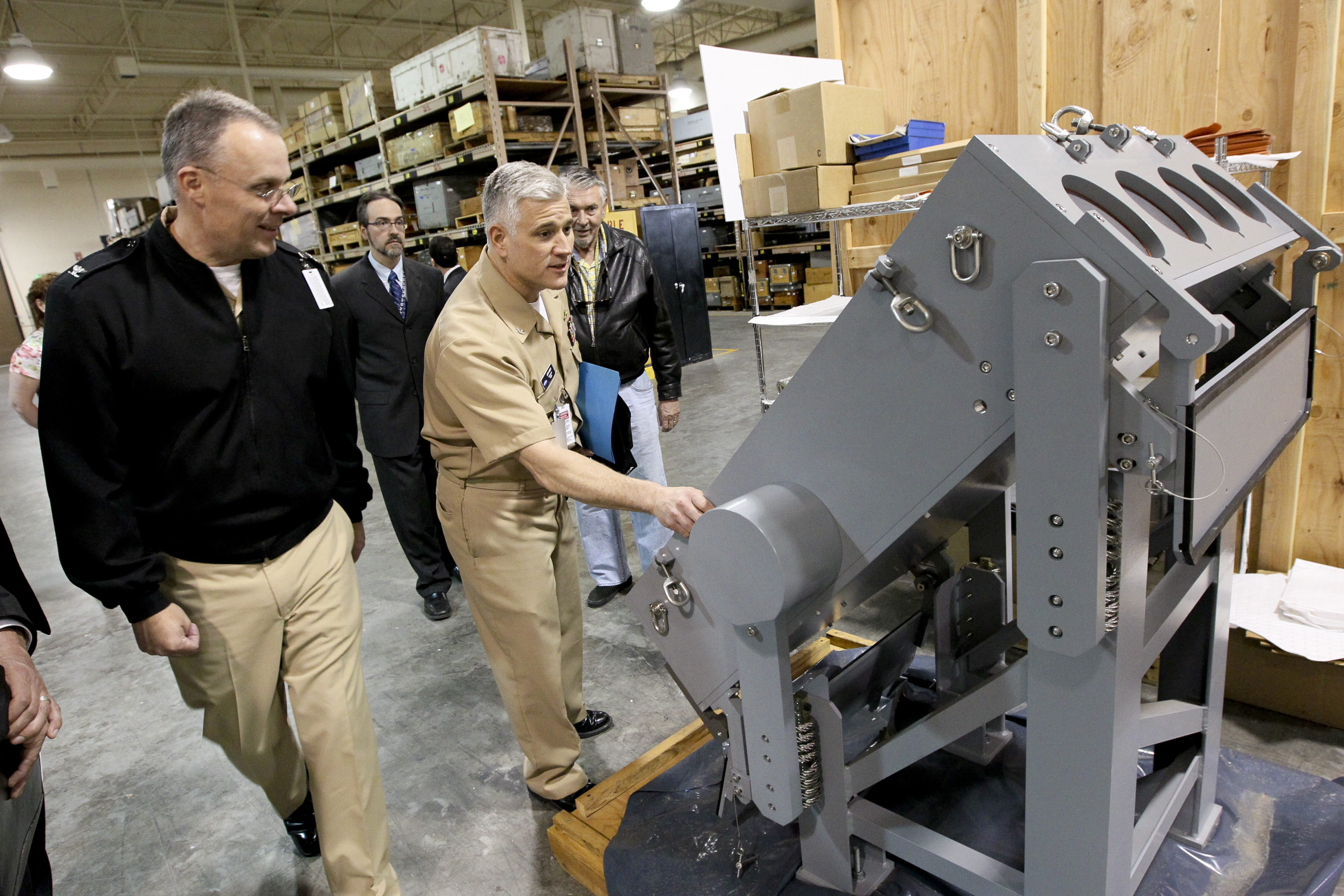
We have heard that the Navy tested vertical launching the Hellfire on a 65 foot boat, simulating an LCS, and that they expect to mount vertically launched Hellfires on the LCS. Hopefully this will be a good option for cutters as well, with the capability of holding the missiles at the ready for long periods.
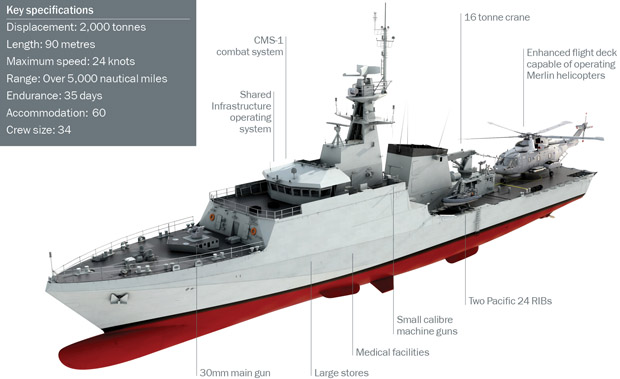
Photo: https://navynews.co.uk/archive/news/item/11615, Click to enlarge
(Note the helicopter in the illustration may make the ship appear smaller than it really is because the helicopter, a Merlin, is actually quite large, with a max. take off weight approximately 50% than an H-60.)
The Royal Navy blog, NavyNews, has announced the start of work on the first of three new 90 meter (295 foot) OPVs.
These are closely related to the three ships built for Trinidad and Tobago that I had suggested the Coast Guard might buy or lease, that ultimately went to Brazil as the Amazonas class after the original buyer refused to accept them.
At a total cost of 348M pounds ($558.8M or an average of $186M each) they cost a bit more than I had hoped for Cutter X ($175M), and quite a bit more than the cost of the three built for Trinidad and Tabago ($80M each). Still these are very close to what the Coast Guard could build as Cutter X.
The planned crew (34) is smaller than I would have expected.
Still they represent some very capable patrol vessels that the Coast Guard may have an opportunity to work with in the Caribbean.
Coast Guard News release:
WASHINGTON – Senior leaders from the U.S. Coast Guard and the National Oceanic and Atmospheric Administration (NOAA) signed a Fleet Plan and Officer Exchange memorandum of understanding (MOU) on Wednesday at a ceremony at U.S. Coast Guard Headquarters.
Coast Guard Vice Adm. Charles Michel, deputy commandant for operations, and NOAA Vice Adm. Michael Devany, deputy under secretary for operations, were the signing officials for the joint letter of promulgation.
The Coast Guard and NOAA have collaborated for over 200 years. The Fleet Plan supplements the Cooperative Maritime Strategy (CMS) that was signed in February 2013 and establishes a course of action to guide cooperation in the operation and maintenance of marine and aviation platforms. This direction also expands valuable inter-agency work currently underway, such as repairing NOAA ships at the Coast Guard Yard and advancing Arctic preparedness through collaboration with the Coast Guard’s Arctic Shield test and evaluation program.
The Officer Exchange MOU supports both the CMS and the Fleet Plan by allowing the exchange of officer personnel for the purpose of sharing professional knowledge, expertise, doctrine, and for the professional development of officers. Coast Guard officer candidates and the NOAA Corps already train together at the Coast Guard Academy in New London, Conn.
“The Fleet Plan and Officer Exchange MOU builds on the long history of cooperation between NOAA and the Coast Guard. Our shared responsibilities in serving the American people’s interests in the maritime domain are fortified by our even closer relationship,” said Michel.
“NOAA and the Coast Guard share a commitment to providing the highest level of service to the nation,” said Devany. “These important agreements provide a framework for leveraging our respective resources and enhancing collaboration where we have common interests regarding personnel, fleet operations, research and development.”
More information about the NOAA Commissioned Officer Corps is available at http://www.noaacorps.noaa.gov/
I have considering suggesting that there should be a closer relationship between the Coast Guard and NOAA. Oceanography used to be a regular Coast Guard activity. The ships sometime look similar. We seem to have a lot in common or at least in parallel.
gCaptain has a Reuters report that discusses the apparent difficulties the Canadian Coast Guard is experiencing in dealing with the additional traffic in the Arctic.
It has been around for over 30 years. While many of us questioned the choice, and joked about the pilots’ need to get back in time for happy hour, it is hard to argue with the fact that this was perhaps the sexiest aircraft ever flown by the Coast Guard.
DefenseMediaNetwork has a nice tribute to aircraft on the occasion of its retirement.
Naval Open Source Intelligence pointed me to a report by the Office of Naval Research (ONR) on the use of multiple unmanned surface assets to protect an asset and if necessary initiate a coordinated attack.
“The technology—called CARACaS (Control Architecture for Robotic Agent Command and Sensing)—is under development by ONR, and can be put into a transportable kit and installed on almost any boat. It allows boats to operate autonomously, without a Sailor physically needing to be at the controls—including operating in sync with other unmanned vessels; choosing their own routes; swarming to interdict enemy vessels; and escorting/protecting naval assets.”
Why should the Coast Guard care? The Coast Guard also protects vital maritime assets including passenger ships, vessels with dangerous cargos, and Navy assets including major ships and ballistic missile submarines so there is that direct application.
The system also appears capable of providing a persistent patrol capability that might be useful in Interdiction Operations. We cannot put a boat crew in a RHIB and send them off to operated as an independent extended sensor for 24 hours, but we could do that with an automated RHIB.
gCaptain has an interesting little tidbit on developing technology for inspecting the underwater body of ships and boats.
We only have a limited sample of the effects of modern weapon systems, so I think they are worthy of consideration.
gCaptain has a report on the recent test launch of a Naval Strike Missile from LCS-4, USS Coronado, I would like to point out the video that shows the result of a hit by this type missile in an earlier test that is included in gCaptain’s report and posted above, and talk about not the damage that was done, but the damage that was not done.
The result, is shown on the video at time 0:55. The target of this earlier test was a decommissioned Norwegian Oslo class frigate. These are relatively small ships, 317 feet long and 2,100 tons full load, only a little larger than a Bear class cutter and considerably smaller than the average merchant ship.
The Naval Strike Missile has a 125 kG warhead, smaller than that of a Harpoon (just under 500 pounds), but still respectable. The explosion and the resulting smoke are impressive. The damage would almost certainly have caused a mission kill, wiping out critical command and control, sensor, and fire control systems.
On the other hand, it appears the hull is largely intact. In fact, the target did not sink, it was subsequently towed back into port. I have observed that sea-skimming anti-ship cruise missiles always seem to strike about 20 feet or more above the waterline. This may be necessary to ensure they do not strike waves as they make their final approach, but it also seems to limit hull damage. This kind of hit might not have damaged the propulsion or steering gear, particularly on a larger ship.
If the Coast Guard is required to stop a medium to large ship, bent on doing some mischief, I don’t think even a cruise missile like NSM, could assure immobilization of the threat.
gCaptain reports the result of a GAO report on the procurement of LCS-1 and LCS-2. Looks like perhaps a lesson in how not to manage a ship procurement program. The ships still have defects the crew has to deal with.
 Chuck Hill's CG Blog