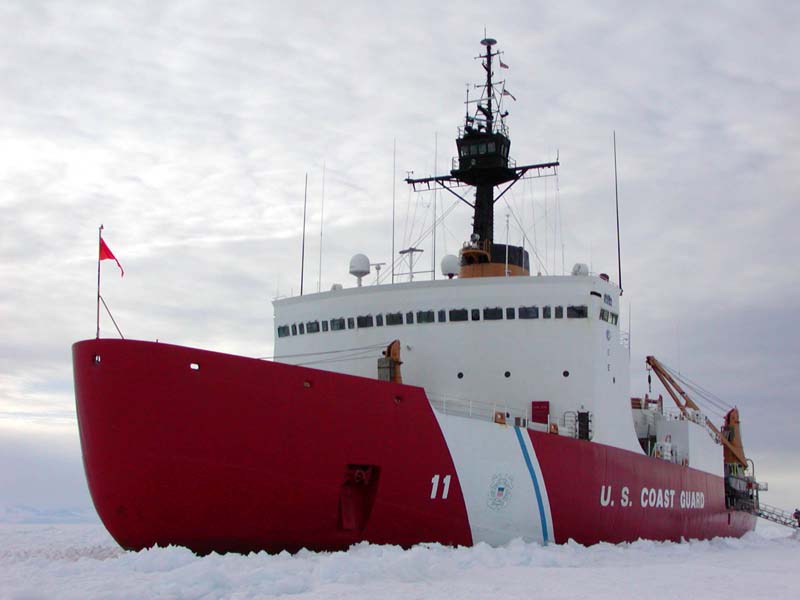
USCGC Polar Sea (WAGB-11): US Coast Guard Photo
–
The question of whether the Polar Sea should be reactivated has been kicking around for a while. After all, the Navy and the Coast Guard have been saying the country needs three heavy and three medium icebreakers. The proposed new icebreaker is projected to cost about $1B and will not increase the size of our icebreaker fleet. It will simply arrive in time to replace the Polar Star. The renovation of the Polar Sea was projected to cost on the order of $100M and provide seven to ten years of additional life. If you compare that to $1B for 30 years for a new icebreaker that sounds like a good trade-off, so why not?
–
–
“Although a second heavy icebreaker would provide redundancy, the cost of this redundant capability would come at the expense of more pressing and immediate operational demands.
–
This is the conclusion of a report to Congress entitled “USCGC Polar Sea Business Case Analysis” dated November 07, 2013, that I will refer to simply as the analysis.
download (pdf): Their summarized findings:
–
“A total of 43 mission critical systems in five general categories were assessed and assigned a condition rating. Overall, Propulsion, Auxiliary and Prime Mission Equipment are rated Poor to Fair, while Structure and Habitability are rated Fair to Good. POLAR SEA reactivation is estimated to cost $99.2 million (excluding annual operations and support costs) to provide 7-10 years of service to the Coast Guard. Given the age of the icebreaker, operations and support costs are projected to rise from $36.6 million in the first year of operation to $52.8 million in the tenth year of operation. Combining reactivation costs and point estimates for operating costs, reactivation would cost $573.9 million. Accounting for operational and technical uncertainties, using a 90% Confidence Level Risk Analysis, the total potential cost rises to $751.7 million.
“Arctic seasonal icebreaking demands through 2022 can be met with existing and planned Coast Guard assets, as current requirements do not justify the need for heavy icebreaking capability in the Arctic. Heavy icebreaker capability is needed to perform Operation Deep Freeze in Antarctica, but Coast Guard assets may not be the only option available to the National Science Foundation to support this activity. Although a second heavy icebreaker would provide redundancy, the cost of this redundant capability would come at the expense of more pressing and immediate operational demands. POLAR STAR, when fully reactivated, will provide heavy icebreaker capability until a new icebreaker can be delivered to meet both current and emerging requirements.”
It does not take much reading between the lines to see that the real issue here is not the one time renovation cost, it is the high annual cost of maintaining a complex plant that is increasingly unsupportable. Congress might fund the renovation costs, but the annual maintenance costs are likely to be taken out of hide and the projected $36.6M to $52.8M per year is just too much for the increased capability. The conclusion that restoring her to her original configuration is not a viable option is probably reasonable, but it is the only alternative. Because
Polar Sea’s basic structure is sound. Quoting the analysis,
“Based on the results of the inspection, the structure is rated EXCELLENT and the average remaining service life for the structure remains 25+ years. No significant wastage or corrosion was noted and no major repairs have been necessary since the last report.”
Maine Engines and Propellers:
The Polar Class have always been “maintenance intensive” and a good part of the reason is the complexity of her nine engine propulsion system and her controlable pitch propellers (CPP).
–
The complexity of her six diesel engines and three gas turbines is rather self explanatory. That they are now old and virtually unsupportable makes the problems even more obvious, but the propellers merit additional explanation. Quoting from the analysis (p.16),
–
“The CPPs are rated POOR.
–
“The following discussion is quoted from the Polar Service Life Extension Project (SLEP), Option A, Scope and Feasibility Analysis submitted by M. Rosenblatt and Son! AMSEC LLC, May 2006 and is an excellent description of the challenges that still confront the CPP system: Controllable Pitch Propellers and Associated Hydraulic Systems. This remains the most significant problem that must be solved if the cutters are to continue to provide reliable service. The propellers are subject to particularly severe conditions during heavy icebreaking conditions and a significant failure may lead to cancellation of a mission, as well as presenting the potential for leakage of hydraulic fluid to the environment. There are issues relating both to the propeller hubs themselves and the internal hydraulic system components. The following discussion will continue to address the propeller hubs separately from the rest of the CPP system for three reasons: 1) their current condition is different than the rest of the system, 2) the likelihood for a known fix is different, and 3) the propeller hubs cannot be repaired while the ship is deployed or while in the water which vastly impacts operational availability.
–
“Propeller Hubs. The hubs are rated POOR. In recent years, it has been necessary to dry dock the cutters and inspect the propeller hubs after every heavy icebreaking deployment. Throughout the 50 years of experience with the two Polar Class ships, the interval between hub overhauls has never been more than two heavy icebreaking missions. According to the Coast Guard Technical Point of Contact for the CPP hub overhaul contract, every time the hubs have been overhauled there has been some unusual wear, scoring, cracking, leaking, broken parts or other indicator that it was appropriate that the hubs be overhauled before an additional heavy icebreaking mission was attempted. In other words, there has been no indication that overhauls were unnecessarily being performed at too short an interval. Over the past 25 years, dozens of modifications have been made to the hubs attempting to eliminate the negative conditions found. Typically corrections in one spot have lead to new symptoms in another location. Sizes, clearances, and material strengths are in critical balance. While the hubs have undoubtedly been improved over the past 25 years, their service life without overhaul remains relatively short.
–
Overall Condition:
–
The following is the “Reader’s Digest” version of the Analysis’ report on the summary of the ship’s condition:
–
POOR:
Overall main propulsion system
Main propulsion diesel engines
Controllable Pitch Propellers (CPP)
Ship Service Diesel Engine
Uncontaminated Seawater System
Electrical distribution system (parts and technical support)
Cargo Cranes
–
FAIR:
Propulsion Gas Generators and Turbines
Propulsion Control System: Switchgear, Rectifiers, and Exciters
Machinery Control and Monitoring System (MCAMS)
Ship Service Diesel Generator (SSDG)
Steering Gear
Ventilation System
Fire Main and Flushing (Seawater) System
Sanitary Systems
Aqueous Film Forming Foam (AFFF) Systems
Central Hydraulic System (CHS)
Anchor Windlass
Bus transfer switches
Electrical distribution system (preservation).
Habitability
–
GOOD:
Propulsion Generators
Aft Stem Tube Bearings (as yet untested)
Forward Stem Tube Bearings
Cooper Split Roller Bearing
Lube Oil Purifiers
Evaporators
Incinerator
Oily Water Separator
Fresh Water Systems
Chilled Water System
Halon Systems
400 Hz Switchboard
Electrical distribution system (mechanical)
–
EXCELLENT:
Reduction Gears
Propulsion Shafting
Thrust Bearing
Emergency Diesel Generator (EDG)
Auxiliary Boilers
Helicopter Power Supply
Local Monitoring & Alarm System
Diesel Fuel Transfer & Purification System
Structural
–
UNTESTED:
Boat Davits
–
REMOVED:
Electronics systems
Outfit and spares
–
An Opportunity in the form of a Problem:
–
The Coast Guard has been using a National Security Cutter over the last two summers to provide the equivalent of a Coast Guard Section afloat in the absence of infrastructure ashore, effectively a helicopter airstation, a small boat station, communications, and command and control. These very expensive ships certainly have a number of desirable characteristics, but they are hardly what one would envision if planning an Arctic station ship from scratch. The hull is simply not strong enough for the environment. Not only is it not an icebreaker, it is not even ice strengthened.
–
If we take advantage of the Polar Sea’s still robust hull, by spending more money up front (Congress would have to appropriate it, it could not come out of hide) and replace the engineering plant with good choices that both reduce manning and increase reliability, we might have effectively an additional medium icebreaker for up to 25 years.
–
Yes, it would take more planning and more money up front, but with a bit of redesign and reconstruction it appears the Coast Guard could have an icebreaker of at least 18,000 horsepower with fixed pitch props that could be tailored for an Arctic Station Ship role freeing the NSCs and/or the Polar Star for more normal patrol functions. The six main prop diesel generators could be replaced by perhaps three modern diesel generators, and the three turbines removed altogether. Used as main propulsion generators, three MTU 20V 1163 diesels like the ones on the Bertholf Class would allow any two engines to drive the three existing electric motors at full power. Allowing the existing motors to run in reverse would probably require a new propulsion control system, but the existing system is only rated as fair now anyway. A new digital system would almost certainly be more flexible and easier to maintain and would probably require fewer watch standers. 18,000 horsepower using the existing motors, is way down from her current designed combined diesel and gas turbine output, is more than many of the world’s icebreakers, and more than either of the National Science Foundation’s icebreakers. If more power were deemed essential, it might be possible to put one LM2500 on the center shaft and still get the benefits of a greatly simplified and modernized engineering plant. The Ship Service electrical system might also be updated to provide the capability for one generator to handle the entire load, something the ship does not currently have. It might even be possible to add retractable fin stabilizers (removal of the turbines having made more room in the hull) or at least a rudder roll stabilization system added (the rudders system does need work). Stabilization is desirable in that it would allow her to operate boats and helicopters in more severe conditions.
–
By re-engining the Polar Sea, the Coast Guard would not only get a more reliable ship, requiring a smaller crew, potentially cheaper to operate than a National Security Cutter, it would also leave free up the Polar Sea’s existing engines and propellers and possibly other systems to use as spares to keep Polar Star functional and free her from duties in the Arctic.