Canadian Icebreaker Design Contract Awarded

Tim Colton’s “Maritime Memos” reports STX Canada Marine has been awarded a $9.5M contract to design Canada’s new icebreaker and goes on to make a suggestion:

“Say, Dave, could you please design it so that it meets the US Coast Guard’s requirements as well?  Then maybe Vancouver Shipyards could build four of them, one for you and three for us?  Why is Canada only building one, anyway, when you obviously need at least three?”

Lots of other good stuff there as well including: new Navy AGOR, Congress on harbor maintenance, changes in the Navy’s ship building programs.

C-27Js as MPA?–DOD Declares 38 New Aircraft Surplus

File:USAF C-27J.JPG

Recent DOD statements indicate they intended to “divest” themselves of 38 C-27J. These are all essentially new twin engine aircraft using the engines and glass cockpit of the C-130J. The USAF just released their Air Force Priorities for a New Strategy with Constrained Budgets. Among the “more than 280 aircraft have been identified in the current budget submission for elimination across all Air Force components over the next five years” are 21 C‐27s. (I believe the remaining 17 aircraft are owned by the Army.)

If the Coast Guard could “missionize” these aircraft as they are doing the HC-144A and use them as Maritime Patrol Aircraft (MPA) instead of buying more HC-144As, the service might save close to a billion dollars and get an aircraft that is more capable in almost every respect, and have them sooner. My understanding is that the Coast Guard originally wanted the CASA C-295 which is very close in specification to the C-27J. In many respects, its capabilities approach those of the C-130H. I think it might be worth a look.

The total “revised baseline” for the MPA program is $2.4B for 36 aircraft. The Coast Guard has accepted or contracted for 15 HC-144s. The fifteenth HC-144A cost $41M. If we assume the CG obtains 21 C-27Js instead of 21 HC-144As and assuming a savings of $40M each, that would be $840M. Enough to buy a new polar icebreaker, or two or three ice strengthened cutters, or perhaps three or four OPCs.

This was originally an Army program, handed over to the Air Force. These aircraft were purchased for infra-theater supply using airfields that were too small for the C-130. That need never really surfaced, C-130s, that they had in abundance, could perform all the supply missions and was more efficient in the cargo transport role. The first C-27J was delivered in 2008. Most were delivered in the last two years.

General characteristics

  • Crew: Minimum two: pilot, co-pilot, (plus loadmaster when needed)
  • Capacity: 60 troops or 46 paratroops or 36 litters with 6 medical personnel
  • Payload: 11,500 kg (25,353 lb)
  • Length: 22.7 m (74 ft 6 in)
  • Wingspan: 28.7 m (94 ft 2 in)
  • Height: 9.64 m (31 ft 8 in)
  • Wing area: 82 m2 (880 sq ft)
  • Empty weight: 17,000 kg (37,479 lb)
  • Max takeoff weight: 30,500 kg (67,241 lb)
  • Powerplant: 2 × Rolls-Royce AE2100-D2A turboprop, 3,460 kW (4,640 hp) each
  • Propellers: 6-bladed Dowty Propeller 391/6-132-F/10, 4.15 m (13 ft 7 in) diameter

Performance

  • Maximum speed: 602 km/h (374 mph; 325 kn)
  • Cruising speed: 583 km/h (362 mph; 315 kn)
  • Minimum control speed: 194 km/h; 121 mph (105 kn)
  • Range: 1,852 km (1,151 mi; 1,000 nmi) with 10,000 kilograms (22,000 lb) payload
  • Range at 6,000 kg payload: 4,260 km (2,650 mi; 2,300 nmi)
  • Ferry range: 5,926 km (3,682 mi; 3,200 nmi)
  • Service ceiling: 9,144 m (30,000 ft)

Here are the characteristics of the HC-144A for comparison.

  • Airframe Manufacturer: EADS/CASA, Spain
  • Wing Span: 84ft. 8in.
  • Wing Area: 636sq.ft.
  • Height: 26ft. 10in.
  • Length: 70ft. 3in.
  • Max Gross Weight: 36,380 lbs
  • Empty Weight: 21,605 lbs
  • Propulsion: Two General Electric CT7-93C Turboprop
  • Speed: 236 kts
  • Range: 1,565 nm
  • Endurance: 8.7 h
  • Minumum Crew: Two

Under Water Inspection Capability

VideoRay Pro 4 ROV

Photo Credit: VideoRay.com

The Acquisition Directorate (CG-9) is reporting that the Coast Guard is getting some new equipment.

The devices are designed to “… accurately detect, classify and provide detailed images of threats or other items of interest underwater, such as parasitic hull attachments, improvised explosive devices, scuttled self-propelled semi-submersible vessels, lost Aids to Navigation (ATON) components or even lost personnel. Presently, divers search for these items, a time-consuming and costly process that yields marginal success and places divers in harm’s way. An underwater imaging capability would save labor, time and reduce risk.”

This post on the maker’s website, reporting the sale of the same system to the Dutch Navy, also talks about the CG acquisition and does a good job of describing it and its purpose.

Because we haven’t seen much of it in US ports, most Americans are not aware of how common unconventional attacks on shipping in ports have become, at least in wartime. The Italians were particularly good at these, scoring their first success in WWI, sinking an Austrian battleship. During WWII they made numerous attacks including sinking two British battleships in Alexandria in December, 1941 (a very bad month for battleships). The British also employed unconventional means. Their successes included severe damage to the battleship Tirpitz, sister ship of the Bismark, and an attack on the occupied port of Bordeaux. Viet Cong sappers made many such attacks during the Vietnam War. I could not find a reference, but I believe I remember seeing that they numbered in the hundreds including sinking the carrier escort (CVE) Card, being used as an aircraft transport. We talked about this a earlier, when we were discussing the future of the MSSTs. There is more background there and some interesting comments.

An Italian

 Photo: Italian slow speed torpedo or “pig”

The Captain’s Letter

This bit of humor showed up on my Facebook and I felt the need to share:

Nigel Smith THE CAPTAIN’S LETTER

There follows a well known spoof letter purporting to be from a Master after a particularly unusual set of co-incidences. At least it was well known twenty or thirty years ago. It was sent by Pete Wright. We all used to be able to recall actual incidents which were not too far removed from this wonderfully imaginative whimsy, typically ships running into cranes, dropping anchors through railway trucks and the like, but anyway for those of you not familiar with this – enjoy!

Dear Sir,

It is with regret and haste that I write this report to you. Regret that such a small misunderstanding could lead to the following circumstances, but haste in order that you will receive this report before you form your own preconceived opinions from reports in the world press, for I am sure that they will tend to over-dramatise the affair.

Having just picked up the pilot, the apprentice had returned to the bridge after changing the ”G” flag for the “H” flag and this being his first trip, was having difficulty in rolling up the “G” flag. I therefore proceeded to show him the correct procedure for this operation. Coming to the last part, I told him to “let go” and the lad, though willing, is not too bright necessitating my having to repeat the order in a sharper tone.

At this moment, the Chief Officer appeared from the chart room, having been plotting the vessels progress and, thinking that it was the anchors that were being referred to, he repeated the “let go” to the Third Officer on the fo’csle. The port anchor, having been cleared away, but not walked out, was promptly “let go”. The effect of letting the anchor drop from the pipe while the vessel was proceeding at full harbour speed proved too much for the windlass brake and the entire length of the port chain and stopper was pulled out by the roots. I expect that the damage to the chain locker may be extensive. The braking effect of the port anchor naturally caused the vessel to sheer in that direction – right towards the swing bridge that spans a tributary to the river up which we were proceeding.

The swing bridge operator showed great presence of mind by opening the bridge for my vessel, but unfortunately, he did not think to stop the vehicular traffic, the result being that the bridge partly opened and deposited a Volkswagen, two cyclists and a cattle truck on my fo’csle.

The ships’ company are at present rounding up the contents of the latter, which from the noise I would say are pigs. In his effort to stop the progress of the vessel, the Third Officer also dropped the starboard anchor, too late to be of any practical use for it fell on the swing bridge operator’s control cabin. After the port anchor was let go and the vessel started to sheer, I gave at double ring of “full astern” on the engine room telegraph and personally rang the engine room to order maximum astern revolutions. I was informed that the sea temperature was 53° and asked if there was a film on tonight; my reply would not add constructively to this report.

Up to now I have confined my report to the activities at the forward end of my vessel. Down aft they were having their own problems. At the moment the port anchor was let go, the second officer was supervising the making fast of the after tug down to which he was lowering the ships’ towing spring.

The sudden braking effect of the port anchor caused the tug to run in under the stern of my vessel, just at the moment when the propeller was answering my double ring full astern. The prompt action of the Second Officer in securing the inboard end of the towing spring, delayed the sinking of the tug by some minutes, thereby allowing the safe abandoning of that vessel.

It is strange, but at the very same moment of letting go the port anchor there was a power cut ashore. The fact that we were passing over a cable area at the time suggests that we may have touched something on the riverbed. It is perhaps lucky that the high-tension cables brought down by the foremast were not live, possibly being replaced by the underwater cable, but owing to shore blackout, it is impossible to say where the pylons fell.

It never fails to amaze me the actions and behaviour of foreigners during moments of minor crisis. The pilot, for instance, is at this moment huddled in the corner of my day cabin, alternatively crooning to himself and crying after having consumed a bottle of gin in a time that is worthy of inclusion in the Guinness Book of Records. The tug captain on the other hand, reacted violently, and had to be forcibly restrained by the Steward, who has him handcuffed in the ships hospital where he is telling me to do impossible things with my ship and my person.

I enclose the names and addresses of the drivers and insurance companies of the vehicles on my foredeck collected by the Third Officer after his somewhat hurried evacuation of the fo’csle. These particulars will enable you to claim for the damage that they did to the railings on the number one hold.

I am closing this preliminary report because I am finding it difficult to concentrate with the sounds of police sirens and the flashing lights.

It is sad to think that had the apprentice realised that there was no need to fly pilot flags after dark, none of this would have happened.

For the weekly accountability report, I will assign the following casualty numbers. T/750101 to T/750200 inclusive.

Yours truly,

Master.

The Case for Big(ger) OPCs

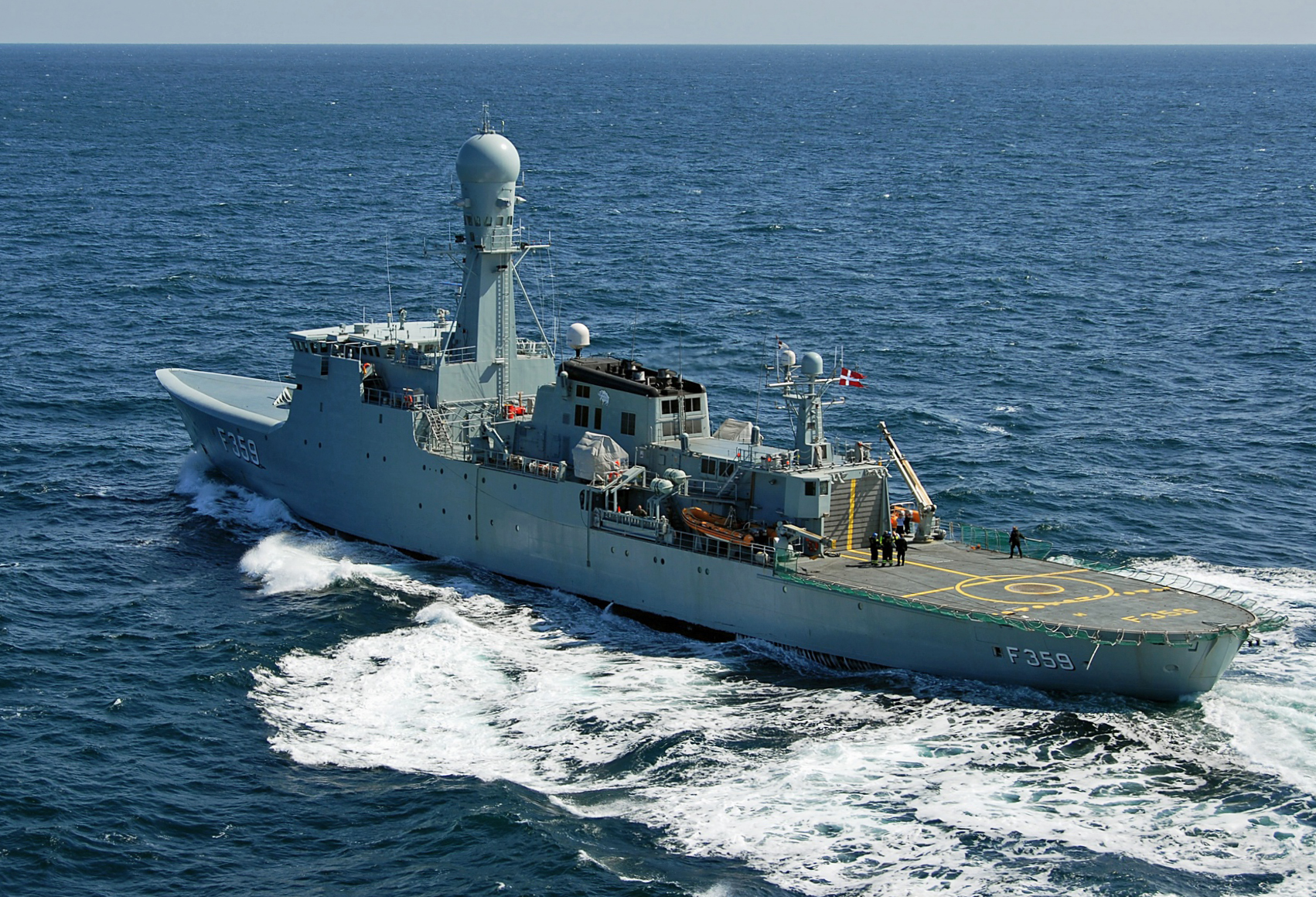
File:HDMS Vaedderen (F359).jpgUSCG Photo: HMDS Vaedderen, at 3,500 tons, a relatively large but simple, ice strengthened Offshore Patrol Vessel of the Thetis Class, with StanFlex modular payload capability

Considering the new Navy destroyer program, GAO identified problems that come from trying to put too much, into too small a hull. They call this problem design density. While perhaps less of a problem for the Coast Guard, this also applies to cutters like the proposed Offshore Patrol Cutter (OPC).

It may be counter-intuitive, but size alone is not necessarily a significant determinant of cost. As we noted earlier, the new largest ships in the world do not really cost that much. In fact, they cost less than the National Security Cutter (NSC), and probably less than the OPC. The GAO report indicates for a given capability, a smaller hull may actually cost more, because the density of systems may make design, construction, and maintenance more difficult. Additionally GAO notes it may lead to shorter hull life as it seems to have in some Navy ships. Certainly it is easier to provide good range and sea keeping if we use a larger hull. Both the crew and the machinery are likely subject to less motion. Larger hulls also mean more underway maintenance may be possible, because it is easier to get to the machinery.

This also goes a long way to explain why the NSC is larger than the 378s, the Fast Response Cutters are larger than the 110s, and why hopefully the the OPCs will be larger than the 210s and 270s. There is also the long term advantage of the vessels being able to take on new and unforeseen future roles, as we saw with the 327s.

A Truely Low Cost Maritime Surveillance Aircraft

Spanish IT contractor Indra, SELEX Galileo, FLIR Systems and Airborne Technologies are equipping an Italian built, light twin aircraft to perform maritime surveillance.


“Regarding the sensors, the aircraft will be equipped with SELEX Galileo’s Seaspray 5000E radar whose detail degree allows distinction of the shapes and sizes of objects and is capable of detecting vessels or small objects in the sea. It will also carry a state-of-the-art  electroptical camera of large format and high definition of FLIR Systems. We should also add a vessel id system which captures the automatic signals of ships. This identification signal emitted by ships is compared with that supplied by the aircraft sensors, thus facilitating surveillance and detection of suspicious actions.”

In its civilian form, the Tecnam P2006 is the lightest certified twin engine aircraft sold in the US. It has two 98 HP engines that can run on either AvGas or premium auto-gas. The four seat is about the size and price of a Cessna 172. Fuel burn is less than 10 gal. per hour.

An ability to search up to 40,000 sq miles (e.g. 200×200) on a single sortie is claimed.

This might be thought of as an alternative to UAVs.

Maritime Suicide Attack Plan Thwarted

Algerian authorities have arrested three alleged la-Qaeda terrorists who were reportedly planning on using a vessel loaded with explosive to attack American or European shipping in the Mediterranean.

This follows the pattern of an earlier attack on the Japanese tanker M. Star on July 28, 2010 and the attacks on the French tanker Limburg in 2002 and the Destroyer USS Cole in 2000.


All CG Vietnam Vets, Presumed Exposed to Agent Orange

Navy Times recently reported that the 47 additional ships had been added to the list of those whose crews may have been exposed to Agent Orange during the Vietnam war.

Looking into this a little further, it appears that all Coast Guard vessels that participated (WAK, WHECs, WLBs, WPBs) are included in the list. Go here for more information. Any Vets who set foot in country are also presumed to have been exposed.

“Veterans must meet VA’s criteria for service in Vietnam, which includes aboard boats on the inland waterways or brief visits ashore, to be presumed to have been exposed to herbicides.

“Veterans who qualify for presumption of herbicide exposure are not required to show they were exposed to Agent Orange or other herbicides when seeking VA compensation for diseases related to Agent Orange exposure.”

A New Icebreaker This Year

The US will finish a new icebreaker this year, unfortunately it is not for the Coast Guard.

Marinelink.com reports the icebreaker M/V Aiviq,

“…contracted by Shell Oil to support drilling in Alaska’s Chukchi Sea, is scheduled to be completed by Louisiana-based Edison Chouest Offshore in early 2012. The vessel, ordered in July 2009, is on track for April 1, 2012, delivery in Galliano, La., and will then head north, according to Shell Oil spokesman Curtis Smith.”

“The vessel is being built to International Maritime Organization’s Polar Code 3, and measures 111.8 m long, with a 22-m beam and 22-m draft. “It has hybrid generators, noise-reduction equipment, and meets or exceeds the U.S. Environmental Protection Agency’s Tier 4 emission standards,” Smith said. The Aiviq can hold thousands of barrels of oil. And because it will be stationed far from medical facilities, the vessel will have a hospital on board.”

(Thanks to Lee Wahler for the heads up.)