Several documents have emerged recently that provide more information on the proposed Offshore Patrol Cutter (OPC), also known as the Maritime Security (Cutter), Medium (WMSM). This builds on information previously published (here, here, here, here and here).
The Request for Proposal included a projected build schedule for the first 11 ships.
- FY 2016 Detail Design
- FY 2017 OPC#1 Construction begins
- FY 2018 OPC#2
- FY 2019 OPC#3
- FY 2020 OPC#4 and #5
- FY 2021 OPC #6 and #7
- FY 2022 OPC #8 and #9
- FY 2023 OPC #10 and #11
There is a notation that the average cost of units 4-9 shall be $276M in FY2016 dollars. (Looks like there might be potential for a multi-year contract here.)
One of the big surprises to me (found in the Fleet Mix Study) was that the OPCs are expected to essentially take over all Alaska Patrols.
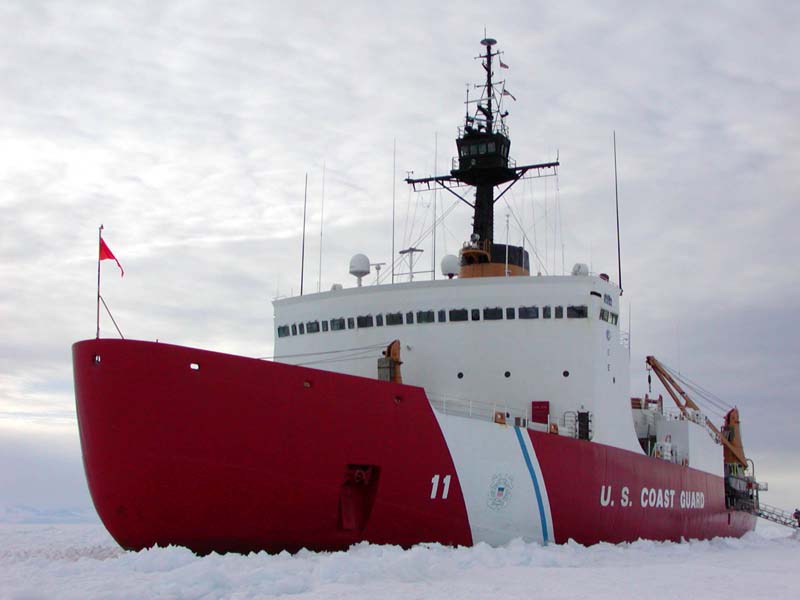
The draft Request for Proposal (RFP) also includes a requirement to equip all of them “to operate in areas of broken plate, pancake, and sea ice ranging from 10 to 30 inches thick.” Along with this, came a requirement to be able to operate an ice capable small boat as well. OPCs are also to have automated topside de-icers.
These characteristics combined with the Commandant’s affirmation that the ships should be capable of boat and helicopter operations in state five seas mean these ships will be very much more capable than the WMECs they are nominally replacing, and at least to some degree, that they are taking over duties previously assigned to 378s.
Towing ability to 10,000 tons is required, same as the 378s.
The ships are expected to be able to do Fueling at Sea (FAS), Replenishment at Sea (RAS), Vertical (Helicopter) Replenishment or VERTREP, and to refuel smaller vessels (apparently reflecting an expectation of sustained operations with WPCs or WPBs at locations remote from their bases).
Minimum ranges was specified as 7,500 nautical miles. (This is a reduction from 8,500 miles). Typical operations as outlined in the Concept of Operations (CONOPS) were 14 days between refueling, 21 days between replenishment, and 45-60 day patrols. It also stated there would typically be a four to six week inport “Charlie” (stand-down/maintenance) period after each patrol; a six to seven week dockside availability every two to three years; and a seven to eight week drydocking every four to five years. “In addition, the cutter will undergo 3-4 weeks of training and evaluation every 10-24 months.”
An expectation that the ships might operate with Expeditionary Strike Groups (ESG) was apparently a recent addition. This helps establish a floor for the ships’ maximum speed, since all the units typically operating in an Expeditionary Strike Group (LHAs, LHDs, LPD, LSDs) have speeds of 20 to 24 knots. When the current generation of LSDs is replaced in the not too distant future, all will do 22+ knots. Of the three ships that typically make up an ESG, the largest (LHAs or LHDs) all do at least 24 knots and frequently act as small aircraft carriers. If the OPCs are to be fast enough to stay with these ships and hopefully maneuver around them, then 25 knots appears to be a minimum rather than a nice to have.
The crew is not to exceed 100, but additional birthing must also be available for a 5 person AvDet and a 5-11 person “Signals Intelligence Support Element,” “and possibly others.”
There was reference to ballistic protection, that I had not seen before.
“The WMSM will provide increased protection for (sic.) small caliber weapons and shrapnel fragmentation around the bridge, CIC, and magazine spaces.”
The ships are to be built the American Bureau of Shipping Naval Ship Rules, but will not have explosive or underwater shock hardening.
Again we do not have access to the draft specifications, but we can deduce some details of the proposed equipment from the Allowance Equipage List included in the Draft RFP. All the systems below are referenced. (In a few cases there may be duplicate listing if different nomenclature is used for the same system.) The outfit, in most respects, repeats or even improves on that of the National Security Cutter:
Communications:
- Military SAT com
- Tactical Data Link System
- IFF
- SBU (presumably “Sensitive but Unclassified”) Network
- SIPRNET (Classified Network)
- NIPRNET (Unclassified Network)
- Entertainment System
Sensors:
- TSR-3D RARAD System, a multimode surface and air surveillance and target acquisition radar
- Electro-Optic/Infrared Sensor system
- RADIAC
Armament:
- Mk 48 mod 1 Gun Weapon System (pdf), which includes the Mk 110 57mm gun, AN/SPQ-9B Surface search and Fire Control Radar, Electro-Optical sensor system Mk 20 mod 0, the Mk 160 GCS Mod 12, and Mk 12 Gun Computer System
- Mk 15 mod 21-25 CIWS (Phalanx)
- Mk 38 mod 2 25 mm
- Gun Weapon System (.50 cal.) SSAM
- Four crew served .50 mounts including Mk 16 and Mk 93 mod 0 or mod 4 mounts
- Mk 46 optical sight
Electronic Warfare:
- Mk 53 Decoy launcher
- AN/SLQ-32 (v)2
Navigation:
- Encrypted GPS
- Electronic Chart Display and Information System
Intelligence:
- Ships Signals Exploitation Space (A change from SCIF (Sensitive Compartmented Information Facility))
- Special Purpose Intel System
Aviation:
- Hangar for helicopter up to and including Navy and Coast Guard H-60s
- Facilities for the support of unmanned Aerial Systems (UAS)
- TACAN
- Visual Landing Aids