“North American Arctic defense could shape outcome of Indo-Pacific conflict” –Indo-Pacific Defense Forum

A U.S. Army Green Beret observes an incoming CH-47 Chinook helicopter during Operation Polar Dagger in Wales, Alaska, in August 2024. IMAGE CREDIT: SPC. BRYON DAVIDSON/U.S. ARMY

The Indo-Pacific Defense Forum reported on a Special Operations Command North (SOCNORTH) exercise,

“To address growing concerns in the Arctic, SOCNORTH recently executed two phases of Operation Polar Dagger, an operational series that demonstrates rapidly deployable, joint SOF capabilities throughout the North American Arctic. It forms the basis of options to deter, disrupt and deny adversary activity in support of U.S. Northern Command’s (USNORTHCOM) layered defense of the U.S. homeland…

“In 2023 and 2024, SOCNORTH and the U.S. Navy partnered to deploy the amphibious transport dock ship USS John P. Murtha and the USS John L. Canley, an expeditionary sea base vessel that supports SOF operations and other maritime missions, to the Bering Sea and the Arctic Circle to support Operation Polar Dagger. USSOF is enhancing its navigation expertise in Arctic terrain and has demonstrated the ability to thrive in the region by executing long-range movements, maritime interdiction operations, rapid infiltration/exfiltration, air-to-ground integration, critical infrastructure defense, domain awareness, and medical evacuation validation, among other engagements.”

(I suspect what this means is that USS John P. Murtha participated in 2023 and USS John L. Canley participated in 2024. Both could not have participated both years.)

A lot of the post is an attempt to explain to an Indo-Pacific audience why a NORTHCOM exercise should be important to them.

Observations: 

It appears that Polar Daggar is a part of the larger NORTHCOM NOBLE DEFENDER exercise. This is apparently a regular annual exercise. NORTHCOM’s on-line magazine reported on the 2023 exercise.

“U.S. Army and Navy assets conduct an interdiction operation in the Bering Sea in July 2024.” Note how flat the seas are. That’s not normal. They did do this in July. You can’t count on seas like this. IMAGE CREDIT: SENIOR AIRMAN JOHNNY DIAZ/U.S. AIR FORCE

There is a serious problem here because there was apparently no Coast Guard participation in these exercises. The Navy’s Pacific Fleet almost never has surface ships anywhere near the Arctic. If you have an urgent need for a ship to do something in the Bering Sea, the Coast Guard is really the only option most of the time. SOCNORTH should be learning how they can exploit Coast Guard resources including ships, boats and aircraft. If you want maritime interdiction in the Bering Sea, if you want maritime domain awareness, who should NORTHCOM call? –the Coast Guard.

Want to fly a “Night Stalker” helicopter off of a ship? Want to launch ATACMS from the Chukchi Sea or maybe Tomahawk or SM-6 from a Mk70 launcher? You could put it on the flight deck of a cutter. 

Need follow-up logistics for paratroopers dropped into an isolated coastal location? Coast Guard.

A satellite image of Shemya Island. What is now called Eareckson Air Station, with its lengthy runway, is seen along the southern edge. Google Earth

Not enough Air Force transports available when you need to move troops to reinforce Shemya? Kodiak C-130Js can help with that.

Cutter might even put a landing party ashore to provide quick protection for a critical facility and stand offshore to provide some AAW protection with its 57mm.

East-Coast-based U.S. Naval Special Warfare Operators (SEALs) conduct an over the beach infiltration on Shemya Island, Alaska, Sept. 6, 2023, as part of Operation Polar Dagger. During the operation, special operations forces projected the ability of U.S. forces to defend critical infrastructure, enhanced all-domain awareness, demonstrated operational reach, and strengthened our understanding of activity in the Arctic. (U.S. Navy photo by Mass Communication Specialist 2nd Class Matthew Dickinson)

In 2023, Special Forces operating from USS John P. Murtha (LPD-26) did an infiltration exercise. A cutter could have done the same thing, and it probably would have been more realistic since an LPD is unlikely to be available.

Any surface or land action at the start of a conventional conflict against Russian and/or China that involves the Arctic is likely to be a surprise involving small units, probably involving covert actions from unconventional platforms, paratroopers, and small unit insertions. At least initially, it will be a “run what you brung” war. We will have to fight with what we have and effectively the Coast Guard is the surface navy for Alaska.

The “Center of Gravity” for the theater is likely to be the Bering Strait. As long as the US controls the strait, the Northern Sea Route will be useless for traffic between the Russian North coast and China or the Russian Pacific Coast.

The photo that leads off this post was taken at Wales, Alaska, population 145, 111 miles (179 km) northwest of Nome. The location is significant in that it is on the Eastern edge of the Bering Strait. It appears someone has recognized the significance of the location.

This Day in Coast Guard History, December 28

Based on the Coast Guard Historian’s timeline, https://www.history.uscg.mil/research/chronology/
With inspiration from Mike Kelso

December 28

1835  The “Dade Battle” occurred when Seminole Indians ambushed and killed Major Francis Langhorne Dade and his Army command while they were on the march on Fort King Road from Fort Brooke to reinforce the troops at Fort King (Ocala).  This battle was the immediate cause of the Second Seminole War, a war in which the Revenue Cutter Service played an important role.

Cape Flarry Lighthouse

1857  The light was first illuminated in the Cape Flattery Lighthouse, located on Tatoosh Island at the entrance to the Straits of Juan de Fuca, Washington.  “Because of Indian trouble it was necessary to build a blockhouse on Tatoosh Island before even commencing the construction of the lighthouse. Twenty muskets were stored in the blockhouse, and then the lighthouse work began.”

Light House Service Seal

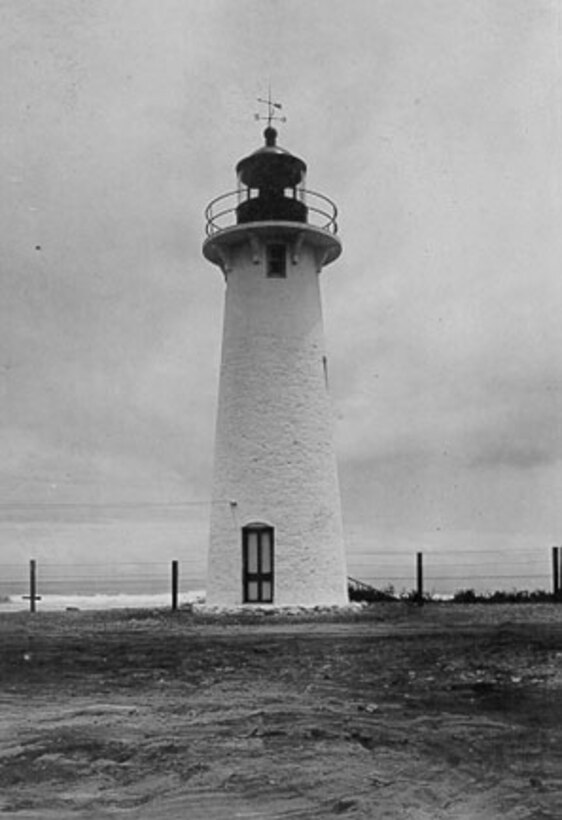
Barbers Point Light, Barbers Point, outside of Kalaeloa, Oahu, Hawaii

1903  An Executive Order extended the jurisdiction of the Lighthouse Service to the non-contiguous territory of the Hawaiian Islands.

USCGC Tahoma (WMEC-908)

2014  CGC Tahoma returned safely to its homeport of Kittery, Maine after a 55-day patrol conducting operations and training in the Gulf of Maine and Georges Bank.  Tahoma’s law enforcement teams conducted boardings of commercial fishing vessels to inspect safety gear and enforce marine resource management to ensure sustainable fisheries in the North Atlantic.  On December 1, 2014 Tahoma’s crew assisted the disabled F/V Madison Kate following an engine casualty.  Tahoma’s crew put the vessel in tow and safety and transferred it to a Coast Guard Station Brant Point motor life boat.

“Quentin Walsh — D-Day planner and Cherbourg liberator 80 years ago!” –MyCG

190606-N-DM308-001 A graphic illustration of the future Arleigh-Burke class guided-missile destroyer USS Quentin Walsh (DDG 132). (U.S. Navy photo illustration by Mass Communication Specialist 1st Class Paul L. Archer)

MyCG has a retelling of the life of my favorite Coast Guard Hero, Quentin Walsh. Read the whole thing, but I have quoted below the section on what he and his 53 man  SeaBee unit did in less than three weeks following the Normandy invasion.

German prisoners march out of surrendered Cherbourg under U.S. Army guard. U.S. Navy photo.

By Tuesday, June 27th, Walsh’s men had fought their way through to Cherbourg’s harbor. During this assault, Walsh moved his men quickly to occupy strategic parts of the port and take control the harbor. During the assault, the men in his unit experienced a twenty-five percent casualty rate. By the end of the day, Walsh’s unit had advanced to the city’s old naval arsenal, where he accepted the surrender of 400 German troops.

After capturing Cherbourg’s port facilities, Walsh learned that the Germans held American paratroopers in the city’s old citadel at Fort du Homet. In the highlight of the Cherbourg operation, and likely his career, Walsh and one of his officers put themselves in harm’s way to save the lives of the Americans. The two officers entered the fort under a flag of truce and met with the commanding officer of the German garrison. By greatly exaggerating the numeric strength of his small force of Sea Bees, Walsh convinced the commanding officer to surrender the stronghold. With the surrender of Fort du Homet, Walsh and his men disarmed another 350 German troops and liberated over fifty American prisoners.

I have added this story to my Heritage page. There is an earlier post here reporting that the Secretary of the Navy had announced the decision to name DDG-132 after Walsh while on the deck of USCGC Eagle, in Cherbourg, June 6, 2019.

USS Quentin Walsh (DDG-132), a Flight III Arleigh Burke class destroyer, is to be built by Bath Iron Works.

This Day in Coast Guard History, December 26/27

Based on the Coast Guard Historian’s timeline, https://www.history.uscg.mil/research/chronology/
With inspiration from Mike Kelso

December 26

Coast Guard manned LSTs 202 and 204, Landing at Cape Gloucester, 230 miles (370 km) west of Rabaul and 245 miles (394 km) northeast of Port Moresby.

1943  Landings at Cape Gloucester were conducted by Coast Guard-manned LSTs 1822666768168202204, and 206.  The LST-22 shot down a Japanese “Val” dive bomber while LST-66 was officially credited with downing three enemy aircraft.  Two of her crew were killed by near misses.  LST-67 brought down one Japanese dive bomber while LST-204 shot down two and the gunners aboard LST-68 claimed another.  The LST-202 claimed three enemy planes shot down.

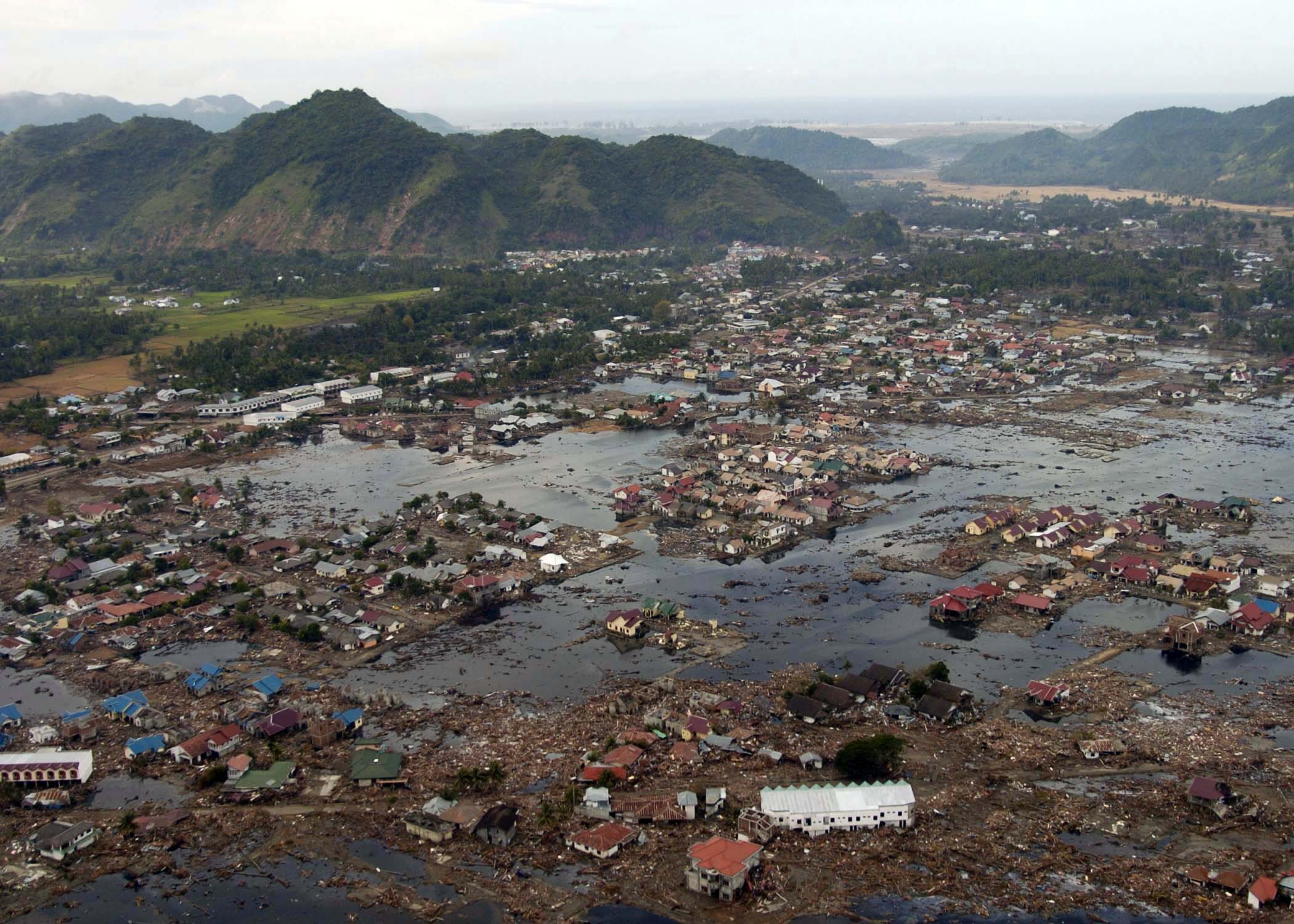
050102-N-9593M-040 Indian Ocean (Jan. 2, 2005) A village near the coast of Sumatra lays in ruin after the Tsunami that struck South East Asia. U.S. Navy photo by Photographer’s Mate 2nd Class Philip A. McDaniel

2004  A 9.1-magnitude earthquake off the coast of the Indonesian island of Sumatra triggered a tsunami that killed around 230,000 people across a dozen countries, reaching as far as East Africa. CGC Munro, deployed as part of Expeditionary Strike Group 5 (ESG-5), along with the other units in the Group, responded.  The cutter shuttled more than 80 tons of humanitarian relief supplies from Singapore to USS Bonhomme Richard (LHD-6), also part of ESG-5, for distribution to the victims of the tsunami.

December 27

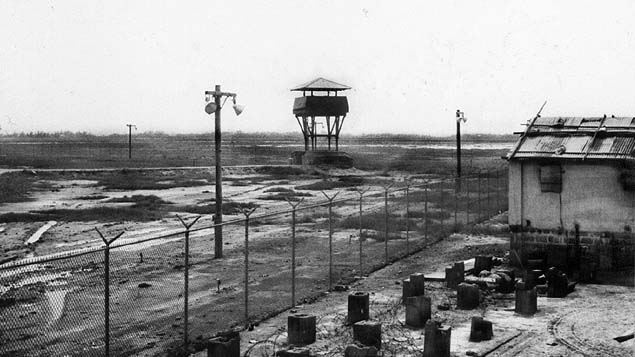
1968  The United States Air Force requested additional LORAN-C coverage in Southeast Asia and by December 27, 1968 the Coast Guard had received authorization to proceed with the project.  This led to the construction a LORAN station at Tan My, South Vietnam, that supplemented the other LORAN stations in Southeast Asia first established in 1966 under an operation code-named Tight Reign.

“Coast Guard Cutter Forward and Coast Guard Cutter Bear, homeported in Portsmouth, Virginia, finish an at-sea transfer while underway on a two-month patrol. Coast Guard Cutter Forward returned to homeport on April 10, 2021.” (U.S. Coast Guard photo)

1977  The Coast Guard awarded Tacoma Boat-building Company, Inc., of Tacoma, Washington, a $110,207,245 contract for the detail design and construction of four 270-foot Medium Endurance Cutters.

2012  Watchstanders at Coast Guard Sector Anchorage first received contact from the crew of the tug Aiviq, which was towing MODU Kulluk, a Royal Dutch Shell Company ice-strengthened oil drilling barge, back to its winter port of Seattle.  In extremely heavy seas, the tow line parted and Aiviq requested Coast Guard assistance.  CGC Alex Haley was diverted from its patrol and, after Aiviq experienced total engine failure, attempted to take both the rig and Aiviq under tow.  The line fouled Haley’s port propeller, forcing the cutter to return to Kodiak for repairs.  CGCs Hickory and SPAR were dispatched to provide further assistance while Royal Dutch Shell sent three additional tugs to the scene.  Coast Guard aircraft rescued the rig’s 18-man crew safely on December 29 and delivered spare engine parts to Aiviq. Despite these efforts Kulluk went aground at Oceans Bay, Alaska, on December 31, 2012.  The rig was later refloated and towed to Unalaska.  No injuries or pollution incidents were reported and ultimately Kulluk was scrapped.

The AIVIQ, the unfortunate main player in this accident, was selected to tow the KULLUK from Alaska to Seattle. Picture ECO Publicity.

“The Aleutian Low looms over the North Pacific as a climatic warning to mariners navigating the Alaskan waters. This semi-permanent feature is made up of the day-to-day storms that traverse these seas in a seemingly endless procession. With these storms come rain, sleet, snow, the howling winds and the mountainous seas that make the northern Gulf of Alaska and the southern Bering Sea among the most treacherous winter waters in the Northern Hemisphere.”

USINDOPACOM Exercises & Engagements

INDOPACOM Defense Forum Special Features has a post that includes the map above that shows where “Exercise, Joint Combined Exchange or Training Teams” are located.

On the linked post, you can hover over the dots, and it will list activities in that location. Coast Guard is associated with dots identified as Solomon Islands, Federated States of Micronesia (FSM), Guam, Palau, Papua New Guinea, and Australia. It should have included the Marshall Islands as well. All these are also associated with Operation Blue Pacific.

Federated States of Micronesia, the Marshall Islands, and Palau are Compact of Free Association states. Guam and the Northern Mariana Islands are US territory.

The same post also has a different map that shows the location of DOD units normally located in the AOR (area of operations) that may be of interest.

“Serious About Building Maritime Capacity in the High Latitudes? Look South” –CIMSEC

CIMSEC has a post by two active-duty Coast Guard Officers suggesting greater engagement between the US Coast Guard and Navy with their Latin American counter parts in regard to operations in Polar Regions.

They also mention a new Colombian Coast Guard Arctic Research Vessel, ARC ‘Simon Bolivar (PO-151). Thought you might be interested in some specifications. More details here.

  • Displacement of 3,250 tons
  • Length: 83 meters (272′)
  • Beam: 16 meters (52.5′)
  • Max Speed: 13 knots

(The designation, PO, indicates Patrol Offshore and is shared with the former USCG Reliance, a WMEC210, as well as at least four other ships, two as small as 131 tons. Colombian Navy OPVs are designated PZE. PZE or PZEE (Spanish: Patrullero de Zona Economica Exclusiva), Exclusive Economic Zone patrol boat) Amazingly logical.

None of the Latin American ships in the post mentioned are as capable as the Polar Star or the planned Polar Security Cutter. They probably will never go as far South as Polar Star will go as it makes its way to McMurdo, but this does clearly illustrate that smaller, cheaper, ships that are not as difficult to build, can do useful work in the Polar regions.

Ceremony as the first Colombian research vessel ‘ARC Simon Bolivar’ departs for Antarctica.Credit: Juan Cano/Presidency of Colombia

“Coast Guard adds first polar icebreaker to its fleet in 25 years” –MyCG

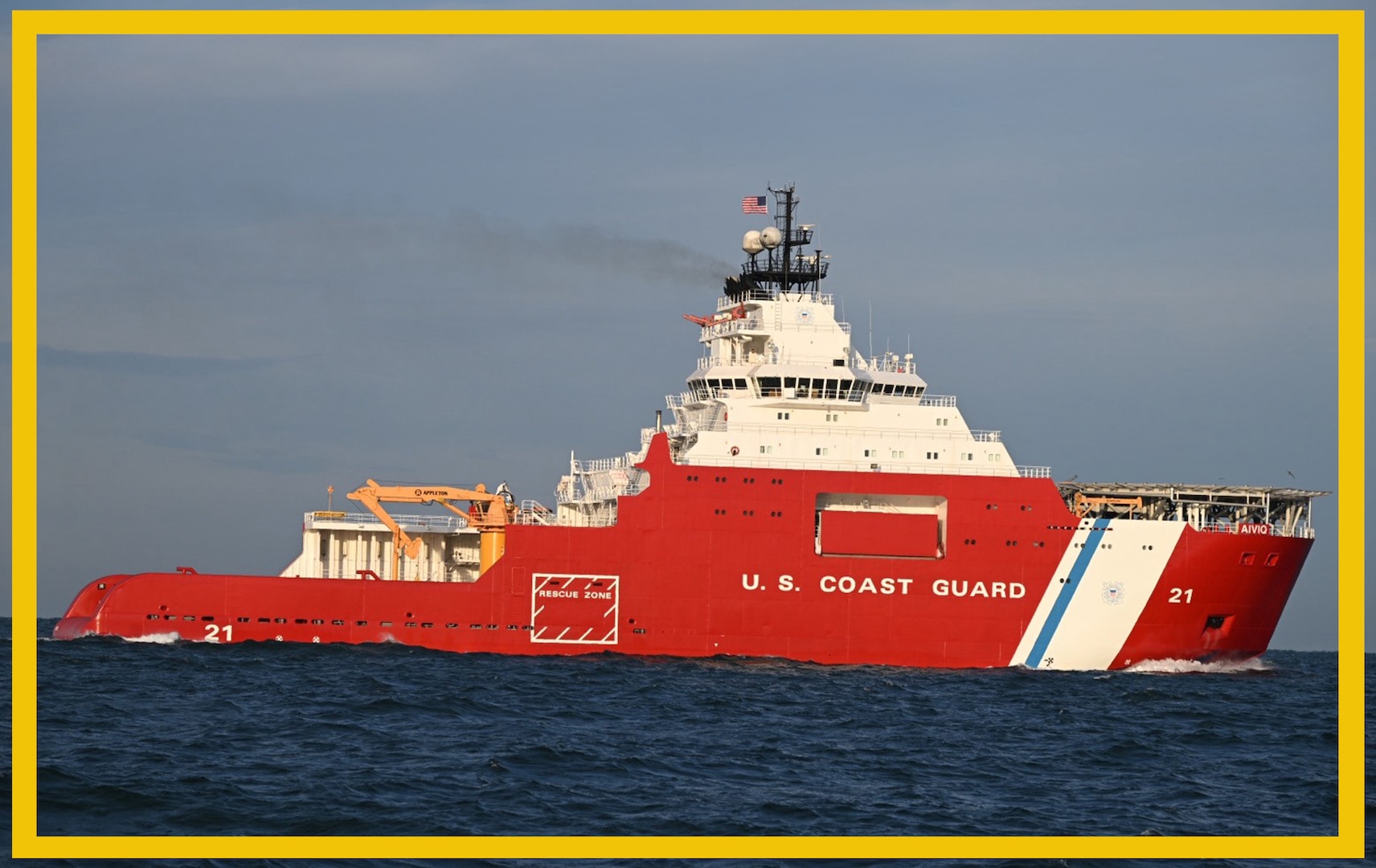
The future Coast Guard Cutter (CGC) Storis, the Service’s newest icebreaker, near Tampa, FL on December 10, 2024. The Coast Guard purchased the M/V Aiviq in November 2024 to bolster U.S. presence in the Arctic. The vessel will be renamed CGC Storis (WAGB 21) upon commissioning.

Passing along this report from MyCG.

There is still much work to be done before the ship is ready for its first patrol as a cutter. I expect the helo deck forward will be removed, and a deck and hangar will be installed aft. Hopefully they will also enclose some additional space to increase the freeboard aft, currently about three feet. The low freeboard caused problems in the past.

This seems to indicate that it will be some time before she is homeported in Juneau which suggests Seattle, or less likely Kodiak in the interim.

Interesting that they expect to man it with a crew smaller than that of a 210 (60 vs 75).


Dec. 23, 2024

Coast Guard adds first polar icebreaker to its fleet in 25 years

By Kathy Murray, Senior Writer, MyCG

The Coast Guard has officially welcomed its first polar icebreaker in more than 25 years – the recently acquired Aiviq, a commercial vessel that will be renamed CGC Storis.

Storis means “great ice” in Scandinavian. The name is also a nod to the original CGC Storis, a legendary light icebreaker and medium endurance cutter commissioned in 1942 that patrolled for submarines and ran convoys during World War II and led the first American transit of the Northwest Passage. In 1948, Storis was moved to Alaska where it conducted law enforcement, search and rescue, and humanitarian relief for 59 years until its decommissioning in 2007.

The new CGC Storis has undergone limited changes since its acquisition last month. These included painting the hull red and labeling the ship as WAGB-21. The vessel will be permanently homeported in Juneau, Alaska once the shoreside infrastructure is ready. The design and construction work for the homeporting project will take several years.

“The Coast Guard is thrilled to acquire this icebreaker,” said Commandant Adm. Linda Fagan. “Like its namesake, this cutter highlights the Coast Guard’s long history of operating in the Arctic and demonstrates our commitment to assert and protect U.S. sovereignty in the region.”

How it came about 

The Coast Guard received appropriation for a commercially available polar icebreaker in 2024 to supplement mission readiness and capability in the polar regions while Polar Security Cutters (PSC) are built. At a time of heightened activity in the area – including the first joint Russian/Chinese patrol passing near Alaska this summer – the Service only has two operational polar icebreakers. Our medium polar icebreaker, CGC Healy, was temporarily sidelined after experiencing an electrical fire in July. Meanwhile, the CGC Polar Star, a heavy polar icebreaker, is nearly 50 years old.

On Nov. 20, the Coast Guard purchased the M/V Aiviq, a 360-foot U.S.-built polar class 3-equivalent icebreaker for $125 million in a deal with Offshore Surface Vessels LLC. The vessel, which was constructed in 2012, has supported oil exploration in the Chukchi Sea off the coast of Alaska in the Arctic Ocean, and has deployed twice to the Antarctic. As a polar class 3-equivalent icebreaker, the future CGC Storis is expected to be capable of operating in waters that are otherwise inaccessible to most Coast Guard cutters.

What this means for future icebreakers 

Buying the future CGC Storis won’t affect the acquisition of the PSCs. The Coast Guard still needs a mix of eight to nine polar icebreakers to meet its operational requirements. In a congressional hearing last month, Vice Adm. Peter Gautier, the Deputy Commandant for Operations, noted the challenges in the region were mounting. “I acknowledge we have a national security threat now from the increased threat of competitors who are working together in ways we have not seen,” he said, adding that the U.S. would be at risk without these new icebreakers.

The Coast Guard is authorizing the shipbuilder, Bollinger Mississippi Shipbuilding, to build the first 16 modules that will be incorporated in the first PSC, CGC Polar Sentinel, with estimated delivery in 2030.

In the interim, the future CGC Storis is expected to help bridge the gap and provide additional capability in support of national security in the region.

How was the new icebreaker named? 

Before the future CGC Storis was acquired, a working group generated a list five potential names that were submitted to an official naming committee composed of senior officers and enlisted personnel. This group ranked their top three choices.

“Storis” was an early favorite given the long history and accomplishments of its namesake. In addition to its previously mentioned activities, the original CGC Storis:

  • was first to arrive to the scene of the sinking CGC Escanaba in 1943, which was believed to have been torpedoed or hit a mine
  • became the first U.S. registered vessel to circumnavigate North America
  • was on scene for the largest U.S. earthquake (magnitude 9.2) in Alaska in 1964
  • was the oldest commissioned cutter in the Coast Guard during its tenure, earning the title “Queen of the Fleet”
  • participated in the 1990 rescue of the M/V Alaskan Monarch off of St. Paul Island, which was immortalized in the movie, “The Guardian”

How big will the crew be on this new icebreaker? 

The initial commissioning crew of the future CGC Storis will consist of approximately 60 officers and enlisted personnel. They will be assigned in the summer of 2025.

“Coast Guard building nation’s first Polar Security Cutter” –Coast Guard News

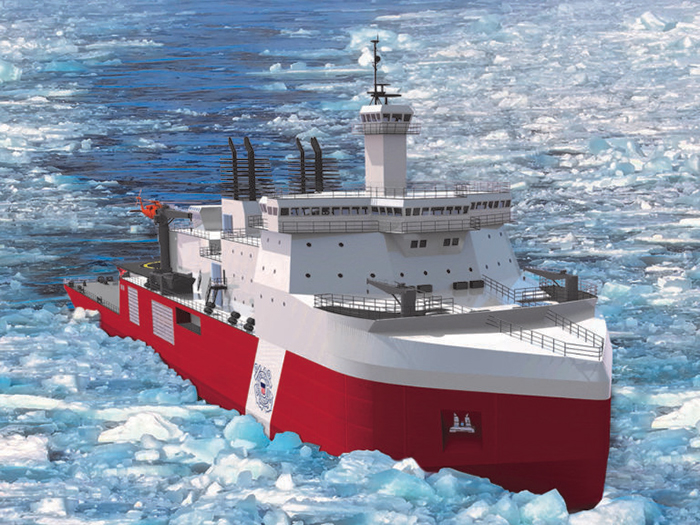
USCG Polar Security Cutter [Image courtesy Halter Marine / Technology Associates, Inc.]

Some good news. Below is a news release from Coast Guard News.

The design for the Polar Security Cutter (heavy icebreaker) is sufficiently mature to allow construction, and the shipyard has shown that it can do this type of construction.

Even so, delivery is not expected until 2030.


Dec. 23, 2024

Coast Guard building nation’s first Polar Security Cutter

The U.S. Coast Guard and U.S. Navy Integrated Program Office received approval Dec. 19 to begin building the first Polar Security Cutter (PSC).

The PSC marks the first heavy polar icebreaker to be built in the United States in more than five decades.

The work is being performed by Bollinger Mississippi Shipbuilding in Pascagoula, Mississippi, the prime contractor for design and construction of the future PSC fleet. This decision continues work that has been underway since the summer of 2023 as part of an innovative approach to shorten the delivery timeline of these critical national assets.

The approval incorporates eight prototype fabrication assessment units (PFAUs) currently being built or planned. The PFAU effort was structured as a progressive crawl-walk-run approach to help the shipbuilder strengthen skills across the workforce and refine construction methods before moving into a full-rate production. The PFA has prepared the government and the shipbuilder to begin construction of the PSC class, resulting in more precise, cost-effective and reliable construction processes.

The Coast Guard’s operational polar icebreaking fleet currently includes one heavy icebreaker, the 399-foot Coast Guard Cutter Polar Star, commissioned in 1976, and one medium icebreaker, the 420-foot Coast Guard Cutter Healy, commissioned in 1999.

The service recently acquired a commercially available polar icebreaker to provide additional presence and mission capability in the Arctic.

For more information on the PSC class visit the Polar Security Cutter website.

This Day in Coast Guard History, December 24/25

Based on the Coast Guard Historian’s timeline, https://www.history.uscg.mil/research/chronology/
With inspiration from Mike Kelso

December 24

It was just minutes past midnight of Christmas Eve 1955 when the Gum Tree Levee on the Feather River in Sutter County collapsed, sending a 21-foot wall of water into Yuba City. In the darkness of the night, the town would go into complete chaos, with families fleeing from their homes to escape the deadly flood.

1955  A Coast Guard helicopter was the first rescue unit to reach a flood disaster scene in Yuba, California.  Its crew hoisted 138 persons to safety within 12 hours.  The first 58 were made possible because of the light from a small handheld searchlight from positions of peril among chimneys, television antennas, and trees.  In all, the Coast Guard assisted Federal, state, and local agencies in saving over 500 persons by helicopters and boats.

December 25

1944  Allied forces liberated and occupied Palompon and Leyte in the Philippines.

1998  Coast Guard helicopters from Air Station Barbers Point rescued balloonists Richard Branson, a British billionaire, American millionaire Steve Fossett, and Per Lindstrand when bad weather forced them to ditch their balloon off Hawaii during their attempt to be the first balloonists to circle the globe.

This Day in Coast Guard History, December 22/23

Based on the Coast Guard Historian’s timeline, https://www.history.uscg.mil/research/chronology/
With inspiration from Mike Kelso

December 22

1819  The revenue cutter Dallas seized a vessel laden with lumber that had been unlawfully cut from public land in what was one of the first, if not the very first, recorded instances of a revenue cutter enforcing an environmental law.

1837  Congress authorized President “to cause any suitable number of public vessels, adapted to the purpose, to cruise upon the coast, in the severe portion of the season, and to afford aid to distressed navigators.”  This was the first statute authorizing activities in the field of maritime safety, thus interjecting the national government into the field of lifesaving for the first time.  Although revenue cutters were specifically mentioned, the performance of this duty was imposed primarily upon the Revenue Marine Service and quickly became one of its major activities.

December 23

1904  Near Oak Island and Fire Island, New York the American schooner Frank W. McCullough ran aground on Fire Island Bar, 2 miles from the former station and 4 from the latter, at about 9 am.  The Oak Island crew reached the vessel at 10:30 am and the Fire Island crew a half hour later.  They found her pounding heavily and leaking badly. They manned the pumps and assisted the crew in throwing overboard the cargo of lumber; but on the flood tide the sea began to break over the wreck and they were obliged to give up for fear of being washed overboard.  The Fire Island surfboat filled in the seaway and foundered.  At midnight the sea moderated and all hands, 14 surfmen and 5 of schooner crew, abandoned the wreck in the Oak Island surfboat and at 2 a.m. reached the shore.  The vessel was lost.

USCGC Lagare

2014  CGC Legare returned to its homeport of Portsmouth, Virginia following a 52-day patrol through the Caribbean and into the eastern Pacific Ocean.  During their patrol, Legare’s crew transited through the Panama Canal and coordinated with multiple countries in Central and South America, along with partner agencies to stem the flow of illegal drugs into the United States.  The unified effort resulted in the interdiction of multiple suspected drug smugglers and vessels transporting approximately 1200 kilograms, or approximately 2,645 pounds of cocaine, worth an estimated estimated street value of $40 million.