Chuck Hill's CG Blog

Chuck Hill's CG Blog

This Day in Coast Guard History, October 13

Based on the Coast Guard Historian’s timeline, https://www.history.uscg.mil/research/chronology/
With inspiration from Mike Kelso

The U.S. Coast Guard Cutter Eagle (WIX 327) passes USS Constitution, one of the six frigates ordered in 1794, in Boston Harbor during the ship’s July Fourth turnaround cruise as part of Boston Navy Week. Boston Navy Week is one of 15 signature events planned across America in 2012. The eight-day event commemorates the bicentennial of the War of 1812, hosting service members from the U.S. Navy, Marine Corps and Coast Guard and coalition ships from around the world. (U.S. Navy photo by Sonar Technician (Submarine) 2nd Class Thomas Rooney/Released)

1775  This is the date that the Navy recognizes as it’s official birthday.  The United States Navy traces its origins to the Continental Navy, which the Continental Congress established on October 13, 1775, by authorizing the procurement, fitting out, manning, and dispatch of two armed vessels to cruise in search of munitions ships supplying the British Army in North America.  The legislation also established a Naval Committee to supervise the work.  Altogether, the Continental Navy numbered some fifty ships over the course of the war, with approximately twenty warships active at its maximum strength.  After the American War for Independence, Congress sold the surviving ships of the Continental Navy and released the seamen and officers.  The Constitution of the United States, ratified in 1789, empowered Congress “to provide and maintain a navy.” Acting on this authority, Congress ordered the construction and manning of six frigates in 1794, and the War Department administered naval affairs from that year until Congress established the Department of the Navy on April 30, 1798.  In 1972, however, Chief of Naval Operations (CNO) Admiral Elmo R. Zumwalt authorized recognition of October 13, 1775 as the Navy’s official birthday.  There is no official motto for the U.S. Navy.  However “Non sibi sed patriae” (Not Self But Country) is often cited as the Navy’s unofficial motto.

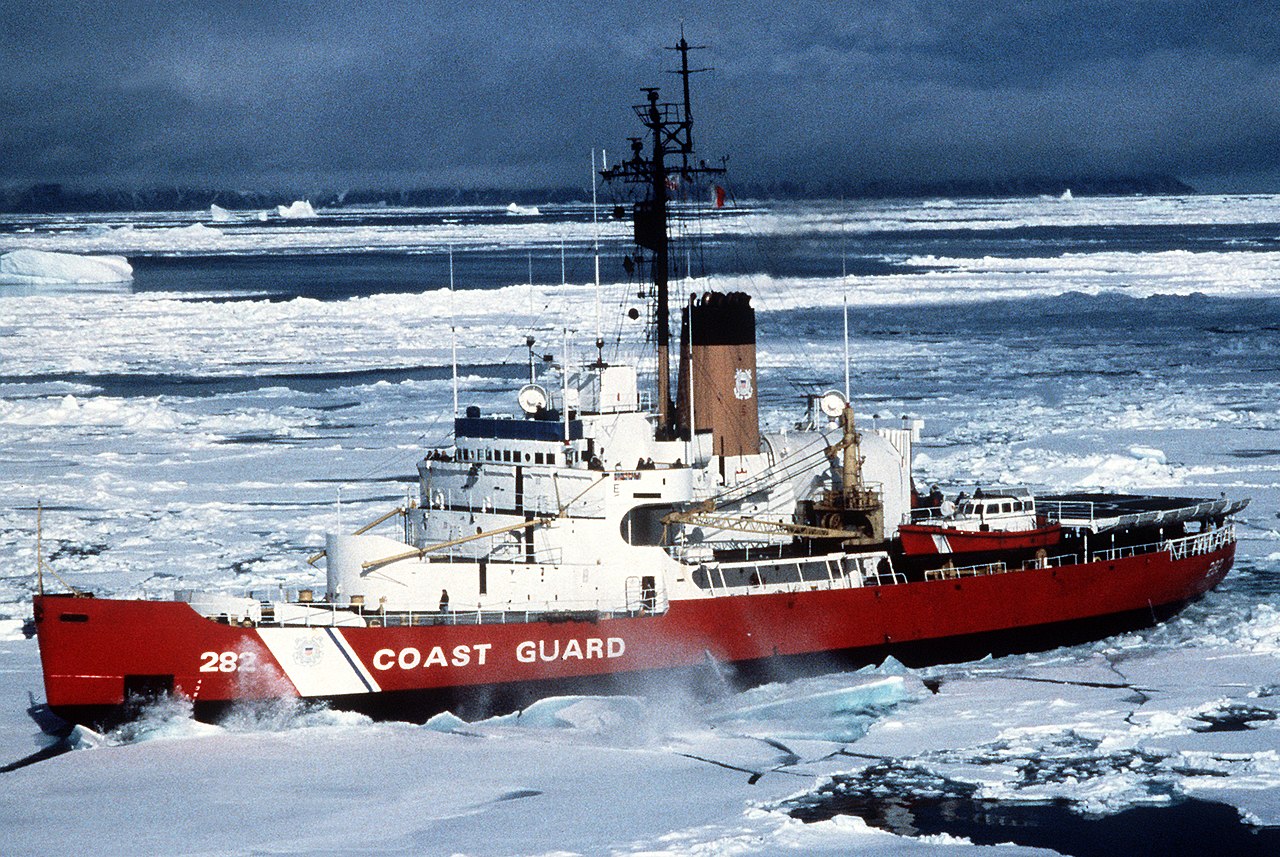
USCGC Southwind near port of USCG Base Berkley, after returning from a 27,000 mile tour of the Arctic.

1968  CGC Southwind departed Baltimore, Maryland for a seven-month deployment to Antarctica and other world-wide destinations.  By the time she returned to Baltimore on May 7, 1969 she had become only the second cutter in Coast Guard history to circumnavigate the globe.

Southwind had a varied carrier. From Wikipedia,

USCGC Southwind (WAGB-280) was a Wind-class icebreaker that served in the United States Coast Guard as USCGC Southwind (WAG-280), the Soviet Navy as the Admiral Makarov, the United States Navy as USS Atka (AGB-3) and again in the U.S. Coast Guard as USCGC Southwind (WAGB-280).

1988  The first U.S. merchant marine World War II veterans received their Coast Guard-issued discharge certificates.  Congress gave the merchant mariners veterans’ status and tasked the Coast Guard with administering the discharges.

USCGC IDA LEWIS

1995  CGC Ida Lewis was launched, the first of the new 175-foot Keeper class buoy tenders.

“Coast Guard Announces Conditions of Entry for Vessels Arriving from Sudan to Enhance U.S. Port Security” –CG News

Sudan displayed in dark green color, claimed territories not administered in light green

An interesting short announcement from Coast Guard News.


Coast Guard Announces Conditions of Entry for Vessels Arriving from Sudan to Enhance U.S. Port Security

Oct. 7, 2024

The Coast Guard has announced conditions of entry for vessels arriving from the Republic of Sudan in the Federal Register.

This Day in Coast Guard History, October 11

Based on the Coast Guard Historian’s timeline, https://www.history.uscg.mil/research/chronology/
With inspiration from Mike Kelso

Keeper Richard Etheridge (on left) and the Pea Island Life-Saving crew in front of their station, circa 1896.

1896  The crew of the Pea Island (North Carolina) Life-Saving Station, under the command of Keeper Richard Etheridge, performed one of their finest rescues when they saved the passengers and crew of the schooner E.S. Newman, after that ship ran aground during a hurricane.  Pushed before the storm, the ship lost all sails and drifted almost 100 miles before it ran aground about two miles south of the Pea Island Lifesaving Station.  Etheridge, a veteran of nearly twenty years, readied his crew.  They hitched mules to the beach cart and hurried toward the vessel. Arriving on the scene, they found Captain S. A. Gardiner and eight others clinging to the wreckage.  Unable to fire a line because the high water prevented the Lyle Gun’s deployment, Etheridge directed two surfmen to bind themselves together with a line.  Grasping another line, the pair moved into the breakers while the remaining surfmen secured the shore end. The two surfmen reached the wreck and tied a line around one of the crewmen. All three were then pulled back through the surf by the crew on the beach.  The remaining eight persons were carried to shore in this fashion. After each trip two different surfmen replaced those who had just returned.  For their efforts the crew of the Pea Island Life-Saving Station were awarded the Gold Lifesaving Medal in 1996.  (From Wikipedia: Five months after Etheridge had taken charge of Pea Island Station, arsonists burnt the station to the ground…“In the following days, the Newman’s captain searched for and found the piece of the side that held the vessel’s name and donated it to the crew as an offering of his thanks. For a century, this would be the only award the Pea Island crew received for their efforts. The 1896 Pea Island crew voted to give the wooden sideboard of the Newman to Theodore Meekins, the young surfman who first spotted the distress signal and who swam out to the wreck several times during the rescue. (Fifth from left in photo.)”)

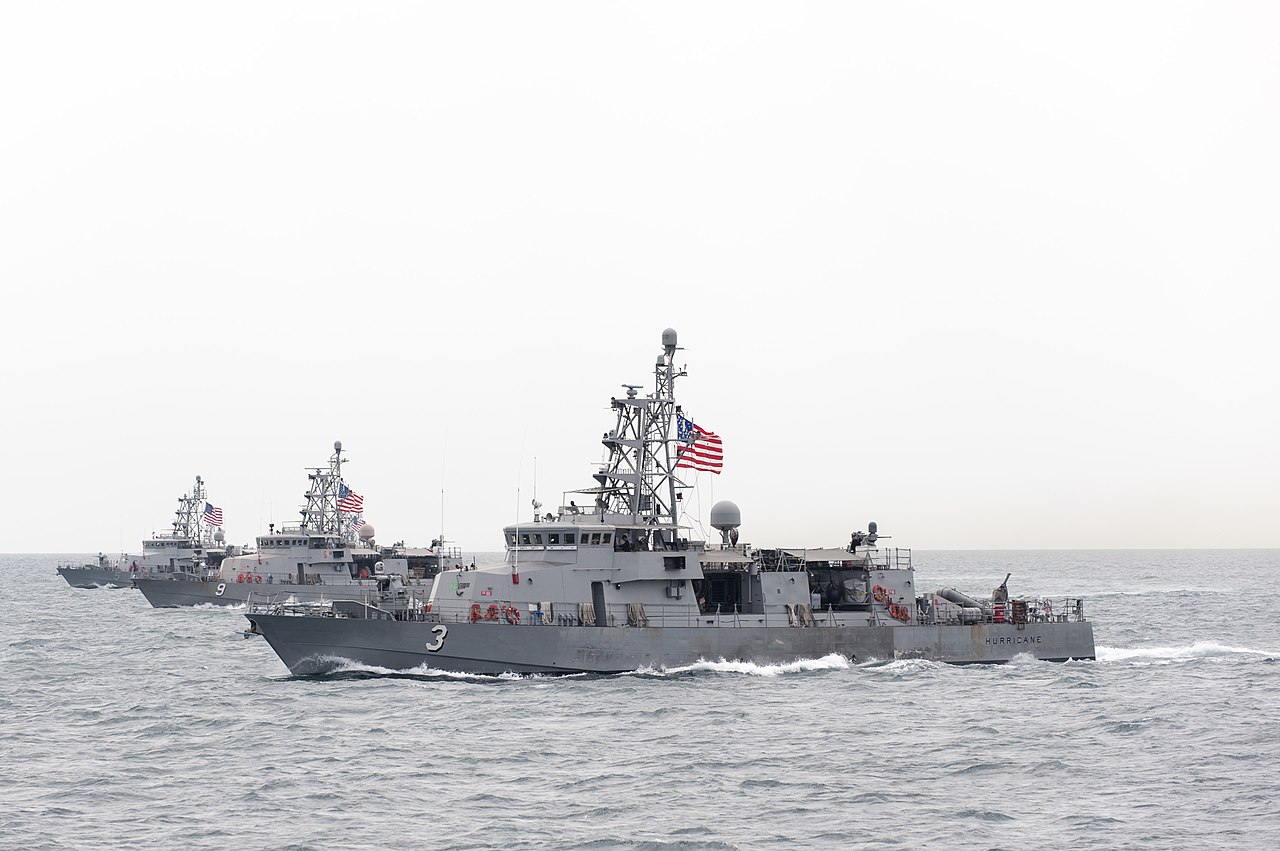
The first three fast response cutters—the USCGC Richard Etheridge (WPC-1102), Bernard C. Webber (WPC-1101), and William Flores (WPC-1103).
U.S. COAST GUARD

1897  Property saved at Cape Hatteras, North Carolina.  During a severe storm the surf threatened to wash away a fish house, with valuable nets and other gear.  Surfmen saved the property and took it to a place of safety.  They also assisted the Cape Hatteras lighthouse keeper to remove the lighthouse’s Fresnel lens to a secure place as the lighthouse was in danger of being knocked down by the sea.

141219-N-DX365-258
BAHRAIN (Dec. 19, 2014) Helicopter Sea Combat Squadron (HSC) 26, Det. 1, conducts a vertical onboard delivery with the U.S. Coast Guard Cutter Maui (WPB 1304). HSC-26 is a forward deployed naval force asset attached to Commander, Task Force 53 to provide combat logistics and search and rescue capability throughout the U.S. 5th Fleet area of responsibility. (U.S. Navy photo by Mass Communication Specialist 1st Class Joan E. Jennings/Released)

2013  CGC Maui, operating in the Persian Gulf as part of Patrol Forces Southwest Asia and assigned to Combined Task Force 152, rescued five Iranian mariners after they were fount adrift in a life raft in the northern waters of the Persian Gulf.  Maui’s crew later transferred the survivors to an Iranian Coast Guard vessel.

“Northrop Grumman Unveils the Next Generation of Bushmaster® Chain Gun®” –News Release

Northrop Grumman’s M230LF Dual Feed Bushmaster® Chain Gun® will offer two feed paths that can switch between air burst and high explosive, dual purpose ammunition rounds. (Photo Credit: Northrop Grumman)

Below is a news release from Northrop Gruman. The gun has been around since 1973 when developed for the AH-64 Apache attack helicopter, but the dual feed is new. While they say the single feed and dual feed share 60%-part commonality, that means they are 40% different so there are significant changes.

Dual feed is a big deal because it means a gun in a remote weapon station can now be ready to deal with both surface and air threats.

I’m pretty sure, the Coast Guard wants to be able to counter drone attacks–both air and surface. This weapon, used in a remote weapons system, is small enough to be considered a .50 caliber replacement, and it would be much more effective against both air and surface threats.


For the first time operators can change between advanced ammunition rounds with the flip of a switch

PLYMOUTH, Minn. – Oct. 9, 2024 – Northrop Grumman Corporation (NYSE: NOC), a leading manufacturer of medium-caliber cannons, is introducing its next-generation M230 Link Fed (M230LF) Dual Feed Bushmaster® Chain Gun®, offering two ammunition feed paths for the first time. This new 30x113mm medium caliber chain gun is a proven variant of the M230LF chain gun to counter uncrewed aerial threats (C-UAS) and ground engagements.

  • By offering a dual feed, the need for mixed ammunition belts in a single feed is eliminated.
  • The ability to switch between two kinds of ammunition is now possible. A standard recommended ammunition load includes XM1211 proximity fuzed rounds for C-UAS and XM1198 high explosive, dual purpose rounds for anti-armor capability.
  • The M230LF is currently at Technology Readiness Level 6. Meeting this threshold enables the capability to undergo live fire demonstrations that are currently scheduled for early 2025.

Northrop Grumman Unveils the Next Generation of Bushmaster Chain Gun

Northrop Grumman’s M230LF Dual Feed Bushmaster® Chain Gun® will offer two feed paths that can switch between air burst and high explosive, dual purpose ammunition rounds. (Photo Credit: Northrop Grumman)

Expert:

Dave Fine, vice president, armament systems, Northrop Grumman: “The M230LF Dual Feed Bushmaster Chain Gun offers new flexibility by switching between ammunition paths using dual-feed technology. Using advanced technology combined with five decades of battle-proven experience, this next-generation cannon will empower operators to quickly respond to threats. This chain gun is the latest in our Bushmaster line to deliver reliable, multi-mission capabilities addressing the evolving threat environment.”

About the M230LF Dual Feed Bushmaster:

As the first medium caliber chain gun in the world to offer a dual feed, the M230LF brings flexible lethality to the evolving battlespace. The cannon’s system can instantly switch between ammunition paths, enabling operators to seamlessly address targets that require different 30x113mm ammunition types.

A dual feed system gives operators the option to change between advanced ammunition rounds with the flip of a switch, delivering increased mission flexibility and lethality. The ability to select between two different rounds ensures targets are addressed with the best ammunition for the target type saving time, reducing logistical burdens and allowing for more engagements before needing to reload the system.

For operators already using the M230LF, the Bushmaster loads out at a similar weight to the single feed M230LF and features 60%-part commonality, leading to faster routine repairs and decreased down time for maintenance. Single feed M230LF cannons will continue to be produced for customers that prefer that option.

Northrop Grumman is a leading global aerospace and defense technology company. Our pioneering solutions equip our customers with the capabilities they need to connect and protect the world, and push the boundaries of human exploration across the universe. Driven by a shared purpose to solve our customers’ toughest problems, our employees define possible every day.

This Day in Coast Guard History, October 10

Based on the Coast Guard Historian’s timeline, https://www.history.uscg.mil/research/chronology/
With inspiration from Mike Kelso

1798  Secretary Benjamin Stoddert, first Secretary of the Navy, sent the first instructions to cutters acting in cooperation with the Navy in support of the Quasi-War with France, via the various collectors of customs.

Original St Joseph boathouse, 1874 – station keepers like Napier were expected to sleep in their boathouses. Public Domain.

1877  Captain Joseph Napier, Keeper of Life-Boat Station No. 6 (St. Joseph, Michigan), commanded a rescue mission for which he was awarded a Gold Lifesaving Medal.  His citation reads: “for the daring gallantry he displayed in rescuing the crew of the schooner D. G. Williams, near the harbor of Saint Joseph, Michigan on the October 10, 1877.  The schooner lay stranded during a heavy gale on the outer bar, with the sea breaking over her, and her unfortunate crew of six men up in the rigging for safety. Captain Napier got together three volunteers, commandeered a boat, and pushed out for the wreck.  At the first attempt the boat was capsized in the breakers.  On the second try he reached the wreck and returned with two of the sailors.  The third trip the boat was completely filled with water, but was bailed and again reached the vessel, bearing off two men.  At the fourth attempt Captain Napier and his three assistants were thrown out of the boat by a furious surge and one of his legs was badly hurt.  One of the men swam ashore.  Another got a line flung to him from the wreck and was taken aboard.  Captain Napier and the other man, clinging to the boat, succeeded in righting and bringing it alongside the schooner.  They then took off the two remaining men of her crew, together with the man taken on board, and regained the shore in safety.  On other occasions Captain Napier was known to have shown equal heroism on desperate seas.  Most notable instance was his rescue of the crew of the schooner Merchant during a tempest in 1854.  For this feat he was presented with a gold watch suitably inscribed by citizens of Chicago.”  He was the first recorded Life-Saving Serviceman to be awarded the Gold Lifesaving Medal.

USCGC Joseph Napier (WPC 1115)

1929  Clarence Samuels, commanding CG Patrol Boat AB-15, was promoted to Chief Quartermaster, thereby becoming the Coast Guard’s first African-American chief petty officer.

Lieutenant Junior Grade Clarence Samuels
First Hispanic of African descent commanding officer of a Coast Guard vessel during wartime


“Chinese Maritime Safety Officers Beat Vietnamese Fishermen During South China Sea Interdiction, Say Officials” –USNI

Personnel from the China Maritime Safety Administration board and attack the crew of the Vietnamese fishing vessel QNg 95739 TS. Screenshot of a Maritime Safety Administration video released by SCSPI on Sept. 29, 2024. 

The US Naval Institute News Service reports an incident in which personnel of the China Maritime Safety Agency boarded a Vietnamese fishing vessel. The boarding was resisted by the Vietnamese fishermen (see the video below) and when the Chinese agents came aboard, they severely beat the fishermen with metal rods.

This is just another example of the Chinese attempting to intimidate their perceived enemies by using brutal, but usually less than deadly force. There have been conflicts with India and the Philippines at similar levels of violence. Chinese fishermen have also responded with similar levels of violence when being boarded by South Korean Coast Guard.

I am surprised this was done by the China Maritime Safety Agency rather than by the China Coast Guard. This may reflect an attempt by the Maritime Safety Agency to enhance its status in the Chinese government, perhaps even an effort to prove its continued relevance.

Where this happened is not stated. Presumably it was inside China’s self-declared Nine Dash Line, but outside China’s internationally recognized Exclusive Economic Zone (EEZ) and probably within Vietnam’s EEZ.


This Day in Coast Guard History, October 9

Based on the Coast Guard Historian’s timeline, https://www.history.uscg.mil/research/chronology/
With inspiration from Mike Kelso

Fresnel Lens at Point Arena Lighthouse Museum, Point Arena Lighthouse, Mendocino County, California. Taken on 25 March 2012 by Frank Schulenburg

1852  The Lighthouse Board, which administered the lighthouse system until July 1, 1910, was organized. “This Board was composed of two officers of the Navy, two officers of the Engineer Corps, and two civilians of high scientific attainments whose services were at the disposal of the President, and an officer of the Navy and of the, Engineers as secretaries. It was empowered under the Secretary of the Treasury to “discharge all the administrative duties” relative to lighthouses and other aids to navigation. The Secretary of the Treasury was president of the Board, and it was authorized to elect a chairman and to divide the coast of the United States into twelve lighthouse districts, to each of which the President was to assign an army or navy officer as lighthouse inspector.” (The Lighthouse Board revolutionized coastal navigation.)

1858  The Secretary of the Treasury appointed a three-man board of U.S. Revenue Marine officers to consider a lifeboat design best adapted for life-saving work.

PC-590 Sea Trials. Source, Bob Daly/PC-1181/NavSource.

1945  Coast Guard manned patrol vessel USS PC-590 grounded and sank in typhoon off Okinawa.  All hands were rescued.

Okinawa, 9 October 1945. PC-590 breaking up in Typhoon Louise. Source: CDR John B. Payne, USNR, Ret. and NavSourcce.

1982  The first rescue using COSPAS/SARSAT occurred on this date when the trimaran Gonzo capsized 300 miles east of Cape Cod.  Gonzo’s ELT distress transmission was picked up by the Soviet COSPAS satellite and the sailing ship’s coordinates were transmitted to the U.S.  A Coast Guard HC-130 and a Canadian Air Force aircraft were directed to the scene and USCGC Vigorous safely rescued the three crewmen.  The new “space-age” satellite search-and-rescue system was a joint U.S., Canadian, French and Soviet project that at this time utilized a single Soviet satellite.

The components and operation of the Cospas-Sarsat system

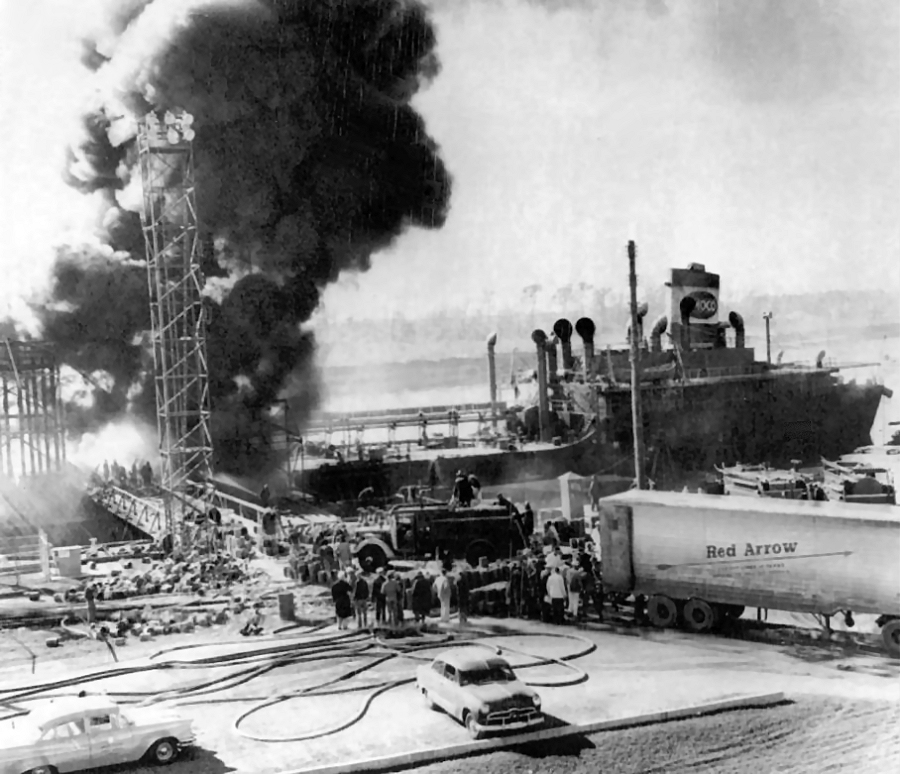
1993  Crews from seven 8th District units and several civilian vessels joined forces in response to an explosion and fire aboard the 660-foot bulk-liquid carrier OMI Charger near the Houston Ship Channel.  She had no fuel aboard when the explosion occurred the night of October 9.  CGC Point Spencer served as the command platform and personnel and boats from ATON Team Galveston joined the response effort, which included fire-fighting, SAR, and pollution response assistance.  The fire was extinguished five hours after the initial explosion.  Two of the tanker’s crewmen were killed in the blast.  Personnel from the Gulf Strike Team arrive on scene on October 10 and determined that the vessel’s fuel was still all aboard.  It was removed prior to the vessel being towed to port where it was declared a total loss.  A joint Coast Guard and National Transportation Safety Board met to investigate the explosion.

OMI Charger. From Wikipedia: “On October 9, 1993, while the tanker was anchored at Boliver Roads near Galveston, Texas, work began on sealing a previously discovered leak in a cargo tank. When a crew member lit an arc welder inside a tank, it ignited gasoline vapors, causing a tremendous explosion which killed three crew members and injured seven. The subsequent fire burned for five hours, and the ship was a total loss.”

“Interview with the Chief of the Colombian Navy” –Naval News

The 93-meter Offshore Patrol Vessel (OPV) is the first OPV that was designed and built by national means in Colombia

Naval News has an excellent interview with Vice Admiral Juan Ricardo Rozo Obregon, Chief of the Colombian Navy. It covers many topics of common interest with the US Coast Guard.

He mentions an intelligence sharing system I was not aware of.

Currently, we have developed capabilities in information systems and software development, reaching a high degree of technological independence. This autonomy has allowed the creation of advanced technological solutions with our own resources, reflected in the digitalization and automation of processes. An important example of these advances is the development of the Orion Platform, which integrates drug trafficking information from more than 62 countries worldwide, registering alerts and operational results with real-time visualization and monitoring.

Simon Bolivar, Arctic-capable Research Ship (Colombian Navy photo)

Also discussed is Colombian Navy support of Antarctic research.

Illustration of the Colombian Navy’s future SIGMA 10514 frigate (Damen picture)

An accompanying illustration of one of the five Damen designed light frigates Colombia is building gives us a bit more indication of how they will be armed. There is a 76mm on the bow, a 16 cell vertical launch system, quad cruise missile launch tubes between the bridge and the stacks, and a BAE 40m Mk4 well aft on top of the hangar. They will probably have ASW torpedo tubes as well.

This Day in Coast Guard History, October 8

Based on the Coast Guard Historian’s timeline, https://www.history.uscg.mil/research/chronology/
With inspiration from Mike Kelso

1847  To reduce the expenditures of the Treasury Department, Secretary of the Treasury Robert J. Walker ordered a reduction of the complements on revenue cutters.

Kaskaskia River, IL (Oct. 10, 1990)–The Coast Guard Cutter Sumac (WLR-311) on Kaskaskia River in Illinois. Photo by PA2 Robin Ressler

1986  Coast Guard units evacuated flood victims from the St. Louis area using punts, helicopters and trucks after the Mississippi and Missouri rivers flooded.  In all, 150 Coast Guardsmen participated in the emergency flood relief efforts.  Coast Guard units that sent relief teams were: MSO St. Louis; Base St. Louis; CGCs Sumac, Cheyenne, and Cimarron; ATON Facility Leavenworth, Kansas; 2nd District office; and Air Stations New Orleans and Traverse City.

USCGC Cheyenne

USCGC Cimarron