Changing Naval Balance

For background:

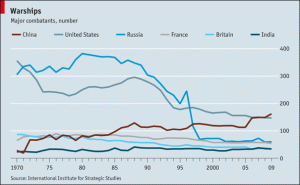
https://chuckhillscgblog.net/wp-content/uploads/2011/02/warships.gif?w=300

Numbers of course, are not the whole story. The US fleet is, by tonnage, far in excess of any competitor. The relatively strong allied fleets of Japan and South Korea are not included. The US still far outspends most of the rest of the world and most of the top ten navies of the world are our allies.

Still the decline of the Russian (Soviet) Navy and the continued growth of the Chinese Navy are clear. China’s rapidly improving quality including ships comparable to Aegis destroyers is not.

Source: Combat Fleets of the World here.

Taiwan Coast Guard Adds Two New Ships

The Taiwan Coast Guard, has just accepted two new major ships, the “Tainan” a 2,462 tons “frigate” and “Patrol Boat No. 7,” 1,845 tons. Both appear similar in configuration and capability to Japanese and Chinese Cutters–they appear to be made to merchant standards, and their armament is modest.

The Taiwanese President, Ma Ying-jeou, presided over the commissioning of the larger vessel. The “feel good” statements are here. A more forthright statement of their purpose is here.

The Taiwan (Republic of China) Coast Guard is a relatively recent addition, having been formed in 2000. They seems to have followed the USCG model in many respects.

The Taiwanese Coast Guard is charged with policing a total area of 540,000 square kilometers, which is 15 times larger than the island of Taiwan.

Taiwan is the third party in the dispute with China and Japan over the islands variously known as Senkaku, Diaoyu, Diaoyutai, or the Pinnacle Islands.

(This photo, found on the first link, shows a Taiwan Coast Guard ship that looks an awful lot like a 270.)

More on New Chinese WHEC

Some new information and an artist rendering of a 128.6 m (424 ft), 5,418 ton, 20.4 knot cutter to be delivered to the Maritime Safety Administration (MSA) in May of 2012. (Most of the recent construction has been for the Chinese Maritime Surveillance (CMS).)

The post also includes a link to an August 2010 post that explains the five different agencies that perform Chinese maritime law enforcement.

Chinese F/V Sinks after Ramming S. Korean CG Vessel

D. E Reddick provided this information as a comment on an earlier post regarding tensions between Japan and China. I thought it deserved a separate posting.

“Now a Chinese fishing trawler has rammed a South Korean Coast Guard vessel. One Chinese fisherman died, two Chinese fishermen are missing, and four SK coast guardsmen have been injured. The 63 ton Chinese trawler capsized after ramming the larger SKCG vessel. Reportedly, there were 50 Chinese trawlers fishing within SK territorial waters at the time of the incident. The video from Al Jazeera (English) demonstrates just how violently the Chinese crew were acting during the incident.

“RTT News – Chinese Fisherman Killed In Clash With South Korean Coast Guard

http://www.rttnews.com/Content/MarketSensitiveNews.aspx?Id=1510141&SM=1

“A video and text report from Al Jazeera – Chinese trawler in Yellow Sea clash

“A routine check goes awry after Chinese fishermen stop South Korean coast guards from boarding trawler in Yellow Sea.”

http://english.aljazeera.net/video/asia-pacific/2010/12/20101218175020549693.html

China Building Six Major Cutters a Year–How many are Enough?

China Defense Blog is reporting “In order to improve the capacity of marine law enforcement and safeguard marine rights, China plans to build 30 vessels for marine law enforcement in the next five years.” The source is here, but the blog has pictures, as well the complete text, while the source has none.

I found this quotation puzzling:

“China has a vast area of seas, but the number and the tonnage of vessels for marine law enforcement are both small. China’s fleet does not meet the standard of one vessel per 1,000 square kilometers (emphasis applied) and there is a huge gap compared to other developed countries, said Li Lixin, director of South China Sea Branch of State Oceanic Administration of China, on Monday.”

For comparison, from Wikipedia:

The US has the largest EEZ in the world: 11,351,000 sq km

Japan EEZ: 4,479,358 sq km

China’s EEZ is much smaller, 877,019 sq km. Even adding the EEZ of Taiwan and other areas claimed by China, but disputed by others (3,000,000 sq km) the total is 3,877,019 sq km.

Applying a one patrol vessel to 1,000 sq km would mean the USCG should have 11,351 cutters. In fact we have 43 patrol cutters over 1000 tons or about 1 per 264,000 sq km. If the Chinese had a ship to patrol area ratio like ours, they would only need three or four ships. Clearly there is a disconnect here.

We talked a bit about a comparison of the Japanese Coast Guard and their Chinese counterparts here, and it is clearly the Japanese they are comparing themselves to.  There is a pretty good article on the various agencies the Chinese use to do maritime law enforcement missions here.

The other nations with the largest EEZs are Australia, France, Russia. Japan, with the 9th largest EEZ, has the largest fleet of cruising cutters in the world. China’s EEZ is 32nd in size.

Still I think the Chinese may be on to something in terms of justifying their fleet. Maybe we ought to do some sort of resource to area of responsibility comparison. We know that our EEZs in the Southwest Pacific and Arctic are under served.

Chinese and Japanese Coast Guards, Another Turn of the Screw

Related posts:

There are more signs that tension between China and Japan is ratcheting up, and that their Coast Guards are the instruments of choice. The Chinese are reinforcing their Coast Guard in the Disputed area. The Chinese have disputes with a number of their neighbors, but I think they have several reasons for choosing to confront the Japanese first.

  1. Of all their claims to territory in dispute, claims to the islands variously know as the Senkaku, Diaoyu, Diaoyutai, or Pinnacle Islands, appear the most supportable.
  2. Both the Republic of China (Taiwan) and the People’s Republic of China see the islands as part of Taiwan (which the PRC, of course, also sees as part of China). This dispute puts the people of both mainland China and Taiwan on the same side against Japan. That may be seen in Beijing as politically useful.
  3. Because of their history, the Chinese people are ready to think the worst of the Japanese, so it is not hard to generate anti-Japanese feelings. Generating the same level of hostility against the Vietnamese or the people of the Philippines would be difficult.
  4. The Chinese have significant leverage on the Japanese economy, in that they have a virtually monopoly on rare earth minerals required for manufacture of many high tech devices. Playing this card has prompted a call to diversify sources for the minerals, but alternate sources are still years away.
  5. The Chinese may believe that, because the Japanese have the strongest military among the countries who have conflicting claims with China, if China can get the Japanese to roll over–the other countries may assume they cannot resist and will also cave.

Sidbar, Handicapping the contenders: If it came to blows between the two Coast Guards, I would put my money on the Japanese, but winning that particular battle may not be in the plan. Pointedly the Chinese are sending their “fastest marine law enforcement vessel.” This ship, “China Sea monitoring 75,” is slightly smaller than a 270 and only about one knot faster. The balance is changing rapidly, but the Japanese Coast Guard is still far larger and better equipped than their Chinese counterpart. In fact the Japanese Coast Guard (JCG) has more patrol vessels over 1,000 tons than the US Coast Guard, including eleven that are as large or larger than the National Security Cutter (go here and click on “pamphlet” for a pdf which includes information about the missions, organization, and assets of the Japanese Coast Guard)

In all probability, units of the nine ship Hateruma class (292 ft long, 1,300 ton, 30 knots, armed with the Mk44 Bushmaster II 30mm autocannon with laser-optical fire-control system), specifically intended to police of Senkaku Islands, will be among several vessels that will respond to any Chinese challenge.

The requirements that shape the latest vessels of the Japan Coast Guard seem to have been influenced by their experience in the “Battle of Amami-Oshima.” To call it a battle might be an exaggeration. It was a running gun-fight between an armed North Korean trawler and 20 vessels of the Japanese Coast Guard in 2001. In spite of intense machine gun fire from both sides, the North Korean vessel appears to have been scuttled, rather than sunk by fire from the Japanese vessels, the trawler’s crew choosing death rather than surrender. I find it hard to understand, in view of our experience in Vietnam, but the Japanese felt their 20mm Gatling guns were out-ranged by 9K38 Igla MANPADS and B-10 and recoilless rifle fire from the trawler. As a result they have built ships specifically intended to counter North Korean spy ships that have stabilized heavy machine guns from 20 mm M61 Gatling guns to Bofors 40mm/70s with associated fire control systems and for “High-speed, high-functionality” large patrol ships such as the three ships of the Hida class, 1,800 tons and three ships of the Aso class, 770 tons, hulls that are “bullet proof” (presumably against machine-guns up to 14.5mm–protection against anything larger would require great weight of armor).

It’s interesting to compare the JCG choices for ships of the Hateruma class and Hida class with the projected OPC. The JCG ships are much faster at 30+ knots. They have no hanger, but they can handle very large helicopters. USCG ships tend to be small naval combatants, while JCG ships appear to be built more along the lines of merchant ships. Armoring hulls is apparently not something the USCG has considered. USCG ships tend to be armed to fight at relatively longer ranges (gun ranges to 9 miles) against adversaries with sophisticated weapons including cruise missiles, while the JCG ships seem to be  optimized more for combat at relatively close, but not extremely close range (beyond 2000, but certainly less than 10,000 yards), ranges where crew served weapons and small arms are essentially useless, but their heavier weapons under electro-optic fire control can still dominate.

Sidebar, The Aftermath: Against the JCG the Chinese Coast Guard would probably loose a fight, but that might be best outcome from the Chinese point of view. If this is more about national unity and justifying sacrifice for additional weapons, nothing promotes national resolve like seeing stretchers come off a ship with wounded men to be greeted by their wives and girlfriends,  followed by body bags met by grieving widows and children. In any case, the Japanese will be portrayed as bullies–easy for the Chinese people to believe–and a strong military reaction justified. Both sides will have their cameras ready, because any encounter will be played out thousands of times on YouTube by battling videos, as we saw in the Gaza flotilla incident.

(Thanks to DER for bringing this to my attention.)


Japanese Coast Guard at Center of Sino-Japanese Dispute

Japan, China, and Taiwan are in a dispute over islands that convey ownership of potentially oil and gas rich offshore areas. The Japanese Coast Guard finds itself in the middle of the dispute. In the latest move it looks as if the Chinese may be moving drilling equipment into the disputed area. This is on the heals of apparently more aggressive fisheries enforcement by the Japanese Coast Guard that resulted in two Japanese cutters being rammed and a Chinese vessel seized with its captain still being held for prosecution. Some additional background here.

China’s Coast Guards

Information Dissemination has an article about the Coast Guard’s counterparts in China. Five agencies share the Coast Guard’s missions: China Maritime Surveillance (CMS) of the State Oceanic Administration (SOA), Fisheries Law Enforcement Command (FLEC), Maritime Safety Administration (MSA) of the Ministry of Transport, the anti-smuggling force of the General Administration of Customs, and their “Coast Guard” (aka Maritime Police in Chinese). All seem to be expanding, particularly China Maritime Surveillance and the Maritime Safety Administration.

The article talks almost exclusively about their cutters, including new construction. Apparently they don’t have many aircraft. There is no comprehensive list of personnel. Individually each is smaller than the USCG, but it sounds like collectively, they may have more personnel than the Coast Guard.

Chinese Claim the entire South China Sea as Sovereign Territory.

As noted earlier, there doesn’t seem to be universal agreement on what the “Law of the Sea” (UNCLOS) means. The Washington Post is reporting that Senior Col. Geng Yansheng, a Ministry of Defense spokesman, has claimed that China has “indisputable sovereignty” over the South China Sea but would continue to allow others to freely navigate the 1.3 million-square-mile waterway.

On July 23 Secretary Clinton crossed the Chinese by suggesting an multilateral approach to resolution of competing claims. Competing claims involve Japan, Taiwan, Brunei, Vietnam, Indonesia, Malaysia, the Philippines. Claims to the Spratley Islands group seem to be particularly contentious. There is an outline of competing claims here. China has used force in the past, seizing the Paracel Islands from Vietnam in 1976. Dai Bingguo, China’s state councilor in charge of foreign policy, had told Secretary Clinton in May during a tense exchange on the region that China viewed its claims to the sea as a “core national interest.” In addition they seem to have thrown down the gauntlet to the US over exercises in the Yellow Sea.

To complicate matters, the Chinese have a new weapon system, and anti-ship ballistic missile, to enforce their claims, that makes the Navy’s traditional response to Chinese aggressiveness appear much more dangerous.