GAO Responds to Fleet Mix Studies, Part 1, The Report

In my post, Irresponsibly Rebuilding the Fleet-a Look at the Future, I talked about why it was essential that the Coast Guard build at least two Offshore Patrol Cutters (OPC) a year, when it finally starts building them in 2016. My concern is that there is still no wide spread support for funding the Coast Guard’s “Program of Record” which includes 25 OPCs in addition to eight National Security Cutters and 58 Fast Response Cutters.

Conceptual Rendering of the OPC

The Coast Guard has recently gone public with similar concerns.

Studies are playing an important part in the effort to build consensus on what the Coast Guard’s fleet of Cutters should look like in the future and how to get there. May 28 of this year, we looked at the Executive Summary of the Offshore and Aviation Fleet Mix Study completed in 2009, but only recently made public. The Coast Guard completed a second phase of its Fleet Mix Study which looked at the effects of two funding levels on the procurement process in May 2011 and the Department of Homeland Security completed a “Cutter Study” in August 2011.

May 31, 2012 GAO released a report to Congressional Committees titled “Observations on the Coast Guard’s and the Department of Homeland Security’s Fleet Studies” [PDF] along with briefing slides provided on April 20, 2012. I’m going to quote GAO’s report and slides extensively.

GAO saw there objectives as to:

  • “(1) What are the key results of the Coast Guard’s Fleet Mix Studies and DHS’s Cutter Study with respect to recapitalization and operations?
  • “(2) How useful are these studies to DHS, the Office of Management and Budget (OMB), and the Coast Guard for informing recapitalization decisions?” Continue reading

Offshore and Aviation Fleet Mix Study Published

The Coast Guard has made public the Executive Summary of its Offshore and Aviation Fleet Mix Study. “FierceHomelandSecurity” has published a short summary of the content.

They also provided a direct link to the “Executive Summary” (a 24 page pdf). It is heavy with acronyms, and there is no list of acronyms attached to the Executive Summary, although there is probably one in the full study. I’ve attached a list of those I found, at the end of the post for those who might want a little help going through the summary.

“This initial phase of the FMA (Fleet Mix Analysis-ed.) is intended to address offshore surface and aviation capabilities. Follow-on FMA phases will assess capabilities needed for coastal and inland missions as well as emerging missions, such as Arctic operations and those of the Deployable Operations Group (DOG).

“ES.5.1  SCOPE:

“The FMA explored the projected Fleet mix requirements to meet the CG’s 11 statutory missions in FY2025. Mission requirements were based on nine Mission Performance Plans (MPPs) and an assessment of critical activities, such as training and support, which consume asset mission availability.

“The FMA included all CG aviation (fixed- and rotary-wing), all white-hull cutters (FRC up to NSC), and all applicable C4ISR systems.

“The FMA focused on activities in the offshore and aviation operating environment. Offshore and aviation are defined in the FMA as being generally 50+ nautical miles offshore and/or requiring extended presence. The FMA also considered missions within 50 nautical miles that consume air asset availability.

“The FMA used the 2007 CG Fleet, as defined in the 2007 Modeled CONOPS (Concept of Operations-ed.) and the “Deepwater” POR (Program of Record-ed.) as Baselines for comparative performance and cost analysis.

“ES.5.2  ASSUMPTIONS

“Preliminary Operational Requirements Document (P-ORD) thresholds were used for the OPC (Offshore Patrol Cutter-Chuck).

“The OPC and NSC will operate 230 days away from homeport (DAFHP). No specific crewing method is assumed (i.e., crew rotation concept [CRC]).

“The HC-144A will operate at 800 programmed flight hours (PFH) per year. (This is a reduction from previous assumption–Chuck)

“U.S. Navy out-of-hemisphere (OOH) (2.0 OPC/NSC) and Joint Interagency Task Force South (JIATF-S) (7.0 OPC/NSC) support was consistent with the FY2010 demand.

“Additional acquisition/next generation platforms have the same capabilities and cost as the FMA Baseline Fleet mix cutters and aircraft (e.g., the next-generation short range recovery (SRR) helicopter is an MH-65C).

“ES.5.3  CONSTRAINTS:

“The High Latitude regions of the ice shelf and Deployable Operations Group (DOG) mission requirements were not considered.

“No specific MDA performance measures have been established to model.

“87-ft coastal patrol boat (CPB), 225-ft seagoing buoy tender (WLB), Department of Defense (DoD)/Department of Homeland Security (DHS), and foreign asset contributions were considered, but force level requirements for 87-ft CPB, 225-ft WLB, DoD/DHS and foreign assets were not assessed.

“Additional shore facilities (e.g., schools, berthing, simulators/training aids, etc.) beyond those directly associated with platforms (e.g., piers, hangars, etc.) are not included in costs.

“”The need for non-operational/shore billet increases commensurate with the projected increases in operational manning was not assessed and is not included in costs.

“All cost estimates are rough order of magnitude (ROM) and are not budget quality.

“Additional specific assumptions utilized for modeling, simulation, and costing are included in their respective chapters of the final report.

“ES.3  Methodology:

“The Fleet Capacity Analysis (FCA) combined information developed in the mission validation phase, the capability definition phase, and a Warfare Analysis Laboratory Exercise (WALEX) to produce an objective Fleet mix and incremental Fleet mix alternatives. To develop the objective Fleet mix, the FMA used three independent teams with unique force projection tools or methodologies – the Database Enhanced Center for Naval Analysis (CNA) IDS Asset Assessment Tool (CIAAT) Model (DECMv2), the Mission Effectiveness Asset Needs Model (MEAN), and a qualitative analysis by a panel of CG SMEs – to develop a force structure that was aligned with MPP capability and capacity targets. Each team applied their methodology using a common set of asset characteristics and mission demands to develop a zero-based force mix (capable of meeting all mission requirements) projection. The results from these independent projections were considered as three “lines of position” (LOPs) and were consolidated to form a conceptual “fix.””

Seven Alternative Fleets:

The Study looks at seven levels of effort: Continue reading

Alternate Weapons for New Large Cutters?

Had an interesting discussion about why the National Security Cutter retained the Phalanx Close In Weapon System (CIWS) while the very similar weapons suite on the Freedom class Littoral Combat Ship used the Rolling Airframe Missile (RAM) system instead.

https://i0.wp.com/upload.wikimedia.org/wikipedia/commons/2/2c/RIM-116_Rolling_Airframe_Missile_Launcher_3.jpg

Mk 49 Rolling Airframe Missile Launching System Photo credit: Darkone 13 Aug, 2006, via Wikipedia

My friend contended that, while the Phalanx is very maintenance intensive, the launcher for the RAM is virtually maintenance free, which would benefit the relatively small crew. He also noted that the current models have an excellent anti-surface capability and longer range than the Phalanx.

This got me to thinking. I won’t make a recommendation, but will discuss alternatives that might be considered. I’ll talk about who is using the RAM and how, and discuss how the Coast Guard might use it, and its advantages and disadvantages as a possible replacement for the Phalanx and possibly even the 57 mm. But before we get to that, as we are always told, you have to start with the mission.

Continue reading

Multi-crewing, Coming to a Neighborhood Near You

Now that there are three National Security Cutters commissioned and  homeported in Alameda, we will soon see the first attempts at using multiple crews to man them, the “Crew Rotation Concept.” Four crews will man three ships. Additional facilities for the fourth crew are being built on Coast Guard Island.

There is a discussion of the Navy’s current plans for doing something similar here, along with comments on their previous experience with the concept.

https://i0.wp.com/upload.wikimedia.org/wikipedia/commons/7/7c/USCGC_Waesche_by_Yerba_Buena_Island.jpg

Photo Credit: U.S. Coast Guard photo ID: 100228-G-2129M-004, Petty Officer 3rd Class Kevin Metcalf

We have had previous posts on the concept and they always prompted a lively discussion:

The Navy’s reason for wanting to “swap” crews centers on a desire to avoid the dead time inherent in the long transit to their operating areas. In the Coast Guard case it is more a desire to reduce AC&I costs. Providing more op-days per hull even if the day to day operating cost per op-day are almost certain to be higher.

Continue reading

FY2013 AC&I Budget Request

Thanks to fiercehomelandsecurity.com, we have a summary of the FY2013 budget request for the Coast Guard. They also provide a link to the full budget justification.

I would like to focus on the AC&I portion and compare and contrast it with the FY 2012 appropriation which we talked about here.

Total AC&I funds go down from $1,463,968,000 to $1,192,309,000, a drop of almost 18%.

In the out years (FY 2014, 2015 and 2016) the AC&I budget is projected to rise above the FY2012 level.

A number of programs are zeroed out in FY 2013, either because they are cancelled, are on hold, or because they are complete. These include “In-service Vessel Sustainment,” Response Boat-Medium, HH-60 conversion projects, Long Range Surveillance Aircraft (C-130H/J), Rescue 21, Inter-agency Operations Centers (IOCs).

AC&I for vessels went up from $642M to $879.5M, but last year did not fund an NSC as this one does. As has been reported the seven and eighth NSC have been removed from the out-year budgets.

The breakdown for “vessels” (cutters, small boats and related equipment) looks like this:

………………………………………………….FY2012………..FY2013

Total for Vessels ……………………………….$642M……….$879.5M

  • Survey and Design – Vessels & Boats ….$6M ………….$2.5M (175 ft WLM begins)
  • In Service Vessel Sustainment (ISVS) ….$14M…………..(Restarts FY2014)
  • Response Boat – Medium (RB-M) ……$110M…………. (Complete)
  • National Security Cutter (NSC) …………$77M………….$683M
  • Offshore Patrol Cutter (OPC) …..………$25M……………$30M
  • Fast Response Cutter (FRC) …….……$358M………….$139M
  • Cutter Boats ………………………………$5M…………….$4M
  • MEC Sustainment ……………………….$47M…………..$13M
  • Heavy Icebreaker …………………………………………….$8M

Icebreakers:

There is a total of $770M identified for a new icebreaker in FY 2014, 2015, and 2017. Total acquisition cost “TBD.”

“The survey and design phase (for the new icebreaker) would last from the second quarter of fiscal 2013 through the fourth quarter of fiscal 2016, according to the justification.”

Offshore Patrol Vessels:

The $30M is to fund competitive design efforts by up to three short-listed competing ship building organizations.  This is expected to be a two step, three year design process beginning after the end of FY 2012, followed by a presumably three to four year construction process to hopefully deliver the first OPC before the end of calender year 2019. Surprisingly the out-years appear to provide for OPC construction at the rate of only one ship per year. Only $360M per year in FY2015 (first ship), 2016, and 2017. If we continue to build OPCs at only one per year it will take until 2043 to build the 25 projected by which time the newest 270 will be 53 years old. 2045 if we build two extra to replace the cancelled NSCs. (That would be truly ridiculous.) Stretching out the production run will inevitably lead to higher unit costs in contrast to the multi-year production contracts the Navy used for the Littoral Combat Ships (two five year contracts with options for up to 10 ships each).

Fast Response Cutters

The cutters are being built at a rate of four per year. Last years budget included funds for six. FY 2013 request funds number 19 and 20, and will keep the line going. FY 2014, 2015, and 2016 go back up to a $360M/year level.

AC&I for aircraft dropped from $354.4M to $74.5M.

Out years are all higher than FY 2012, as purchases of HC-144s are projected to go back up from $43M in FY 2013 to $220M/year for the succeeding three years and a total of $470M is projected for C-130s 2014-2016. Some notes of interest below:

“The LRS program continues efforts to extend the operating life and enhance the capability of the HC-130H fleet by replacing key component Center Wing Boxes (CWBs) and adding new capability (avionics-A1U), permanently defers the second avionics upgrade (A2U), and reduces the scope of the mission systems upgrade in favor of C-130J production. Consolidation of the C-130H and C-130J PPAs into one new LRS Project enables greater flexibility toward achieving an 11H/11J fleet configuration, which is expected to result in increased mission effectiveness and minimizes lifecycle cost. The eventual goal is to transition to an all C-130J fleet by the mid-2020s, when it will no longer be practical or affordable to keep the C-130H in service.”

“The Coast Guard intends to leverage FY 2012 funding initially intended for the H-60 Radar Sensor System for sustainment segments now underway, including life-limiting component recapitalization and replacement of obsolete components. These revised plans will focus resources on sustaining existing capacity and capability.”

Finally:

AC&I for “Shore, Military Housing and Aids to Navigation dropped from approximately $200.7M to 69.4M.

If we could get the Air Force’s nearly new C-27Js in lieu of HC-144s as has been discussed, it might allow us to build a second OPC each year.

(Note most of the cost breakdown information is found on page CG-AC&I-12)

Draft Technical Package for the Offshore Patrol Cutter Released

The Acquisitions Directorate (CG-9) has issued the draft technical package for the Offshore Patrol Cutter. It was announced on the Federal Business Opportunity website, March 12, 2012.

“The red-lined draft System Specification contains all of the changes that the Coast Guard incorporated as a result of industry comment. This document will be automatically distributed to those companies and individuals that received the draft OPC specification released in May 2011. The other draft documents will be available on the USCG OPC website at: http://www.uscg.mil/acquisition/OPC/default.asp

A two step Acquisition process is expected. First, three contractors will be selected to develop their preliminary designs into fully detailed contract proposals. They will compete for the final award which will include the first OPC and all documentation. It may (and probably will) also include options for follow-on ships. So far, the Coast Guard is saying they will maintain their flexibility regarding who will build follow-on ships.

On the Acquisitions directorate website, you can down load hundreds of pages of technical requirements for the contractors, but don’t expect to find updated information on the specification of the ships. As noted above, revised draft specifications were sent to companies and individuals that received the draft OPC System Specification released in May 2011. Hopefully the Acquisition Directorate will release at least some basic information in the near future.

Still going through the documents yields some useful information of more general interest. The list of Government furnished Equipment (GFE) and Government Furnished information (GFI) tells us about much of the equipment the vessels are expected to carry. (I will not list all the normal items included on every cutter.)

Armament:

  • Mk 48 mod 1 Gun weapon system
  • Mk 110, 57mm gun system
  • Electro Optical Site Sensor (EOSS), MK 20 MOD 0
  • 25mm, MK 38 MOD 2
  • Two SSAM gun systems, (remotely operated .50 Caliber)

Sensors:

  • IFF, AN/UPX-29A
  • AN/SLQ-32B(V)2 (and Mk 53 NULKA decoy system)
  • Multi-Mode Radar (air as well as surface? AN/SPQ-9?)
  • Encrypted GPS
  • CBRN monitoring

Boats: 2 x 7m OTH IV (apparently no 11m boat)

Aviation:

  • TACAN
  • Visual Landing Aids (VLA)
  • Glide Slope Indicator (GLI)
  • Wave Off Light Assembly (WOLS)

The Mk48 Mod 0 (www.dtic.mil/ndia/2011gunmissile/Thursday11660_Aswegan.pdf) is apparently the system on the National Security Cutter. Perhaps, the Mk48 mod 1 is simply an improvement, but unlike some of the other components of the system, the AN/SPQ-9 radar is not called out specifically, so this system may not have a radar. It may be that the “multi-mode radar” refers to the AN/SPQ-9. Hopefully that is the case.

A quick scan through the other documents shows that the Coast Guard has not ruled out the possibility of hybrid or integrated diesel-electric propulsion.

“One Line Diagram. During Contract Design the Contractor shall provide the Electric-Drive Propulsion System One Line Diagram (if an Electric Propulsion System or IDE is provided). [235-01-2219]”

Other included systems are:

  • Two encrypted computer networks including one for classified material.
  • Television systems for both monitoring security and entertainment and training.
  • UHF MIL SAT COM Equipment
  • A crane for loading stores
  • A bow thruster
  • An unmanned air system (UAS)

It appears there may also be a SCIF (Sensitive Compartmented Information Facility).

Generally it appears, a much more sophisticated ship that the WMECs they are replacing.

(illustration: French shipbuilder DCNS concept)

Intercept That Drug Runner–Sorry, Not Enough Ships

https://i0.wp.com/upload.wikimedia.org/wikipedia/commons/3/36/USCGC_Hamilton_%28WHEC-715%29.jpg

File:USCGC Reliance WMEC 615.jpghttps://i0.wp.com/upload.wikimedia.org/wikipedia/en/e/ea/Thetis_cutter_WMEC-910.jpg

There have been several articles recently as a result of a breakfast meeting with reporters hosted by Air Force Gen. Douglas Fraser, chief of the U.S. Southern Command, reporting that SouthCom is intercepting only one in three drug shipments that they know about. He sited diversion of assets for combat operations in Afghanistan and Iraq, and operations off Libya, Somalia, and Iran.

One thing I found very curious, as noted in the AOL defense report, “Fraser focused on Navy vessels and did not specifically address the Coast Guard, which does contribute some ships to Southern Command operations.” Why the hell not?

The General reported a decline in our ability to intercept drug shipments.

At sea, Fraser explained, the U.S. Navy is retiring the smaller ships that have traditionally been the mainstay of drug interdiction patrols, the aging and increasingly expensive to operate Perry-class frigates, while their much-delayed replacement, the Littoral Combat Ships, is just beginning to enter service. “We ‘ll see a gap in the numbers of those types of ships,” Fraser said. “So we’re working with the Navy to see what other types of vessels and capability that’s coming back from Iraq might be available,” particularly small craft that have been used for river patrol and offshore patrol in the Gulf. Such boats could boost the U.S. fleet’s own interception capability but also, and perhaps more importantly, some could be transferred to friendly countries that are currently short on assets to intercept drug boats moving through their own territorial waters.

Nationaldefensemagazine.org also reported he made reference to the possibility of terrorists entering the US by using the drug smuggling routes.

There was much made of the lack of assets available to partner nations.

Here is a proposal, The Coast Guard still has 10 WHECs and 29 WMECs that are due for replacement. If we can get them replaced, we can turn them over to partner nations. That should essentially totally eliminate any shortage of vessels in SouthCom. The sooner we replace them the more useful they will be.

Why couldn’t the General have put in a good word for the Coast Guard?

New Budget Cancels Plan for Last Two NSCs

File:USCGC Waesche by Yerba Buena Island.jpg

U.S. Coast Guard photo ID: 100228-G-2129M-004, by Petty Officer 3rd Class Kevin Metcalf

Defensedaily.com is reporting that while the FY 2013 budget request would fund the sixth National Security Cutter, additional purchases would be delayed while the Department reevaluates its needs.

Homeland Security Secretary Janet Napolitano said yesterday that the reason for proposing a pause in the NSC program is due to budget constraints as well as examining how it fits with the Navy’s plans.

“We will look at [NSC’s] seven and eight in light of what the Navy is doing,” Napolitano told the House Appropriations Homeland Security Subcommittee during a hearing to examine her department’s budget request. “So we need to look at what the DoD is doing with respect to their own force lay down to see what we need to be putting in the acquisition pipeline.”

Presumably this ties in with the Navy’s review of their own programs.

It has been recognized for a long time that current plans would require a substantial increase in AC&I funding. The GAO has called the program of record “unachievable.”

While I certainly applaud coordination with DOD, this could mean a lot of different things.

Will the Navy try to move the Littoral Combat Ship program to the CG as replacement for the OPC?

Will the Navy try to avoid cutting their building programs further by suggesting that the CG does not need large ships for drug enforcement because they will supply platforms for CG boarding teams? or

This might not be so bad. When Under Secretary of the Navy Robert O. Work  discusses American Sea Power, he almost never fails to mention the contribution of the Coast Guard. Perhaps some additional thought will go into how possible military roles should be reflected in the requirements for Offshore Patrol Cutters (OPC), Icebreakers, and other assets.

An OPC that  reflects military requirements would almost certainly be larger and more capable than one designed only to meet peacetime requirements that might otherwise have been forced on the CG in an austere budget climate. Those greater capabilities probably would also make it a more capable CG asset in peacetime.

The differences might include a larger hull, more speed, better aviation facilities, and better communications and sensors, possibly including a towed array that would be useful for detecting drug subs (both true subs and self propelled semi-submersibles).

Its not clear yet, if this is a disaster or an opportunity. Perhaps a new way of justifying CG assets will come out of this, and the government will see that putting money in the CG is a sound investment.

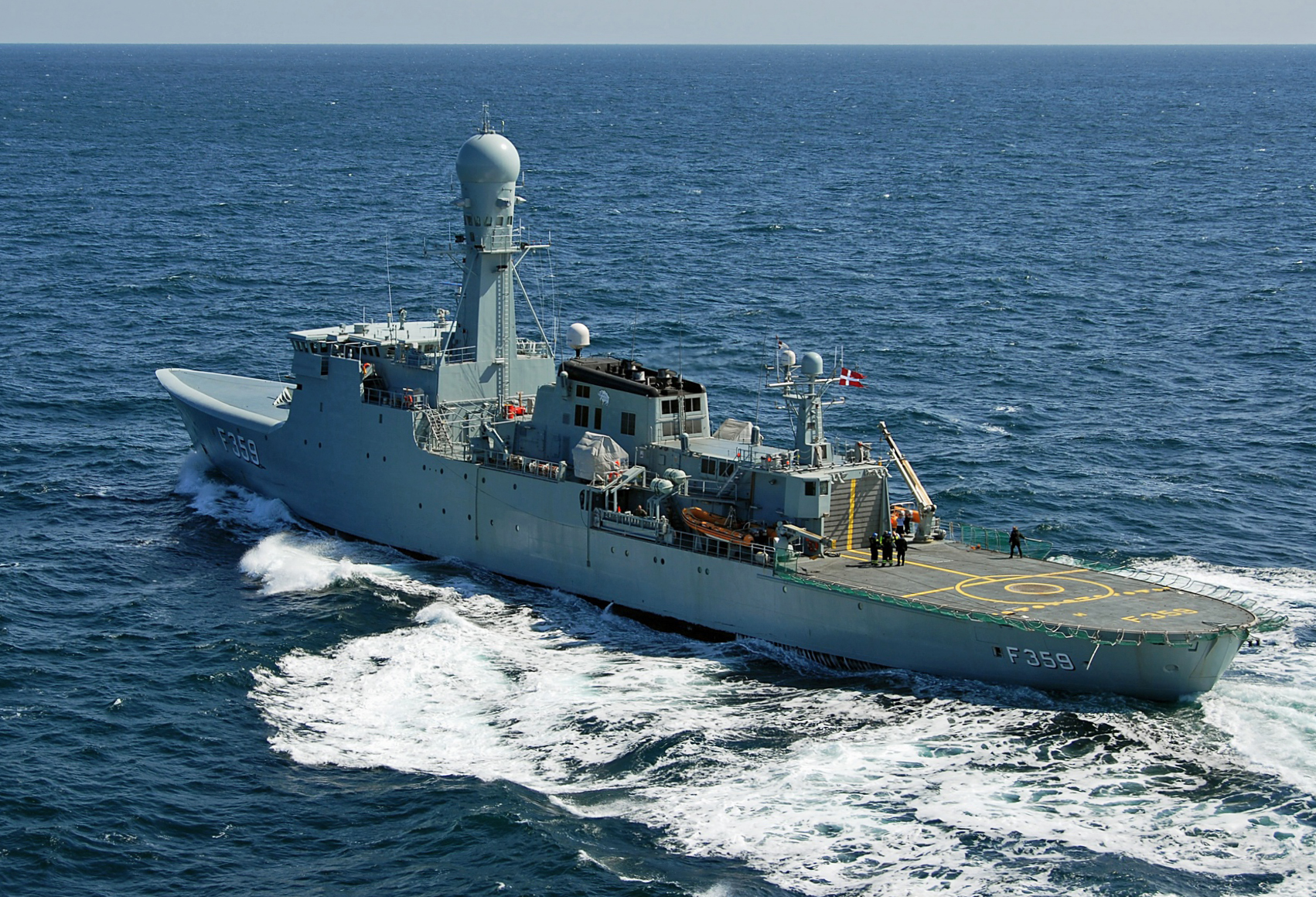
The Case for Big(ger) OPCs

File:HDMS Vaedderen (F359).jpgUSCG Photo: HMDS Vaedderen, at 3,500 tons, a relatively large but simple, ice strengthened Offshore Patrol Vessel of the Thetis Class, with StanFlex modular payload capability

Considering the new Navy destroyer program, GAO identified problems that come from trying to put too much, into too small a hull. They call this problem design density. While perhaps less of a problem for the Coast Guard, this also applies to cutters like the proposed Offshore Patrol Cutter (OPC).

It may be counter-intuitive, but size alone is not necessarily a significant determinant of cost. As we noted earlier, the new largest ships in the world do not really cost that much. In fact, they cost less than the National Security Cutter (NSC), and probably less than the OPC. The GAO report indicates for a given capability, a smaller hull may actually cost more, because the density of systems may make design, construction, and maintenance more difficult. Additionally GAO notes it may lead to shorter hull life as it seems to have in some Navy ships. Certainly it is easier to provide good range and sea keeping if we use a larger hull. Both the crew and the machinery are likely subject to less motion. Larger hulls also mean more underway maintenance may be possible, because it is easier to get to the machinery.

This also goes a long way to explain why the NSC is larger than the 378s, the Fast Response Cutters are larger than the 110s, and why hopefully the the OPCs will be larger than the 210s and 270s. There is also the long term advantage of the vessels being able to take on new and unforeseen future roles, as we saw with the 327s.