How Much Are Our Fisheries Worth?

NOAA has an answer according to this report from BairdMaritime. The short answer is “…the commercial fishing and seafood industry including imports generated US$153 billion in sales in 2014, an eight per cent increase from 2013, and supported 1.39 million jobs such as harvesters, processors, dealers, wholesalers and retailers…Domestic harvest without imports produced US$54 billion in sales, a figure similar to 2013, and supported 811,000 jobs…”.

You can see the full report here: Fisheries Economics of the United States, 2014 (pdf)

(Despite the 2014 date, the report was issued in May 2016.)

UN Command doing Fisheries in S. Korea

I find this report from MarineLink a bit curious.

South Korea and the U.N. Command, which overseas the Korean War armistice, said on Friday they had begun a joint operation to keep Chinese fishing vessels from operating illegally off the west coast.”

Why would the UN command be interested in enforcing fisheries regulation? It maybe because the area in question has been a flash point in the conflict between North and South Korea. Still seems a little strange.

French Navy Using Satellites for Maritime Domain Awareness Including CG Missions

Navy Recognition is reporting a contract between the French Navy and a consortium of Airbus Defence and Space and Telespazio France that would provide “user-friendly” 24 hour a day access to satellite derived  optical and radar imaging and AIS (Automatic Identification System) data to each maritime zone command.

Airbus Defence and Space and Telespazio France will be utilising a unique combination of satellites for the Trimaran 2 service, which supplements the range of resources already implemented by the French Navy and form an integral part of its operations concept. This contract, which runs from 2016 to 2020, will improve the effectiveness of the Navy’s missions on the world’s oceans: whether combating trafficking, preventing illegal immigration, performing search and rescue operations at sea, detecting pollution and toxic discharges, or monitoring protected maritime areas. (emphasis applied–Chuck)

France has a huge Exclusive Economic Zone, second only to that of the US and very nearly as large, but its Navy, which also does Coast Guard functions, is smaller than the US Coast Guard.

Apparently the same contractors are providing similar data to the Australian Border Force and the European Maritime Safety Agency (EMSA).

New S. Korean Cutter

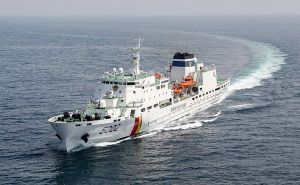
SKoreaLargestCutter

Jane’s 360 is reporting that the S. Korean Coast Guard has commissioned their largest and most heavily armed cutter.

Lee Chung-ho has a length of 150.5 m, a beam of 16.5 m, a loaded displacement of 6500 tonnes and a complement of 104 persons, although 140 persons can be embarked.

The hybrid propulsion system has four MTU 20V1163M94 diesels (each rated at 9,900 bhp) and two 750KW electric motors that are connected to the propellers.

How big is it?

The cutter, at 6,500 tons, is 44% larger than the Bertholf class. While its length and beam are almost identical to Japan Coast Guard’s two largest cutters, the displacement is reportedly far less. I have seen no info on the draft, so that is at least possible. In any case, it is definitely much smaller than the huge cutters the Chinese have built.

The post compares the new cutter to the slightly smaller Sambong-ho (pennant 5001), which entered service in 2002 and was previously the largest cutter in the S. Korean Coast Guard, stating it is three knots faster. That would indicate a top speed of 24 knots. The new cutter has a four diesel power plant compared to its predecessor’s two engine plant. In addition, the two 750 HP electric motors mounted on the shafts which should allow the cutter to slow cruise while the main diesels are cold iron.

Weapons: 

According to Wikipedia, S. Korean has 34 cutters over 1000 tons. All are armed with one or more 20 mm Vulcan Gatling Guns and .50 caliber machine guns. Fourteen have Bofors 40 mm guns, and one other also has a 76 mm. The 20 mm and 40 mm mounts are locally produced in S. Korea.

Looking at the armament, it may be an upgrade compared to the typical S. Korean cutter, but only slightly better armed than what appears to be, becoming a world wide standard for offshore patrol vessels–a medium caliber gun, 57 or 76 mm, and a pair of 20 to 30mm machineguns in remotely controlled weapon stations. It is really no better armed than the 1,150 ton PC-1005, the Hankang, smallest of S. Korea’s 34 cutters major cutters, commissioned in 1985.

All the weapons appear to have been recycled from previous installations. In the photo, an older model OTO Melara 76 mm, like those used on the FRAMed Hamilton class WHECs and Bear class WMECs is clearly visible on the bow. There is also a Vulcan 20 mm mount on the O-3 deck superfiring over the 76 mm mount forward of the bridge. It also appears to have a locally built twin Bofors 40 mm compact mount using an earlier version of the Bofors than the 70 caliber weapon currently offered, which appears to be atop the superstructure aft. She has no CIWS, missiles, or ASW capability.

What is it with these very large cutters?:

Japan, China, and S. Korea, have now each built two very large cutters. Why to they exist?

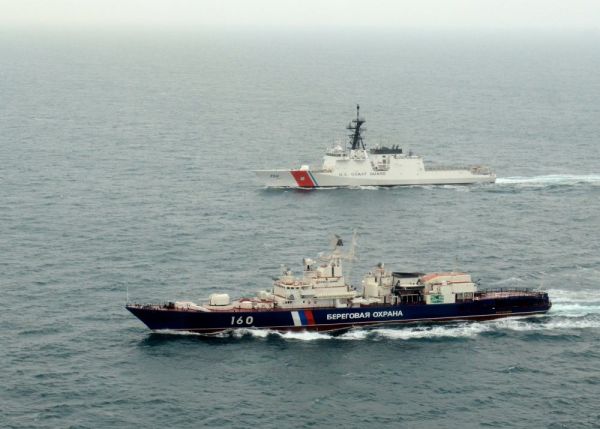
It is their size, not their weapons, that make them exceptional. The Russian Coast Guard has smaller, but much more heavily armed ships (Krivak III frigates and Grisha II class corvettes).

There has been a general trend for ships of all types to grow in size. Their crews are not exceptionally large, so the operating cost may not be that much more.

Still these are significantly bigger than other cutters built by the same coast guards, at the same time, apparently for the same missions.

None of these three nations has a patrol area as distant and demanding as Alaska.

Japan did have a reason for building the first of these. Shikishimacommissioned in 1992, was intended to escort plutonium transport ships between Europe and Japan, but I have seen no explanation for the ships that followed.

Is it prestige, just “keeping up with the Jones?”

Are they intended for a future shoving match? If so, they are giving up agility for presence.

Are they perhaps intended as flag ships for long term operations?

I would love to hear the reasoning from someone in the know.


Alaska, FY2017 Budget, Homeports

Bertholf-and-Vorovsky

Some interesting little notes from Alaska Dispatch News here and http://politicalnews.me/ here.

From the first:

“…in the appropriations bill passed out of committee Thursday, Murkowski secured language directing the Coast Guard to consider basing a national security cutter near the Arctic. The bill also directs the Coast Guard to station two offshore patrol cutters in Kodiak and appropriated $325 million for fast-response cutters, two of which are scheduled to be stationed in Ketchikan in 2017.”

From the second:

  • CG Base Kodiak: Murkowski secured $22 million for upgrades to CG Base Kodiak to support future OPC homeporting and current NSC operations.

  • Search and Rescue: Murkowski secured language directing the Secretary of Homeland Security to report on the plans of the Coast Guard to ensure long-term search and rescue capabilities in the Arctic.

  • Response Capabilities: Murkowski inserted an amendment directing the Secretary of Homeland Security to report on the Coast Guard’s plans to ensure it is capable of conducting its response missions throughout the Bering Sea and Arctic Ocean.

I think we could make a good case for homeporting two or even three OPCs in Kodiak, but don’t think we will see any NSCs homeported in Alaska.

Replacing the 110s in Alaska with the more seaworthy Webber class as quickly as possible also makes a lot of sense. We might want to put a couple at Dutch Harbor as well.

Thanks to Daniel for bringing this to my attention. 


FY2017 Budget

NSC&FRC

It is still a long way from being a law, but you can see the bill as it currently stands here.

I would like to note that while the FY2017 budget bill includes $95M for  long lead time materials for the tenth National Security Cutter, most of the cost will fall in FY2018 when we will also be funding the OPC and FRC programs, and maybe an icebreaker.

Are they really thinking ahead? If they are going to fund a 10th NSC, they need to do it this year.

China Coast Guard Cutter Built on Frigate Hull

Type054cutter

China Defense Blog is reporting the Chinese Coast Guard is getting at least one cutter based on the same hull used for the Type 054 frigate. I have to believe there will be several more.

The Type 054 is a large and apparently successful class of frigate. The ships are only slightly smaller than the Bertholf class, displacement 4,053 tons full load, length 134.1 m (440 ft), beam 16 m (52 ft), 30,400 HP, 27 knots, compared to the Bertholf’s 4,500 tons, 127.4 m (418 ft), 16.46 m (54 ft), 49,875 HP, and 28 knots.

My first reaction is that they should make very good cutters. They have a four diesel power plant that should be economical to operate and very flexible. The frigates reportedly have a range of over 8,000 miles. They also have reasonably good aviation facilities.

Type054A800px-Aft-deck_of_the_PLAN_frigate_Yi_Yang_(FF_548)

US Navy photo:  120917-N-YF306-107 GULF OF ADEN (Sept. 17, 2012) Sailors from the guided-missile destroyer USS Winston S. Churchill (DDG 81) board the Chinese People’s Liberation Army (Navy) frigate Yi Yang (FF 548) to meet prior to conducting a bilateral counter-piracy exercise.

The Chinese Coast Guard has been experiencing explosive growth. China has built some huge cutters, they have gotten some hand-me-down frigates from their navy, and there have been reports that the China Coast Guard will be getting ships based on the Type 056 Corvette, but until recently, new construction Chinese cutters were not warships. They looked more like research vessels. Most have been armed with nothing heavier than 14.5 mm machine guns. This ship may mark a change.

Building based on a Navy design assures that should the need arise, these ships can be upgraded to a more combat ready configuration. How they are equipped when commissioned will give us an indication of the future direction of the Chinese Coast Guard. Will it remain essentially civilian, or will it become an increasingly capable naval auxiliary?

Which systems will be retained from the frigate configuration, and which systems are deleted? My guess is, that they will emerge with a medium caliber gun (either the 76 mm being currently fitted to the Navy’s Type 054As or the older 100 mm that was fitted on the original Type 054s) and two 30 mm gatling guns (these may be older model AK-630s rather than the newer CIWS fitted on current Navy Type 054As). I don’t expect to see the Vertical Launch Systems that support AAW and ASW systems, Anti-Ship Cruise missiles, torpedo tubes, or the sonars which are being fitted to the Navy versions, but if any of these are fitted, it will mark a drastic change in the character of the Chinese Coast Guard.

Thanks to Lee for bringing this to my attention.

CBP Coastal Interceptor Vessel, First of 52

NewCoastalInterceptorVesselPhotoCBP-59862

New Coastal Interceptor Vessel Photo CBP

MarineLink reports Customs and Border Protection’s (CBP) Air and Marine Operations (AMO) has acquired the first of a planned 52 Coastal Interceptor Vessels (CIV), that look a lot like Coast Guard Response Boat, Small.

“AMO marine interdiction agents will operate the CIV in offshore coastal waters to combat maritime smuggling and protect U.S. ports from acts of terrorism.”

This sounds a lot like duplication of Coast Guard Missions. But then they do not do the other Coast Guard missions.