CG Response to Hurricane Matthew in Caribbean

hamilton-and-evans

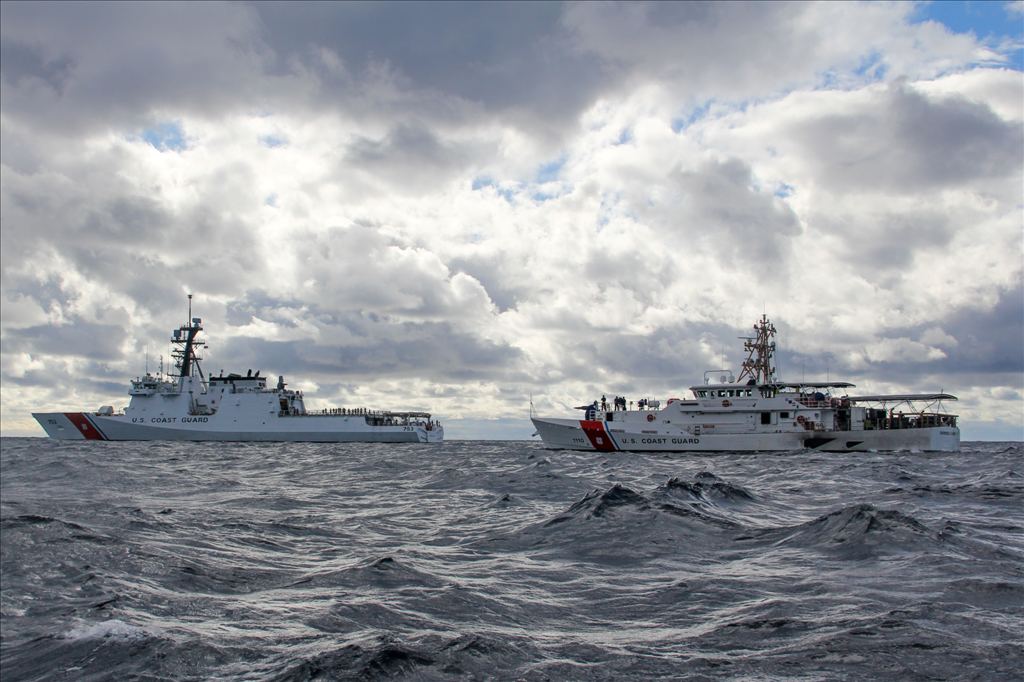
Photo: USCGC Hamilton (WMSL-753) (left) and USCGC Raymond Evans (WPC-1110)

A quick review of what is happening.

A Coast Guard aircraft has done a damage assessment in Haiti. News release here.

HURRICANE IVAN (FOR RELEASE)

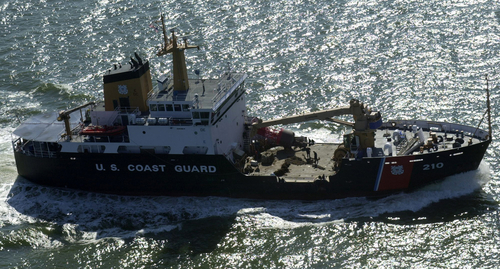
PENSACOLA BEACH, Fla. (Sept. 20, 2004)–Coast Guard cutter CYPRESS, a 225-foot buoy tender homeported in Mobile, Ala.

USCGC Cypress (WLB-210) is enroute. Additional aviation assets and two flood punt teams from Memphis, Tennessee are being staged at AVTRACEN Mobile. News release here.

Cutter Hamilton (WMSL-753) is in the area and is being augmented with additional Coast Guard medical personnel transported to GITMO by a C-130. Additionally “Coast Guard (air) crew members launched Thursday to transport personnel and supplies to support post Hurricane Matthew relief efforts in Great Inagua, Bahamas and other areas qffected by the storm.”

Massive Investment Coming to Northern Alaska

caeluspipelinewsj

Photo from Wall Street Journal, Click to enlarge.

The Wall Street Journal is reporting that little known Caelus Energy has made a huge find of oil in Smith Bay off the North Slope of Alaska, West of the current North Slope oil fields.

To get at the oil they expect to use “barges built along the Gulf Coast, then towed to Alaska and permanently sunk in the bay to create man-made drilling islands.”

To move the oil they expect to build “an $800 million, 125-mile pipeline that will carry the oil underneath state-owned waters to connect with existing pipelines.”

What does this mean to us?

Certainly, it means that there will be more activity in the Arctic. That may mean more work for the Coast Guard. On the other hand, it may not be a bad thing to have some of the assets the oil company will bring to the Arctic there for mutual aid.

Those commercially built, medium icebreakers are probably going to have another buyer soon, and may not be on the market for long.

This may also be an opportunity to share some infrastructure in the Arctic.

I do have to wonder why the pipeline will be, “underneath state-owned waters,” when it would be much shorter if it went from point to point rather than following the coast. Do they think it will be easier to maintain, or are they avoiding Federal regulation?


Three New Ships for Norwegian Coast Guard

norwaycgcutternordkapp_in_bodo_3

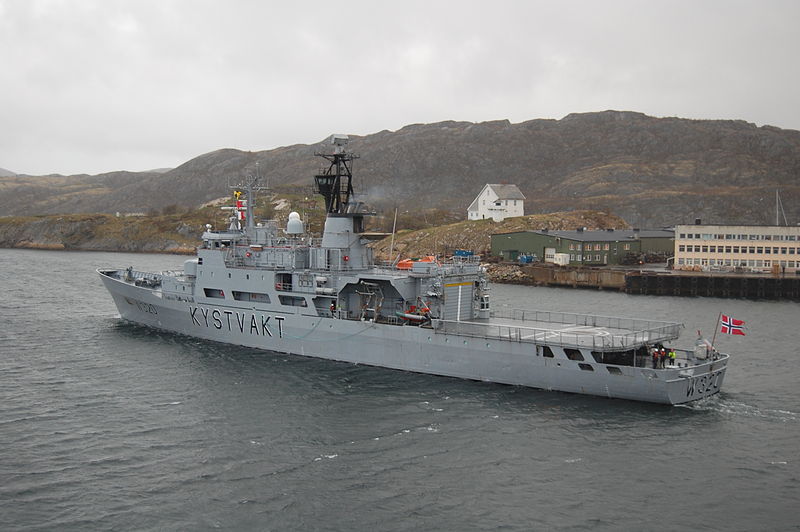
KV Nordkapp, lead ship of a class of three which will be replaced. Photo by Marcusroos

The Barents Observer reports Norway is ordering three new icebreaking cutters for the Norwegian Coast Guard which will replace the Nordkap class.

I note the Nordkapp class looks like they could have been a contender for the OPC contract–3.200 tons, 345 ft (105 meters) long, ice strengthened, helo deck and hangar, 22 knots, 57mm gun, plus hull mounted sonar and provision for adding Penguin ASCMs and ASW torpedoes. The new ships may end up looking a lot like the OPC.

Two 110s to be Transfered to Republic of Georgia

OLYMPUS DIGITAL CAMERA

OLYMPUS DIGITAL CAMERA

CG-9 reports, 

“The Coast Guard transferred the former cutters Jefferson Island and Staten Island to the Georgian coast guard in a ceremony at the Coast Guard Yard in Curtis Bay, Maryland, Sept. 30, 2016. The event marks the Office of International Acquisition’s first transfer of 110-foot patrol boats to a friendly nation through the Excess Defense Articles program.”

UAE Transport, Former US High Speed Vessel Swift, Hit by Shore based ASCM

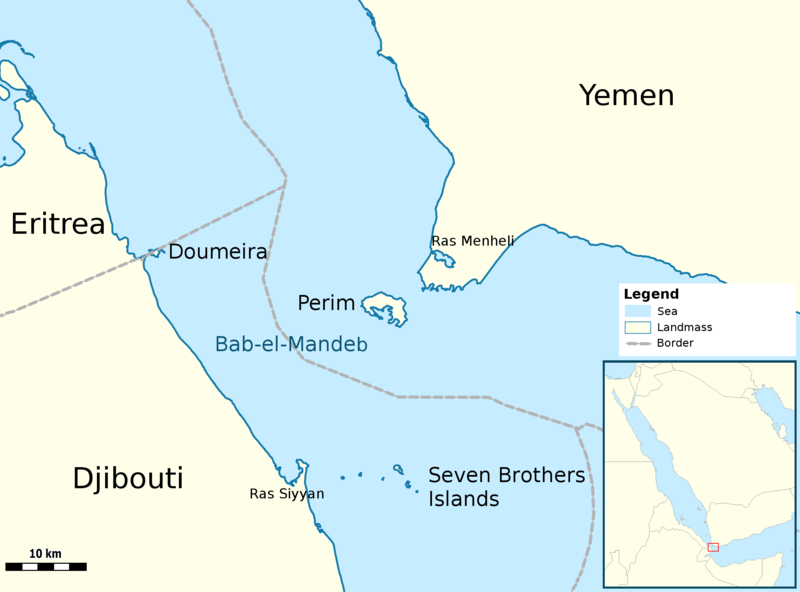
There have been numerous reports (and here) that the former US Navy High Speed Vessel Swift has been attacked and apparently destroyed by a Chinese designed but possibly Iranian built C-802 anti-ship cruise missile (ASCM) while transiting the 25 mile wide Bab-el-Mandeb Strait at the southern end of the Red Sea.

Map of Bab-el-Mandeb.png

Map of the Bab-el-Mandeb by Archer90

The missile was launched by a rebel group in Yemen. This not the first report of their use of anti-ship cruise missiles. They have claimed to have hit ships of the Saudi led coalition before. Plus the American built Israeli Corvette Hanit was hit by a Hezbollah launched C-802 in 2006. If we ever get in a situation like MarketTime again, there is a good possibility that even insurgent groups might have ASCMs.

The C-802 is similar in size and capabilities to the US build Harpoon. There is at least one report that the former Swift deployed Mk36 SRBOC.

Thanks to Peter for bringing this to my attention. 

Addendum: 

A photo of the vessel, severely damaged but still afloat here: http://www.marinelog.com/index.php?option=com_k2&view=item&id=23324:video-hsv-swift-hit-by-missile-attack&Itemid=231

They are also saying the damage was done by multiple shoulder launched missile (presumably anti-tank guided missiles) rather than a single ASCM.

Three Chinese Fishermen Kill While Fleeing S. Korean Coast Guard

ABC is reporting that three crewmembers of a Chinese fishing vessel that attempted to flee enforcement action by the S. Korean Coast Guard were found dead of apparent smoke inhalation after the vessel caught fire after the Coast Guard tossed flash bang grenades aboard.

Thanks to Luke for bringing this report to my attention.

Navy to Eliminate Rating System for Enlisted, CG to Follow?

The US Naval Institute News Service is reporting that the Navy will eliminate its 241 year old job specific rating system and move to a system more like that used by the Army, Air Force, and Marines.

I would assume the Coast Guard will follow suite. Changes to uniforms, schools, even the way petty officers are addressed.

The Navy will reportedly drop the Airman, Fireman, Seaman distinction for non-rates and call them all Seaman. Will we have Coast Guardsman Recruit, Coast Guardsman Apprentise, and Coast Guardsman as the new E-1, E-2, and E-3?

What Might a Wartime OPC Weapons Fit Look Like?

opc-eastern

Four years ago I wrote a post suggesting that the Offshore Patrol Cutter might be designed from the start for a wartime weapons fit, but then fit them out with only those systems required for their peacetime missions, which might have included only its helicopter, UAS, and 25 mm Mk38 Mod2 gun(s).

I started with the assumption that the OPC should be able to mount a weight of weapons at least equal to those mounted on the 255 foot Owasco class cutters as built during World War II (140-150 tons). This figure did not include ammunition other than depth charges, consequently, nearly all the weight was above the main deck. This now appears very conservative in that the Eastern OPC design is about twice the size of the Owasco Class. (For another data point, when built, the USS Fletcher, first of a class of 175 destroyers with a design displacement of 2,700 tons, had 161.8 tons of armaments and 190.8 tons of ammunition.)

In the earlier post, a possible wartime outfit that I believed might be used for designing the ship (and the weights I used) included:

Total 124.4 tons

Since we now have a notional design for the cutter and my own views have changed somewhat, I thought it might be worthwhile to revisit how this class might be armed in wartime. The design may have ruled out some of the systems above, but the surprisingly large size suggest it should be fairly adaptable.

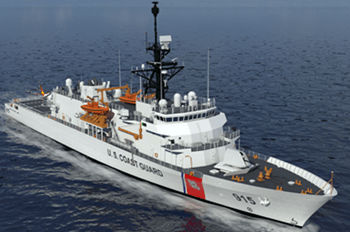
In fact it looks like the OPC could be turned into a credible warship adding only deck mounted systems that require only minimal deck penetration for cabling and the like.

What’s already there?:

Based on earlier information, as built, the design will includes provision for

For a total of 28.55 tons

Anti-Ship Cruise Missile:

 LRASM_TSL_Concept_Lockheed_Martin
LRASM topside launcher concept. The size and weight are comparable to launchers for Harpoon. Photo: Lockheed Martin.
Currently there are three potential anti-ship cruise missiles that might be used, Harpoon, LRASM, and Naval Strike Missile. Harpoon weighs 1,523 lb (691 kg) with a 488 pounds (221 kg) a warhead. Naval Strike missile is smaller, longer ranged, and more intelligence with a weight of 900 lbs (410 kg) with a 276 (125 kg) warhead. LRASM is the newest and supposedly the most “intelligent.”
As I posted earlier, I think the Coast Guard could use a couple of LRASM on each of their NSCs and OPCs even in peacetime as a means of addressing the threat of a terrorist attack using a medium or large ship. It is the missile’s range (about twice the others) and purported ability to target specific parts of a specific target rather than its larger warhead, that made the LRASM the system of choice for this role.
Reportedly the LRASM deck mount is comparable in size and weight to the Mk141, which is the standard quad deck launcher for Harpoon. The only source I could find, indicated that the weight of a quad Mk141 with missiles is 27,126 lbs or 13.6 tons, or 27.2 tons for an eight missile battery. Still I can’t believe the LRSM will not weigh a bit more than Harpoon, seeing its warhead is twice as large. I will assume a quad deck mount weighs about 15 tons, or 30 tons for an eight missile outfit. In any case, if other types of missiles were used, they would weigh less.
These might be positioned either on the fantail or on the platforms aft of the 57mm and below the bridge, one deck above the foc’sle where it appears they plan to mount .50 caliber machineguns possibly in Mk49 ROSAM.

RGM-84 Harpoon SSM was fired from a Mk-141 missile launcher aboard USS Shiloh (CG 67). The Shiloh’s beam is only one foot more than that of the Offshore Patrol Cutter. Looking at the photo, you can see that the launchers take up well under half the width of the fantail.

opcplacemat

Photo: Click to enlarge

 Evolved Sea Sparrow Missile:
It appears it may be possible to equip the OPCs with ESSM (Evolved Sea Sparrow Missile). A new version of the missile, the ESSM block II, will obviate the need for illuminators that have been required for earlier versions. These would allow the cutter to provide limited local area AAW protection for ships that the cutter might be escorting out up to 25 miles. Additionally they can be used against surface targets.
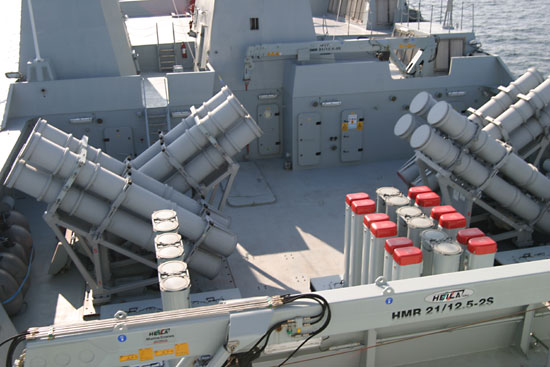
Using the Mk56 VLS a loaded 12 missile module weighs 11.5 tons. Physically it is not very large. 3.66 m (12 ft) x 2.71 m (9 ft) x 4.65 m (15’3″) high. We could locate one or perhaps two of these on top of the superstructure where they apparently intend to store the third boat.  This may seem relative high in the ship, but it is the same position where the Oliver Hazard Perry (FFG-7) Class frigates mounted their 76mm gun and the OPC is considerably beamier (54 vis 45 foot).
harpoonmk56

Photo: Click to enlarge. The relatively small foot print of the Mk56 VLS system (pdf) can be seen here on a Danish Absalon-class command and support ship (beam 64 feet, by comparison the Offshore Patrol Cutters’ beam is 54 feet–same as that of the Bertholf class National Security Cutters).  Two sets are visible in the foreground, one set of twelve with missile canisters with red tops in place to the right, on the ship’s centerline, and a second set of twelve without canisters to the left. The Absalon class has three twelve missile sets, with the third set off camera to the right. 

VLSLauncher_korvet
 
Photo: 12 earlier Mk48 mod3 VLS for ESSM seen here mounted on the stern of a 450 ton 177 foot Danish StanFlex300 Flyvefisken class patrol boat.  The Mk56 launchers replace the Mk48s with an approximate 20% weight savings. 
SeaRAM: 
searam_lead_img
This could really be any of three systems, Phalanx, SeaRAM (a modified Phalanx with eleven rolling airframe missiles instead of the 20 mm gun) or the 21 round Mk 49 RAM launcher. Loaded, all three are about 8.5 tons or less.
An operations research study done for Australia “Limitations of Guns as a Defence against Manoeuvring Air Weapons,” (pdf) by Christian Wachsberger, Michael Lucas and Alexander Krstic, Weapons Systems Division, Systems Sciences Laboratory, DSTO-TN-0565 has convinced me that gun systems are unlikely to effective in the future, so for the OPC I would choose two SeaRAM. This has also been chosen for the frigate follow on to the Navy’s LCS.
Two LCS systems could provide automated 360 degree protection against the sudden attack of a coordinated anti-ship missile attack. One system could replace the Mk38 mod2 system currently planned for placement on top of the hangar. A second system could be sited on the superstructure forward and below the bridge, behind and above the 57mm. This might require a small extension of the superstructure to provide a platform sufficiently large enough to both support the system and allow access for maintenance.
AN/SQR-20 Multi-Function Array (Thales CAPTAS 4):
 captas-4_vds_fremm_sna_2016_surface_navy_news_2
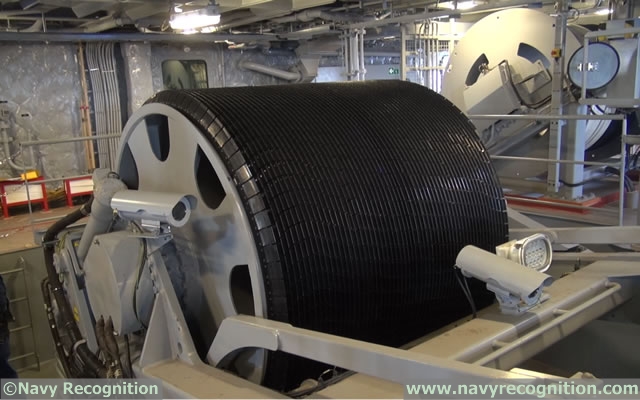
Photo: NavyRecognitionReeling system for the CAPTAS-4 Variable Depth Sonar tether aboard a French Navy FREMM Frigate (Aquitaine class).
If there is a submarine threat, we will need a sonar. Additionally passive towed arrays may be used as a targetting system for anti-ship cruise missiles. In peacetime, a towed array might also be to locate semi-submersibles.
The Thales CAPTAS-4 is one of the systems being considered for the LCS and its frigate derivative. The current version weighs 20.6 tons. The US version will probably be lighter since the Navy is looking for a lighter version for the LCS. Additionally there are lighter options made by Thales and others, so what ever might be chosen is going to be this weight or less. It would of course be mounted on the fantail.

Mk38 mod2/3 and Mk49 ROSAM: 

I will assume that the two Mk49 RO

SAM will be retained and the Mk38 mod2 (or mod3) will be relocated and a second Mk38 (1.15 tons) will be added.

Summary: 

The resulting additions would be:

  • Multi-Function Array (CAPTAS-4) (20.6 tons)
  • MH-60 (11.75 tons)
  • 8 x LRASM (30 tons)
  • 24 x ESSM (23 tons)
  • 2 x SeaRAM (22 missiles) (17 tons)
  • 57mm Mk110 gun w/1000 rounds (15.4 tons)
  • 2 x Mk38 mod2/3 (2.3 tons)
  • 2 x .50 cal. in Mk49 ROSAM (0.25 tons)

This totals 120.3 tons or 91.75 tons more than the planned outfit as built.

We don’t really know if the ship can take this much weight. Assuming it displaces 4,000 tons, which seems likely, this is about a 2.3% increase in displacement and much of the weight is relatively high.

Is it feasible?

There are things that can be done to counterbalance the effects of this additional weight. Some fuel tanks might have to be left permanently full or be converted to ballast tanks. Given the extreme range of the cutter, even half of the design range would be more range than most Navy combatants.

We know the ship is supposed to have some weight moment reservation for additional weapons but we don’t know how much. There is also the requirement that the ship be able to take on, feed and shelter 500 migrants on the foc’sle or flight deck. Those 500 people alone would amount to almost 40 tons of additional top weight.

There are alternatives that could provide a simlar outfit while moving the weight lower. A more extreme change would be to replace both the Mk56 VLS (23 tons) and the 57mm Mk110 (15.4 tons) with Mk41 VLS (33.6 tons) in place of the 57mm. We would loose the gun, but this would provide the additional capability of launching Anti-Submarine Rockets (ASROC) as well. That might be a good trade, but it would require more radical reconstruction.

In short, adding less weight in weapons than carried by the 255 foot Owasco Class cutters of WWII, the Offshore Patrol Cutter could be turned into an effect surface combatant comparable to many frigates. The same sort of alterations could also be appied to the National Security Cutters.

New Dual Fuel Finnish Icebreaker

polaris_finnishlngicebreker

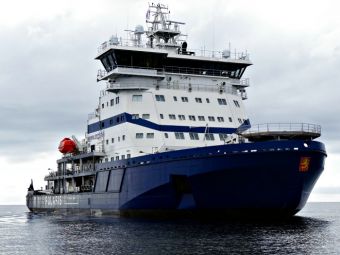
MarineLog reports the delivery of the world’s first Icebreaker capable of running on LNG. It does appear that its capabilities using LNG alone may be limited. “The diesel-electric propulsion system includes two Wartsila 6,000 kW engines and one 1,280 kW dual fuel engine.” If, as it appears, only the 1,280 kW engine can use LNG.

I found the size of the Finnish icebreaker fleet interesting.

“Following delivery, the Finnish Transport Agency handed the vessel over to Arctia Icebreaking Oy, A Finnish state-owned company that operates a fleet of vessels that provide icebreaking services. Besides the Polaris, Arctia Icebreaking Oy operates three multipurpose icebreakers, one oil spill recovery icebreaker, three 113-ton bollard pull icebreakers, and one harbor icebreaker and towing vessel. The newest oceangoing icebreakers in the fleet, the Fennica and Nordica—two 230-ton bollard pull icebreakers—were both delivered in 1993.”

Note, the range and endurance required of these icebreakers is closer to what we think of as domestic icebreakers rather than polar icebreakers, but still an impressive fleet.

Late addition: gCaptain has a more complete description of the ship: http://gcaptain.com/arctech-helsinki-delivers-worlds-first-lng-powered-icebreaker-finnish-government/

Man Overboard Alarm

Photo: ALERT2 Man-Overboard Alarm System from Emerald Marine Products 

Loosing a man overboard is one of those nightmares you never want happening on your watch. I was CG liaison officer at Fleet Training Group San Diego when a 210 that had recently lost two men over board came through for REFTRA. Four crewmen, being good sailors, took it upon themselves to go on deck during a storm to secure some loose equipment. All four were washed overboard. The sea then deposited two of them back on board. The other two were never found, so it does happen.

MarineLink has a story about a device that alarms the watch when its wearer goes in the water.

“Upon receiving an MOB activation signal, the AR100 Receiver sets off a loud, 95 dB alarm and bright red alert light on the display. It can be wired to shut down engines—essential for solo mariners and fishermen. Connected to a compatible GPS chartplotter, it automatically sets an overboard waypoint. External speakers and strobes can be utilized with the AR100. It can also be configured to alert via a remote cellular dial-up, radio transmission burst or Internet-connected device. The AR100 Receiver runs on 12V, or on 110V using the optional power supply. It comes with a flexible whip antenna, coaxial cable and full mounting hardware.


“The optional ALERT2 Portable Directional Finder aids crew in locating the MOB when visual contact is lost due to darkness or sea conditions. Unlike AIS, which is typically installed in the wheelhouse, the directional finder can be used on deck. Rescuers sweep the horizon to quickly home-in on the transmitter’s signal for a fast recovery.

“Emerald Marine Products’ ALERT2 AT101 Transmitter lists for $269, the AT200 IS model for $369, the AR100 Receiver for $749 and the Portable Directional Finder for $899. Discounted pricing is available for packages.”

Note, I don’t really know if this a good company or its products are the best of the type, so I’m not endorsing the particular product, but simply pointing out that such things exist. Maybe the Coast Guard is already using them. I know I would feel better, if I knew my BMOW was wearing a device with the capability claimed for these.