New Military Law Concerning Domestic Violence and Sexual Assault

I  am quoting here some information received via email from the Service Women’s Action Network (SWAN) regarding legislation signed into law on August 13, 2018 as part of the John S. McCain National Defense Authorization Act (NDAA) for Fiscal Year 2019.  Changes include:

  • Adding a new punitive article dealing with domestic violence to the Uniform Code of Military Justice (UCMJ).
  • Requiring a report of the feasibility of extending Special Victim Counsel availability to victims of domestic violence.
  • Establishing a uniform Command Action Form for reporting the final disposition of sexual assault offenses when the perpetrator is subject to the UCMJ and the victim has filed an unrestricted report.
  • Standardizing of policies across the Services related to expedited transfer in cases of sexual assault or domestic violence.
  • Requiring the development of a plan for implementation of oversight of DoD’s Sexual Harassment Prevention and Response policy.
  • Requiring oversight of the Registered Sexual Offenders’ Management Plan.
  • Requiring the DoD and the Department of Labor’s Veterans Employment and Training Service to update the Transition Assistance Program (TAP) to establish new pathways for more individualized counseling.  Also, all those departing the military will receive information on resources available to them in the local community where they have chosen to reside to include resources for those suffering from Military Sexual Trauma (MST).

“Ready, Responsive, Relevant?” a Public Affair Critique, USNI

USCGC Rollin A. Fritch (WPC-1119)

August has brought the US Naval Institutes annual “Coast Guard Issue” of their magazine, Proceedings, which is mostly not about the Coast Guard. Never the less there are Coast Guard related articles included and there is one on this side of the pay wall that really deserves the service’s attention, “Ready, Responsive, Relevant?” It looks at the Coast Guard’s Public Affairs program. Its written by Lieutenant Commander Krystyn Pecora, USCG, XO on Seneca (WMEC-906), an Academy graduate and permanent cutterman, a former external affairs officer for District Five with a master’s degree in media and communications studies.

She needs to be listened to, because as she points out, the Budget is linked to Public Perception of Value. 

She found that the program lacked focus, leadership, and resources.

Considering “focus”:

In her examination of focus, she refers to a 2001 USNI article, “Branding the Coast Guard” also worth a read. It points out.

“Never has a governmental agency been such a success and failure at the same time. The Coast Guard is lauded daily in the nation’s press for spectacular operational successes, yet is chronically unable to obtain an adequate budget from the nation it serves. This dichotomy was illustrated quite graphically in March 2000 when the Coast Guard won the accolades of Government Executive magazine for being the nation’s most efficient and best run federal agency but was ridiculed in the same article for its naiveté and repeated failures in the budget process. “

His solution:

“The Coast Guard’s travails will never be addressed adequately until it abandons the myth that it is a single, monolithic organization and accepts the reality that it is a “holding company” for a number individual, mutually supporting, maritime service organizations. It also must focus on the individual services, not the holding company, in the competition for federal dollars and support.”

In a modern interpretation of the argument LCdr Pecora suggests, 

if 11 strategic teams were developed, each devoted to defining and promoting one of the Coast Guard’s missions. All 11 missions have millions of constituents interested in the specific services the Coast Guard provides. For example, northern constituents care more about domestic icebreaking capabilities compared to constituents in warmer climates. Realistically, the Coast Guard cannot use the same communications playbook for each of these constituent groups. Strategic teams translating national intent to regional audiences through the district external affairs offices would ensure each mission receives ongoing attention to daily operations, akin to the U.S. Navy’s type commander construct.

This dedicated effort would be a far cry from today’s whack-a-mole operations in which the service focuses its efforts on the mission currently most in need of acquisition funding. Instead of having missions fighting for pieces of the funding pie, the Coast Guard could grow support for funding all constituent interests concurrently. In addition, this construct takes advantage of the current information environment, in which audiences select news sources that resonate with their personal interests rather than relying on traditional media outlets. It would not matter which brand image is imagined when asked to envision a Coast Guardsman; that brand image would have been a result of calculated microtargeting based on a person’s region and interests.

Considering Leadership:

Compared to the professionalism of DOD public affairs.

“The experience disparity for the Coast Guard is substantial; this is the second public affairs–related tour for its current Chief of Public Affairs. His predecessor served his first public affairs tour in this leadership position. This lack of experience is a service-wide failure. The Coast Guard would not place a novice in charge of any operational program but consistently accepts this scenario for its communications program. “

Considering Lack of resources: 

There is much more in the article, but a single paragraph,

“On average, there is one enlisted public affairs watchstander representing 22 Coast Guard units of varying size, in geographically diverse locations, often across multiple states, with varied missions. The folly of the current footprint was identified by the service’s own reports in the aftermath of both the Cosco Busan (2007) and Deepwater Horizon (2010) oil spills. These reports called for the public affairs program to be increased in size to decrease public affairs response times to sustain messaging during long-term events. 11 For context, the public affairs response to the 2017 Atlantic hurricane season consisted of half the rate, leaving skeleton crews across the nation to cover daily operations. The program simply cannot handle two national-level events at the same time. “

Please read the entire article, there is much, much more. 


140 Foot Icebreaking Tugs Get New Davits

140 foot icebreaking tug with new davit

The In-service Vessel Sustainment Program modifications for the 140 foot domestic icebreaking tugs include a new davit that should make boat launching much quicker and easier. Compare the photo above with the earlier photo below. You can see that the O-1 deck has been extended out to the side of the hull and the new davit replaced a kingpost style derrick. Here is the vendor’s press release that provided the more recent photo.

Katmai Bay (WTGB 101) is tied to the pier at Group Sault Saint Marie, Michigan, Sept. 2001. USCG photo by PA1 Harry C. Craft III

Thanks to Lee for bringing this to my attention. 

Tradewinds 2018 and the Caribbean’s Maritime Security Challenges–CIMSEC

Participants in the Tradewinds 2018 exercise. Seen here are U.S. Coast Guard Cutter Charles David Jr. (WPC-1107, most distant); the British RFA Mounts Bay (L3008, left), a Bay-class auxiliary landing ship dock; Canada’s HMCS Shawinigan (MM 704, right), a Kingston-class coastal defense vessel; and Mexico’s ARM Oaxaca (PO 161, foreground), an Oaxaca-class patrol vessel along with a Mexican helicopter AS365N3 Panther. 180616-N-ZZ999-0004.JPG Photo By: Able Seaman John Iglesias

CIMSEC provides a brief review of the SOUTHCOM sponsored 2018 Tradewinds exercise along with background information about current maritime security challenges in the Caribbean.

New British Motor Surf Boat

gCaptain reports the Royal National Lifeboat Institution has a new class of 13 meter motor (Surf) Lifeboats that are unique in being waterjet propelled.

Comparing Wikipedia descriptions, the Shannon class are composite compared to aluminum construction for the Coast Guard’s 47 foot MLB. Displacement is lower (14.6 tons vs 18 tons). Length is slightly less (44’7″ vs 47’11”). Beam is slightly greater (14’11” vs 14’0″). Draft is less (2’6″ vs 4’6″). Speed is slightly higher (27 knots vs 25). Range is up (250 vs 200)

The RNLI vessel Shannon being recovered. RNLI photo

As reported in the Wikipedia description of the class,

Most Shannons are launched by a newly-designed launch and recovery system by which a tractor propels the lifeboat on its cradle into the water. The cradle is then tilted and acts as a mobile slipway as the boat is launched by release of a single chain from the wheelhouse, rather than the old carriage launched method of four chains being released by crew members on deck. Recovery is bow first onto the cradle, which then rotates through 180 degrees, enabling the boat to be launched again within ten minutes. Some Shannons will be kept afloat at moorings or a pontoon berth and the boats are also capable of being slipway launched, although only Swanage currently has a slipway launched Shannon. The boat at Workington uses the same unique davit crane system as the previous Tyne class boat.

Thanks to Lee for bringing this to my attention.

LED lighting may interfer with FM and AIS

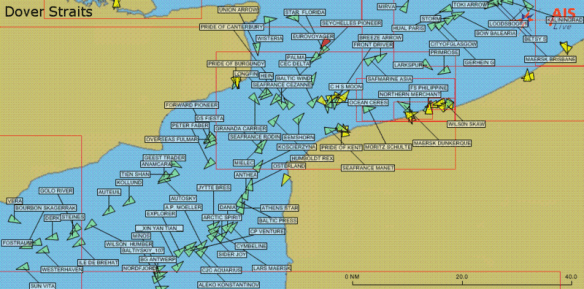
Display of maritime traffic provided by AIS. Only vessels equipped with AIS are displayed, which excludes most fishing boats, pleasure craft, inland navigation and vessels less than 300 tons. Location: Dover Straits/English Channel. Author: fr:User:Pline

Quoted below is a potentially important safety alert, #13-18, from the Coast Guard. 

The U.S. Coast Guard has received reports from crews, ship owners, inspectors and other mariners regarding poor reception on VHF frequencies used for radiotelephone, digital selective calling (DSC) and automatic identification systems (AIS) when in the vicinity of light emitting diode (LED) lighting on-board ships (e.g., navigation lights, searchlights and floodlights, interior and exterior lights, adornment).

Radio frequency interference caused by these LED lamps were found to create potential safety hazards. For example, the maritime rescue coordination center in one port was unable to contact a ship involved in a traffic separation scheme incident by VHF radio. That ship also experienced very poor AIS reception. Other ships in different ports have experienced degradation of the VHF receivers, including AIS, caused by their LED navigation lights. LED lighting installed near VHF antennas has also shown to compound the reception.

Strong radio interference from LED sources may not be immediately evident to maritime radio users. Nonetheless, it may be possible to test for the presence of LED interference by using the following procedures:

  • 1. Turn off LED light(s).
  • 2. Tune the VHF radio to a quiet channel (e.g. Ch. 13).
  • 3. Adjust the VHF radio’s squelch control until the radio outputs audio noise.
  • 4. Re-adjust the VHF radio’s squelch control until the audio noise is quiet, only slightly above the noise threshold.
  • 5. Turn on the LED light(s). If the radio now outputs audio noise, then the LED lights have raised the noise floor. (Noise floor is generally the amount of interfering signals / static received beyond the specific signal or channel being monitored.)
  • 6. If the radio does not output audio noise, then the LED lights have not raised the noise floor.

If the noise floor is found to have been raised, then it is likely that both shipboard VHF marine radio and AIS reception are being degraded by LED lighting.

In order to determine the full impact of this interference, the Coast Guard requests those experiencing this problem to report their experiences to Coast Guard Navigation Center. Select “Maritime Telecommunications” on the subject drop down list, then briefly describe the make and model of LED lighting and radios effected, distance from lighting to antennas and radios effected, and any other information that may help understand the scope of the problem.

This Safety Alert is provided for informational purposes only and does not relieve any domestic or international safety, operational, or material requirement. Developed by the U.S. Coast Guard, Spectrum Management and Telecommunications Policy Division. Distributed by the Office of Investigations and Analysis. Questions may be sent to HQS-PF-fldr-CGF-INV@uscg.mil.

New OPVs for France, Trinidad and Tobago, the Philippines, and India

Four new Offshore Patrol Vessels (OPV) projects, totaling 20 vessels, have been reported.

NavyRecognition reports the French Navy has issued a Request for Information preparatory to procurement of six OPVs to operate from French overseas territories. They are seeking 22 knot vessels about 70 meters (230 feet) in length with facilities to support a vertical take off and landing (VTOL) unmanned air system (UAS). Given France’s recent history with OPVs these may look a lot like Offshore Supply Vessels.

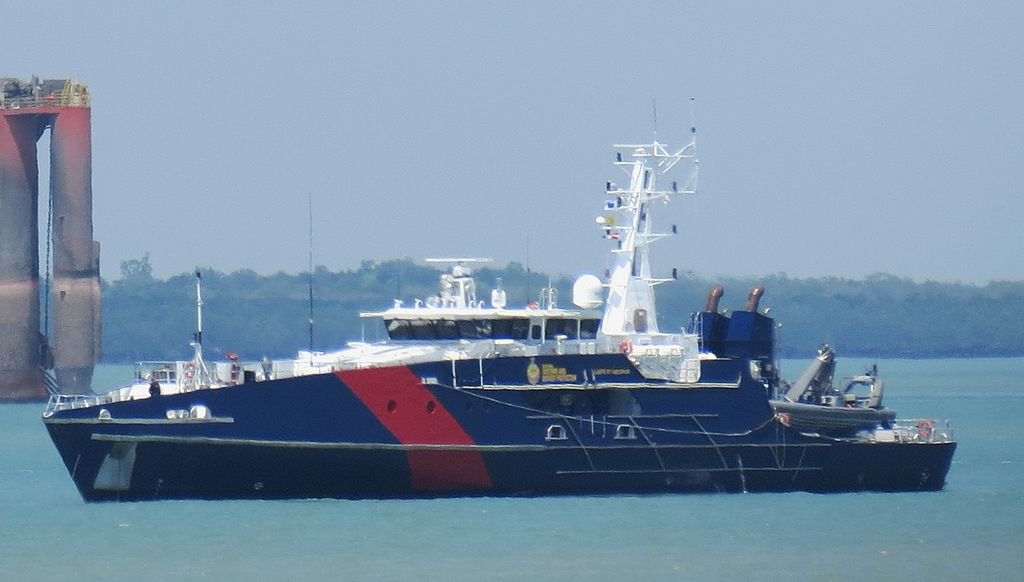
The Australian Customs patrol boat ACV Cape St George on Darwin Harbour in 2014, Photo by Ken Hodge

Australian Shipbuilder Austal has been contracted to build two Cape Class OPVs (illustrated above) for the Trinidad and Tobago Coast Guard. These are 58 meter (190 foot) 25 knot vessels with a 4,000 mile range. Ten have already been built for the Australian Navy and Border Force.

It appears Austal’s yard in the Philippines may be building six 80 meter OPVs for the Philippine Navy. These would reportedly be based on the Cape Class Patrol Vessels, but would be much larger, have steel hulls, and helicopter support facilities (helo deck certainly, but not clear if that would include a hangar).

Indian Navy Photo: INS Saryu, the lead ship of her class of advanced offshore patrol vessels of the Indian Navy

India is planning to procure six “New Generation Offshore Patrol Vessels.” It sounds like these will evolve from the Saryu Class OPV which are 2,230 tons displacement, 344 feet in length, 42 foot of beam, with a 12 foot draft with a speed of 25 knots. The Saryus are armed with a 76mm Oto Melara gun and two Soviet designed AK-630, 30mm six barrel Gatling guns (just forward of the funnels in the photo). They also have a hangar and flight deck for a HAL Dhruv medium weight helicopter. The new ships should be at least equal in capability.