Reportedly she is aground from the bow to amidships and props are damaged.
The Shoal is part of the South China Sea claimed by China as well as the Philippines. Perhaps, not surprisingly China has dispatched cutters to the scene and has offered to help remove the Philippine vessel. Having another Philippine vessel permanently aground on a disputed feature of the South China Sea is the last thing they want. The Philippines will reportedly refuse Chinese assistance, but there is some concern that they may attempt to remove the ship anyway.
The US Naval Institute Proceedings’ September 2018 issue has an article recommending installation of Naval Strike Missiles (NSM) on the Bertholf class National Security Cutters (NSC) and the Argus class Offshore Patrol Cutters (OPC), “Distribute Lethality to the Cutters,” by LCdr. Daniel M. Wilshire, USCG. Its outside the paywall; you can just click on the link.
He makes some good points.
The Navy does not have enough ships.
The Coast Guard is building 36 likely candidates.
Using deck mounted canister launchers it should not be too difficult to mount NSM on cutters.
The systems would be Navy owned and we could use Navy training.
Arming cutters for combat, including missiles is not new.
If there is a major conflict, cutters may find themselves in combat, whether they are prepared for it or not.
These are not a replacement for Navy construction.
We should not wait for the outbreak of war before arming cutters
In conclusion he says.
“The prospect of great power conflict once again looms. Though the time and nature of that conflict is not clear, one thing is certain: when the next war breaks out, Coast Guard cutters will go into harm’s way as they have done in nearly every major conflict since 1790, not only because every ship will be needed, but because doing so is part of the Coast Guard’s history and culture. Procurement and training decisions made today will dictate whether the Coast Guard enters that conflict with the weapons needed to best help deter or defeat a peer competitor. Failing to put antiship cruise missiles on the 36 cutters of the NSC and OPC classes, cutters that will serve for the next 50-plus years, is an omission that the Navy, the Coast Guard, and the nation can ill-afford.”
My only comment would be:
First, I would prefer to see the longer ranged, heavier Long Range Anti-Ship Missile used instead of NSM, as I believe it is better suited for our peacetime anti-terrorism mission as well as being a more effective weapon in wartime.
Second, while it is probably a more complex change, reviving the Coast Guard’s Wartime Anti-Submarine Warfare Mission would probably be an even more important addition to the “National Fleet” than an expanded anti-surface capability. While it probably would contribute nothing to our peacetime anti-terrorism mission, long range acoustic sensors might help our counter-drug effort.
060520-N-4104L-005 White Beach, Okinawa (May 20, 2006) – The U.S. Coast Guard Cutter Sherman (WHEC 720) leaves the White Beach Naval Facility, Okinawa pier to begin its participation in exercise Southeast Asia Cooperation Against Terrorism (SEACAT) 2006. SEACAT is a weeklong at-sea exercise designed to highlight the value of information sharing and multi-national coordination with participating navies during practical maritime interception training opportunities. USCGS Sherman is homeported in Alameda, Calif. U.S. Navy photo by Senior Chief Journalist Melinda Larson (RELEASED)
Janes is reporting that the former USCGC Sherman was handed over to the Sri Lanka Navy on 27 August in a ceremony in Honolulu.
This is the second cutter Sri Lanka has received. They still operate the former the former USCGC Courageous (WMEC-622) decommissioned 19 Sept. 2001 and inducted in the Sri Lankan Navy as P-621 SLNS Samudura 19 Feb. 2005. (Anyone know why she was decommissioned?)
They also have a couple of new 2,200 ton Indian built OPVs, but the former USCGC Sherman will be the largest vessel in the Sri Lanka Navy.
Legion Magazine gives us a technical analysis of a Water-Borne Improvised Explosive Device of the type used by Houthi rebels to attack Saudi lead coalition forces and merchant ships in the vicinity of the Bab-el-Mandeb Straits.
We have talked about these before, here and here. They are apparently radio controlled, 10 meter (33 foot), twin outboard powered boats, built in the UAE and donated to the Yemeni Navy for Coast Guard duties. As we learned earlier, the warhead was a 1000 pound shaped charge from a P-15 (Styx) missile.
The analysis shows construction of the circuit that would cause the explosive to detonate, how the throttle was worked, and speculated on the steering.
Really, making one of these is too simple. It is not impossible we will see something like this in the US. In the radio control hobby, we would call this a two channel control system, controlling only steering and throttle. It doesn’t get much simpler than that. As I speculated earlier, there was a video link from the WBIED to the operator. In addition, there was also a link to pass GPS information to the operator.
The analysis unfortunately does not tell us the frequencies used to control the boat or provide video from the boat, or to provide the GPS information from the boat to the control station. That information would give us an idea of the effective range of the system and provide the basis for electronic countermeasures. Presumably the information is available to those who have a need to know. There is a good chance these explosive boats are controlled from a vessel near by.
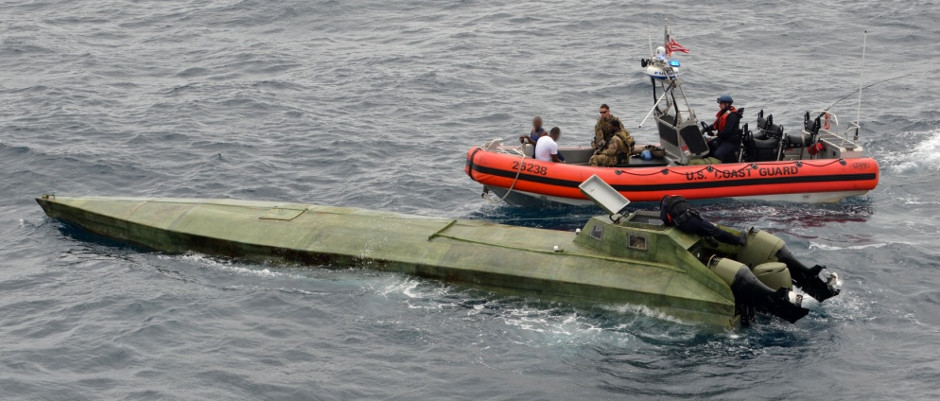
Rear-cockpit ‘hybrid narco-sub’ had been intercepted by the USCG cutter Mohawk on 3rd July 2018. Photo by Petty Officer 3rd Class Brandon Murray, USCG
Covert Shores provides the latest in a series, looking at the craft used by drug smugglers in recent interdictions, with particular emphasis on the emergence of hybrid, high-speed, cockpit aft, outboard powered craft.
Not exactly the typical low profile self propelled semi-submersible, but definitely low observable if they are not making a visible wake. Maybe their tactic is a combination of sprint and drift?
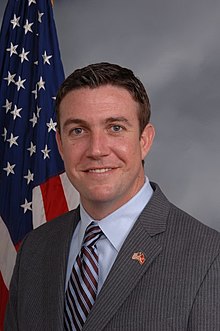
The Tuesday indictment of Rep. Duncan Hunter on corruption charges could have an impact on a number of defense-related pet projects for the Republican lawmaker, including the potential sale of military drones to Jordan.
The indictment charges that Hunter and his wife, Margaret, who served as a campaign consultant, stole more than $250,000 in campaign funds to pay for overseas vacations, bar tabs, dental work and other personal purchases, despite objections from staff.
Hunter, a 41-year-old California Republican, has repeatedly denied the charges, and indicated Wednesday he intends to continue to run for re-election in November.
But following his indictment, House Speaker Paul Ryan, R-Wis., announced that Hunter’s committee assignments would be revoked while the criminal case is pending (emphasis applied, Chuck) — including his seat on the House Armed Services Committee.
I hate to see this happen. As chair of the House Coast Guard and Maritime Transportation Subcommittee, Representative Hunter has been a strong advocate for the Coast Guard. With funding for the Icebreaker in the balance it is a bad time to weaken a strong pro-Coast Guard voice.
The Coast Guard’s Nationwide Automatic Identification System (NAIS) achieved full operational capacity (FOC) on May 24, 2018.
Jewuan Davis, program manager for the NAIS program (CG-9332), explained that FOC was achieved when the capability had been “deployed and accepted at the 58 critical ports and 11 waterways identified in the NAIS Operational Requirements document.” Currently, permanent transceiver systems are deployed and fully operational at 134 total regional sites, providing operational coverage of the 58 critical ports and 11 waterways. On a daily basis, NAIS receives an average of over 264 million vessel messages and provides data feeds to over 80 Coast Guard and other government agency systems worldwide.
The milestone was recognized during a ceremony at Coast Guard Headquarters on July 26, 2018. In attendance were Rear Adm. Michael Ryan (CG-7), Rear Adm. Michael Johnston (CG-93) and Rear Adm. Michael Haycock (CG-9). During the ceremony, the flag officers shared real stories of how NAIS was used to enhance maritime domain awareness (MDA) across the Coast Guard.
The NAIS acquisition stemmed from the Maritime Transportation Security Act of 2002 which directed requirements to establish a system of effective maritime domain awareness and security for every port act of 2006. MDA is defined as the effective understanding of anything associated with the maritime domain that could impact the security, safety, economy or environment. “The Coast Guard is the lead federal agency for maritime security, maritime safety, maritime mobility, national defense in U.S. coastal waters and protection of natural resources in U.S. coastal waters,” said Davis, “NAIS is critical to the Coast Guard’s ability to fulfill its responsibilities in those areas.”
NAIS enables the Coast Guard to maintain MDA by providing a comprehensive view of the nation’s waters. As a result, decision makers are better positioned to respond to safety and security risks; improve the safety of vessels and ports through collision avoidance; and strengthen national security through the detection, identification, and classification of potential threats from offshore.
The NAIS program started in 2004. Reflecting on the process 14 years later, Davis said, “A lot of detailed planning, interagency coordination, and hard work was invested into the successful completion of this milestone and full delivery of this capability to the Coast Guard’s operational users.” There are many contributors to thank for the success including the entire NAIS Program Management Office team and previous program managers and team members who put hard work and diligence into the early stages of developing NAIS. Davis extends a special thanks to the Office of Command, Control, Communications, Computer and Sensors Capabilities (CG-761); Sustainment Manager (CG-681); NAIS product line team at Command, Control, and Communications Engineering Center and all operational users for “helping us continually improve and refine the tool into the critical asset it is today.”
The next major milestone for the NAIS acquisition program will be the completion of acquisition decision event 4, acquisition gate review and transition of management responsibility for NAIS from acquisitions to the sustainment community, scheduled to occur in the fourth quarter of fiscal year 2018. After that point, the sustainment community will assume responsibility for the continued maintenance of NAIS and managing technical refreshes of the capability to keep the system up to date.
Twenty-five nations, 46 surface ships, five submarines, 17 land forces, more than 200 aircraft, and 25,000 personnel participated in the latest RIMPAC exercise. Nations represented included Australia, Brunei, Canada, Chile, Colombia, France, Germany, India, Indonesia, Israel, Japan, Malaysia, Mexico, Netherlands, New Zealand, Peru, Republic of Korea, Republic of the Philippines, Singapore, Sri Lanka, Thailand, Tonga, United Kingdom, United States and Vietnam.
180710-G-ZV557-1313 PACIFIC OCEAN (July 10, 2018) Crewmembers aboard the USCGC Bertholf (WMSL 750) check the flight deck July 10, 2018, alongside the flight crew of the a U.S. Navy HSC-4 Black Knight MH-60 helicopter 15 miles south of Oahu, Hawaii, while in support of RIMPAC 2018. Photo by Petty Officer 2nd Class David Weydert
And the Coast Guard was there. USCGC Bertholf even headed one of the Task Groups. But I have yet to see any stories from the Coast Guard about Coast Guard participation.
Consequently there is not a lot I can say about what the Coast Guard did. Can’t help but think this was a missed opportunity.
All we seem to have are Navy photographs with their captions.
RIMPAC 2018 will also be the first time that US Coast Guard Maritime Security Response Team West (MSRT-W) participates in RIMPAC SOCAL. US Navy Photo
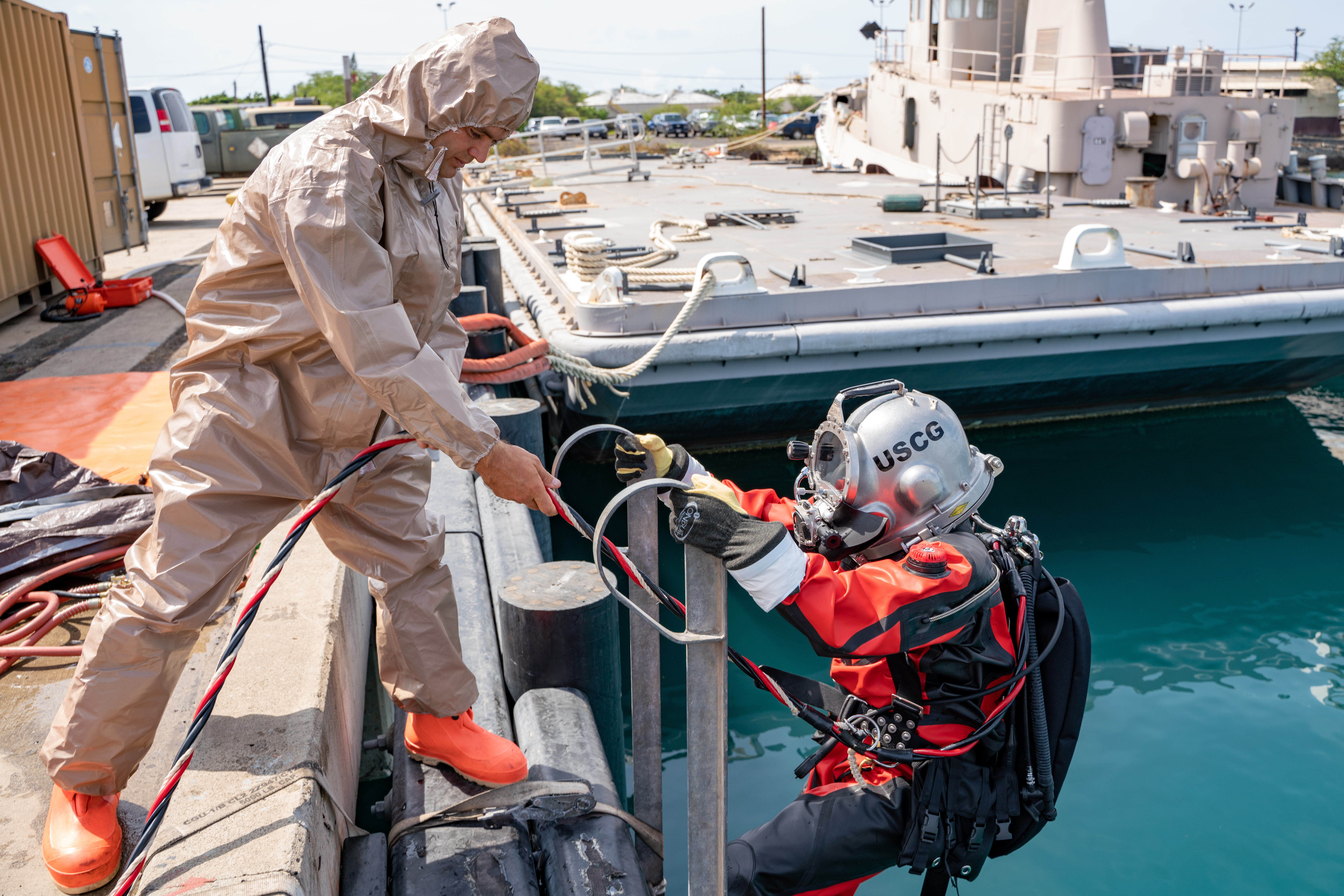
180710-N-CW570-1068 JOINT BASE PEARL HARBOR-HICKAM, Hawaii (July 10, 2018) U.S. Coast Guardsmen assigned to Regional Dive Locker Pacific conduct diving operations during a decontaminated water diving symposium at Joint Base Pearl Harbor-Hickam during Rim of the Pacific (RIMPAC) exercise, July 10, 2018. (U.S. Navy photo by Mass Communication Specialist 1st Class Arthurgwain L. Marquez/Released)
The Sinking Exercises
One of the highlights of RIMPAC is always the ability to test ordnance against an actual ship in a Sink-EX. This time there were two target ships, the former USS Racine (LST-1191) and a frigate, the formerUSS McClusky (FFG 41).
The Racine Sink-EX
This RIMPAC was a bit unusual, in that US Army and Japanese ground units participated in the Racine Sink-EX.
Using targeting from a US Army Gray Eagle drone and AH-64E team, the former Racine was hit by four Japan Ground Self Defense Force surface to surface missiles, a Naval Strike Missile fired from a US Army vehicle with a Palletized Load System (PLS), five HIMAR artillery rockets were fired (no indication how many hits), a Harpoon missile fired by an Australian P-8 Maritime Patrol Aircraft, and another Harpoon and a torpedo from a US submarine.
Photo By Master Chief Petty Officer Brian Brannon | 180712-N-HO130-2002 PACIFIC MISSILE RANGE FACILITY BARKING SANDS, Hawaii (July 12, 2018) Members of the Japan Ground Self-Defense Force (JGSDF) fire a Japanese Type 12 Surface-to-Ship Missile (SSM-12) at the ex-USS Racine (LST-1191), positioned at sea, during a sinking exercise, July 12, at Pacific Missile Range Facility Barking Sands on the island of Kauai, Hawaii, during the Rim of the Pacific (RIMPAC) exercise. This marks the first time the U.S. Army and JGSDF have participated in a sinking exercise during RIMPAC. (U.S. Navy photo by Master Chief Mass Communication Specialist Brian Brannon/Released)
The McClusky Sink-EX
We don’t have a video of the McClusky Sink-EX. An early report indicated that she was sunk by fire from “from a ship and an aircraft.”
Subsequently we learned that the Singapore Navy, presumably RSS Tenacious (71) which has space for up to 24 Harpoons, fired two Harpoons at the decommissioned FFG and that unlike most Harpoon strikes, these hit at the waterline, causing the ship to sink earlier than expected. (Really I think all anti-ship cruise missiles should be programmed to strike the waterline–perhaps a terminal dive. Usually their detonations let in air rather than water, damaging the target rather than sinking it.)
“In all, six Harpoons were successfully shot between the two SINKEX events, according to manufacturer Boeing.”
I presume this means two surface launched by the Singapore Navy and two air launched against the FFG and one sub launched and one air launched by the Australian P-8 against the LST.
An Air Force launched LRASM was originally planned to be used against Racine, but I have seen no indication one was launched during the exercise.
Innovation Fair
The Naval Institute reported on a new RIMPAC program, the “Innovation Fair.” While apparently it included a lot of high-tech presentations; it was a simple low-tech “why didn’t I think of that” good idea that won the prize, and it looks like something the Coast Guard could use, a floating and reflective damage control (DC) bag.
Royal Malaysian Navy Sub-Lieutenant Chan Jun Kwan, assigned to frigate KD Lekiu (FFG 30), displays a damage control floating bag concept developed by his crew during the inaugural Rim of the Pacific (RIMPAC) exercise innovation fair. US Navy photo.







 Chuck Hill's CG Blog