ARABIAN SEA (Sept. 7, 2023) United Kingdom Royal Navy Sailors assigned to frigate HMS Lancaster (F 229) inventory illicit drugs seized in the Arabian Sea, Sept. 7. (Photo by Courtesy photo)
Below is a news release from US Naval Forces Central Command.
5th Fleet (NAVCENT) has been doing some interesting stuff. They have assembled a coalition called “Combined Maritime Forces” that might serve as a model for operations in the South China Sea, Western Pacific, and the Eastern Pacific/Caribbean drug transit zones. Of course, the US Coast Guard is playing a part here and here.
MANAMA, Bahrain —On September 7, UK warship HMS Lancaster (F229), operating in support of the French-led Combined Task Force (CTF) 150 seized more than 450kg of illegal drugs including heroin and hashish in the Arabian Sea.
With a street value of approximately $9.5 million this is the first narcotics seizure since the French Navy took over command of CTF 150 from the UK in July. The Combined Maritime Forces (CMF) remain committed to disrupting criminal and terrorist activities by restricting their freedom of maneuver in the maritime environment.
Capt Yannick Bossu, CTF 150 Commanding officer said, “This seizure demonstrates once again the operational effectiveness of CTF 150 and illustrates the UK and France’s commitment to maritime security alongside their regional and international partners.”
Cmdr Chris Sharp, HMS Lancaster Commanding Officer remarked, “This success again demonstrates how international partners can work together in stopping illegal maritime activity which funds terrorist activity. This was a great success shared by all those involved.”
CTF 150 is one of the five operational forces of CMF, a 38-nation maritime partnership headquartered in Bahrain. CMF strengthens the maritime security in this strategic area, by countering activities that finance terrorism and international crime. This is the twelfth time that France commanded CTF 150.
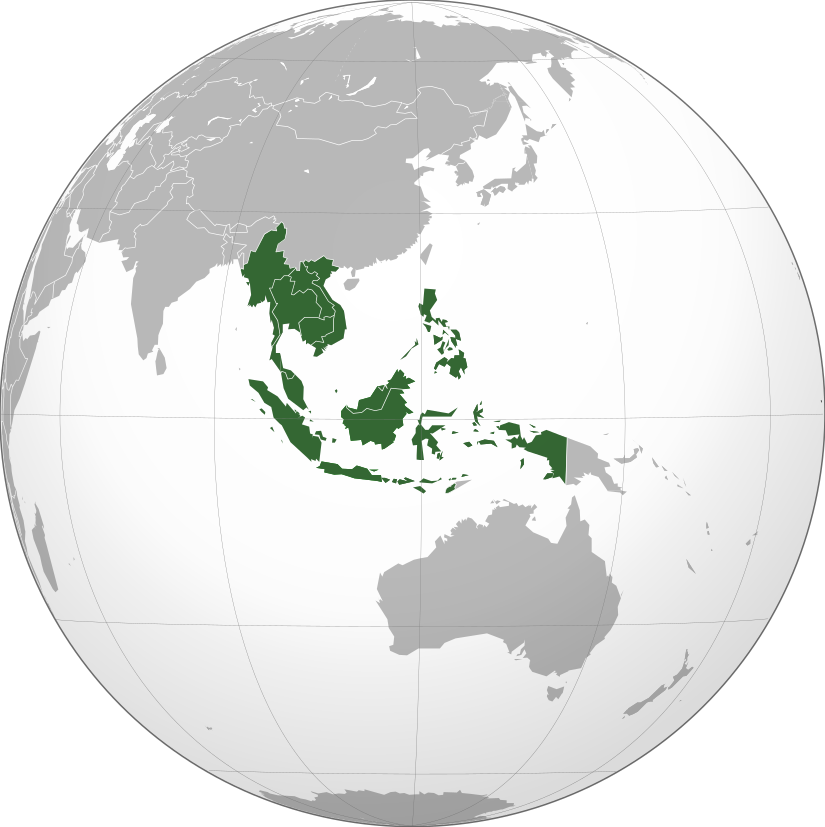
“Units from the countries of ASEAN began their first ever joint military drills in Indonesia’s South Natuna Sea amid rising geopolitical tensions between major powers and protests against China’s activities in the South China Sea…The five-day non-combat operation is aimed at developing military skills, including maritime security and patrols, and the distribution of humanitarian assistance and disaster relief, the Indonesian military said in a statement.”
This is a step toward establishment of recognized norms and cooperative law enforcement by ASEAN members in the South China Sea.
Significantly Indonesia is taking a leadership role. Indonesia seems to be the most aggressive nation in ASEAN with regard to protecting their EEZ assets.
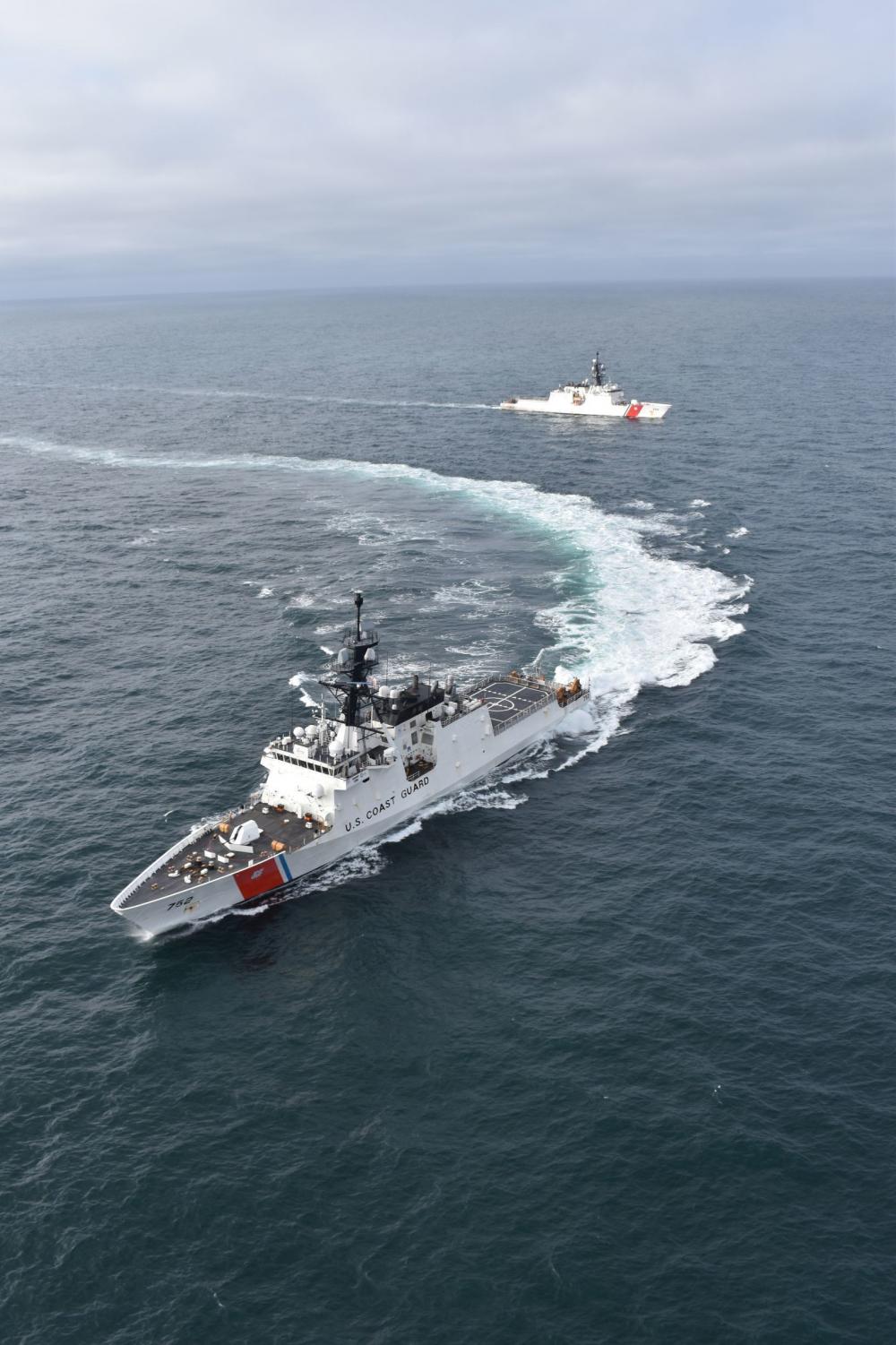
U.S. Coast Guard Cutters Stratton (WMSL 752) and Kimball (WMSL 756) steam in formation while patrolling the U.S.-Russian Maritime Boundary Line (MBL), in the Bering Sea, Sept. 26, 2022. This marked the first time two national security cutters jointly patrolled the MBL above the Arctic Circle. (U.S. Coast Guard courtesy photo).
US Coast Guard cutter provides presence during Russian military exercise in Bering Sea
D17 Public Affairs
JUNEAU, Alaska – The crew of Coast Guard Cutter Kimball (WMSL 756), in coordination with U.S. Northern Command, provided U.S. presence during a Russian military exercise in the Bering Sea, Friday.
The Kimball patrolled in the vicinity of U.S. fishing vessels conducting their work in international waters within the U.S. exclusive economic zone (EEZ) during ongoing Russian military operations, which included the launch of a missile, approximately 300 miles southwest of St. Lawrence Island.
“Though military operations and exercises in international waters are lawful,” said Rear Adm. Megan Dean, Seventeenth Coast Guard District commander, “we will continue to ensure there are no disruptions to U.S. interests or commerce in the maritime environment around Alaska.”
On Sept. 10, an urgent warning of navigational dangers advisory message, known as a HYDROPAC, was released through the National Geospatial Agency regarding Russian military operations in the Bering Sea. The area of the HYDROPAC includes a portion of the U.S. EEZ southwest of St. Lawrence Island along the U.S./Russia Maritime Boundary Line and remains in effect through Sept. 24.
The Coast Guard notified vessels and the commercial fishing industry operating in the vicinity of the HYDROPAC, and made notifications to federal, state and tribal governments about the exercise. The Coast Guard continues to provide notifications throughout the maritime and fishing industry by all available means.
The Kimball, a 418-foot legend-class national security cutter homeported in Honolulu, Hawaii, is currently operating under the Seventeenth District’s Operation Frontier Sentinel.
Operation Frontier Sentinel is a Seventeenth Coast Guard District operation designed to meet presence with presence and ensure there are no disruptions to U.S. interests in the Alaskan maritime environment. The Coast Guard routinely patrols international waters under the service’s statutory authorities to ensure maritime safety and security of the U.S. maritime industry, to protect U.S. sovereign rights and to promote international rules-based order. Coast Guard presence ensures due regard for all lawful uses of the seas.
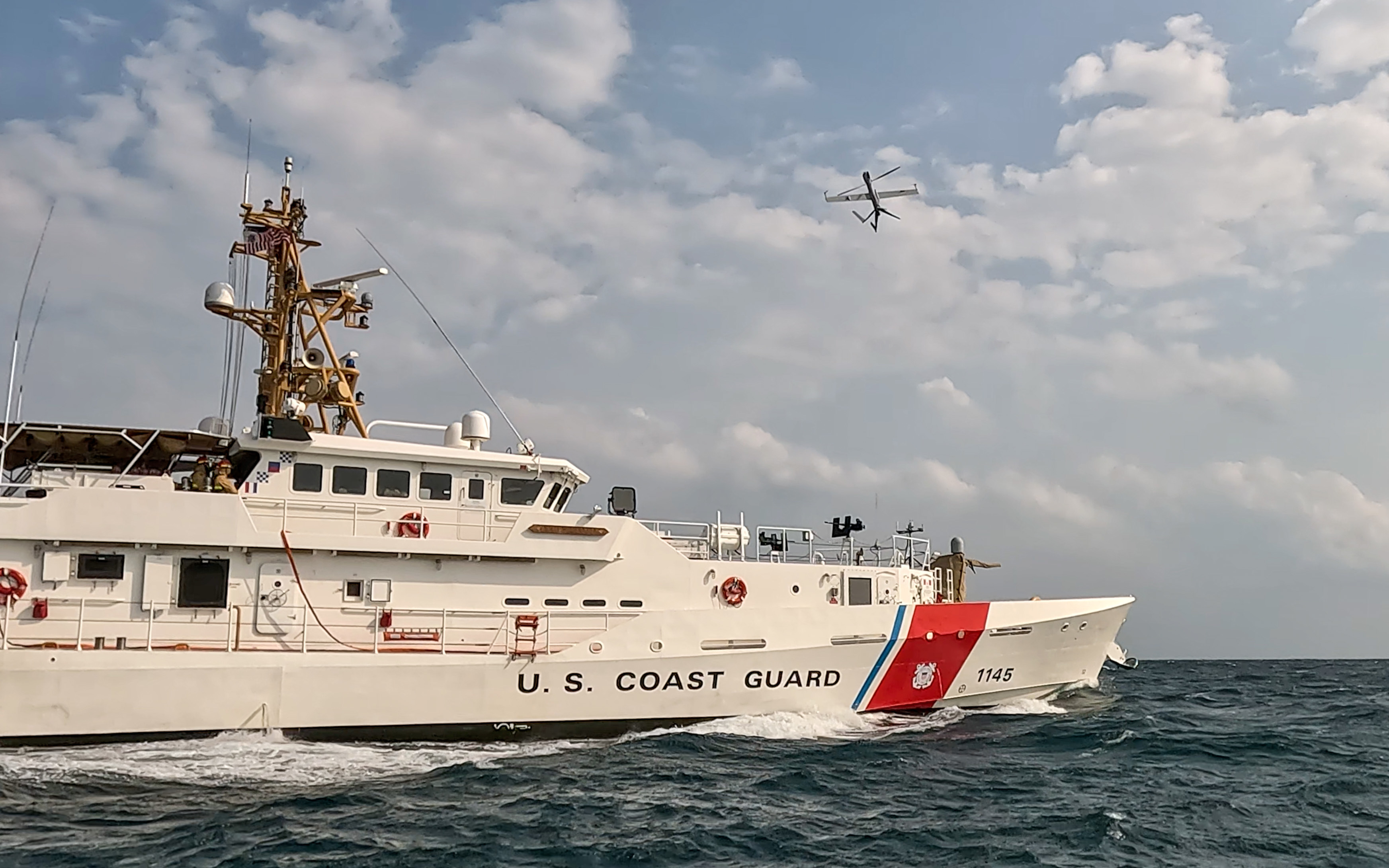
221207-N-NO146-1001 ARABIAN GULF (Dec. 7, 2022) An Aerovel Flexrotor unmanned aerial vehicle (UAV) takes off from U.S. Coast Guard fast response cutter USCGC Emlen Tunnell (WPC 1145) transiting the Arabian Gulf, Dec. 7. U.S. 5th Fleet’s Task Force 59 launched the UAV during Digital Horizon, a three-week event focused on integrating new unmanned and artificial intelligence platforms, including 10 that are in the region for the first time. (U.S. Navy photo)
We have begun to see very capable, vertical takeoff and landing (VTOL) unmanned air systems that fall into the DOD Group Two standard.
Weight: 21 to 55 pounds (10 to 25 kg)
Nominal operating altitude: <3500 feet or 1 km above ground level.
Speed: <250 knots
Recently Elbit Systems reported they would be providing a Group 2 VTOL to the Israeli Army, and we have the photo above of an Aerovel Flexrotor taking off from a Webber class patrol craft,
These small, unmanned air systems (UAS), which can combine sophisticated sensors and endurance of four to over 24 hours, may be better search platforms than our H-65 helicopters.
Group 2 UAS are even smaller than the Martin V-Bat. It appears, they might be able to operate from Webber class cutters. Operating UAS from the Webber class on a regular basis would provide them much of the air search advantage of larger flight deck equipped cutters.
Below is a news release on another aircraft in this class, the Edge Autonomy VXE30. The VIDAR sensor referred to in the news release, is also used on the Scan Eagle (a catapult launched Group 2 UAS) used on National Security Cutters. There is more on the unmanned VXE30 here.
Edge Autonomy’s VXE30 UAS. The VXE30 vertical take-off and landing (VTOL) solution is the latest and most advanced version of the “Stalker” series of small uncrewed aerial systems (sUAS) from Edge Autonomy.
Sentient’s AI-enabled ViDAR optical sensors soar on Edge Autonomy’s VXE30 “Stalker” UAS in successful live demonstrations
ViDAR – Sentient’s AI-enabled wide area motion imagery deployed for real-time maritime surveillance at the edge
VIRGINIA BEACH, Va. (Aug 29, 2023) – Sentient Vision Systems (Sentient) has successfully completed live demonstrations of its AI-enabled ViDAR (Visual Detection and Ranging) payload deployed on Edge Autonomy’s VXE30 UAS. The VXE30 vertical take-off and landing (VTOL) solution is the latest and most advanced version of the “Stalker” series of small uncrewed aerial systems (sUAS) from Edge Autonomy. When coupled with Sentient’s ViDAR, the VXE30 provides a passive, wide area search capability, enabling it to serve a myriad of maritime operations. The joint capability will be on display at DSEI 2023, 12-15 September in London.
ViDAR, developed by Sentient, utilizes AI; Computer Vision, and Machine Learning integrated with Electro-Optic and Infrared (EO/IR) sensors to passively detect objects that are difficult to spot by the human eye or recognize on a conventional radar. With these enhanced capabilities, Stalker will be more capable of accurately detecting and locating people, objects, and vessels (day and night) far from the operator.
ViDAR has been deployed on intelligence, surveillance, and reconnaissance missions (ISR), maritime patrol and border protection, as well as search and rescue missions since 2015. ViDAR is proven to be effective in challenging maritime conditions up to Sea State 6 (very rough with waves 13 to 20 feet high/ 4 to 6 meters).
Sentient has successfully evolved ViDAR into a compact, lightweight, low power form factor—low SWaP (size, weight, and power) — suitable for deployment on small Group 2 / NATO Class 1 UAS such as the VXE30. Its successful integration onto the VXE30 demonstrates its broad operating envelope and ability to provide unprecedented long-endurance imaging capability in contested environments all around the world.
Joshua Stinson, Edge Autonomy’s Chief Growth Officer said, “The integration of ViDAR onto the VXE30 is an essential part of our UAS deployment program. ViDAR’s passive detection system will further the VXE30’s capabilities to remain undetected in a contested environment while carrying a powerful maritime detection sensor that provides a real-time picture of the maritime domain. This capability could make all the difference in a mission’s success.”
Paul Harris, Sentient’s VP of Business Development agreed and said, “We are delighted to be working with Edge Autonomy to demonstrate how effective ViDAR is at increasing the utility of the small and agile VXE30 for the challenges of the modern battlespace. We look forward to displaying our joint capabilities at DSEI.”
With close to 4,500 systems deployed, Sentient’s AI-enabled sensor edge solutions for wide area motion imagery are proven for detection in missions worldwide.
Sentient Vision Systems specializes in passive, modular optical sensors for persistent, wide area motion imagery. Sentient’s artificial Intelligence (AI)-enabled edge solutions better detect and identify small objects in real time, on land and at sea. With more than 20 years of development in moving target indication, AI computer vision and machine learning, Sentient has deployed thousands of systems worldwide in the field of Intelligence, Surveillance, Search and Rescue, enhancing situational awareness, accelerating informed decisions, and saved numerous lives. Follow Sentient on LinkedIn , Vimeo, YouTube and Twitter
Edge Autonomy is a leader in providing innovative autonomous systems, advanced optics, and resilient energy solutions to the U.S. Department of Defense, the U.S. Federal Civilian Agencies, allied governments, academic institutions, and commercial entities. Edge Autonomy draws on a 34+ year history of aerospace engineering, advanced manufacturing expertise, and technologically advanced manufacturing. With headquarters in San Luis Obispo, CA, and key production capabilities abroad, Edge Autonomy’s 400+ team members deliver results in multiple markets. Follow Edge Autonomy on LinkedIn, Facebook and Twitter.
Below is a 4th Fleet News Release. Ten Saildrones will be operating in the Caribbean.
NEWS | Sept. 13, 2023
Saildrones Set Sail in Support of U.S. 4th Fleet’s Operation Windward Stack
By U.S. Naval Forces Southern Command/U.S. 4th Fleet Public Affairs
NAVAL STATION KEY WEST, Fl. – Commercial operators began deploying 10 Saildrone Voyager Unmanned Surface Vessels (USVs) out to sea today, a critical first step in U.S. 4th Fleet’s Operation Windward Stack.
Launched from Naval Air Station Key West’s Mole Pier and Truman Harbor, the Saildrones’ mission once on station is to improve maritime domain awareness, or MDA, by detecting and quantifying targets that pass within range of the Saildrones’ sensors.
Operation Windward Stack is a long-term operation of unmanned and manned forces working together, also known as a hybrid fleet, as envisioned by the Secretary of the Navy and the Chief of Naval Operations. Windward Stack is part of 4th Fleet’s unmanned integration campaign, which provides the Navy a region to experiment with and operate unmanned systems in a permissive environment, develop Tactics, Techniques, and Procedures (TTPs) against near-peer competitors, and refine manned and unmanned Command and Control (C2) infrastructure, all designed to move the Navy to the hybrid fleet.
First, operators and watchstanders at U.S. 4th Fleet will conduct tests and coordinate information flow as the solar-powered Saildrones sail into the Caribbean. “Operation Windward Stack begins with testing as we integrate the information we receive from the Saildrones into our fleet command center to further increase maritime domain awareness in the U.S. Southern Command Area of Responsibility (AOR),” said Lt. Cmdr. John Clark, U.S. 4th Fleet’s Current Operations (COPS) Director. “We will eventually have the opportunity to work through the command and control of both manned and unmanned forces operating throughout our region.”
The 10 Saildrones will serve as the initial unmanned vessels in the operation. Plans are to add additional USVs, unmanned aerial vehicles (UAVs) and manned maritime forces over the next few months to further challenge C2 integration and to expand the MDA coverage.
“We were able to demonstrate coordinated operations of manned and unmanned forces during UNITAS LXIV, a multinational maritime exercise, but that was for a relatively short time,” said Capt. David Fowler, U.S. 4th Fleet Maritime Operations Center (MOC) Director. “With Windward Stack, we’re going to coordinate these operations for many months. That is how we will truly learn what these unmanned vessels can do for us on a day-to-day basis.”
U.S. Naval Forces Southern Command/U.S. 4th Fleet supports USSOUTHCOM’s joint and combined military operations by employing maritime forces in cooperative maritime security operations to maintain access, enhance interoperability, and build enduring partnerships in order to enhance regional security and promote peace, stability and prosperity in the Caribbean, Central and South American region.
Allies training together is routine, but there was a real surprise in the story,
The containerized configuration of the SM-6 launcher augments the U.S. Navy’s operational flexibility, facilitating rapid deployment and utilization in diverse theaters of operation, thereby underlining the commitment of the United States to ensure the security interests of itself and its allies.
—There is a containerized launch system for SM-6—
This means any ship with a good air search radar, sufficient deck space, and can handle the additional topside weight (like perhaps an NSC, OPC, or even an LCS) can have both a long range AAW missile system and a long range high supersonic anti-ship/anti-surface missile system.
As an Anti-Air system, the SM-6 incorporates an active radar seeker, so it does not require the radar illuminators that dominated the architecture of most AAW missile ships which used semi-active homing.
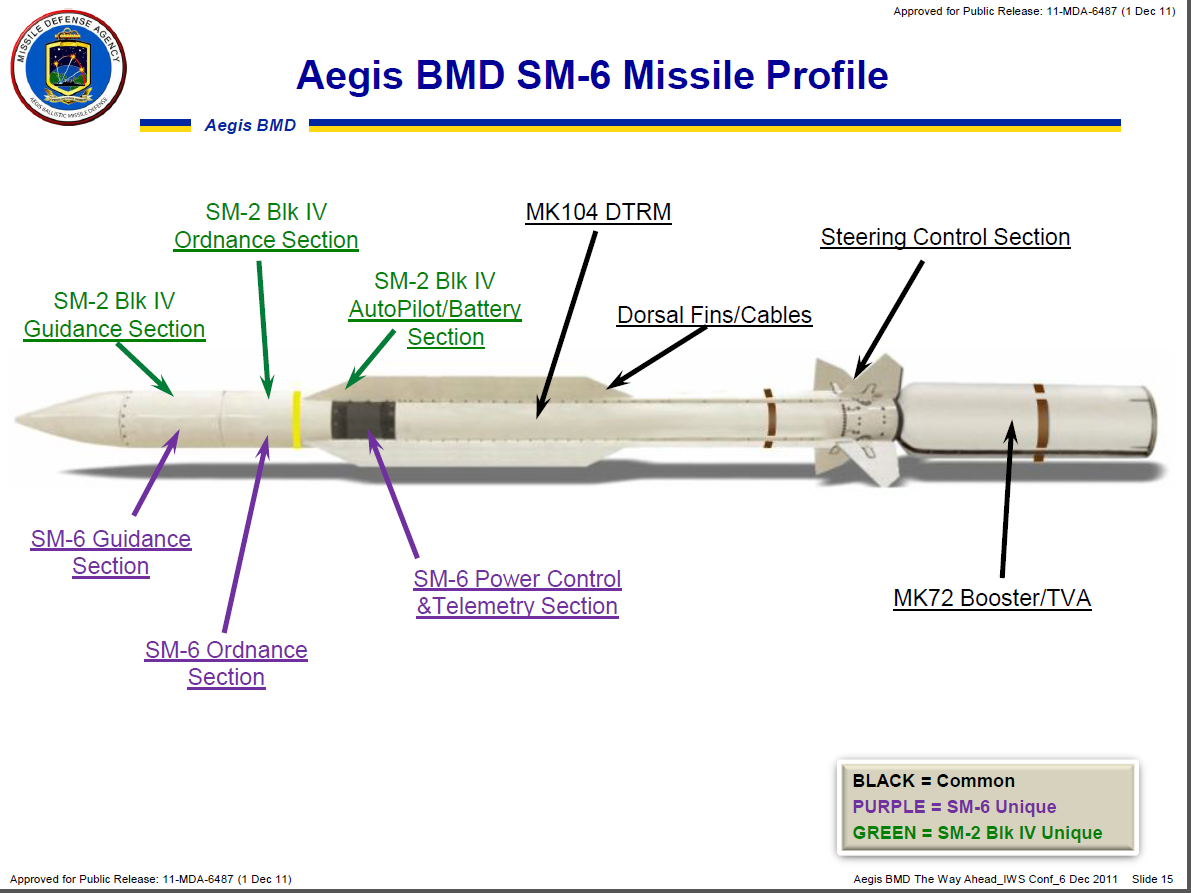
The RIM-174 Standard Extended Range Active Missile (ERAM), or Standard Missile 6 (SM-6), is a missile in current production for the United States Navy. It was designed for extended-range anti-air warfare (ER-AAW) purposes, providing capability against fixed and rotary-wing aircraft, unmanned aerial vehicles, anti-ship cruise missiles in flight, both over sea and land, and terminal ballistic missile defense. It can also be used as a high-speed anti-ship missile. The missile uses the airframe of the earlier SM-2ER Block IV (RIM-156A) missile, adding the active radar homing seeker from the AIM120C AMRAAM in place of the semi-active seeker of the previous design. This will improve the capability of the Standard missile against highly agile targets and targets beyond the effective range of the launching vessels’ target illumination radars. Initial operating capability was planned for 2013 and was achieved on 27 November 2013.
Presumably the launcher is based on the Mk41 VLS and if so, it should be able to launch a variety of weapons including ESSM, a shorter ranged, smaller, much cheaper missile that can be quad packed into the launcher, and vertical launch ASROC.
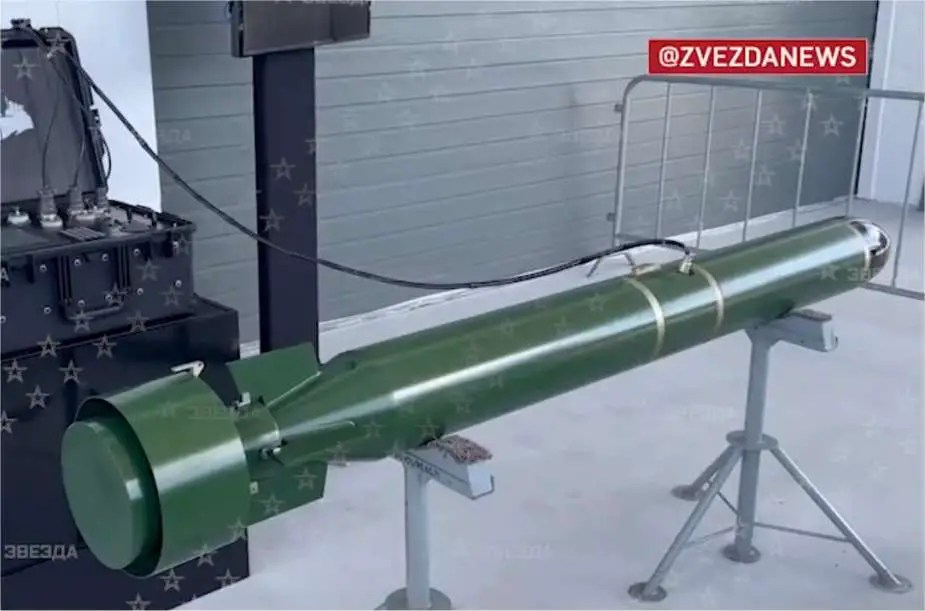
“It can target submarines, unmanned underwater vehicles, which is very relevant today, and surface ships…220mm in caliber, varies in length from 2.1 to 2.4 meters and weighs between 100 and 140 kg.”
The CVLWT is reportedly 6.75″ (171mm) in diameter, about 85″ (2.16 meters) in length, and weighs about 220 pounds (100 kilos).
I contend the Coast Guard could use the CVLWT to forcibly stop even large merchant ships that might be used by terrorists or for other nefarious purposes, probably without sinking it, which might lead to serious unintended consequence.
A portable missile launcher capable of firing a combination of long-range anti-ship and anti-air weapons was spotted this week undergoing testing aboard a Littoral Combat Ship in San Diego, Calif., according to photos provided to USNI News.
Based on a series of photos reviewed by USNI News, the launcher is a Lockheed Martin MK 70 containerized vertical launching system that is capable of firing both a Raytheon Standard Missile 6 and a Tomahawk Land Attack Missile. It was spotted on the flight deck of Independence-class LCS USS Savannah (LCS-28), which was pier-side in San Diego, according to a USNI News review of the images.
If you can operate Army missile launchers from an LCS you can also operate them from a Coast Guard cutter.
This could be particularly useful in Alaska where there are no Navy ships and limited road infrastructure. Launchers could be flown to meet cutters already in Alaskan waters long before Navy ships could reach the area.
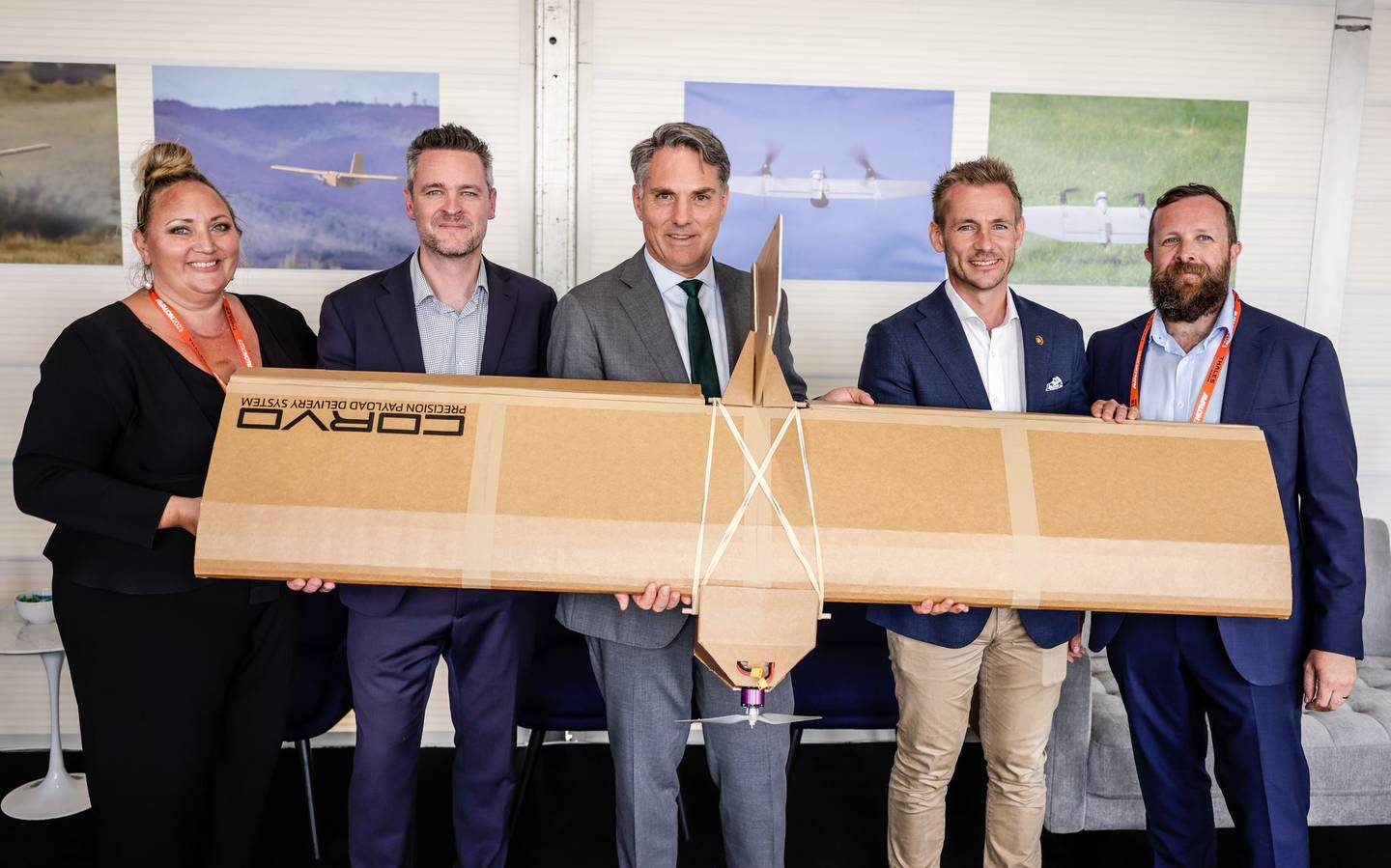
SYPAQ company officials host Australian Deputy Prime Minister Richard Marles and the Ukrainian ambassador to Australia, Vasyl Myroshnychenko, during a March 2023 event following Australia’s donation of 600 Corvo Precision Payload Delivery System drones to Ukraine. (SYPAQ photo)
Ukrainian soldiers have received hundreds of drones, gifted to them by Australia, to capture surveillance video crucial for preparing missions to retake ground from Russian forces.
The data comes from GoPro cameras strung from holes punched into disposable cardboard drones.
This shows just how simple it can be to get an Unmanned Air System ISR capability, or perhaps a weapons delivery capability.






 Chuck Hill's CG Blog