Some photos from Twitter:


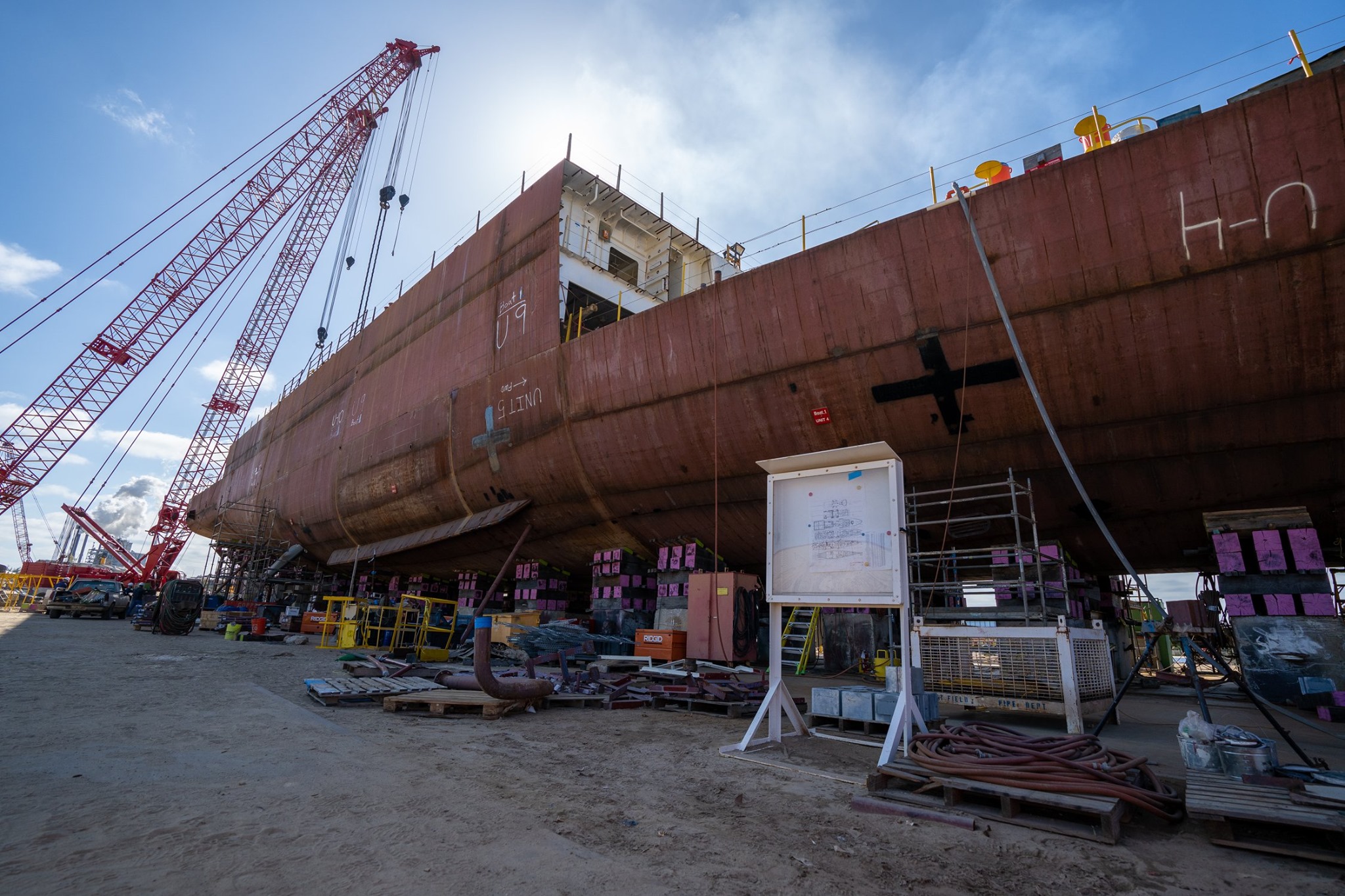

Thanks to Walter for bringing this to my attention.

Some photos from Twitter:
Thanks to Walter for bringing this to my attention.

The Congressional Research Service has again updated their report on Coast Guard cutter procurement. (The link will always take you to the most recent edition of the report.) I have reproduced the summary in full below. I have applied emphasis by “bolding” some parts, but first some comments.
As you will see below, the Congress is still keeping the option of NSC#12 open, and, in fact, they are asking the Coast Guard if there isn’t justification for it.
“The Committee is disappointed that the Coast Guard has not officially conveyed to the Committee a determination on whether a twelfth NSC is required…” (Explanatory Statement, p. 25) “The Coast Guard is encouraged to officially convey a determination to the Committees as to whether a 12th vessel is needed.” (Conference, p. 25)
With the expansion of the Coast Guard’s support for distant missions, and the delays in the delivery of the OPCs, looks like we could make a good case for NSC#12.
Congress has asked for a reevaluation of our needs,
SEC. 9422 (re. Elijah E. Cummings Coast Guard Authorization Act of 2020, p. 26). Report on fast response cutters, offshore patrol cutters, and national security cutters.
(a) In general.—Not later than 90 days after the date of the enactment of this Act, the Commandant shall submit to the Committee on Commerce, Science, and Transportation of the Senate and the Committee on Transportation and Infrastructure of the House of Representatives a report on the combination of Fast Response Cutters, Offshore Patrol Cutters, and National Security Cutters necessary to carry out Coast Guard missions.
(b) Elements.—The report required by subsection (a) shall include—
(1) an updated cost estimate for each type of cutter described in such subsection; and (2) a cost estimate for a Sensitive Compartmented Information Facility outfitted to manage data in a manner equivalent to the National Security Cutter Sensitive Compartmented Information Facilities.
So far I have heard nothing to indicate the Coast Guard has complied with this request, which was enacted into law 92 days ago. This report and the determination of the requirement for NSC#12 may be tied up in DHS.
I assume the “…cost estimate for a Sensitive Compartmented Information Facility outfitted to manage data in a manner equivalent to the National Security Cutter Sensitive Compartmented Information Facilities” refers to adding this capability to the Offshore Patrol Cutter.
Summary
The Coast Guard’s program of record (POR), which dates to 2004, calls for procuring 8 National Security Cutters (NSCs), 25 Offshore Patrol Cutters (OPCs), and 58 Fast Response Cutters (FRCs) as replacements for 90 aging Coast Guard high-endurance cutters, medium-endurance cutters, and patrol craft. The Coast Guard’s proposed FY2021 budget requested a total of $597 million in procurement funding for the NSC, OPC, and FRC programs; Congress provided a total of $837 million for FY2021, with the additional $240 million being for the FRC program.
NSCs are the Coast Guard’s largest and most capable general-purpose cutters; they are replacing the Coast Guard’s 12 Hamilton-class high-endurance cutters. NSCs have an estimated average procurement cost of about $670 million per ship. Although the Coast Guard’s POR calls for procuring 8 NSCs to replace the 12 Hamilton-class cutters, Congress through FY2021 has fully funded 11 NSCs, including the 10th and 11th in FY2018. In FY2020, Congress provided $100.5 million for procurement of long lead time materials (LLTM) for a 12th NSC, so as to preserve the option of procuring a 12th NSC while the Coast Guard evaluates its future needs. The Coast Guard’s proposed FY2021 budget requested $31 million in procurement funding for activities within the NSC program; this request did not include further funding for a 12th NSC. The Coast Guard’s proposed FY2021 budget also proposed a rescission of $70 million of the $100.5 million that Congress provided for a 12th NSC, with the intent of reprogramming that funding to the Coast Guard’s Polar Security Cutter (PSC) program; Congress did not approve this request. Nine NSCs have entered service; the ninth was commissioned into service on March 19, 2021.
OPCs are to be less expensive and in some respects less capable than NSCs; they are intended to replace the Coast Guard’s 29 aged medium-endurance cutters. Coast Guard officials describe the OPC and PSC programs as the service’s highest acquisition priorities. OPCs have an estimated average procurement cost of about $411 million per ship. The first OPC was funded in FY2018. The Coast Guard’s proposed FY2021 budget requested $546 million in procurement funding for
the third OPC, LLTM for the fourth, and other program costs. On October 11, 2019, the Department of Homeland Security (DHS), of which the Coast Guard is a part, announced that DHS had granted extraordinary contractual relief to Eastern Shipbuilding Group (ESG) of Panama City, FL, the builder of the first four OPCs, under P.L. 85-804 as amended (50 U.S.C. 1431-1435), a law that authorizes certain federal agencies to provide certain types of extraordinary relief to contractors who are encountering difficulties in the performance of federal contracts or subcontracts relating to national defense. The Coast Guard is holding a full and open competition for a new contract to build OPCs 5 through 15. On January 29, 2021, the Coast
Guard released a Request for Proposals (RFP) for this Stage 2 contract, as it is called. Responses to the RFP are due by May 28, 2021. The Coast Guard plans to award the Stage 2 contract in the second quarter of FY2022.
FRCs are considerably smaller and less expensive than OPCs; they are intended to replace the Coast Guard’s 49 aging Island-class patrol boats. FRCs have an estimated average procurement cost of about $65 million per boat. A total of 64 have been funded through FY2021, including four in FY2021. Six of the 64 are to be used by the Coast Guard in the Persian Gulf and are not counted against the 58-ship POR quantity for the program, which relates to domestic operations. Forty of the 64 have been commissioned into service, and three others have been accepted by the Coast Guard and are awaiting commissioning. The Coast Guard’s proposed FY2021 budget requested $20 million in procurement funding for the FRC program; this request did not include funding for any additional FRCs.


The Navy League’s on line magazine, “Seapower,” has an interesting article discussing the Coast Guard’s support of the Space Program.
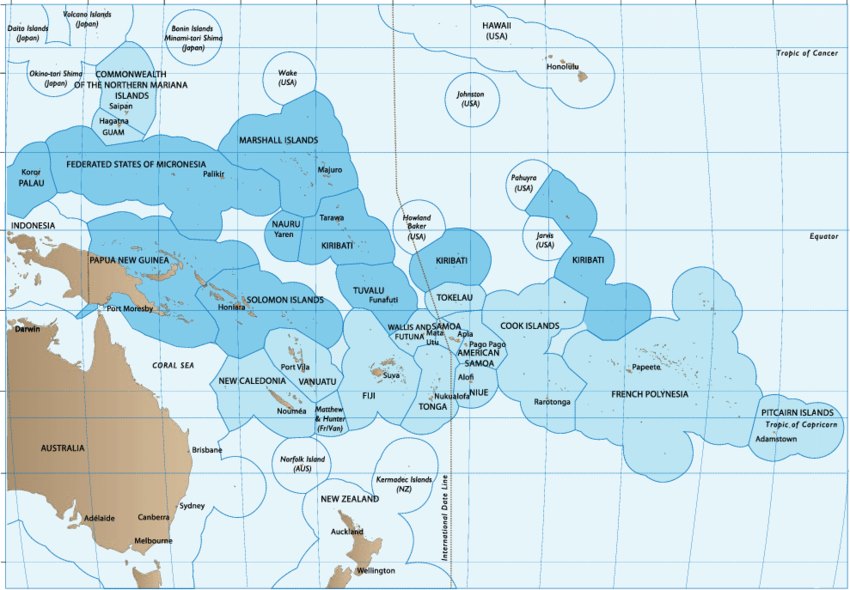
The IndoPacific Defense Forum discusses efforts of Pacific Island nations to stake their claim to their EEZ as it exists now, rather than wait until rising waters eliminate some of the islands the EEZ is currently based upon.
The US, and consequently the Coast Guard, has obligations to several of these States under Compacts of Free Association. We also are motivated by concern that these nations not become dependent on China.

Below is an Atlantic Area news release. In the photo above, you can see that both cutters are equipped with upgrades.
 News Release U.S. Coast Guard Atlantic Area Contact: Coast Guard Atlantic Area Public Affairs Office: (757) 398-6521 After Hours: (757) 641-0763 Atlantic Area online newsroom U.S. Coast Guard ships depart Puerto Rico on mission to strengthen Trans-Atlantic ties ATLANTIC OCEAN — The Legend-class national security cutter USCGC Hamilton (WMSL 753) with the Sentinel-class fast response cutters USCGC Charles Moulthrope (WPC 1141) and USCGC Robert Goldman (WPC 1142) departed Puerto Rico to transit the North Atlantic to Europe, Thursday, April 1, 2021. “U.S. Coast Guard cutters have a long history of protecting America’s interests at home and abroad. This historic deployment demonstrates how we can strengthen our national security by extending the Coast Guard’s global reach and firming our commitments to Allies and partners in the region,” Capt. Timothy Cronin, commanding officer, USCGC Hamilton. Hamilton is escorting the fast response cutters across the Atlantic before conducting a patrol in the U.S. Navy’s Sixth Fleet area of responsibility to maintain maritime security alongside NATO Allies and partners. The Moulthrope and Goldman crews will continue to their new homeport of Manama, Bahrain, with brief stops for logistics and relationship building. Planning for the escort and deployment began last year to ensure smooth delivery of the fast response cutters, replacing the Island-class ships currently in operation under the U.S. Navy’s Fifth Fleet command. “Our primary goal for the fast response cutters is to complete the 9,000-mile voyage to homeport safely and efficiently. In addition, we will capitalize on opportunities to strengthen international partnerships promoting security and prosperity throughout some of the world’s busiest maritime trade routes,” Lt. Cmdr. Steven Hulse, commanding officer, USCGC Charles Moulthrope. “We expect to showcase the capabilities of the fast response cutter, and the U.S. Coast Guard to advance the shared maritime strategy for security with the U.S. Navy and naval partners in the region, while concurrently engaging with them on the more traditional U.S. Coast Guard missions of search and rescue, maritime law enforcement, and illegal fisheries enforcement,” Lt. Cmdr. Samuel Blase, commanding officer, USCGC Robert Goldman. The U.S. Navy and U.S. Coast Guard operate forward, from the littoral to the open ocean, ensuring stability and open sea lanes across all maritime domains. U.S. Coast Guard operations in U.S. Sixth Fleet demonstrate our commitment, flexibility, and capability to operate and address security concerns throughout Europe and Africa. “The U.S. Coast Guard is a member of the Joint Force, a key and always-ready instrument to further national security objectives globally,” said Vice Adm. Steven Poulin, commander, U.S. Coast Guard Atlantic Area. “It’s been almost two decades since we sent the Island-class patrol boats to Bahrain. As we seek to modernize our asset support to the U.S. Navy in the Arabian Gulf, this is an excellent opportunity to advance partnerships and learn from our allies in the region.” Hamilton is the fourth ship in its class. The Legend-class is the largest current cutter class of the U.S. Coast Guard. These vessels support various missions, including environmental protection, search and rescue, fisheries, port security, counterterrorism, law enforcement, drug interdiction, defense operations, and other military operations. Moulthrope and Goldman are the first two of six Sentinel-class ships headed to U.S. Patrol Forces Southwest Asia. Established in 2002 to support Operation Iraqi Freedom, PATFORSWA played a critical role in maritime security and maritime infrastructure protection operations. It is the U.S. Coast Guard’s largest unit outside of the United States. PATFORSWA is currently providing U.S. Navy’s Fifth Fleet and U.S. Central Command with combat-ready assets, utilizing our unique access to foreign territorial seas and ports, formulating strong and independent relationships with patterns throughout the Arabian Gulf, and leveraging the full-spectrum, flexible vessel boarding capabilities and maritime country engagements on the shore. U.S. Sixth Fleet, headquartered in Naples, Italy, conducts the full spectrum of joint and naval operations, often in concert with allied and interagency partners, to advance U.S. national interests and security and stability in Europe and Africa. Based in Portsmouth, Virginia, U.S. Coast Guard Atlantic Area oversees all Coast Guard operations east of the Rocky Mountains to the Arabian Gulf. Also, they allocate ships to deploy to the Caribbean and Eastern Pacific to combat transnational organized crime and illicit maritime activity. |


Military.Com reports the Marines are looking at new Cold Weather uniform items for use in Arctic conditions, including underwear, caps, and mittens that allow use of weapons. May be something the Coast Guard should take a look at.

While the Atlantic Fleet has begun to exercise North of the Arctic Circle, Pacific Fleet has yet to exercise surface ship even close to that latitude. That may be changing, though I suspect they will still not get much further North than the Aleutians.
US Naval Institute News Service reports,
The 15th Marine Expeditionary Unit and the yet-to-be-named carrier strike group will be key players in the Pacific Air Force-led exercise Northern Edge 2021 from May 3 to 14, exercise planner Air Force Lt. Col Michael Boyer said on Wednesday.
Part of the exercise will attempt to blend the Marines’ Expeditionary Advance Base Operations (EABO) that is charting the course of the service’s modern Pacific island-hopping campaign with the PACAFs Agile Combat Employment, a concept that allows the service to operate from more than just well-prepared air bases, Boyer said.
This is a big jump in Navy participation.
I expect the Coast Guard will have at least a minor role in the exercise. Coast Guard cutters and aircraft normally are included in the annual Northern Edge exercises. As I recall, in an earlier exercise, a Coast Guard C-130 was used to help set up an austere forward operating base for the Air Force.

Modern War Institute brings us a report of the recent Artic Winter Patrol by USCGC Polar Star from the viewpoint of a 2020 Academy Graduate, Ens Madeline Colwell, serving as an Ice Pilot on temporary assignment from USCGC Healy.
Good read.
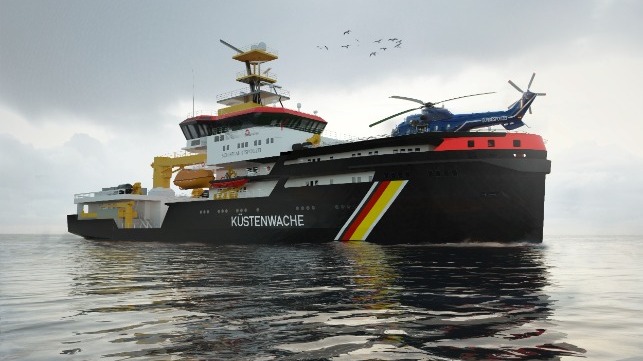
It is always interesting to find that others deal with missions you perform in a very different way.
A Marine Link report on the new ship above piqued my curiosity about the parent agency. The German Federal Waterways and Shipping Administration (WSV),
“… is responsible for ensuring a safe, smoothly flowing and thus economically efficient shipping traffic. The tasks comprise the maintenance, operation as well as the upgrading and construction of the federal waterways including the locks, weirs, bridges and shiplifts.
The responsibility of the Federal Waterways and Shipping Administration extends to a total of 23,000 km² of maritime waterways and approximately 7,300 km of inland waterways. In addition, we maintain Vessel Traffic Service Centres at waterways in the coastal area and traffic control centres at inland waterways and we use special vessels for different specialist tasks (buoy laying, emergency missions, direction-finding etc.).
Around the clock, our experts on the water and ashore ensure safe traffic flows.
Our leitmotif is: “Facilitate mobility and protect the environment!”
Sounds like it has some of the Coast Guard’s missions and some Corps of Engineers missions.
The ship itself is described as multi-purpose. Presumably it tends buoys, but it is far bigger and more powerful than any USCG buoy tender, at over 90 meters (290′) in length driven by two steerable propulsion units of 4,500 KW each (over 12,000 HP total). It also has a 2,990 kW (over 4,000 HP) pumpjet. Our most similar ship seems to be USCGC Mackinaw. (240′ in length and 9,119 shp/6.8 MW).
Mackinaw is of course a domestic icebreaker, in addition to being able to tend buoys. The new German ship looks like it might also be capable of light icebreaking. (Maybe Tups who comments here frequently would be able to tell us.)

SCHOTTEL RudderPropellers type SRP 750 (each 4,500 kW at 750 rpm) on the left. SCHOTTEL PumpJet type SPJ 520 (2,990 kW) on the right. Image: SCHOTTEL
The German ship also has a gas-tight “citadel” structure with a protective air supply, in order to carry out operations in hazardous atmospheres. In the Coast Guard only the National Security Cutters have this feature.
Guest author Peter Ong has been asking some questions about Polar Star’s recent, unusual Arctic Winter deployment. –Chuck
—
“The Coast Guard has a long and rich history of conducting operations around the world, and international demand for increased Coast Guard capability and presence has never been greater. The Coast Guard’s diverse set of statutory missions provides the Service with unique authorities, capabilities, and partnerships that support national security and foreign policy objectives around the globe. — U.S.C.G. spokesperson, Headquarters, Washington D.C.

The U.S. Coast Guard’s sole remaining active-duty heavy Polar icebreaker, the 45-year-old USCGC Polar Star (WAGB 10), returned home to Seattle on Saturday, February 20, 2021. America’s aging icebreaker left homeport Seattle in December 2020.
Originally scheduled for “Operation Deep Freeze” to resupply McMurdo Station in the Antarctic, the Polar Star sailed north because of COVID-19 restrictions in Antarctica. This was the first time since 1982, nearly 40 years, that a heavy U.S. Coast Guard icebreaker ventured north to “Show the Flag” and support America’s presence in the Arctic. While sailing in the Bering Sea, the heavy icebreaker was armed with two .50cal M2HB heavy machine guns, armament that normally would not be mounted on an Antarctic voyage.
“CGC POLAR STAR is the Nation’s only operational heavy icebreaker and is capable of year-round deployments in the Polar Regions. Typically, CGC POLAR STAR supports the annual resupply of McMurdo Station as part of Operation Deep Freeze; however, the Coast Guard can redirect limited assets based on mission needs and priorities.” — U.S.C.G. spokesperson, Headquarters, Washington D.C.
The reason for the Polar Star’s trip was because the Coast Guard’s only medium Arctic icebreaker, 21-year-old USCGC Healy, suffered an engine room fire and starboard drive breakdown during its Arctic voyage in August 2020. Healy has since completed repairs at Mare Island Dry Dock, Vallejo, California, and has sailed back to homeport Coast Guard Station, Seattle, where it shares the docks with the heavy icebreakers Polar Star and the inactive Polar Sea (the Polar Sea suffered a crippling engine malfunction that has keep her inactive since 2010, and engine repairs were deemed too costly for the Polar Sea to ever sail again).
“CGC HEALY’s emergency dry dock is complete. Main motor repairs are continuing at CGC HEALY’s homeport in Seattle, WA to facilitate planned maintenance work. The Coast Guard anticipates all repairs will be completed by May 2021 in advance of CGC HEALY’s next scheduled deployment.” — U.S.C.G. spokesperson, Headquarters, Washington D.C.

The U.S. Coast Guard Shares “Lessons Learned” on the Polar Star’s Arctic Trip
As the first heavy U.S. icebreaker to sail into the Arctic in almost forty years (and the first US icebreaker in the Arctic during the Winter in a very long time–Chuck), what lessons have the Coast Guard and the crew of the 45-year-old icebreaker learned? When the Polar Star departed, the ship was forty-four years old; she turned forty-five over the Christmas Holidays.
U.S. Coast Guard Headquarters, Washington D.C., responded to questions via email. “Overall, this was an incredibly successful patrol for CGC POLAR STAR, as the cutter remained 100% fully mission capable for the duration of the deployment. The extreme Arctic winter environment forced the crew of CGC POLAR STAR to perform unanticipated engineering maintenance, as limitations associated with working in sub-zero temperatures affected operations. For example, extremely cold temperatures in the engine room impacted the designed operation of several engineering systems, which required innovative adjustments to standard procedures. The deployment also identified cold-weather limitations of the MK-IV Over-the-Horizon (OTH) cutter boat. Lessons learned from operating the MK-IV OTH in these temperatures are now informing the development of operational requirements for the next generation of Polar Region small boats. Finally, the winter deployment revealed the potential need to adjust electronic sensor systems to operate in extremely cold weather.”

Since the USCGC Healy’s repairs are planned to finish in May, 2021, the Polar Star may return to its usually Antarctic duties, pending COVID restrictions, although Coast Guard Headquarters, Washington D.C., did not confirm this.
When asked if the U.S. Coast Guard plans to lease any private icebreakers for Arctic duties to make up for the shortage in available U.S. government icebreakers, the Coast Guard spokesperson replied, “The Coast Guard is working with the Navy to identify potential bridging strategies that would increase U.S. surface presence in the Arctic prior to delivery of the first Polar Security Cutter.”
Chuck’s comments. Thanks to Peter Ong for sharing this with us.
I was a bit surprised by this, “… the heavy icebreaker was armed with two .50cal M2HB heavy machine guns, armament that normally would not be mounted on an Antarctic voyage.” There is no reason the Polar Star should not carrier her .50 machine guns when going to Antarctica. This is what the Treaty says.
Article I
1. Antarctica shall be used for peaceful purposes only. There shall be prohibited, inter alia, any measures of a military nature, such as the establishment of military bases and fortifications, the carrying out of military maneuvers, as well as the testing of any types of weapons.
2. The present Treaty shall not prevent the use of military personnel or equipment for scientific research or for any other peaceful purpose.
There is no prohibition in the Treaty against using armed vessels in the Arctic. Historically armed Icebreakers operated in the Antarctic after ratification of the Treaty.
Under Article VII,
“All areas of Antarctica, including all stations, installations and equipment within those areas,
and all ships and aircraft at points of discharging or embarking cargoes or personnel in Antarctica, shall be open at all times to inspection by any observers designated in accordance with paragraph 1 of this article.“
but there are really no security concerns about the 100 year old technology of the .50 cal. M2. It is not that they are likely to be needed, but we seem to be imposing limitations that really don’t exist. False presumptions may unnecessarily limit our future options.
 Chuck Hill's CG Blog