
Seems like a lot of significant news releases today. Another one below.
We already know Munro is participating in RIMPAC 2020. What I found most interesting here is this paragraph.
Embarked aboard Munro is a detachment from U.S. Navy Helicopter Sea Combat Squadron 21, who completed over 40 hours of training on board prior to their integration in RIMPAC.
Helicopter Sea Combat Squadron 21 (HSC-21), nicknamed “Blackjacks”, is an aviation unit of the United States Navy based at Naval Air Station North Island. HSC-21 is made up of five expeditionary detachments that deploy aboard ships including Combat Logistics Force support ships, Hospital Ships and Amphibious Assault ships, among others. HSC-21 flies the Sikorsky MH-60S Seahawk helicopter.
Missions include:
Search and Rescue (SAR)
Logistical Support
Naval Special Warfare (NSW)
Anti-Surface Warfare (ASUW)
Vertical Replenishment (VERTREP)
Medical Evacuation (MEDEVAC)
The MH-60S can be armed with Hellfire, rockets, and forward firing weapons in addition to the door gun and is also expected to conduct mine countermeasures operations.
I am curious both, when and where the helicopter training was conducted and what role the cutter/helo combination will play in the exercise.
(In the previous post, you might have also noticed a photo of USCGC Tahoma doing flight ops with a Danish MH-60R ASW helicopter.)

Coast Guard Cutter Munro Joins RIMPAC Following 37-day Alaska Patrol
|
||||||
 |
 |
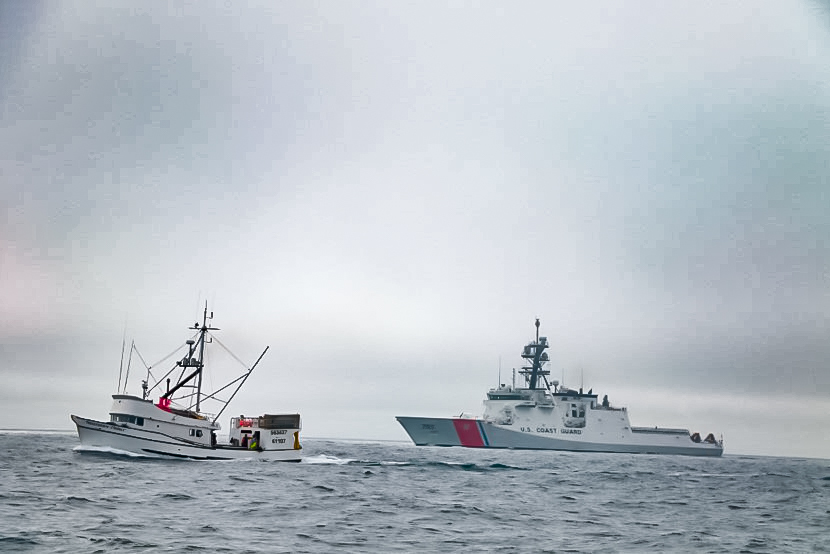
| The crew of the U.S. Coast Guard Cutter Munro conducts a boarding of a fishing vessel off the coast of Alaska. Prior to their participation in RIMPAC, the Munro crew patrolled the maritime boundary line to prevent foreign fishing vessel incursions into U.S. waters. | |
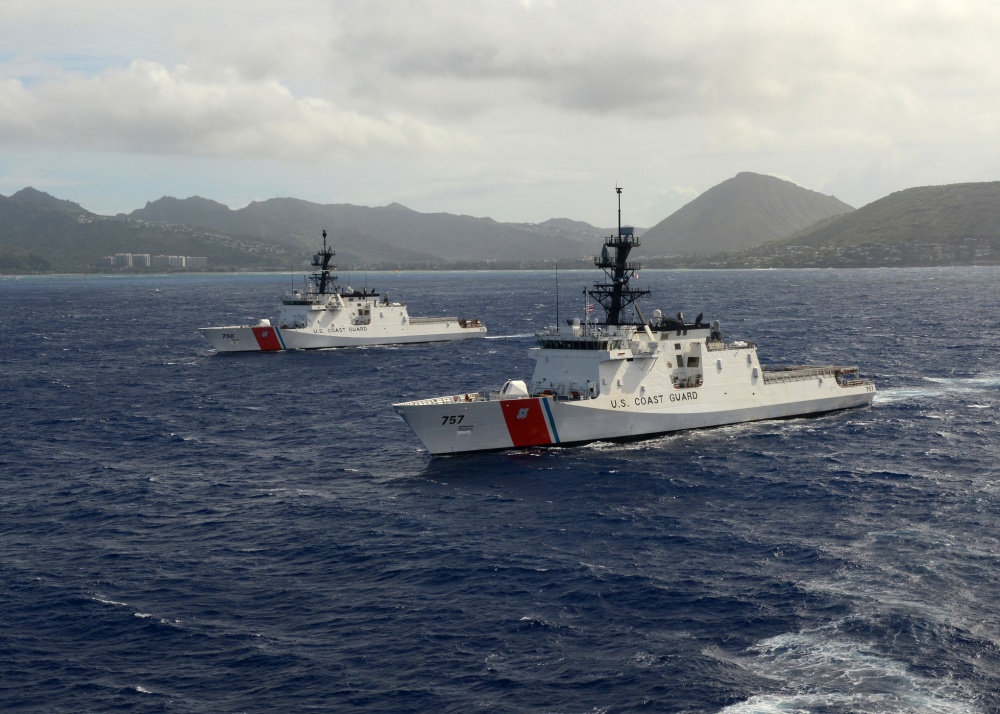
Coast Guard Cutter Munro (WMSL-755) began participation Monday, August 17, in this year’s exercise Rim of the Pacific (RIMPAC) following a 37-day Alaska patrol.
Ten nations are participating in this year’s RIMPAC, the world’s largest international maritime exercise held biennially in the waters surrounding Hawaii. This marks the 27th iteration hosted by the United States in the series that began in 1971.
Twenty-two surface ships, one submarine, multiple aircraft and approximately 5,300 personnel from Australia, Brunei, Canada, France, Japan, New Zealand, Republic of Korea, Republic of the Philippines, Singapore, and the United States join forces from August 17 to August 31.
This year’s exercise includes multinational anti-submarine warfare, maritime intercept operations, and live-fire training events, among other cooperative training opportunities.
Prior to arriving in Hawaii for RIMPAC, the Munro crew deployed to the waters off Alaska, patrolling the maritime boundary line to prevent foreign fishing vessel incursions into U.S. waters. The crew conducted 11 living marine resource boardings, and oversaw the first Coast Guard operational deployment of an unmanned aerial system in the Bering Sea since 2018.
“I am incredibly proud of Munro’s crew and the work we accomplished in Alaskan waters,” said Capt. Blake Novak, Munro’s commanding officer. “We provided a Coast Guard presence, securing our border and protecting vital natural resources in the Bering Sea. We boarded fishing vessels as far north as the Arctic Circle and along the Aleutian Islands to ensure the U.S. fishing fleets continue to operate safely. Munro has transitioned and prepared to leverage our joint and combined capabilities in the Rim of the Pacific exercise.”
Embarked aboard Munro is a detachment from U.S. Navy Helicopter Sea Combat Squadron 21, who completed over 40 hours of training on board prior to their integration in RIMPAC.
The at-sea-only construct for RIMPAC 2020 was developed to ensure the safety of all military forces participating, and Hawaii’s population, by minimizing shore-based contingents, while striking a balance between combating future adversaries and the COVID-19 threat. RIMPAC provides a unique training opportunity designed to foster and sustain cooperative relationships that are critical to ensuring the safety of sea lanes and security on the world’s interconnected oceans.











 Chuck Hill's CG Blog