Intercept at Sea, Israeli Style

I’ve seem several reports of the Israeli seizure of a Panamanian flag vessel, the KLOS-C, reportedly transporting long range rockets and perhaps other weapons being shipped by Iran to terrorists in Gaza. But NavyRecognition’s is the first report I’ve seen that actually showed the seizure. They also the show the reported route of the weapons.

The intercept point looks to be a bit over 700 miles from the nearest Israeli port. Apparently the crew of the Panamanian ship is claiming they had no idea what they were carrying.

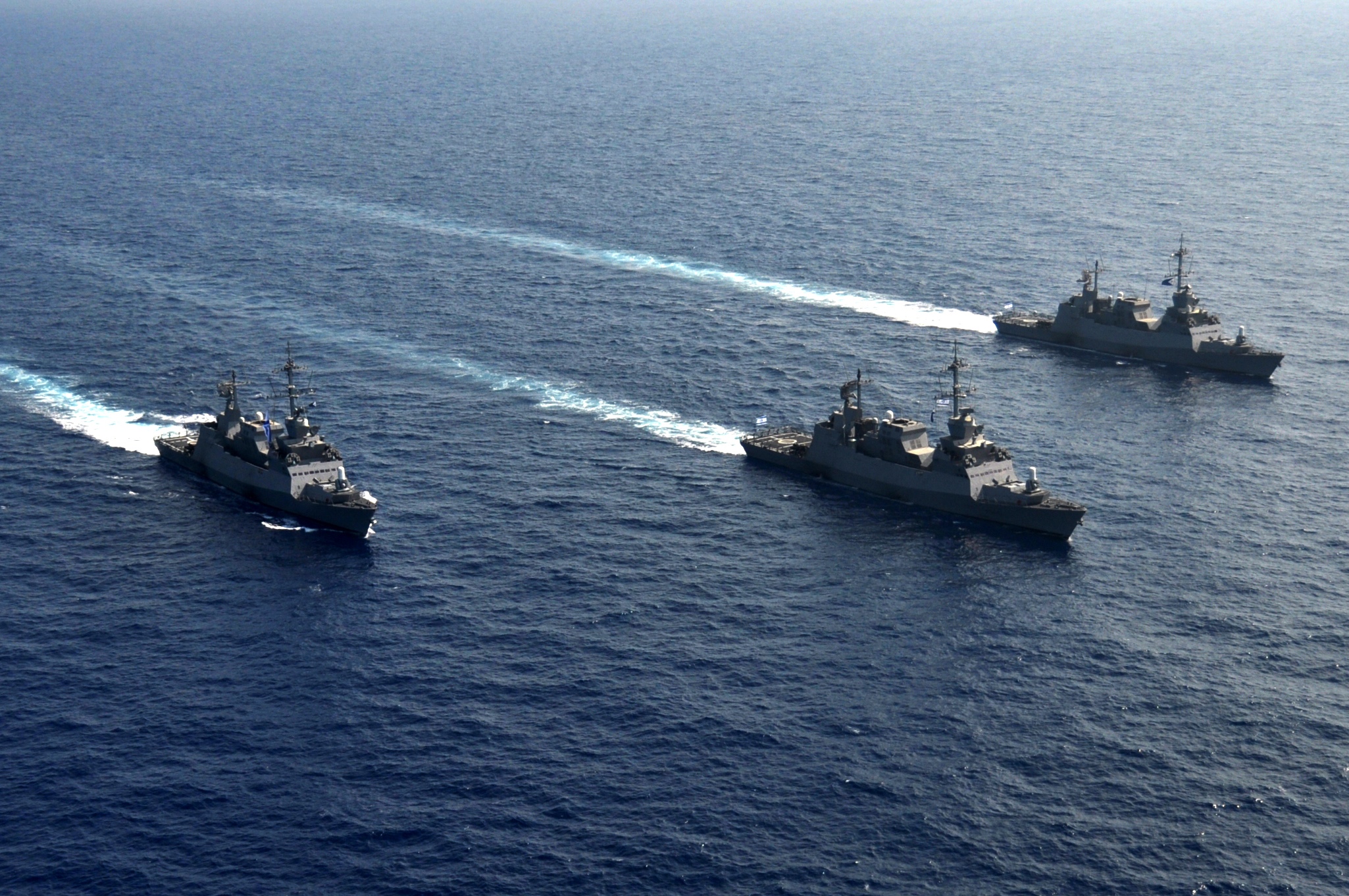
It is interesting to see the forces the Israeli Navy used to make this seizure. They did not scrimp. They apparently made the boarding using three RHIBs and they had at least two surface combatants on scene, a Sa’ar 5 corvette (1,275 tons full load, larger than a 210, but smaller than a 270) and a missile boat, which appears to be a Sa’ar 4.5 (488 tons full load, about a third larger than an FRC). From the video it is obvious they had an aircraft on scene, possibly a helicopter from the Sa’ar 5. It may have been overkill in this case but both of the two Israeli vessels carried anti-ship missiles and a CIWS. The Sa’ar 5 corvette is also equipped with short range AAW missiles, and the missile boat has a 76 mm.

File:Three Sa'ar 5 Class Missile Corvettes Going For a Cruise.jpg


Photo: Israeli Sa’ar 5  corvettes. Israeli Defense Forces photo

File:Saar45nirit011.jpg


Photo: Sa’ar 4.5 missile boat, Israeli Defense Force photo

State of the Coast Guard Address

I’m afraid I’m a bit late with this, but if you have not seen or heard Admiral Papp’s State of the Coast Guard Speech you can read it here.

Actually it is a good speech, and it cites several indicators that the Acquisitions Directorate has gotten its act together. Lots of other issues addressed as well.

How to Create Enemies and Make People Hate You–China vs Indonesia

We have already talked about China’s difficulties with her neighbors Japan and the Philippines. Now we have a report of a confrontation with Indonesia. Apparently Indonesia had chosen to keep this quiet, but the Chinese have chosen to brag about it.

The Indonesian vessel involved was reportedly a Todak class, which is a German Lurssen “PB-57” design, a bit larger than the FRC at 447 tons fl, 58.1 meters long and 7.6 meters of beam, armed with a Bofors 57mm (like that on the NSC), a 40mm and two 20mm. Clearly if it had come to a fight, the Indonesian vessel would have enjoyed an advantage, at least until Chinese reinforcements arrived.

China is showing a complete disregard for the provisions of the UNCLOS treaty to which they are a party.

Making an enemy of Indonesia is a particularly bad idea for China, in that Indonesia potentially controls all the major straits through which the vast majority of Chinese trade must pass and all the alternatives are also in the hands of nations China seems intent on alienating.

Could This be Bollinger’s OPC Candidate?

During Vietship 2014 Nava Exhibition in Vietnam, Dutch shipyard Damen unveiled for the first time the design of the Sigma 9814 Corvette ordered by Vietnam. It was announced in October 2011 that Damen shipyard in Vlissingen, Netherlands will build four Sigma corvettes for the Vietnamese Navy. The first two ships will be built in Vlissingen (Netherlands), and the last two (options) will be built in Vietnam, under Dutch supervision.

Navy Recognition is showing a photo of a model of a new corvette being built by Bollinger’s partner Damen for the Vietnamese Navy. The ships is the right size, 98 meters long and 14 meters of beam (321 ft x 46 ft).

We already discussed the fact that Damen had built an OPC sized ship for the Vietnamese counterpart of the USCG.

The photo even looks a little like the ships in this earlier illustration from Bollinger. The reported dimensions of the new Vietnamese vessel also correspond to the dimensions given for Damen’s 2600 ton OPV.

An interesting feature is how well armed this Vietnamese Corvette will apparently be. This bodes well for potential upgrades to the OPC. Quoting Navy Recognition:

the new SIGMA 9814 class will be fitted with:
8x MBDA Exocet MM40 Block 3
12x MBDA MICA VL surface-to-air missiles (in VLS)
1x Oto Melara 76mm main gun
2x Oto Melara MARLIN-WS 30mm gun mounts
The corvette will acomodate one anti-submarine helicopters Ka-28. The corvettes are set to receive the latest generation of electronics and sensors from Thales including TACTICOS combat management system,SMART-S Mk 2 radar and STING EO Mk 2 electro-optical fire control system.

New Commandant Nominated

Official portrait of U.S. Coast Guard Vice Adm. Paul Zukunft. U.S. Coast Guard photo.

Vice Adm. Paul Zukunft. U.S. Coast Guard photo.

The Coast Guard Compass has just announced that,

“Department of Homeland Security Secretary Jeh Johnson announced President Obama’s intent to nominate Vice Adm. Paul F. Zukunft, currently Pacific Area commander, to be the next commandant of the United States Coast Guard in an all hands email to DHS personnel.”

You can see the full announcement here.

Here is his official bio:

Vice Admiral Zukunft previously served as the Assistant Commandant for Marine Safety, Security and Stewardship. His other Headquarters flag assignments include the Director of Response Policy and the Assistant Commandant for Capability.

In 2010, Vice Admiral Zukunft served as the Federal On-Scene Coordinator for the Deepwater Horizon Spill of National Significance where he directed more than 47,000 responders, 6,500 vessels and 120 aircraft during the largest oil spill in U.S. history.

Vice Admiral Zukunft was promoted to flag rank in 2006 and his previous flag assignments include Commander, Eleventh Coast Guard District and Director, Joint Interagency Task Force West.

His senior staff assignments included Chief of Operations, Coast Guard Pacific Area and Chief of Operations Oversight, Coast Guard Atlantic Area where he directly supervised all major cutter oin the Atlantic and Pacific theaters. He also served as Chief of Staff, at the Fourteenth Coast Guard Districin Honolulu.

Vice Admiral Zukunft has commanded six units and served extensively in the cutter fleet where he commanded the cutters CAPE UPRIGHT, HARRIET LANE, and RUSH.

Vice Admiral Zukunft graduated from the U.S. Coast Guard Academy in 1977 with a Bachelor of Scdegree in Government; from Webster University in 1988 with a Master of Arts degree in Managemand from the U.S. Naval War College in 1997 with a Master of Arts degree in National Security and Strategic Studies. He is a graduate of the Asia Pacific Center for Strategic Studies Executive Seminar and Harvard’s Kennedy School of Government National Preparedness Leadership Initiative Course.

Vice Admiral Zukunft is a native of North Branford, Connecticut. He wears the permanent Cutterman pin and is a certified NIMS ICS Type I Area Commander. His personal awards include the Department of Homeland Security Distinguished Service Medal, Defense Superior Service Medal, three Legions of Merit and five Meritorious Service medals with “O” device among others.

Trade-offs in the 378 FRAM

File:USCGC Sherman WHEC-720 Vietnam War.jpg

Coast Guard photograph, PHC Ken Mather, USCGC Sherman (WHEC-720) in her original configuration with a 5″/38 and dual hedgehogs, April 1969. 

This is hardly a current topic, but it is one I have seen discussed several time, most recently in comments on a post about the new Canadian Arctic/Offshore Patrol Ship (AOPS), e.g. why the Coast Guard used the 76mm Mk75 gun on the 378 FRAMs rather than the 5″/54 Mk45.

It is true that, although about four tons heavier, the early model 5″/54 Mk45 mounts were a drop in replacement for the 5″/38 mounts we had on the 378s. It would have appeared an easy choice, but in order to accommodate the additional weight of the Harpoons and CIWS, perhaps the Coast Guard had no choice but to go with a lighter gun. That gun (and its associated firecontrol system) was certainly seen as a significant improvement over what we had had in essentially all respects including reduced manning and maintenance.

If we look at the weights as built that were removed:

one 5″/38 (20.5 tons) and two hedgehogs (14.4 tons), totalling approximately 35 tons

and compare that to some of the weights added

one 76 mm Mk75 gun (8.2 tons), two Mk141 quad harpoon launchers (11.8 tons total), eight Harpoon (6 tons), and a Mk 15 Phalanx CIWS (6.8 tons).  Total approximately 32.8 tons. Plus more weight for the addition of the hangar. Essentially the difference was a wash.

If instead, we had used the 5″/54 Mk45 mod 0 (24.5 tons) in addition to the harpoons and CIWS, the total weight would have been 16.3 tons higher or 49.1 tons.

There are other weights that might be added in calculating the total weight devoted to armaments, but obviously I don’t think this was an excessive amount, there are too many examples of smaller ships with far more weapons. I previously noted, (“OPC-Design for Wartime, Build for Peacetime”) that as built the little 255s had 140 to 150 tons of weapons.

Even so, an additional 16.3 tons topside (even if that is only about 0.5% of the full load displacement) might have been too much for the 378s. I don’t know. Perhaps a former 378 engineer or DCA could enlighten the discussion.

File:USCGC Mellon WHEC-717.jpgPhoto: Navy photo, USCGC Mellon, with 76mm, Harpoon, and Phalanx CIWS

Coast Guard Foundation Setting Up Douglas Munro Scholarship Fund

The Maritime Professional is carrying an announcement from the

“The Coast Guard Foundation, a nonprofit organization committed to the education and welfare of Coast Guard members and their families, announced today it has established the Douglas Munro Scholarship Fund. Named for the only Coast Guard member to be awarded the Medal of Honor, the new scholarship will help children of Coast Guard members achieve their goals of a college education.”

Check out the Maritime Professional post for details including a limited edition challenge coin offer.

Progress on Canada’s Arctic Offshore Patrol Ship

Arctic/Offshore Patrol Ship

MarineLog is reporting a new contract has been awarded for Canada’s Arctic Offshore Patrol Ship (AOPS).

FEBRUARY 21, 2014 — OSI Maritime Systems Ltd. (OSI), Burnaby, BC, has been selected by Lockheed Martin Canada to support the design activity of the bridge and navigation capabilities for the Royal Canadian Navy’s (RCN) new class of Arctic/Offshore Patrol Ships (AOPS).

But mostly I wanted to share the illustration. To review, this is a Canadian Navy project, not Coast Guard. It is based on the Norwegian Coat Guard’s Swalbard icebreaker but the design is smaller and simplified somewhat. They plan to build “six to eight” and they will be used both in the Arctic and for more conventional patrol duties.

What we see is a relatively large OPV/light icebreaker, with what appears to be excellent facilities for boats and a single helicopter up fairly large size with facilities to handle at least a small number of containers. Compared to the USCG’s Offshore Patrol Cutters they will probably be about twice the size, oriented much more toward the Arctic, their capability as a conventional patrol vessel is likely to be compromised by low max speed, the icebreaker hull shape, and an almost total lack of weapons.

Schedule for Barque Eagle

This is a direct quote in full of a Coast Guard News Release. I don’t normally do that, but thought there might be enough interest::

NEW LONDON, Conn. – Coast Guard Barque Eagle has finalized its training schedule for 2014.  During the year, Eagle will sail to the Caribbean, along the East Coast, to Canada, and throughout New England.

In late March, Eagle will sail to North Carolina with the Coast Guard and National Oceanic Atmospheric Administration (NOAA) Officer Candidates.  The voyage will include a port call in Morehead City, N.C.

The Eagle will return to New London in early April and will depart for the annual summer deployment in May to train Coast Guard Academy cadets.  While in New London in April, the Eagle plans to moor downtown at City Pier and open for local tours on a daily basis.

Following cadet final examinations, Eagle will set sail in early May and is scheduled to travel to the following ports: San Juan, Puerto Rico; Oranjestad, Aruba; Cozumel, Mexico; Miami; Sydney, Canada; St. Johns, Canada; New York City, N.Y.; Bourne, Mass.; and Rockland, Maine.  Eagle will return to New London City Pier in early August.  During these voyages, Eagle will train four different groups of approximately 150 cadets each.

In late August, Eagle will depart with the fall Coast Guard and NOAA Officer Candidate classes, traveling to Yorktown, Va. and then to Baltimore. While in Baltimore, Eagle will take part in the celebration of the 200 year anniversary of Francis Scott Key’s penning of the Star Spangled Banner. 

Following the celebration, Eagle will transit to the Coast Guard Yard facility in Baltimore and commence work on its upcoming Service Life Extension Project.  Eagle will remain at the Yard facility until the spring of 2015, when the Barque will travel to New London to commence the 2015 training program.

Specific port call dates are:

Morehead City, N.C.               March 27-30

San Juan, Puerto Rico            May 21-24

Oranjestad, Aruba                 May 28-31

Cozumel, Mexico                   June 7-10

Miami, Fla.                           June 14-17

Sydney, Canada                    June 28-July 1

St. Johns, Canada                 July 4-7

New York City, N.Y.                 July 18-21

Bourne, Mass.                       July 24-28

Rockland, Maine                    Aug. 1-4

Yorktown, Va.                        Sept. 4-6

Baltimore, Md.                      Sept. 11-15

At 295 feet in length, the Eagle is the largest tall ship flying the stars and stripes and the only active square-rigger in U.S. government service.

Constructed in 1936 by the Blohm and Voss Shipyard in Hamburg, Germany, and originally commissioned as the Horst Wessel by the German Navy, the Eagle was taken by the United States as a war reparation following World War II.

With more than 23,500 square feet of sail and six miles of rigging, the Eagle has served as a classroom at sea to future Coast Guard officers since 1946, offering an at-sea leadership and professional development experience.

A permanent crew of seven officers and 50 enlisted personnel maintain the ship and guide the trainees through an underway and in-port training schedule, dedicated to learning the skills of navigation, damage control, watchstanding, engineering and deck seamanship.

To follow the adventure onboard Eagle, visit the ship’s Facebook page at: www.facebook.com/CoastGuardCutterEagle.

While inport in February and March, the Eagle will be available for tours at the Ft. Trumbull pier most days from 10 a.m. until 5 p.m.  For more information, call 860-439-1562,