Who is the New Namesake for the former USCGC Dallas

On May 22, the former USCGC Dallas was handed over to the Armed Forces of the Philippines. Rear Admiral John Korn, Assistant Commandant for Acquisitions, passed the long glass to Philippine Navy Captain Ernesto Baldovino. The ship entered Philippine service and was given a new name, BRP Ramon Alcaraz (PF-16). (Video here)

It is a proud name. Information about Ramon Alcaraz, from the Philippine Department of National Defense below:

Philippine Defense Newsletter: Who is Commodore Ramon Alcaraz?

by Department of National Defense – Philippines on Wednesday, May 23, 2012 at 8:49pm.

DND-OPA | Camp Gen. Emilio Aguinaldo | 22 May 2012 – On May 6, 2012, H.E. Benigno S. Aquino, III announced during the commemorative ceremonies of the surrender of Corregidor during World War II that the second Weather High Endurance Cutter (WHEC) to join the Philippine Fleet will be named after Navy hero, the late Commodore Ramon A. Alcaraz.

Noon of May 22, during the 114th anniversary of the Philippine Navy Fleet, Philippine Ambassador to the United States, Hon. Jose L. Cuisia with AFP Chief of Staff General Jesse D. Dellosa and PN Fleet Commander Rear Admiral Jose Luis Alano was at the Charleston yard of the United States Coast Guard to formally receive the retired USCG Dallas….

(This part of the article appears on the May 2012 issue of the Philippine Defense Newsletter)

Ramon A. Alacaraz or “Monching”  to friends was born on August 31, 1915 in Plaridel, Bulacan, He entered the cadetship at the Philippine Military Academy on June 15, 1936 and received his commission as a 3rd Lieutenant on March 15, 1940. Ka Monching was one of the 79 new officers from the PMA. A year and half after the PMA, he would be integrated into the US Army Forces Far East (USAFFE) and assigned to the newly created Off Shore Patrol (OSP) of the Philippine Army.

Then Commonwealth President Manuel L. Quezon contracted the acquisition 36 units of fast motor torpedo boats of British design as part of the off shore defense of the Philippines amidst the growing fears over an expansionist imperial Japan. The OSP was formally organized on February 9, 1939 with headquarters at the Muelle del Codo at the Port Area in Manila under the command of 1st Lieutenant Jose V. Andrada.

The OSP, the forerunner of the Philippine Navy was assigned with three units of US Navy motor torpedo boats or Q-Boats (Quezon-boats); Q-111 “Luzon,” Q-113 “Agusan” and Q-112 “Abra” which was captained by Alcaraz.

Upon the outbreak of the war, as commander of the Q-112 Abra, then boat Captain Alcaraz shot down three Japanese dive bombers zigzagging at the straight between Bataan and Corregidor island. Alcaraz and the Abra crew’s initiative stopped the Japanese from completing their objectives. Gen. Douglas McArthur promoted on the spot Alcaraz on January 1942 at Corregidor for heroism and gallantry in action.

Alcaraz would later get captured by the Japanese and imprisoned at the Malolos, Bulacan Prisoner of War camp. Ka Monching was released by the Japanese on August 10, 1942 after undergoing months of intensive “rejuvenation program.” He was paroled and instructed to be re-trained at the Torres High School in Gagalangin, Tondo to join the Bureau of Constabulary.

Graduating in September 1942 as a commissioned police officer, Alcaraz was told that his first assignment was Lanao del Norte. He faked a malaria illness resulting to his confinement at San Lazaro. Ka Monching missed the boat to Mindanao and was later re-assigned to Bayombong, Nueva Vizcaya.

In the mountains of the Sierra Madre, he would clandestinely meet with guerrilla leaders under the command of Lt. Col. Manuel Enriquez. Though a middle ranking officer of the police reporting directly to high ranking officials of the Japanese kempetai, Alcaraz was clandestinely forming his network of informants against the occupying forces.

All throughout the occupation period, Ka Monching gave the Japanese forces a false sense of security, gathering information and informing USAFFE Headquarters in exile up to the right time to fight came to light in the liberation of the Philippines in 1944.

Alcaraz would continue to serve the defense establishment even after the war and upon instructions of then Defense Secretary Ramon F. Magsaysay, Commodore Alcaraz was instructed to study the organization of the United States Marine Corps.

He would later use this learning experience to designate Philippine Navy personnel to form the First Marine Company under the command of his Q-Boat Executive Officer, Lt. Cdr. Manuel Gomez. The company would be based at the Marine Station at Port Area, Manila and eventually grow, becoming the present day Philippine Marine Corps.

The Commodore last served as head of the Naval Operating Forces until his retirement on January 22, 1966. Alcaraz received multiple decorations in the course of his service in the Armed Forces. Among the awards and decorations include a Gold Cross, the U.S. Silver Star, Philippine and American Defense Medals, World War II Victory medal, Philippine Independence medal and others.

He left for the U.S. when Martial Law was declared to continue with the fight for the rights and benefits of Filipino veteran soldiers who fought alongside U.S. forces in World War II.

Ka Monching’s last battle was the passage of the Filipino Veterans Equity Bill, which finally became law as the American Recovery and Reinvestment Act of 2009 on February 17, 2009. The act appropriated a total of US$198 million authorizing the U.S. Department of Veterans Affairs to release a one-time, lump-sum payment to eligible World War II (WWII) Philippine veterans

On June 25, 2009, Ka Monching peacefully passed away at the age of 94 at his home in Orange County in California. ***

Cutter Class Names and Descriptors

On an earlier post, a conversation developed over how we refer to the various Coast Guard vessel classes. I had called the 154 foot WPC, Fast Response Cutters (FRC), of the Sentinel Class, the Webber Class. It went like this:

—————————————————————————————————————————

Jimmy, “If you’re shooting for an A+ in accuracy, it’s the Sentinel class, not the Webber class.”

Chuck Hill, “Let’s just say I like Webber better, and it fits the international norms of usage.”

EBurley, “That being said, the Coast Guard has, at least, a decent tradition of naming cutter classes after something over than the first ship in the class – the WEBBER is just the most recent example:
418′ WMSL: Legend class (lead ship: USCGC BERTHOLF)
378′ WHEC: Secretary/Hero class (lead ship: USCGC HAMILTON)
270′ WMEC: Famous (cutter–ed.) class (lead ship: USCGC BEAR)
110′ WPB: Island class (lead ship: USCGC FARALLON)
87′ WPB: Marine Protector class (lead ship: USCGC BARRACUDA)
“Other examples include the Cape and Point classes of patrol boats, the Bay class ice breaking tugs, the Polar class icebreakers, Keeper class coastal buoy tenders, and the Treasury/Secretary class cutters (327′).
Desk riding cutterman, “I’ve heard the WHEC’s called the HAMILTON class a few times, the 210′s called the RELIANCE class, and the Navy kept trying to call the WMSL’s the BERTHOLF class when they were ramping up for the WAESCHE testing. It was really funny to watch the crew of WAESCHE get frustrated.
“I’m fine if we want to continue down that road but for the love of God, please start naming the first of class with the understanding that people will call it the”____” class. The BEAR class, the BARRACUDA class, and the BERTHOLF class don’t really roll of the tongue like the PERRY, TICON, or BURKE classes. It’s like naming a child, don’t give them a name that will be easy to pick on in school.
“So the story I heard with the 378′s was that we shifted the names mid stream because we changed departments and no longer wanted to name cutters as treasury secretaries.
—————————————————————————————————————————
If we look at just one class, we see they can be referred to as 378s, Hamilton Class, Secretary Class/Hero Class, WHEC 715 class, and because they are the only units in that category WHECs or simply HECs. Depending on the context there might be some confusion between this “Secretary” Class and the previous “Secretary” Class (327s).
When the Coast Guard wants to build a new class of ships, they have to call it something, so we got names like National Security Cutter and Fast Response Cutter. In the previous generation it was “High Endurance Cutters,” “Medium Endurance Cutters,” and Patrol Boats (No one wanted to advocate for “Low Endurance Cutters.”) These are programs that describe needs. When we get a little further along, there is a proposed design to meet the needs, we have to call it something, so we get names like “Sentinel” Class cutters, before the first of class is ever named and before the design is finalized. To my mind, these names are only placeholders until the design is finalized (giving us the final length) and first of class is named giving us the actual name of the class.
The Navy usually handles this need for a place holder name by using a hull number, e.g. DD-963, FFG-7. The Coast Guard could have done this if they had called the Bertholf’s the WHEC-750 class, but instead they chose to invent a new ship type to describe the class, WMSL.
Calling the class National Security Cutters offered a poor description of the ship, because that is not what these vessels do most of the time, and further–if these are National Security Cutters, then it implies that other cutters don’t do National Security.
I’m not sure of the intent in calling the Webber class, Fast Response Cutters. Are they intended to respond quickly, or are they fast cutters that sit around waiting to respond. In either case it implies passivity and something of an emergency response role, when I suspect these vessels will actually spend a lot of time on patrol.
Offshore Patrol Cutter at least seems to be reasonably accurate as a descriptor, but why didn’t we simply call it the MEC replacement cutter. It is pretty obvious they need replacement. It is obvious to anyone who has spent at least ten minutes reading about the program any where but here, that, that is their purpose (for some reason the Acquisitions Directorate OPC web page fails to mention this fact).
Historically I believe the Coast Guard only went to type designations proceeded by “W” in preparation for operations with the Navy prior to WWII. Bill Wells tells me as late as 1938 references were to cruising cutters, patrol cutters, and patrol boats.  The type designations they used, WPG, WPC, WSC, were standard Navy type designations with the addition of the Coast Guard designator (CG–Patrol Gunboat, Patrol Craft, Sub Chaser). This helped the Navy make proper use of Coast Guard vessels. The system persisted until the mid 60s when vessels were re-designated WHEC and WMEC.  The 125, 165 and new 210 foot WPCs were redesignated WMECs, and existing 327 and 255 foot WPGs and 311 ft WAVPs, as well as the 378 foot WPGs, then building, were redesignated WHECs.
If our object were to help others understand what these ships do, we might consider using designators that are more easily recognized by the rest of the world, as we have done with the Webber class WPCs. The Bertholfs might be WFF (CG frigate) or perhaps a more descriptive WPF (CG patrol frigate. This goes back to the CG manned patrol frigates (PF) of WWII). The  Offshore Patrol Cutter might also be designated WPF. If we wanted to differentiate them, we could use an optional suffix WPF(L) and WPF (S) (large and small).
Convincing others that the Coast Guard needs ships begins with an understanding of what the ships will be used for. If we create a new type designation for each class, it becomes redundant in the Coast Guard and incomprehensible to the rest of the world.

Chinese to commission 36 cutters in three years

While the Coast Guard will perhaps soon be commissioning four 353 ton Webber Class Fast Response Cutters a year, and has been averaging one large cutter every two years, it looks like the Chinese Maritime Surveillance Administration (CMS) will have commissioned 36 new cutters from 2010 to 2012 including seven 1500 ton class, fifteen 1000 ton class and fourteen 600 ton class “to better protect China’s maritime interests.” This is a huge, rapid expansion of their assets. (Also the tonnage ratings the Chinese provide tend to be light displacement, so they understate their size.)

This is only one of several Chinese agencies that do Coast Guard type task. Other agencies are also building ships. These agencies use relatively few air assets, and these ships are less sophisticated. But as Stalin was reported to say, quantity has a quality all its own.

To put this in perspective, China’s recognized EEZ is 877,019 km2 . They claim approximately 3,000,000 km2 additional, disputed by other nations, or about 3,877,019 km2 in total. The US EEZ is 11,351,000 km2 so even considering all their claimed EEZ, it is only a slightly more than a third the size of our own.

Problems with Stratton

There has been a recent AP report that USCGC Stratton, the newest National Security Cutter has had a problem with holes developing in the hull.

I’m told this may have been the result of improperly grounded electric welding equipment. Hopefully she will get this behind her quickly.

Emerging Tech?

Two related items, on an emerging technology–solar powered ships.

First a solar powered vessel completes an around the world journey. It did take them quite a while.

And of more immediate interest, the Marine Log is reporting a builder is offering a solar power augmented alternative to the Fast Response Cutter (FRC).

It takes so little power to move a ship at modest cruise speeds, there might be a place for this in our future. I still wonder about walking around on the solar cells on the proposed FRC alternative.

(Thanks Lee)

Alternate Weapons for New Large Cutters?

Had an interesting discussion about why the National Security Cutter retained the Phalanx Close In Weapon System (CIWS) while the very similar weapons suite on the Freedom class Littoral Combat Ship used the Rolling Airframe Missile (RAM) system instead.

https://i0.wp.com/upload.wikimedia.org/wikipedia/commons/2/2c/RIM-116_Rolling_Airframe_Missile_Launcher_3.jpg

Mk 49 Rolling Airframe Missile Launching System Photo credit: Darkone 13 Aug, 2006, via Wikipedia

My friend contended that, while the Phalanx is very maintenance intensive, the launcher for the RAM is virtually maintenance free, which would benefit the relatively small crew. He also noted that the current models have an excellent anti-surface capability and longer range than the Phalanx.

This got me to thinking. I won’t make a recommendation, but will discuss alternatives that might be considered. I’ll talk about who is using the RAM and how, and discuss how the Coast Guard might use it, and its advantages and disadvantages as a possible replacement for the Phalanx and possibly even the 57 mm. But before we get to that, as we are always told, you have to start with the mission.

Continue reading

Offshore Patrol Cutter–Draft Specifications, Update

OPC Conceptual RenderingWhen the draft technical package for the Offshore Patrol Cutter was released, I provided what information I could glean from the attachments, but the basic specs were not available. Fortunately CG-9 were kind enough to agree to answer my questions about the basic requirements for the design. I would like to thank Ms. Maureen Schumann and Mr. Brian R. Olexy for their assistance.
The following are my questions and Mr. Olexy’s response:

Q1) What are the threshold and desired capabilities for maximum speed? Range? at what speed? Personnel accommodations? Anticipated crew size?

A1) The objective top speed is 25 knots (22 knots minimum acceptable top speed).  The objective range of the OPC is 9500 nm (8500 nm minimum acceptable range) at 14 knots sustained speed.

The objective underway crew size is 90, with a threshold of 104.  The objective for total number of accommodations is 126 (accommodations for 120 total personnel is the minimum acceptable capability).

Q2) Still a requirement for two enginerooms? with power equally split? Any specific requirements for the power plant other than diesels?

A2) The OPC Specification requires the propulsion plant to be arranged in at least two separate main machinery spaces so that a level of propulsion capability is retained in the event of a complete loss of one main machinery space. (Note this is a change, providing more flexibility in the design–Chuck)

Q3) Is there space and weight set aside for additional weapons in war time?

A3) The OPC will be capable of accommodating equipment and configurations needed for operations in higher threat environments.

Q4) Are there provisions for loading mission modules or containers for specific missions?

A4) The OPC will not use mission modules and is not required to carry ISO containers.

Q5) What size helicopter will be able to land on deck? What size helicopter can be hangered? UAV(s)?

A5) The OPC will be able to land H-1, H-3, H-6, H-60 and H-65 helicopter variants.  The objective requirement for hangaring capability is USCG H-65 and USCG/USN H-60 variants (minimum acceptable hangaring capability: USCG H-65).

Space, weight and power allocations for future UAS operations are also included in the requirements.

Q6) Provision for only two boats? Both 7meter? No 11 meter? Capacity for 11 meter later?

A6) The OPC boat provision threshold is to deploy with and support two boats capable of over-the-horizon operations; the objective is to deploy with two OTH boats and one additional boat, for a total of three.  The specification defines “over-the-horizon” as “any of a family of nominal 7+ meter aluminum hulled boats…”

Q7) Underway replenishment capability for both full and stores?

A7) The OPC will be capable of receiving fuel (DFM and JP-5) and water from a replenishment ship and solid cargo via VERTREP.

Q8) Still have the requirement for taking on 500 migrants and keeping them on deck?

A8) Yes. The specific requirement is the capability to embark, process and sustain up to 500 migrants for up to 48 hours.

Q9) Still a 10,000 ton towing capacity?

A9) Yes. The OPC shall have the capacity to tow astern up to OPC-equivalent displacement through SS5 and to up to 10,000 long tons through SS2.

Q10) Does the design specification still preclude a stern ramp?

A10) Yes, Ships Work Breakdown Structure (SWBS) section 070 of the spec precludes a stern ramp.

Q11) Does the fact that the NSC program has been cut from eight to six mean the OPC program will go from 25 to 27?

A11) The program of record for the NSC prescribes eight cutters.  The program of record for the OPC prescribes 25 cutters.

Q12) Is the multi-mode radar referred to, the radar component of the gun firecontrol system? An AN/SPQ-9? Or is the fire control system electro-optic only?

A12) Yes, the multi-mode radar is envisioned to be part of the gun fire control system, but it has not been defined yet.

———————————————————-

The earlier post has information on the selection process and the projected government furnished equipment.

Where Is the Money Going?

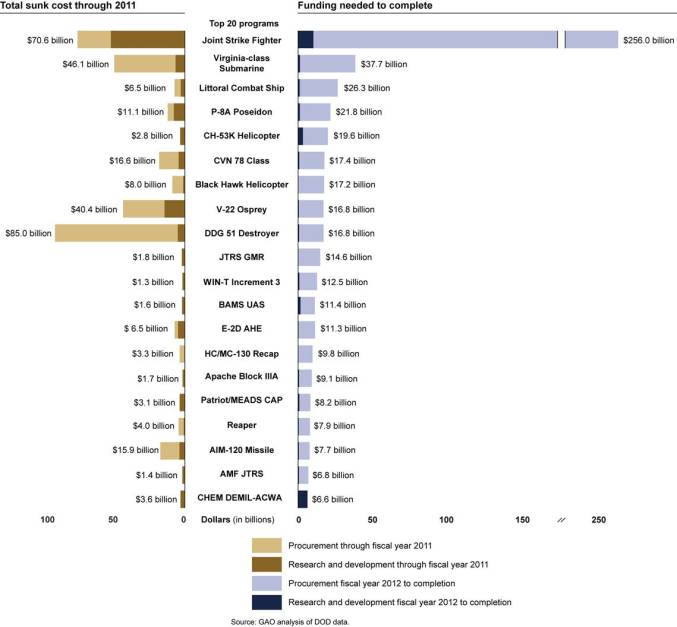
Wonder why we cannot afford NSCs 7 and 8, and why we will be building only one OPC a year? Why the Coast Guard cannot get the approximately $2-2.5B/year it needs for modernization and is making do with $1.4B? There are lots of explanations, but take a look at this chart.

Informationdissemination.net has a great discussion of this. I always knew the F-35 was a big program, but I never realized how big. The thing I find most frightening in this is that one contractor is so monopolizing the Defense Budget that it may kill off its competitors not just in the US but all over the world.
“Among the 96 programs in DOD’s 2011 portfolio, the Joint Strike Fighter is the costliest, the poorest performer in terms of cost growth, and the program with the largest remaining funding needs. The Joint Strike Fighter accounts for 21 percent, or nearly $327 billion, of the planned total acquisition cost of the portfolio.
“The Joint Strike Fighter program alone is expected to account for 38 percent—or almost $246 billion—of the future procurement funding needed. This amount is enough to fund the remaining procurement costs of the next 15 largest programs.
Let’s see, $70.6B in and $256B to go, without considering probable future growth, that is $326.6B, enough to buy about 467 National Security Cutters.