German Corvette Brings Down Drone

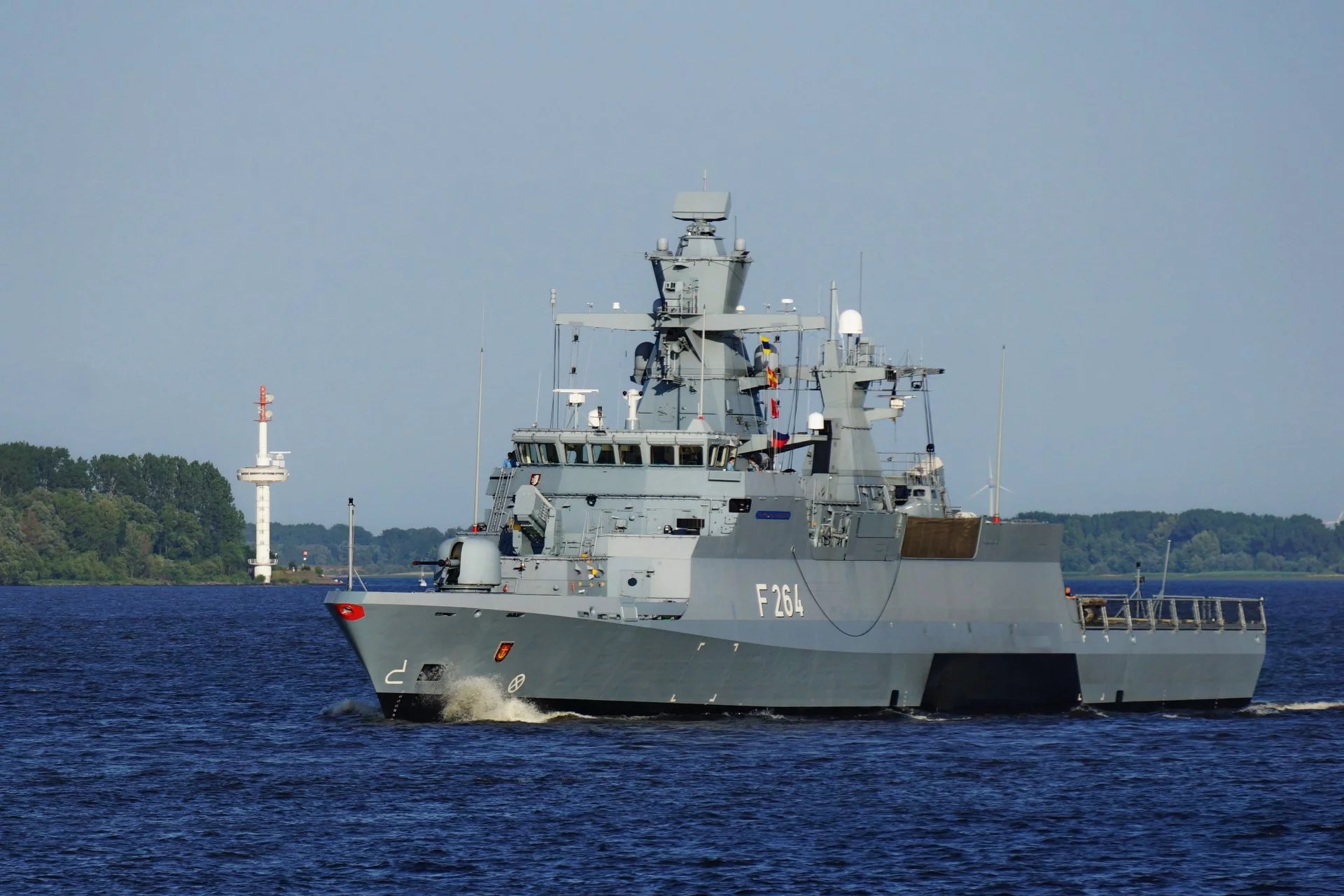
German Navy Braunschweig-class corvette Ludwigshafen am Rhein. (Picture source: German MoD)

ArmyRecognition’s Navy News reports,

According to information published Die Zeit on October 17, 2024, the German Navy corvette Ludwigshafen am Rhein, deployed as part of the United Nations Interim Force in Lebanon (UNIFIL), successfully intercepted and neutralized an approaching drone near the Lebanese coast.

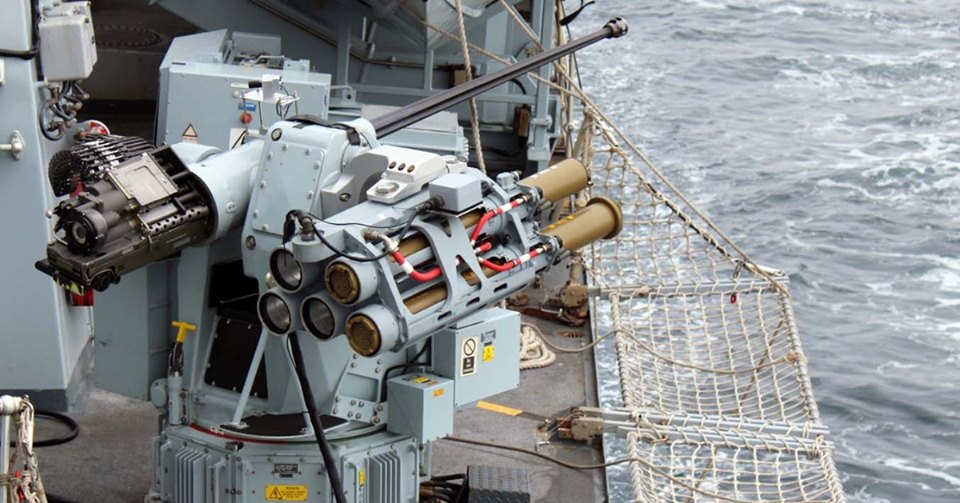
Unfortunately, the report does not specify which defensive system brought down the drone, but the corvette is relatively small, only a little larger than a WMEC270, and compared to the American DDGs that have been operating against kamikaze drones in the Red Sea, their options were limited.  It has two 21 cell RAM (rolling airframe missile) launcher, a 76 mm gun similar to that found on the WMEC270s, two 27mm guns, and an Electronic Countermeasures System.

Most US successes against drones have involved air to air intercepts or the use of very expensive standard missiles, with some attributed to medium range ESSMs (Evolved Sea Sparrow Missiles). In one case a drone was brought down by a Phalanx CIWS (Close in Weapon System) like that mounted on the National Security Cutters, but that was a last ditch effort not a weapon of choice.

The Italian Navy, showing great confidence in their 76mm Strales system, shot down a kamikaze drone after forgoing an opportunity to engage it with surface to air missiles.

Hopefully we will learn more about this incident.

Another APKWS Based System, “EAGLS: US Army gets new anti-drone systems featuring laser-guided 70mm rockets” –Interesting Engineering

Mooresville, NC, July 22, 2024 – MSI Defense Solutions has delivered the first 70mm centric Counter-UAS system acquired by the Department of Defense for use by the United States Army. Through the Rapid Acquisition Authority (RAA), MSI was awarded a contract for six EAGLS™ (Electronic Advanced Ground Launcher System) counter-UAS systems, including associated engineering and maintenance support. The contract was awarded by Naval Air Systems Command (NAVAIR) to support forward deployed forces facing emerging and persistent Uncrewed Aerial Systems (UAS) threats.

Interesting Engineering reports,

The US Army has received the six MSI Defense Solutions’ (MSI) Electronic Advanced Ground Launcher Systems (EAGLS) to improve its counter-drone capabilities.

In April, the US Army’s Naval Air Systems Command (NAVAIR) announced the order for a firm-fixed-price contract with MSI with a not-to-exceed value of $24,186,464.

Aside from the fact that the Naval Air Systems Command (NAVAIR) does not belong to the US Army, there is good information here, about systems that might find their way onto US Coast Guard assets. (Anything that can be mounted on a road going 4×4 vehicle can be mounted on a ship, and I think we have, or should have, a counter UAS capability requirement.)

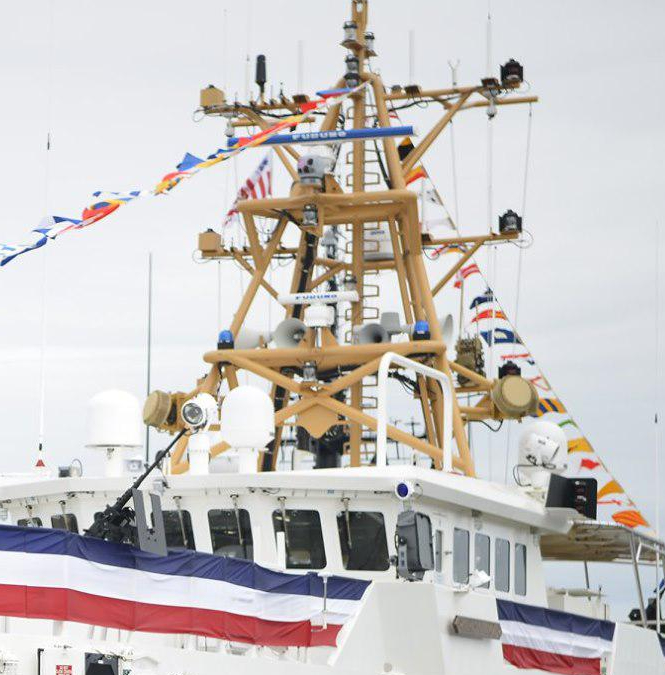
USCGC Charles Moulthrope (WPC-1141) prior to departure for PATFORSWA.

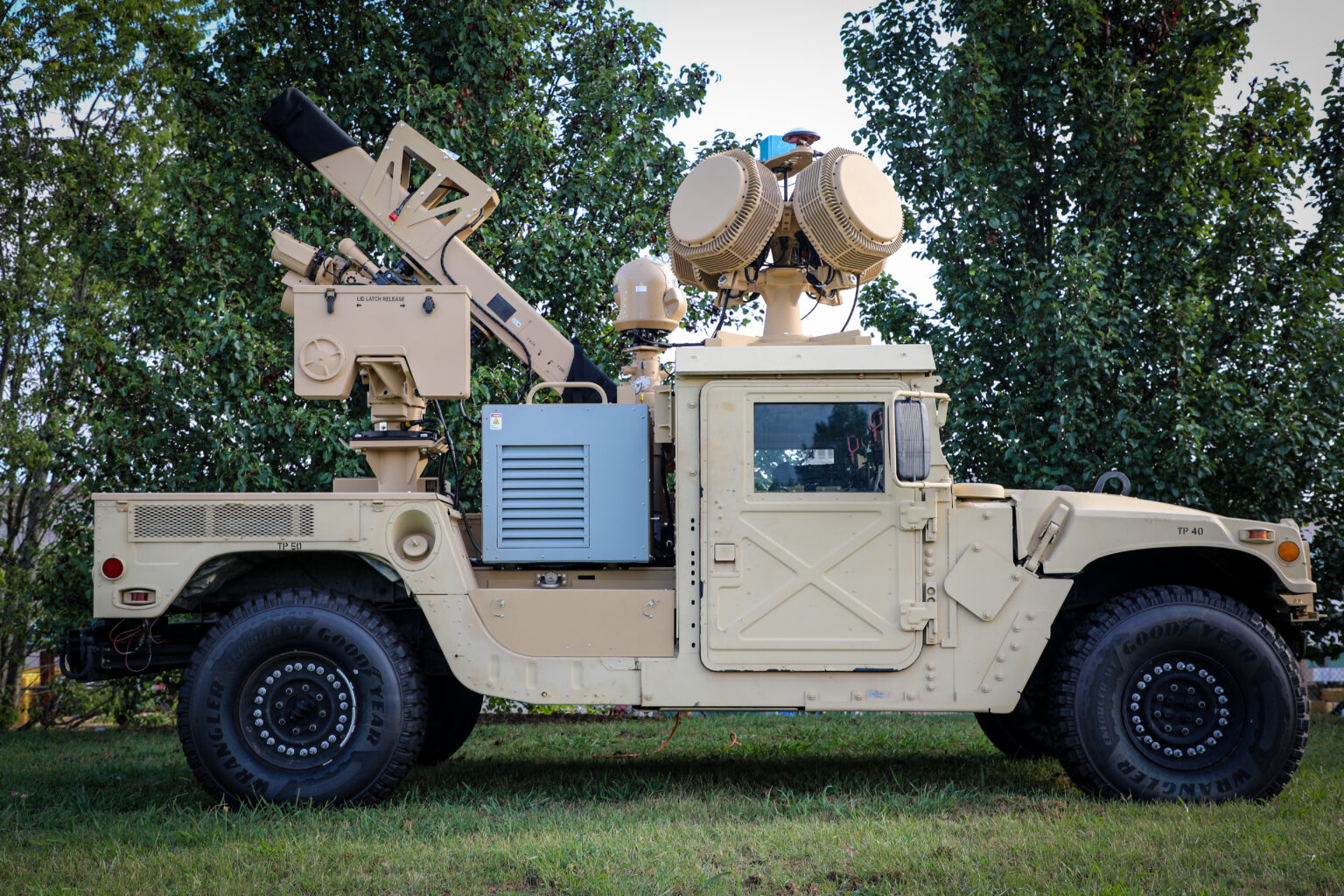
Those radars on top of the truck cab may look familiar.

The purchase seems to show confidence that APKWS can be used effectively against Unmanned Air Systems. The more modest Vampire system is already being used in Ukraine.

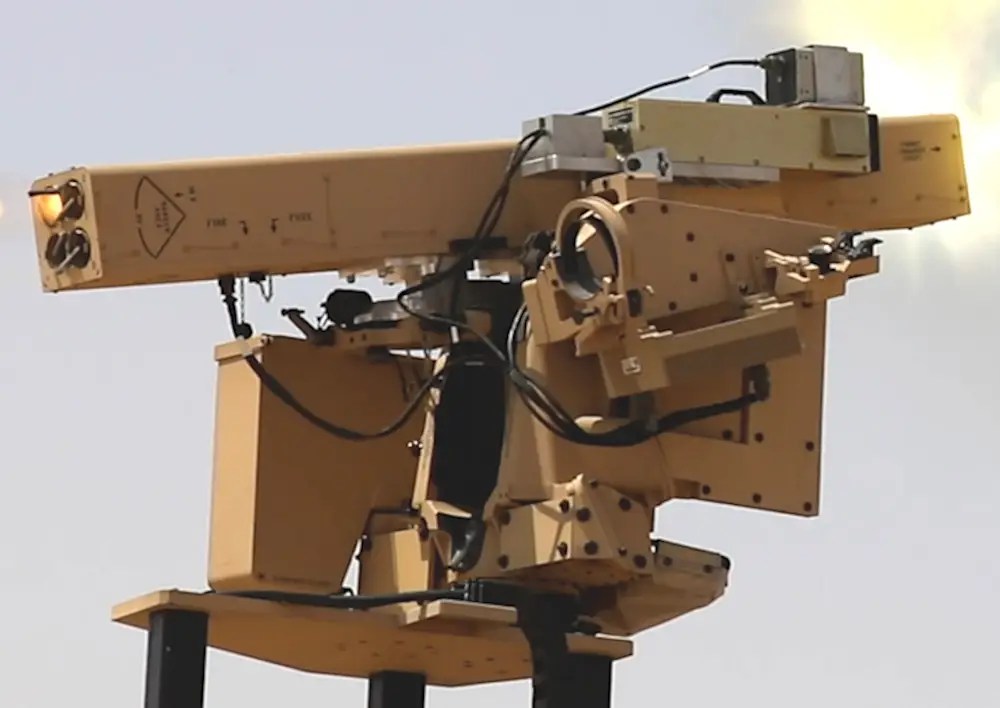
A close-up of the modified CROWS II fitted with the LAND-LGR4 launcher and the added sensor or other system (silver/gray rather than tan). US Army

APKWS, like most 70mm guided rocket systems, is a modification of the Hydra 70mm (2.75″) unguided rocket, which is available with a variety of warheads and fuses, including a proximity fuse.

The system can do more than just counter UAS. This is a system we could put any cutter, WPB size and up, and have most of the effective range and hitting power of a 76mm and at three times the effective range of a 25mm Mk38 Mod2/3 with minimal footprint and support requirements.

The Navy is Looking for Counter Drone Systems

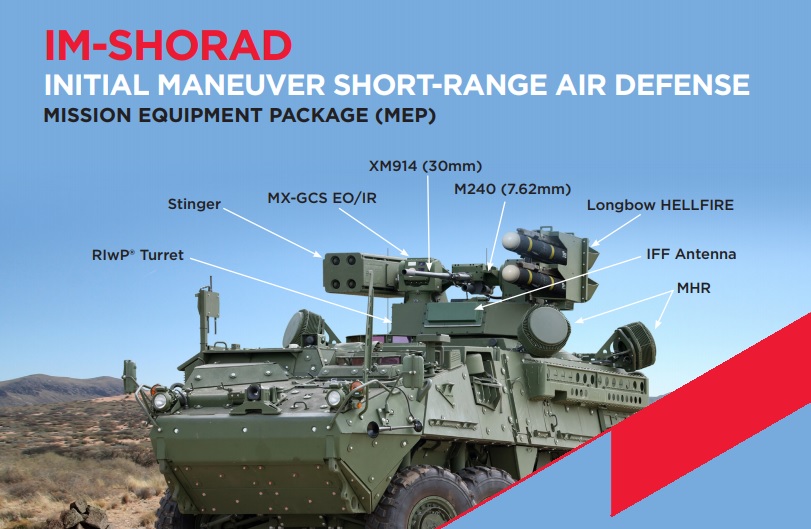
Interim Maneuver Short-Range Air Defense (IM-SHORAD). The sensors and remote weapon system used here looks like it might be a contender.

The Navy is looking for mature counter Unmanned Air Systems (c-UAS) that can be rapidly deployed. They have issued a Request For Information (FRI). Responses are due today, so we are talking near term if it happens. 

Looks like it might be something the Coast Guard could use,

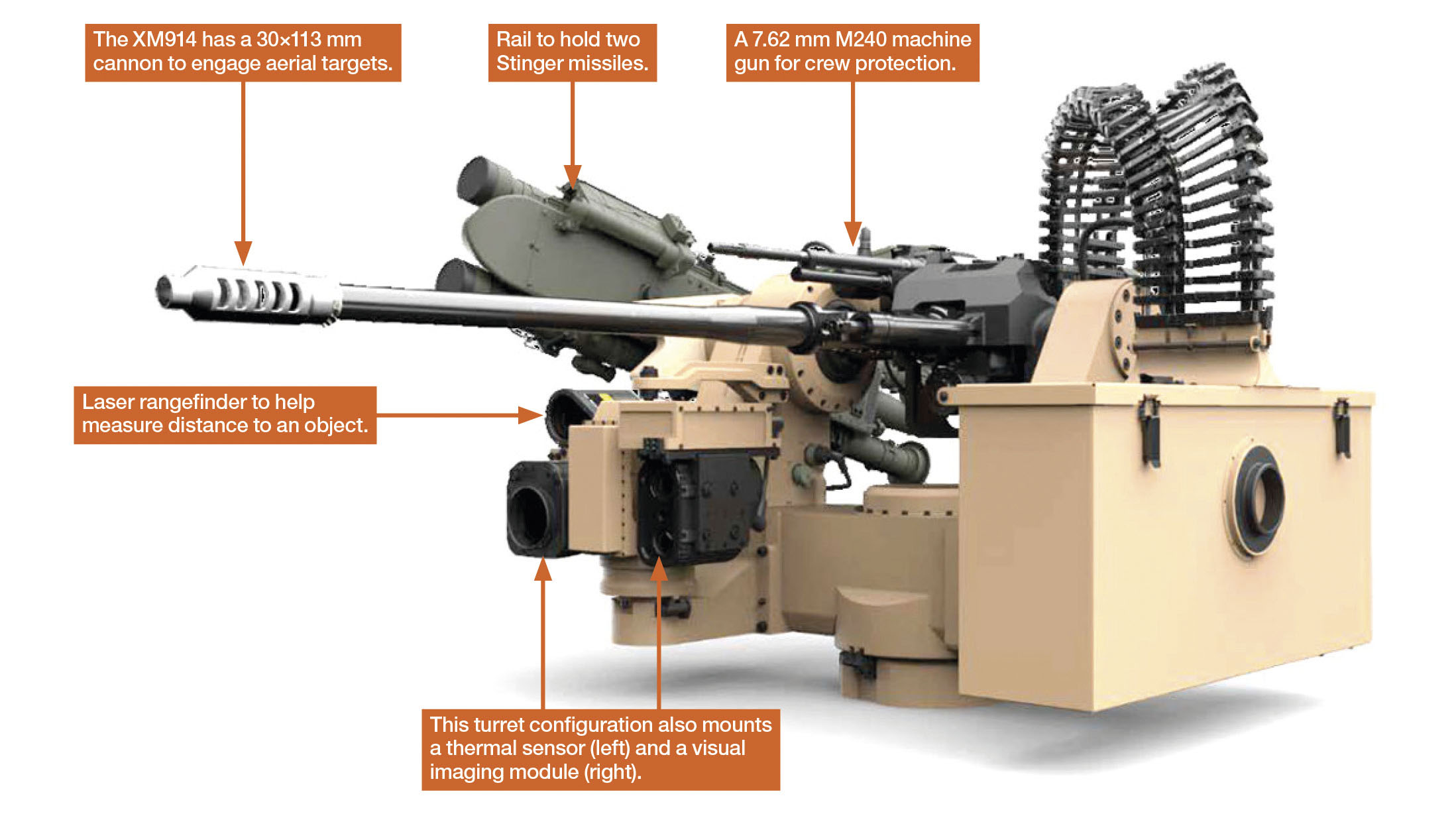
Marine Air Defense Remote Weapon Station. Use of this Remote Weapons Station would require an interface with cueing sensors.

Below is SECTION 3: [Requirements Overview]


PEO IWS 11.0 is looking for respondents to submit feasibility and capability information on innovative, mature solutions to counter Group 3-5 UAS from surface ships.  System requirements include:

  1. Mature systems that are in production and can be deployed in 1-6 months (preferred), or 6-12 months at the latest.
  2. Demonstrated performance against Groups 3 to 5 UAS, with demonstrated capability against other classes of UAS’s being of interest.
  3. Minimal integration requirements with Naval combat systems; with independent, self-contained capability highly desirable.

If the system is capable against Group 5 UAS (the largest UASs, over 1320 pounds (600 kg) and with no limit on their maximum speed) it’s likely the system will also have a capability against at least subsonic cruise missiles and manned aircraft and perhaps against winged smart bombs. After all, a Naval Strike missile fits the definition of a Group 4 UAS. Surface launched Harpoon or Tomahawk would be Group 5 UAS.

The War Zone has a fairly long post about this including discussion of alternatives. They seem to think these systems are destined for DDGs, but I think the need to equip other types, that do not have robust AAW capabilities, may be more urgent. If a C-UAS has an anti-surface capability, I could see such a system replacing Mk38 mounts. Alternately a 30mm Mk38 Mod4 mount that also mounts AAW missiles (like Stinger) might meet the requirement.

Martlet Light Multirole Missile launchers mounted on MSI 30mm gun mount that will be used in US Navy service as the 30mm Mk38 Mod4.

Mine Countermeasures Ships and MSC ships are currently essentially unarmed. They might be recipients.

Minimal integration requirements with Naval combat systems; with independent, self-contained capability highly desirable” would certainly mean it should not be too difficult to add to a cutter.

“Roadrunner Reusable Anti-Air Interceptor Breaks Cover” –The Drive

The Drive reports on a new sort of modular system that has a wide range of possible uses including as an anti-air weapon against threats from small drones to cruise missiles. It is small and relatively cheap. It can loiter. It can return and be refueled. It requires only minimal maintenance. It can be cued by a number of systems. It probably would work against surface targets too. It is jet powered, with high sub-sonic speeds.

NAVAIR Providing VAMPIRE APKWS Counter UAS System to Ukraine

The Drive has a new post, “Our Best Look At A VAMPIRE Counter Drone System For Ukraine.”

We have known for a while that APKWS was being used by Ukraine and that it was being mounted on vehicles along with Electro-Optic fire control systems to counter unmanned air systems (drones). (More here.)

What surprised me most in the new “The Drive” article was that the systems were developed my NAVAIR. That means this is a Navy developed system. Since the Coast Guard gets all of its weapons, other than small arms, from the Navy, that may mean the Coast Guard may be more likely to be able to get the system.

The Vampire combination of APKWS, Electro-Optic Sensors, and Firecontrol seems to be the easiest way for the Coast Guard to protect high value targets from potential air and surface suicide drone attacks without spraying bullets that may cause collateral damage. It is also flexible enough to be used against small, fast, highly maneuverable surface threats. It might even be useful against larger targets. It certainly seems to be exceptionally effective for its cost, weight, support requirements, and minimal footprint.

I would like to see them on all cutters, but getting this sort of capability for the cutters in PATFORSWA is most urgent.

APKWS for Counter Drone

At about $30,000 each APKWS is a low-cost way to provide a precision counter to a number of threats.

We have already seen reports of the 70mm APKWS guided rocket being used against relatively small Class 2 unmanned aerial systems.

A close-up of the modified CROWS II, a small remote weapons system mount, fitted with the LAND-LGR4 launcher and the added sensor or other system (silver/gray rather than tan). US Army

Here we have a better picture of how the system might be deployed on the PATFORSWA Webber class patrol craft.

The PATFORSWA cutters already have the air search/detection or “hunter” part of a C-UAS system. Reportedly their Mk38 systems have been upgraded to 30mm capable of firing airburst munitions that can provide close in UAS kill capability. Adding a CROWS II RWS with LAND-LGR4 launcher and a laser designator mounted on the O-1 deck, above and behind the Mk38, would allow them to begin engaging UAS and other threats at triple the effective range of the 30mm.

Three PATFORSWA Island Class Cutters Decommissioned

This from Chris Cavas on Twitter. More photos there.

Three hard-working 110-foot US #Coast Guard cutters were decommissioned 22 March in a ceremony at Manama, #Bahrain. Cutters MAUI WPB1304, MONOMOY WPB1326 & WRANGELL WPB1332 served in the Persian Gulf since 2004, will now be available for foreign transfer.

USCGC Adak was previously decommissioned and sold to Indonesia. Likely these little ships will continue to provide useful service.

They are being replaced in Bahrain by larger and more capable Webber class Fast Response Cutters. It appears the newly arrived cutters are equipped to counter Unmanned Systems.

Thanks to Walter for bringing this to my attention. 

Bahrain Bound FRC gets Upgrades, LRAD and Short Range Air Search

(As we get into this, you may want to click on the photo to get an enlarged view.)

This Spring, the first two Webber class patrol craft are expected to go to Bahrain to start replacing the six 110 foot WPBs of Patrol Force South West Asia (PATFORSWA).  Two more will join them in the Fall and the last two in 2022. Back in 2018, I speculated on what might be done to modify them for duty in this more dangerous area. Apparently the Coast Guard leadership has had a few ideas of their own.

We have some very shape observers among the readers of this blog.

First Andy provided the photo of USCGC Charles Moulthrope (WPC-1141) above and pointed out the Long Range Acoustic Device (LRAD, the gray device mounted near rail on the O-1 deck just this side of the port forward corner of the bridge) and the four round sensors a short way up the mast two on each side. I note these systems were not on the ship when it was handed over by Bollinger (photo below).

The 41st fast response cutter (FRC), Charles Moulthrope, as delivered to the Coast Guard in Key West, Florida, Oct. 22, 2020. It is the first of six planned FRCs to be stationed in Manama, Bahrain. (U.S. Coast Guard photo)

Then Secundius identified the four round sensors on the mast as Sierra Nevada Modi RPS-42 S-Band Radar.

From the Company web site: “RPS-42 is an S-Band tactical hemispheric air surveillance radar system. It is a member of the non-rotating, solid-state, digital radar family Multi-mission Hemisphere Radar (MHR), developed by RADA Electronic Industries Ltd.
“The RPS-42 is a pulse Doppler, software-defined radar platform, that can detect, classify and track all types of aerial vehicles – including fighters, helicopters, UAVs, transport aircraft, etc. at tactical ranges. A single radar platform provides 90º azimuth coverage. Hemispheric coverage is achieved when four radars are employed as a system. Mobile or stationary, the system can be integrated with any C⁴I system and other radars and sensors. The software is able for On-the-Move (OTM) Operation. The radar can operate either as a stand-alone or as part of a large-scale surveillance system.
“The Antenna is an Active Electronically Scanned Array (AESA) based on Galliumnitrid (GaN) Amplifiers. Its diameter is 50.4 cm , the max width is 16.5 cm. (19.8″ x 6.5″ –Chuck)
“The achievable range for detection of the smallest drones (known as Nano UAV) is 3.5 km”

These radars use Galliumnitrid (GaN), the new technology in radar, that allows the AN/SPY-6 to significantly outperform the earlier AN/SPY-1 found on most Aegis equipped warships. (Reportedly a 3000% improvement)

You can get an appreciation of what this is about from this Popular Mechanics article. This Is the ATV-Mounted Jammer That Took Down an Iranian Drone.

There is more here: Light Marine Air Defense Integrated System [LMADIS] (globalsecurity.org)

I’m only guessing, but I would think the FRC would also have the same or equivalent complementary equipment as the LMADIS, e.g. small EO/IR camera, Skyview RF Detection system and Sierra Nevada MODi RF jammer (Photo below, I may be seeing the jammer–pictured below–located above and behind the port side RPS-42 radar arrays, visible between the radar arrays and the tripod legs). The cutters of this class are already normally equipped with electro-optic devices, both on the mast and on the Mk38 gun mount, which can provide a kinetic counter to UAVs.
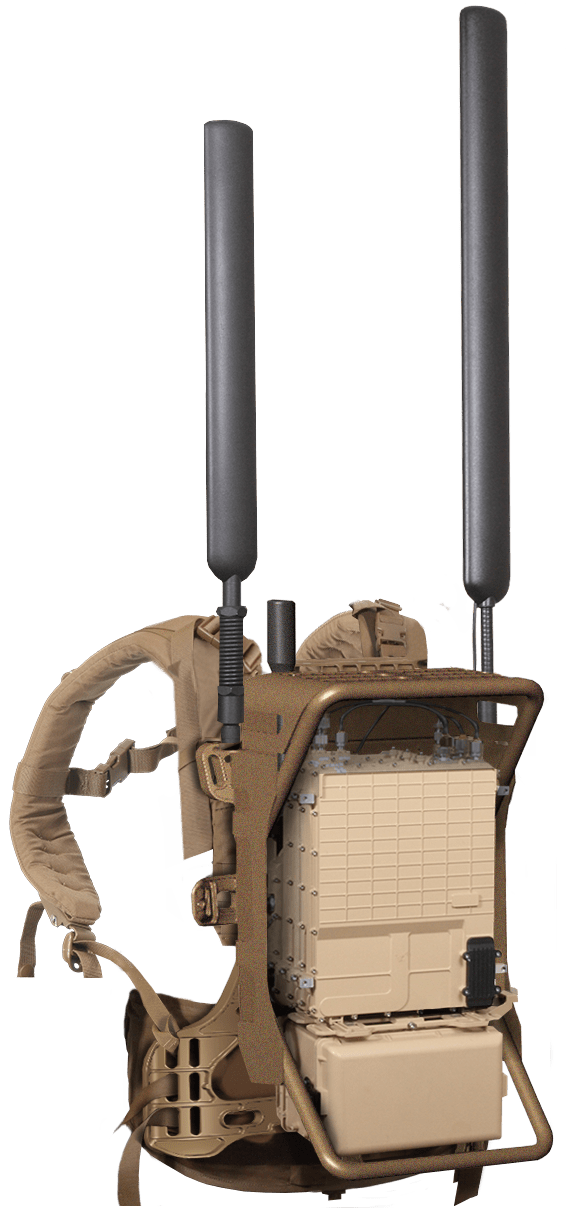
Sierra Nevada MODi RF jammer. From the company web site, “SNC’s Modi II is the most modern & highly-capable dismounted EMC system in the DOD inventory.”

This was probably what the Commandant was talking about, when he said that Coast Guard PATFORSWA had a counter UAS role in a recent interview.

I am thinking, this radar might also be used on some of our other cutters as well, perhaps the 210s and the six 270s to be FRAMed, to provide them better control of their helicopters on approach in bad weather. The 210s have no air search radar and the 270s will almost certainly lose the Mk92 fire control system which provides their only air search radar currently. Reportedly the radar has a range of up to 30km and an instrumented range of 50km at altitudes from 30ft to 30,000 feet. Apparently the Marines are also using it to direct fire for their short range air defense systems. which includes a 30mm gun and Stinger missiles.

Thanks to Andy and Secundius for kicking this off.

“Coast Guard to develop drone interception capability” –Defense Systems

Defense systems reports that,

“The U.S. Coast Guard is developing a counter-drone capability to both protect its own locations and to guard protected assets under special circumstances as provided for under a recent law.”

Ever since a quadcopter crash landed about two meters from German Prime Minister Angela Merkel in 2013 there has been a recognition that these systems might be used for sinister purposes.

Terrorist have started using drones as a cruise missile, lite.

The R&D Center has apparently already had a successful test.