“U.S., Canada Coast Guards, Royal Canadian Air Force conduct search and rescue exercise near Herschel Island, Yukon” –D17

Herschel Island in the arctic, location circled. Basic map is NASA Blue Marble image, with the circle drawn in Inkscape. via NASA World Wind

Below is a press release from District 17 (Alaska). Except for the mention of the Arctic, this sounds like a pretty routine SAR exercise but look at the map above. This was more than 150 miles north of the Arctic Circle, on the Northwest Passage, North of the Canadian mainland. The helicopter would have deployed from Kodiak on the South side of Alaska more than 800 miles South. Click on the link above to see the video.

Oct. 3, 2023

(VIDEO AVAILABLE) U.S., Canada Coast Guards, Royal Canadian Air Force conduct search and rescue exercise near Herschel Island, Yukon

ANCHORAGE, Alaska – The U.S. Coast Guard and Canada Coast Guard conducted a cooperative search and rescue training exercise near Herschel Island, Yukon, Canada, on Saturday.

The exercise centered around the French cruise ship Le Commandant Charcot, whose crew simulated an onboard fire with severe personal injuries and a complete evacuation of the vessel.

The crew of a U.S. Coast Guard HC-130 aircraft from Air Station Kodiak were first to respond to the simulated distress call and acted as the on-scene commander for the exercise, coordinating response efforts and relaying communications.

Later a Royal Canadian Air Force HC-130 crew responded to drop medical supplies and response personnel onto Herschel Island where exercise participants that were acting as injury victims awaited treatment.

A U.S. Coast Guard MH-60 Jayhawk helicopter crew from Air Station Kodiak also responded by lowering a rescue swimmer onto the deck of the cruise ship to hoist mannequins acting as injured crew members.

“The increase in human activity in the arctic means there may be a potential for increased Search & Rescue response there as well,” said Captain Brian McLaughlin, Chief of Incident Management at U.S. Coast Guard District Seventeen. “Exercising the Coast Guard’s capabilities to operate in one of the most demanding and remote regions in the world, while simultaneously identifying the associated challenges, highlights the critical importance of these joint exercises and their influence on future operational success along our shared maritime border with Canada.”

The exercise, which took more than a year to plan, is part of the Coast Guard’s ongoing commitment to a safe and secure arctic.

Correction: The title of this press release was changed to reflect all entities involved.


VARD’s “Vigilance” 75 meter OPV Design

Naval News provides a bit more information on VARD’s proposal of a 75 meter OPV using the CUBE system of replaceable modules for the Canadian Navy. The discussion of the OPV begins in the video at time 3:26.

If these are to replace the 12 ship Kingston class, now 24 to 27 years old, this could be a significant program.

We talked about this proposal earlier. Canada apparently intends to deploy these well beyond the Canadian EEZ. The flight deck appears to be small and perhaps capable of operating only UAS. I still think the design generally is a little too tight, that it should be 5 to 15 meters longer and have a flight deck capable of operating a helicopter. I would also like to see a gun larger than 30mm.

Nevertheless, the CUBE system looks promising, possibly permitting an OPV to be quickly converted to meet emerging needs.

There is no indication Canada has accepted this design, but I have seen no information about competing designs.

Thanks to Lee for bringing this to my attention. 

“UMS SKELDAR And Ultra Maritime Unveil UAS-Based ASW Solution At DSEI 2023” –Naval News

Two V-200 “Sea Falcon” VTOL UAV on the helideck of German Navy’s corvette Braunschweig. Note, this is a relatively small ship, about the size of a 270, with a beam of 13.28 m (43 ft 7 in), about the same as a Hamilton class 378′. Picture by Commander of the German Naval Aviation.

Naval News reports,

UMS SKELDAR and Ultra Maritime unveiled their jointly developed anti-submarine warfare (ASW) solution at DSEI 2023…The solution, a Rotary Wing UAS providing an ASW sonobuoy dispensing capability, is based on the SKELDAR V-200 Uncrewed Aircraft System (UAS) and was developed as part of a contract under the Canadian Department of National Defence’s (DND) Innovation for Defence Excellence and Security (IDEaS) program. 

This is an interesting idea. By itself, without any weapon, it may not be very useful, but it might prove a useful addition to a mix that includes ASW helicopters on standby for prosecution and ships with gear for monitoring and interpreting sonobuoy transmissions.

The Skeldar doesn’t have the endurance of the Scan Eagle, used by the Coast Guard, but it does have a much higher payload weight, 40 kg (88 pounds) compared to Scan Eagle’s 5 kg (11 pounds) and Skeldar doesn’t require separate launch and recovery equipment. (As it seems in all aircraft, there is a tradeoff between payload and fuel.)

The extra payload weight may not make much difference if you can pack everything you want into that 5 kg on the Scan Eagle, but it does open up options, larger sensors, light logistics cargo runs, and the ability to drop things.

Other than sonobuoys and weapons there are a number of things we might want to be able to drop from a UAS: buoys to measure drift for a SAR case, radios or pumps to a vessel in distress, lifejackets, or inflatable rafts.

Wikipedia reports, UMS Skeldar V-200 UAS is used by the militaries of six nations. It is used by the German Navy on their K130 Braunschweig class corvettes (pictured above), and will be used by the Belgian and Netherlands Navies on their City class mine countermeasures vessels.

This is a Canadian program. The Canadian Navy uses Skeldar, CU-176 Gargoyle in Canadian service, on their DeWolf class Arctic Offshore Patrol Ships (AOPS). If the Canadian Navy chooses to continue development of this sonobuoy drop capability, presumably they will also use the UAS on some of their frigates, or perhaps they are working toward an ASW role for their AOPS.

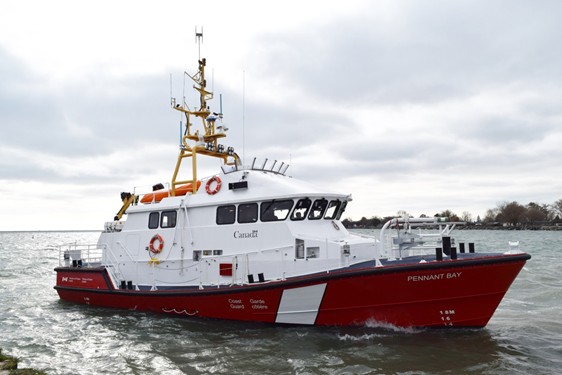
Canadian Coast Guard Bay Class Motor Lifeboats–MLB and WPB Replacement?

Canadian Coast Guard vessel CCGS Garbarus Bay | Photo credit: Mel & Jer Creative

Recent reports of the delivery of CCGS Garbarus Bay prompted me to look again at the Canadian Coast Guard Bay class motor lifeboats. They are considerably larger than the USCG 47 foot MLBs. I was also reminded; we have not heard anything recently about replacements for the now retired 52 foot MLBs. The 87 foot WPBs are also nearing the end of their useful life. A large, reasonably fast MLB like the bay class could replace the 52 foot MLBs and some of the WPBs. (In other places we may need a different kind of WPB replacement.) With their smaller crew, be less expensive to operate than the WPBs. These could be the true “Fast Response Cutters” capable of responding in extreme weather when a Response boat medium or even an 87 footer could not. Might even call them Response Boat, Large.

The Canadians are procuring 20 of these large MLBs. The vessel’s particulars are as follows:

  • Displacement: 62.5 tons (47 foot MLBs are 18 tons; 87 footers are 91 tons)
  • Length overall: 19.0 meters (62′)
  • Length DWL: 17.5 meters (57.4′)
  • Beam: 6.3 meters (21′)
  • Depth at midship: 2.58 meters
  • Hull draft, nominal: 1.67 meters (5.5′)
  • Power: 2,400 kW (about 3,200 HP, more than the 2,950 HP of the 87 foot WPBs and more than three times the power of the 47 footers)
  • Speed: 23.5 kts

According to Wikipedia,

They are capable of operating in 12-metre (39 ft) waves, and in wind conditions at 12 on the Beaufort scale. The vessels’ hulls will be aluminum, not FRC (fibre reinforced composite), as with the original Severn design.

Canadian Coast Guard vessel CCGS Chedabucto Bay | Photo credit: Chantier Naval Forillon

“USNI News Fleet and Marine Tracker: Aug. 14, 2023” –USNI

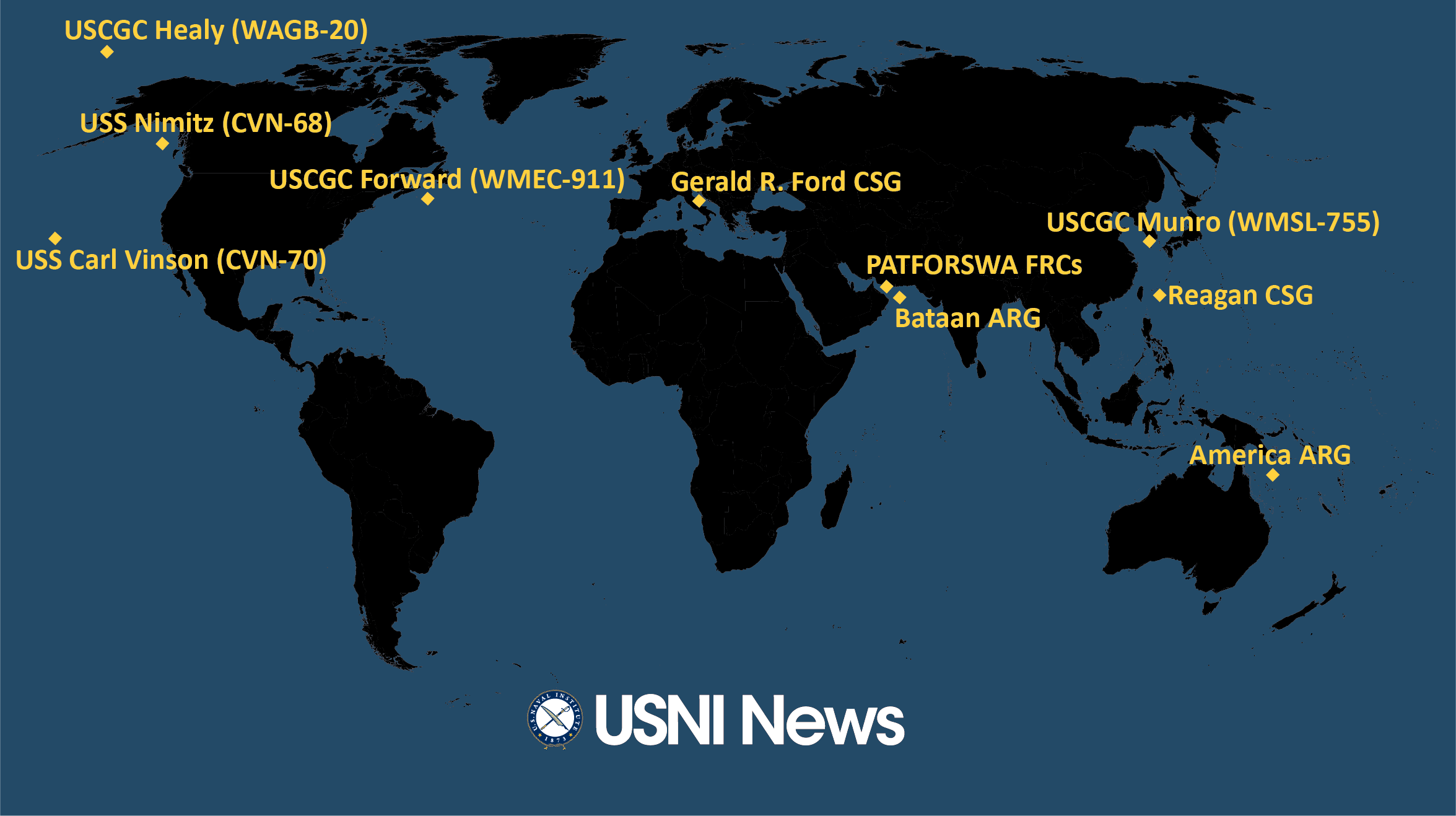
The US Naval Institute News Service “Fleet Marine Tracker” continues to report atypical Coast Guard activities. It continued to report on USCGC Healy’s Arctic deployment and mentioned PATFORSWA as they have since they have since they began including Coast Guard units in May.

This week, they included some activity I have not seen reported elsewhere.

“Legend-class National Security Cutter USCGC Munro (WMSL-755) departed Fleet Activities Yokosuka (CFAY) and is now in South Korea.”

“Coast Guard Cutter Forward (WMEC-911) is currently supporting Operation Nanook. Operation Nanook is an annual Canadian-led exercise that fosters international cooperation and shared responsibility in the Arctic and the northern Atlantic Regions.”

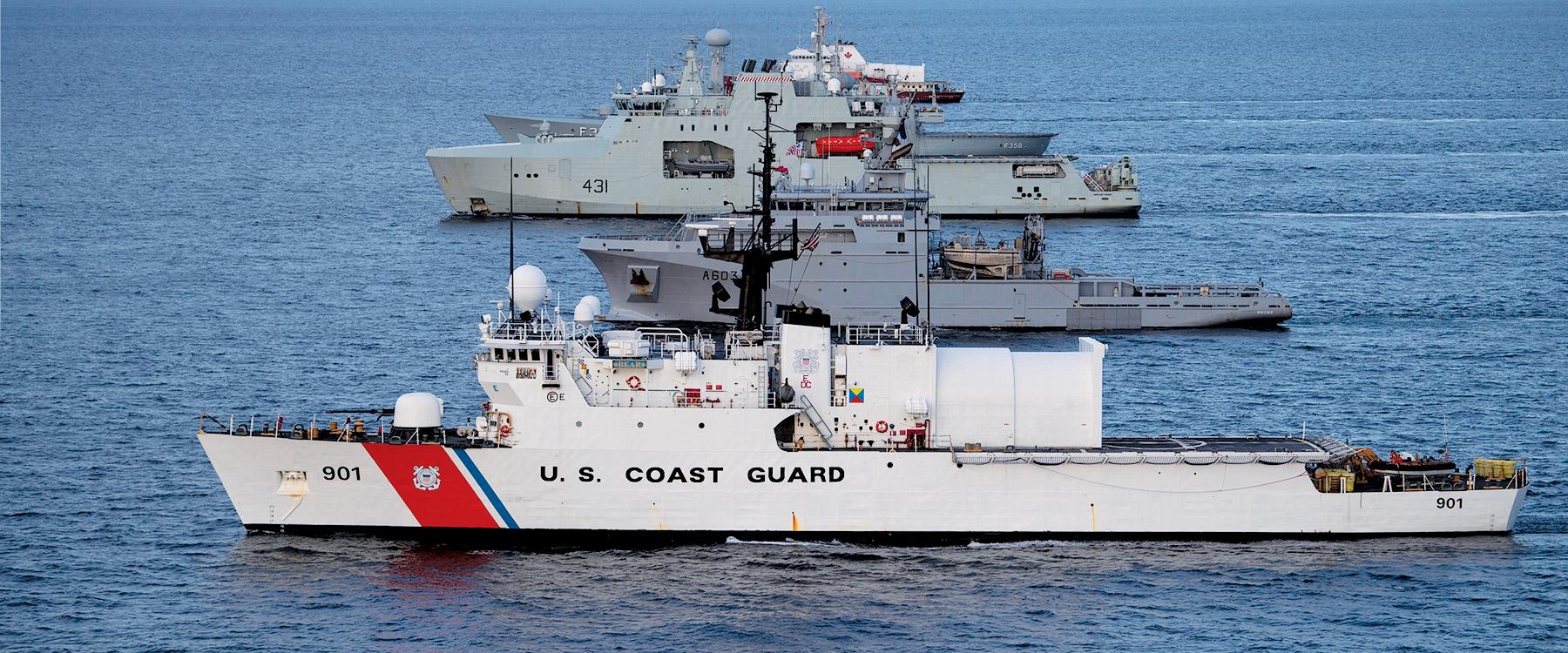
The USCGC Bear (WMEC-901) and allied ships from Canada, Norway, France, and Denmark steam in formation in the North Atlantic Ocean during last year’s Operation Nanook in August 2022. 

“INSIDE LOOK aboard HMCS Harry DeWolf” –Video

Just a short video, made at least a couple of years ago, but particularly wanted to feature the “cable deck,” time 1:27 to 1:45, where you see mooring and anchoring gear conspicuously missing from the foc’sle. Keeping this gear inside the ship is critical to keeping it operational in the Arctic environment.

A total of eight ships of the class are planned, six for the Canadian Navy and two for their Coast Guard. Navy or Coast Guard, these “Arctic Offshore Patrol Ships” (AOPS) essentially perform what we view as Coast Guard missions. They are 6,615 ton ships, 340 feet (103.6 meters) in length. Four diesel generators provide power to two electric motors that provide 12,000 HP for a 17 knot max speed. Range is 6,800 nautical miles at 14 knots. The crew is 65 with accommodations for 87. The gun seen in the video is a weatherized version of the 25mm Mk38. They are Polar Class 5.

Canada’s Multi-Purpose Vessels

Canadian CG MPV. Credit Aker Arctic.

Canada has a project to replace a large part of the Canadian Coast Guard fleet with up to 16 Multi-purpose Ships at an estimated cost of $14.2 billion (Canadian), with the first ship to be delivered in 2029.

There has not been a lot of reporting about this class, but frequent contributor Walter pointed me to two sources, Seaspan Shipyards and designer Aker Arctic. It appears they have very concrete ideas about what the class will look like.

Canadian CG MPV. Credit Aker Arctic.

MISSIONS:

According to Aker Arctic,

The MPVs will also perform cargo missions, bringing supplies to northern communities, carry out search & rescue and patrol missions, in addition to icebreaking. Most of their time will be spent on the St Lawrence River, the Great Lakes, and along the Canadian East Coast. Additionally, they will have a summer Arctic mission leaving from Victoria in British Columbia and travelling north around Alaska to the Canadian Arctic.

Due to the wide variety of tasks, the long-distance mission to the western Arctic, and the fact that some of the waterways have a limited depth, the vessel needed to be compact with a shallow draught, narrow beam, high endurance, and with a large cargo capacity.

CHARACTERISTICS:

  • Displacement: about 8,500 tons
  • Length, overall: 99.9 meters (328′)
  • Beam: 20.3 meters (66.7′)
  • Draft: 6.2 meters (20’4″)
  • Propulsion: diesel-electric; two azimuthing propulsion units

As is the case with all Canadian Coast Guard cutters, they have no fixed armament. It does look like it could host a medium sized helicopter and containerized systems, including perhaps below the hangar deck.

RANGE:

To me the most surprising characteristic of the ship is its range, 12,000 nautical miles. This was apparently driven by a summer Arctic mission from Victoria in British Columbia, north around Alaska to the Canadian Arctic.

ICE CLASS: 

These ships will be Canadian Ice Class 4, meaning they will have the capability to maintain a speed of 3 knots through ice 4 feet thick. The Canadian Coast Guard will consider these heavy icebreakers. We don’t have any figures on horsepower, but they probably will have less than 20,000 HP which, in the USCG system, would classify them as light icebreakers.

Compared to the US Coast Guard’s “heavy” Great Lakes icebreaker, Mackinaw (3,500 tons and 73m), these will be more powerful and more than twice as large. These might be a good design for the planned second USCG Great Lakes icebreaker.

IMPLICATIONS FOR THE USCG:

Aside from possible use of the design for Great Lakes icebreaker, these might be pretty close to what the USCG needs for their planned medium icebreakers. Certainly, consultation with Canadian counterparts will sharpen the focus of the US design effort. We might also have reasons to limit beam and draft.

“Vard Unveils New ‘Vigilance’ OPV Design” for Canada –Naval News

Vigilance OPV design for Canada by VARD

Naval News reports,

Tailored to the needs of the Royal Canadian Navy’s future fleet, Vigilance strikes the balance between flexibility, adaptability, and size, while maintaining the life-cycle cost advantages VARD’s naval designs are known for.  The vessel has been conceived for high-tempo sovereignty missions and engineered for global deployment and forward basing abroad.

There is not really a lot of information here.

They are to replace the Kingston Class Maritime Coastal Defence Vessels, which have been used to do drug interdiction in the Caribbean with USCG Law Enforcement teams doing the boardings. It is a class of twelve ships so there may be that many replacements, but also possibly fewer.

USCGC Escanaba (WMEC 907) and USCGC Richard Snyder (WPC 1127) practice maneuvering with the Royal Canadian Navy’s Kingston Class Maritime Coastal Defence Vessel HMCS Goose Bay (MM 707) in the Davis Strait on Aug. 13, 2021.  (Photo courtesy Royal Canadian Navy)

There is no indication of size but there is a clue in the identification of the rendering that accompanied the post, “VARD-7-075-Vigilance-Offshore-Patrol-Vessel-770×410.jpg”. Using VARD’s naming convention this is a “7 series” ship meaning “Naval and Security” that is about 75 meters (246 feet) long. Given the intention to employ them “forward basing abroad,” particularly as a Pacific nation, limiting the size to only 75 meters may be unwisely parsimonious. A larger ship would be both more capable in adverse weather conditions and more adaptable to future requirements. The Kingston class are only 55.31 m (181 ft 6 in) overall, so 75 meters would be an upgrade, but it is still a very small OPV, particularly if it is to operate helicopters. It would be similar in size to Malta’s P71 or the Danish Knud Rasmussen class.

If the ship is in fact 75 meters in length, then the flight deck seen in the fendering does appear relatively short for landing a helicopter, especially since Canada’s Navy and Air Force do not operate any small helicopters that might be operated from the ships. The logo that accompanies the post may suggest that the flight deck is for unmanned air systems rather than helicopters. The UAS in the logo appears to be the Swedish built UMS Skeldar V-200known as CU-176 Gargoyle in Canadian Service. This UAS is also in service with the Belgian, German, Netherlands, and Spanish Navies.

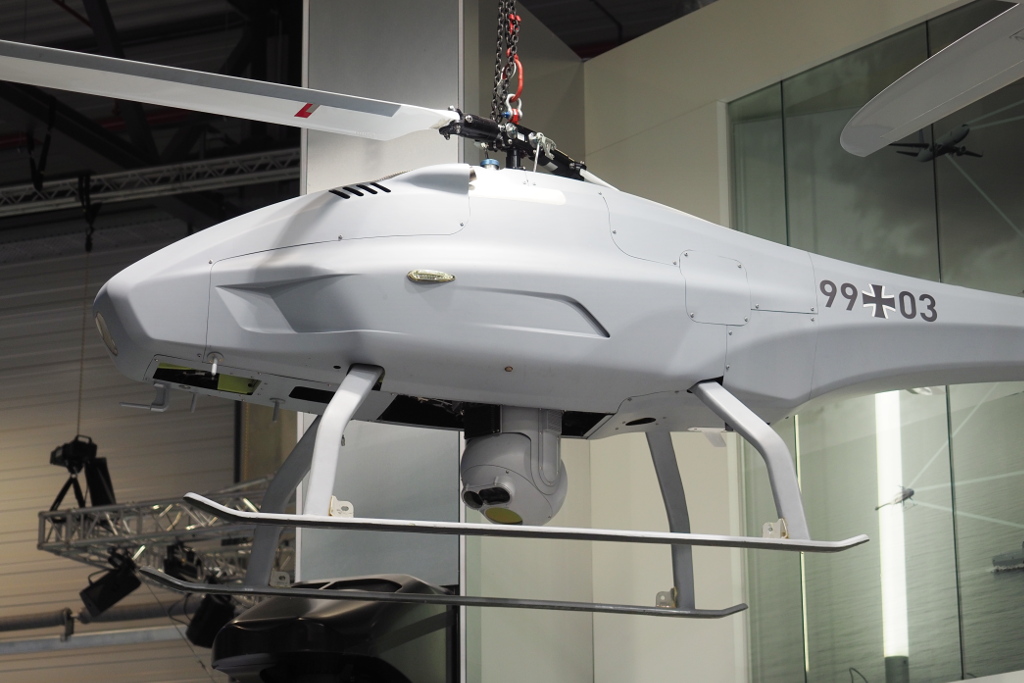
UAV SKELDAR V-200 in German service, tail marking 99+03, at ILA Berlin Airshow 2022. Photo credit: Boevaya mashina.

The gun seen in the rendering suggest a 30mm Mk38 Mod4. In view of the fact the Arctic Offshore Patrol Ship is armed only with a 25mm Mk38 Mod2/3 that would to conform to past policies. The same gun is expected to be on the new Canadian frigate.

Looking at VARD’s design catalog, I see some resemblance to their 72 meter and 85 meter designs.


Video below added as late addition, thanks to Dave. 

“Canadian Coast Guard Plans to Order Up to 61 Small Vessels” –Marine Link

Marine Link reports,

“…the Canadian Coast Guard, on Thursday announced $2.5 billion CAD (roughly $1.8 billion USD) for the construction of up to 61 new small vessels and the ongoing replacement of small craft, barges and workboats within the Canadian Coast guard fleet… These include six Mid-shore Multi-Mission Vessels; one Near-Shore Fishery Research Vessel; 34 Cape Class Search and Rescue Lifeboats; and 16 Specialty Vessels, including two Special NavAids Vessels, four Special Shallow Draft Buoy Tenders, four Inshore Science Vessels; four Special Enforcement Vessels, two Lake Class Vessels, and four Air Cushion Vehicles.”


“U.S. Coast Guard, U.S. Navy, Mexican Navy and Royal Canadian Navy participate in North American Maritime Security Initiative” –D11

Illustration of a Mexican Navy Oaxaca class Offshore Patrol Vessel. ARM Hidalgo is a vessel of this class.

Below is a news release from District 11 you can also see on the Coast Guard News website. There are additional photos there. I have put together photos to illustrate the type vessels involved.

190729-N-AD499-1166 SEATTLE (July 29, 2019) The Royal Canadian Navy Kingston-class coastal defence vessel HMCS Edmonton (MM 703) participates in a parade of ships in Elliott Bay during the 70th annual Seattle Fleet Week. Seattle Fleet Week 2019 is a time-honored celebration of the sea services and provides an opportunity for the citizens of Washington to meet Sailors and Coast Guardsmen, as well as witness firsthand the latest capabilities of today’s maritime services. (U.S. Navy photo by Mass Communication Specialist 3rd Class Victoria Foley/Released)

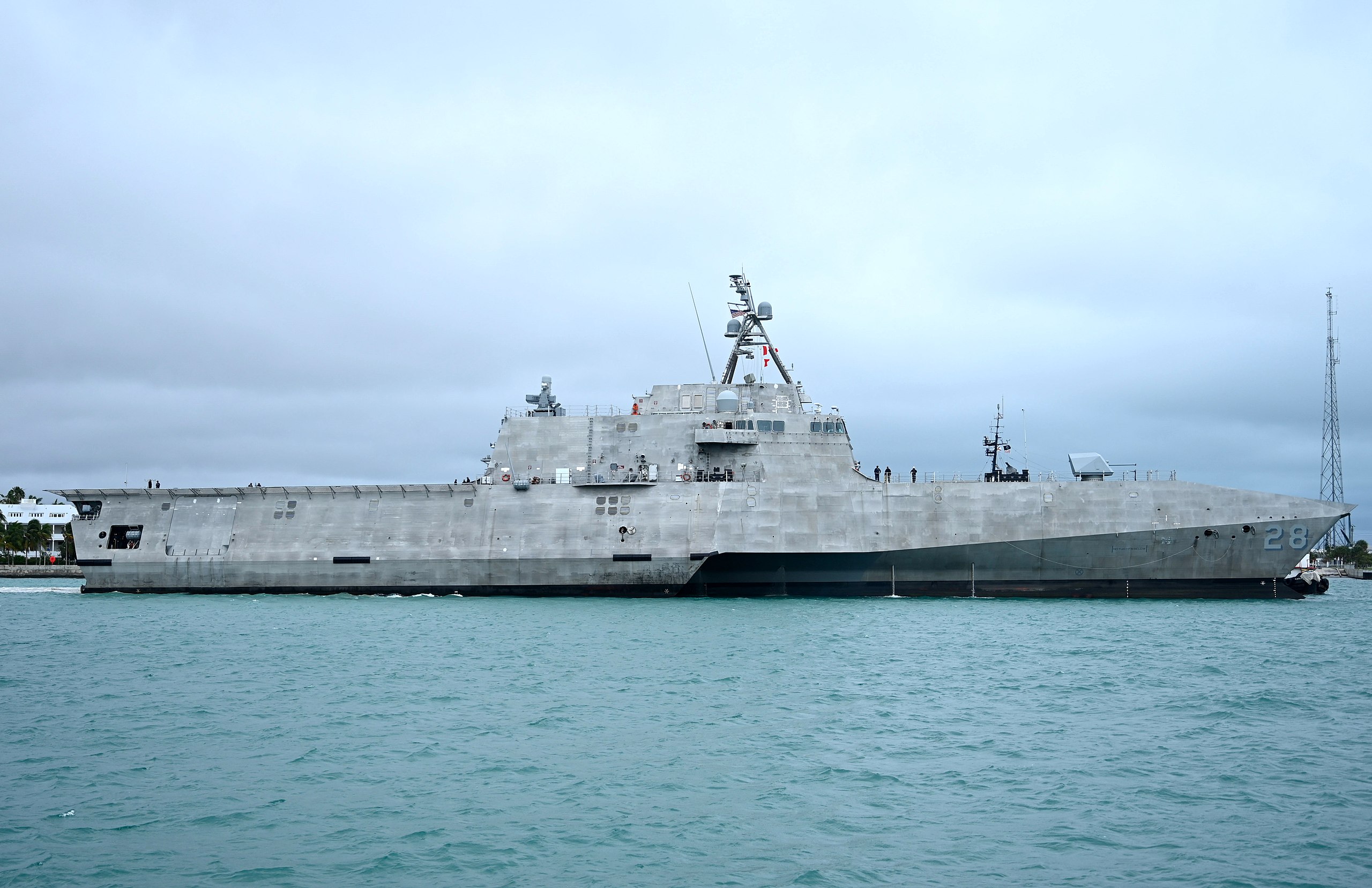
220209-N-IW125-1091 KEY WEST, Fla. (Feb. 9, 2022) The Navy’s 14th Independence-variant littoral combat ship, USS Savannah (LCS 28), pulls into Truman Harbor in Key West, Fla. Feb. 9, 2022. (U.S. Navy photo by Mass Communication Specialist 2nd Class Nicholas V. Huynh)

NEWPORT, OR, UNITED STATES
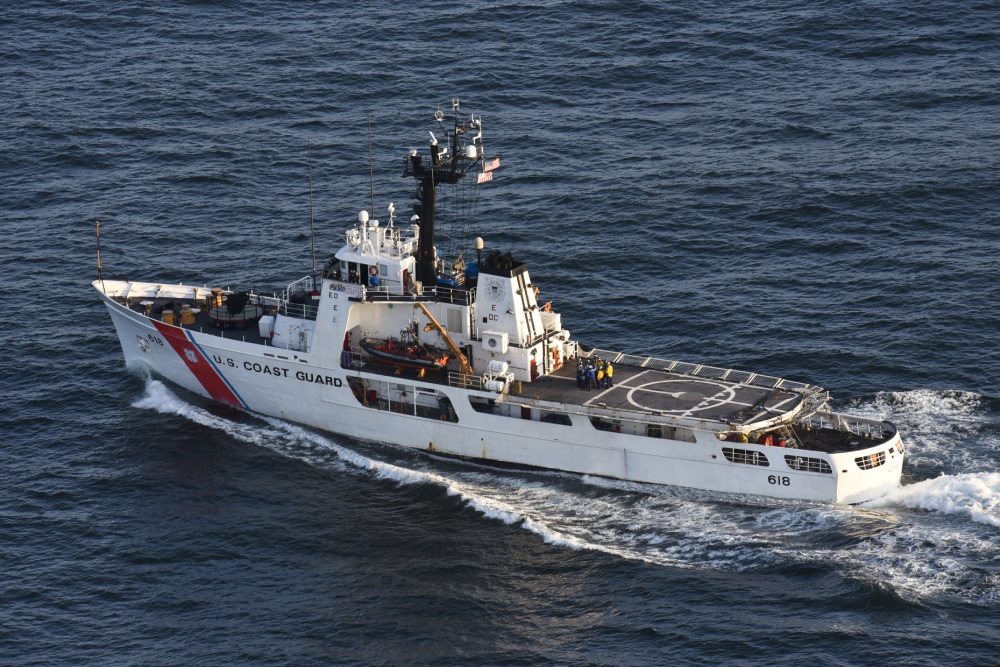
08.16.2019, Coast Guard Cutter Active (WMEC 618) transits across the Pacific Ocean near Newport, Ore., in support of Operation Pacific Fortune on Aug. 16, 2019. The Active is a 210-foot Medium Endurance based out of Port Angeles, Wash. (U.S. Coast Guard photo by Petty Officer 2nd Class Steve Strohmaier)

 April 6, 2023

U.S. Coast Guard, U.S. Navy, Mexican Navy and Royal Canadian Navy participate in North American Maritime Security Initiative

ALAMEDA, Calif. — The U.S. Coast Guard, along with the U.S. Navy, Mexican Navy (SEMAR) and the Royal Canadian Navy (RCN) participated in the North American Maritime Security Initiative (NAMSI) exercise off the coast of Manzanillo, Mexico March 27-31.

First instituted in 2008, NAMSI is an interagency and tri-lateral forum among U.S., Mexican and Canadian maritime commands intended to develop and refine maritime operations, as well as synchronize training and operational interoperability amongst forces of the three nations. The three participating nations actively seek opportunities to operate together and strengthen their cohesive approach to enhance regional maritime security in North America.

The U.S. Coast Guard District 11 and SEMAR collaborate extensively under NAMSI, conducting an average of four multinational passing exercises each year. The NAMSI Pacific Exercise (PACEX) 2023 is a full-scale Maritime Law Enforcement (MLE) based exercise that facilitates MLE operations with a SAR nexus built in. The exercise is intended to strengthen the crew’s knowledge in handling various situations and offers unique training scenarios like communication drills or maneuvering exercises.

“This exercise provides U.S., Mexico and Canada the opportunity to develop and refine our training and operations as partner nations,” said Rear Adm. Andrew Sugimoto, commander, U.S. Coast Guard District 11. “We take pride in our ability to strengthen partnerships and interoperability among the nations’ sea services.”

The U.S. Coast Guard Cutter Active and the U.S. Navy Independence-variant littoral combat ship USS Savannah (LCS 28), joined the SEMAR ship ARM Hidalgo and the RCN ship HMCS Edmonton, off the coast of Manzanillo in support of the NAMSI PACEX 2023. The operational units were supported by aviation assets from the U.S. Coast Guard and SEMAR, as well as the respective command centers in U.S. Coast Guard District 11, U.S. Navy 3rd fleet, SEMAR Tenth Naval Region and SEMAR headquarters.

The crews of Active and U.S. Coast Guard cutter Benjamin Bottoms also deployed in support of Operation GREEN FLASH (OGF). OGF is the operationalization of NAMSI procedures leveraging U.S., Canadian, and Mexican maritime forces, with the intent of disrupting transnational criminal organization activity that occurs in the shared maritime environment. U.S. Coast Guard District 11 organizes annual iterations of OGF which strengthens the relationship between the major stakeholders under NAMSI. Historically, there have been two iterations of OGF a year, averaging 30 days each.

“The cutter Active’s crew was excited to conduct this mission alongside our partners given its importance for the safety and security of the shared maritime environment,” said Cmdr. Brian Tesson, commanding officer, U.S. Coast Guard Cutter Active. “The partnerships between the U.S., Mexico and Canada strengthened our overall maritime security posture while reinforcing the mutual esprit de corps between our services.”