A Question of Proportionality / What to do about Philippine Outposts in the South China Sea?

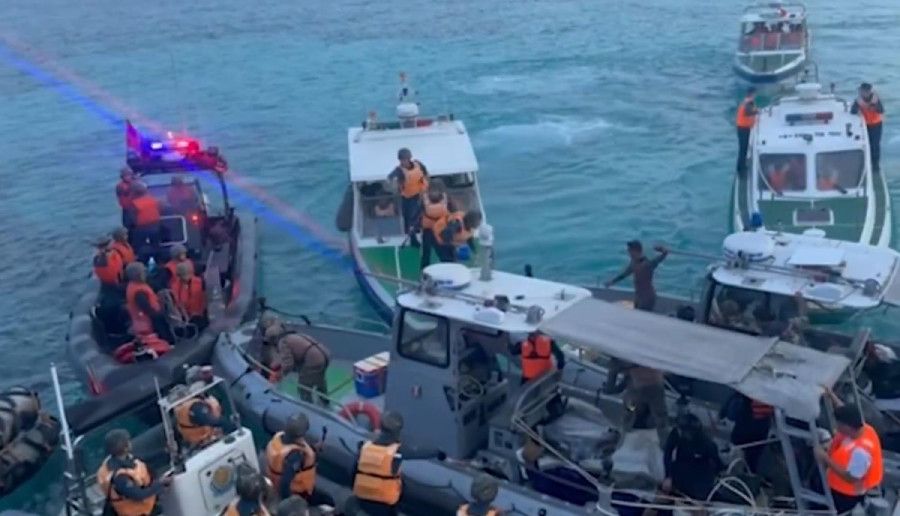
A still image taken from footage released by the Armed Forces of the Philippines showing China Coast Guard personnel confronting a resupply mission (Photo: Armed Forces of the Philippines)

Real Clear Defense reports,

Philippines Vows To Fight Back if Assaulted Again in South China Sea

At first, I was happy to see this, but I think they are making a mistake.

Philippine forces will defend themselves with “the same level of force …“If a knife is used, for example, our personnel will also use a knife, nothing more, under the concept of proportionality.”

If you are outnumbered in a knife fight you will lose. They will be outnumbered, and they will lose. That would be allowing the Chinese to write the rules of the game. Deadly force is deadly force. If someone is threatening you with a deadly weapon, you need to fire a warning shot, and if they keep coming shot the SOB.

Crews need to say, no one will take my vessel from me. As someone said, “Don’t Give Up the Ship.”

The Chinese are not going to start a war that might include the US until they are fully prepared to do so. Then and only then, they will want to open with a surprise attack.

The Philippines needs to raise the stakes for the Chinese to the point that they either back down or start a war with the US before they are really ready.

Right now, the Chinese are attempting to shape the battlefield to their advantage, building unsinkable missile cruisers surrounding Taiwan. The Philippines holds territory where they would like to place another missile launching platform. So does Japan. China should not be allowed to seize these positions.

Immediately the Philippines should make it clear to the Chinese, that they have no right to be in the Philippine EEZ, or any other country’s, behaving as they have. There is no reason to negotiate because they have no standing. That was decided in the international court of arbitration.

It might be possible to make a joint statement by the Philippines, Japan, Vietnam,  Indonesia, and maybe others.

When a move is made, it needs to be made with overwhelming strength on scene. That is possible if the Philippines employs surprise and has international support on scene. Philippine TA-50 jet aircraft should be overhead, ready to deter an attack on Philippine forces.

The result will be an incident, not a war. We have already seen lots of incidents, this will just add to the list, but this time we need the Chinese to back down.

Scarbough Shoal  and Second Thomas Shoal need to be reinforced and built up. The US and Japan could and should help the Philippines do it. Mirror what the Chinese have done. Make an artificial island, garrisoned with Marines, give it radars, effective AAW systems, and some of the Philippines’ BraMos missiles.

The Chinese are not going to like it, but unless they want to start a war with the US before they are ready, they will back down. Pulling a piece or two out of their plan to surround Taiwan with missile firing islands might actually prevent an attack on Taiwan.

“US Coast Guard says boardings of Chinese fishing vessels in South Pacific legal” –Reuters

Australian Royal Navy personnel stand in formation on a pier as the U.S. Coast Guard Cutter Harriet Lane (WMEC-903) and crew prepare to moor at HMAS Cairns, Queensland, Australia, March 7, 2024. The Harriet Lane and crew had a five-day port call in Cairns during its inaugural 2024 Operation Blue Pacific patrol in Oceania. (U.S. Coast Guard photo by Petty Officer 2nd Class Ty Robertson)

Reuters reports,

The U.S. Coast Guard has rejected comments by a Chinese diplomat that its recent boardings of Chinese fishing boats in the Pacific Islands alongside local police are illegal, saying the joint patrols are at the behest of Pacific nations to protect coastal fisheries…In the letter, Wang (China’s Ambassador to New Zealand Wang Xiaolong–Chuck) claimed the agreements are not binding on China’s fishing fleet.

Does this mean Chinese Fishing Vessels will resist boardings originating from US Coast Guard vessels even if they are headed by agents of the coastal state? or when USCG officers are acting on behalf of the Coastal State?

South Korea Seizes Chinese Fishing Vessels –Newsweek

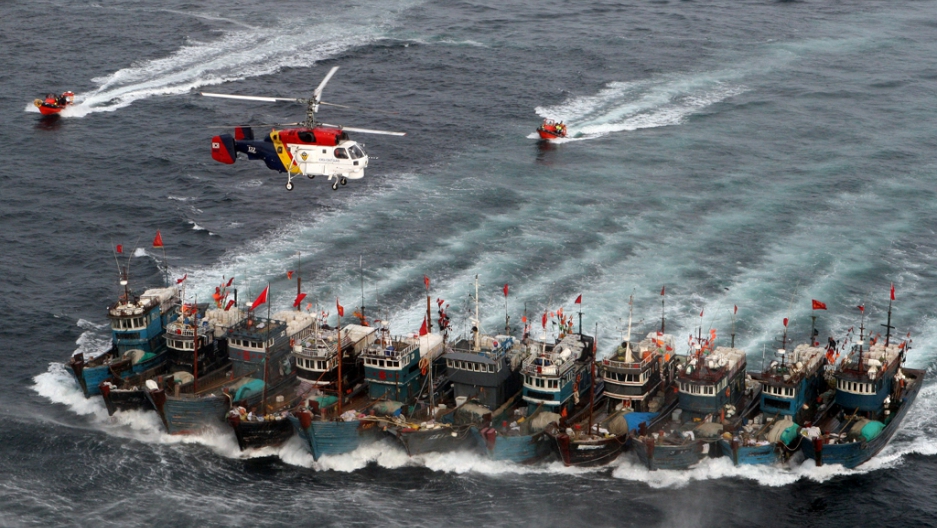
A picture taken on November 16, 2011 from a South Korean helicopter shows Chinese fishermen wielding sticks to stop an attack by South Korean coastguard commandoes armed with clubs aboard rubber boats during a crackdown on alleged illegal fishing in South Korean waters in the Yellow Sea off the southwestern coast county of Buan. South Korea’s coastguard mobilized 12 ships, four helicopters and commandoes for a special three-day crackdown on illegal fishing by Chinese boats this week. REPUBLIC OF KOREA OUT AFP PHOTO / DONG-A ILBO (Photo credit should read DONG-A ILBO/AFP/Getty Images)

Newsweek reports,

“South Korea’s Coast Guard seized five Chinese vessels for allegedly fishing illegally in the country’s waters late last month, confiscating boats and deporting several crew members…The joint patrol’s 30 participating vessels and three aircraft waters were operating in the vicinity of Jeju Island from March 25-31, Korea JoongAng Daily reported.

“The country’s coast guard said that, on average, 300 Chinese vessels fish illegally in the country’s exclusive waters each day, with that figure dropping to an estimated 140 during periods of intensified crackdowns.”

As you can see from the photo above and below. This is not a new problem.

A picture taken on November 16, 2011 from a South Korean helicopter shows Chinese boats banded together with ropes, chased by a coastguard helicopter and rubber boats pacted with commandoes, after alleged illegal fishing in South Korean waters in the Yellow Sea.
Credit: Dong-A-Ilbo

In many cases these encounters have become violent. The South Koreans have not been afraid to seized Chinese fishing vessels, but on the other hand they have not been successful in stopping large scale illegal fishing.

“The huge, resource rich territory China will snatch while the West dithers” –The Telegraph

The Telegraph has an opinion piece by retired Royal Navy Commander and former CO of the Ice Patrol Vessel HMS Endurance, Tom Sharpe OBE.

He feels, as I do, that we are headed for conflict over claims to Antarctica. It is after all, the last land area on earth where no nation exercises sovereignty.

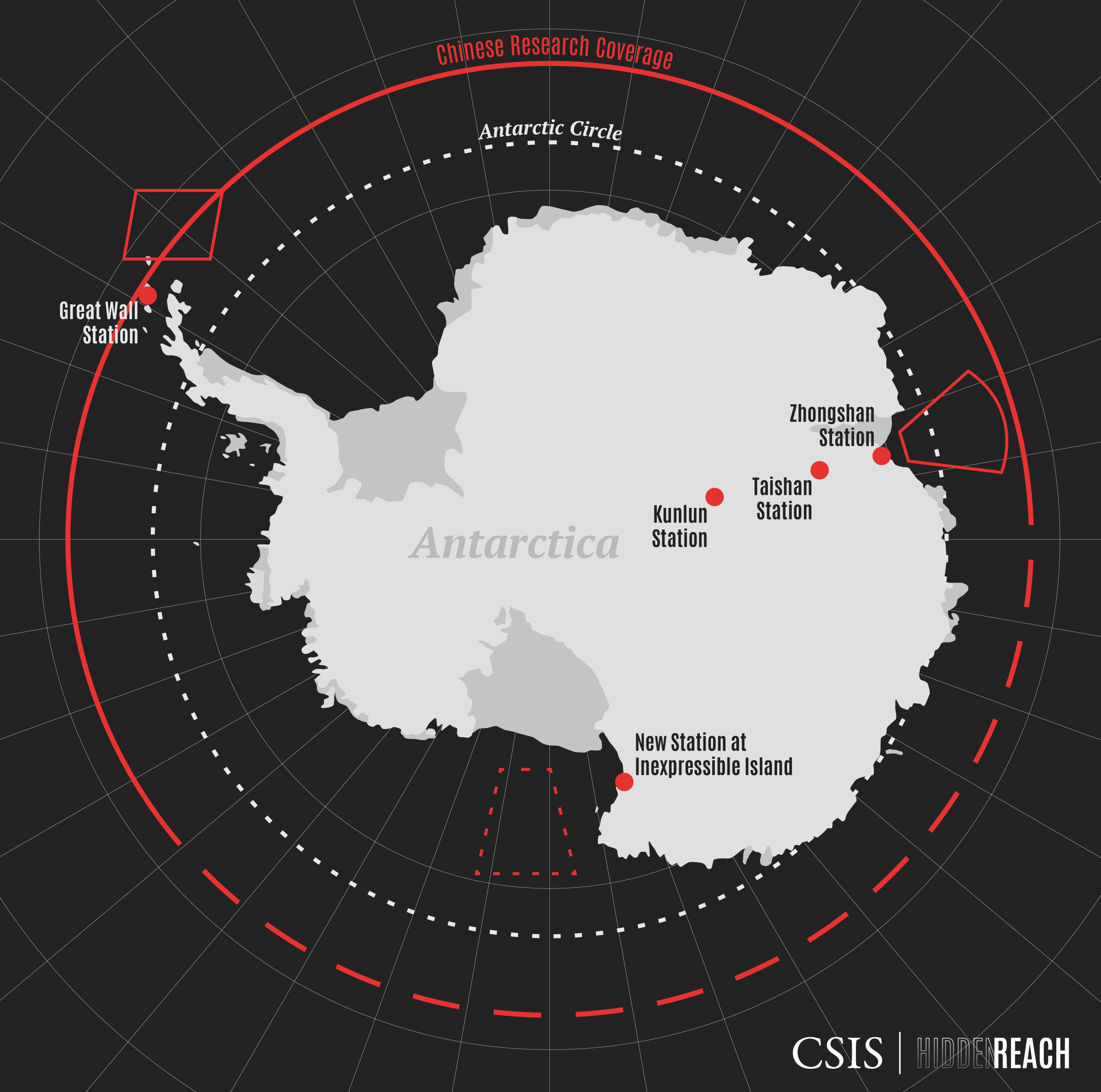
China’s presence in the Antarctic is growing rapidly and, as they have shown in the South China Sea, they may choose not to accept the decisions of international courts.

Adapted from a 2021 Chinese environmental evaluation report submitted to the Secretariat of the Antarctic Treaty. Source CSIS

What this boils down to is that, after courts make their decisions, we may have to fight in Antarctic to make those decisions stick.

We don’t seem to have given much thought to the possibility of combat in and around Antarctica, but I believe it is a real possibility, perhaps not soon, but beginning in 2048 when the Antarctic Treaty comes up for renegotiation. 24 years may seem to be a long way off, but we are building now the assets that will be available in 2048.

By then the rapidly growing Chinese presence in Antarctic, as well as their Navy are likely to be in a very strong position. We are already seeing the Chinese apparently establishing dual use (civilian and military) facilities in Antarctica.

In the interim, we can expect China and perhaps others to try to skirt the rules to strengthen their presence. We need to monitor and challenge any gray zone operations.

Command Structure:

These are the Unified Combatant Commander’s Areas of Responsibility.

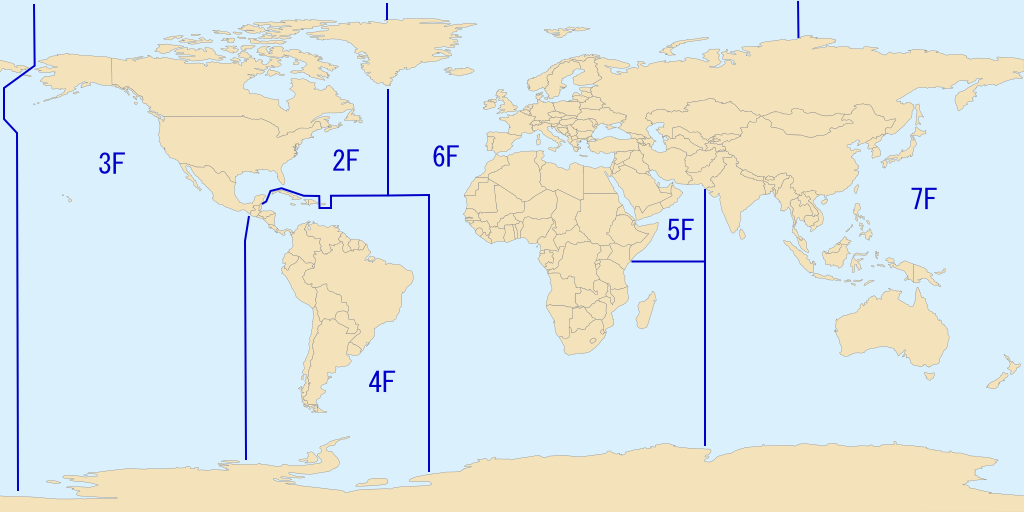
There is an obvious reason that Antarctica does not seem to be on anyone’s radar. Looking at who is potentially responsible for operations in the Antarctic, it is a hodgepodge. Various parts of the Continent might fall under SOUTHCOM, AFRICOM, and INDO-PACOM.

US Navy Fleet Organization

3rd Fleet, 4th Fleet, 6th Fleet, and 7th Fleet all have a nominal slice, but none of these commands consider the area their primary concern.

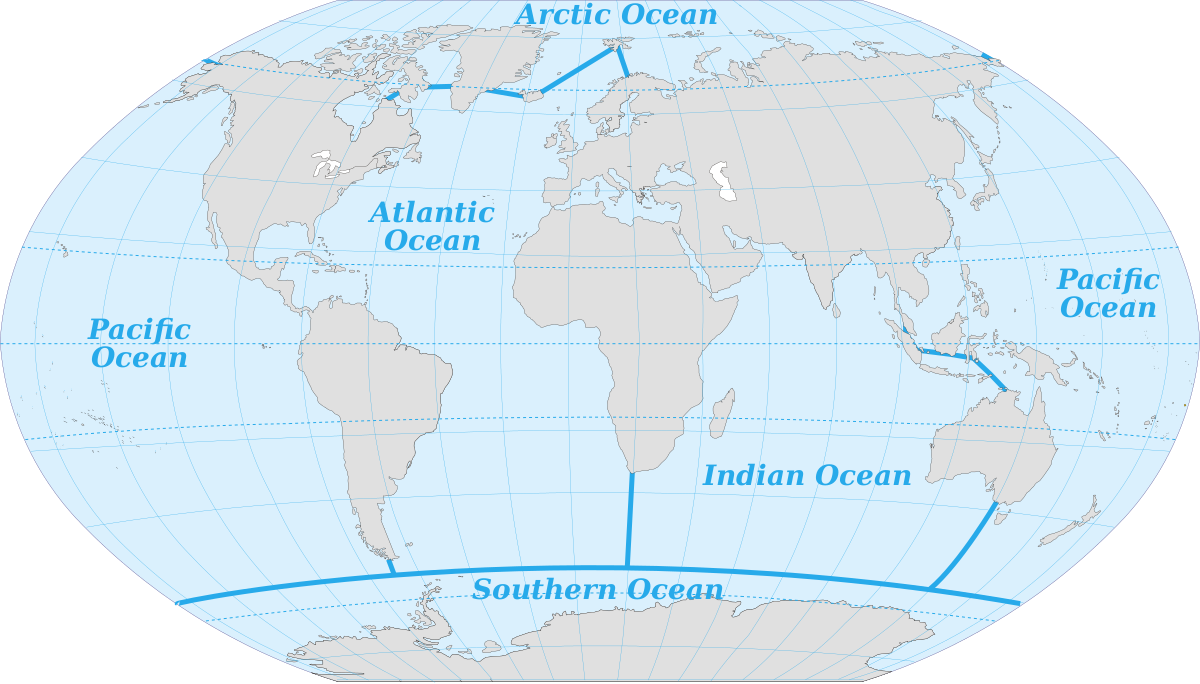
World map of oceans : English version. By Pinpin via Wikipedia.

There is no single national command authority that covers all of Antartica or the Southern Ocean. Really no one is in responsible for the area below 60 degrees South.

It seems likely that in the near term, Southern Ocean fisheries will require some protection. The only nation I have heard of doing fisheries protection in the Southern Ocean outside their own EEZ is New Zealand.

The Coast Guard currently operates the only US polar icebreakers. At some point the Coast Guard may become involved in fisheries protection in the Southern Ocean. If there is conflict in Antarctica, Coast Guard assets will likely be needed to gain access.

Related: 

“Manipulated images do not show US-China maritime ‘clash'” –AFP Philippines

Manipulated images do not show US-China maritime ‘clash’
© Provided by AFP Fact Check

MSN reports an Armed Forces Philippines story,

YouTube videos viewed tens of thousands of times in the Philippines do not show a military confrontation between the United States and China in the South China Sea, a hotly contested waterway that has long been a source of tension in Asia Pacific. The videos included compilations of old warship photos — some of which were manipulated — and there have been no official reports of a US-China spat.

“US Coast Guard aggressively confronts a Chinese warship circling near Ayungin,” reads the title of a YouTube video posted on February 7, 2024

The video is no longer on YouTube, but undoubtably, it is still out there somewhere.

Someone created a video reporting an incident between the US Coast Guard and the China Coast Guard that never happened.

The story shows how the images were manipulated.

“Russian and Chinese naval exercises: Reading between the lines” –The Watch

A Coast Guard Cutter Kimball crewmember observing a Russian Destroyer in the Bering Sea, September 19, 2022. Coast Guard Photo

The Watch provides an opinion piece by ADAM LAJEUNESSE, PHD, an associate professor in the public policy and governance program, at St. Francis Xavier University in Canada.

He discusses why the Russians and Chinese decided to extend their exercise into waters near Alaska, and what the US response should be to such demonstrations.

Managing the response is therefore a balancing act. These activities cannot be ignored or even downplayed, but emphasis should be put on short-circuiting adversary messaging. Beijing is anxious to paint U.S. FONOPs as shams. While the U.S. government has been disciplined in its messaging as it was during a similar voyage in 2021, more emphasis should be placed on the PRC’s right to be there. Though it may seem counterintuitive, there is a benefit to overtly recognizing Chinese ships’ right to be in the region. While that may be politically tricky, it should be possible to warn of the dangers posed by the PRC’s navy generally, while also emphasizing its right to be anywhere on the high seas.

Russia’s attempt to portray itself as a great power equal, capable of threatening the U.S. homeland can, likewise, be turned back upon itself. The reality is that Moscow’s weakness has forced it to increasingly rely on the PRC for economic and political support. Its naval partnership should be addressed more explicitly for what it is, the gradual replacing of Russian power in the North Pacific and, potentially, the Arctic by the PRC.

His evaluation is a perfect explanation of why having such exercises monitored by Coast Guard cutters, as had been done in 2021 and 2022, was a perfect response. (In fact, Chinese warships transited US territorial waters in 2015.)

Why the change in 2023?

To some extent at least, I think the Navy response, specifically sending DDGs to shadow the group, was because they were stung by unfair criticism, that we looked weak because there had been no obvious US Navy presence previously.

If NORTHCOM wanted to take out the Chinese/Russian surface action group (SAG), air assets could have done the job. That the US Navy SAG never exceeded four units, if anything does make us look weak.

Perhaps a USAF B-1 fly-over on a day when no live fire exercises were scheduled might have been an appropriate response. (B-1s with LRASM are a particularly deadly anti-ship combination.)

If there had been hostilities, putting a numerically inferior US Navy SAG close to a potentially hostile SAG, might have just resulted in a friendly fire incident, if the Air Force confused US units with Chinese or Russian units.

Also, we should never miss an opportunity to remind the Russians, they have reason to fear China more than the US. The Russian ships in the SAG were all either older or smaller than their Chinese counterparts, and I am sure the Chinese made it abundantly clear to the Russians, that they had outgrown any Russian tutoring.

“China Protests as U.S. Carrier Goes on Patrol With Philippine Navy” –Maritime Executive

BRP Ramon Alcaraz (former USCGC Dallas) equipped with new Sea Giraffe multi-mode radar in Cebu.

Maritime Executive reports,

“This week, the Carl Vinson Carrier Strike Group will carry out a two-day joint patrol with Philippine forces…The carrier USS Carl Vinson leads the exercise, accompanied by cruiser USS Princeton and destroyers USS Sterett and USS Kidd. The Philippine contributions include the former U.S. Coast Guard cutters USCGC Hamilton and USCGC Dallas, which were transferred to the Philippine Navy and renamed.

USS Dewey (DDG-105), bottom, steams in formation with the Philippine Navy offshore patrol vessel BRP Gregorio del Pilar (PS 15, the former USCGC Hamilton) while conducting a bilateral sail in the South China Sea, Oct. 21, 2023. US Navy Photo

The following information is from Wikipedia, concerning their ongoing modernization.

The Philippine Navy plans to modernize the entire ship of the class, with an initial program to upgrade the ship’s sensors, and another program to improve its weapon systems.

Several systems were acquired through US Foreign Military Sales (FMS) and Foreign Military Financing (FMF), which includes the BAE Systems Mk. 38 Mod. 2 machine gun system, the SAAB AN/SPS-77 Sea Giraffe AMB 3D air/surface search radar, and the FLIR Systems SeaFLIR 230 Electro-Optical/Infra-Red Camera.[20]

Meanwhile, the Philippine Navy will launch a program to acquire, install and integrate several other sensors into the ship, as part of the Horizon 2 phase of the Revised AFP Modernization Program. Among those to be acquired are new Combat Management System (CMS), Hull Mounted Sonar (HMS), and a Radar Electronic Support Measures (R-ESM).

Future upgrades are planned to install defensive and offensive missile systems, as well as torpedo weapon system, although funding is still being secured and might only be included in the next phase of the Navy’s modernization program.

In 2020 October 14, Navy chief Giovanni Carlo Bacordo revealed the completion of the 3D modeling program for the entire ship class’ cabling systems to be used for their electronic upgrades (CMS + 4 sensors).

“Top Ten Navies by Aggregate Displacement, 1 January 2024” –Analysis and diagram by Phoenix_jz

Two years ago, I did a post with a similar title from the same source. Somehow, I missed the 2023 edition. As I said in the earlier post, I don’t know , but the data appears to be credible, and it looks like readers are checking his figures. 

It is very difficult to read the tonnages at the bottom of the graph unless you are using a computer and click on the graph to see it in a larger size. 

The creator’s notes and some additional comments are below. 


Hello all!

Well, 2024 is upon us, and as such so is the third edition of my top ten navy list. For those unfamiliar, here are links to 2022 and 2023, with a general explainer of the whole concept in the 2022 version.

The long and short of it is that this graph reflects a personal tracker I keep of almost every large and moderately sized navy, and calculates the aggregate displacement of these navies. It’s not a perfect way to display the size of navies – far from it in fact – but it is at least more representative than counting numbers of hulls alone, in my opinion.

To break down what each of these categories mean;

  • Surface Warships is an aggregate of all above-water warships and major aviation and amphibious assault platforms. This category includes CVNs, CVs, CVLs, LHDs, LHAs, LPDs, CGs, DDGs, FFGs, corvettes, OPVs, CPVs, lighter patrol craft, and MCM vessels.
  • Submarines is what it says on the tin – SSBNs, SSGNs, SSNs, SSKs, and for select nations where applicable (and where information is available), special purpose submarines. Please note dedicated training submarines are counted separately.
  • AORs includes all major fleet replenishment vessels (coastal vessels do not count, however).
  • Other Auxiliaries is a very wide net that essentially captures everything else. Special mission ships, support vessels, minor amphibious assault vessels (LSDs, LSTs, LCAC’s, LCM’s, LCU’s), training vessels, tugs, coastal support vessels, hydrography ships – all essential parts of navies, but generally often paid less attention to as they’re not as flashy as the warships proper.

Interesting trends in data that I thought I would share for various navies, and thoughts and observations otherwise;

The USN is, unsurprisingly, still top dog by a huge margin. In spite a net decommissioning of five ships this year, the USN has grown overall by about 32,000 tons – four ‘cruisers’, two SSNs, four LCS, and five patrol craft decommissioned against the introduction of three destroyers, an SSN, five LCS, and a replenishment ship. It is worth noting that 2023 is the first year since 2010 that the USN has commissioned three destroyers in a year, though a repeat performance in the next couple years is unlikely – these ships were launched in 2020 and 2021, and only one destroyer per year was launched in 2022 and 2023.

No one will be surprised to hear that the PLAN has grown for the nth consecutive year, adding the final Type 055 batch I and the remaining Type 054A Batch V, for almost 50,000 tons of new surface combatants. Much of the remaining increase in displacement for this year (which totaled nearly 90,000 tons) reflected a steady pace of modernization in mine warfare, landing forces, and logistical support/other auxiliaries. As with last year, the number of minor patrol craft continue to plummet as the PLAN continues to divest many of its obsolescent brown-water combatants, or relegates them to training duties.

Moving on to ongoing construction, progress on the new destroyer batches continues at pace. At least two Type 055 Batch II appear to be under construction, and the overall number of Type 052D Batch IV appears to be at least ten. The first ship actually launched at the very end of 2022 (at Jiangnan), and two further have been launched by the same yard as well as three at Dalian. Two more remain under construction at each yard. The first of these ships to be launched appears to be on trials and will likely commission this coming year. The Type 054A program of the navy appears to have finally wrapped up (construction of the hull for the China Coast Guard continues), and the Type 054B program has continued at pace if not scale – two ships were launched this year, but modules of further units have been scarce. Rounding things out for major surface vessels, a new Type 075 LHD was launched this past December. Conspicuously absent has been sightings of any modules for new carriers. Considering Fujian (Type 003) began construction at some point from 2015 to 2017, one has to wonder if we will see China launch another carrier before the end of the decade.

Perhaps most consequential of all, however, has been the completion of new production facilities at Bohai and a resumption of Type 093 SSN launches. The first of the new Type 093B launched in 2022, and has been followed up by two more launches this year (possibly up to three). A sustained pace of two submarines a year, or even just three submarines every two years, would quickly add up could see anywhere from nine to eleven new SSNs launched by the end of 2027, and in service by early 2030s. Only time will tell what the actual drumbeat of production will be.

Russia’s VMF woes in the Black Sea have continued unabated, except less at sea and largely fueled by the Franco-British SCALP cruise missile. The most dramatic loss by far was the destruction of the Project 636.3 ‘Improved’ Kilo Rostov-on-Don in drydock at Sevastopol, but similar attacks claimed the destruction or constructive loss of a Karakurt-class corvette (under construction, not in service) and two Ropucha-class LSTs. The infamous TB-2 made a brief return to destroy a Serna-class LCU, and two other LCU’s may have finally become the first victims of Kamikaze USVs this past November, for a total of 11,407 tonnes lost.

In regards to the more regular cycle of commissioning and decommissioning, one frigate, one MCM vessel, and three corvettes were brought into service, as well as a new SSGN, SSBN, and SSK each. Against this a corvette, SSGN, SSBN, and SSK were decommissioned. Overall, in spite of losses the VMF managed a net gain of 6,324 tonnes of surface warships and submarines. Anyone who checks against my figures from last year will note that the increase in the VMF’s overall tonnage this year is far more substantial, due to the auxiliary category. Though some of this was from new vessels, this was mostly down to a badly needed overhaul and reorganization of that part of my tracker, particularly for the tug fleet. Did you know the Russian navy tug fleet displaces more than either the Argentine or Canadian navies? Now you do! Seriously – it would be the 20th largest navy in the world by itself.

As a final note on the VMF – it is worth remembering that ships commissioned in the Russian navy are not always actually in service, as ships can often languish in near-terminal refits or simply be left inactive without a formal decommissioning. Almost half the remaining Projekt 877 Kilo’s, for example, appear to be inactive at this point (5 of 10).

(In comments the author noted the following, “Russian naval losses during the war have totalled 13 vessels for 29,870 tonnes. Quite a bit – but also only about 1.4% of their current overall tonnage.” –Chuck)

The British Royal Navy observes a second year of marginal reduction in overall tonnage (-2,640t, or -0.3%), losing another Type 23 frigate as well as the last Echo-class survey ship. Against this the RFA brought into service the first MROSS, ProteusProteus represents a considerable increase in subsurface capability, though the loss of a frigate with no replacement ship to replace it for another thee to four years is painful, especially given how many of the remaining eleven ships are deep in LIFEX/Post-LIFEX refits. With that said, their new frigate programs are moving on steadily. Steel was cut on two new frigates this year – the future HMS Birmingham (4th Type 26) and HMS Active (2nd Type 31), bringing the total construction volume to five frigates building and one fitting out.

The JMSDF continues to grow, albeit at a more moderate pace this year (+6,530t, or +0.9%), inducting a new Mogami-class frigate and Taigei-class attack submarine, while shifting another Oyashio-class from the active fleet to a training role. Two more FFM were launched this year, though surprisingly they have not started construction on the next pair. This past November, it was announced that the Mogami-class FFM would be curtailed at 12 units (of 22 planned), and followed on by an evolution of the design known as FMF-AAW. The FMF-AAW will feature greater air and surface warfare capabilities. Twelve such ships are planned.

The Indian Navy’s growth in 2023 was far less dramatic than in 2022, but still noteworthy (+9,200t, or +1.5%), as adding a new conventional attack submarine and destroyer to the fleet has finally pushed them over the 600,000-tonne line.

The Marine Nationale grew by almost 9,000 tonnes (2.1%) this year, largely down to the retirement and replacement of a patrol ship, nuclear attack submarine, and tugs with an equal number of replacements. Though it is worth noting that the new attack submarine is not fully operational yet – that will happen in 2024 – so technically the MN’s attack submarine fleet is really four boats at this point in time.

The saga of eight and ninth place swapping around continues, as the ROKN has managed to move back to the position of eighth largest navy in the world. In 2023 they added a net 15,374t (+4.3%), commissioning four Daegu-class frigates, a second KSS-III class attack submarine, an MCM vessel and a pair of LCACs, against the decommissioning of two corvettes and five PKM’s.

In contrast, the Marina Militare continues to feel the bite from the two FREMM sold to Egypt, as well as delays in brining the LHD Trieste into service – intended for 2023 but again pushed back, now to the spring of 2024. The first PPA ‘Light+’, Raimondo Montecuccoli, was brought into service in 2023 – an OPV on paper, but light frigate in practice. Against this one of the elderly Maestrale-class frigates, Zeffiro, was retired, as was one of the fleet’s AORs (Vesuvio) and a water tanker (Bormida), resulting in a real drop of 7,073 tonnes (-1.9%). The drop seen versus the chart versus last year is more dramatic (totals 16,632 tonnes), which reflects both cleaning up data on old auxiliary platforms for which information is scarce, and correcting some minor sheet errors, which totaled 9,559 tonnes.

The outlook should be looking up in the future – as previously mentioned, the LHD Trieste should enter service this year, as should the fourth and fifth PPA. The first of two replacement FREMM (GPe) was launched in late 2023 and a second will follow this spring, with both being slated to enter service in 2025 alongside the sixth PPA and second Vulcano-class replenishment ship – barring any delays.

Finally, the Indonesian Navy saw another year of growth, adding a net 9,930 tonnes (+3.1%), with another hospital ship commissioned, a new survey ship, corvette, and two new MCM vessels and FACs each, as well as several patrol boats. The TNIAL continues a steady program of domestic construction of patrol craft, and construction is ongoing on two Iver Huitfelt derivative frigates, with the keel of the first vessel laid down this past August. They have also cut steel on a new hydrography ship, which will launch in Indonesia and complete fitting out in Germany.

What comes next in terms of major platforms for the TNIAL is somewhat up in the air. As with the year prior, there has been no progress made on the procurement of six FREMM from Italy, despite a contract being signed two and a half years ago (June 2021). In spite of this, they have expressed interest in procuring two PPA to bolster their patrol fleet. In the interest of expediting procurement, they are looking at two ‘Light+’ configuration vessels currently fitting out at Muggiano – Marcantonio Colonna (due for delivery to the MMI in the latter half of 2024) and Ruggiero di Lauria (due for delivery to the MMI in mid-2025). According to the General Manager of Fincantieri’s Naval Vessels Division, Dario Deste, a contract for the two vessels could be signed in the first half of 2024.

(In answer to a question the author added this in the comments–Chuck)

No.11 to 20 are as follows for 1 January 2024;

  • 11: Turkey – 297,298t
  • 12: Taiwan – 268,958t
  • 13 Egypt – 232,046t
  • 14: Spain- 229,373t
  • 15: Germany – 226,655t
  • 16: Australia – 224,074t (decided to add the National Support Squadron, which added about 30kt)
  • 17: Greece – 189,184t
  • 18: Brazil – 162,29t
  • 19: Chile – 161,404t
  • 20: Argentina – 138,620t
(A reader, , added this–Chuck)

Listed by ranking for this year:

Nation Change from 2023 (tonnes) 2023 Ranking Change from 2022 (tonnes) 2022 Ranking
United States +55,658 1st +250,308 1st
China +93,567 2nd +99,299 2nd
Russia + 211,333 3rd +166,682 3rd
United Kingdom -2,640 4th -5,815 4th
Japan +6,530 5th +23,790 5th
India +9,200 6th +62,349 6th
France +8,925 7th +12,145 7th
South Korea +15,374 9th +7,153 8th
Italy -16,632 8th -3,452 9th
Indonesia -70 10th +17,709 10th

Probably not surprising given all these nations are competing more or less with each other, but the rankings have basically remained the same except for Italy and South Korea trading places in 2023, then reverting to their 2022 places again this year. Nobody previous top 10 navy has left the club either.

However, do note that not all of the year-to-year tonnage differences are due to actual changes in fleet size/composition. As Phoenix mentioned in his post, the Russians in particular got a huge tonnage jump this year because he changed the way he counts auxiliaries, and given the discrepancy between his reported +32k figure for the USN and the numbers, there’s probably some math correction involved there too.


“Inside the U.S. Coast Guard patrols off Peru in mission to stop overfishing” –NBC News

NBC News reports on Coast Guard efforts to counter Illegal, Unregulated, Unreported fishing off Peru. The report is not really very clear in that it states the Chinese vessels are outside Peru’s territorial waters but is not clear if they are saying they are outside the 12 mile limit or they are outside the EEZ. The way it was phrased it sounded like they were referring to the 12 mile limit, but the distinction is frequently poorly understood by the media.

Previous Operation: PERU, 10.07.2023, Courtesy Photo, USCG District 11
The Coast Guard Cutter Alder approaches a squid fishing vessel while CG-2007, a C-130 from Air Station Barbers Point in Hawaii, flies over (upper left) during Operation Southern Shield 2023, October 2023. The Coast Guard recently completed the first high-seas boardings and inspections off the coast of Peru under a newly adopted multi-lateral agreement to monitor fishing
and transshipment operations within the South Pacific Regional Fisheries Management Organization (SPRFMO)Convention Area. (U.S. Coast Guard photo)

It is clear that USCGC Alder is off Peru. This is the second time the Pacific Area has used this buoy tender to conduct a distant fisheries patrol, having completed a previous similar patrol 29 November 2023. During the earlier patrol, enforcement was under the auspices of the South Pacific Regional Fisheries Management Organization (SPRFMO). That is probably the case here as well.

Thanks to Paul for bringing this to my attention.

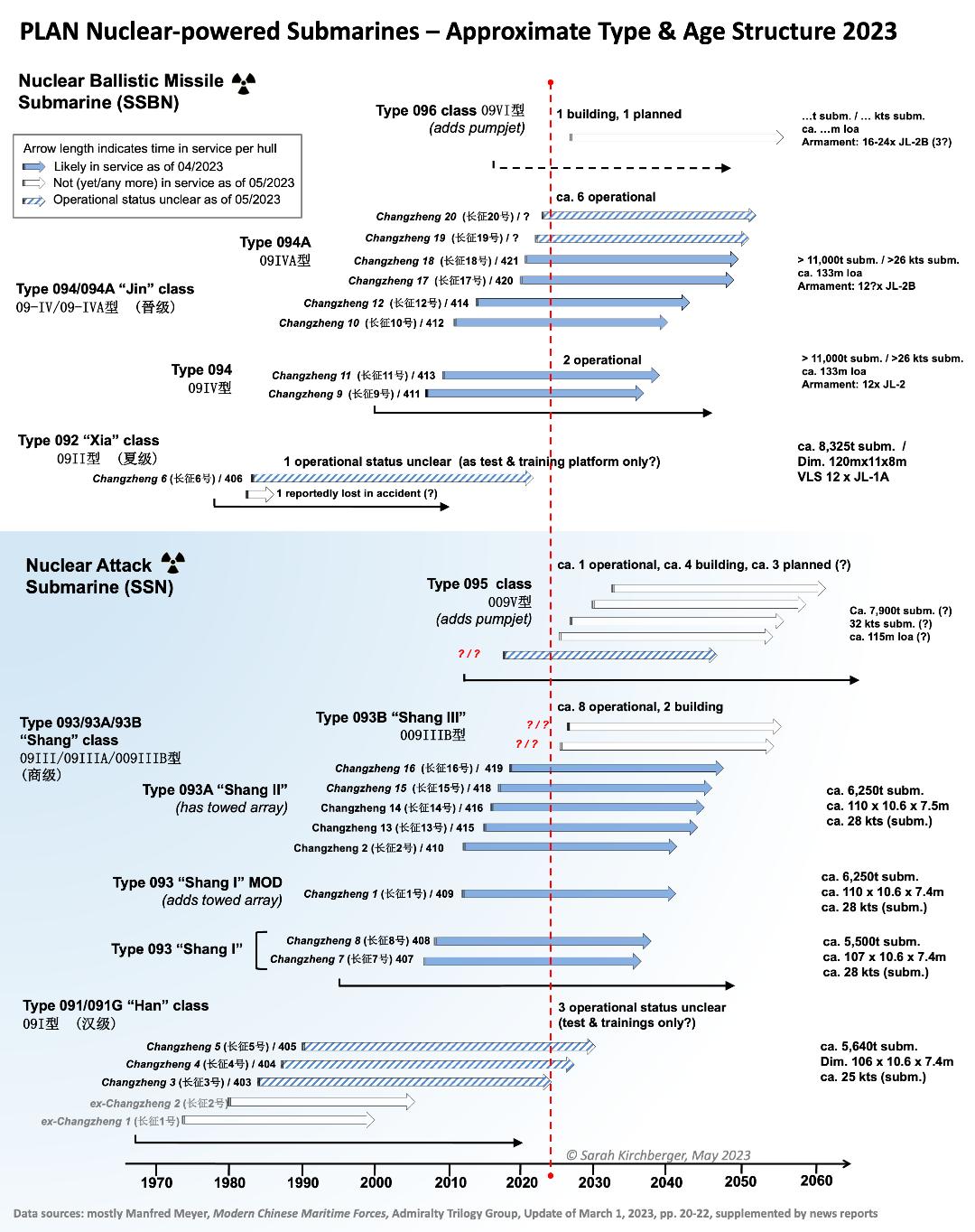
“Chinese Submariner Appointed Head of People’s Liberation Army Navy” -USNI

The infographic above is from a May 2023 post, “China’s PLAN Surface and Sub Order of Battle

The US Naval Institute News Service reports,

“China’s President Xi Jinping appointed a new Chief for the People’s Liberation Army Navy in a Monday ceremony in Beijing…Adm. Hu Zhongming…Hu was previously the PLAN Chief of Staff and is a submarine officer though details of his career are sparse, a Chinese media report in 2015 stated that Hu had a served in the PLA 92730 unit, which operates China’s nuclear submarine.”

I have not been able to confirm it, but as I recall the previous head of the PLAN was also a submariner.

It is worth noting that in October 2020 the USNI reported that China was doubling its nuclear submarine building capacity.

It appears that the Chinese intend to match or exceed the US’s normal two nuclear submarine per year build rate, while continuing to build a substantial fleet of conventionally powered air-independent submarines.

Meanwhile NORTHCOM says Russia is close to having cruise missile launching nuclear submarines cruising persistently off the US coasts.

It is becoming apparent, that in any future major conflict, submarines will be a threat, not just in distant waters, but in virtually any ocean right up to the US coast.

It is time for the Coast Guard and Navy to cooperate in redeveloping a Coast Guard role in ASW, whether it be permanently installed or containerized add-ons with Navy helicopter and personnel augmentation.