Marine Air-Ground Tablet (MAGTAB)

A moving map on a MAGTAB. (Image credit: USMC/Cpl. Lisa Collins)

Having recently read a couple of posts about a test of a new missile system launched from a Marine Attack helicopter, discovered that the Marines have what is effectively a secure handheld tactical data link, and it has been in the field since at least 2019.

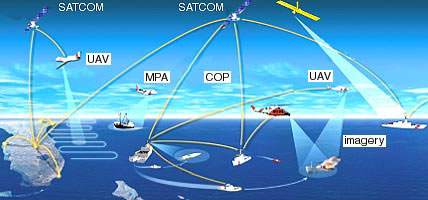
That it is also capable of being used as a fire control system for missiles in the maritime environment appears promising, but more importantly, the Coast Guard could use something like this for coordinating with small units like helicopters, patrol boats, cutter boats, and response boats. This appears to provide much of the capabilities of a Combat Information Center.

Maybe the R&D center should look into it.

Screengrab of a Nov. 27, 2019 video by the US Marine Corps on the MAGTAB, showing the mission status of various tactical actions and asset movements. (Image credit: USMC/Cpl. Lisa Collins)

“The Coast Guard is investing in underway connectivity…and it’s paying off!” –MyCG

Below is news from MyCG. I am publishing it in full for convenience. It is a great advertisement for Starlink which has played a significant role in Ukraine’s Maritime Drone offensive against Russia, but the most surprising thing for me was this,

“…soon all users will have Dial-In Phone System (DIPS), a new capability that assigns a unique telephone number to every member of the workforce to last for the duration of their career. With it, you will be able to make and receive phone calls, and have voicemail, within DoD365 Teams….even underway! (Watch out for another MyCG article next week for more information about DIPS!)”

WOW!!


Aug. 16, 2023

The Coast Guard is investing in underway connectivity…and it’s paying off!

By AJ Pulkkinen, MyCG staff writer

The Coast Guard is aggressively adding Starlink commercial satellite communications on most cutters. This next-generation upgrade provides a twenty-fold increase in the speed of shipboard networks.

The C5I team already installed Starlink on 17 cutters and targets all major cutters (WMSL, WMEC, Polars) for completion by the end of this calendar year (CY) WLB (225s) and FRC (154s) are targeted during CY24, along with the 17 WPBs (87s) that have installed legacy commercial satellite communications.

Starlink technology provides the bandwidth and latency for shipboard users that is on par with those working at a desk in an office ashore.

Bandwidth and latency are two different aspects of network performance. Bandwidth is the amount of data that can be transferred over a network for a definite period of time. Latency is the amount of time it takes for a bits of data to travel from one point on a network to another.

Underway users already equipped with Starlink are experiencing drastic increases in connection capability, such as connectivity to CG applications including Direct Access, FSMS, SharePoint, OneDrive and the full suite of DOD365 apps, and the ability to seamlessly upload and download large media files.

Starlink’s performance more easily allows underway users to access personal email, banking and social media. And soon all users will have Dial-In Phone System (DIPS), a new capability that assigns a unique telephone number to every member of the workforce to last for the duration of their career. With it, you will be able to make and receive phone calls, and have voicemail, within DoD365 Teams….even underway! (Watch out for another MyCG article next week for more information about DIPS!)

Starlink also provides global coverage, notably in the high latitudes. The cutter Eagle experienced minimal to no loss in coverage while crossing the North Atlantic to the Azores. Capt. Jessica Rozzi-Ochs says, “Starlink has seamless transition from satellite to satellite, unlike the legacy system, which drops service while it looks for and tracks a new satellite. This was particularly impressive when we experienced heavy weather (20+ foot seas, hard rain, 40-50 knots of wind) and Starlink didn’t go down once.”

Gone will be the days of having to come back to port only to spend hours or days at the computer because you lacked connectivity while underway.

The Eagle’s crew reported great success with their Starlink. By having consistent access to the Financial System Management Solution (FSMS), Eagle’s supply office reduced the number of offline requisitions, which minimized human error in tracking commitments and expenditures underway. They were able to better communicate with vendors and partners, streamlining the acquisition processes and coordinating port services for their port calls. With this enhance communication, they procured parts essential for maintaining the cutter fully mission capable even when short turnaround times were necessary.

The Eagle’s crew was able to frequently upload pictures and video to social media accounts in near-real time while underway. These timely posts reached a wide audience, with several posts reaching over 45,000 views.

Starlink will help alleviate one of the greatest burdens on our cutter community: intermittent connectivity. This capability will transform shipboard life, and serve as an invaluable tool for recruitment, retention, and the sea duty attractiveness.

Silicon Valley Innovation Program (SVIP), Coast Guard Language Translation Without Internet

Above is a Department of Homeland Security, Science and Technology, video release. Below is the accompanying narrative.

Incidentally, the underway replenishment ship seen in the video is the New Zealand Navy’s HMNZS Aotearoa . She is unique in being ice-strengthened and winterized for operations in the Antarctic environment.

“Coast Guard to Triple Western-Pacific Deployments, Policy Chief Says” –Defense One

Defense One has an interview with Rear Adm. Michael Ryan, the Coast Guard’s deputy commandant for operations policy and capabilities.

The reference to tripling Western-Pacific Deployments seems to reflect the planned deployment of three National Security Cutters to the Western Pacific in 2023, but that is not explicitly stated and there is also reference to homeporting a WMEC in the Western Pacific, topics we discussed here.

Most of the interview is really about connectivity, data collection, and analysis. Hopefully we will see some data used for a new Fleet Mix Study, that will determine our needs and be able to justify them to Congress.

It was interesting to me that the interview was a result of Admiral Ryan’s attendance at the National Defense Industrial Association’s Expeditionary Warfare conference in Arlington, Va.

“USCG selects KVH for new 5-year small cutter satcom connectivity contract” –Marine Log

“Coast Guard Cutter John F. McCormick (WPC 1121) crew transits through the San Francisco Bay, Saturday, March 4, 2017, during their voyage to homeport in Ketchikan, Alaska. The cutter was named after McCormick who received the Gold Lifesaving Medal in 1938 for his exceptional skill in maintaining control of the 52-foot motor lifeboat Triumph while responding to a vessel in need near the Columbia River Bar under treacherous conditions, allowing the crew to recover a crewmember that had been washed overseas. Coast Guard photo by Petty Officer 2nd Class Loumania Stewart”

Marine Log reports,

Middletown, R.I., KVH Industries, Inc., (Nasdaq: KVHI), has been awarded a U.S. Coast Guard contract worth a potential $69 million that will see it supply the next-generation satellite communications solution for the service’s small cutter fleet of more than 140 vessels/platforms. Chosen in a full and open competitive procurement process, KVH’s TracPhone V7-HTS Ku-band satellite communications system and mini-VSAT broadband service will be the U.S. Coast Guard’s Small Cutter Connectivity (SCC) Ku-band System and Airtime Support Services solution. The USCG also anticipates that approximately 20 new cutters will join the small cutter fleet over the next five years, requiring the same level of support that KVH will provide to the already deployed vessels.

I presume the additional “approximately 20 new cutters” are the remaining Webber class Fast Response Cutters.

Marines’ Next-gen Handheld Targeting System (NGHTS)–Naval Today

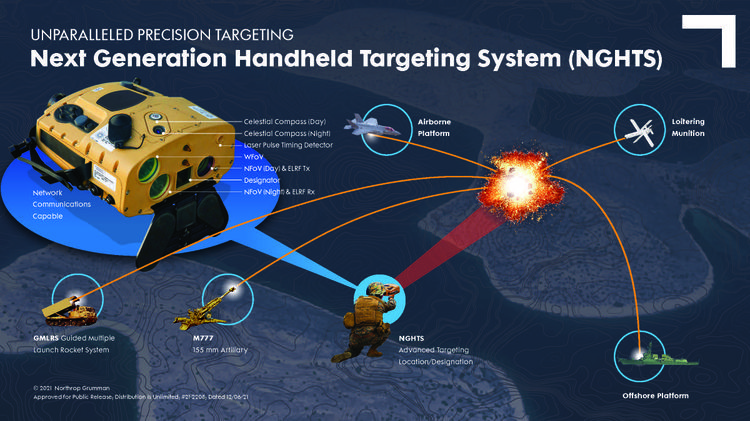
Next Generation Handheld Targeting System (NGHTS) Photo by: Northrop Grumman. 

Naval Today reports,

“US-based aerospace company Northrop Grumman Corporation has been selected to provide the US Marine Corps with the next-generation handheld targeting system (NGHTS).”

As disclosed, NGHTS is capable of performing rapid target acquisition, laser terminal guidance operation and laser spot imaging functions. Its high-definition infrared sensors provide accuracy and grid capability over extended ranges.

So, what does this have to do with the Coast Guard?

If the Coast Guard is to respond to a terrorist attack using a medium to large ship, we have to respond in one of two ways. We either have to stop the ship with Coast Guard systems, or we have to call in help from other armed forces. Either way, something like this could help.

Plus, the device seems to have additional capabilities that might be useful.

In what is likely to be a rapidly developing threat situation, I have little faith, that we can get help in time, but if we do, we are going to need to quickly and effectively identify the target. This can be a lot more difficult than you might think. Army and Air Force pilots are not trained in ship recognition. They are unlikely to be able to recognize a particular ship based on a description. Using a laser designator insures there would be no misunderstanding about which ship is their target.

If Coast Guard are going to forcibly stop a terrorist-controlled vessel, we need accurate weapons that will not result in collateral damage. Laser guided weapons can fill this role.

These systems seem to have capabilities beyond laser designation. Looking at the illustration above, it appears it also can serve as a compass, perhaps capable of taking bearings day or night, and of providing low probability of intercept, line of sight communications.

This could even be used on smaller units like the response boats. Large cutters are getting the Mk20 Electro-Optic Sensor System (It is still not clear to me, if that includes a laser designator but it does seem likely). On a rolling ship we would probably rather have a mounted rather than handheld system, but some kind of mount would probably not be too difficult. Since it is supposed to be network capable, presumably its imaging could be remoted to command positions.


“Time to Revise the Japan Coast Guard Act?” –The Diplomat

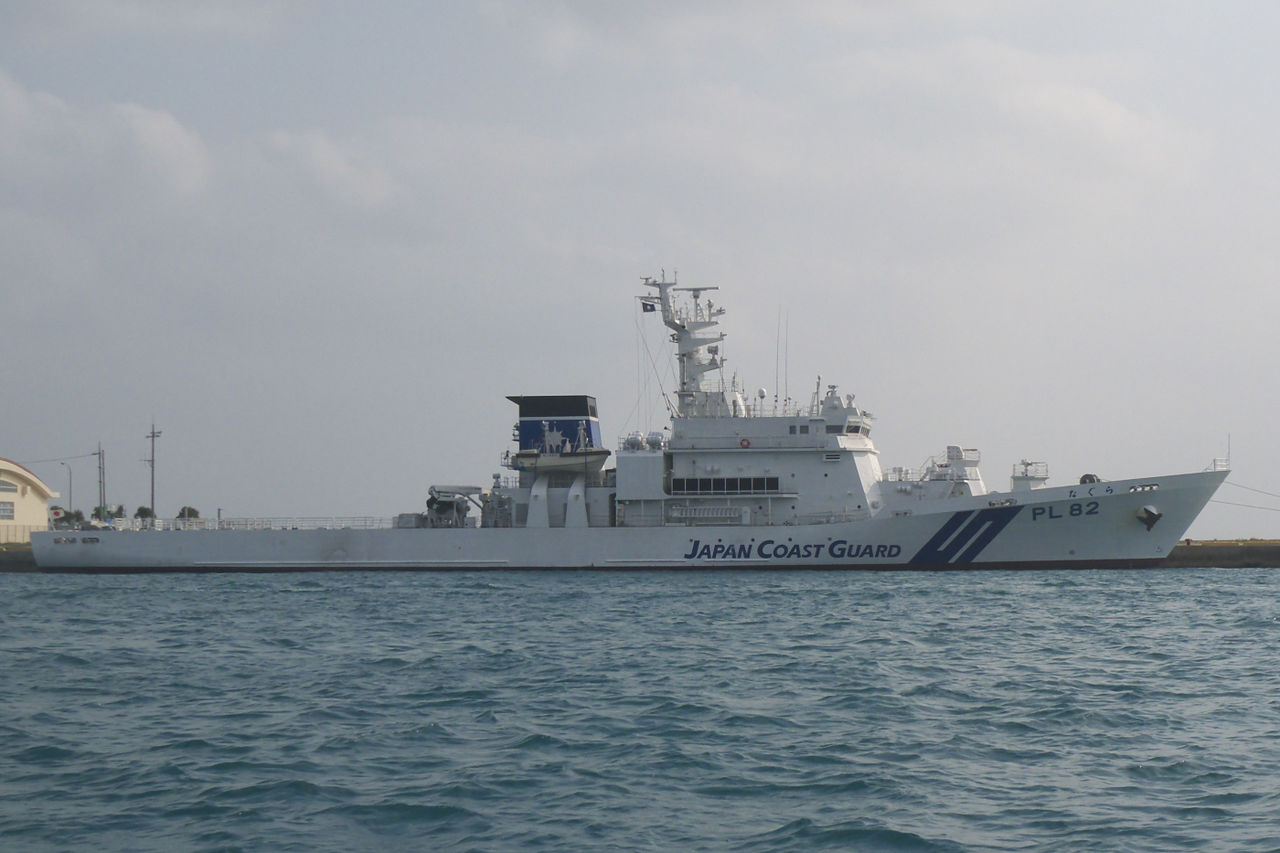
Japan Coast Guard patrol vessel PL82 Nagura at the Port of Ishigaki. Photo from Wikipedia Commons, by Yasu

The Diplomat reports that Japan is considering changes to their laws governing the Japan Coast Guard.

One proposal seeks to add “maintenance of  territorial sea integrity” and “security of territorial sea” to the Act’s mission, while another seeks to moderate the prerequisites allowing harm through use of weapons by Coast Guard officers. All of these proposals seek to give the JCG more muscle.

I don’t have a feel for what the actual proposed changes are, but I do know the Japan Coast Guard does not have the same close relationships with the Japanese Navy (Maritime Defense Force) that the USCG enjoys with the USN. It is not a military service. They don’t share equip or even use the same fuel. You can bet they don’t share the same communications systems. This means that the organization is not as useful as it might be in wartime, and, of more immediate concern, it means coordination in crisis is far more difficult.

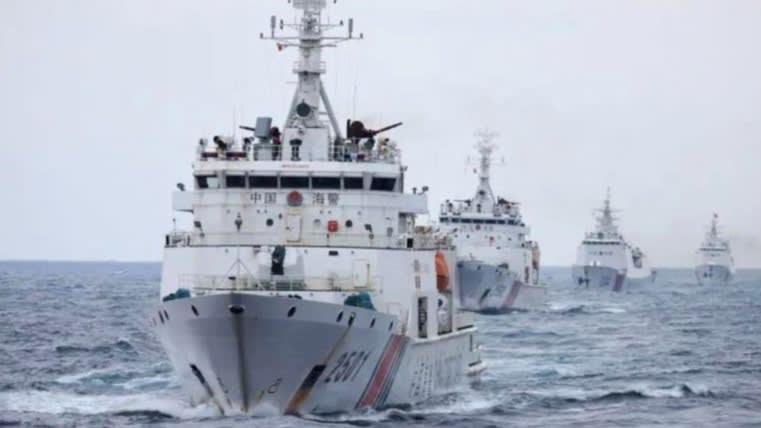
Currently none of the Japan Coast Guard vessels have weapons larger than 40mm, and very few have an air search radar or any kind of AAW firecontrol system. If Japanese Self Defense Forces are not immediately available as backup, it might be hard not to feel intimidated by better armed China Coast Guard vessels, particularly if supported by aircraft.

This Chinese coast guard ship is equipped with weapons believed to be 76-millimeter guns. © Kyodo

“Eastern Shipbuilding opens new C5I integration facility for offshore patrol cutter” –Defense News

Eastern Shipbuilding Group is on contract to build the first four offshore patrol cutters for the U.S. Coast Guard and is competing for the contract for the rest of the class. The first ship, Argus, is in construction and expected to deliver by the end of 2022. (Eastern Shipbuilding Group photo)

Defense News reports,

PANAMA CITY, Fla. — Eastern Shipbuilding Group, Northrop Grumman and their industry partners formally opened a test and integration center this week for the C5I systems at the heart of the U.S. Coast Guard’s new offshore patrol cutter program.

This OPC production facility is meant to reduce risk on what the Coast Guard calls its top acquisition priority. Within mockups of the bridge, the operations center and other key rooms, every piece of internal and external sensing and communications equipment will be networked together in this facility at Eastern’s Allanton yard first, tested for any integration hiccups and then sent up the road to the company’s Nelson Street yard where the OPC hulls are being constructed.

Northrop Grumman Vice President for Maritime Systems and Integration Todd Leavitt told Defense News this C5I system — command, control, communications, computers, cyber, intelligence, surveillance and reconnaissance — is more complex than even the Consolidated Afloat Networks and Enterprise Services (CANES) program the company worked on for the U.S. Navy.

That is only a small part of the report which includes information about the ship’s internal communications system. A shoreside facility is a great idea. It will likely eliminate post delivery teething problems that can be expensive and delay deployment.

We really need these ships to work right out of the box.

“SOLVING COMMUNICATIONS GAPS IN THE ARCTIC WITH BALLOONS” –CIMSEC

A NASA long duration balloon is prepared for launch on Antarctica’s Ross Ice Shelf near McMurdo Station in 2004. (NASA photo)

CIMSEC provides a discussion of the possibility of using high altitude balloons as communications links in the Arctic.

Even if balloons are not the answer, the article at least does an excellent job of outlining the difficulties of communicating in the Arctic (or Antarctic).