Pentagon press secretary Brig. Gen. Pat Ryder confirmed that the USS Carney shot down three land attack missiles as well as several drones that were launched by Iran-backed Houthi forces in Yemen.
Presumably this refers to land based anti-ship cruise missiles.
USS Carney (DDG-64) is a Flight I Burke class guided missile destroyer. In 2016 Carney completed an upgrade with a SeaRAM rolling airframe missile launcher replacing her after Phalanx CIWS.
Reportedly Carney brought down three cruise missiles and 8 drones. Other reporting suggests Carney was in company with USS Bataan (LHD-5) which may have been the intended target.
This incident occurred in the Red Sea. PATFORSWA cutters also operate in this area.
“We cannot say for certain what these missiles and drones were targeting, but they were launched from Yemen heading north along the Red Sea, potentially towards targets in Israel,” Ryder said in a Pentagon briefing. A U.S. official said they do not believe the missiles were aimed at the ship. That official spoke on condition of anonymity to discuss military operations that had not yet been announced.
The first Air Force Research Lab video above talks about a new weapon, but it is also recognition of a new threat.
Let’s talk about what is wrong with the scenario in the video, how the Coast Guard could use this new weapon, along with the “Rapid Dragon” delivery system, and why the Coast Guard not only could, but should be the agency to use this weapon against this particular threat.
“Conventional cruise missiles or hypersonic cruise missiles, low-radar cross-section cruise missiles, cruise missiles from Russia, cruise missiles from China, potentially other countries. Cruise missiles that can be launched from undersea, from 100 miles-plus off the coast. Cruise missiles from on the sea. … Cruise missiles from the air. Cruise missiles from commercial vehicles launched out of a container that can be masked as part of the commercial ship. (emphasis applied–Chuck)
The video shows a ballistic missile being preped for launch from a container. That is possible, but cruise missiles are more likely. In any case, potential actions to stop the launch would be the same.
In the video we see a Navy P-8 Maritime Patrol Aircraft monitoring the activities of a suspicious container ship. Presumably the war has not started since they don’t call for an Air Force fighter to bring in the weapon until the P-8 sees a launcher being elevated for missile launch. This is really too late to call the Air Force. Before the Air Force can get a fighter on scene, the missiles will have been launched. The aircraft monitoring the ship’s activity should be able to immediately initiate countermeasure. The P-8 Poseidon is capable of carrying Anti-Ship Cruise missiles of 725 kg (1,598 lb). It might be able to deploy the QUICKSINK weapon seen in the video which is based on a 2,000 pound bomb. It could certainly deploy a similar weapon based on the 1000 pound bomb. The problem is that, at this stage in the run-up to war, P-8s should be looking for submarines that might also launch cruise missiles, and fighter aircraft don’t have the endurance to loiter on scene waiting for something to happen. They would also be needed to intercept any cruise missiles that are launched.
In the actual sinking, this was a big bomb used against a small ship, but the key to its effectiveness what where it exploded.
The weapon is discussed here, “Air Force destroys target vessel with ship-killing JDAM.” It clearly is intended to exploit the non-compressibility of water to allow a weapon that would not normally immediately sink a ship, if it hit above the waterline, to break the ship in half.
“In a September 2021 interview with Military.com, Meeks said one of the bomb’s modifications was a redesigned nose plug. This is intended to keep the bomb from veering off in an unintended direction if it hits the water before the target, which Meeks likened to skipping a stone across the surface of a pond.”
There is additional information about the seeker here, including how it works (GPS to get to the general area, then radar, and imaging IR), expected cost (substantially less than $1M for the all up rounds bought in quantity), and range (15 miles, potentially more with range extending wing kits).
As I have pointed out numerous times, no other non-nuclear weapon equals a modern torpedo’s ability to sink a ship. Apparently the Air Force agreed and decided to develop a weapon that would kill a ship in the same way a modern torpedo does, by detonating under water, preferably below the keel, rather than by directly hitting the target above the waterline. Looking at the videos, it appears the bomb enters the water, almost vertically, close to the port side. We see the familiar lift of the center section as we have seen many times when a Mk48 torpedo is used against a surface target, after which the ship breaks in half. For comparison, here is a destroyer hit by a Mk48, and a Mk48 torpedo’s warhead contains far less explosive than a 2000 pound bomb.
The Launch Platforms:
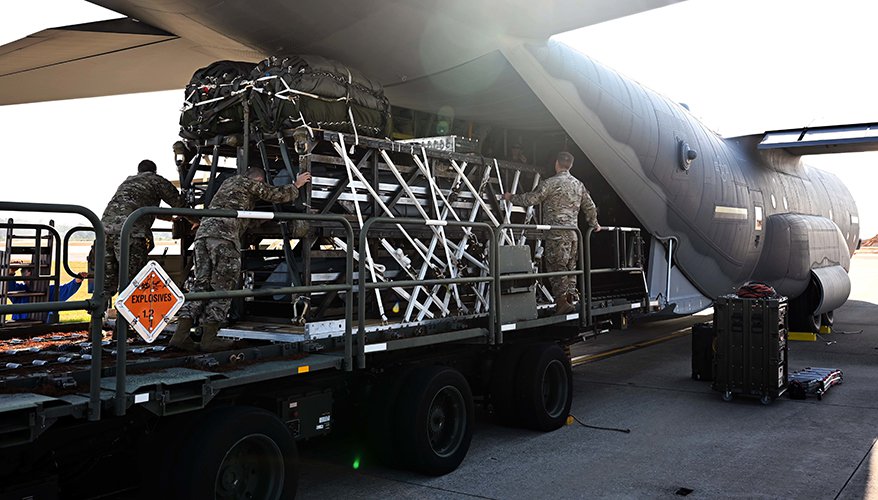
The weapon can be used on a wide variety combat aircraft. The video shows and F-35 and the actual test was done with an F-15, but there is no reason this could not In fact be dropped from a Coast Guard fixed wing using the “Rapid Dragon” concept.
It is not that the Coast Guard will necessarily be the only ones doing this mission, but the Coast Guard does seem to be particularly well suited for the purpose.
If we are to keep watch on vessels off the US coast in the run up to war, you want aircraft with long endurance. You want excellent communications. You want good electro optics so that you can watch what is happening on a ship from outside the range of shoulder launched air defense systems (MANPAD). You get all that with Coast Guard fixed wing aircraft equipped with the Minotaur system. Using Air Force’s QUICKSINK modified JDAM from the Rapid Dragon launcher means we can have a single unit that can remain on station for an extended period, observe the actions of target of interest, communicate effectively, and if necessary promptly eliminate a threat while freeing other assets like the P-8 and fighters to do jobs only they can do.
It would not be necessary for the Coast Guard to store the weapons or arm the aircraft if a agreement could be reached allowing DOD facilities to load the Rapid Dragon and weapons. Actually targeting would be done by DOD assets anyway. It appears this mission could be performed, even to our smallest fixed wing, the HC-144.
Is it doable?:
A recent report suggests that it is. Lt. Gen. James Slife, who leads Air Force Special Operations Command said, “It doesn’t require any aircraft modifications, it doesn’t require any special aircrew training.”
Might be of interest to compare the amount of ordanance used in this SINKEX. It should be recognized that this retired USN frigate was probably a larger, more resilient target than the one used in the “QUICKSINK” demonstration, but I suspect, if QUICKSINK had been used agains the frigate, the results would have been the same, though it probably would have taken the two halves of the ship longer to sink.
During World War II, we all probably know that the Coast Guard surface forces had a strong record of augmenting the US Navy in anti-submarine warfare and amphibious assault operations.
Coast Guard aviation’s contribution was considerably less significant. They continued to do SAR and flew anti-submarine patrols. By the end of the war, there was at least one Coast Guard squadron dedicated to anti-submarine patrols, but while generally aircraft were more successful than surface vessels against submarines, sinking about 400 U-boats, more than half of all the U-boats destroyed during WWII, all Coast Guard submarine sinkings were done by surface vessels.
During the Vietnam war, when the Coast Guard deployed 82 foot patrol boats and High Endurance Cutters off the coast as part of Operation Market Time, and buoy tenders serviced aids in Vietnamese waters, the Coast Guard’s aviation contribution to the war was limited to exchange pilots serving with the DOD units. Coast Guard aircraft supported LORAN stations that were vital to the war effort, but I have not heard of any Coast Guard aircraft participating directly in the Vietnam War.
During the first Iraq War, I seem to recall some Coast Guard aircraft assisted TRANSCOM with logistics. In addition, Coast Guard HU-25s monitored pollution that resulted from Iraqi sabotage of Kuwaiti oil facilities.
Generally, Coast Guard aircraft have played little or no role in America’s wars. It is not too surprising since warplanes tend to be specialized.
The system is roll-on/roll-off and requires no integration with the aircraft.
Interestingly the most recent test appears to have targeted a maritime target.
We certainly are not likely to see even Air Force transports doing this sort of thing routinely unless it is a truly big war or at least the desire is to launch a devastating number of missiles in single massive assault.
Surprisingly, Coast Guard aircraft might be seen as the best transports to do this sort of thing, since their Minotaur systems provide the possibility of updating targeting information with organic sensors and doing post attack battle damage assessment if the environment permits.
Coast Guard aircraft use becomes more likely if the conflict is worldwide, Air Force transports are otherwise engaged, and a nation, or nations, in the Western Hemisphere decides to take advantage of US distraction and attack an ally.
It might also happen, if there is a wartime decision to sink all hostile controlled shipping. (That might follow a warning to masters to intern the ships within a reasonable time period.)
Two posts from Naval News. French shipbuilders are doing well in the patrol vessel market.
First, “The Ministry of Armed Forces of Senegal and French shipbuilder PIRIOU signed November 17 a procurement contract for three OPV 58 S for the Navy of Senegal. The vessels will be fitted with missile systems, a first for this African navy.”
Second, “The Government of Ukraine gave its green light for the procurement of 20 FPB 98 patrol vessels made by French shipyard OCEA.”
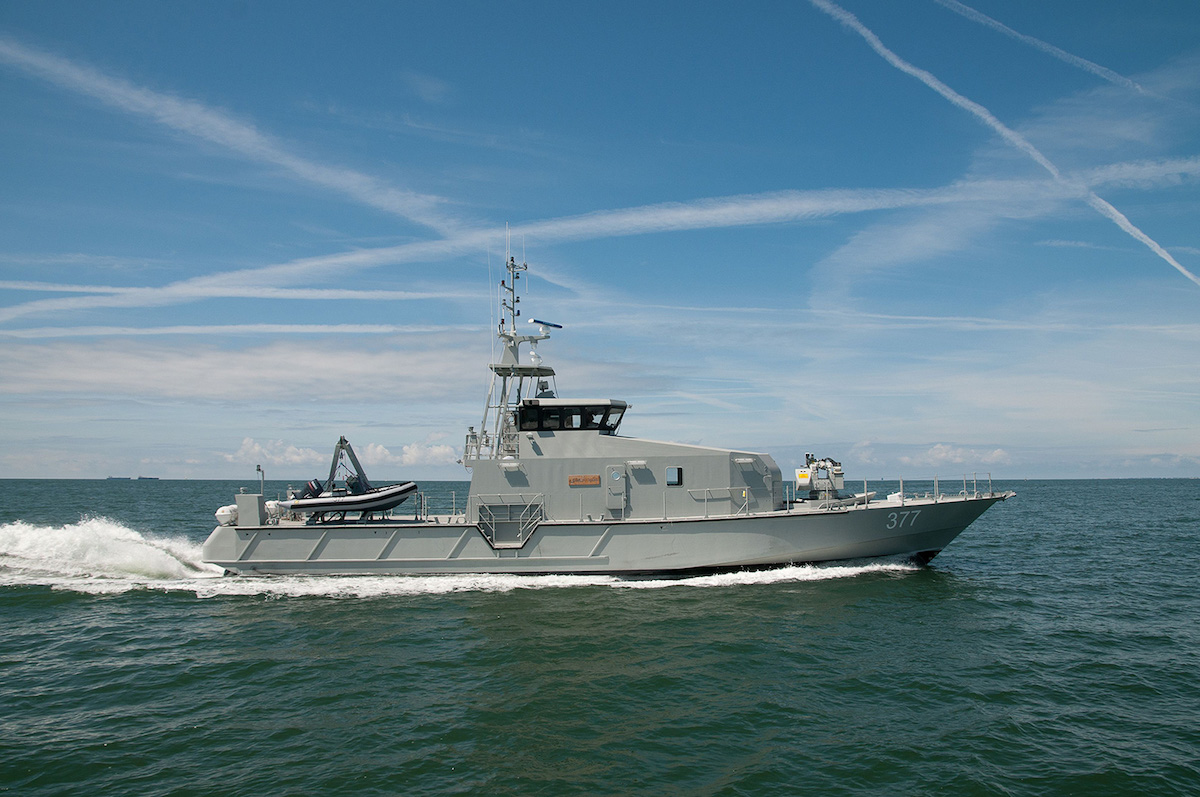
The Senegalese OPVs:
The ships for Senegal fall into that class significantly larger than the Webber class, but significantly smaller than the OPCs. They will be even a little smaller than the 210s. It would be at the lower end of a type, I have called cutter X, vessels with a crew and equipment similar to that of a Webber class FRC, but with better sea keeping and longer endurance. Specifications are:
Length: 62.20 meters (204′)
Width: 9.50 meters (31.2′)
Draft: 2.90 meters (9.5′)
Speed: 21 knots
Range / Endurance: 25 days, 4,500 nautical miles @ 12 knots
The Marte MK2/N missile weighs 310 kg (682#) and is 3.85 metres (12.6′) long. The warhead weighs 70 kilogram (154 pound). The missile, has “an effective range in excess of 30 km, is a fire and forget, all weather sea skimming missile with inertial mid-course navigation through way points and active radar terminal homing. These missiles give these boats a range almost double that of the 57mm or 76mm guns.
SIMRAD-RC is a remote weapons station for launch of two Mistral missiles. Developed as a shoulder launched, Man Portable Air Defense (MANPAD) system, Mistral is a short ranged (6km) IR homing missile. It is claimed to be capable against a range of air targets as well as small surface targets.
Ukrainean OCEA FPB 98 patrol boat:
OCEA FPB 98 patrol boat (Credit: OCEA)
This is a deal, we discussed in July, when it appeared likely. I will repeat the description here.
They have a GRP hull and are powered by two 3,660 HP Caterpillar diesels using waterjets. Specs for vessels of this type sold to Algeria.
Displacement: 100 tons
Length: 31.8 meters (104’4″)
Beam: 6.3 meters (20’8″)
Draft: 1.2 meters (3’11”)
Speed: 30 knots
Range: 900 nmi @ 14 knots
Crew: 13
They will probably be equipped with a 20 to 30mm gun.
Above: Marketing video for comparable Russian system
The Washington Free Beacon is reporting that China is developing containerized cruise missiles launch systems for a land attack version of its 290 mile range YJ-18 anti-ship cruise missile which is a reverse engineered version of the Russian Klub-K cruise missile.
“China is building a long-range cruise missile fired from a shipping container that could turn Beijing’s large fleet of freighters into potential warships and commercial ports into future missile bases.”
“China operates or is building deep water ports in several strategic locations, including Bahamas, Panama, and Jamaica that could be used covertly to deploy ships carrying the YJ-18C.”
In China, every enterprise is ultimately an arm of the State, ready to do the States bidding. We have seen their fishing fleet serve as a naval militia, it is likely their merchant marine would also serve military purposes beyond simply carrying cargo. In fact they have announced that that is their intent.



 Chuck Hill's CG Blog