USCGC Stratton in the Philippines

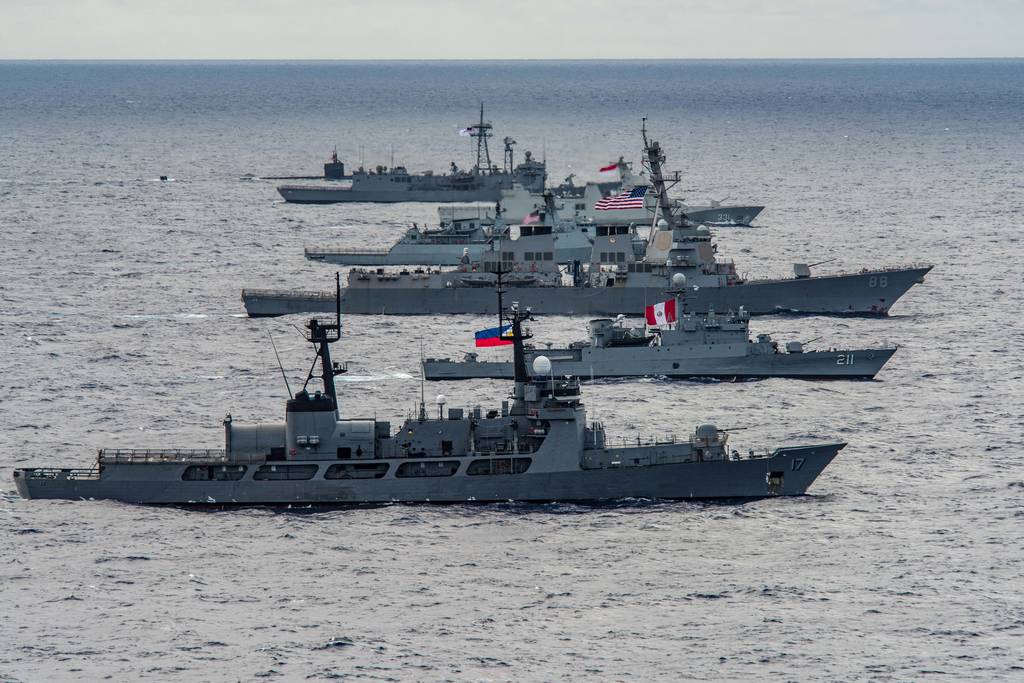
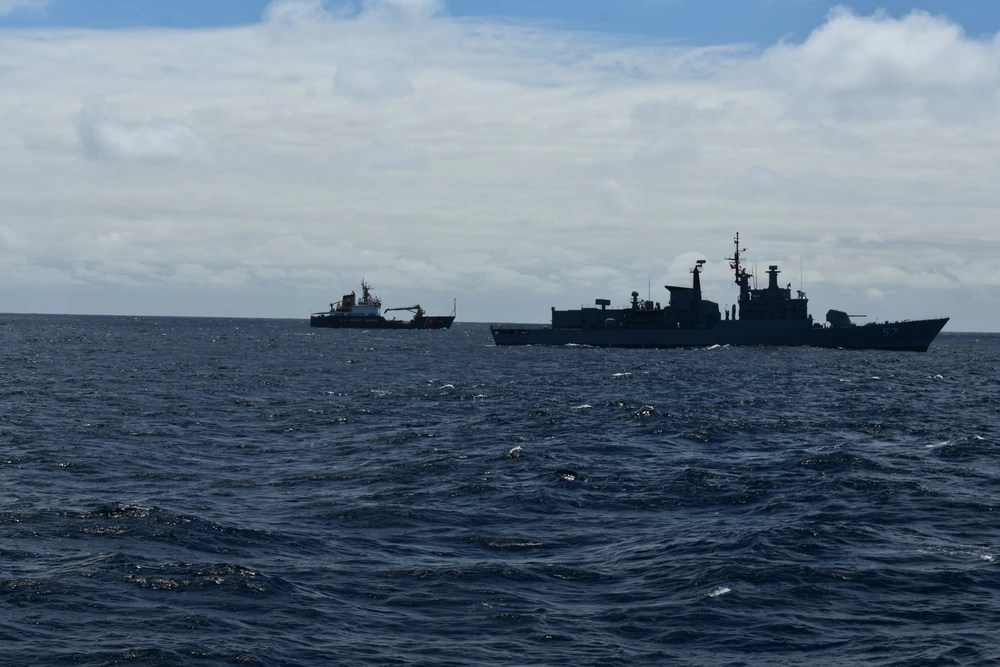
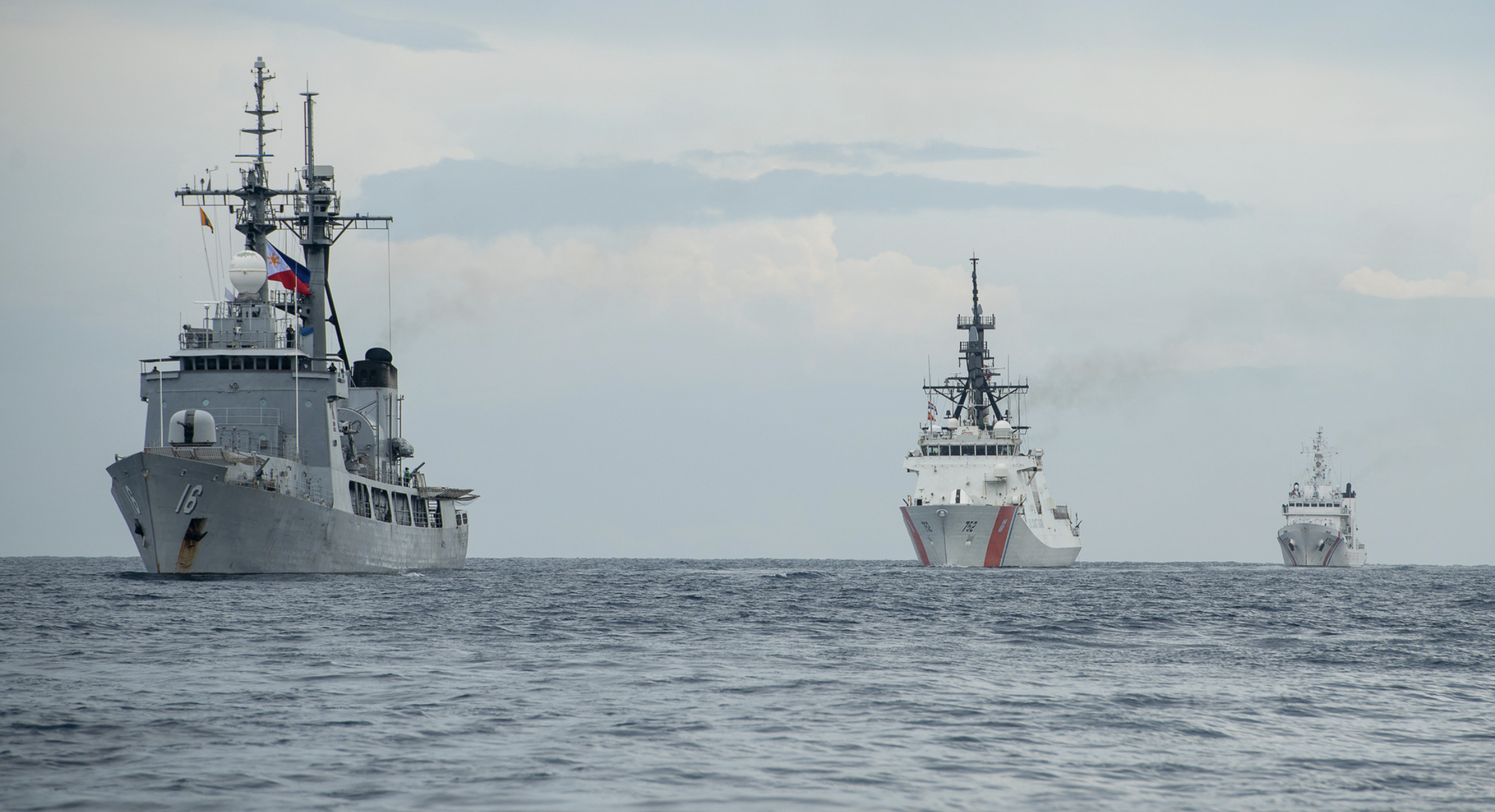
The Legend-class USCGC Stratton (WMSL 752) sails with Philippine Navy’s Gregorio del Pilar-class patrol ship BRP Ramon Alcaraz (PS-16) (former USCGC Dallas) and Philippine Coast Guard Vessel BRP Melchora Aquino (MRRV-9702) as part of a division tactics exercise in the Sulu Sea, May 20, 2025. Stratton is deployed and assigned to Destroyer Squadron (DESRON) 15, the Navy’s largest DESRON and the U.S. 7th Fleet’s principal surface force. The U.S. Coast Guard has operated in the Indo-Pacific for more than 150 years, and the service is increasing efforts through targeted bilateral patrols with our national security cutters, fast response cutters, and other activities conducted in support of maritime missions to enhance our regional partnerships. (U.S. Coast Guard photo by Petty Officer 3rd class William Kirk)

Below the line is a report of Alameda based USCGC Stratton’s visit to the Philippines at the start of a Western Pacific deployment. The report mentions exercising “with the Armed Forces of the Philippines and the PCG.”

“Following their departure, Stratton’s crew conducted a bilateral Maritime Cooperative Activity (MCA) …The MCA included exercises in maritime domain awareness, division tactics, maneuvering, and visit, board, search and seizure procedures.”

Following the link above we learn,

Participating units included the Legend-class cutter USCGC Stratton (WMSL-752) and a P-8A Poseidon maritime patrol and reconnaissance aircraft from the U.S. Navy, as well as the Philippine Navy’s Gregorio del Pilar-class patrol ship BRP Ramon Alcaraz (PS16); Acero-class patrol gunboats BRP Gener Tinangag (PG903) and BRP Domingo Deluana (PG905); an AW109 naval helicopter; the Philippine Air Force’s Super Tucano and Sokol helicopters; and the Philippine Coast Guard’s Teresa Magbanua-class patrol vessel BRP Melchora Aquino (MRRV 9702).

That is a pretty substantial exercise, US Navy, Philippine Navy, and Philippine Air Force in addition to US and Philippine Coast Guards.

While the Philippine Coast Guard has many of the trappings of a military service, they are not nearly as well armed as their Chinese, US, and Japanese counterparts. Their most powerful weapon seems to be .50 caliber machine guns. If they get into an armed confrontation with the Chinese, they cannot go it alone. Notably this was not a SAR exercise. Perhaps the idea was to practice coordination of support for the Philippine Coast Guard in their interactions with the Chinese, making sure the Philippine CG can communicate with the Philippine Navy and Air Force and with US assets in the area.

Army Recognition’s Naval News also has a report on the exercise which mentioned that Japanese built Philipine WPC BRP Malapascua (MRRV 4403) also participated in the exercise. “Philippine and US Naval Forces Conduct First Joint Maritime Exercise to Strengthen Indo-Pacific Maritime Security


May 24, 2025

U.S. Coast Guard Cutter Stratton departs Philippines, commences months-long Indo-Pacific patrol

PUERTO PRINCESA, Philippines — The U.S. Coast Guard Cutter Stratton (WMSL 752) and its crew departed Puerto Princesa, Philippines, Monday, after in-port engagements and visits with the Philippine Coast Guard (PCG), the U.S. Ambassador to the Republic of the Philippines MaryKay Carlson, U.S. embassy staff, and PCG District Palawan senior leadership.

Stratton’s visit to Puerto Princesa marked the first international port call of their months-long deployment to the Indo-Pacific region.

Following their departure, Stratton’s crew conducted a bilateral Maritime Cooperative Activity (MCA) with the Armed Forces of the Philippines and the PCG within the Philippines’ exclusive economic zone. The MCA included exercises in maritime domain awareness, division tactics, maneuvering, and visit, board, search and seizure procedures.

These engagements demonstrate the U.S. commitment to maritime governance that supports security, freedom and prosperity in the region.

The U.S. Coast Guard serves as a unique instrument of national power, bridging defense, diplomacy and law enforcement to further national objectives and mutual interests with allies and partners like the Philippine Coast Guard.

During the visit, Stratton’s commanding officer, Capt. Brian Krautler, welcomed Amb. Carlson, PCG Commandant Adm. Ronnie Gil Gavan, and senior PCG leaders aboard Stratton, highlighting U.S. Coast Guard interoperability with allies.

“Our alliance with the Philippine Coast Guard has cultivated a close, collaborative maritime partnership—this is Stratton’s second deployment to the Philippines during my two years aboard as commanding officer,” Krautler said. “Our enduring partnership enables combined effects and cooperation across a broad spectrum of engagements and operations. Stratton’s deployment to the Indo-Pacific will further strengthen our relationships with allied coast guards and services throughout the region.”

The U.S. Coast Guard works closely with regional allies to deliver a broad range of capabilities in support of a prosperous and secure Indo-Pacific. Multilateral operations like the at-sea MCA and in-port engagements enhance cooperation, improve interoperability and strengthen readiness.

While moored, Krautler and Stratton’s leaders also met with the WESTCOM Commander PCG District Palawan for a pre-sail planning meeting to discuss bilateral search and rescue exercises (SAREX) to enhance cooperation. At-sea operations and exercises with the Philippine Coast Guard will strengthen the ability to execute coordinated maritime operations and enhance overall mission readiness.|

The U.S. Coast Guard’s commitment to a prosperous and secure Indo-Pacific requires working closely with regional allies, allowing the service to improve its logistics flexibility to better deliver a broad range of capabilities.

During the patrol, Stratton is scheduled to engage with regional partners and participate in joint operations aimed at enhancing maritime safety and security. Throughout its Indo-Pacific deployment, Stratton is assigned to Destroyer Squadron (DESRON) 15, the Navy’s largest DESRON and the U.S. 7th Fleet’s principal surface force. DESRON 15 regularly assumes tactical control of surface units operating in the area.

Stratton’s port call to the Philippines marks the cutter’s third visit following stops in 2019 and 2023. Consistent U.S. Coast Guard national security cutter deployments to the region demonstrate the U.S. commitment to strong maritime governance that supports security, freedom and prosperity in the Western Pacific.

Commissioned in 2012, Stratton is one of ten Legend-class national security cutters and one of four homeported in Alameda, California. National security cutters are 418 feet long, 54 feet wide and have a 4,600 long-ton displacement with a top speed of 28 knots, a range of 12,000 nautical miles and can hold a crew of up to 170. National security cutters routinely conduct operations throughout the Pacific, where their combination of range, speed and ability to operate in extreme weather provides mission flexibility.

The namesake of U.S. Coast Guard Cutter Stratton is Capt. Dorothy Stratton, who led the service’s all-female reserve force during World War II. Dorothy Stratton was the first female commissioned officer in the Coast Guard and commanded more than 10,000 personnel. The ship’s motto is “We can’t afford not to.”

“North American Arctic defense could shape outcome of Indo-Pacific conflict” –Indo-Pacific Defense Forum

A U.S. Army Green Beret observes an incoming CH-47 Chinook helicopter during Operation Polar Dagger in Wales, Alaska, in August 2024. IMAGE CREDIT: SPC. BRYON DAVIDSON/U.S. ARMY

The Indo-Pacific Defense Forum reported on a Special Operations Command North (SOCNORTH) exercise,

“To address growing concerns in the Arctic, SOCNORTH recently executed two phases of Operation Polar Dagger, an operational series that demonstrates rapidly deployable, joint SOF capabilities throughout the North American Arctic. It forms the basis of options to deter, disrupt and deny adversary activity in support of U.S. Northern Command’s (USNORTHCOM) layered defense of the U.S. homeland…

“In 2023 and 2024, SOCNORTH and the U.S. Navy partnered to deploy the amphibious transport dock ship USS John P. Murtha and the USS John L. Canley, an expeditionary sea base vessel that supports SOF operations and other maritime missions, to the Bering Sea and the Arctic Circle to support Operation Polar Dagger. USSOF is enhancing its navigation expertise in Arctic terrain and has demonstrated the ability to thrive in the region by executing long-range movements, maritime interdiction operations, rapid infiltration/exfiltration, air-to-ground integration, critical infrastructure defense, domain awareness, and medical evacuation validation, among other engagements.”

(I suspect what this means is that USS John P. Murtha participated in 2023 and USS John L. Canley participated in 2024. Both could not have participated both years.)

A lot of the post is an attempt to explain to an Indo-Pacific audience why a NORTHCOM exercise should be important to them.

Observations: 

It appears that Polar Daggar is a part of the larger NORTHCOM NOBLE DEFENDER exercise. This is apparently a regular annual exercise. NORTHCOM’s on-line magazine reported on the 2023 exercise.

“U.S. Army and Navy assets conduct an interdiction operation in the Bering Sea in July 2024.” Note how flat the seas are. That’s not normal. They did do this in July. You can’t count on seas like this. IMAGE CREDIT: SENIOR AIRMAN JOHNNY DIAZ/U.S. AIR FORCE

There is a serious problem here because there was apparently no Coast Guard participation in these exercises. The Navy’s Pacific Fleet almost never has surface ships anywhere near the Arctic. If you have an urgent need for a ship to do something in the Bering Sea, the Coast Guard is really the only option most of the time. SOCNORTH should be learning how they can exploit Coast Guard resources including ships, boats and aircraft. If you want maritime interdiction in the Bering Sea, if you want maritime domain awareness, who should NORTHCOM call? –the Coast Guard.

Want to fly a “Night Stalker” helicopter off of a ship? Want to launch ATACMS from the Chukchi Sea or maybe Tomahawk or SM-6 from a Mk70 launcher? You could put it on the flight deck of a cutter. 

Need follow-up logistics for paratroopers dropped into an isolated coastal location? Coast Guard.

A satellite image of Shemya Island. What is now called Eareckson Air Station, with its lengthy runway, is seen along the southern edge. Google Earth

Not enough Air Force transports available when you need to move troops to reinforce Shemya? Kodiak C-130Js can help with that.

Cutter might even put a landing party ashore to provide quick protection for a critical facility and stand offshore to provide some AAW protection with its 57mm.

East-Coast-based U.S. Naval Special Warfare Operators (SEALs) conduct an over the beach infiltration on Shemya Island, Alaska, Sept. 6, 2023, as part of Operation Polar Dagger. During the operation, special operations forces projected the ability of U.S. forces to defend critical infrastructure, enhanced all-domain awareness, demonstrated operational reach, and strengthened our understanding of activity in the Arctic. (U.S. Navy photo by Mass Communication Specialist 2nd Class Matthew Dickinson)

In 2023, Special Forces operating from USS John P. Murtha (LPD-26) did an infiltration exercise. A cutter could have done the same thing, and it probably would have been more realistic since an LPD is unlikely to be available.

Any surface or land action at the start of a conventional conflict against Russian and/or China that involves the Arctic is likely to be a surprise involving small units, probably involving covert actions from unconventional platforms, paratroopers, and small unit insertions. At least initially, it will be a “run what you brung” war. We will have to fight with what we have and effectively the Coast Guard is the surface navy for Alaska.

The “Center of Gravity” for the theater is likely to be the Bering Strait. As long as the US controls the strait, the Northern Sea Route will be useless for traffic between the Russian North coast and China or the Russian Pacific Coast.

The photo that leads off this post was taken at Wales, Alaska, population 145, 111 miles (179 km) northwest of Nome. The location is significant in that it is on the Eastern edge of the Bering Strait. It appears someone has recognized the significance of the location.

“Enhancing Domain Awareness in the Arctic” –Third Fleet

A U.S. Navy P-8A Poseidon takes off at Joint Base Elmendorf-Richardson, Alaska, Sept. 14, 2024. The P-8 Poseidon aircrew assigned to Patrol Squadron (VP) 9 and a U.S. 3rd Fleet Naval and Amphibious Liaison Element (NALE) supported joint and bi-national forces from Alaskan North American Aerospace Defense Command Region and Alaskan Command during Operation POLAR VORTEX by providing maritime domain awareness in conjunction with the 611th Air Operations Center air component to provide domain awareness during operations and exercises in remote regions of Alaska and the Arctic. (U.S. Air Force photo by Senior Airman Quatasia Carter)

Below is a 3rd Fleet press release. Notably missing is any mention of the Coast Guard, that might be understandable, but I have also seen no Coast Guard news release about participation in Operation POLAR VORTEX. If you are doing Maritime Domain Awareness anywhere around Alaska, you would think the Coast Guard would be involved.


Oct. 28, 2024

Enhancing Domain Awareness in the Arctic

By Tech. Sgt. Donald Hudson

During Operation POLAR VORTEX, a Naval and Amphibious Liaison Element (NALE) led by U.S. 3rd Fleet and supported by U.S. Fleet Forces was embedded into the bi-national Alaskan North American Aerospace Defense Command (NORAD) Region at Joint Base Elmendorf-Richardson, Alaska.

The NALE is primarily a function of the Navy Reserve, with Reserve personnel filling roughly 98 percent of NALE billets, given the operational tempo of this unique work. NALE Sailors train in mobilization to billet (MOB to-billet) positions and generally deploy on 90 to 270-day orders, responding both to planned operations and emergent crises, including training exercises, freedom of navigation operations, and humanitarian assistance and disaster relief. MOB-to-billet is the activation (other than for training) of SELRES Sailors to serve in the authorized and funded manpower billet at the command to which they are permanently assigned.

NALE units are attached to U.S. Fleet Forces Command, U.S. Pacific Fleet, U.S. Naval Forces Europe and Africa, and most numbered fleets.

While in Alaska, the NALE worked alongside U.S. Air Force and Royal Canadian Air Force (RCAF) members in the 611th Air Operations Center (AOC) to increase domain awareness in the Arctic region during Operation POLAR VORTEX by instantly linking maritime and air domain awareness.

“The situational awareness the NALE has provided is the most maritime awareness the AOC has had in the 14 years I’ve been here,” said Alaska Air National Guard Col. Jeff Smith, deputy commander, 611th AOC. “It’s been great to see the coordinated efforts between air and maritime domains.”

By co-locating, the NALE and 611th AOC were able to coordinate information instantly to the Joint Force Air Component Commander (JFACC) and provide a detailed real-time operating picture from the surface to air across some of the most remote operating areas in Alaska.

The NALE worked to seamlessly integrate their expertise of maritime domain awareness and employ a Navy P-8 Poseidon alongside joint and bi-national air assets. The cooperation increased tactical performance of joint forces validating command and control and tactical execution of mission objectives between various aircraft including exercising simulated air-to-surface strikes.

“The NALE has been essential to air operations,” said RCAF Brig. Gen. David Moar, deputy commander, Alaskan NORAD Region. “They were key in synchronizing air operations with naval air assets and providing information to enable the JFACC to coordinate and support the maritime component.”

3rd Fleet operations in U.S. Northern Command’s (USNORTHCOM) area of responsibility throughout the Gulf of Alaska aligned with Commander, U.S. Pacific Fleet objectives to demonstrate resolve and credible deterrence in defense of the homeland in the area. The operations also supported USNORTHCOM and NORAD’s mission of homeland defense, aerospace warning and control, and preserving a stable Arctic region in cooperation with U.S. Allies and partners.

“The NALE is an essential part of integrating the Maritime Operations Center (MOC) and AOC to provide multi-domain awareness to both Component Commanders,” said U.S. Navy Capt. Chris “Turtle” Turl, NALE director. “By coordinating information between each Commander’s guidance, the NALE facilitates the planning and execution of the mission to effectively meet the commander’s intent.”

NALE Sailors regularly engage in training exercises, freedom of navigation operations, and humanitarian assistance and disaster relief to enable better integration between joint air assets. The NALE provide the necessary face to-face contact among planner, commanders and staff to ensure mutual understanding, unity of effort and reduce friction between components.

Operating across the vast distances and remote areas in the Arctic comes with many operational hurdles to overcome such as harsh weather and sea conditions causing increased risk to aircrews should an incident occur. Enhancing communication between joint forces is essential to meet the mission while overcoming obstacles and lowering operational risks.

Through joint and bi-national teamwork the NALE and 611th AOC were able to maximize domain awareness and more effectively employ air assets saving time, and costs while reducing risk and increasing efficient use of tactical air assets and manpower.

UNITAS 2024 Photos

Guest author Andres Tavolari sent me a link to the Armada de Chile Flickr account which currently has a reported 14,813 photos.

The most recent photos are from UNITAS 2024. There are some really excellent photographs. Presumably as additional photos are added, page numbers will change, but currently, at least the first seven pages, more than 600 photos, are all devoted to UNITAS 2024 and more may be added.

An earlier post provided identification of participants.

UNITAS 2024 Participants

Since the announcement of the start of UNITAS 2024, I have been looking for a more detailed list of participating units.

We already knew about US participants, including US Coast Guard Tactical Law Enforcement Team (TACLET) Pacific Law Enforcement Detachment (LEDET); and USCG Maritime Security Response Team East (MSRTE) Direct Action Section, but had little information about non-US ships and aircraft involved.

Got a pleasant surprise in the form of an email from my Chilean connection, Andres Tavolari, providing a link to the information.

Andres was the author of one of the most widely read posts ever on this blog,

Three Nations Share German OPV Design             

That post was about an 80 meter Fassmer OPV design that was planned to be built in Argentina, Chile and Colombia. Chile built four. Colombia built three. Argentina dropped out of the program and instead bought four Bouchard (formerly L’Adroit) class OPVs. Germany subsequently built three 86 meter versions for their federal police force and Singapore has ordered four similar vessels.

Three of these 80-meter OPVs are participating in UNITAS 2024

The Chilean website provides a small side view graphic or silhouette for each ship and aircraft type along with the country the asset is from and a link to a photograph. In the case of the Chilean assets, there is additional descriptive information.

The website is in Spanish, but my browser provided an understandable translation.

Aircraft came from Chile, the US, Ecuador, and Uruguay.

19 ships and submarines were identified.

Chilean Navy participants include eight floating units: three frigates, two OPVs, an 42,000 ton oiler, a 12,000 ton French built LSD(H) that they have apparently used to resupply their Antarctic Station (video above), a small Landing Ship Tank (LST), and a submarine.

The US Navy has sent USS Germantown (LSD-42), USS St. Louis (LCS 19), and USS Hampton (SSN 767).

Argentina, Brazil, and Peru sent frigates. Ecuador sent a corvette. Mexico sent ARM Benito Juarez, classed as a long range ocean patrol ship, but really much more, being equipped with a CAPTAS-2 towed array active/passive sonar and armed with US sourced anti-ship Harpoon missiles and anti-air Evolved Sea Sparrow Missiles (ESSM) and Rolling Airframe Missiles (RAM). The UK sent a 5.000 ton ice capable patrol, survey, and support ship, HMS Protector.

The Chilean Navy has done a great job of providing accompanying video as well.

This year’s exercise will include cyber, and Fourth Fleet is also bringing some unmanned systems. There will also be a SINKEX.

Really, this is some of the best coverage of an exercise I have ever seen, and the underway portion hasn’t even started.

Andres also told me,

“At the same time, other American gear visited us: at least, a C-17 which brought an UH-60 and a HIMARS launcher with what appears to be a reloading truck.”

“MQ-9B SeaGuardian Showcased at RIMPAC 2024” –News Release

An MQ-9 Sea Guardian unmanned maritime surveillance aircraft system flies over the Pacific Ocean during U.S. Pacific Fleet’s Unmanned Systems Integrated Battle Problem (UxS IBP) 21, April 21. UxS IBP 21 integrates manned and unmanned capabilities into challenging operational scenarios to generate warfighting advantages. US Navy Photo

The Coast Guard has an unfilled requirement for a shore based Uncrewed Air System (UAS) to provide Maritime Domain Awareness.

Below is a news release from General Atomics Aeronautical Systems, Inc.

Reading the news release, I see the system incorporated an “integrated Minotaur Mission System.” Minotaur is a system currently being installed on all Coast Guard fixed wing search aircraft as well as US Navy and Marine Corps platforms. It went on to say “For RIMPAC, the MQ-9B effectively passed ISR&T (Intelligence, surveillance, reconnaissance, and targeting–Chuck) information to various surface and air units, such as the Nimitz-class carrier USS Carl Vinson, Guided Missile Destroyers (DDGs), Littoral Combat Ships (LCS), frigates, patrol boats, P-8s, P-3s, and numerous other U.S. and foreign units that took part in the exercise.” Could that have included Midgett and her task force? The use of the MQ-9B to drop sonobuoys for the task force and their embarked ASW helicopters would have been an interesting experiment.


GA-ASI’s MQ-9B SeaGuardian® Showcased at RIMPAC 2024

Sonobuoy Dispensing System and LRASM Among the New Capabilities Featured

SAN DIEGO – 14 August 2024 – With the completion of the U.S. Navy’s Rim of the Pacific (RIMPAC) flight operations on July 28, 2024, the MQ-9B SeaGuardian® Unmanned Aircraft System (UAS) supplied by General Atomics Aeronautical Systems, Inc., self-deployed back to its home base in El Mirage, Calif., but only after introducing an array of new capabilities. The flight home followed close to 100 flight hours supporting RIMPAC 2024 over the four-week exercise in and around the Hawaiian Islands.

RIMPAC is the world’s largest international maritime exercise. RIMPAC 2024 featured 29 nations, 40 surface ships, three submarines, 14 national land forces, more than 150 aircraft, and 25,000 personnel.

SeaGuardian provided real-time Intelligence, Surveillance, and Reconnaissance (ISR) data feeds to the U.S. Pacific Fleet Command Center using Signals Intelligence (SIGINT) parametrics and full-motion video to the watch floor and intelligence centers for real-time dynamic tasking — just as it did for the RIMPAC 2022 exercise. This year, SeaGuardian delivered some new features and capabilities, including Long Range Anti-Ship Missile (LRASM) targeting and a new Sonobuoy Dispensing System (SDS) to support its Anti-Submarine Warfare capability. SeaGuardian was configured with a prototype SDS pod capable of deploying 10 A-size sonobuoys per pod (SeaGuardian can carry up to four SDS pods or up to 40 sonobuoys) and the SeaVue Multi-role radar from Raytheon, an RTX business. Upon dispensing, the sonobuoys were successfully monitored and controlled by the SeaGuardian’s onboard Sonobuoy Monitoring and Control System (SMCS).

SeaGuardian is a maritime derivative of the MQ-9B SkyGuardian® and remains the first UAS that offers multi-domain Intelligence, Surveillance, Reconnaissance, and Targeting (ISR&T) as an internal payload that can search the ocean’s surface and depths in support of Fleet Operations. At RIMPAC 2024, SeaGuardian showcased all operational payloads, which includes the SeaVue, SNC’s Electronic Support Measures (ESM) solution, an Automatic Identification System (AIS), and a self-contained Anti-Submarine Warfare (ASW) system.

SeaGuardian’s multi-domain capabilities allow it to flex from mission to mission and pass real-time sensor data directly to the Fleet. For RIMPAC 2024, SeaGuardian added Link 16 Joint Range Extension Application Protocol (JREAP) “C” (internet protocol) and an integrated Minotaur Mission System to provide real-time sensor data for the various Maritime Operations Centers, ships, and aircraft with Minotaur nodes.

“For RIMPAC, the MQ-9B effectively passed ISR&T information to various surface and air units, such as the Nimitz-class carrier USS Carl Vinson, Guided Missile Destroyers (DDGs), Littoral Combat Ships (LCS), frigates, patrol boats, P-8s, P-3s, and numerous other U.S. and foreign units that took part in the exercise,” said GA-ASI President David R. Alexander.

On July 31, 2024, SeaGuardian self-deployed back to GA-ASI’s Desert Horizon Flight Operations Facility in El Mirage, Calif.

About GA-ASI

General Atomics Aeronautical Systems, Inc. (GA-ASI), an affiliate of General Atomics, is a leading designer and manufacturer of proven, reliable RPA systems, radars, and electro-optic and related mission systems, including the Predator® RPA series and the Lynx® Multi-mode Radar. With more than eight million flight hours, GA-ASI provides long-endurance, mission-capable aircraft with integrated sensor and data link systems required to deliver persistent situational awareness. The company also produces a variety of sensor control/image analysis software, offers pilot training and support services, and develops meta-material antennas.

For more information, visit www.ga-asi.com     

Avenger, Lynx, Predator, SeaGuardian, and SkyGuardian are registered trademarks of General Atomics Aeronautical Systems, Inc.


NSC and FRC Participate in Navy COMTUEX

USCGC Stone completes an Underway Replenishment.

The Navy League’s online magazine, Seapower, has a report on a recent Navy/Marine Composite Training Unit Exercise (COMPTUEX), “WASP ARG AND 24TH MEU COMPLETE JOINT FORCE’S MOST COMPLEX TRAINING,” that included an interesting note,

“U.S. Coast Guard Maritime Security Response Team (MSRT) East, USCGC Stone (WMSL 758), and USCGC Angela McShan (WPC 1135) participated in numerous events alongside the Navy and Marine Corps team to train and increase proficiency.”

I think this is a bit unusual, so it raised some questions in my mind. Training for doing LE boardings is normal and using a Coast Guard patrol craft to play an opposing force would not be that unusual, but the presence of USCGC Stone, a national security cutter (NSC), seems out of the ordinary. Is this just a one off or is there significance for Coast Guard Defense Readiness planning? Was this an experiment?

This particular COMTUEX was also otherwise unusual because an Amphibious Ready Group (ARG) does not normally have a destroyer attached.

So why would an NSC be involved? There are several possibilities, some mundane, some perhaps groundbreaking.

The post reports the training included, “events such as live-fire exercises, strait transits, maritime security exercises, amphibious landings, maritime interdiction, non-combatant evacuation operations, foreign humanitarian assistance, and counter-unmanned aerial systems (C-UAS) engagements.”

  • We know Stone did an Underway Replenishment.
  • There was an opportunity for formation steaming.
  • It may have been an opportunity to do some cross deck helicopter operations.
  • If Stone is to be included in the upcoming RIMPAC exercise (June and July), this would have been a good tune-up.

Now I will offer a couple of more imaginative, some will say imaginary, possibilities.

If an amphibious operation is conducted, Coast Guard units might provide SAR in case any of the landing craft are sunk. An NSC with Helicopter(s) would make a good SAR commander, while FRCs could follow the landing craft close into the beach, just as cutters did during the Normandy invasion.

Until recently, ARGs have generally operated without escort vessels. While operating off the hostile shore of a near peer adversary would probably require more than one AAW escort, there may have been a recognition that even during long transits from the West Coast, there may be a submarine threat.

The destroyer in this case, USS Cole (DDG 67), was a Burke class Flight I. When they were designed, they were expected to accompany aircraft carriers that had both fixed and rotary wing ASW aircraft in their air wing, so their design did not include helicopter hangars. The carrier based fixed wing aircraft are no longer active, and an ARG does not normally include ASW helicopters. Having seen National Security Cutters hosting Navy H-60s during the last two RIMPAC exercises, perhaps pairing an NSC with a Flight I Burke class DDG could provide a roost for ASW helicopters near the center of the formation while allowing the DDG greater flexibility in its positioning. The cutter could also function as plane guard, following the big deck amphib the way an escort is normally assigned to follow a carrier in case an aircraft goes into the water.

(During the Second Gulf War a WHEC assigned to a Carrier Strike Group functioned as plane guard and also provided a TACAN beacon because the one on the carrier was inoperative. All the other escorts had departed the scene to be in position to launch a Tomahawk missile strike.)

Coast Guard In Indo-Pacific Exercises

Photo from an earlier exercise: Philippine Coast Guard vessels join Japanese and U.S. Coast Guard ships during joint exercises off the coast of Bataan, Philippines, in June 2023. IMAGE CREDIT: Philippine Coast Guard

The US Coast Guard seems to be everywhere lately. Two recent exercises:

Balikatan 2024 builds Philippine-U.S. interoperability, multilateral partnerships

“France deployed a naval vessel to the exercise for the first time, the frigate FS Vendémiaire, while the Philippine and U.S. coast guards deployed vessels for the joint naval exercises for the first time.”

U.S., Pakistan Forces Complete Exercise Inspired Union 2024

“A U.S. Coast Guard maritime engagement team, a U.S. Marine Corps fleet anti-terrorism security team, a civil affairs team, and an expeditionary mine countermeasures and diving team, took part in Inspired Union.”

RIMPAC Preparation

Navy ships assemble to form a multinational fleet for a photo exercise off the coast of Hawaii during the Rim of Pacific (RIMPAC) exercise on July 26, 2018. Twenty-six nations, more than 45 ships and submarines, about 200 aircraft and 25,000 personnel are participating in RIMPAC. (MC3 Dylan Kinee/U.S. Navy)

The biannual RIMPAC exercise is regularly the largest naval exercise in the world, and the Coast Guard is a regular participant. During the last two RIMPACs National Security Cutters did some interesting stuff, including commanding a task force and hosting Navy MH-60R and MH-60S Helicopters.

In addition, the Coast Guard will have a role in securing the safety of participating units.

It is almost certain we will see some former US Coast Guard cutters participating since they are now in the navies or coast guards of Colombia, Sri Lanka, Nigeria, the Philippines, Vietnam, and Bangladesh.

I hold out hope that Coast Guard units may be able to participate in a SINK-EX. even if the target is a former Coast Guard patrol boat, but it’s not likely.

Using the comments section, I will use this post to pass along information on preparation for the exercise. Below are posts that give us some previews of what to expect.

Buoy Tender, FRC, C-130 Used for International Fisheries Enforcement–Operation Southern Shield

PERU, 10.06.2023, Courtesy Photo, USCG District 11
San Francisco based USCGC Alder (WLB-216) raises the South Pacific Regional Fisheries Management Organization (SPRFMO) flag while patrolling the Eastern Pacific Ocean during Operation Southern Shield in October 2023. The Coast Guard recently completed the first high-seas boardings and inspections off the coast of Peru under a newly adopted multi-lateral agreement to monitor fishing and transshipment operations within the SPRFMO Convention Area, a region which encompasses nearly a quarter of the Earth’s high seas. (U.S. Coast Guard photo by Petty Officer 2nd Class Kenneth Honore)

Below is a District 11 news release. It came with 24 photos. I have included a few here. The captions are informative. I have edited some of the captions to include homeports and minimize duplication. I have also added a few links and the schematic below.

SPRFMO CONVENTION AREA
This schematic is available only to illustrate the Area of application of the SPRFMO Convention, which is described in legal terms in Article 5. The schematic is not part of the Convention text and has no legal status; it is not intended to reflect exactly the maritime spaces of adjoining coastal states.

PERU, 10.07.2023, Courtesy Photo, USCG District 11
The Coast Guard Cutter Alder approaches a squid fishing vessel while CG-2007, a C-130 from Air Station Barbers Point in Hawaii, flies over (upper left) during Operation Southern Shield 2023, October 2023. The Coast Guard recently completed the first high-seas boardings and inspections off the coast of Peru under a newly adopted multi-lateral agreement to monitor fishing
and transshipment operations within the South Pacific Regional Fisheries Management Organization (SPRFMO)Convention Area. (U.S. Coast Guard photo)

LIMA, PERU, 10.06.2023, Courtesy Photo, USCG District 11
The aircrew of the Coast Guard 2007, an HC-130 based out of U.S. Coast Guard
Air Station Barbers Point, Hawaii, poses for a picture with observers from the Peruvian Navy and Air Force, in Lima Peru, October 2023. During the course of two weeks, Peruvian observers accompanied the USCG aircrew as they conducted overflights of the fishing fleet on the high seas during Operation Southern Shield 2023. (U.S. Coast Guard photo by pilot-in-charge, Lt. Zachary Hunter)

There was a Webber Class WPC involved as well. This follows the pattern of pairing a WLB with an FRC for distant operations that we have also seen in the Western Pacific.

PERU, 10.06.2023, Courtesy Photo, USCG District 11
The crew of San Pedro based USCGC Terrell Horne (WPC-1131) conducts a patrol in the Eastern Pacific Ocean in support of Operation Southern Shield 2023, October 2023. (U.S. Coast Guard photo)

These operations followed an international exercise, GALAPEX 2023.

09.23.2023, Courtesy Photo, USCG District 11
Participants in GALAPEX 2023 pose for a group picture following a law enforcement boarding exercise during GALAPEX 2023, Sept. 23, 2023. Coast Guard Cutters Alder and Terrell Horne conducted a boarding of Ecuador Bae Isla Floreana as the first major exercise and introduction to GALAPEX, a recurring multi-national maritime exercise led by Ecuador and included participation with delegates from Argentina, Brazil, Chile, Colombia, Costa Rica, the European Union, France, Italy, Mexico, Panama, Peru, the United Kingdom, and the United States. (U.S. Coast Guard photo by Lt. j.g. Kimberly Byron)

09.25.2023, Courtesy Photo, USCG District 11
U.S. Coast Guard Cutter Alder (background) transits in formation alongside Peru BAP (Buque Armada Peruana) Bolognesi (FM-57) as it prepares for the next exercise during GALAPEX 2023, Sept.25, 2023. (U.S. Coast Guard photo)


 Oct. 16, 2023

Coast Guard Cutter crews conduct first high-seas boardings off the coast of Peru, under new SPRFMO measure

ALAMEDA, Calif. — The crews of the Coast Guard Cutters Alder, Terrell Horne and an HC-130 Hercules aircraft recently completed the first high-seas boardings and inspections, in the Eastern Pacific Ocean, under a newly adopted conservation and management measure to monitor and inspect fishing and transshipment operations at-sea in the South Pacific Regional Fisheries Management Organization (SPRFMO) Convention Area.

As part of Operation Southern Shield, the Coast Guard conducted boardings and overflights within the SPRFMO Convention Area on the high seas off the coast of Peru. For years, the Coast Guard has executed counter-illegal, unreported, or unregulated (IUU) fishing operations and participated in high seas boarding inspections (HSBI) around the globe. This operation was significant as it was timed to implement newly adopted rules in the SPRFMO Convention Area, which comprises nearly a quarter of the Earth’s high seas. The SPRFMO Commission consists of 17 members from Asia, Europe, the Americas, and Oceania, as well as two cooperating non-contracting parties. The primary species targeted in the Convention area are jack mackerel and jumbo flying squid.

Just prior to Operation Southern Shield, the Coast Guard participated in GALAPEX 2023, a recurring joint and multinational exercise hosted by Ecuador and executed in the vicinity of the Galapagos Islands. The Coast Guard conducted communications exercises, practiced counter-narcotics boarding scenarios, and hosted observers from Peru, Ecuador, and Brazil. GALAPEX culminated with full-scale exercises focused on a coordinated multinational response to counter IUU fishing. At the conclusion of the exercise, the Coast Guard patrolled south to focus on high seas boarding inspections off the coast of Peru.

“The U.S. Coast Guard remains committed to conducting combined maritime operations and exercises throughout the Eastern Pacific and will continue to capitalize on every opportunity to work with, learn from, and coordinate through our partners,” said Capt. James O’Mara, Chief of Enforcement for Coast Guard 11th District.  “The relationships our services build while planning and executing these operations are essential. The logistics required to enable these operations are significant, and it only happens with the tremendous support of partners like Ecuador and Peru.”

IUU fishing has replaced piracy as the leading global maritime security threat. Areas out on the high seas, beyond any country’s exclusive economic zone, can be exploited by fishermen engaged in IUU fishing, as they fish beyond the reach of most law enforcement entities. The Coast Guard’s actions provide inspection presence on the high seas among a distant water fishing fleet made up of more than 400 fishing and transshipment vessels. Much of the fishing in the Eastern Pacific is accomplished by these distant water fishing vessels, some which remain at sea for years at a time, and many of which are supported by transshipment vessels. The Coast Guard’s recent operation directly supported Central and South American partners and their desire to monitor and expand maritime domain awareness of fishing activity near their exclusive economic zones.

Each day during the operation a Coast Guard C-130 aircraft flew sorties over the fishing fleet on the high seas with observers from the Peruvian Navy and Air Force. The crew of the Coast Guard Cutter Terrell Horne also diverted to assist the Peruvian Navy in a search and rescue operation. The Terrell Horne located the vessel, then transported an injured fisherman back to shore to receive further medical care from local Peruvian officials.

“The U.S. Coast Guard is committed to working with our allies and partners to strengthen the international fisheries enforcement regime and stop the pervasive IUU fishing threat,” said Rear Adm. Andrew Sugimoto, commander, Coast Guard 11th District. “Operation Southern Shield is just the latest example of that commitment, and we will continue to model and support rules-based order. We applaud the SPRFMO Commission for adopting these latest inspection guidelines and hope to see additional management measures adopted in the future to ensure the sustainability of our ocean resources. Last year we operated off the Galapagos, this year off the coast of Peru, and we will continue to deploy aircraft, cutters, and personnel to support our partners and monitor these distant water fleets wherever they roam. These operations help bring like-minded countries closer together to protect vulnerable fish stocks, support the economic stability of coastal nations, the livelihoods of small-scale and artisanal fishermen, and safeguard ocean resources that fuel global populations and economies.”