“U.S., Canada Coast Guards, Royal Canadian Air Force conduct search and rescue exercise near Herschel Island, Yukon” –D17

Herschel Island in the arctic, location circled. Basic map is NASA Blue Marble image, with the circle drawn in Inkscape. via NASA World Wind

Below is a press release from District 17 (Alaska). Except for the mention of the Arctic, this sounds like a pretty routine SAR exercise but look at the map above. This was more than 150 miles north of the Arctic Circle, on the Northwest Passage, North of the Canadian mainland. The helicopter would have deployed from Kodiak on the South side of Alaska more than 800 miles South. Click on the link above to see the video.

Oct. 3, 2023

(VIDEO AVAILABLE) U.S., Canada Coast Guards, Royal Canadian Air Force conduct search and rescue exercise near Herschel Island, Yukon

ANCHORAGE, Alaska – The U.S. Coast Guard and Canada Coast Guard conducted a cooperative search and rescue training exercise near Herschel Island, Yukon, Canada, on Saturday.

The exercise centered around the French cruise ship Le Commandant Charcot, whose crew simulated an onboard fire with severe personal injuries and a complete evacuation of the vessel.

The crew of a U.S. Coast Guard HC-130 aircraft from Air Station Kodiak were first to respond to the simulated distress call and acted as the on-scene commander for the exercise, coordinating response efforts and relaying communications.

Later a Royal Canadian Air Force HC-130 crew responded to drop medical supplies and response personnel onto Herschel Island where exercise participants that were acting as injury victims awaited treatment.

A U.S. Coast Guard MH-60 Jayhawk helicopter crew from Air Station Kodiak also responded by lowering a rescue swimmer onto the deck of the cruise ship to hoist mannequins acting as injured crew members.

“The increase in human activity in the arctic means there may be a potential for increased Search & Rescue response there as well,” said Captain Brian McLaughlin, Chief of Incident Management at U.S. Coast Guard District Seventeen. “Exercising the Coast Guard’s capabilities to operate in one of the most demanding and remote regions in the world, while simultaneously identifying the associated challenges, highlights the critical importance of these joint exercises and their influence on future operational success along our shared maritime border with Canada.”

The exercise, which took more than a year to plan, is part of the Coast Guard’s ongoing commitment to a safe and secure arctic.

Correction: The title of this press release was changed to reflect all entities involved.


“U.S. Iraq and Kuwait Wrap Up Successful Trilateral Exercise” –NAVCENT

231002-N-NO146-1002 ARABIAN GULF (Oct. 2, 2023) An Iraqi vessel approaches the Sentinel-class U.S. Coast Guard fast response cutter USCGC Robert Goldman (WPC 1142) during a trilateral exercise in the Arabian Gulf, Oct. 2. The Sentinel-class U.S. Coast Guard fast response cutters USCGC Robert Goldman (WPC 1142) and USCGC Clarence Sutphin Jr. (WPC 1146) teamed with Kuwait Coast Guard fast patrol boat Wadhah (P 316), Kuwait Coast Guard speed boat (400), Kuwait Navy supply ship KNS Al-dorrar, Kuwait Navy patrol boat KNS Failaka, Kuwait Navy coastal patrol boat KNS Bateel 3 and KNS Bateel 4, a Kuwait helicopter, Iraq Navy patrol boat PB-307 and Iraq Navy patrol boat PB-310 to conduct joint patrols focused on visit, board, search, and seizure (VBSS) procedures, small boat operations, fishermen safety, and communication equipment checks, among many maritime security concerns during the two-day exercise. (Photo by Courtesy photo)

Below is a NAVCENT news release involving PATFORSWA.

U.S. Iraq and Kuwait Wrap Up Successful Trilateral Exercise

By U.S. Naval Forces Central Command Public Affairs | October 03, 2023

MANAMA, Bahrain —

Maritime forces from Iraq, Kuwait and the United States completed a two-day trilateral exercise focusing on counter-piracy and maritime security in the Northern Arabian Gulf, Oct. 3.

The Sentinel-class U.S. Coast Guard fast response cutters USCGC Robert Goldman (WPC 1142) and USCGC Clarence Sutphin Jr. (WPC 1146) teamed with Kuwait Coast Guard fast patrol boat Wadhah (P 316), Kuwait Coast Guard speed boat (400), Kuwait Navy supply ship KNS Al-dorrar, Kuwait Navy patrol boat KNS Failaka, Kuwait Navy coastal patrol boat KNS Bateel 3 and KNS Bateel 4, a Kuwait helicopter, Iraq Navy patrol boat PB-307 and Iraq Navy patrol boat PB-310 to conduct joint patrols focused on visit, board, search, and seizure (VBSS) procedures, small boat operations, fishermen safety, and communication equipment checks, among many maritime security concerns.

This exercise builds upon previous VBSS engagement training by introducing simulated target vessels, increased VBSS drill repetitions and, as a first, conducting VBSS exercises aboard Kuwaiti ships.

Six years ago, the trilateral exercise concept was driven by the three partner nations’ desire to cooperatively address maritime security concerns in the Arabian Gulf. Since that time, the exercises have grown in complexity and are more focused on regional needs.

“Part of what makes this exercise valuable is the ability to take advantage of the wide breadth of knowledge, experience and VBSS tactics together,” said Lt. Hunter Stowes, Goldman’s commanding officer. “Exercises like this continues to strengthen our regional partnerships, maintain and improve upon our ability to integrate seamlessly with our allies and improve our skill sets in the maritime domain.”

“Kuwaiti naval forces cooperate and coordinate with regional navies to ensure maritime security in the Northern Arabian Gulf,” said Major Gen. Haza AlAlati, Commander Kuwait Naval Force.

“Our exercises, working alongside U.S. 5th Fleet, Kuwait and Iraq Navies, ensure the security and safety of the fisherman in the international waters in the Northern Arabian Gulf,” said Major Gen. Talal Almuwanes, Commander Kuwait Coast Guard.

“The aim of this exercise is to enhance skills, develop training capabilities, maintain preparedness and readiness, exchange experiences between the participating forces, and strengthen international relations within the framework of cooperation and coordination for joint action,” said Major Gen. Laith Abdul Sattar Abdul Jabbar, Iraq Um Qaser Naval Base commander.

Vice Adm. Brad Cooper, Commander U.S. Naval Forces Central Command/U.S. 5th Fleet, said the exercises demonstrate the flexibility of regional forces to adapt to changing environments.

“With this latest iteration, we are continuing to advance interoperability at sea,” he said. “It’s an honor to continue this series of exercises with our Kuwaiti and Iraqi friends. This trilateral exercise proves once again that when we work together, we achieve so much more. Maritime security in the Northern Arabian Gulf is critical to regional maritime security, reinforcing the value and importance of these exercises with Kuwait and Iraq.”

U.S. Naval Forces Central Command/U.S. 5th Fleet’s area of operations (AOO) encompasses about 2.5 million square miles of water area and includes the Arabian Gulf, Red Sea, Gulf of Oman, Gulf of Aden, Arabian Sea and parts of the Indian Ocean. This expanse, comprised of 21 nations, includes three critical choke points at the Strait of Hormuz, the Suez Canal and the Strait of Bab al Mandeb.

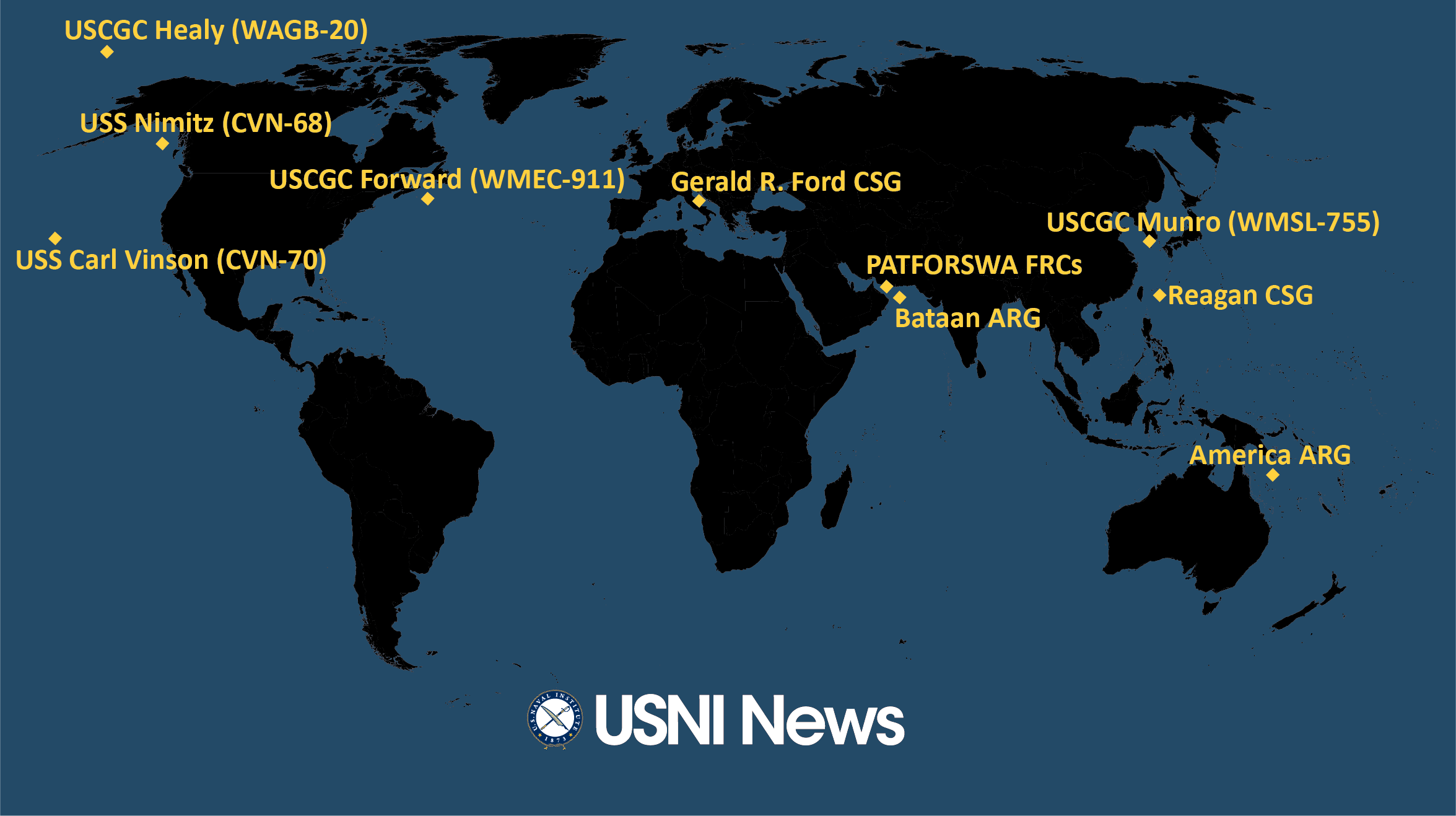
“USNI News Fleet and Marine Tracker: Aug. 21, 2023”

USCGC Munro (WMSL-755) escorts USNS Fisher (T-AKR-301) in the East China Sea on Aug. 12, 2023. US Navy Photo

Looking at the latest US Naval Institute “Fleet and Marine Tracker,” I am a bit surprised to see there are still 3 Navy ships operating under 4th Fleet, presumably doing drug interdiction. This is an uptick.

Again, they report on atypical Coast Guard operations:

  • Legend-class National Security Cutter USCGC Munro (WMSL-755) departed South Korea last week and is in the Korea Strait. (As I mentioned earlier, there is a possibility, cutters may encounter the new North Korean corvettes.)
  • Coast Guard Cutter USCGC Healy (WAGB-20) continues its work in the Beaufort Sea. Healy is on a five-month deployment in partnership with ONR and the National Science Foundation.
  • Coast Guard Cutter USCGC Forward (WMEC-911) is currently supporting Operation Nanook. Operation Nanook is an annual Canadian-led exercise that fosters international cooperation and shared responsibility in the Arctic and the northern Atlantic Regions. The cutter recently made a port call in Nuuk, Greenland.

You can use Control F “USCGC” if you want to quickly find the Coast Guard cutters mentioned in the USNI posts.

PATFORSWA is mentioned again.

The link in the Healy entry, “U.S., Canadian Icebreakers Conduct Operation, Rendezvous en Route to Arctic Ocean” is interesting, plus there is more in the USNI post including an “adorable” polar bear photo.

“USNI News Fleet and Marine Tracker: Aug. 14, 2023” –USNI

The US Naval Institute News Service “Fleet Marine Tracker” continues to report atypical Coast Guard activities. It continued to report on USCGC Healy’s Arctic deployment and mentioned PATFORSWA as they have since they have since they began including Coast Guard units in May.

This week, they included some activity I have not seen reported elsewhere.

“Legend-class National Security Cutter USCGC Munro (WMSL-755) departed Fleet Activities Yokosuka (CFAY) and is now in South Korea.”

“Coast Guard Cutter Forward (WMEC-911) is currently supporting Operation Nanook. Operation Nanook is an annual Canadian-led exercise that fosters international cooperation and shared responsibility in the Arctic and the northern Atlantic Regions.”

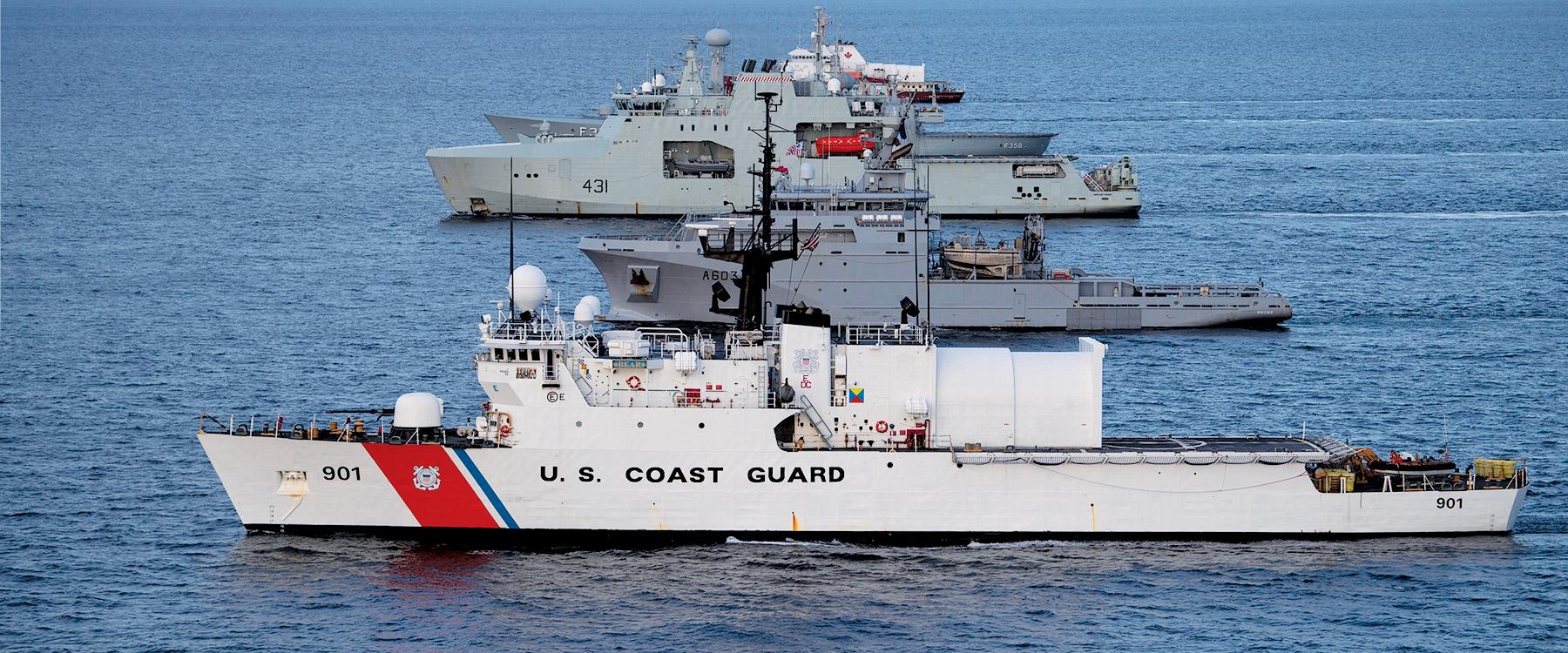
The USCGC Bear (WMEC-901) and allied ships from Canada, Norway, France, and Denmark steam in formation in the North Atlantic Ocean during last year’s Operation Nanook in August 2022. 

UNITAS 2023

I had expected that at least some Coast Guard units would participate in UNITAS 2023, July 11-21, given the Coast Guard’s prominent role in 4th Fleet, but I find no mention of CG participation.

Also bit disappointed we don’t have a listing of non-US units participating too.

Below is SOUTHCOM’s summary of the event. The incorporation of unmanned systems should have been very interesting.


Overview

UNITAS is an annual exercise conducted in Atlantic and Pacific waters around Central and South America. UNITAS LXIV included maritime and amphibious phases and, for the first time ever, included integrated operations of unmanned systems in the exercise. The exercise was held July 11-21, 2023, in Colombia.

The exercise develops and sustains relationships that increase the capacity of our emerging and enduring partners’ maritime forces to achieve common desired effects.

Training Scenarios

UNITAS’ challenging training addresses key aspects of multinational and combined operations such as technology standardization and common operating procedures. Training included scenarios addressing electronic warfare, anti-air warfare and air defense, anti-surface warfare, live fire, maritime interdiction, littoral operations, and amphibious operations.

UNITAS LXIV consisted of two concurrent phases: at sea and amphibious. The maritime domain included the littorals which incorporates not only the ocean, but also the area inland from the shore that can be supported and defended directly from the sea. The majority of the amphibious training took place along the coast where marines and naval infantry trained in support of greater naval operations. The amphibious phase consisted of riverine operations and culminated in a landing from naval vessels.

Unmanned Systems training: In April the Secretary of the Navy and the Chief of Naval Operations announced that the Navy will scale unmanned systems to the fleet level by operationalizing unmanned systems in the U.S. 4th Fleet area of operations. Specific to UNITAS LXIV, the Navy deployed and exercised several unmanned systems to enhance maritime domain awareness, conduct battle damage assessment in support of the UNITAS LXIV live-fire sink exercise, or SINKEX, and integrate unmanned system operations with partner nation navies. The deployment of multiple unmanned systems is new to UNITAS but will become the standard as NAVSOUTH/4th Fleet takes lessons learned to inform the Navy’s hybrid fleet coming in the next decade. Additionally, the U.S. Marine Corps employed unmanned systems in support of its Force Design 2030 concept and will refine tactics, techniques, and procedures (TTPs) to inform the service on operational employment.

Women, Peace and Security Symposium: UNITAS LXIV featured a forum on the topic of women, peace and security. The forum is part of a global effort to support the contributions of women in the defense and security sectors around the world. The program is a cornerstone to SOUTHCOM’s mission of promoting security partnerships across the Western Hemisphere.

Participating Countries

UNITAS LXIV featured 20 participating countries: Belize, Brazil, Canada, Chile, Colombia, Dominican Republic, Ecuador, France, Germany, Honduras, Jamaica, Mexico, Panama, Paraguay, Peru, Spain, South Korea, United Kingdom, Uruguay, and the United States.

Participating U.S. Forces

  • USS New York (LPD 21)
  • USS Cole (DDG 67)
  • USS Little Rock (LCS 9)
  • USS Pasadena (SSN 752)
  • USNS Burlington (T-EPF 10)
  • Patrol Squadron Five (VP 5)
  • Mobile Diving and Salvage Unit (MDSU) 2
  • Explosive Ordnance Disposal Mobile Unit (EOD) 612
  • Mine Countermeasures Group 3 (MCMGRU 3)
  • Expeditionary Mine Countermeasures EOD Company 61 (EODMU 61)
  • Helicopter Sea Combat Squadron 22 (HSC 22)
  • Helicopter Maritime Strike Squadron 70 Detachment 2 (HSM 70 Det 2)
  • Joint Communications Support Element (JCSE)
  • Fleet Surgical Team (FST) Eight
  • Meteorological Environmental Team (MET)
  • 3rd Battalion, 23rd Marine Regiment (3/23)
  • 4th Amphibious Assault Battalion (4th AABn)
  • 8th Combat Logistic Battalion (CLB 8)
  • 4th Combat Engineer Battalion (4th CEB)
  • Marine Medium Tiltrotor Squadron 774 (VMM 774)
  • Marine Light Helicopter Attack Squadron 775 (HMLA 775)
  • Marine Aerial Refueler Transport Squadron 234 (VMGR-234)
  • Marine Aircraft Control Group – 48 (MACG-48)
  • Marine Fighter Attack Squadron 112 (VMFA-112)
  • Commander, Destroyer Squadron 40 (COMDESRON 40)
  • Commander, Amphibious Squadron Four (COMPHIBRON FOUR)
  • U.S Marine Corps Forces South (MARFORSOUTH)
  • Special Operations Command South (SOCSOUTH)
  • U.S. Naval Forces Southern Command/U.S. 4th Fleet
  • U.S. Southern Command (USSOUTHCOM)

Background

UNITAS I took place in 1960 with forces from Argentina, Brazil, Chile, Colombia, Ecuador, Peru, Uruguay, the United States, and Venezuela. This year marks the 64th iteration of the world’s longest-running annual multinational maritime exercise. Additionally, this year Colombia celebrated the bicentennial of its navy, a historical milestone commemorating 200 years of the country’s maritime forces.

“UNITAS LXIV to begin in Colombia” –USNAVSOUTH/4TH FLEET PUBLIC AFFAIRS

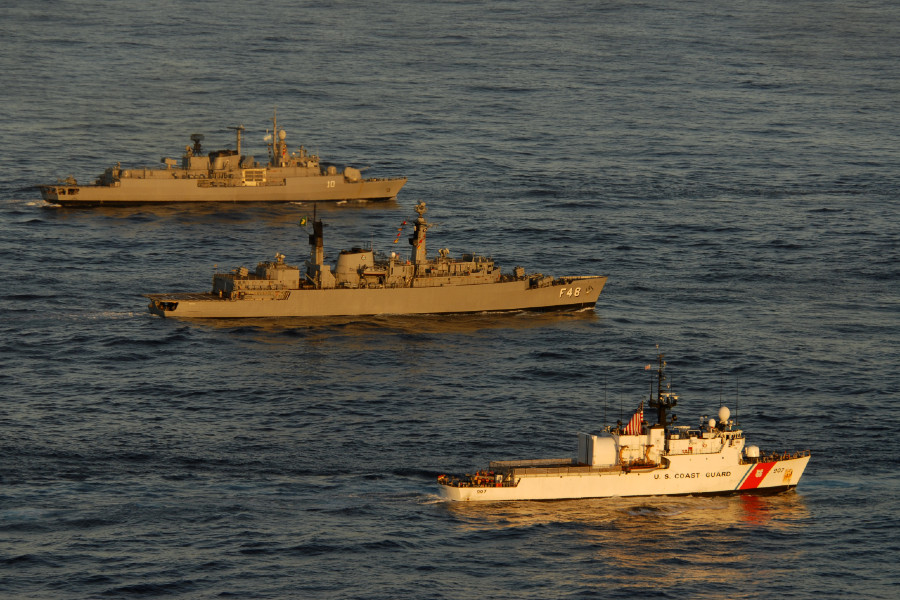
The US Coast Guard cutter USCGC Escanaba (WMEC 907), Brazlian Navy ship BNS Bosisio (F 48) and Argentinian navy ship ARA Almirante Brown (D-10) move into formation for a photo exercise during the Atlantic phase of UNITAS 52 on May 4, 2011. The formation included a total of ten ships from the US, Brazil, Mexico and Argentina. (Photo: US Navy/Mass Communication Specialist 1st Class Steve Smith)

Below is a news release announcing the start of exercise UNITAS LXIV (64 if you are not up on your Roman numerals). There is no mention of Coast Guard participation, but maybe they “simply forgot us.” Think we can bet there are some Coasties involved.

Britain’s Royal Navy also sent one of their highly regarded destroyers, HMS Dauntless.

With 26 surface vessels and three submarines participating, I think this is larger than most of the recent UNITAS exercises. In 2022 it was 19 ships, one submarine, 21 aircraft, accounting for approximately 5,500 total military personnel.

This year will see an attempt at large scale integration of unmanned systems into the exercise by 4th Fleet.


July 11, 2023

UNITAS LXIV to begin in Colombia

By USNAVSOUTH/4TH FLEET PUBLIC AFFAIRS

– U.S. Navy and Marine forces are set to arrive in Cartagena in support of UNITAS LXIV, the world’s longest-running multinational maritime exercise in the world, scheduled to start July 11, 2023.

The Colombian navy will host this year’s UNITAS, which will feature 26 warships/vessels, three submarines, 25 aircraft (fixed wing/helicopter), and approximately 7,000 people from 20 partner nations. Forces will conduct training operations off the coast of Cartagena, Colombia, and ashore in Covenas and Barranquilla, Colombia, through July 21. This year marks the 64th iteration of the exercise. Additionally, this year Colombia will celebrate the bicentennial of its navy, a historical milestone commemorating 200 years of the country’s maritime forces.

“UNITAS is so much more than a two week exercise. All participating nations have given much time, energy and effort into the months of planning leading up to what will be one of the most complex UNITAS to date,” said Rear Admiral Jim Aiken, commander U.S. Naval Forces Southern Command/U.S. 4th Fleet. “Utilizing air, surface, sub-surface, and unmanned assets, and land units, UNITAS will provide the multinational force a challenging environment in which to conduct training across the full spectrum of maritime operations. UNITAS strengthens maritime partnerships, enhances proficiency and improves interoperability of the participating forces, which is why so many partner nations are taking part this year.”

As part of the U.S. Navy’s future hybrid fleet, the Chief of Naval Operations has tasked U.S. 4th Fleet to scale unmanned platforms to the fleet level. An addition to this year’s UNITAS will include the integrated operations of unmanned air, surface, and subsurface systems into the exercise. UNITAS’ challenging training address key aspects of multinational and combined operations such as technology standardization and common operating procedures.

“This is our first opportunity to integrate unmanned systems into our operations at sea,” said Rear Adm. Aiken. “UNITAS has often served as a test bed for technology, so it is appropriate that we begin our unmanned integration campaign to operationalize the hybrid fleet here in UNITAS.”

In addition to the United States, UNITAS LXIV will bring together 19 nations from all over the world to train forces in joint maritime operations that enhance tactical proficiency and increase interoperability. Participating nations include Belize, Brazil, Canada, Chile, Colombia, Dominican Republic, Ecuador, France, Germany, Honduras, Jamaica, Mexico, Panama, Peru, Paraguay, Spain, South Korea, United Kingdom, United States, and Uruguay.

Following the UNITAS LXIV Opening Ceremony on July 12, the in port phase of the exercise will feature subject matter expert exchanges, professional symposia, ship rider exchanges, and operations meetings. During this time, Marines and Sailors will conduct expeditionary training events in Covenas to include riverine operations and diving and salvage operations.

During the UNITAS LXIV Underway Phase, forces will participate in events testing all warfare operations, to include live-fire exercises such as a SINKEX and an amphibious ship-to-shore landing and force retraction.

“Marines and Sailors from across the United States will travel to Colombia to not only train alongside our partner nations’ militaries, but to hone the skills required to operate as part of a larger maritime force focused on sea control and sea denial,” said Lt. Gen. David G. Bellon, commander, U.S. Marine Corps Forces, South, and U.S. Marine Corps Forces, Reserve. “We will be exercising command and control from a forward position as Marines set up and employ Expeditionary Advanced Base Operations to enhance naval capabilities as part of UNITAS.”

U.S. forces participating in UNITAS LXIV include USS New York (LPD 21), USS Cole (DDG 67), USS Little Rock (LCS 9), USS Pasadena (SSN 752), and USNS Burlington (T-EPF 10). Other U.S. participants include Patrol Squadron Five (VP 5), Mobile Diving and Salvage Unit (MDSU) 2, Explosive Ordnance Disposal Mobile Unit (EOD) 612, Mine Countermeasures Group 3, (MCMGRU 3), Expeditionary Mine Countermeasures EOD Company 61 (EODMU 61), East-coast based Naval Special Warfare units, Helicopter Sea Combat Squadron 22 (HSC 22), Helicopter Maritime Strike Squadron 70 Detachment 2 (HSM 70 Det 2), Joint Communications Support Element (JCSE), Fleet Surgical Team (FST) Eight, and the Meteorological Environmental Team (MET). U.S. Marine forces include 3rd Battalion, 23rd Marine Regiment (3/23), 4th Amphibious Assault Battalion (4th AABn), 8th Combat Logistic Battalion (CLB 8), 4th Combat Engineer Battalion (4th CEB), Marine Medium Tiltrotor Squadron 774 (VMM 774), Marine Light Helicopter Attack Squadron 775 (HMLA 775), Marine Aerial Refueler Transport Squadron 234 (VMGR-234), Marine Aircraft Control Group – 48 (MACG-48), and Marine Fighter Attack Squadron 112 (VMFA-112). Finally, Commander, Destroyer Squadron 40, (COMDESRON 40), Commander, Amphibious Squadron Four (COMPHIBRON FOUR), U.S Marine Corps Forces South (MARFORSOUTH), Special Operations Command South (SOCSOUTH), USNAVSOUTH/FOURTHFLT, and U.S. Southern Command (USSOUTHCOM) are participating in UNITAS LXIV.

UNITAS, which is Latin for unity, united, or oneness, was conceived in 1959 during a previous era of strategic competition when representatives at the first Inter-American Naval Conference in Panama agreed to conduct an annual maritime exercise with one another. Prior to UNITAS I in 1960, U.S. Chief of Naval Operations Adm. Arleigh Burke reviewed preparations for the multinational exercise. He commended planners for their progress, especially in building compatible communication systems among navies, and predicted that UNITAS would build strong relationships among Sailors of the Western Hemisphere.

U.S. Naval Forces Southern Command/U.S. 4th Fleet supports U.S. Southern Command’s joint and combined military operations by employing maritime forces in cooperative maritime security operations to maintain access, enhance interoperability, and build enduring partnerships in order to enhance regional security and promote peace, stability and prosperity in the Caribbean, Central and South American region.

U.S. Marine Corps Forces, South is the Marine Corps component to U.S. Southern Command, is responsible for planning exercises, operations, and overall Marine Corps support for the SOUTHCOM assigned area of responsibility.

CG in July 6 USNI Fleet and Marine Tracker, No Mention of UNITAS

The US Naval Institute News “Fleet and Marine Tracker” is continuing to plot the approximate locations of a few Coast Guard units. I first noticed this change in the May 22, 2023 edition.

The July 6 post reported.

U.S. Coast Guard Cutter Stratton (WMSL-752) is underway in the Western Pacific.

and

Coast Guard Cutter Eagle departed Funchal Madeira (Portugal) and is en route to Hamilton, Bermuda.

The post again acknowledged the existence of PATFORSWA. I guess this is going to be boiler plate for all future Fleet and Marine Tracker posts.

U.S. Coast Guard Sentinel-class Fast Response Cutters (FRCs) are forward-deployed to the region under Patrol Forces Southwest Asia (PATFORSWA). (Note this is a broken link–Chuck) PATFORSWA deploys Coast Guard personnel and ships alongside U.S. and regional naval forces throughout the Middle East. Initially deployed in 2003 to support Operation Iraqi Freedom, PATFORSWA is now a permanent presence based out of the Kingdom of Bahrain

What originally caught my eye, when I first saw this post, was the plotted position of USCGC Richard Snyder (WPC-1127), which placed her in the high Arctic, about 2000 miles North of where she was actually reported to be.

The U.S. Coast Guard Cutter Richard Snyder, a Sentinel Class cutter homeported at Atlantic Beach, N.C., teamed with Bermudian authorities this past week in patrols that included a focus on deterring maritime drug smugglers, according to local reports.

The report also reflects the start of the UNITAS 2023 Exercise (have not been able to find the official dates) with six Navy ships in 4th Fleet compared to a typical number of two. One or more Coast Guard cutters are probably involved in the exercise. The only participant I was able to identify was USS New York (LPD-21). Reportedly the exercise will include significant use of unmanned systems.

Coast Guard SAR units, particularly aviation units, get frequent recognition. I appreciate that they are giving Coast Guard surface units some recognition in these posts, but the few mentions don’t reflect the bulk of the work being done by Coast Guard ships.  Perhaps a simple statement of number of large cutters and number underway would be nice.

“U.S., Philippine, Japan Coast Guards conduct trilateral engagements in the Philippines” –DVIDS

(From left) Japan Coast Guard Vessel Akitsushima (PLH 32), U.S. Coast Guard Cutter Stratton (WMSL 752), Philippine Coast Guard vessels BRP Gabriela Silang (OPV 8301) and BRP Melchora Aquino (MRRV-9702) conduct a trilateral engagement in the South China Sea June 5, 2023. Stratton deployed to the Western Pacific to conduct engagements with regional allies and partner nations, reinforcing a rules-based order in the maritime domain. (U.S. Navy photo by Chief Petty Officer Brett Cote)

Passing along the Coast Guard Pacific Area release below, distributed by the Defense Video Information Distribution Service (DVIDS). An earlier post, “Philippine Coast Guard Will Hold First-Ever Trilateral Exercise with U.S., Japan” –USNI, provided information on the participating ships.


Story by Chief Petty Officer Matthew Masaschi,

06.09.2023

MANILA, Philippines — The U.S. Coast Guard Cutter Stratton (WMSL 752) and crew departed the Philippines Thursday following the first trilateral engagements between the U.S., Philippine, and Japan Coast Guards.

Stratton’s crew conducted professional exchanges and joint operations in port and at sea with the Japan Coast Guard Vessel Akitsushima (PLH 32) and the Philippine Coast Guard during Stratton’s months-long Indo-Pacific deployment.

Stratton, the Akitsushima and Philippine Coast Guard vessels Gabriela Silang, and Melchora Aquino spent three days at sea off the coast of Bataan, Philippines, executing simulated search-and-rescue scenarios, maritime law enforcement boardings, passing exercises, and formation maneuvering drills. Additionally, they conducted communications and signaling drills, crew professional exchanges and joint boat and air operations following their Manila port visit.

While in Manila, members from the three services conducted combined damage control training, executed cooperative mission planning and table-top exercises ahead of at-sea combined operations. They conducted crew exchanges and toured partner vessels, participated in a women-in-law-enforcement discussion panel, played in a basketball tournament, volunteered at a beach cleanup, visited a children’s hospital and gathered for social receptions.

“It was an honor for Stratton to come together with our Philippine and Japan Coast Guard allies to learn from each other, work together to address common challenges and enhance our interoperability for joint maritime operations,” said U.S. Coast Guard Capt. Brian Krautler, Stratton’s commanding officer. “The experiences gained from our multi-mission trilateral operations underway, our professional exchanges in port and the relationships forged over the last week have been invaluable enablers for the U.S. Coast Guard and our allies to secure a continued free and open Indo-Pacific.”

The multi-day trilateral engagement was named “Kaagapay,” a Filipino word meaning “standing side by side.”

The relationship between the United States Coast Guard and Philippine Coast Guard was built over many years of partnership between the two services. The relationship flourished through the Philippine cadet exchange program at the U.S. Coast Guard Academy, U.S. Coast Guard mobile training team deployments to the Philippines, Philippine Coast Guard Officer enrollment in the U.S. Coast Guard’s Maritime Law Enforcement Academy, engagements by U.S. Coast Guard Cutter Midgett and U.S. Coast Guard Cutter Munro in Manila in recent years and Stratton’s subsequent participation in the first trilateral USCG, PCG, and JCG training operation. The U.S. and Philippine Coast Guard’s partnership has solidified the commitment of both services to upholding a rules-based order in the maritime domain.

The engagement was another SAPPHIRE touchpoint between the U.S. and Japan Coast Guards. In 2022, Operation SAPPHIRE was established through a memorandum of cooperation between the U.S. and Japan Coast Guards as a perpetual operation to strengthen relationships, increase bilateral engagements, and focus on maintaining a free and open Indo-Pacific.

Operating under the tactical control of Commander, U.S. 7th Fleet, Stratton’s crew will engage in professional and subject matter expert exchanges with partners and allies throughout the Indo-Pacific during their months-long patrol to the region.

The U.S. Coast Guard maintains steadfast partnerships and strives for persistent presence in the Indo-Pacific region. Stratton’s current Indo-Pacific patrol is the cutter’s second patrol in the region and one of seven national security cutter deployments to the Indo-Pacific since 2019.

The Coast Guard provides expertise in all aspects of maritime governance, within the mission sets of: search and rescue; illegal, unreported, and unregulated fishing; maritime environmental response; maritime security; maritime domain awareness; maritime aviation operations; and humanitarian assistance and disaster relief.

Commissioned in 2012, Stratton is one of four Coast Guard legend-class national security cutters homeported in Alameda, California. National security cutters are 418-feet long, 54-feet wide, and have a 4,600 long-ton displacement. They have a top speed in excess of 28 knots, a range of 12,000 nautical miles, endurance of up to 90 days and can hold a crew of up to 170.

National security cutters feature advanced command and control capabilities, aviation support facilities, stern cutter boat launch and increased endurance for long-range patrols to disrupt threats to national security further offshore.

U.S. Coast Guard Pacific Area is responsible for U. S. Coast Guard operations spanning across six of the seven continents, 71 countries and more than 74 million square miles of ocean. It reaches from the shores of the West Coast of the United States to the Indo-Pacific, Eastern Pacific, Arctic and Antarctic regions. Pacific Area strives to integrate capabilities with partners to ensure collaboration and unity of effort throughout the Pacific.

“Philippine, US, Japanese coast guards carry out anti-terror drill in disputed waters” –Radio Free Asia

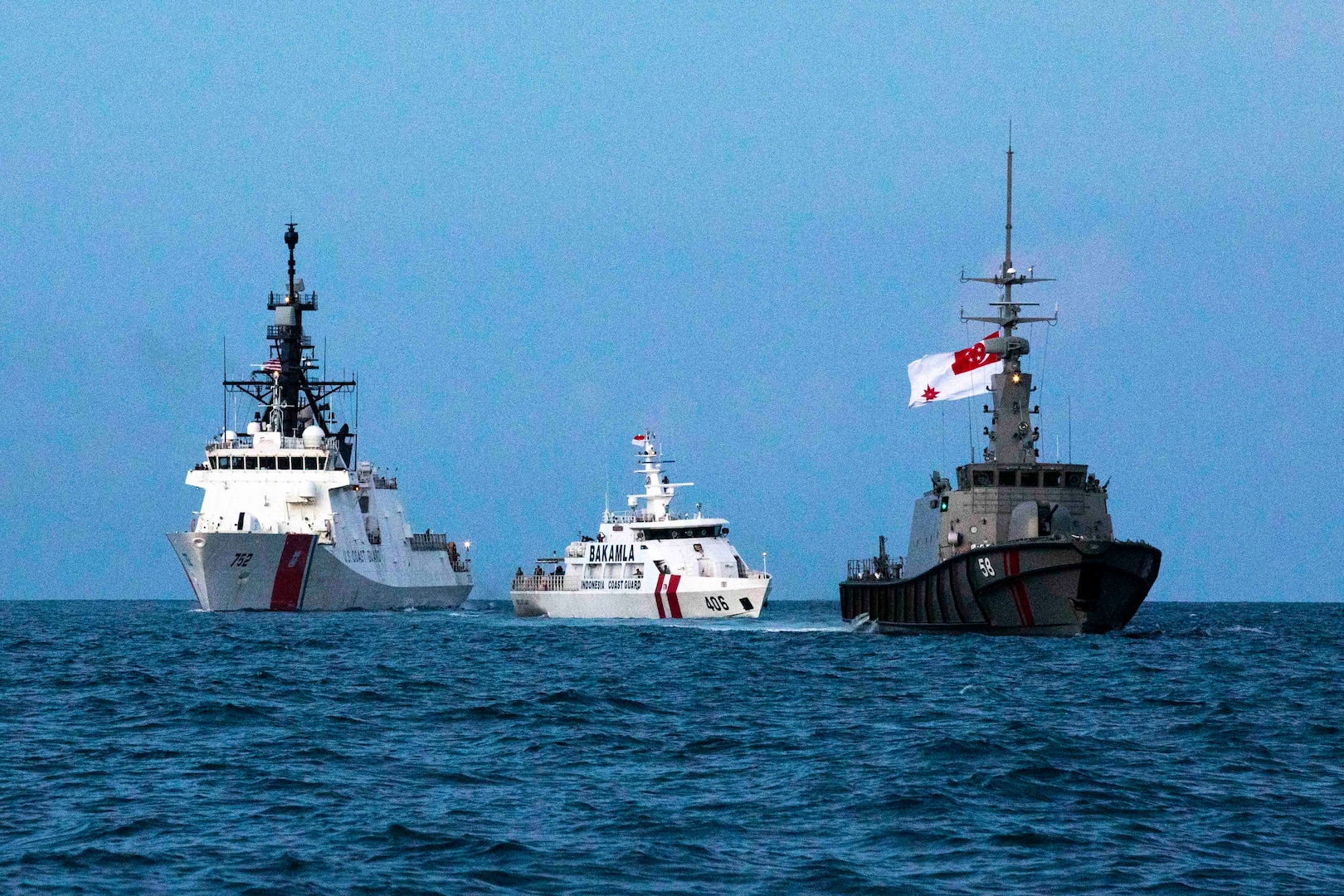
GlobalSecurity.Org has a report on a tri-lateral Counter-Terrorism exercise conducted by the US, Japan, and Philippine Coast Guards. This was part of an exercise discussed earlier. The USCGC Stratton was the USCG contingent. The photo above was taken a bit earlier and shows Stratton exercising with vessels from Indonesia and Singapore.

“Philippine Coast Guard Will Hold First-Ever Trilateral Exercise with U.S., Japan” –USNI

BRP Teresa Magbanua, sister ship of BRP Melchora Aquino (MRRV-9702), during sea trials off Japan (Photo: Philippine Coast Guard)

https://news.usni.org/2023/05/29/philippine-coast-guard-will-hold-first-ever-trilateral-exercise-with-u-s-japanThe US Naval Institute News Service reports, beginning 1 June,

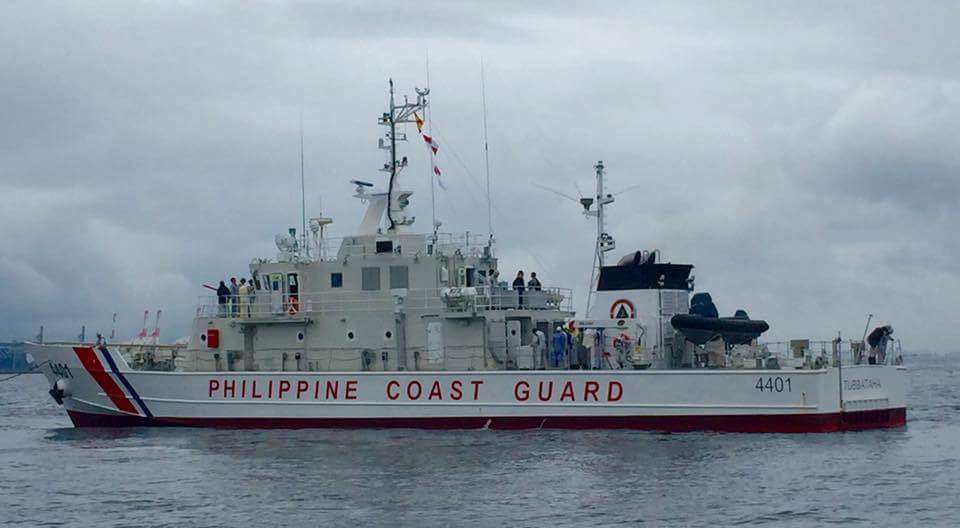
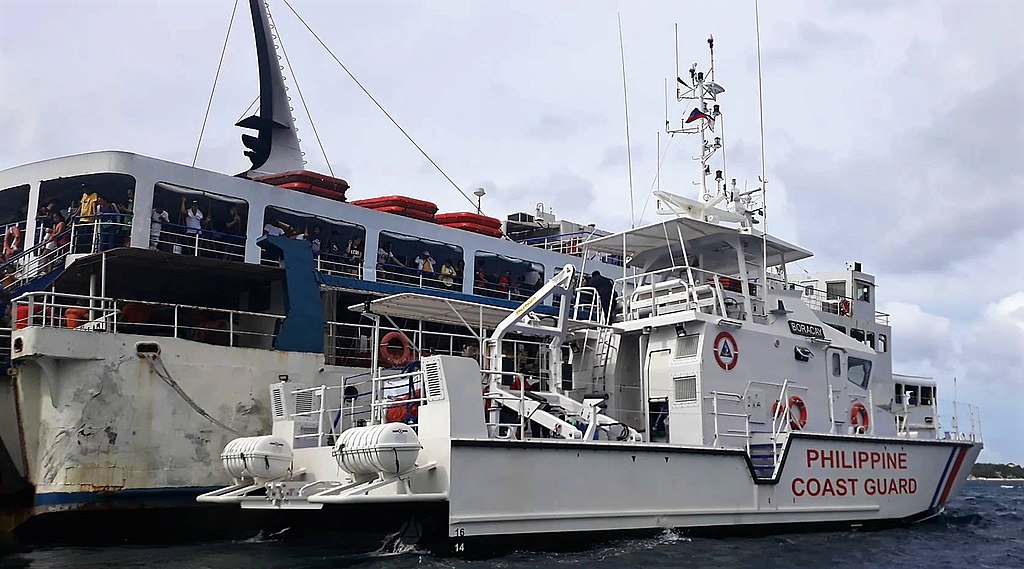
“BRP Melchora Aquino (MRRV-9702), BRP Gabriela Silang (OPV-8301), BRP Boracay (FPB-2401) and one 44-meter multi-role response vessel will conduct the exercise with National Security Cutter USGCC Stratton (WMSL-752) and Japanese patrol vessel Akitsushima (PLH-32).”

I will just provide some photos with links to the Wikipedia description of the vessels. Note none of the Philippine Coast Guard vessels have any permanently mounted weapons.

JCG_Akitsushima(PLH-32), 9,300 tons (full load), Port of Kobe, July 9, 2017. Photo credit: Hunini, via Wikipedia.

USCGC Stratton moored in San Diego, California. Photo by BryanGoff

BRP Gabriela Silang (OPV-8301) as it sails home to the Philippines. 3 May 2021. Photo: Philippine CG.

44-meter multi-role response vessel BRP Tubbataha during its delivery to the Philippine Coast Guard, Philippine CG PAO photo

BRP Boracay (FPB-2401), 23 October 2018, Philippine CG photo.