NSC and FRC Participate in Navy COMTUEX

USCGC Stone completes an Underway Replenishment.

The Navy League’s online magazine, Seapower, has a report on a recent Navy/Marine Composite Training Unit Exercise (COMPTUEX), “WASP ARG AND 24TH MEU COMPLETE JOINT FORCE’S MOST COMPLEX TRAINING,” that included an interesting note,

“U.S. Coast Guard Maritime Security Response Team (MSRT) East, USCGC Stone (WMSL 758), and USCGC Angela McShan (WPC 1135) participated in numerous events alongside the Navy and Marine Corps team to train and increase proficiency.”

I think this is a bit unusual, so it raised some questions in my mind. Training for doing LE boardings is normal and using a Coast Guard patrol craft to play an opposing force would not be that unusual, but the presence of USCGC Stone, a national security cutter (NSC), seems out of the ordinary. Is this just a one off or is there significance for Coast Guard Defense Readiness planning? Was this an experiment?

This particular COMTUEX was also otherwise unusual because an Amphibious Ready Group (ARG) does not normally have a destroyer attached.

So why would an NSC be involved? There are several possibilities, some mundane, some perhaps groundbreaking.

The post reports the training included, “events such as live-fire exercises, strait transits, maritime security exercises, amphibious landings, maritime interdiction, non-combatant evacuation operations, foreign humanitarian assistance, and counter-unmanned aerial systems (C-UAS) engagements.”

  • We know Stone did an Underway Replenishment.
  • There was an opportunity for formation steaming.
  • It may have been an opportunity to do some cross deck helicopter operations.
  • If Stone is to be included in the upcoming RIMPAC exercise (June and July), this would have been a good tune-up.

Now I will offer a couple of more imaginative, some will say imaginary, possibilities.

If an amphibious operation is conducted, Coast Guard units might provide SAR in case any of the landing craft are sunk. An NSC with Helicopter(s) would make a good SAR commander, while FRCs could follow the landing craft close into the beach, just as cutters did during the Normandy invasion.

Until recently, ARGs have generally operated without escort vessels. While operating off the hostile shore of a near peer adversary would probably require more than one AAW escort, there may have been a recognition that even during long transits from the West Coast, there may be a submarine threat.

The destroyer in this case, USS Cole (DDG 67), was a Burke class Flight I. When they were designed, they were expected to accompany aircraft carriers that had both fixed and rotary wing ASW aircraft in their air wing, so their design did not include helicopter hangars. The carrier based fixed wing aircraft are no longer active, and an ARG does not normally include ASW helicopters. Having seen National Security Cutters hosting Navy H-60s during the last two RIMPAC exercises, perhaps pairing an NSC with a Flight I Burke class DDG could provide a roost for ASW helicopters near the center of the formation while allowing the DDG greater flexibility in its positioning. The cutter could also function as plane guard, following the big deck amphib the way an escort is normally assigned to follow a carrier in case an aircraft goes into the water.

(During the Second Gulf War a WHEC assigned to a Carrier Strike Group functioned as plane guard and also provided a TACAN beacon because the one on the carrier was inoperative. All the other escorts had departed the scene to be in position to launch a Tomahawk missile strike.)

Changing of the Guard, WPC for WMEC

USCGC ALERT departing Astoria

Passing this along from the “Coast Guard Sea Duty Veterans” Facebook page. The post was by Bill James.


On Friday, 10 May, Cutter ALERT sailed beneath the Astoria-Megler bridge, crossed the Columbia River Bar, and proceeded south enroute to her new homeport of Cape Canaveral, Florida.
Simultaneously, the newly built CGC DAVID DUREN, one of the two 154’ USCG Sentinel Class cutters proceeded northward on its journey from Key West to its new homeport of Astoria, OR.
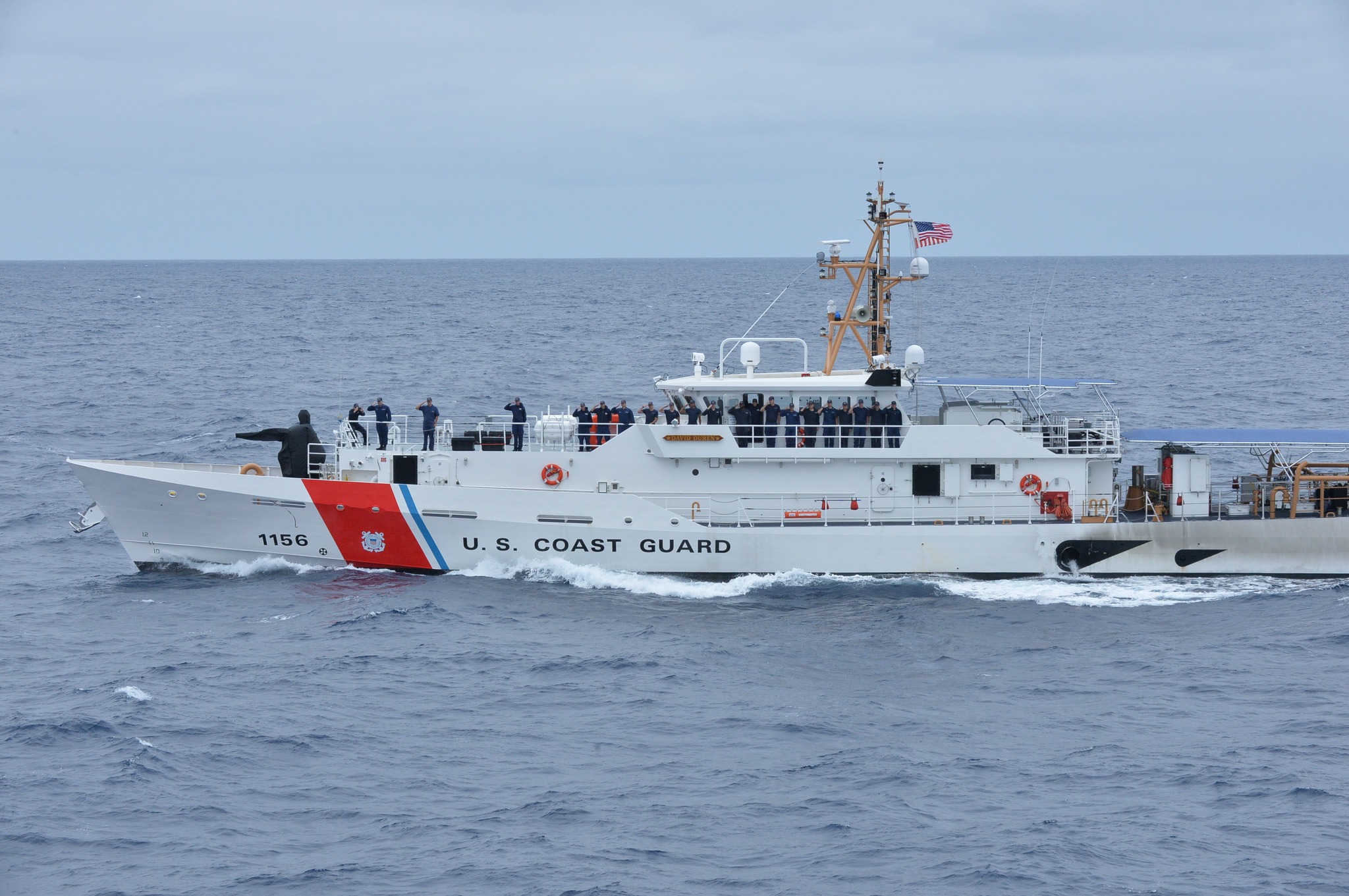
This Thursday, 16 May, the two cutters passed close abroad in the Eastern Pacific Ocean. DAVID DUREN rendered passing honors and ALERT returned the salute, thereby properly relieving ALERT’s 30-year watch to the first of two Sentinel Class Cutters to be stationed in Astoria.

USCGC DAVID DUREN (WPC-1156) Renders Passing Honors

“How Fast Response Cutters Have Transformed Coast Guard Operations In Guam” –Naval News / What About Air Assets?

The crew of USCGC Oliver Henry (WPC 1140) arrives in Pohnpei, Federated States of Micronesia, on Feb. 1, 2024, to download supplies for delivery to the outer islands of the FSM to combat the effects of a current drought. The supplies included 2,000 lbs of rice, three medical kits, 70 gallons of bottled water, and boxes of paper products. (Photo courtesy of U.S. Embassy Kolonia)

Naval News has an excellent article reviewing the additional capabilities Webber class FRCs have provided. It also highlights the vast operating area and associated challenges including necessary maintenance.

U.S Coast Guard Forces Micronesia Sector Guam’s AOR is based on Guam Search and Rescue Region. (U.S Coast Guard Navigation Center) Around 3 million square kilometers or 1.9 million square miles and includes the entirety of Palau, the Federated States of Micronesia, and Republic of the Marshall Islands.

For scale, the distance from the bottom of the area above to the top is 1020 nautical miles. According to the post, “It’s [an area] two thirds the size of the continental United States that we patrol with three ships and 300 people,” (I suspect that was in reference to the Contiguous 48, but it’s a huge area.)

ASSETS:

Something that should not be missed is that the only normally available rotary wing assets in the area are a squadron of Navy MH-60S, and there are no fixed wing SAR or law enforcement assets in the region. If an extensive search is required for any reason, it usually means flying a C-130J over 3,400 nautical miles down from Coast Guard Air Station Barbers Point, Hawaii just to get to Guam.

Major Cutters do occasionally cruise these waters, but it is rare. There is also a 225 foot buoy tender homeported in Guam.

Hopefully these waters will see USCGC Harriet Lane frequently, but on her first Western Pacific patrol, it did not appear she deployed with a helicopter (I believe Barbers Point has only three). Being one of the first four 270s that were built by Tacoma Boat, her flight deck is not strong enough to support the Navy MH-60S so they could not even us her flight deck to extend their range, much less operate from the ship.

Most of the time, there will only be one Coast Guard surface vessel underway in this vast area. Assets are still too few to provide any degree of persistence as a deterrent to Illegal, Unreported, or Unregulated (IUU) fishing. Any vessels involved in IUU fishing would likely have a good idea where our cutters are operating and with no fixed wing search aircraft, our ability to search for IUU perpetrators is extremely limited.

In addition to more cutters, we really need good maritime domain awareness, probably meaning some kind of long-range search aircraft, manned or unmanned, operating routinely in this area. We might consider basing C-27Js in Guam. It is a long way from USCG support, but the Australian Air Force also flies C-27Js, so there might be some synergy there.

“Coast Guard to commission new ship in New London, Connecticut”

USCGC MELVIN BELL (WPC-1155) Photo by: Petty Officer 2nd Class Briana Carter VIRIN: 240131-G-HT254-1095.JPG

Below is a Coast Guard news release. This may be the first time many cadets will get an opportunity to see a Webber class WPC. Note the approximately four and a half months between delivery and commissioning. The next two FRCs will go to Astoria, Oregon.


March 25, 2024

MEDIA AVAILABILITY: Coast Guard to commission new ship in New London, Connecticut

WHO: Rear Adm. John W. Mauger, the First Coast Guard District commander, Lt. Patrick Kelly, the Coast Guard Cutter Melvin Bell (WPC-1155) commanding officer, Rita Mayer, the cutter’s sponsor, along with additional Bell family members.
WHAT: Commissioning Ceremony for Coast Guard Cutter Melvin Bell
WHEN: Thursday, March 28, at 10:00 a.m.
WHERE: Coast Guard Academy at 31 Mohegan Ave Pkwy, New London, CT 06320.

Editor’s Note: Media interested in attending must RSVP to D1PublicAffairs@uscg.mil by 8 a.m. Wednesday to gain access to the ceremony.

New London, CT. — The Coast Guard Cutter Melvin Bell (WPC-1155) is scheduled to be commissioned during a ceremony Thursday at 10 a.m. at the Coast Guard Academy in New London.

The Coast Guard’s newest cutter was accepted by the Coast Guard on November 16, 2023, and will be the sixth and final fast response cutter homeported in Boston.

The Sentinel-class fast response cutter (FRC) is designed for multiple missions, including drug and migrant interdiction; ports, waterways and coastal security; fishery patrols; search and rescue; and national defense. The Coast Guard has ordered a total of 65 FRCs to replace the 1980s-era Island-class 110-foot patrol boats. The FRCs feature advanced command, control, communications, computers, intelligence, surveillance and reconnaissance equipment; over-the-horizon cutter boat deployment to reach vessels of interest; and improved habitability and seakeeping.

All Coast Guard fast response cutters are named after an enlisted Coast Guard hero who distinguished themselves in the line of duty. Melvin Kealoha Bell was a master chief electronics technician and served in the Coast Guard from November 1938 to December 1958. ETCM Melvin Bell distinguished himself during World War II by transmitting the first warning messages to military installations in Pearl Harbor on the morning of December 7, 1941, when the Japanese attacked. He continued to prove instrumental throughout the war as he helped break enemy codes leading to numerous victories, including the Battle of Midway and in an operation to break up a Nazi espionage network in New York City. ETCM Bell became the first Pacific Islander to achieve the rank of chief petty officer, the first master chief electronics technician and the first master chief petty officer of color.

“Coast Guard Cutter Procurement: Background and Issues for Congress, Updated March 25, 2024” –CRS

USCGC David Duren is the first of three FRCs to be homeported in Astoria, OR

The Congressional Research Service (CRS) has again updated their “Report to Congress on Coast Guard Cutter Procurement”. (This link will always take you to the most recent edition of the report.) My last post on this evolving document was in reference to the October 19,2023 update. I have reproduced the one-page summary in full below. It gives a good picture of where we are. (The CRS report on icebreakers has also been updated.)

There have been other updates in the interim, but I have been looking forward to this one because it reports the 2024 budget as enacted into law, and (surprise, surprise) it includes two Fast Response Cutters that were not in the 2024 budget request. From page 35,

“Enacted The explanatory statement for Division C of H.R. 2882/P.L. 118-47 of March 23, 2024, provides the funding levels shown in the “Enacted” column of Table 1. The explanatory statement states that the increase of $200.0 million for the FRC program is for “no less than two Fast Response Cutters and the economic price adjustment for Fast Response Cutters funded in prior years”.”

There was a request for four additional FRCs in the Unfunded Priorities List. The House Appropriations Committee had wanted to fund four ($355M) while the Senate Appropriations Committee approved none. Apparently, they compromised. (Nice to see bipartisan support.)

Two Additional FRCs ($216M) are also in the 2025 budget request. (The appropriation amounts include addition funds for FRC program support over and above shipyard construction costs.)

If you do the math, you will see that there has been a departure from the original “Program of Record” (8 NSCs, 25 OPCs, and 58 FRCs for 91 total). The current program will provide 11 NSCs, 25 OPCs, and 67 FRCs (one of which severely damaged in a fire) for a total of 102 operations ships, 104 if we get the two additional FRCs in the FY2025 budget.

While this may look like a large gain, the number of large patrol cutters (36 over 1000 tons) is well below historical norms (=>41), while demands on the cutter fleet have grown substantially, no OPCs have been actually delivered, and the entire WMEC fleet is already well overage.


Summary
The Coast Guard’s program of record (POR), which dates to 2004, calls for procuring 8 National Security Cutters (NSCs), 25 Offshore Patrol Cutters (OPCs), and up to 71 Fast Response Cutters (FRCs) as replacements for 90 aging Coast Guard high-endurance cutters, medium-endurance cutters, and patrol craft.

National Security Cutters are the Coast Guard’s largest and most capable general-purpose cutters; they are replacing the Coast Guard’s 12 Hamilton-class high-endurance cutters. NSCs have an estimated average procurement cost of about $670 million per ship. Congress has fully funded the procurement of 11 NSCs—three more than the 8 in the Coast Guard’s POR. The Coast Guard’s proposed FY2024 budget requested $17.1 million in procurement funding for the NSC program. The Coast Guard’s proposed FY2025 budget requests $7.0 in procurement funding for the NSC program, and the Coast Guard’s FY2025 Unfunded Priorities List (UPL) includes an item for an additional $50.0 million in procurement funding for activities relating to the 11th NSC. Nine NSCs have entered service; the Coast Guard accepted delivery of the 10th on October 13, 2023, and plans to commission it into service in 2024. The 11th is under construction.

Offshore Patrol Cutters are intended to replace the Coast Guard’s 29 aged medium-endurance cutters. Coast Guard officials describe the OPC program and the Polar Security Cutter (PSC) program (which is covered in another CRS report) as the service’s highest acquisition priorities. The first four OPCs are being built by Eastern Shipbuilding Group (ESG) of Panama City, FL. The Coast Guard held a full and open competition for a new contract to build the next 11 OPCs (numbers 5 through 15). On June 30, 2022, the Coast Guard announced that it had awarded a fixed-price incentive (firm target) contract to Austal USA of Mobile, AL, to produce up to 11 offshore patrol cutters (OPCs). The Coast Guard’s proposed FY2024 budget requested $579.0 million in procurement funding for the construction of the sixth OPC and other OPC program costs. The Coast Guard’s proposed FY2025 budget requests $530.0 million in procurement funding for the construction of (once again) the sixth OPC and other OPC program costs, and states that the requested FY2024 procurement funding would now be for the construction of the fifth OPC rather than the sixth.

A June 2023 Government Accountability Office (GAO) report on the OPC program states “The OPC’s total acquisition cost estimate increased from $12.5 billion to $17.6 billion between 2012 and 2022…. In addition, the program incurred a 1.5-year delay in the delivery of the first four OPCs…. GAO also found indicators that the shipbuilder’s significant level of complex, uncompleted work may lead to further delays.”

Fast Response Cutters are considerably smaller and less expensive than OPCs; they are replacing the Coast Guard’s 49 aging Island-class patrol boats. The Coast Guard’s FY2020 budget submission estimated the total acquisition cost of the 58 cutters intended for domestic use at $3.748 billion, or an average of about $65 million each. A total of 65 FRCs have been procured through FY2023. As of March 25, 2024, 54 FRCs have been commissioned into service. The Coast Guard’s proposed FY2024 budget requested $20.0 million in procurement funding for the FRC program, and the Coast Guard’s FY2024 UPL included an item for $400.0 million in procurement funding for procuring four more FRCs at an average cost of $100 million each, to provide increased Coast Guard presence and engagement with allied and partner countries in the Indo-Pacific region. The Coast Guard’s proposed FY2025 budget requests $216.0 million in procurement funding for the FRC program for the procurement of two more FRCs for operations in the Indo-Pacific region, plus additional FRC program costs.

“BOLLINGER SHIPYARDS DELIVERS US COAST GUARD CUTTER DAVID DUREN (FRC 1156) TO U.S. COAST GUARD” –Bollinger News Release

USCGC David Duren is the first of three FRCs to be homeported in Astoria, OR

Below is a Bollinger news release.

This delivery is a little more than 16 weeks after the delivery of USCGC Melvin Bell (WPC-1155) on November 16, 2023. There are still nine more on order, and the FY 2025 budget request asks for two more. The Coast Guard has said all 65 on order will be delivered by 2025, but that seems unrealistic. Delivery rates have generally been five per year or less, and it appears there will be only three in 2024. Looks like deliveries will extend into at least 2026.

The next Fast Response Cutter, the future USCGC Florence Finch (WPC-1157) will also go to Astoria and is expected to be delivered June 13, 2024. Sector Columbia River will have to wait a bit for their third FRC since WPC-1158 is expected to go to Kodiak with delivery expected October 24, 2024.

As noted below, deliveries are made at Key West. Typically, it has been about three months from delivery to commissioning of units this class.


LOCKPORT, La., — (March 18, 2024) – Bollinger Shipyards (“Bollinger”) recently delivered the USCGC David Duren to the U.S. Coast Guard in Key West, Florida. This is the 182nd vessel Bollinger has delivered to the U.S. Coast Guard over a 35-year period and the 56th Fast Response Cutter (“FRC”) delivered under the current program.

“We’re incredibly proud to deliver the USCGC David Duren, the first of three Fast Response Cutters to be homeported in Astoria, Oregon,” said Bollinger President & CEO Ben Bordelon. “We’re confident that pound for pound, the quality and capabilities of the FRC platform are unmatched and that this vessel will outperform its mission requirements and expectations in the challenging conditions where it will operate in the Pacific Northwest. Our unique experience building for the Coast Guard is unparalleled and has shown time and time again that we successfully deliver the highest quality vessels on a reliable, aggressive production schedule. We look forward to continuing our historic partnership with the U.S. Coast Guard.”

The USCGC David Duren will be the first of three FRCs to be homeported in Sector Columbia River, which is known as “The Protectors of the Pacific Northwest.” The sector is responsible for coastal safety, security, and environmental protection, as well as protecting and securing vital infrastructure, rescuing mariners in peril at sea, enforcing federal law, maintaining navigable waterways, and responding to all hazards impacting the maritime transportation system along the Oregon coast.

As the U.S. Congress continues to debate Fiscal Year 2024 government funding, the future of the Fast Response Cutter Program remains uncertain. While the House Homeland Security Appropriations Bill included funding for four new FRCs, the Senate bill did not include funding for any new vessels. The prospect for a year-long Continuing Resolution (CR) at last year’s funding level introduces a critical level of uncertainty, as funding levels continue to lag behind the meteoric rise in raw material and input costs. The Coast Guard’s Fiscal Year 2025 Budget to Congress includes procuring two more FRCs to provide increased Coast Guard presence and engagement with allied and partner countries in the Indo-Pacific region. Last year, Adm. Linda Fagan, the Commandant of the U.S. Coast Guard, said, “The Indo-Pacific is clearly a consequential region for America’s future. The United States Indo-Pacific Strategy identifies an expanded role for the U.S. Coast Guard as a top Administration priority as we seek to ensure a region that is free and open. The U.S. Coast Guard will continue its long history of operational presence in the region with additional cutter patrols and deployable specialized forces.”

Each FRC is named for an enlisted Coast Guard hero who distinguished themselves in the line of duty. Boatswain’s Mate Master Chief David N. Duren was one of the most iconic figures in the history of Coast Guard surfmen. Considered perhaps the finest boat driver in the history of the modern Coast Guard, he is remembered by his shipmates and mentees not only for his expertise in seamanship, but also for his leadership and character. Between 1979 and 1983, Duren deployed on search and rescue cases more frequently than any other officer-in-charge and, in one year, executed over 250 cases. During this tour, Duren received two Coast Guard Medals for exceptional heroism, and the Douglas A. Munro Inspirational Leadership Award. Perhaps more remarkable was the fact that the personnel under his watch at Depoe Bay earned a total of 24 medals and awards.

ABOUT THE FAST RESPONSE CUTTER PLATFORM

The FRC is an operational “game changer,” according to senior Coast Guard officials. FRCs are consistently being deployed in support of the full range of missions within the United States Coast Guard and other branches of our Armed Services due to its exceptional performance, expanded operational reach and capabilities, and ability to transform and adapt to the mission. FRCs have conducted operations as far as the Marshall Islands—a 4,400 nautical mile trip from their homeport. Measuring in at 154 feet, FRCs have a flank speed of 28 knots, state of the art C4ISR suite (Command, Control, Communications, Computers, Intelligence, Surveillance, and Reconnaissance), and stern launch and recovery ramp for a 26-foot, over-the-horizon interceptor cutter boat.

ABOUT BOLLINGER SHIPYARDS

Bollinger Shipyards (www.bollingershipyards.com) has a 78-year as a leading designer and builder of high-performance military patrol boats and salvage vessels, research vessels, ocean-going double hull barges, offshore oil field support vessels, tugboats, rigs, lift boats, inland waterways push boats, barges, and other steel and aluminum products from its new construction shipyards as part of the U. S. industrial base. Bollinger has 13 shipyards, all strategically located throughout Louisiana and Mississippi with direct access to the Gulf of Mexico, the Mississippi River and the Intracoastal Waterway. Bollinger is the largest vessel repair company in the Gulf of Mexico region.

Teledyne FLIR Defense Unveils Advanced Thermal Weapon Sight at SHOT Show in Las Vegas” –News release

Below is a news release. Sorry that this is late, but I think still interesting. More on the system from Army Times here.

I am particularly concerned about the fact that the PATFORSWA‘s six FRCs have only .50 cal. machine guns to defend the vessels from attacks coming up the stern. While we have seen some indication, they may have been given improved sights (this looks like a lead computing sight), but as far as we know, those weapons have only iron sights. In view of the possibility of swarming surface and drone attacks, I would hope for some improvements. I would like to see remote weapon stations and/or APKWS, but if not, then at least improvements in the protection of the gunner and his ability to take out the maximum number of targets with the minimum number of rounds. Hopefully they will not have to stop to reload in the middle of an engagement.

Spray and pray is just not a good answer.

There are a number of improvements that might be beneficial. A sight like this would help with initial target detection and minimize the number of wasted rounds, especially at night. 

Not doubt it could improve the potential of any Coast Guard machine guns used for force protection or Ports, Waterways, and Coastal Security. It would improve the likelihood of effective disabling fire and minimize the probability of collateral damage.


New ThermoSight® HISS-HD is the ultimate sniper sight for precision shooters;

Can detect, identify and engage targets, day or night, at more than 2,200 meters

LAS VEGAS, January 23, 2024 ― Teledyne FLIR Defense, part of Teledyne Technologies Incorporated (NYSE:TDY), today unveiled its new long-range cooled thermal sniper sight, the ThermoSight® HISS-HD, at this week’s annual SHOT Show in Las Vegas. The lightweight, high-performance thermal weapon sight allows precision shooters to detect, identify and engage targets more than 2,200 meters away with unparalleled accuracy.

Designed for seamless integration, the HISS-HD clip-on thermal weapon sight easily mounts on any MIL-STD-1913 rail interface in front of an existing scope. HISS-HD can interface with various day scopes and weapon platforms, offering long-range optics and a high-definition display that delivers exceptionally clear imagery for snipers and machine gun crews.

“The new ThermoSight HISS-HD is the unmatched choice for precision shooters looking for a versatile, lightweight thermal sight that increases their range and accuracy,” said Rob Tarantino, vice president of Surveillance Strategy and Development at Teledyne FLIR Defense. “With HISS-HD, we’ve leveraged our world-class thermal imagiing technology to provide marksmen with a superior tool to identify and engage targets anywhere, in any environment.”

HISS-HD is an ideal option for long range snipers and missions involving reconnaissance, force protection, surveillance, and forward observation. With the added flexibility of an optional remote-control pendant, the HISS-HD enhances shooting stability, reduces revealing movements, and is configured for remote observation. This unique combination of stand-off range and long-range target engagement empowers shooters with unrivaled overmatch capability in any operational scenario.

“CENTCOM (USCGC Clarence Sutphin Jr.) Intercepts Iranian Weapons Shipment Intended for Houthis” –U.S. Central Command Public Affairs –U.S. Central Command Public Affairs

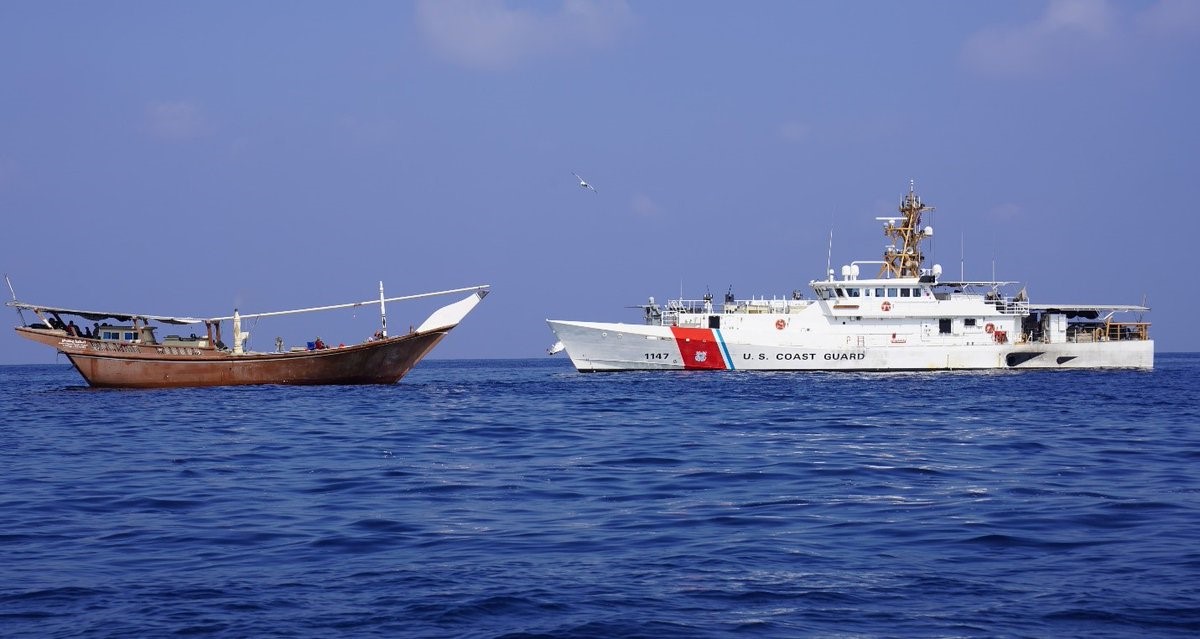
Feb 15, 2024 ,U.S. 5TH FLEET – The U.S. Coast Guard Sentinel-class fast-response cutter USCGC Clarence Sutphin Jr. (WPC 1147) seizes a vessel carrying military-grade weapons and other lethal supplies in the Arabian Sea, Jan. 28. Clarence Sutphin Jr. operates in the U.S. 5th Fleet area of operations to help ensure maritime security and stability in the Middle East region.

Below is a US Central Command news release

Feb 15, 2024, U.S. 5TH FLEET – Military-grade weapons and other lethal supplies are stacked on the deck of a vessel seized by the U.S. Coast Guard Sentinel-class fast-response cutter USCGC Clarence Sutphin Jr. (WPC 1147) in the Arabian Sea, Jan. 28. Clarence Sutphin Jr. operates in the U.S. 5th Fleet area of operations to help ensure maritime security and stability in the Middle East region.

A U.S. Coast Guard cutter, forward deployed to the U.S. Central Command (CENTCOM) area of responsibility, seized advanced conventional weapons and other lethal aid originating in Iran and bound to Houthi-controlled areas of Yemen from a vessel in the Arabian Sea on Jan. 28.

The U.S. Coast Guard Sentinel-class fast-response cutter USCGC Clarence Sutphin Jr. (WPC 1147), assigned to U.S. Naval Forces Central Command, located the vessel and boarded it in the Arabian Sea. The boarding team discovered over 200 packages that contained medium-range ballistic missile components, explosives, unmanned underwater/surface vehicle (UUV/USV) components, military-grade communication and network equipment, anti-tank guided missile launcher assemblies, and other military components.

The direct or indirect supply, sale or transfer of such aid violates U.N. Security Council Resolution 2216 (as extended and renewed by resolutions 2675 and 2707).

“This is yet another example of Iran’s malign activity in the region,” said Gen. Michael Erik Kurilla, CENTCOM commander. “Their continued supply of advanced conventional weapons to the Houthis is in direct violation of international law and continues to undermine the safety of international shipping and the free flow of commerce.”

CENTCOM is committed to working with our allies and partners to counter the flow of Iranian lethal aid in the region by all lawful means including U.S. and U.N. sanctions and through interdictions.

“U.S. Approves Potential $3.9B MQ-9B UAV Sale to India” –USNI

An MQ-9 Sea Guardian unmanned maritime surveillance aircraft system flies over the Pacific Ocean during U.S. Pacific Fleet’s Unmanned Systems Integrated Battle Problem (UxS IBP) 21, April 21. UxS IBP 21 integrates manned and unmanned capabilities into challenging operational scenarios to generate warfighting advantages. US Navy Photo

The US Naval Institute News Service reports,

The State Department greenlit a potential $3.9 billion deal of General Atomics MQ-9B drones to India today…The proposed package for the Indian military includes 31 SkyGuardian unmanned aerial vehicles, 310 Small Diameter Bombs and 170 Hellfire missiles. Associated radars and anti-submarine equipment for the maritime-focused SeaGuardian variant, a derivative of the SkyGuardian, were also included.

It appears, India will join Allies Australia, Belgium, Canada, Italy, Japan (Coast Guard and Maritime Self Defense Force), the Netherlands, and the UK as operators of the MQ-9 for Maritime Domain Awareness.

$3.9B is a scary number if you are the Coast Guard, but this is a large, comprehensive, and probably multi-year procurement, probably including training and support. This is also a joint service procurement with the Indian Air Force getting eight aircraft, the Indian Army eight, and the Indian Navy sixteen.

This is what the US Coast Guard Acquistions Directorate (CG-9) says about Land-based UAS,

“The Coast Guard has validated a mission need for land-based UAS to significantly enhance ocean surveillance in support of the service’s operations. Coast Guard land-based UAS flight crews are jointly operating maritime-variant Predator UAS (Guardian) on maritime missions with Customs and Border Protection to enhance the Coast Guard’s understanding of potential land-based UAS solutions and support the development of a land-based UAS requirements package.”

That sounds suspiciously like, we are doing the same thing we have been doing for what, the last two decades? I can understand the hesitance to get into land based UAS before Sense and Avoid systems, allowing Remotely Piloted Air Systems (RPAS) to operate in the national airspace, were developed, but they are available now. Time to move on this.

We don’t have to jump in with both feet. We can do what we are still doing with Scan Eagle and use contractor owned and operated systems, but let’s at least see what the latest systems can do for us.

Maybe a detachment of land based UAS like the MQ-9B Sea Guardians in Florida or Puerto Rico, where they can support the 20 Webber class District 7 FRCs that do not have organic air assets.

“Fast Response Cutter Laydown, Report to Congress, November 15, 2023” –USCG

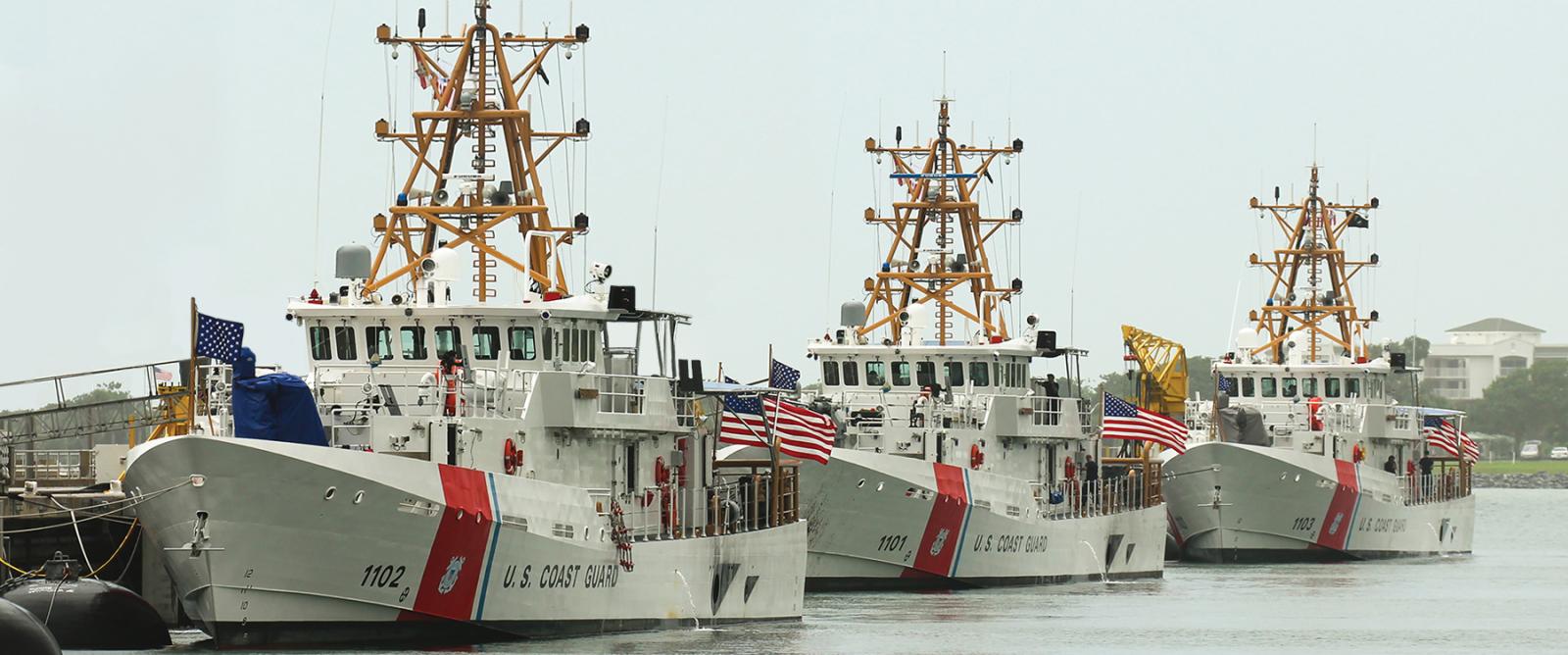
The first three fast response cutters—the USCGC Richard Etheridge (WPC-1102), Bernard C. Webber (WPC-1101), and William Flores (WPC-1103).
U.S. COAST GUARD

Just wanted to alert anyone interested to the existence of this document.

Don’t think there are any real surprises here, but homeports are a bit more complete than the Wikipedia information.

It does further clarify the fate of USCGC Benjamin Dailey (WPC-1123) that suffered a fire while in dry dock. The ship was found beyond economical repair, decommissioned, and is stored awaiting ultimate disposition. That means that the current plan is for 64 operational FRCs with a request outstanding for four more. It may mean at least one of the future FRCs will be based in Pascagoula, as a replacement.