Coast Guard Polar Icebreaker Modernization: Background and Issues for Congress–Updated

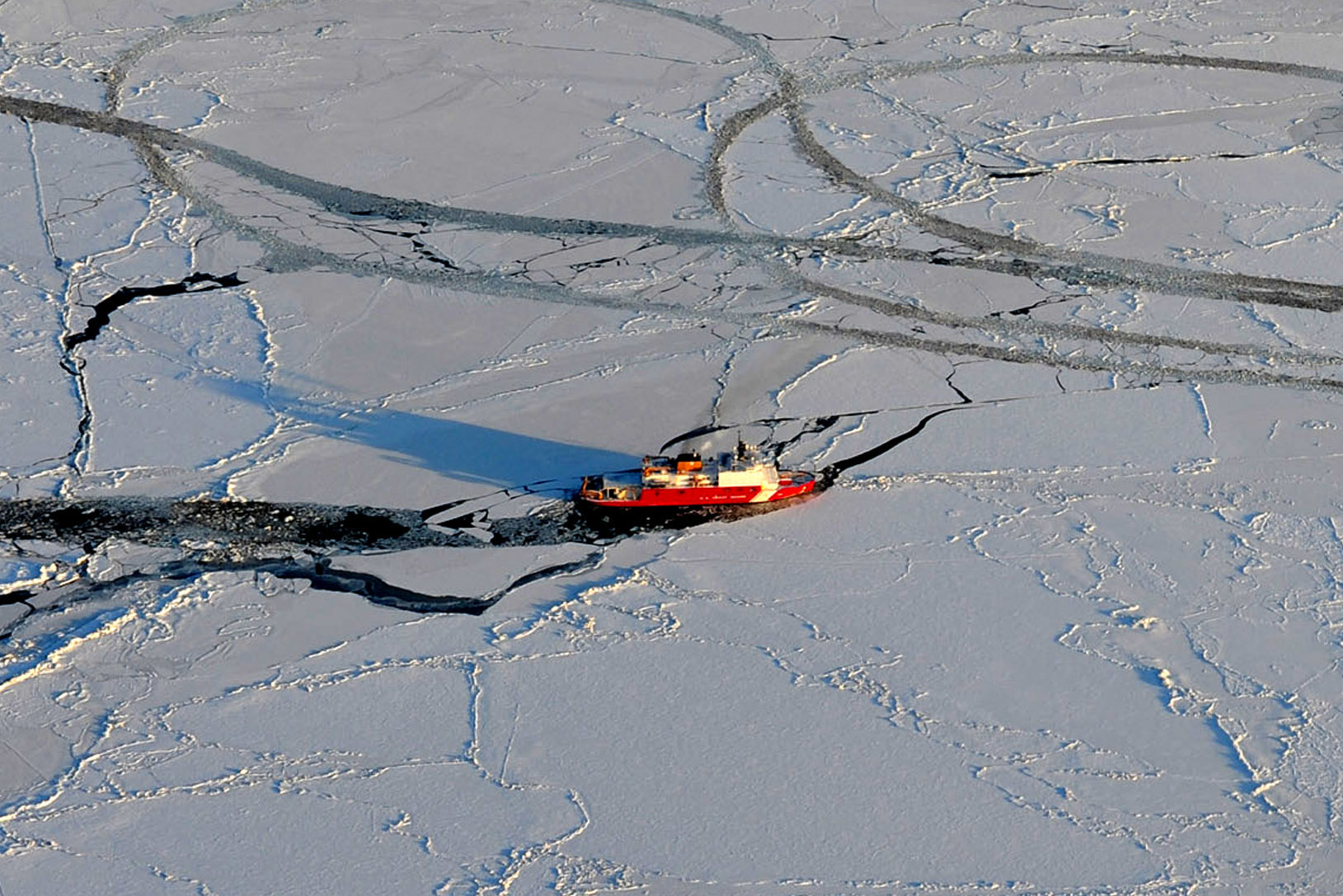
POLAR SEA and POLAR STAR side by side in McMurdo Sound, Antarctica

The US Naval Institute News Service has provided a copy of the Dec. 14, 2015 Congressional Research Service report, “Coast Guard Polar Icebreaker Modernization: Background and Issues for Congress,” by Naval Ronald O’Rourke.

This updates a series of earlier reports.

It is quite clear from the report that even if things go as planned, which I doubt it will, we will have a period of two to six years when we will have only one medium icebreaker and no heavy icebreakers.

If we do as currently planned, we will not see a new icebreaker until at least 2024.

We have looked at alternatives that might carry us through until the US can truly recapitalize its current fleet.

We can renovate Polar Sea. Clearly Congress is running out of patience waiting for a decision about what to do with this ship. We ought to ask for the funds to renovate it one way or the other.

We can lease one or two of these excess icebreakers. We could put one in the Great Lakes to satisfy those interests and it could in worst case exit the Great Lakes and go to the assistance of a polar icebreaker or break into resupply Thule airbase in Greenland.

Both of these are relatively low cost options. They deserve serious consideration.

USNI Publishes “Arctic Issue”

The US Naval Institute, has, for what I believe is the first time, published an issue of “Proceedings” that is dominated by discussion of the Arctic.

Pages 18 to 37 are devoted to the Arctic, including four articles and a sidebar. I think that is at least as much as they devoted to the Coast Guard, in the “Coast Guard Issue.”

Only one of these articles is available on line to non-members, “Geopolitical Icebergs,” by Dr. Auerswald, a professor of security studies at the National War College.

The other articles, also available on-line to members are:

  • “Defending Polar Access”
  • “More Access for the Arctic”
  • “A Mechanism for Arctic Crisis Response”

Throughout there is a call for more resources, particularly icebreakers.

The last short article, “A Mechanism for Arctic Crisis Response,” advocates positioning a structure in the Chukchi Sea. I can’t help but think putting the resources on land might be a bit easier in the long run.

Or alternately, modify the Polar Sea, as I have suggested, and use her for that purpose.

Now, These Are Heavy Icebreakers

The Iceberg Design Bureau is going to deliver three Project 22220 nuclear-powered icebreakers before 2020. It also is designing other advanced nuclear-powered icebreakers, Iceberg Director General/Chief Designer Alexander Ryzhkov told TASS on Thursday.

Artist impression of nuclear powered dual displacement icebreaker “Arktika” (project 22220)
Image: Atomflot

NavyRecognition reports that Russia claims they will have three more nuclear powered icebreakers by 2020 (when the US plans to start building it first new heavy icebreaker since 1977). They also announced plans for two more classes of nuclear icebreakers and a floating nuclear power plant.

The new icebreakers are expected to have a power of 120 MW or more than twice the power of the Polar Star.

Domestic Icebreaker Innovation

Zurich, Switzerland headquartered, ABB Group reports they “will provide the power, automation and turbocharging capabilities for the most advanced port icebreaker ever built.”

The Russian built ship’s configuration is unusual, described as “a totally new concept especially developed for heavy harbour ice conditions with extensive thick brash ice.” It has four 3 MegaWatt Azipod units with two in the stern and two at the bow.

Sounds like this configuration might permit the ship to be used as an oblique icebreaker, allowing it to clear a channel wider than the ship’s beam.

Tups, who seems to be our resident icebreaker expert, brought this to my attention. He feels this type of icebreaker may be appropriate for the Great Lakes. He notes that the new Russian icebreaker is “slightly bigger than USCGC Mackinaw…about 50 ft longer, 10 ft wider, 5 ft deeper and about twice as powerful.”

Michigan Senators Push for Another Great Lakes Icebreaker

EdisonChouestOffshoreAHTSicebreaker

MarineLog reports that both Senators from Michigan have requested “Robust” funding for a “Heavy Icebreaker” for the Great Lakes.

OK they called the Mackinaw a heavy icebreaker, and we know it really is not, so something less may work.

Looking at the excess Shell icebreakers we talked about earlier, it appears the already built icebreaker Aiviq, with a beam of 80 feet, is a little too large to squeeze through the St. Lawrence Seaway, but if Tups was right, and this is the icebreaking vessel Shell had under construction at Edison Chouest, its beam, 22 meters (72.2 feet) is less than the 78 foot  maximum for the Seaway. Maybe something could be worked out.

This is a lot larger and more powerful than USCGC Mackinaw.

Ship Name: LA SHIP 304
Shiptype: Anchor Handling Tug Supply
LR/IMO No.: 9788368
Gross tonnage: 6,000
Year of Build: 2017
Flag: United States Of America
Status: Keel Laid (status changed 2014-11-17)
Operator: Galliano Marine Service LLC
Shipbuilder: LaShip LLC
Length Overall: 94.600 m
Breadth Moulded: 22.000 m
Depth: 11.800 m
Machinery overview: 4 diesel electric oil engines driving, connected to 2 electric motors reduction geared to screw shafts driving 2 Azimuth electric drive units. Total Power: Mcr 20,240kW (27,520hp), Csr 17,204kW (23,392hp)
Prime mover detail: Design: Caterpillar, Engine Builder: Caterpillar Inc – USA, 4 x C280-16, 4 Stroke, Single Acting, Vee, 16 Cy. 280 x 300, Mcr: 5,060 kW (6,880 hp) at 900 rpm

Being somewhat cynical, if this was more than a political gesture, I would have thought they would have gotten signatures from Senators from other states that border the Great Lakes.

Australia to Build a Polar Icebreaker

An artist's impression of Australia's new icebreaker.

Thanks to Tups for bringing this to my attention. He mentioned it in comments on an earlier post, but I felt it warranted a separate post.

The Sydney Morning Herald reports, the Australian Government is close to a “decision to select a British-based operator and Dutch shipyard for Australia’s $1 billion Antarctic icebreaker project.” gCaptain provides additional details and more images.

The new 156-metre long, 23,800-tonne vessel will have increased cargo and marine science capability but is expected to carry around the same number of passengers.

Its crucial ice-breaking capacity will give it the power to steam through 1.65-metre ice, compared to Aurora‘s 1.23 metres.

The $1B may sound familiar, about what the USCG expects to spend on a new Polar Icebreaker, but in fact that includes its full lifecycle cost and these are Australian $$, so in fact it is more like $710M. Presumably there will be savings because the ship will be built in Romania.

Perhaps inevitably the procurement process has been criticized. That there is only one bidder and the ship will not be built in Australia, both cause concern.

The ship is expected to operate out of Hobart, Tasmania.

The ship appears narrower than conventional icebreakers. It appears to be a hybrid, combining cargo, research, and icebreaking functions in a single relatively large ship.

Australia’s claims on Antarctica (held in abeyance now because of treaty) are extensive. Looking at the diagram below, they appear to include about half of the larger Eastern half of Antarctica. It may be that their stations are more accessible than those of the US. Their stations lie close to the Antarctic Circle while McMurdo is about 600 miles closer to the pole. In the Northern hemisphere the North coast of Iceland and the Bering Strait are on about the same latitude as their Antarctic stations.

512px-Antarctica_CIA_svg

Shipping LNG in the Arctic

We have some indication, we will soon see LNG being shipped in the Arctic. gCaptain reports an apparent intention of a Chinese/Greek consortium to build five ice capable LNG tankers for the transport of Russian LNG via the Arctic.

If these ships actually use an Arctic route to China, it will almost certainly be via the Northern Sea Route close to Russia rather than the North West Passage near Canada and the US, but both routes must exit very close to Alaska as the traffic moves through the 45 mile wide Bering Strait and past the Diomedes and St. Lawrence Island.

There is no indication of how large these proposed LNG tankers are, but take a look at the size of the tanks on this LNG tanker in this photo, one of several you can find at this gCaptain post.

11999647_883005611775415_7858886048042016997_o

Yes, those are people casting the shadows.

Icebreaking Mega-Yacht

Profile

gCaptain reports a proposal from Damen and Dutch luxury superyacht builder AMELS, offering a line of icebreaking Mega-Yachts sized 65, 90, and 100 meters in length. The design incorporates a double-acting hull, capable of breaking ice stern-first and an “Axe Bow” for good seakeeping in ice-free seas.

The basic hull form might make a decent Arctic Patrol Cutter.

President Calls for More Icebreakers

USCGCHealeyCGphoto

The New York Times is reporting that, in a Speech today, the President will call for new icebreakers for the Coast Guard including accelerating the one currently planned and for additional icebreakers beyond that.

“The aging Coast Guard fleet is not keeping pace with the challenge, the administration acknowledged, noting that the service has the equivalent of just two “fully functional” heavy icebreakers at its disposal, down from seven during World War II. Russia, by contrast, has 41 of the vessels, with plans for 11 more. China unveiled a refurbished icebreaker in 2012 and is building another.

“Mr. Obama will propose speeding up the acquisition of a replacement icebreaker that had been planned for 2022, setting a new date of 2020, the White House said. He will also propose that planning begin on the construction of new ones, asking Congress to provide “sufficient resources” to fund them.”

Hopefully these WAGBs and the rumored additional National Security will move the perception of what is a normal AC&I budget closer to a realistic level.