Changes in the Fleet

Defense Industry Daily has an update on the status of the National Security Cutter (NSC) program. The seventh (Kimball) has been ordered and they report how the previously ordered cutters are progressing.

HII receives a $497 million fixed-price, incentive-fee contract from the U.S. Coast Guard to build WMSL 756, the 7th Legend Class National Security Cutter. Construction is expected to begin in January 2015, and delivery is scheduled for some time in 2018.

Ingalls has delivered the first 3 NSCs. WMSL 753 Hamilton is 81% complete and will deliver in Q3 2014; WMSL 754 James is 52% complete and will launch in April 2014; and WMSL 755 is scheduled for launch in the Q4 2015.  Sources: HII, “Ingalls Shipbuilding Awarded $497 Million Contract for Seventh U.S. Coast Guard National Security Cutter”.

Hamilton will be the first of two NSCs expected to be based in Charleston. Note the contract prices quoted are not the full cost of the ships.

Gallatin is being transferred to the Nigerian Navy, making this the second 378 transferred there. This leaves the Coast Guard with ten “high endurance cutters”, seven 378s and three NSCs, all on the West Coast.

The eighth Fast Response Cutter (FRC) has been commissioned and the ninth has been delivered.


Littoral Operations Center, a Coast Guard Role?

MarineLink is reporting,

“The Naval Postgraduate School (NPS)in Monterey has established a new Littoral Operations Center (LOC) to focus on these threats and opportunities and is hosting a series of workshops this week to examine littoral operations…The LOC will conduct and promote the study of U.S. Navy and allied partner nation policy, strategy and technology necessary to deal with conventional, irregular and criminal threats in these crowded and cluttered coastal waters and their adjacent lands,” said LOC Director, NPS Senior Lecturer Dr. Kalev Sepp.”

This looks like something the Coast Guard should be involved in.

How to Create Enemies and Make People Hate You–China vs Indonesia

We have already talked about China’s difficulties with her neighbors Japan and the Philippines. Now we have a report of a confrontation with Indonesia. Apparently Indonesia had chosen to keep this quiet, but the Chinese have chosen to brag about it.

The Indonesian vessel involved was reportedly a Todak class, which is a German Lurssen “PB-57” design, a bit larger than the FRC at 447 tons fl, 58.1 meters long and 7.6 meters of beam, armed with a Bofors 57mm (like that on the NSC), a 40mm and two 20mm. Clearly if it had come to a fight, the Indonesian vessel would have enjoyed an advantage, at least until Chinese reinforcements arrived.

China is showing a complete disregard for the provisions of the UNCLOS treaty to which they are a party.

Making an enemy of Indonesia is a particularly bad idea for China, in that Indonesia potentially controls all the major straits through which the vast majority of Chinese trade must pass and all the alternatives are also in the hands of nations China seems intent on alienating.

Progress on Canada’s Arctic Offshore Patrol Ship

Arctic/Offshore Patrol Ship

MarineLog is reporting a new contract has been awarded for Canada’s Arctic Offshore Patrol Ship (AOPS).

FEBRUARY 21, 2014 — OSI Maritime Systems Ltd. (OSI), Burnaby, BC, has been selected by Lockheed Martin Canada to support the design activity of the bridge and navigation capabilities for the Royal Canadian Navy’s (RCN) new class of Arctic/Offshore Patrol Ships (AOPS).

But mostly I wanted to share the illustration. To review, this is a Canadian Navy project, not Coast Guard. It is based on the Norwegian Coat Guard’s Swalbard icebreaker but the design is smaller and simplified somewhat. They plan to build “six to eight” and they will be used both in the Arctic and for more conventional patrol duties.

What we see is a relatively large OPV/light icebreaker, with what appears to be excellent facilities for boats and a single helicopter up fairly large size with facilities to handle at least a small number of containers. Compared to the USCG’s Offshore Patrol Cutters they will probably be about twice the size, oriented much more toward the Arctic, their capability as a conventional patrol vessel is likely to be compromised by low max speed, the icebreaker hull shape, and an almost total lack of weapons.

New Zealand’s “OPC” (OPV) in Action

NavalToday reported on HMNZS Otago recently returned from an almost three month voyage doing Coast Guard style operations, including fisheries enforcement, in the Ross Sea, near Antarctica. Interesting they feel an obligation to do fisheries 2000 miles frim New Zealand.

HMNZS Otago is a ship similar in concept to the Offshore Patrol Cutter, being an ice strengthened medium sized (1,900 ton, 85 meter) offshore patrol vessel. The class was discussed along with a few other potential Arctic Patrol Cutters here and to a limited extent as the basis for a potential OPC design here.

The Chinese Coast Guard to Build World’s Largest Offshore Patrol Vessel–and More

This is a post I prepared for CIMSEC. It reiterates material we’ve already discussed, but also adds some additional thoughts.

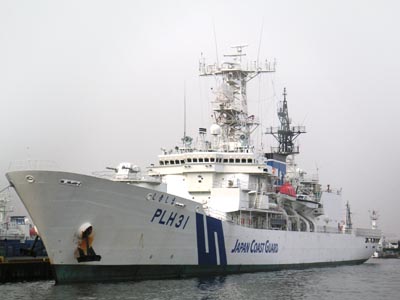
File:JapanCoastGuard Shikishima.jpg
Japanese Coast Guard Cutter Shikishima, this class of two are currently the largest offshore patrol vessels in the world. Photo from Japanese Wikipedia; ja:ファイル:JapanCoastGuard Shikishima.jpg
Since its formation in 2013 by the consolidation of four previously independent agencies into a single entity (notably excluding the SAR agency), the Chinese Coast Guard has been experiencing phenomenal growth and has become China’s instrument of choice in its “small stick diplomacy” push to claim most of both the South China Sea and the East China Sea.
They commissioned two 4,000 ton cutters in January alone. It appears the growth will continue. The Wuchang Shipbuilding Industry Company has just been awarded a contract for four new 5,000 ton cutters, and China Ship-building Industry Corporation has been contracted to build two additional surveillance ships, one of 10,000 tons and another of 4,000-tons.
The US Coast Guard’s largest patrol cutters are the 418 foot, 4,500 ton full load Bertholf Class National Security Cutters. The illustration that accompanies the story of the four new 5,000 ton cutters shows a ship, in many ways similar to the National Security Cutter. It appears there is a medium caliber gun on the bow. (This would be a significant but not unexpected change for the Chinese Coast Guard.) There is a frame over what appears to be a stern ramp not unlike that on the NSC. The hull shape also appears similar to the NSC.
The “10,000 ton” cutter is likely to look similar to the Japanese Coast Guard’s two 492 foot, 9,350 full load, Shikishima class high endurance helicopter carrying cutters seen in the illustration above, but they may actually be much larger. Comparing their new ship to the Japanese cutters, the displacement of the Japanese ships was quoted as 6,500 tons, their light displacement. If the 10,000 tons quoted for the Chinese cutter is also light displacement, it could approach 15,000 tons full load. As reported here the new Chinese OPV will have a 76mm gun, two 30mm, facilities to support two Z-8 helicopters, and a top speed of 25 knots.
The size of the helicopters is notable. The Z-8 is a large, three engine, 13,000 kg helicopter based on the Aérospatiale SA 321 Super Frelon. The transport version of this helicopter can transport 38 fully equipped troops. The same airframe is also used for SAR, ASW, and vertical replenishment.
Undoubtedly the new vessels tonnage would give it an advantage in any sort of “shoving match” with vessels of other coast guards, but why so large?
The original justification for the Japanese cutters was to escort plutonium shipments between Japan and Europe, but the second cutter was built long after that operation was suspended, so clearly the Japanese saw a different justification for the second ship of the class.
Even so the Chinese ship may prove larger still. Other than prestige, why so large? China’s EEZ is small (877,019 sq km) compared to that of the US (11,351,000 sq km) or even Japan’s (4,479,358 sq km). Even adding the EEZ of Taiwan and other areas claimed by China, but disputed by others (3,000,000 sq km), the total is only 3,877,019 sq km, and patrolling it does not require the long transits involved in patrolling the US or even the Japanese EEZ.
10,000 tons is about the size of a WWII attack transport, and with its potential to embark two large helicopters China’s new large cutter could certainly exceeds the capability of WWII destroyer and destroyer escort based fast transports (APD). Using its helicopters and boats it could quickly land at least an infantry company as could many of the smaller cutters. Chinese Coast Guard ships are already a common sight throughout the contested areas of the South China and East China Seas. Will Asia wake up some morning to learn there have been Chinese garrisons landed throughout the contested areas by the now all too familiar Chinese Coast Guard Cutters.