“We Need More Coast Guard” says 7th Fleet

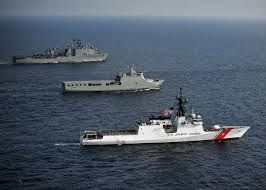
Waesche Carat 2012

NationalDefenseMagazine.org has a piece that reports the Seventh Fleet advocating for the Coast Guard.

There is an apparent error in that Capt. David Adams is identified as “Commander of the Navy’s 7th Fleet.” I assume they mean he is a spokesman for ComSeventhFleet. Nevertheless, the good news is that someone in 7th Fleet is advocating for the Coast Guard. The bad news is that the Coast Guard may not be, being recognized for what it is already doing.

The implied desire in the article that the Coast Guard send ships to the South China Sea to confront the Chinese Coast Guard,

“We have no white hulls in the Pacific, hardly,” Adams said. “We are going to have to fund the Coast Guard, not to do their conventional missions, but to come and help with the white-hull problem out in the Pacific.”

is probably a non-starter, both because of a shortage of Coast Guard assets and because the Coast Guard has no authority in the waters in question, but that may not have been what the Captain was really saying, although taking Philippine and Vietnamese fisheries enforcement officers aboard a National Security Cutter and using it for fisheries enforcement under their authority in the South China Sea could be interesting.

Dean Cheng, senior research fellow at the Heritage Foundation’s Asian studies center suggested,

“‘The Coast Guard is a civilian entity, and there is little reason to my mind that [it] should not exercise in conjunction with the coast guards and civilian law enforcement entities of American allies’ in the Asia-Pacific region, he said”

Mr. Cheng, must have missed USCGC Waesche’s participation in CARAT 2012, the transfer of two 378s to the Philippines and boats to Vietnam and really for the 1000th time, the Coast Guard is a military service.

(Actually very few of the China Coast Guard ships are repainted navy ships and most of their cutters are not as well armed as their USCG counterparts.)

What more can the Coast Guard do? We could certainly sell (or the State Department could give) cutters, boats, and aircraft to SE Asian countries and help train their coast guards. Foreign Military Sales of Offshore Patrol Cutters, Webber class WPCs, and HC-144s with subsequent training might be an instrument of foreign policy. There used to be a something called “seconding” whereby officers of one country filled billets in the armed services of another, but the USCG is not going to be enforcing their laws.

If the nations of Southeast Asia do as Bob Marley sang and “Stand-up, stand-up for your right,” and the Chinese gray hulls “over the horizon” are indeed tempted to intercede, I hope some haze gray 7th Fleet ships are near by to dissuade them from doing anything foolish. Coast Guard cutters will not.

Note, I changed this post after realizing I had misread parts of the referenced post.

Chinese Drift Net F/V Seized in the North Pacific

CCGD17 is reporting an unusual fisheries case.

This seizure was a result of an international effort. The F/V was spotted by a Canadian CP-140 (similar to a P-3) and boarded by a team from Morgenthau assisted by two Chinese agents, 625 miles East of Tokyo (Japan was also listed as a participant in the operation). After violations were discovered, the vessel was detained and custody subsequently transferred to a Chinese Coast Guard cutter.

I can’t help but be curious what will happen to the vessel, its owners and crew, when the Chinese government seems to condone and even encourage violation of international fisheries norms elsewhere.

Canadian SAR Aircraft, C-27J a Leading Contender

DehavillandCC-115Buffalo01
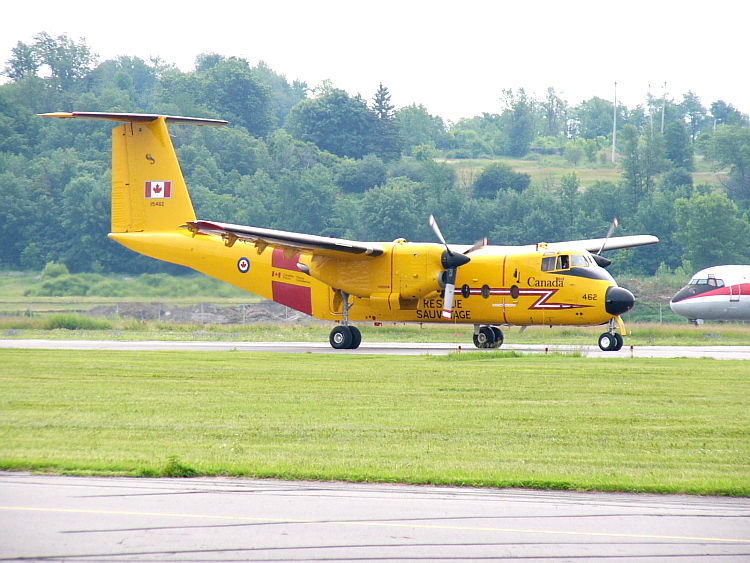
442 Transport and Rescue Squadron De Havilland Canada DHC-5 Buffalo (CC-115)

Canada’s military seems to be having a lot of trouble with their procurement, new naval helicopter, new patrol vessels, and new SAR aircraft All have taken much longer than expected.

DefenseIndustryDaily reviews the status of their program to replace their existing SAR aircraft which are now overworked DHC-5 (CC-115) Buffalo on the West Coast and CC-130E/H Hercules on the East Coast, in the works since 2008.

According to the report, the C-27 appears to be the most likely choice, other contenders include the HC-144’s big brother the EADS-CASA C295, the C-130J, the Bombardier DASH-8, the DHC-5NG Buffalo being resurrected by Viking Air Ltd., and the Bell V-22.

Canadian Coast Guard’s New Shipboard Helicopter

Bell B429

Defense Industry Daily is reporting the Canadians have selected the Bell B429 as their new shipboard Coast Guard helicopter

“The request for proposals closes on May 27, but rivals AgustaWestland, Airbus Helicopters Canada and Sikorsky have all signalled they won’t be submitting bids, leaving Bell and its model 412 chopper (actually the B429–Chuck) as the only contender…. The companies declining to take part are doing so because their aircraft are heavier than the maximum of 4,989 kilograms (11,000 pounds), a safety limit established for the decks of coast guard ships in the 1970s.

Industry sources said at least one potential bidder expressed concern that the standard was outdated and asked the federal government for data on how the weight restriction was calculated. The intention was to prove the decks could handle higher ratings, but officials just came back and said the standard was the standard.”

The Bell B429 is a twin engine helicopter with the capability of allowing single pilot flight in IFR (instrument flight rules) conditions, designed for the medivac market. It is about 2000 pounds lighter than the MH-65 but is otherwise similar in performance. There are a number of door options including clamshell doors in the rear and an option for retractable wheeled landing gear.

Australia, Does it Need a Coast Guard?

In Australia most coast guard functions are handled by the Navy and Air Force. DefenceIQ has an interesting discussion of this alternate arrangement of responsibilities and its shortcomings.

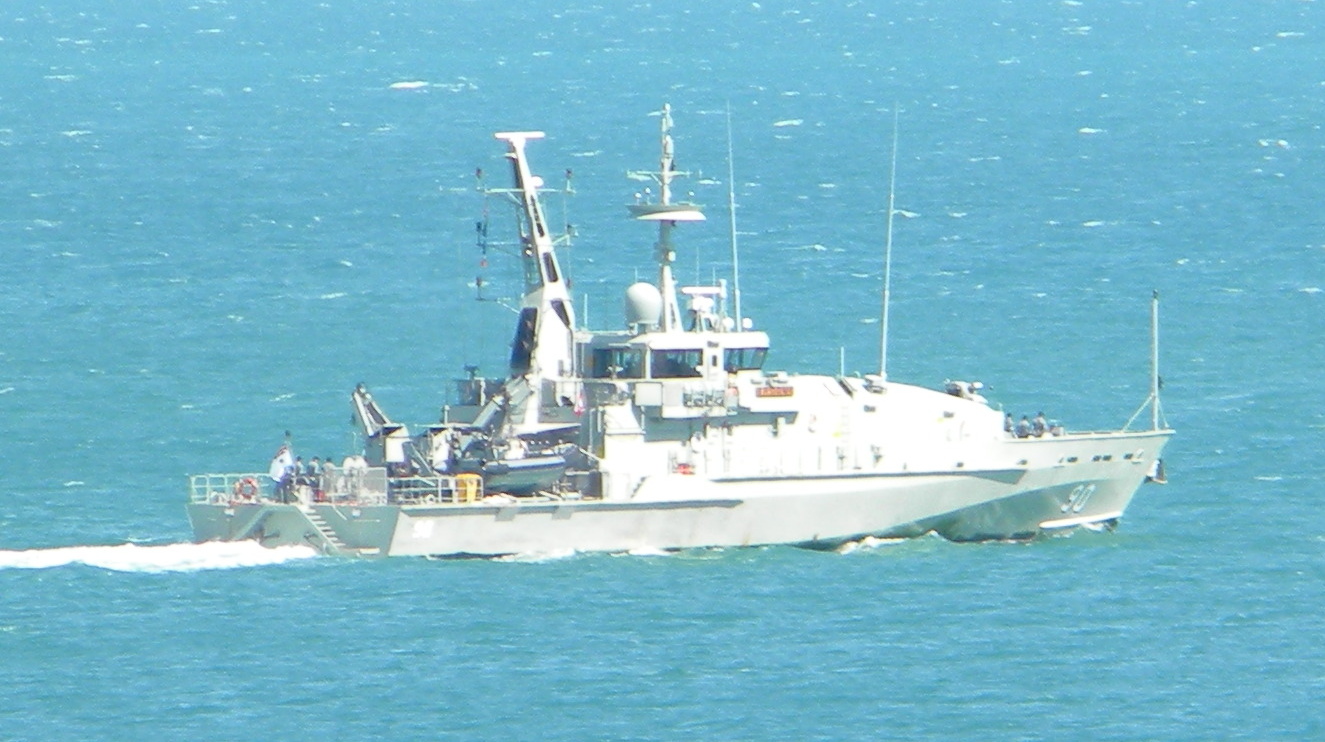
I also note the Australian Navy and their Customs service both operate similar patrol vessels, the Armidale class and the Cape class, and if anything the Customs’ Cape class are more capable.

Thanks to Lee for bringing this to my attention.

Russia Builds an OPC

NavyRecognition is reporting the launch of the first for a class of ships being built for the Maritime Border Guards of the Federal Security Service of the Russian Federation (FSB, successor of the KGB). The ship is similar in many respect to the projected Offshore Patrol Cutter.

Named “Ocean,” she is reportedly ice strengthened with a displacement of 2,700 tons, a speed of 20 knots, a range of 12,000 miles, and a 60 day endurance. She has a hangar and flight deck, at least two RHIBs, and a 76mm gun. Unlike previous classes used by the Maritime Boarder Guards this is not an adaptation of a Navy design.

South Korea Disbands Coast Guard?

Versions of the following quotation are frequently mis-attributed to Petronius.
We trained hard … but it seemed that every time we were beginning to form up into teams we would be reorganized. I was to learn later in life that we tend to meet any new situation by reorganizing; and a wonderful method it can be for creating the illusion of progress while producing confusion, inefficiency, and demoralization.
In fact it is from the magazine article “Merrill’s Marauders” (Harper’s Magazine, 1957) that earned Ogburn (Charlton Ogburn) his book contract. In full, it reads thus:
We trained hard, but it seemed that every time we were beginning to form up into teams we would be reorganised. Presumably the plans for our employment were being changed. I was to learn later in life that, perhaps because we are so good at organising, we tend as a nation to meet any new situation by reorganising; and a wonderful method it can be for creating the illusion of progress while producing confusion, inefficiency and demoralization. http://en.wikipedia.org/wiki/Charlton_Ogburn

After the sinking of the ferry Sewol with the loss of over 300, South Korea’s President Park Geun-hye is vowing to dismember the South Korean Coast Guard.

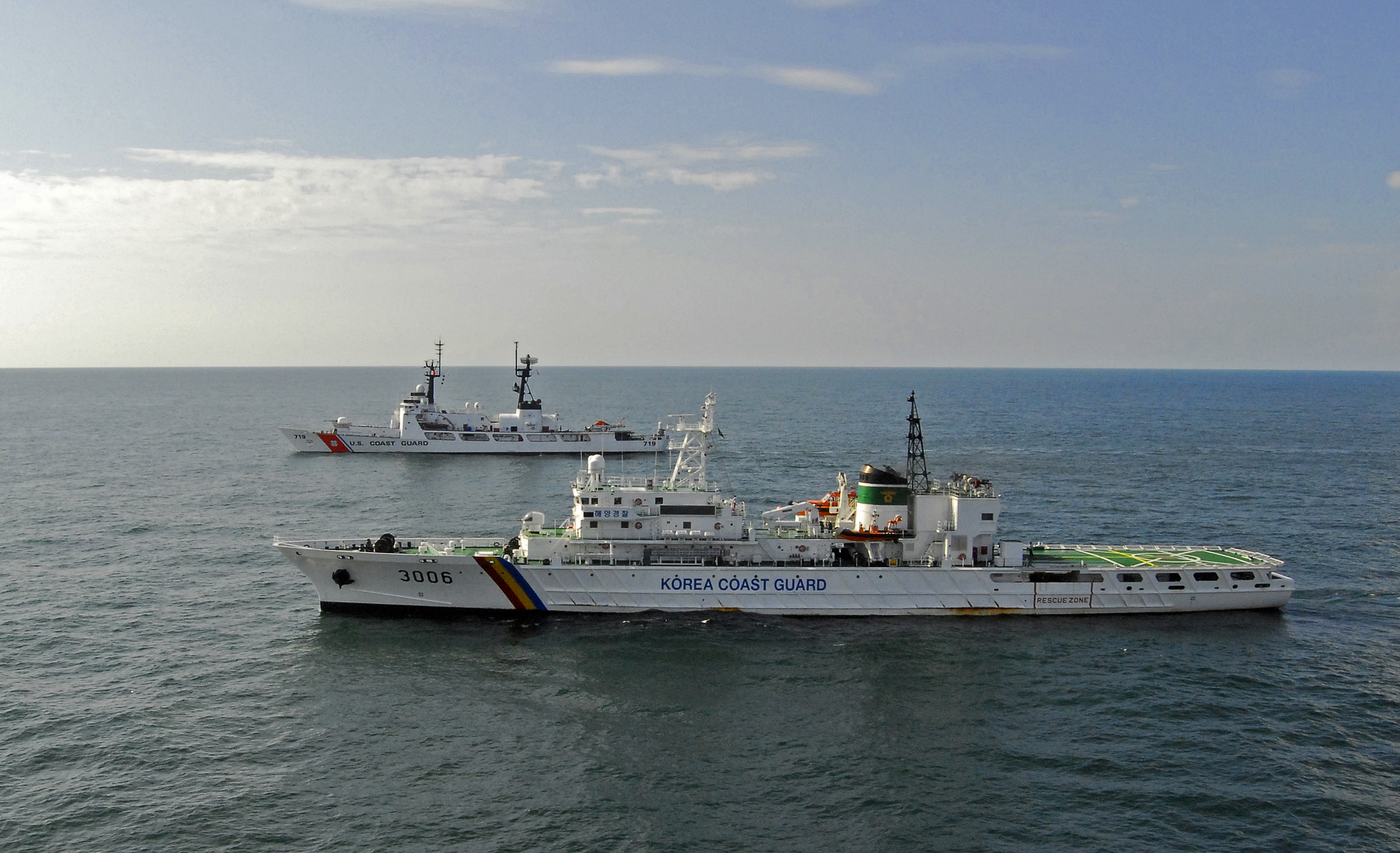
South Korea’s EEZ is only about three percent that of the US’s but their Coast Guard is relatively large with about 4,500 personnel (according to my Combat Fleets of the World). Wikipedia indicates they have six fixed wing and 18 helicopters (not a lot, but proportionately more than the USCG). Most surprisingly, they have 33 ships of over 1000 tons with a total displacement greater than that of all USCG WMECs, WHECs, and WMSLs combined. They also have 39 WPCs of 250 to 500 tons. I don’t see any evidence that they have any responsibility for Aids to Navigation, Alien Migrant Interdiction (although that might be a subset of another mission} or ice operations, otherwise their mission set seems to parallel that of the USCG, but their priorities are shaped by the proximity of North Korea, China, and Japan.

The New York Times reports their President sees the problem as a cozy relationship between regulators and the regulated, something all regulatory organizations must guard against.

With that, she declared a war against what she called her country’s deeply entrenched culture of “kkiri kkiri,” or collusive ties between businesses and government regulators that she said had spawned lax regulatory enforcement and an easy acceptance of poor safety standards throughout the society.

The BBC reports,

Ms Park added that in its current form, the coastguard would be unable to prevent another large-scale disaster.

“The coastguard continued to get bigger in size but did not have enough personnel and budget allocated for maritime safety, and training for rescue was very much insufficient,” she said, according to Reuters.

Stars and Stripes has some very revealing statistics regarding the experience of South Korean Coast Guard Personnel.

Eleven out of the 13 coast guard chiefs named since 1996 have been land-based police officers, not coast guard officers; the top 14 current coast guard officers have no experience working as captains for 1,000-ton-class ships or bigger vessels; and about 25 percent of its top 67 officers have had less than one month of experience working on patrol ships, the coast guard said, confirming reports published by lawmakers.

It really appears that the problem is not the fact that they have a Coast Guard, but that it has been mismanaged and unprofessional. Clearly their Coast Guard is big enough, but it suffers from a leadership that does not understand the Marine environment and that will not be helped by the proposed reorganization. I am afraid the proposed reorganization will only provide the appearance of action while failing to address the very real problems.

They might benefit from more time spent with the US Coast Guard.

Drug Enforcement Return on Investment

FierceHomelandSecurity is reporting on testimony of both the Commandant and the Commander of SouthCom, Marine Corps Gen. John Kelly, before a joint hearing of the House Transportation and Infrastructure and Foreign Affairs subcommittees.

“Joint Interagency Task Force South, which is part of Southcom and includes the Coast Guard, (other–Chuck) military services and other agencies, seizes the majority of the cocaine bound for the United States, said Marine Corps Gen. John Kelly, the Southcom commander. Yet it receives only 1.5 percent of the federal government’s total counternarcotics budget, he said.”

Commandant Adm. Robert Papp, who appeared alongside Kelly, said that in the past five years, the Coast Guard seized more than twice the amount of cocaine as all domestic law enforcement agencies – federal, state and local – combined.

Over the last five years, Coast Guard ships and law enforcement detachments operating in the offshore regions have removed more than a million pounds of cocaine with a wholesale value of nearly $17 billion. This is more than two times the amount of cocaine seized by all other U.S. federal, state and local law enforcement agencies combined.

While I have my own reservations about the effectiveness of efforts to restrict supply, if you are going to attempt to cut supply, it sure looks like funding Coast Guard efforts should be the first place to put your money.

Three Nations Share German OPV Design

Toro_air_view

Toro_+_Dauphin
Photos: Chilean Navy photos of OPV Toro, 2012, note 40mm forward

We have a guest post today, Andres Tavolari, a 1st Lt in the Chilean Marine Corp Reserve talks about the recent christening of the third of a series of five ships that the US Coast Guard would consider Offshore Patrol Cutters. Not only have these ships supported SouthCom missions, Colombia and Argentina are also building ships of this class so cutters are likely to encounter and perhaps work with these or similar ships in their counter drug operations. Of the three countries Chile’s program is the most advance. Chuck

On last April 1st, was christened the third Fassmer-80 OPV for the Chilean navy. Named “Marinero Fuentealba” after a sailor who died trying to rescue the crew of a stranded ship on a storm in 1965, the new OPV will be delivered to the Navy in August 2014.   This is the third ship of a class of five for the Chilean navy, which are built in the ASMAR shipyard, Talcahuano, Chile, a German design selected among several bidders (Fincantieri, Vosper Thornycraft, Kvaerner Masa Marine, Damen and Fassmer). The detailed engineering was done by ASMAR which did 50,000 hours of modeling on the ships’ systems and components. The ships are classified as LRS +100 A1 LMC UMS.

The original design was modified in several aspects, most importantly, the addition of a hangar for a medium size helicopter.   With an overall length of 80,60 meters (264′), a waterline length of 74,40 (244′) and a moulded beam of 13,00 meters (42.6′), the Chilean Fassmer 80 OPV have a full load displacement of 1728 tons. With such a displacement, at 12 knots, their range is 8.000 nautical miles with accommodations for 60 persons including 20 passengers and the helicopter crew. The endurance is 30 days, carrying 298 m3 of fuel oil, 48 m3 of fresh water and 20 m3 of helicopter fuel. Two 12V26 Wärtsilä engines, delivering 4.080 KW (5,471 SHP each) @ 1.000 rpm, work on two 4 blades controllable pitch propelers. At 80% MCR the speed is 20 knots.   The first 2 ships are armed with a 40 mm gun taken second hand from German Type 148 missile boats, and with up to six .50 machine gun, although normally four are embarked. The third ship, the “Fuentealba” will be armed with a 76 mm Oto Melara gun also from a Type 148 missile boat. Some sources indicate its secondary armament will be up to 6 x 20 mm guns (probably old Oerlikon 20mm/70). This third ship has an ice strengthened hull and a different communications set, details have not been released yet. With these modifications “Fuentealba” will cost 43% more than the first two ships of the class, whose cost was less than $50M US each.   The flight deck and hangar are optimized for medium helicopters. Normally an AS-365 N2 Dauphin helicopter, similar to the MH-65, will be embarked. Typically it will be used for MIO and rescue operations.

There are two single points davits for two locally built 7,40 meters RIBs which can be launched and recovered while sailing at up to 12 knots. Under the flight deck is a working space with enough space for up to three 20 foot container sized units. There are four hatches in the flight deck permitting an easy access to the work deck. It is served by a Palfinger Marine PK 60000M crane installed on the flight deck. On the work deck and stern are the necessary fittings for towing other ships, towing being one of the main mission of this class of ships in Chilean service. Notably the second ship in the class (OPV 82 “Toro”) has, on the stern, 2 racks for depth charges!! Although an old weapon, several Chilean navy ships have been equipped with depth charges, as useful weapons for warning shots against submarines.

The Chilean Fassmer 80 OPVs have a Sperry Marine integrated Bridge System, an integrated communication system and an unmanned machinery space, remotely controlled. They are also equipped with the Mobile Maritime Command and Control System “SMC MM” and the ARIES fire control system for the 40 mm gun. Both systems are developed locally by SISDEF and DESA CHILE. It is most probable that the “Fuentealba” will be equipped with the SAETA fire control system, developed by DESA CHILE for the Chilean SA’AR missile boats armed with 76 mm guns.

The Chilean OPVs are operated by the Dirección General del Territorio Marítimo (DIRECTEMAR), a special branch within the Chilean Navy. The missions carried out by this ships are: coast guard, fishery protection, search and rescue, contamination control, training and support of isolated communities. Nevertheless, the first two ships have also deployed to international exercises and operations, such as UNITAS, PANAMAX and MARTILLO, the last one in combination with forces of the US Southern Command for fighting drugs smuggling in the Caribbean. The Colombian navy has received 2 slightly modified ships build locally by COTECMAR and has contracted a third ship, planning to build as many as 6, for operating 3 in the Pacific and 3 in the Caribbean (Argentina is also planning at least four-Chuck). Main modifications are a different mast, a different 40 mm gun, a telescopic hangar for a Bell 412 helicopter and a stern ramp. The stern ramp was considered less important for the Chilean Navy, which opted for improved towing capacity of towing ships and additional space for supporting isolated communities rather than the improved ability to deploy a boat quickly when chasing “go-fast” boats, since this is not a threat in Chilean waters. The OPV “Fuentealba” will be deployed to the Third Naval Zone, with homeport in Punta Arenas, on the Magellan Strait.

Thanks to Andres for his contribution. I noted this in the German Navy blog “Marine Forum” Daily News, 8 April, “CHILE – PERU Probably related to their ongoing dispute over Pacific Ocean sea areas, both the Chilean and Peruvian navy have (temporarily?) removed hull numbers and names from nearly all naval vessels, rendering identification difficult.” Hopefully this will be resolved amicably. Chuck

Addendum:
OPV Colombia 1

OPV Colombia 2

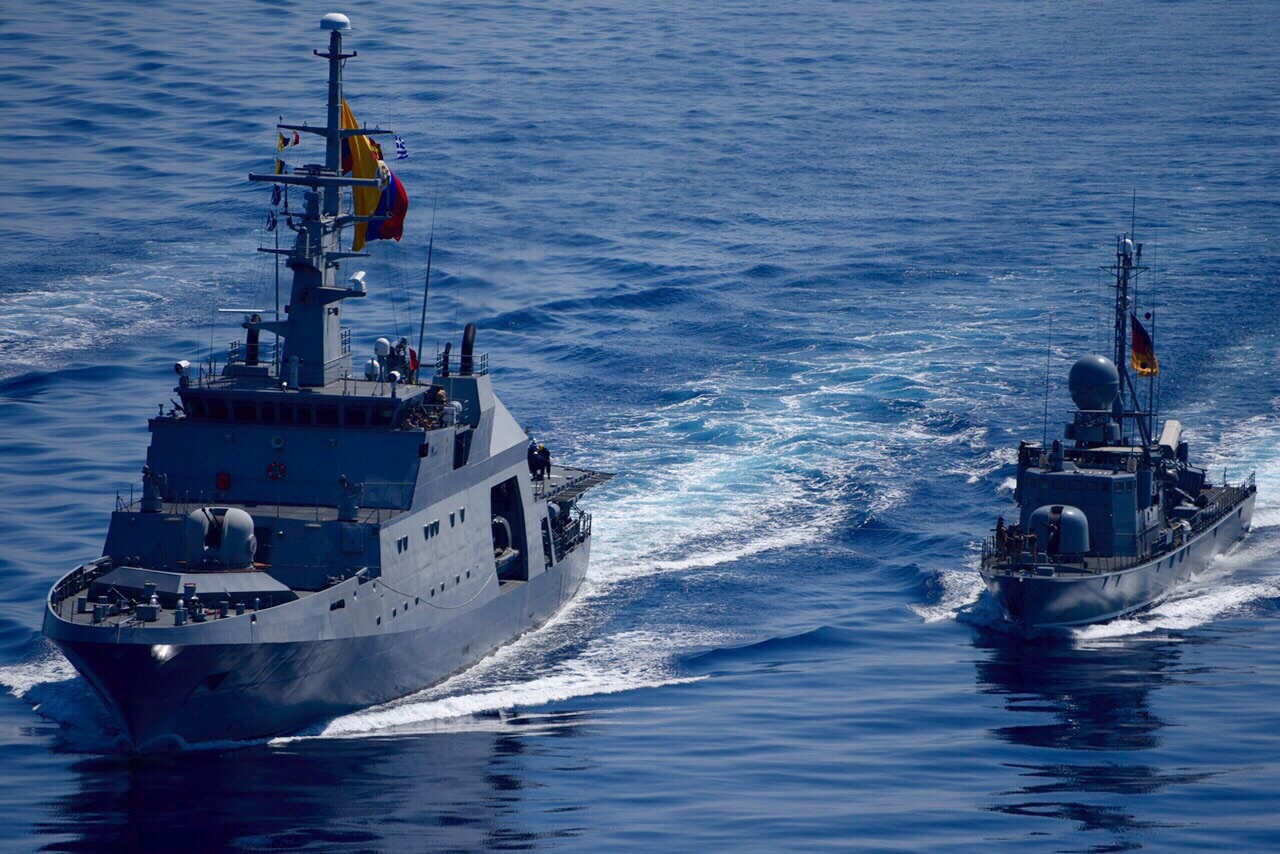
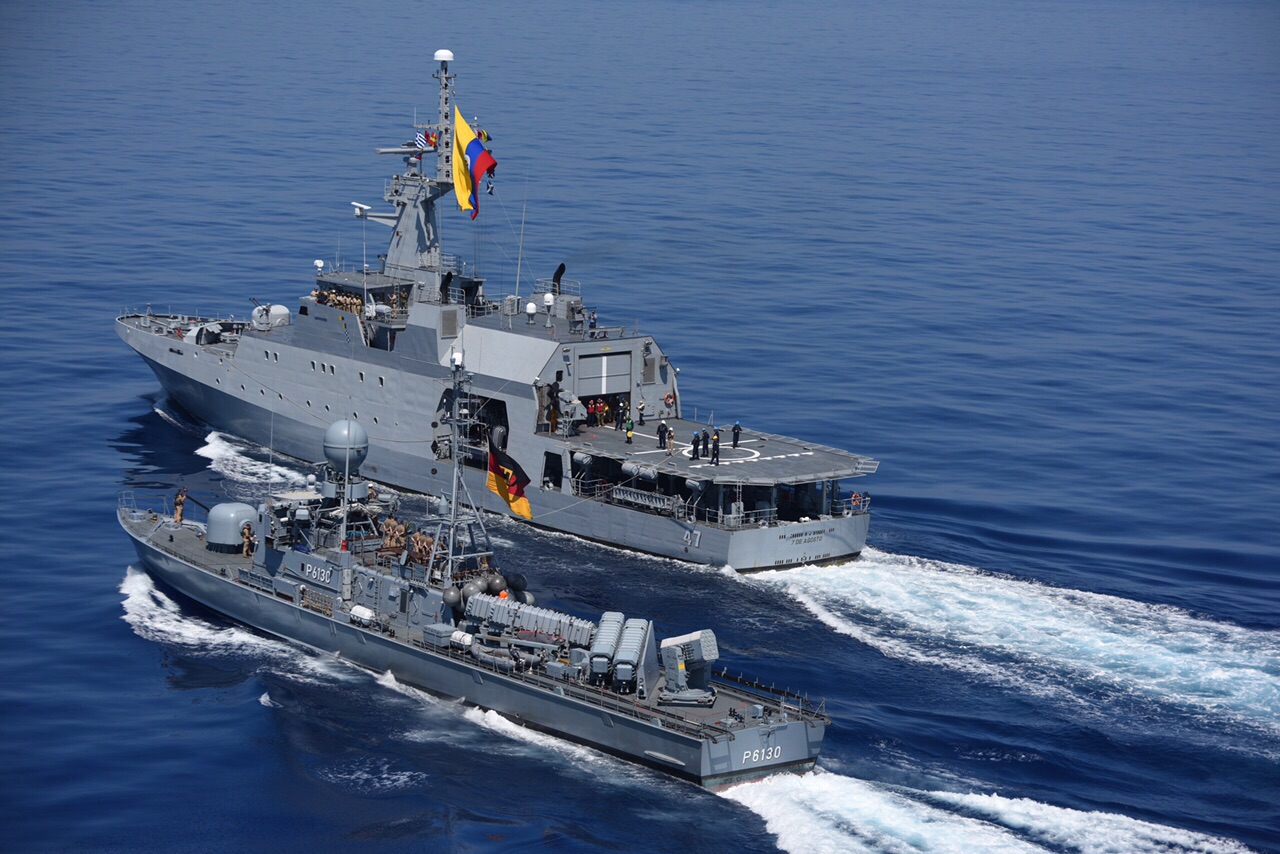
Photos provided Andres Tovalari. Colombian Navy OPV “7 de Agosto” sailing along a German Navy missile boat. Ship is currently part of Operation Atalanta countering piracy in the Indian Ocean.

As noted here,

“With 85 sailors on board, 7 de Agosto is armed with a 40 mm Oto Melara 40L70 twin gun, a 20 mm Oerlikon GAM-BO1 gun, and two Thor T-12 Remote Controlled Weapons Stations (RCWS). The T-12 RCWS includes a .50-calibre M2HB machine gun linked to a Controp SHAPO maritime day/night observation system.”

It is less obvious, but she also has a stern boat  ramp as well.

opv80

UK Border Force

As you may know, while the UK does have a coast guard, it is not much like the US Coast Guard. Nevertheless all the tasks remain. Their UK Border Force, which is part Customs, part TSA, and part Coast Guard, is their organization for addressing drug and alien migrant interdiction problem. Apparently they are using a patrol boat design which is a bit larger than the Webber class WPCs. Specs and video on the last link.