“Coast Guard MH-65 Dolphin helicopters retired after 36 years of service in Alaska” –News Release


An MH-65 Dolphin helicopter crew based out of Air Station Kodiak and
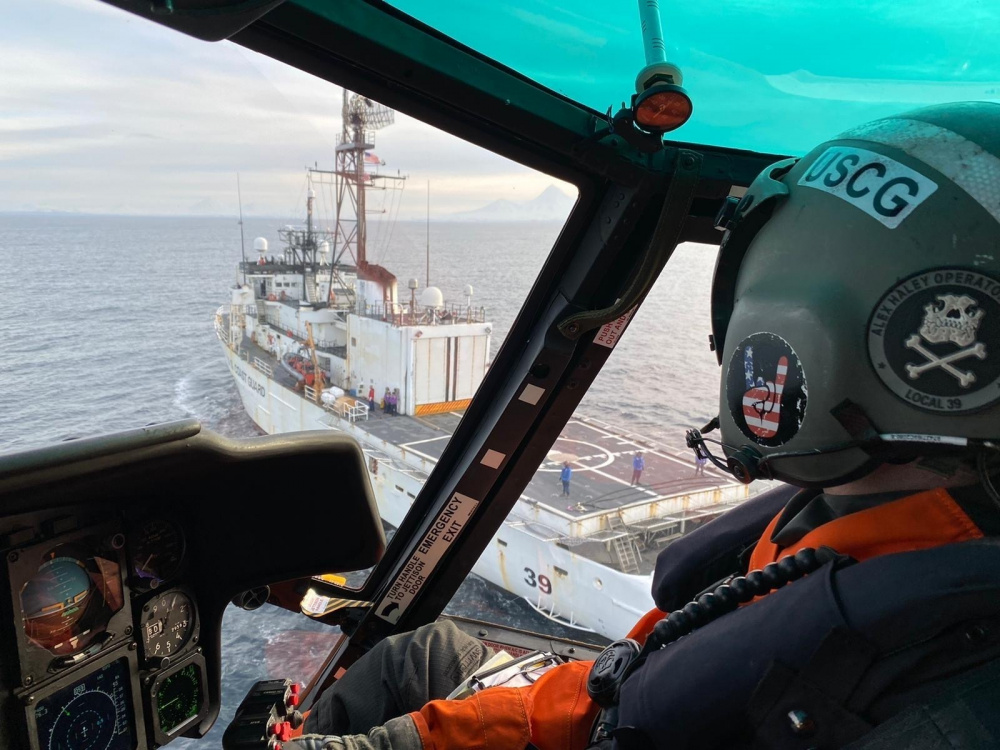
deployed aboard Cutter Alex Haley, prepares for a helicopter in-flight refueling at sea evolution with the cutter crew during a search and rescue case near Dutch Harbor, Alaska, Wednesday, Dec. 30, 2020. The crew hoisted an injured fisherman from the vessel Magnus Martens and placed him in the care of awaiting Guardian Flight Alaska personnel for further transport to Anchorage. (U.S. Coast Guard photo by Lt. Benjamin DeGroot)

Below is a District 17 news release. This marks an important step in the move to an all H-60 rotary wing fleet and it also means that ships on ALPAT will be moving to operating MH-60s rather than H-65s.

I have to wonder, since recently upgraded MH-65Es will be with us for a very long time, if perhaps we might be able to open a new Coast Guard air station in Guam or the Northern Marianas (probably Tinian where the USAF is refurbishing an air base) and perhaps in American Samoa using H-65s. (I notice, when USCGC Harriet Lane recently deployed to the Western Pacific, she apparently did so without a helicopter, which would have made the ship more effective.) Certainly, the people of these American territories would welcome the additional SAR resources. That additional Western Pacific air stations might also, at least temporarily, operate Coast Guard fixed wing aircraft would also help to counter Illegal, Unreported, Unregulated (IUU) fishing.


 April 24, 2024

KODIAK, Alaska – The Coast Guard retired the Air Station Kodiak MH-65 Dolphin helicopter fleet during a ceremony, Tuesday.

Capt. Timothy Williams, commanding officer of Air Station Kodiak, presided over the ceremony honoring the 36 years of service the MH-65 Dolphin airframe and its crews provided to the Arctic region.

Air Station Kodiak currently has a rotary-wing fleet of six MH-60 Jayhawk helicopters. The unit will shift to a rotary-wing ship-and-shore based fleet of nine MH-60 Jayhawks in 2025.

Air Station Kodiak will be the fourth Coast Guard Air Station to transition to a single rotary wing fleet of MH-60 Jayhawk helicopters. Air Stations Borinquen, Traverse City, and New Orleans all recently completed similar transitions.

“For decades, the cutter and helicopter team were the core of the ALPAT mission,” said Cmdr. James Kenshalo, MH-65 Dolphin pilot. “Together they projected force and protection to the most extreme remote regions of our nation’s territories, operating beyond where help could reach. Countless lives have been saved because of these dedicated crews.”

Commissioned in January of 1988, the Alaksa Patrol (ALPAT) mission executed solely by MH-65 Dolphin aircrews provided Coast Guard Cutters with a reliable airborne asset during Alaska Patrols.

To read more about the Coast Guard MH-65 Dolphin and MH-60 Jayhawk helicopters click the following links:

SRR – MH-65 (uscg.mil)

MH-60T Service Life Extension Program (uscg.mil)

“How Fast Response Cutters Have Transformed Coast Guard Operations In Guam” –Naval News / What About Air Assets?

The crew of USCGC Oliver Henry (WPC 1140) arrives in Pohnpei, Federated States of Micronesia, on Feb. 1, 2024, to download supplies for delivery to the outer islands of the FSM to combat the effects of a current drought. The supplies included 2,000 lbs of rice, three medical kits, 70 gallons of bottled water, and boxes of paper products. (Photo courtesy of U.S. Embassy Kolonia)

Naval News has an excellent article reviewing the additional capabilities Webber class FRCs have provided. It also highlights the vast operating area and associated challenges including necessary maintenance.

U.S Coast Guard Forces Micronesia Sector Guam’s AOR is based on Guam Search and Rescue Region. (U.S Coast Guard Navigation Center) Around 3 million square kilometers or 1.9 million square miles and includes the entirety of Palau, the Federated States of Micronesia, and Republic of the Marshall Islands.

For scale, the distance from the bottom of the area above to the top is 1020 nautical miles. According to the post, “It’s [an area] two thirds the size of the continental United States that we patrol with three ships and 300 people,” (I suspect that was in reference to the Contiguous 48, but it’s a huge area.)

ASSETS:

Something that should not be missed is that the only normally available rotary wing assets in the area are a squadron of Navy MH-60S, and there are no fixed wing SAR or law enforcement assets in the region. If an extensive search is required for any reason, it usually means flying a C-130J over 3,400 nautical miles down from Coast Guard Air Station Barbers Point, Hawaii just to get to Guam.

Major Cutters do occasionally cruise these waters, but it is rare. There is also a 225 foot buoy tender homeported in Guam.

Hopefully these waters will see USCGC Harriet Lane frequently, but on her first Western Pacific patrol, it did not appear she deployed with a helicopter (I believe Barbers Point has only three). Being one of the first four 270s that were built by Tacoma Boat, her flight deck is not strong enough to support the Navy MH-60S so they could not even us her flight deck to extend their range, much less operate from the ship.

Most of the time, there will only be one Coast Guard surface vessel underway in this vast area. Assets are still too few to provide any degree of persistence as a deterrent to Illegal, Unreported, or Unregulated (IUU) fishing. Any vessels involved in IUU fishing would likely have a good idea where our cutters are operating and with no fixed wing search aircraft, our ability to search for IUU perpetrators is extremely limited.

In addition to more cutters, we really need good maritime domain awareness, probably meaning some kind of long-range search aircraft, manned or unmanned, operating routinely in this area. We might consider basing C-27Js in Guam. It is a long way from USCG support, but the Australian Air Force also flies C-27Js, so there might be some synergy there.

“Media Advisory: U.S. Coast Guard Cutter Harriet Lane is scheduled to return to home port following inaugural Operation Blue Pacific Patrol in Oceania” –CG News

Australian Royal Navy personnel stand in formation on a pier as the U.S. Coast Guard Cutter Harriet Lane (WMEC-903) and crew prepare to moor at HMAS Cairns, Queensland, Australia, March 7, 2024. The Harriet Lane and crew had a five-day port call in Cairns during its inaugural 2024 Operation Blue Pacific patrol in Oceania. (U.S. Coast Guard photo by Petty Officer 2nd Class Ty Robertson)

Below is a Coast Guard News release. The release has some videos including interaction with children in Port Vila, Vanuatu (very cute).

One thing that caught my eye was the use of the plural in this statement, “The Coast Guard plans to use medium endurance cutters (emphasis applied–Chuck) for responsibilities in Hawaiian waters, as well as an increase Coast Guard presence throughout the Indo-Pacific and Oceania.”

Was this just a misstatement by the PAO or does this mean we will see more WMECs in 14th District?

I would also note that Harriet Lane apparently made this patrol without a helicopter. Barbers Point does fly H-65s, but last I heard, they only have three. Did the cutter at least have a Scan Eagle?


April 4, 2024

Media Advisory: U.S. Coast Guard Cutter Harriet Lane is scheduled to return to home port following inaugural Operation Blue Pacific Patrol in Oceania

Editor’s Note:  Media should RSVP by Monday, April 8 by 4 p.m. to Petty Officer 2nd Class Ryan Fisher at ryan.m.fisher@uscg.mil
Imagery of Harriet Lane’s patrol can be found here: Operation Blue Pacific 

Who: U.S. Coast Guard Rear Adm. Michael Day, commander U.S. Coast Guard Fourteenth District, and Cmdr. Nicole Tesoniero, commanding officer U.S. Coast Guard Cutter Harriet Lane (WMEC 903).

What: U.S. Coast Guard Cutter Harriet Lane and crew are expected to return to home port after their inaugural Operation Blue Pacific patrol in Oceania. Media are invited to watch Harriet Lane and crew moor at Pearl Harbor and families be reunited after being away for more than 70 days. Media will be able to hear remarks from Day and Tesoniero regarding Operation Blue Pacific and the increased Coast Guard presence in Oceania.

Where: Joint Base Pearl Harbor-Hickam, 1000 North Rd, Honolulu, Hawaii, 96860

When: Tuesday, April 9 at 10 a.m.  

Harriet Lane and crew partnered alongside allies and several Pacific Island countries from January to April 2024. Among those countries were Samoa, Fiji, Vanuatu, Australia, Papua New Guinea, Nauru and Marshall Islands. The focus was on advising and sharing best practices, along with bolstering our partners’ capabilities to promote and model good maritime governance in the region.

Harriet Lane and crew expanded U.S. Coast Guard presence in Oceania alongside Pacific Island countries exercising bilateral maritime law enforcement agreements with shiprider provisions to strengthen maritime domain awareness and support efforts to combat illegal fishing activities with partners with whom we have existing relationships.

The Harriet Lane is U.S. Coast Guard Pacific Area’s newest Indo-Pacific support cutter and spent more than 15 months in a Service Life Extension Program (SLEP) in Baltimore, Maryland, to prepare for the transition in missions and operations.

The Coast Guard plans to use medium endurance cutters for responsibilities in Hawaiian waters, as well as an increase Coast Guard presence throughout the Indo-Pacific and Oceania. The ship is especially suited for longer-range six-to-eight week joint operational and training patrols in the Pacific, taking pressure off shorter range Hawaii-based cutters more suited to service closer to home port.

Commissioned in 1984, Harriet Lane is a 270-foot medium endurance cutter homeported in Pearl Harbor, Hawaii, to support Coast Guard missions in the Pacific region. The service’s medium endurance cutter fleet supports a variety of Coast Guard missions including search and rescue, law enforcement, maritime defense, and protection of the marine environment.

“U.S. and Independent State of Samoa sign addendum to existing maritime law enforcement agreement in the Pacific” –CG News

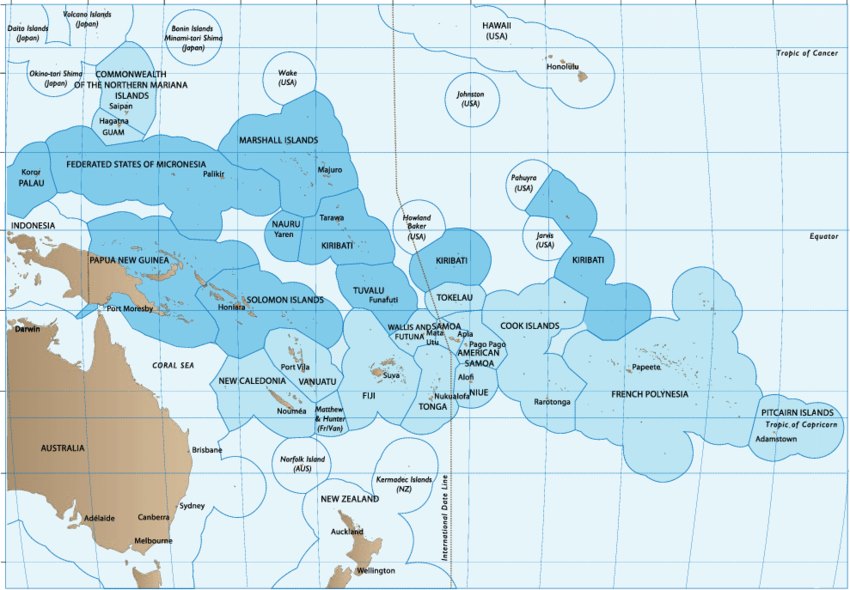
Estimated exclusive economic zones (EEZs) of Pacific Island countries and territories (PICTs). The EEZs of countries that are the Parties to the Nauru Agreement are shown in darker blue. Note that not all EEZs of PICTs have been officially delineated under the United Nations Convention on the Law of the Sea. Source: Patrick Lehodey

Below is a CG news release (includes photos of the signing). The State of Samoa, like Papua New Guinea, is not one of the three nations included in the Compacts of Free Association that include the Federated States of Micronesia and the Republic of Palau that have similar agreements. Of the three Compact of Free Association nations, only the Republic of Marshall Islands does not have the enhanced agreement that permits the US Coast Guard to act in their behalf without a national law enforcement officer on board.

All these island nations have a huge combined EEZ. We are offering help, but our assets in the Western Pacific are thin compared to the assets we have in Atlantic Area policing a much smaller EEZ.

If the illegal fishermen know where the few cutters are, they may just fish illegally in a different area and wait until the cutter leaves. The long-term solution is to help these nations control their own waters and provide enough assets to effectively police the US EEZ in the 14th District. Over and above ships, we need a multinational domain awareness system that can track the illegal fishing and provide intelligence driven enforcement. It looks like we are working on that in the form of the Indo-Pacific Partnership for Domain Awareness (IPDMA) program.


PRESS RELEASE | April 5, 2024

U.S. and Independent State of Samoa sign addendum to existing maritime law enforcement agreement in the Pacific

HONOLULU — The United States and the Independent State of Samoa had the honor to share and sign an addendum to the existing 2012 Bilateral Agreement, at U.S. Embassy Apia in Samoa, to continue and expand operational cooperation to suppress illicit transnational maritime activity, on April 5, 2024.

“In partnership with Samoa, the United States stands committed to safeguarding and ensuring security of Samoa’s economic exclusive zone, by preserving its marine resources, environment, promoting sustainable development for future generations” said U.S. Embassy Apia, Samoa’s Charge d’Affaires, Noriko Horiuchi.

The U.S. Coast Guard and Independent State of Samoa signed the addendum to the existing Bilateral Agreement allowing enhanced maritime law enforcement operations, maritime domain awareness and assists with implementation of integrated operations between the U.S. and Samoa by extending U.S. Coast Guard operability to deter predatory and illegal fishing activities in Samoa’s Exclusive Economic Zone (EEZ).

The enhanced maritime law enforcement agreement represents another tool for Samoa to use to help combat transnational illicit maritime activity and illegal fishing activities within its EEZ. This enhanced agreement enables Samoa to request the U.S. Coast Guard to inspect vessels and enforce their coastal state regulations without a Samoan officer present. This agreement does not replace the joint work conducted with Samoan shipriders; rather, it augments the capability and plays a crucial role in protecting marine ecosystems and the sustainable livelihoods they support.

These enhanced agreements demonstrate the United States’ commitment to a stable, secure and prosperous Pacific region. The strengthened partnerships in the Pacific have been invaluable in increasing the number of boardings within partners’ EEZs, which in turn has led to the deterrence, observation and reporting of vessel crew activities and fishing operations for partner nation’s enforcement agencies.

This advancement follows the similar agreements signed by the Federated States of Micronesia in October 2022, the bilateral defense agreement signed with Papua New Guinea in May 2023, and the enhanced maritime bilateral agreement with the Republic of Palau in August 2023.

“We’re honored to sign this enhanced maritime bilateral agreement with our valued partner, the Independent State of Samoa. This agreement strengthens our collaborative efforts within the region,” said Capt. Tom D’Arcy, chief of response for U.S. Coast Guard District Fourteen in Honolulu. “This agreement serves as a testament to the importance of maritime security in maintaining national sovereignty and regional stability, and we look forward to working even closer with Samoa to effectively address common maritime challenges in the Pacific.”

Through bilateral law enforcement agreements, community engagements and senior leader visits, like the recent U.S. Coast Guard Commandant visit, and subject matter exchanges between maritime agencies, we continue to demonstrate how these partnerships significantly enhance our collective capacity to safeguard shared resources and build a prosperous Oceania that is inclusive and secure for all law-abiding nations.

South Korea Seizes Chinese Fishing Vessels –Newsweek

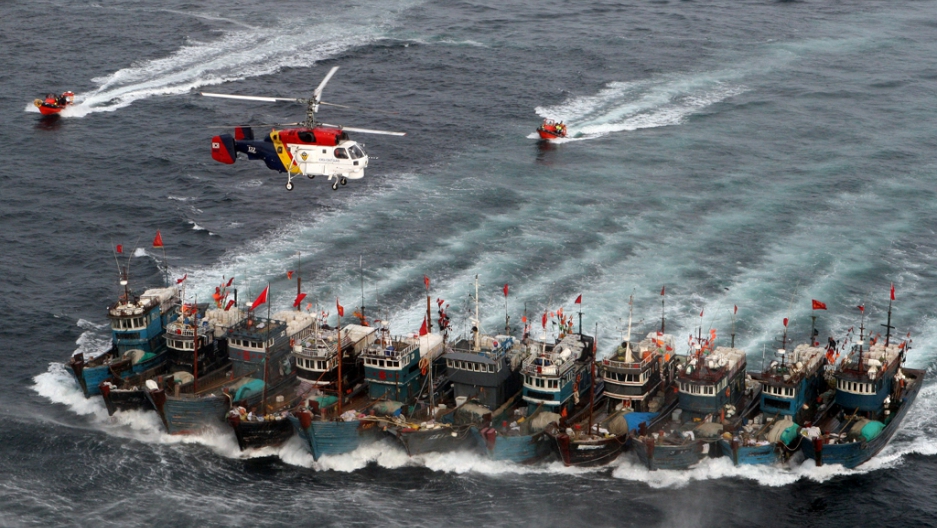
A picture taken on November 16, 2011 from a South Korean helicopter shows Chinese fishermen wielding sticks to stop an attack by South Korean coastguard commandoes armed with clubs aboard rubber boats during a crackdown on alleged illegal fishing in South Korean waters in the Yellow Sea off the southwestern coast county of Buan. South Korea’s coastguard mobilized 12 ships, four helicopters and commandoes for a special three-day crackdown on illegal fishing by Chinese boats this week. REPUBLIC OF KOREA OUT AFP PHOTO / DONG-A ILBO (Photo credit should read DONG-A ILBO/AFP/Getty Images)

Newsweek reports,

“South Korea’s Coast Guard seized five Chinese vessels for allegedly fishing illegally in the country’s waters late last month, confiscating boats and deporting several crew members…The joint patrol’s 30 participating vessels and three aircraft waters were operating in the vicinity of Jeju Island from March 25-31, Korea JoongAng Daily reported.

“The country’s coast guard said that, on average, 300 Chinese vessels fish illegally in the country’s exclusive waters each day, with that figure dropping to an estimated 140 during periods of intensified crackdowns.”

As you can see from the photo above and below. This is not a new problem.

A picture taken on November 16, 2011 from a South Korean helicopter shows Chinese boats banded together with ropes, chased by a coastguard helicopter and rubber boats pacted with commandoes, after alleged illegal fishing in South Korean waters in the Yellow Sea.
Credit: Dong-A-Ilbo

In many cases these encounters have become violent. The South Koreans have not been afraid to seized Chinese fishing vessels, but on the other hand they have not been successful in stopping large scale illegal fishing.

“Vanuatu police, aided by US Coast Guard, say Chinese vessels violated fishing laws” Reuters

USCGC Harriet Lane arrives Pearl Harbor. USCG Photo.

Reuters reports,

“Six Chinese fishing boats were found to be violating Vanuatu’s fisheries law after being inspected by local police who were on board the first U.S. Coast Guard boat to patrol the waters of the Pacific Islands nation, Vanuatu police and officials said.”

Nice to see positive results from USCGC Harriet Lane‘s first Pacific law enforcement deployment. (In just over a month, Harriet Lane will turn 40 years old.)

Notably,

“Last year, a Coast Guard vessel on patrol for illegal fishing was refused access to Vanuatu’s port.”

“Hawaii-based ‘Indo-Pacific Support Cutter,’ focused on Oceania, is on its first Pacific deployment”- Stars and Stripes

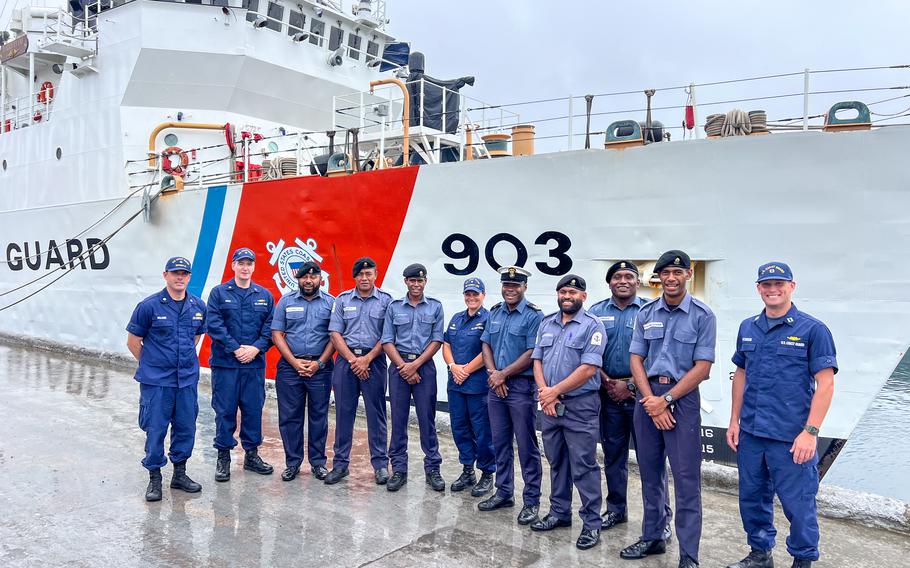
U.S. Coast Guard and Fiji Navy personnel stand in front of the U.S. Coast Guard Cutter Harriet Lane while moored in Suva, Fiji, Feb. 19, 2024. (Charly Tautfest/U.S. Coast Guard)

Stars and Stripes has a nice long article about USCGC Harriet Lane’s first Pacific deployment.

It also suggests we may have been pushing the Guam and Hawaii based Fast Response Cutters (FRS) beyond their limits for long term operation.

“But the small vessels are also limited in both how far and how long they can operate. While they can island hop, they struggle with sustained operations on the high seas, and a high operation tempo has strained the vessels. Some are in need of serious maintenance soon.” (emphasis applied–Chuck)

There is also no mention of the fact that frequently a buoy tender that is larger than Harriet Lane accompanies the FRCs on these expeditionary patrols.

While the article talks about getting new medium sized ships in the Pacific. “…Lane is a “stop gap“ until the service can send a newer, better medium-size ship to the Pacific,” the new Offshore Patrol Cutters (OPC) (more than twice as large as Harriet Lane) will not directly replace the 40 year old cutter in Hawaii. The OPCs are to be based in Long Beach and Kodiak. so rather, it will be that the OPCs relieve the two Hawaii based National Security Cutter of any need to do Alaska Patrols and frees them to do patrols in the Western Pacific.

(Forgive me for being nit picking, but the “Over the Horizon boats” are not “inflatable” even if we do call them RHIBs. For the uninitiated “inflatable” conjures up an entirely different picture.)

“Inside the U.S. Coast Guard patrols off Peru in mission to stop overfishing” –NBC News

NBC News reports on Coast Guard efforts to counter Illegal, Unregulated, Unreported fishing off Peru. The report is not really very clear in that it states the Chinese vessels are outside Peru’s territorial waters but is not clear if they are saying they are outside the 12 mile limit or they are outside the EEZ. The way it was phrased it sounded like they were referring to the 12 mile limit, but the distinction is frequently poorly understood by the media.

Previous Operation: PERU, 10.07.2023, Courtesy Photo, USCG District 11
The Coast Guard Cutter Alder approaches a squid fishing vessel while CG-2007, a C-130 from Air Station Barbers Point in Hawaii, flies over (upper left) during Operation Southern Shield 2023, October 2023. The Coast Guard recently completed the first high-seas boardings and inspections off the coast of Peru under a newly adopted multi-lateral agreement to monitor fishing
and transshipment operations within the South Pacific Regional Fisheries Management Organization (SPRFMO)Convention Area. (U.S. Coast Guard photo)

It is clear that USCGC Alder is off Peru. This is the second time the Pacific Area has used this buoy tender to conduct a distant fisheries patrol, having completed a previous similar patrol 29 November 2023. During the earlier patrol, enforcement was under the auspices of the South Pacific Regional Fisheries Management Organization (SPRFMO). That is probably the case here as well.

Thanks to Paul for bringing this to my attention.

“Australian Border Force crackdown nets 30 foreign fishers, destroys three boats off Kimberley coast” –ABC.net.AU

Map showing the Kimberley Marine Park. The shaded area is a National Park Zone (‘no take’ zone).

ABC.net.au reports the Australian Border Force has seized 30 Indonesian fishers and destroyed three boats in a crackdown against illegal fishing in the 74,469 km2 (28,753 sq mi) Kimberley Marine Park, established in 2018, off Northwestern Australia. The combined catch of the three fishing vessels was over a ton of trepang (sea cucumber).

Australian sea cucumber sells for about $350 (presumably Australian $) per kilogram.(ABC Midwest & Wheatbelt: Chris Lewis)

In addition to the loss of marine catch, there is fear that the fishermen, who frequently come ashore, may bring with them livestock diseases common in Indonesia but not present in Australia.

An illegal fishing vessel is destroyed at sea.(Supplied: Australian Border Force)

Australia has been seeing a resurgence of illegal fishing in their EEZ including Marine Parks, and there have been calls for more vigorous enforcement.

“Report: PRC fishing vessels top abusers of forced labor” –Indo-Pacific Defense Forum

PERU, 10.06.2023, Courtesy Photo
U.S. Coast Guard District 11
U.S. Coast Guard Cutter Alder raises the South Pacific Regional Fisheries Management Organization (SPRFMO) flag while patrolling the Eastern Pacific Ocean during Operation Southern Shield in October 2023. The Coast Guard recently completed the first high-seas boardings and inspections off the coast of Peru under a newly adopted multi-lateral agreement to monitor fishing and transshipment operations within the SPRFMO Convention Area, a region which encompasses nearly a quarter of the Earth’s high seas. (U.S. Coast Guard photo by Petty Officer 2nd Class Kenneth Honore)

The Indo-Pacific Defense Forum reports,

“The People’s Republic of China (PRC) is the leading abuser of forced labor on fishing vessels globally, according to a new study…The United Nations International Labour Organization estimated that 128,000 fishers worldwide were trapped into forced labor aboard vessels, according to the 2022 “Global Estimates of Modern Slavery” report. That figure, however, “likely significantly understates the full extent of the problem. The isolation of the workplace makes it difficult to reach the fishers affected, while the extreme vulnerability that comes with work at sea, as well as the risk of repercussions, can lead to reluctance on the part of fishers to report and discuss abuses,” the report stated.

This practice goes hand in hand with Illegal Unreported and Unregulated (IUU) fishing.

“The PRC’s plundering of coral, clams and fish is “theft on a grand scale, unrestricted warfare on natural resources,” Kevin Edes, a maritime security analyst for SeaLight, a project of Stanford University’s Gordian Knot Center for National Security Innovation, wrote on the SeaLight website in November 2023. Edes noted that Adm. Linda Fagan, commandant of the United States Coast Guard, described the PRC’s IUU fishing as “theft of a nation’s natural resources.”