Offshore Patrol Vessels for the Japanese Maritime Self Defense Force Launched

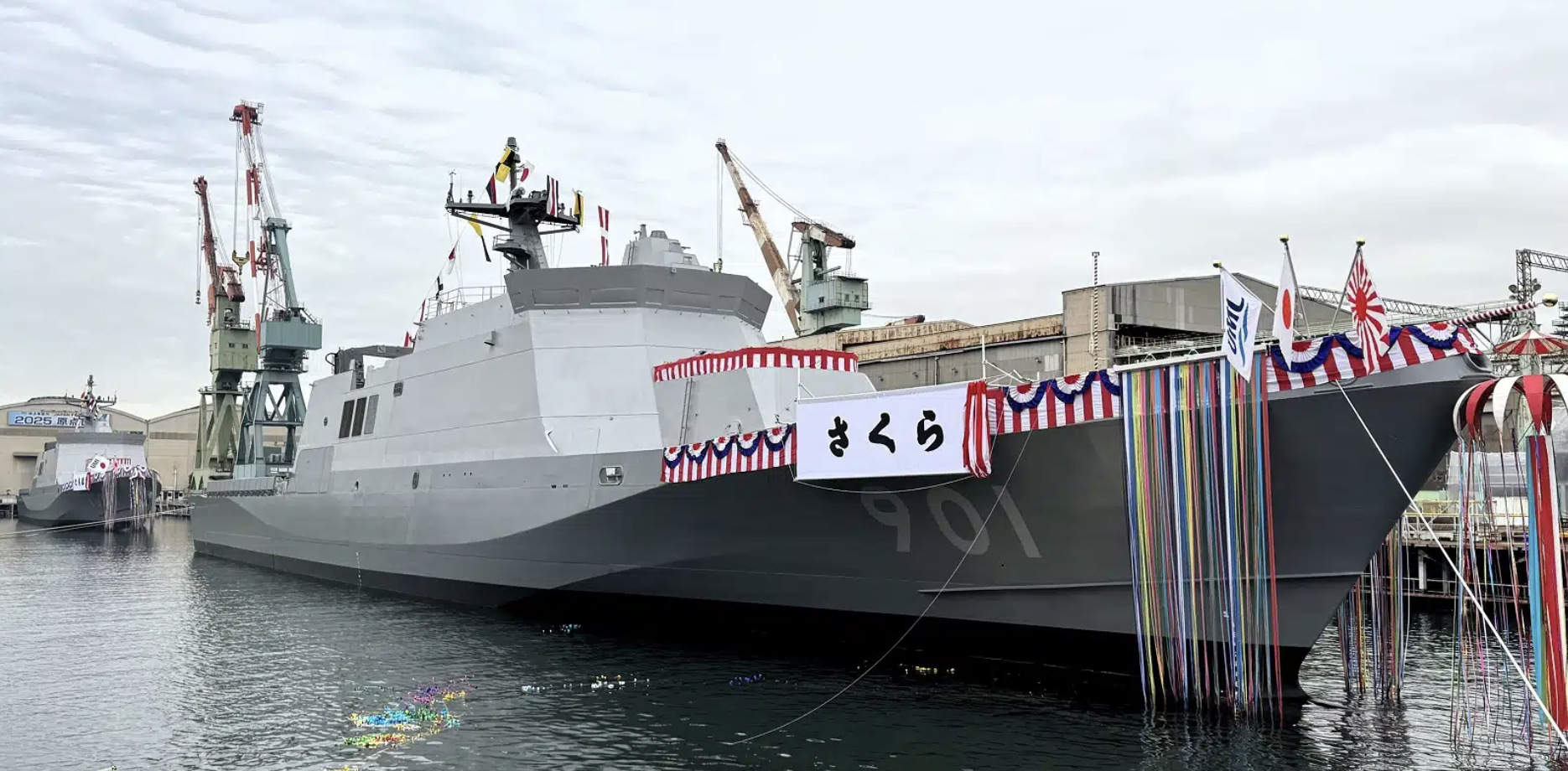
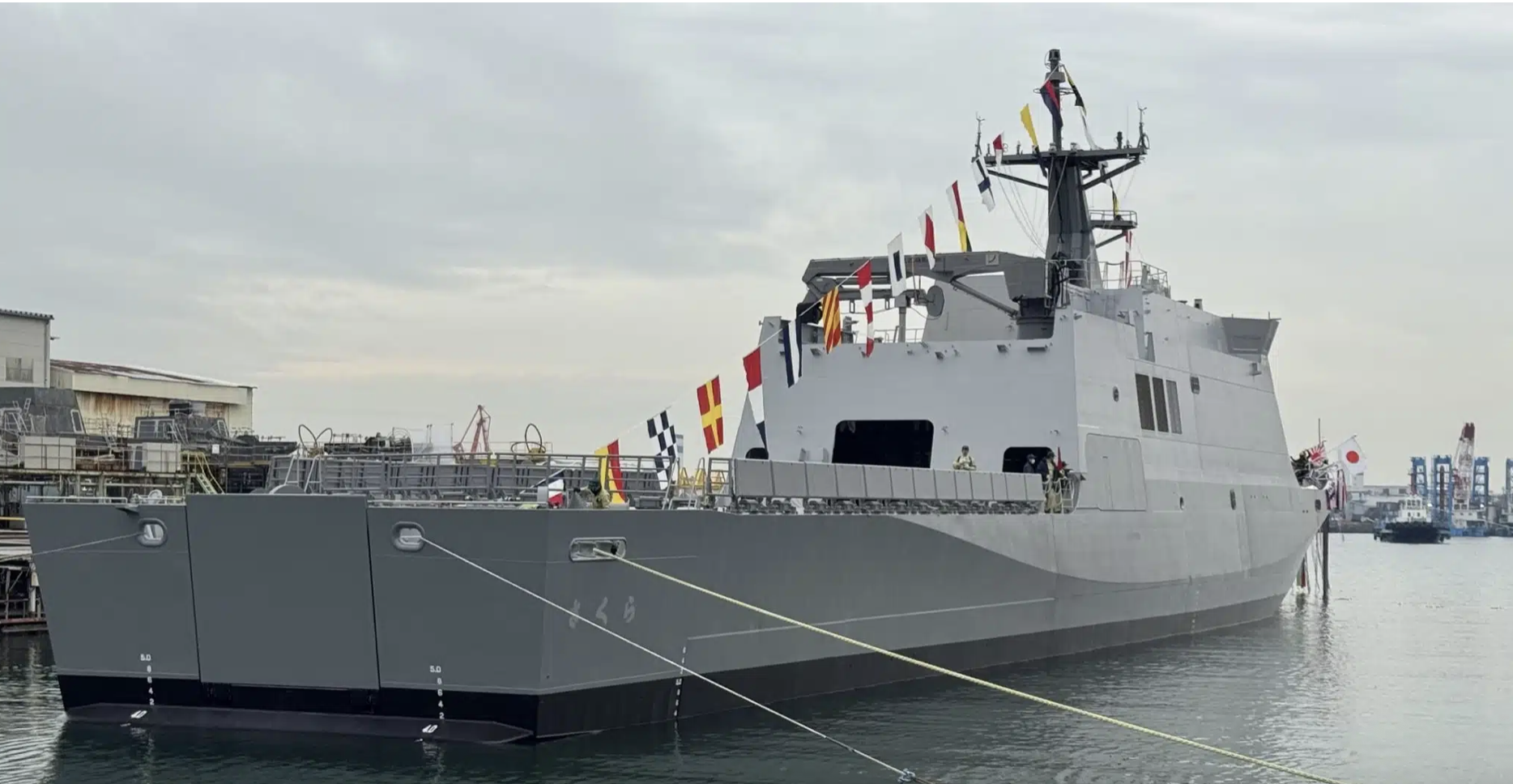
The first and second ships of the Japan Maritime Self-Defense Force’s new patrol vessel class, Sakura and Tachibana, were launched by Japan Marine United (JMU) on November 13, 2025 (photo by Kosuke Takahashi).

Naval News reports the launch of the first two of twelve Offshore Patrol Vessels (OPV) for the Japanese Navy.

“The new patrol vessels measure 95 meters (312 ft) in length, with a standard displacement of 1,900 tons (about 2300 tons full load–Chuck), a depth of 7.7 meters, a draft of 4.2 meters, and a top speed of 25 knots (28.8 mph)…automation technologies have been implemented to reduce crew requirements, limiting the necessary personnel to just 30.”

These ships are particularly interesting because they will operate a relatively large ship with a small crew.

This low crew count is achieved through high levels of automation, including systems like the “Automatic Berthing and Unberthing Function” and an “Integrated Monitoring and Control System” that allows for remote firefighting.

To keep costs down, the ships are relatively simple but include Combined Diesel-eLectric And Diesel (CODLAD) propulsion. The design incorporates space for containerized mission modules below the flight deck.

We have been following this program since its inception.

Over the course of its development, the gun has gotten smaller; the length seems to have been reduced from 100 meters to 95; and the boat and unmanned systems handling facilities have been enclosed as the flight deck was extended to the stern.

Sakura class OPV Japanese Maritime Self Defense Force, at launch. (photo by Kosuke Takahashi).

Two features I was not aware of is that they will use the V-Bat UAS, also used by the USCG and a Mine Counter Measures role has been proposed.

Construction has been very rapid. These two ships were laid down on February 14, 2025. The first four ships are expected to be delivered in 2027.

These will be the first OPVs in Japanese Navy. It is not unusual for navies to include OPVs if they do not have a sea-going Coast Guard, as is the case with the UK, France, and the Netherlands, but Japan has one of the largest Coast Guards in the world, with more large patrol cutters than the USCG. India also has a large Coast Guard and operates OPVs in both its Navy and Coast Guard.

China CG, Japan CG, Philippine CG, Different Answers to Choice of Weapons

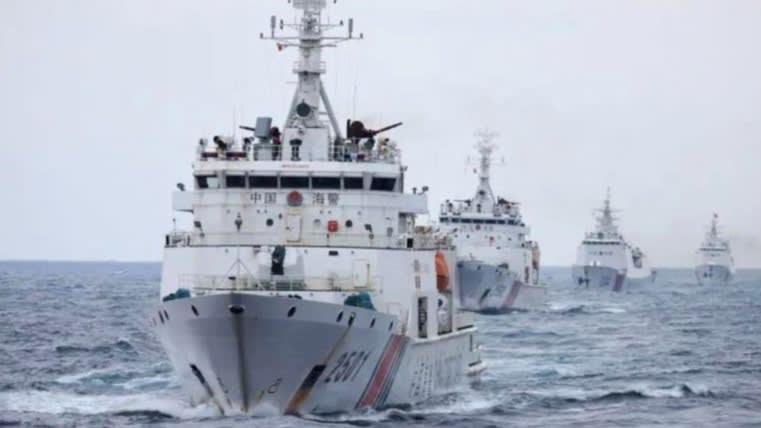
This Chinese coast guard ship 2501 is equipped with weapons believed to be 76-millimeter guns. © Kyodo

A recent large-scale transit of the Miyako Strait by three PLAN frigates and three China Coast Guard frigates has caused some alarm in Japan and raised questions about the armament on Japan Coast Guard cutters. (“China tests maritime blockade strategy in Miyako Strait“}
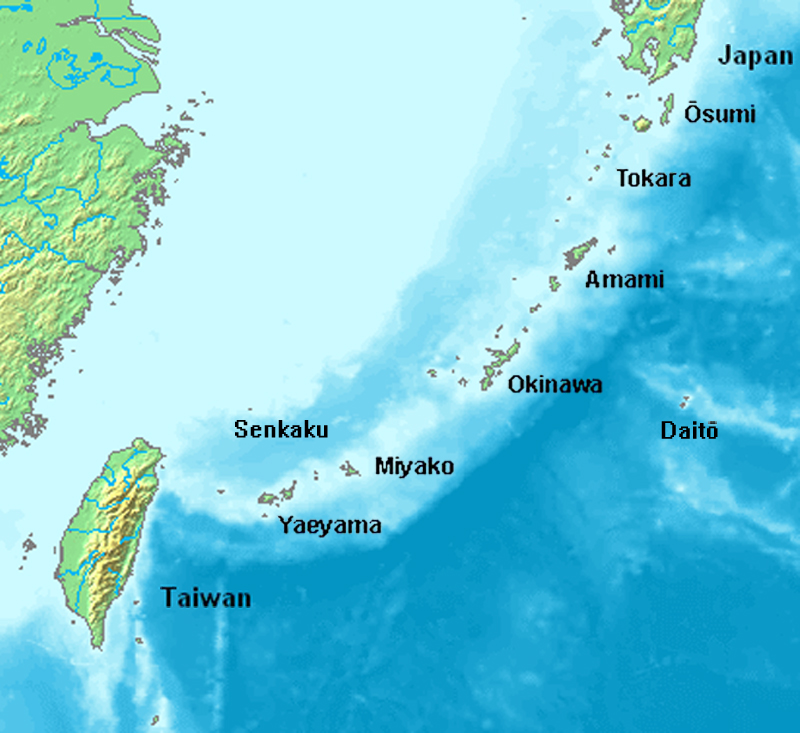
Ryukyu Islands. The Miyako Strait is located between Miyako and Okinawa

Meanwhile we see increasingly aggressive deployment of heavily armed China Coast Guard vessels in the Philippine EEZ. (“Chinese Warships, Aircraft Deploy in Strength to Scarborough Shoal“)

The Chinese, Japanese, and Philippine Coast Guard have each taken different paths in their choice of how to arm their large coast guard vessels.

Changing with the Geopolitical Situation:

China: China Coast Guard (CCG) was formed in 2013 by the consolidation of four existing agencies. At that time none of their vessels were armed with anything larger than crew served machineguns 14.5mm or smaller. July 1, 2018, the China Coast Guard was transferred from the civilian control to the People’s Armed Police. The Coast Guard Law of 1 February 2021 allows CCG ships to use lethal force on foreign ships that do not obey orders to leave Chinese waters. In parallel with this increased militarization, the China Coast Guard expanded dramatically growing into the largest fleet of cutters in the world, with several times more ships than the US Coast Guard. Four frigates or 22 corvettes that have been transferred from the PLA Navy to the CCG have retained much of their gun armament. Their newer cutters are relatively well armed. Typical armament for cutters now includes a 76mm and two 30mm guns. While this armament is typical of many Offshore Patrol Vessels world-wide, it offers significantly greater range and lethality that that of the Japan CG and particularly the Philippine Coast Guard.

Chinese H/PJ-17 30mm

Japan: Prior to the December 2001 “Battle of Amami-Ōshima” in which the Japan CG engaged and ultimately sank a North Korean spy ship disguised as a fishing vessel, most Japanese CG cutters were typically armed with 20mm Gatling guns, the same gun used in the Phalanx Close In Weapon System (CIWS), but with a much simpler fire control system. Though they significantly outnumbered the N. Korea vessel they had considerable trouble dealing with the improvised armaments on the N. Korean Vessel that included at least one recoilless rifle and heavy machine guns. This led Japan to recognize a need for more powerful, longer ranged weapons. Even so, even the largest Japanese Coast Guard cutters, and some are very large, carry no weapons larger than 40mm. The 20mm Gatling guns still seem to be the base armament for their smaller cutters and is the secondary armament for large cutters.
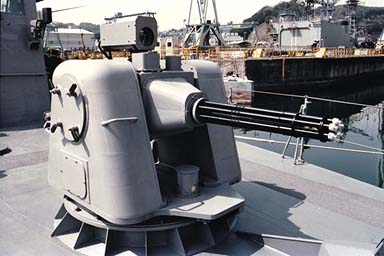
Japanese 20 mm/76 Gatling Gun. Note the camera for remote targeting. JMSDF Photograph.

Philippines: The Philippine Coast Guard is in the unique position of being, in terms of personnel, larger than the Philippine Navy even including Philippine Marine Corps, and in terms of personnel, larger than the China CG. The Philippine Coast Guard was born out of the Philippine Navy in 1967 and it was completely separated in 1998. Despite this military background the Philippine CG is a police and public service organization rather than a military service. Like the Philippine military, much of its history involved suppression of internal unrest. Until 2020 their largest ships were two buoy tenders and still none of their vessels carry weapons larger than .50 caliber machine guns. More large cutters are building, but currently they have only three. The Philippines seems to be determined to show that they are the innocent party being bullied.

Why Arm Cutters?:

No existing cutters were built with the threat of Unmanned Air Systems in mind. This is likely to have an effect on future cutters.

Weapon choices are determined on the basis of expectations of who or what the cutters will have to deal with:

  • fishermen, smugglers–small arms will serve
  • domestic terrorists that might employ small vessels–something a bit heavier, with a premium on accuracy and limited danger of collateral damage, putting guns in remote weapon stations helps, but something that has a very high probability of hit on the first round like APKWS would be better.
  • state sponsored terrorists, revolutionary groups, hostile maritime militia that can employ even large ships–how they will be armed is unpredictable, but opposing cutters need to be at least equal to the most dangerous widely available weapons that are easily tacked on.
  • coast guard of other states in disputed waters–the cutters need to be armed with weapons of equal effective range so that they cannot be intimidated.
  • armed aggression by the military of another state–cutters needed to be armed or at least rapidly upgradeable for the missions they are expected to perform.

For some states the coast guard is the only navy they have, and the coast guard needs to be prepared to assume that role. In other countries, notably the UK and France, their navy also does coast guard type missions that require larger vessels. For other states, like the US, the coast guard is a significant naval auxiliary.

Why Not to Arm Cutters?:

First of course, weapons may incur costs to various degrees–procurement, maintenance, man-days of training, ship-days of training, increased cost to build a ship that can support armaments.

Weapons change how the organization views itself. Is it a military service or a law enforcement agency or exclusively a service provider like Canada’s Coast Guard?

Weapons change how others, including other nations, see the service. International law enforcement cooperation is much easier to achieve than military cooperation. It is easier for a country to trust a Coast Guard cutter in their waters than a haze gray “battleship.” I do think this presumption of trust worthiness has more to do with reputation than the actual armament and that some types of weapons look aggressive while others do not.

Is there an optimum level of weapons for Japan and Philippine Coast Guard cutters?:

The concern in Japan seems to be that with weapons that have greater range, the China Coast Guard can strike with impunity. That seems unlikely to happen as a result of a decision by higher-ups unless they want to provoke a major conflict. That is not an advantageous way to willfully initiate a war, but wars frequently result because one side underestimates the resolve of their counterparts on the other side. An overzealous midgrade CCG officer might see an opportunity to strike a blow that his Japanese or Philippine counterpart could not answer, or China’s national command authority might see using the possibility of just a few shots to inflict some damage on a Japanese or Philippine cutter as just a small step up from ramming.

In any case, leaving the impression that the opposition can inflict significant and lethal damage on your ship, with impunity, does not seem like a good idea.

The one thing guns can do that missiles cannot, is fire warning shots. Larger guns can fire more impressive warning shots at greater ranges than smaller guns. That is a consideration, but once weapons are fired it becomes a smaller step to fire for effect. Even so, a weapon that can fire an impressive warning shot at a range outside the effective range of most improvised armament seems essential. That seems to point to at least a 40mm gun.

The most obvious answer is that Japan and the Philippines should arm their cutters the way most similar vessels are armed, with one 57 or 76mm caliber gun and one or two 20 to 40mm autocannon. This has become almost a worldwide standard for Offshore Patrol Vessels.

There is another alternative that might serve them better, that is to create ambiguity or doubt in the mind of the opposition by installing VLS that could support different types of munitions or have none at all. Are they armed with loitering munitions, Hellfire, Spike ER, Spike NLOS, Sidewinders, short range anti-drone (UAS) weapons, or anti-ship cruise missiles or is a bluff? What is their range? How lethal are their weapons? No way of knowing. 


New Japan Coast Guard Base Ship?

Alex Luck
@AlexLuck9
“Japan intends to procure a very large coast guard hull suitable for supporting helicopter ops and extended EEZ deployments as a “mobile base”, to be commissioned towards 2030.
Reminder that size growth of coast guard assets is a general trend.”

Pulled from X, no idea of the source or validity.

Thanks to Sven for bringing this to my attention.

Japan to Build Five Large Cutters for Philippine Coast Guard

Japanese built Philippine Coast Guard cutter BRP Melchora Aquino

The EurAsian Times reports that Japan and the Philippines have finalized their largest security agreement to date.

“The US $507 million project is funded by an Official Development Aid loan from the Japan International Cooperation Agency. Around $425 million will be utilized in constructing five 97-meter-long multi-mission response vessels (MRRV) and a five-year integrated logistics support package…The patrol vessels are expected to be delivered between 2027 and 2028.”

The Philippine CG already has two ships of this type. We talked about this class earlier. Final specs, if there are no changes, from NavyRecognition,

“The MRRV has a length of 96.6 meters (317 feet–Chuck), a maximum speed of not less than 24 knots, and has a complement of 67 crew members. She has a two 6600 kW (6.6MW) diesel engines.”

That is about 17,700 HP. By comparison, the OPCs, which are longer and twice as heavy. will have 19,520 HP.

It appears the Philippine Coast Guard still has not armed their cutters with anything larger than .50 caliber machine guns. This class does have water cannon. Their Japanese counterparts are armed with either 20mm Gatling guns or Bushmaster II 30mm chain guns in Remote Weapon Stations.

Meanwhile the Philippine Navy is also buying Offshore Patrol Vessels, six from S. Korea. They will be much more heavily armed.

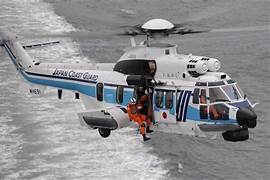
Japan Coast Guard H225 Helicopters

Japan CG Airbus H225 Helicopter

Below is an AirBus news release. The H225 is about the same size as the MH-60J despite the claims in the news release, Wikipedia reports that while the H225 has more power, the MH-60J has a higher speed and greater range.

Japan Coast Guard adds three H225s

Tokyo, 11 April 2024 – Japan Coast Guard (JCG) has placed an additional order for three H225 helicopters, taking its total H225 fleet up to 18. The largest Super Puma operator in Japan received three H225s in December 2023 and one in February 2024 for its growing fleet. The new helicopters will support territorial coastal activities, maritime law enforcement, as well as disaster relief missions in the country.

“The Japan Coast Guard has been an active operator of the Super Puma family helicopters for three decades. This follow-on order demonstrates the customer’s confidence in our products and the dedicated support to their fleet,” said Jean-Luc Alfonsi, Managing Director of Airbus Helicopters in Japan. “We believe the H225 is the perfect choice for JCG’s critical missions for law enforcement, as well as coastal and island protection, given its versatility in all weather conditions. We are committed to fully supporting its existing fleet, as well as its upcoming deliveries, ensuring high availability for its operations.”

JCG’s H225 fleet is covered by Airbus’ highly adaptive HCare Smart full-by-the-hour material support. This customised fleet availability programme allows the national coast guard agency to focus on its flight operations whilst Airbus manages its assets.

As the latest addition to the Super Puma family, the H225 is recognised for its high performance in challenging conditions as well as its outstanding range and payload capacity. The H225 has benefited from Airbus Helicopters’ continuous improvement policy. It is now equipped with new avionics including the largest screens available on the market and an innovative interface that, combined with its renowned autopilot, reduces pilot workload and enables them to focus on the mission at hand.

Offering the industry’s best range, speed, payload and reliability in the 11-ton-category twin-engine rotorcraft, the H225 offers outstanding endurance and fast cruise speed, and can be fitted with various equipment to suit a variety of roles.

24 H225s are currently flown in Japan by Japan’s Ministry of Defence or parapublic operators for various search and rescue missions, VIP, fire-fighting, as well as passenger and goods transportation.

“Unified Response: Joint Naval Drills in South China Sea” –MSN

Vessels from Australia, the USA, the Philippines, and Japan navigate in formation. (AFP Photo)

MSN reports,

The United States, Japan, Australia, and the Philippines … have announced preparations to perform cooperative naval exercises to preserve freedom of navigation and the rule of law as a display of unity…The combined forces of the participating nations will conduct a series of exercises aimed at improving interoperability and cooperation on April 7 as part of the joint naval and air drills.

Notably, there don’t seem to be any coast guard assets from any nation involved in this exercise.

There has been a lot of speculation about the timing of this exercise being so close to that of the trilateral summit which begins April 11, but the exercise is actually pretty small, with only one ship each from the US, Australia, and Japan. The exercise involves no aircraft carriers, submarines, or amphibious assault ships.

The largest ship participating is the Japanese Destroyer Akebono (DD-108) which is not an Aegis ship, and it is one of their smaller destroyers at 6200 tons full load. The US representative is a Littoral Combat Ship, USS Mobile (LCS-26) at 3,104 tons full load.

“US, Philippines, Japan to tackle South China Sea incidents in trilateral summit, says Manila official” –Reuters

Philippine Coast Guard vessels join Japanese and U.S. Coast Guard ships during joint exercises off the coast of Bataan, Philippines, in June 2023. IMAGE CREDIT: Philippine Coast Guard

Reuters reports,

A trilateral summit between the United States, Japan, and the Philippines will include a discussion of recent incidents in the South China Sea, Manila’s foreign ministry said on Friday.

The summit begins April 11.

Can’t help but think this may result in some additional tasking for the Coast Guard.

“Top Ten Navies by Aggregate Displacement, 1 January 2024” –Analysis and diagram by Phoenix_jz

Two years ago, I did a post with a similar title from the same source. Somehow, I missed the 2023 edition. As I said in the earlier post, I don’t know , but the data appears to be credible, and it looks like readers are checking his figures. 

It is very difficult to read the tonnages at the bottom of the graph unless you are using a computer and click on the graph to see it in a larger size. 

The creator’s notes and some additional comments are below. 


Hello all!

Well, 2024 is upon us, and as such so is the third edition of my top ten navy list. For those unfamiliar, here are links to 2022 and 2023, with a general explainer of the whole concept in the 2022 version.

The long and short of it is that this graph reflects a personal tracker I keep of almost every large and moderately sized navy, and calculates the aggregate displacement of these navies. It’s not a perfect way to display the size of navies – far from it in fact – but it is at least more representative than counting numbers of hulls alone, in my opinion.

To break down what each of these categories mean;

  • Surface Warships is an aggregate of all above-water warships and major aviation and amphibious assault platforms. This category includes CVNs, CVs, CVLs, LHDs, LHAs, LPDs, CGs, DDGs, FFGs, corvettes, OPVs, CPVs, lighter patrol craft, and MCM vessels.
  • Submarines is what it says on the tin – SSBNs, SSGNs, SSNs, SSKs, and for select nations where applicable (and where information is available), special purpose submarines. Please note dedicated training submarines are counted separately.
  • AORs includes all major fleet replenishment vessels (coastal vessels do not count, however).
  • Other Auxiliaries is a very wide net that essentially captures everything else. Special mission ships, support vessels, minor amphibious assault vessels (LSDs, LSTs, LCAC’s, LCM’s, LCU’s), training vessels, tugs, coastal support vessels, hydrography ships – all essential parts of navies, but generally often paid less attention to as they’re not as flashy as the warships proper.

Interesting trends in data that I thought I would share for various navies, and thoughts and observations otherwise;

The USN is, unsurprisingly, still top dog by a huge margin. In spite a net decommissioning of five ships this year, the USN has grown overall by about 32,000 tons – four ‘cruisers’, two SSNs, four LCS, and five patrol craft decommissioned against the introduction of three destroyers, an SSN, five LCS, and a replenishment ship. It is worth noting that 2023 is the first year since 2010 that the USN has commissioned three destroyers in a year, though a repeat performance in the next couple years is unlikely – these ships were launched in 2020 and 2021, and only one destroyer per year was launched in 2022 and 2023.

No one will be surprised to hear that the PLAN has grown for the nth consecutive year, adding the final Type 055 batch I and the remaining Type 054A Batch V, for almost 50,000 tons of new surface combatants. Much of the remaining increase in displacement for this year (which totaled nearly 90,000 tons) reflected a steady pace of modernization in mine warfare, landing forces, and logistical support/other auxiliaries. As with last year, the number of minor patrol craft continue to plummet as the PLAN continues to divest many of its obsolescent brown-water combatants, or relegates them to training duties.

Moving on to ongoing construction, progress on the new destroyer batches continues at pace. At least two Type 055 Batch II appear to be under construction, and the overall number of Type 052D Batch IV appears to be at least ten. The first ship actually launched at the very end of 2022 (at Jiangnan), and two further have been launched by the same yard as well as three at Dalian. Two more remain under construction at each yard. The first of these ships to be launched appears to be on trials and will likely commission this coming year. The Type 054A program of the navy appears to have finally wrapped up (construction of the hull for the China Coast Guard continues), and the Type 054B program has continued at pace if not scale – two ships were launched this year, but modules of further units have been scarce. Rounding things out for major surface vessels, a new Type 075 LHD was launched this past December. Conspicuously absent has been sightings of any modules for new carriers. Considering Fujian (Type 003) began construction at some point from 2015 to 2017, one has to wonder if we will see China launch another carrier before the end of the decade.

Perhaps most consequential of all, however, has been the completion of new production facilities at Bohai and a resumption of Type 093 SSN launches. The first of the new Type 093B launched in 2022, and has been followed up by two more launches this year (possibly up to three). A sustained pace of two submarines a year, or even just three submarines every two years, would quickly add up could see anywhere from nine to eleven new SSNs launched by the end of 2027, and in service by early 2030s. Only time will tell what the actual drumbeat of production will be.

Russia’s VMF woes in the Black Sea have continued unabated, except less at sea and largely fueled by the Franco-British SCALP cruise missile. The most dramatic loss by far was the destruction of the Project 636.3 ‘Improved’ Kilo Rostov-on-Don in drydock at Sevastopol, but similar attacks claimed the destruction or constructive loss of a Karakurt-class corvette (under construction, not in service) and two Ropucha-class LSTs. The infamous TB-2 made a brief return to destroy a Serna-class LCU, and two other LCU’s may have finally become the first victims of Kamikaze USVs this past November, for a total of 11,407 tonnes lost.

In regards to the more regular cycle of commissioning and decommissioning, one frigate, one MCM vessel, and three corvettes were brought into service, as well as a new SSGN, SSBN, and SSK each. Against this a corvette, SSGN, SSBN, and SSK were decommissioned. Overall, in spite of losses the VMF managed a net gain of 6,324 tonnes of surface warships and submarines. Anyone who checks against my figures from last year will note that the increase in the VMF’s overall tonnage this year is far more substantial, due to the auxiliary category. Though some of this was from new vessels, this was mostly down to a badly needed overhaul and reorganization of that part of my tracker, particularly for the tug fleet. Did you know the Russian navy tug fleet displaces more than either the Argentine or Canadian navies? Now you do! Seriously – it would be the 20th largest navy in the world by itself.

As a final note on the VMF – it is worth remembering that ships commissioned in the Russian navy are not always actually in service, as ships can often languish in near-terminal refits or simply be left inactive without a formal decommissioning. Almost half the remaining Projekt 877 Kilo’s, for example, appear to be inactive at this point (5 of 10).

(In comments the author noted the following, “Russian naval losses during the war have totalled 13 vessels for 29,870 tonnes. Quite a bit – but also only about 1.4% of their current overall tonnage.” –Chuck)

The British Royal Navy observes a second year of marginal reduction in overall tonnage (-2,640t, or -0.3%), losing another Type 23 frigate as well as the last Echo-class survey ship. Against this the RFA brought into service the first MROSS, ProteusProteus represents a considerable increase in subsurface capability, though the loss of a frigate with no replacement ship to replace it for another thee to four years is painful, especially given how many of the remaining eleven ships are deep in LIFEX/Post-LIFEX refits. With that said, their new frigate programs are moving on steadily. Steel was cut on two new frigates this year – the future HMS Birmingham (4th Type 26) and HMS Active (2nd Type 31), bringing the total construction volume to five frigates building and one fitting out.

The JMSDF continues to grow, albeit at a more moderate pace this year (+6,530t, or +0.9%), inducting a new Mogami-class frigate and Taigei-class attack submarine, while shifting another Oyashio-class from the active fleet to a training role. Two more FFM were launched this year, though surprisingly they have not started construction on the next pair. This past November, it was announced that the Mogami-class FFM would be curtailed at 12 units (of 22 planned), and followed on by an evolution of the design known as FMF-AAW. The FMF-AAW will feature greater air and surface warfare capabilities. Twelve such ships are planned.

The Indian Navy’s growth in 2023 was far less dramatic than in 2022, but still noteworthy (+9,200t, or +1.5%), as adding a new conventional attack submarine and destroyer to the fleet has finally pushed them over the 600,000-tonne line.

The Marine Nationale grew by almost 9,000 tonnes (2.1%) this year, largely down to the retirement and replacement of a patrol ship, nuclear attack submarine, and tugs with an equal number of replacements. Though it is worth noting that the new attack submarine is not fully operational yet – that will happen in 2024 – so technically the MN’s attack submarine fleet is really four boats at this point in time.

The saga of eight and ninth place swapping around continues, as the ROKN has managed to move back to the position of eighth largest navy in the world. In 2023 they added a net 15,374t (+4.3%), commissioning four Daegu-class frigates, a second KSS-III class attack submarine, an MCM vessel and a pair of LCACs, against the decommissioning of two corvettes and five PKM’s.

In contrast, the Marina Militare continues to feel the bite from the two FREMM sold to Egypt, as well as delays in brining the LHD Trieste into service – intended for 2023 but again pushed back, now to the spring of 2024. The first PPA ‘Light+’, Raimondo Montecuccoli, was brought into service in 2023 – an OPV on paper, but light frigate in practice. Against this one of the elderly Maestrale-class frigates, Zeffiro, was retired, as was one of the fleet’s AORs (Vesuvio) and a water tanker (Bormida), resulting in a real drop of 7,073 tonnes (-1.9%). The drop seen versus the chart versus last year is more dramatic (totals 16,632 tonnes), which reflects both cleaning up data on old auxiliary platforms for which information is scarce, and correcting some minor sheet errors, which totaled 9,559 tonnes.

The outlook should be looking up in the future – as previously mentioned, the LHD Trieste should enter service this year, as should the fourth and fifth PPA. The first of two replacement FREMM (GPe) was launched in late 2023 and a second will follow this spring, with both being slated to enter service in 2025 alongside the sixth PPA and second Vulcano-class replenishment ship – barring any delays.

Finally, the Indonesian Navy saw another year of growth, adding a net 9,930 tonnes (+3.1%), with another hospital ship commissioned, a new survey ship, corvette, and two new MCM vessels and FACs each, as well as several patrol boats. The TNIAL continues a steady program of domestic construction of patrol craft, and construction is ongoing on two Iver Huitfelt derivative frigates, with the keel of the first vessel laid down this past August. They have also cut steel on a new hydrography ship, which will launch in Indonesia and complete fitting out in Germany.

What comes next in terms of major platforms for the TNIAL is somewhat up in the air. As with the year prior, there has been no progress made on the procurement of six FREMM from Italy, despite a contract being signed two and a half years ago (June 2021). In spite of this, they have expressed interest in procuring two PPA to bolster their patrol fleet. In the interest of expediting procurement, they are looking at two ‘Light+’ configuration vessels currently fitting out at Muggiano – Marcantonio Colonna (due for delivery to the MMI in the latter half of 2024) and Ruggiero di Lauria (due for delivery to the MMI in mid-2025). According to the General Manager of Fincantieri’s Naval Vessels Division, Dario Deste, a contract for the two vessels could be signed in the first half of 2024.

(In answer to a question the author added this in the comments–Chuck)

No.11 to 20 are as follows for 1 January 2024;

  • 11: Turkey – 297,298t
  • 12: Taiwan – 268,958t
  • 13 Egypt – 232,046t
  • 14: Spain- 229,373t
  • 15: Germany – 226,655t
  • 16: Australia – 224,074t (decided to add the National Support Squadron, which added about 30kt)
  • 17: Greece – 189,184t
  • 18: Brazil – 162,29t
  • 19: Chile – 161,404t
  • 20: Argentina – 138,620t
(A reader, , added this–Chuck)

Listed by ranking for this year:

Nation Change from 2023 (tonnes) 2023 Ranking Change from 2022 (tonnes) 2022 Ranking
United States +55,658 1st +250,308 1st
China +93,567 2nd +99,299 2nd
Russia + 211,333 3rd +166,682 3rd
United Kingdom -2,640 4th -5,815 4th
Japan +6,530 5th +23,790 5th
India +9,200 6th +62,349 6th
France +8,925 7th +12,145 7th
South Korea +15,374 9th +7,153 8th
Italy -16,632 8th -3,452 9th
Indonesia -70 10th +17,709 10th

Probably not surprising given all these nations are competing more or less with each other, but the rankings have basically remained the same except for Italy and South Korea trading places in 2023, then reverting to their 2022 places again this year. Nobody previous top 10 navy has left the club either.

However, do note that not all of the year-to-year tonnage differences are due to actual changes in fleet size/composition. As Phoenix mentioned in his post, the Russians in particular got a huge tonnage jump this year because he changed the way he counts auxiliaries, and given the discrepancy between his reported +32k figure for the USN and the numbers, there’s probably some math correction involved there too.


“Japan amplifies maritime security amid rising regional tensions” –Indo-Pacific Defense Forum

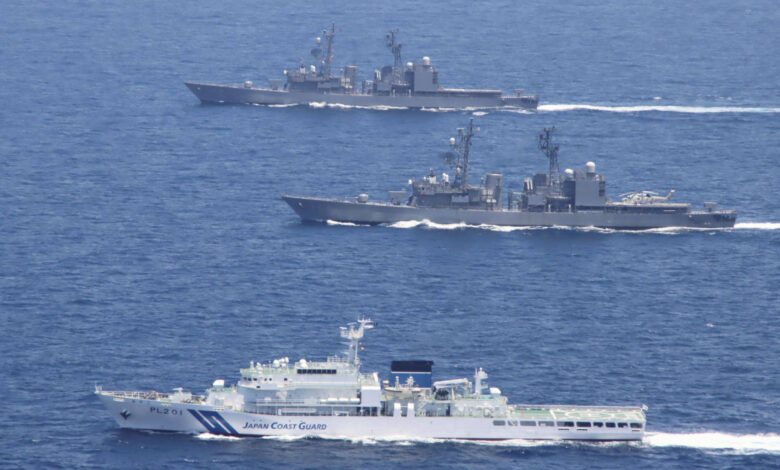
The Japan Coast Guard and Japan Maritime Self-Defense Force conduct a joint drill. IMAGE CREDIT: JAPAN COAST GUARD

Indo-Pacific Defense Forum reports Japan is attempting to increase coordination between their Maritime Defense Force (navy) and Coast Guard.

“Japan’s economic security is wedded to stable sea lines of communication (SLOC) that stretch through the East China Sea to waters around Taiwan, from the South China Seas to the Malacca straits into the Indian Ocean,” Stephen Nagy, professor at the Department of Politics and International Studies at the International Christian University in Tokyo, told FORUM. “The recently announced five-year ocean policy plan aims to bring stability to these SLOCs through more operational synergy between the [J]MSDF and Japan’s Coast Guard.”

There is little doubt this is in response to Chinese misbehavior. Still, until recently there has been little coordination between the two services.

The Japan Coast Guard has a long association with the US Coast Guard. From Wikipedia,

 “…in March 1946, USCG Captain Frank M. Meals was invited to consider the situation. Captain Meals suggested the establishment of a comprehensive coast guard organization based on the USCG. In response to this, the Maritime Safety Agency (MSA) was established as an external station of the Ministry of Transportation in 1948. Its English name was changed to Japan Coast Guard in April 2000.”

The Japan Coast Guard has never had the close association with the Maritime Defense Force that the US Coast Guard enjoys with the US Navy. It appears that is changing.

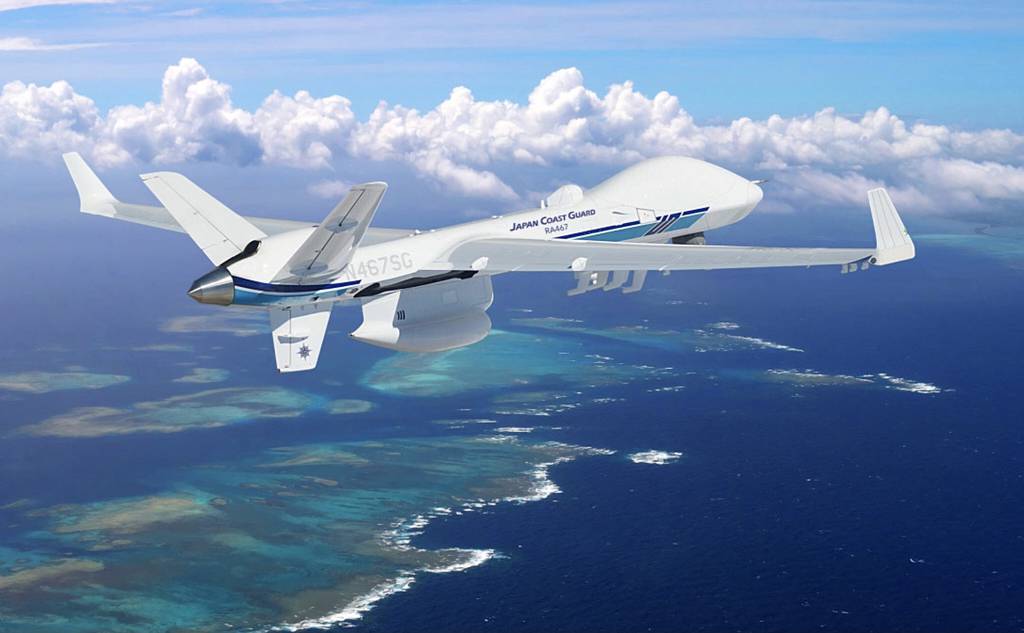
An artist’s rendering shows the Japan Coast Guard’s SeaGuardian drone. (General Atomics Aeronautical Systems)

As noted, the Japan Coast Guard has fielded MQ-9B long endurance, medium altitude, unmanned aircraft, a capability the Japan Maritime Self Defense Force does not yet have.

Seems the Japanese now view the Japan Coast Guard as a trip wire. That if the Chinese make an aggressive move, the Japan Coast Guard is likely to be the first to detect–and feel it.

“U.S., Philippine, Japan Coast Guards conduct trilateral engagements in the Philippines” –DVIDS

(From left) Japan Coast Guard Vessel Akitsushima (PLH 32), U.S. Coast Guard Cutter Stratton (WMSL 752), Philippine Coast Guard vessels BRP Gabriela Silang (OPV 8301) and BRP Melchora Aquino (MRRV-9702) conduct a trilateral engagement in the South China Sea June 5, 2023. Stratton deployed to the Western Pacific to conduct engagements with regional allies and partner nations, reinforcing a rules-based order in the maritime domain. (U.S. Navy photo by Chief Petty Officer Brett Cote)

Passing along the Coast Guard Pacific Area release below, distributed by the Defense Video Information Distribution Service (DVIDS). An earlier post, “Philippine Coast Guard Will Hold First-Ever Trilateral Exercise with U.S., Japan” –USNI, provided information on the participating ships.


Story by Chief Petty Officer Matthew Masaschi,

06.09.2023

MANILA, Philippines — The U.S. Coast Guard Cutter Stratton (WMSL 752) and crew departed the Philippines Thursday following the first trilateral engagements between the U.S., Philippine, and Japan Coast Guards.

Stratton’s crew conducted professional exchanges and joint operations in port and at sea with the Japan Coast Guard Vessel Akitsushima (PLH 32) and the Philippine Coast Guard during Stratton’s months-long Indo-Pacific deployment.

Stratton, the Akitsushima and Philippine Coast Guard vessels Gabriela Silang, and Melchora Aquino spent three days at sea off the coast of Bataan, Philippines, executing simulated search-and-rescue scenarios, maritime law enforcement boardings, passing exercises, and formation maneuvering drills. Additionally, they conducted communications and signaling drills, crew professional exchanges and joint boat and air operations following their Manila port visit.

While in Manila, members from the three services conducted combined damage control training, executed cooperative mission planning and table-top exercises ahead of at-sea combined operations. They conducted crew exchanges and toured partner vessels, participated in a women-in-law-enforcement discussion panel, played in a basketball tournament, volunteered at a beach cleanup, visited a children’s hospital and gathered for social receptions.

“It was an honor for Stratton to come together with our Philippine and Japan Coast Guard allies to learn from each other, work together to address common challenges and enhance our interoperability for joint maritime operations,” said U.S. Coast Guard Capt. Brian Krautler, Stratton’s commanding officer. “The experiences gained from our multi-mission trilateral operations underway, our professional exchanges in port and the relationships forged over the last week have been invaluable enablers for the U.S. Coast Guard and our allies to secure a continued free and open Indo-Pacific.”

The multi-day trilateral engagement was named “Kaagapay,” a Filipino word meaning “standing side by side.”

The relationship between the United States Coast Guard and Philippine Coast Guard was built over many years of partnership between the two services. The relationship flourished through the Philippine cadet exchange program at the U.S. Coast Guard Academy, U.S. Coast Guard mobile training team deployments to the Philippines, Philippine Coast Guard Officer enrollment in the U.S. Coast Guard’s Maritime Law Enforcement Academy, engagements by U.S. Coast Guard Cutter Midgett and U.S. Coast Guard Cutter Munro in Manila in recent years and Stratton’s subsequent participation in the first trilateral USCG, PCG, and JCG training operation. The U.S. and Philippine Coast Guard’s partnership has solidified the commitment of both services to upholding a rules-based order in the maritime domain.

The engagement was another SAPPHIRE touchpoint between the U.S. and Japan Coast Guards. In 2022, Operation SAPPHIRE was established through a memorandum of cooperation between the U.S. and Japan Coast Guards as a perpetual operation to strengthen relationships, increase bilateral engagements, and focus on maintaining a free and open Indo-Pacific.

Operating under the tactical control of Commander, U.S. 7th Fleet, Stratton’s crew will engage in professional and subject matter expert exchanges with partners and allies throughout the Indo-Pacific during their months-long patrol to the region.

The U.S. Coast Guard maintains steadfast partnerships and strives for persistent presence in the Indo-Pacific region. Stratton’s current Indo-Pacific patrol is the cutter’s second patrol in the region and one of seven national security cutter deployments to the Indo-Pacific since 2019.

The Coast Guard provides expertise in all aspects of maritime governance, within the mission sets of: search and rescue; illegal, unreported, and unregulated fishing; maritime environmental response; maritime security; maritime domain awareness; maritime aviation operations; and humanitarian assistance and disaster relief.

Commissioned in 2012, Stratton is one of four Coast Guard legend-class national security cutters homeported in Alameda, California. National security cutters are 418-feet long, 54-feet wide, and have a 4,600 long-ton displacement. They have a top speed in excess of 28 knots, a range of 12,000 nautical miles, endurance of up to 90 days and can hold a crew of up to 170.

National security cutters feature advanced command and control capabilities, aviation support facilities, stern cutter boat launch and increased endurance for long-range patrols to disrupt threats to national security further offshore.

U.S. Coast Guard Pacific Area is responsible for U. S. Coast Guard operations spanning across six of the seven continents, 71 countries and more than 74 million square miles of ocean. It reaches from the shores of the West Coast of the United States to the Indo-Pacific, Eastern Pacific, Arctic and Antarctic regions. Pacific Area strives to integrate capabilities with partners to ensure collaboration and unity of effort throughout the Pacific.