Surplus ISR Aircraft–MC-12Ws

File:MC12Wweb.jpg

Illustration: from stephanelhernault@yahoo.fr via Wikipedia

Earlier we talked about how the Beech King Air C-12 might serve as replacement for the UAV capability currently missing from the Coast Guard’s system of systems.

Now there is a report that ten to twelve MC-12Ws already equipped for ISR may be declared surplus by the Air Force.

I think they are worth a look as possible Coast Guard assets.

DHS might also consider these valuable assets for disaster response.

(Thanks to Lee for the Heads-up)

CG Maritime Force Protection Units

Just a short note to highlight the existence of a couple of unusual units that may not be familiar. They have an important, if largely unrecognized mission. These are the Coast Guard’s Maritime Force Protection Units Bangor, WA and Kings Bay, GA.

The units are perhaps unique in that they have only a single mission, and they are funded by the Navy. They protect Fleet Ballistic Missile submarines while they transit on the surface, to and from their homeports. The possibility of a USS Cole style attack motivated their creation. Each unit consist of approximately 200 Coasties and is commanded by an O-5. Having CG crews and carrying CG colors and markings allows them to enforce a security zone around the subs. Both units stood up in July 2007.

They have some unique equipment too, including four 87 footers that were purchased with Navy funds. They are recognizable because of the stabilized remotely controlled machine guns mounted high on the bow.

  • SEA DRAGON    WPB 87367    Delivered NOV 2007   Kings Bay, GA
  • SEA DEVIL          WPB 87368    Delivered Feb 2008    Bangor, WA
  • SEA DOG            WPB 87373    Delivered April 2009   Kings Bay, GA
  • SEA FOX             WPB 87374    Delivered May 2009    Bangor, WA
File:US Navy 090818-N-1325N-003 U. S. Coast Guardsmen man the rails as the U.S. Coast Guard Cutter Sea Fox (WPB 87374) is brought to life at Naval Base Kitsap.jpg
Photo Credit: KEYPORT, Wash. (Aug. 18, 2009) U. S. Coast Guardsmen man the rails as the U.S. Coast Guard Cutter Sea Fox (WPB 87374) is brought to life at Naval Base Kitsap. (U.S. Navy photo Ray Narimatsu/Released)

The names chosen for these Navy purchased vessels all reprise submarines that fought in WWII. A contemporary report on the arrival of Sea Devil indicates these 87 footers are manned differently as well,

“To carry out its new mission, the Sea Devil carries more crew than most 87-footers, who require more training than most, and it packs more firepower.

“Instead of 11 “racks,” or beds, and a crew of 10, the Sea Devil will carry 12 racks and a crew of 15 because of the extra hours and training anticipated for the unique mission.

“Along with two .50-caliber automatic weapons mounted on each side of the vessel, a third is mounted near the bridge.”

They have a lot of other boats as well, including some non-standard types, like the one in which the Chairman of the Joint Chief took a ride.

Gen. Martin Dempsey, chairman of the Joint Chiefs of Staff, pilots a 64-foot Special Purpose Craft in Puget Sound, Oct. 04, 2012, as part of a familiarization tour of Coast Guard units in the Pacific Northwest. The special purpose craft is based at the Marine Force Protection Unit in Silverdale, Wash. U.S. Coast Guard photo by Petty Officer 3rd Class Nathan W. Bradshaw.

Photo Credit: Gen. Martin Dempsey, chairman of the Joint Chiefs of Staff, pilots a 64-foot Special Purpose Craft in Puget Sound, Oct. 04, 2012, as part of a familiarization tour of Coast Guard units in the Pacific Northwest. The special purpose craft is based at the Marine Force Protection Unit in Silverdale, Wash. U.S. Coast Guard photo by Petty Officer 3rd Class Nathan W. Bradshaw.

Thanks to Tim Colton and Lee Walher for help preparing this.

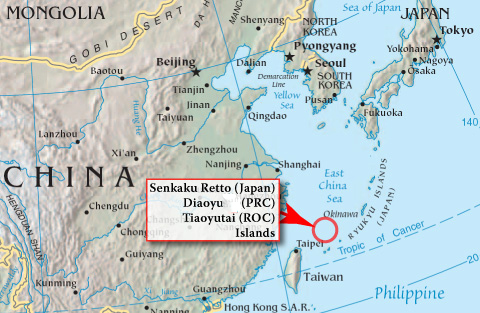
Conflict between Japan and Two Chinas coming to a Head?

Up to six Chinese law enforcement agency vessels, roughly analogous to Coast Guard Cutters, have entered the territorial waters of islands administered by Japan, and Japanese Coast Guard Cutters responded. It does not look like the disagreement is going to go away quietly. Anti-Japanese anger is being nurtured in China. Both China and Japan are preparing for a leadership change, and no one wants to look weak.

File:Senkaku-Diaoyu-Tiaoyu-Islan.jpg

Illustration: from CIA map

A good summary of events is here. A second source indicates the Chinese have “1,000” fishing vessels en route.

“And, whether we like it or not, Washington is involved.

The Chinese have taken an additional step and filed a claim on the islands with the UN describing its interpretation of where the baselines are drawn and enacted a national law that,

“prohibits foreign warships and vessels from entering the waters around the Diaoyu Islands without permission from the Chinese government.”

This seems to reflect China’s broader interpretation of the ability of a state to restrict access to its EEZ.

If the situation were not complicated enough, don’t forget there is a third party here, who are also inserting themselves in the mix. Taiwan also claims these islands and have also sent their Coast Guard into the area.

Photos of some of the players here.

UAS Developments

There has been some interesting news on unmanned air systems (UAS).

A “sense and avoid” radar system has been developed for the the Navy’s Broad Area Maritime Surveillance (BAMS) land based system. Replacing “See and Avoid” with no eyes on board has been a problem in integrating UAS with the domestic air traffic control system. This system does not give all around detection, but then eyes don’t see under the plane or what is coming up behind either.

Lighter than air, or in this case slightly heavier than air always seems almost ready. The Army and Northrop Grumman’s optionally manned long endurance, multi-intelligence vehicle (LEMV). has had its first flight.

“HAV business development director Hardy Giesler told AIN today that, configured as a freighter, the airship could carry a payload of 20 tonnes, but for the ISR mission it is designed to carry a 2,500-pound payload at 20,000 feet for 21 days. The Army says the airship will perform the ISR mission with fuel consumption 10 times less than that of mission-comparable platforms, and that it will provide a 2,000-mile radius of action.”
There is also a report that the few land based drones the Department of Homeland security has employed over water have not been as successful as might have been hoped. It does look like this report originated with Customs and Border Protection’s aviation unit. They might have their own agenda.

GAO Responds to Fleet Mix Studies, Part 2, Commentary

This is my commentary on the Fleet Mix Studies and GAO’s response to them. Part 1, which outlined the results of the studies and GAO’s reaction is here.

Other, previous, related posts include:
Offshore and Aviation Fleet Mix Study Published
Fleet Mix Where Are the Trade-offs

General Comments applicable to the evaluation process

While the best way to consider acquisitions is to consider lifecycle costs, these don’t seem to have been considered by any of the players involved. The NSCs have crews substantially smaller than the 378s they replaced. Presumably they also have lower maintenance and fuel costs as well. If lifecycle costs were considered there would have been less likelihood the NSCs would have been deferred or cancelled, as they seem to have been.

On the other hand the FRCs and OPCs are likely to cost more than the vessels they replace, except that some of the first OPCs are likely to actually replace 378s, which are probably much more costly to operate.

Also the value of these vessels as national security assets is not considered. Trade-offs of construction of cutters vs Navy ships was not considered.

How the Coast Guard has handled the process:

The Coast Guard may have made all the right decisions regarding type and number of assets, but they have not done a good job of explaining why the decisions are the right one, and they do not seem to have succeeded in building a consensus in favor of the program in the Department, Congress and the Administration. These people like to think they are part of the decision making process and, like it or not, they are. They have to be brought along the decision chain, so that they understand the rationale for the ultimate choices. The Fleet mix studies were an opportunity to do that, that was not fully exploited.

Some of the weaknesses I see in the Coast Guard’s studies were that

  • There were no ice-capable ships, so the budgetary effect of this requirement was not dealt with.
  • There is no consideration of trade-off between types.
  • There are no alternative types considered.
  • There was no exploration of the consequences of building less than the “Program of Record.”
  • The time dimension is largely ignored, in that there was little reference to the catastrophic effect of stretching out the replacement program.

It is unfortunate that the Coast Guard took so long to deliver their Fleet Mix Study to Congress. It was certainly not perfect, but Congress asked for it, and it should have been seen as part of a continuing process to build support. Feedback could have been incorporated and there would be an improved product by now. It is still not too late to use follow on studies in an iterative process to help convince decision makers outside the Coast Guard. Continue reading

Navy Merges Coastal and Riverine Forces

Some of the Navy units that the Coast Guard most commonly works with are being reorganized.

The Ports, Waterways, and Coastal Security (PWCS) mission the Coast Guard does in the US, when required outside the US, is a Navy responsibility, although they frequently seek Coast Guard assistance.

The Navy has decided to reorganize the way they do this mission, by combining at least to some extent, the organizations that do river and coastal missions.

They are also getting some new platforms to allow them to operate further from shore, including the new 85 foot patrol boat we talked about earlier.

There isn’t an exact correspondence between the way the Coast Guard defines the PWCS mission and the mission set for this new organization, but there are a lot of similarities and we can expect that there will be opportunities to train and exercise together.

LNG powered Cutter

Recently a rather ordinary looking Norwegian coast guard cutter came to the port of Hamburg and created something of a stir. This little craft KV Barentshav (also here), seemed unremarkable, but its power plant was unusual. In addition to diesel, it could be powered by Liquified Natural Gas.

It has been a long time since we saw a shift in fuel for ships, from coal to oil. Now it seems we may be seeing the beginnings of another shift. The big drivers are reduced fuel cost and reduced emissions. The Norwegians seem to be the leaders here, but the US Coast Guard is not totally unfamiliar, particularly the M side of the house. the Dec 2011 issue of Marine Safety Engineering (pdf) had an article predicting that predicted that natural gas fuel vessels were coming soon.

This issue highlights another technology that is becoming more important every day, and that is the increased use of liquefied natural gas (LNG). Whereas, we previously considered LNG as a cargo, new MARPOL regulations for reduced emissions are now making it an attractive fuel source. It is extremely clean burning and is much lower cost than similarly clean diesel fuel. Marine Safety Engineers are leading the charge in establishing the appropriate safety standards needed for LNG fueled vessels, which not only includes the vessels themselves, but also bunkering facilities and waterways risk management.

Looking at cost, a study of the possible application of this technology to the marine transportation industry is available here: http://www.cleanskies.org/?publication=natural-gas-for-marine-vessels-u-s-market-opportunities (pdf). The study notes,

Based on the current forecasts, natural gas delivered for production of LNG is now at least 70% less expensive on an energy equivalent basis than marine residual fuel and 85% less expensive than marine distillate fuel. EIA currently projects that this relative price advantage will continue, and even increase, through 2035.

LNG does require approximately twice the volume for the same energy content and the infrastructure for its distribution is still limited. Currently engines designed to burn LNG are built by Wartsila, Rolls-Royce, and Mitsubishi. Some of these engines are duel fuel, burning either LNG or conventional diesel fuel.

Considering

  • the US has ample supplies of natural gas,
  • it may be less than half the cost on a per energy unit basis,
  • that its use reduces maintenance costs,
  • LNG is more environmentally friendly, and
  • the possibility of duel fuel makes this option more practical.

Perhaps the Coast Guard may want to think about powering some of its assets with LNG. When the replacement for the 87 foot WPB is planned, it might be worth a look. They fit the profile of good candidates for LNG since they will normally return to the same base to be refueled. Extending usage to road vehicle and support equipment would amortize the cost of providing the infrastructure and make this option even more attractive.

Weapons Testing

As we have noted earlier, I believe there is a need to validate the Coast Guard’s ability to forcibly stop a medium to large vessel being used as a terrorist weapon. To do that the .50 cal., Phalanx 20mm, 25 mm, 57 mm, and 76 mm ought to be tested to confirm their ability to penetrate the side of a substantial ship, and go on to penetrate the cylinders of a truly large diesel engine (they can go to over 30 liters per cylinder).

File:US Navy 101027-N-8913A-252 Rounds from a Mk-15 Phalanx Close-in Weapon System (CIWS) from the guided-missile destroyer USS Mitscher (DDG 57) impact.jpg

(U.S. Navy photo by Mass Communication Specialist Seaman Leonard Adams/Released)

The Navy is restarting its SINKEX program. Perhaps they could be persuaded to allow some controlled testing, with the objective of developing doctrine with regard to effective ranges and choice of ammunition.