CIMSEC has posted an interesting article, “A Feast of Cabbage and Salami: Part I – The Vocabulary of Asian Maritime Disputes” for anyone interested in the current maritime disputes in East Asia, and, in fact, for anyone interested in international maritime law. It is apparently the first of a series and includes a wealth of links for further study.
Category Archives: News
Coast Guard Yard Gets Navy 76mm Guns

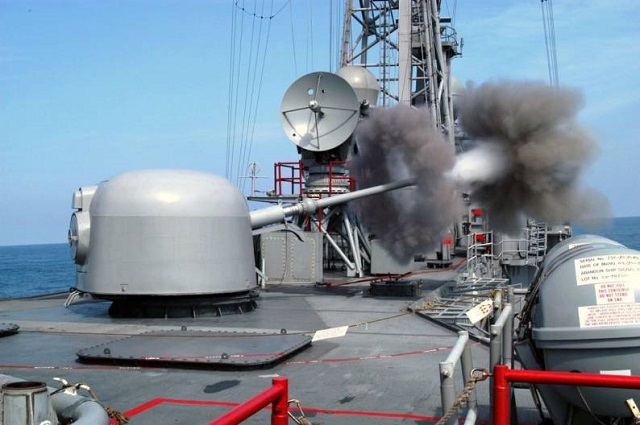
Photo: Mk-75 3”/62 caliber naval gun aboard USS Curts (FFG-38). U.S. Navy photograph
NavyRecognition is reporting that the Navy and Coast Guard are in the process of stripping five FFGs of weapons components that will be used to support Coast Guard Mk75 gun systems on Bear Class WMECs that are expected to be in service into the 2030s. It is not apparent from the post if Mk92 fire control system parts were also scavenged.
It is clear that soon virtually all US expertise in the Mk75 gun will reside in the Coast Guard. We can expect that some of those nations that have received (or will receive) former USCG 378s are likely to ask for help with these system for both training and maintenance.
Incident at Sea–Russia vs Finland
We have a report of harassment of a Finnish research vessel by a Russian Corvette in international waters off Sweden.
NOAA/CG Sign Fleet Plan and Officer Exchange MOA
Coast Guard News release:
WASHINGTON – Senior leaders from the U.S. Coast Guard and the National Oceanic and Atmospheric Administration (NOAA) signed a Fleet Plan and Officer Exchange memorandum of understanding (MOU) on Wednesday at a ceremony at U.S. Coast Guard Headquarters.
Coast Guard Vice Adm. Charles Michel, deputy commandant for operations, and NOAA Vice Adm. Michael Devany, deputy under secretary for operations, were the signing officials for the joint letter of promulgation.
The Coast Guard and NOAA have collaborated for over 200 years. The Fleet Plan supplements the Cooperative Maritime Strategy (CMS) that was signed in February 2013 and establishes a course of action to guide cooperation in the operation and maintenance of marine and aviation platforms. This direction also expands valuable inter-agency work currently underway, such as repairing NOAA ships at the Coast Guard Yard and advancing Arctic preparedness through collaboration with the Coast Guard’s Arctic Shield test and evaluation program.
The Officer Exchange MOU supports both the CMS and the Fleet Plan by allowing the exchange of officer personnel for the purpose of sharing professional knowledge, expertise, doctrine, and for the professional development of officers. Coast Guard officer candidates and the NOAA Corps already train together at the Coast Guard Academy in New London, Conn.
“The Fleet Plan and Officer Exchange MOU builds on the long history of cooperation between NOAA and the Coast Guard. Our shared responsibilities in serving the American people’s interests in the maritime domain are fortified by our even closer relationship,” said Michel.
“NOAA and the Coast Guard share a commitment to providing the highest level of service to the nation,” said Devany. “These important agreements provide a framework for leveraging our respective resources and enhancing collaboration where we have common interests regarding personnel, fleet operations, research and development.”
More information about the NOAA Commissioned Officer Corps is available at http://www.noaacorps.noaa.gov/
I have considering suggesting that there should be a closer relationship between the Coast Guard and NOAA. Oceanography used to be a regular Coast Guard activity. The ships sometime look similar. We seem to have a lot in common or at least in parallel.
Farewell to the Falcon
It has been around for over 30 years. While many of us questioned the choice, and joked about the pilots’ need to get back in time for happy hour, it is hard to argue with the fact that this was perhaps the sexiest aircraft ever flown by the Coast Guard.
DefenseMediaNetwork has a nice tribute to aircraft on the occasion of its retirement.
Huge New Marine Reserve, Pacific Remote Islands Marine National Monument

Photo Credit: Marine Conservatory Institute, Click to enlarge.
We knew this was coming. gCaptain reports implementation and gives more detail.
“The proclamation expands the existing Pacific Remote Islands Marine National Monument to six times its current size, resulting in 490,000 square miles (about 390,000 square nautical miles) of protected environment around tropical islands and atolls in the south-central Pacific Ocean. At that size, it is now the largest protected area on the planet, land or sea. The protected area encompasses the seven islands and reefs of Wake, Johnston, Baker, Howland, Kingman, Jarvis and Palmyra, as well as the ocean around them.”
If I read this right, the area encompassed in larger than the entire US Atlantic Coast EEZ (considering Gulf of Mexico separate) and the difficulty policing it is exacerbated by the fact that it is in several pieces separated by hundreds of miles. As I noted earlier, this sure looks like justification for at least one more cutter in Hawaii, and possibly other additional ships and air assets there or in Guam. A ninth NSC added to the FY2016 budget appears well justified.
Bad News, but No One Hurt
gCaptain reports, “The U.S. Coast Guard Cutter Key Largo collided with the 42-foot commercial fishing vessel Sea Shepherd (not that Sea Shepherd–Chuck) earlier today (Sept 23, 2014–Chuck), sinking the vessel approximately nine nautical miles east northeast of Vieques, Puerto Rico according to a USCG report.”
Presumably we will hear more about this.
Whaling Conundrum
gCaptain reports that the Japanese will resume whaling in spite of rulings against it by the International Court of Justice and the International Whaling Commission.
Mostly, whaling has been done in the waters off Antarctica, although there has been some Arctic Whaling, where the US currently makes no specific territorial claim, but has reserved the right to make claims at a later date. Leaving the policing of these waters by others may be seen as weakening any future US claim and strengthening the hand of Nations that actually police these waters.
Will the US in the person of the Coast Guard attempt to stop Japanese whaling in either the Arctic or the Antarctic?
Singapore Builds “Cutter X”
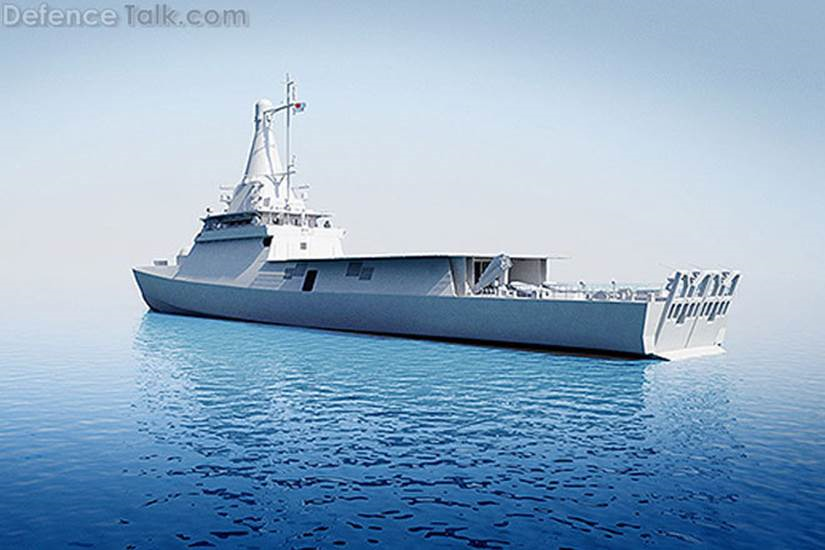
Singapore is building a new class of patrol vessels that look very much like my proposal for “Cutter X”, trading some Webber class and some larger ships for an intermediate design, costing about half what an OPC would cost, basically putting the equipment and crew (with some augmentation) of a Webber Class into a larger more seaworthy hull, to allow them to be used for extended operation in environments that do not require the ice strengthened hull and ability to launch and recover helicopters and boats in sea state five provided by the OPC.
Singapore is building eight of the ships under the project name “Littoral Missions Vessel” to replace eleven smaller, 500 ton, Fearless class patrol vessels that are approaching 20 years old. These ships are reportedly 80 meters in length (262.5 feet), displace 1200 tons (probably a light displacement), have a beam of 12 meters (39.4 feet), a range of 5,000 nautical miles at 15 knots, and a speed of 27 knots, all with a crew of only 30, though they do include additional accommodations for 30 more. (more here)

It appears these ships will use the same engines as the Webber Class. It is not clear how many of these engines they are using. Two would give them almost 12,000 HP which would almost certainly be good for at least 24 knots, but it might require three or four engines to make 27 knots. (reports now indicate the class has two engines totallin about 12,000 HP)
In some respects these ships are more capable than the proposed cutter, in that they will have a 76mm gun and firecontrol system, in addition to smaller remotely operated weapons. It also appears to have space reserved for a small AAW missile system. On the other hand, while the flight deck can handle an H-60, the ship, unlike the French L’Adroit which was my model for “cutter X”, has no helicopter hangar, although it might be possible to add one using the same solution employed on L’Adroit (putting it under the bridge).
Soon, I expect to do an update of the “Cutter X” proposal, based on where we are now in the cutter recapitalization program.
C4ISR Upgrades
The Coast Guard’s Acquisitions Directorate (CG-9) is reporting that
The Coast Guard awarded a $31 million contract to Lockheed Martin Aug. 21, 2014, to purchase equipment to upgrade the electronic systems known as C4ISR – or Command, Control, Communications, Computers, Intelligence, Surveillance and Reconnaissance – on three National Security Cutters and at the NSC C4ISR training facility.
This is part of a larger Command, Control, Communications, Computers, Intelligence, Surveillance and Reconnaissance Project.
“The C4ISR upgrade focuses on improving “interoperability,” or the ability of Coast Guard operating units to share information and coordinate operations with each other, with shore-based command centers and with other government agencies and allies. Other components will allow cutters (and aircraft?–Chuck) to send and receive tactical information including sensor, navigational and planning data to other U.S. military units as well as tactical sharing with international assets.”
“Features
•For NSCs, networked communications, radio direction finding and other capabilities to integrate with Navy battle groups and the broader U.S. government intelligence community
•For NSCs, HC-144As and HC-130Js, an advanced C4ISR suite that includes a common baseline across assets and transitions to an open architecture system of Coast Guard-controlled components with government software data rights
•The OPC’s C4ISR suite will be derived from the baseline used for NSC and other new platforms
•For in-service cutters, installation of commercial satellite communications and AIS
•For 378-foot and 270-foot cutters, Seawatch C2 system”
All well and good, but does it include Link 16? If so why not say so? If not why not? It seems to be very common and affordable. It is installed on boats smaller than the Webber class and on a wide range of aircraft including helicopters so it is certainly doable.