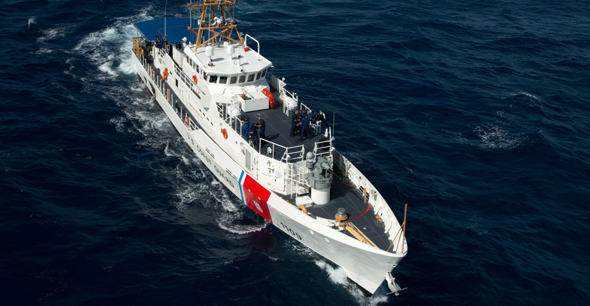
Azerbaijan Coast Guard to Get 6 OPVs and 6 WPBs


Sa’ar 62 OPV

Janes is reporting the Azerbaijan Coast Guard is procuring twelve new Israeli designed vessels to be built in Azerbaijan. These include six 62 meter OPVs (203 foot, the Greek ships of this class are about 450 tons full load) based on the Sa’ar 4.5 missile corvette and six 31.2 meter (102 foot, 95 ton) Shaldag patrol vessels.


SHALDAG Fast Patrol Craft (earlier, slightly smaller version)

Azerbaijan is one of five countries bordering the land locked (and reportedly oil rich) Caspian Sea. The others are Russia to the North, Iran to the South, and Turkmenistan and Kazakhstan on the other side of the Caspian. Russia has several missile corvettes and Iran has both corvettes and small submarines in the Caspian.

Azerbaijan’s total EEZ and total internal area is only 86,600 sq. km. The comparable figure for the US is over 250 times larger.

I’m afraid this may be another area where, in the not too distant future, Americans will get a geography lesson via troubling news reports.

Martime Facilities Security–Swimmer Defense

The Israelis are marketing a anti-swimmer sensor system that claims increased range, believed necessary because increased speed of swimmer delivery systems shortens reaction time.

“The AquaShield ER offers unprecedented detection ranges against all marine threats. The AquaShield ER passed rigorous sea trials achieving detection ranges of up to 3.5 kilometer for Swimmer Delivery Vehicle targets, 1.8 kilometers for Open Circuit Divers and 1.2 kilometers for divers using closed-circuit apparatus.”

Perhaps I am reading to much into this, but this capability may have played a part in intercepting five Hamas commandos who swam ashore in Israel recently as reported here.

I have been out of the loop for a long time, but I suspect the Coast Guard is still not integrated into a multiservice network capable of reacting to a terrorist incursion the way the Israelis reported did.

The Tammuz missile referred to in the report is in the same class as the Hellfire, but with a much longer range (25 km, that is more range than a WWII light cruiser). It has been previously referred to as the Spike NLOS (Non-line of Sight). Since they referred to this being mounted on an OPV rather than a corvette or missile boat, I suspect they are talking about it having been mounted on something relatively small, about the size of an 87 footer.

Other “Coast Guards'” New Ships and Early Disposals

Some news on fleet changes in the UK and New Zealand Navies with regard to their ships that do Coast Guard type work.

The Brits are building three new offshore patrol vessels. They will be built (before the first USCG Offshore Patrol Cutter) to essentially the same design as the three Offshore Patrol Vessels built for Trinidad and Tobago (video above) that I encouraged the Coast Guard to buy or lease four years ago when Trinidad and Tobago refused to pay for the ships they had contracted and BAE was looking for a buyer. Brazil subsequently purchased the vessels and the rights to the design. The remarkable thing about this decision is that the vessels are being built primarily to keep a ship yard busy and they will replace three River class offshore patrol vessels that were commissioned in 2003.


Photo Credit Benchill, Protector-class inshore patrol boat HMNZS Hawea (P3571) entering Otago Harbour, New Zealand

DefenseNews is reporting that New Zealand is considering disposing of two recently build Protector Class Inshore Patrol Vessels that entered service in only 2009 (similar to the Webber class FRCs) and building an additional much larger Offshore Patrol Vessel presumably a third Otago class.

What will happen to these five relatively new ships?

–Australia, in the middle of an alien migrant interdiction crisis, just had a fire on HMAS Bundaberg, a vessel very similar to the New Zealand Protector Class Inshore Patrol Vessels, that is likely to result in total loss. Perhaps they will take the excess New Zealand vessels, they were after all built in an Australian shipyard, but they really need something larger, perhaps the excess British River class.
–The Philippine Navy and Coast Guard also needs more modern patrol vessels to deal with Chinese incursions into their EEZ. The Philippine Coast Guard already has 56 meter vessels built in the same yard that made the New Zealand vessels but they could also use larger vessels like the Rivers.

30mm Better Than 57mm?

The MK46 Mod 1 weapon system fires a round during a live-fire qualification exercise aboard the amphibious transport dock ship USS New Orleans (LPD-18). US NAvy Photo

The MK46 Mod 1 weapon system fires a round during a live-fire qualification exercise aboard the amphibious transport dock ship USS New Orleans (LPD-18). US NAvy Photo

The Navy has apparently made a decision I find incomprehensible. They have decided to alter the DDG-1000 design, replacing the two 57mm Mk110 mounts (the same gun on the Bertholf class and projected for the OPC) with two 30mm Mk 46.

According to the US Naval Institute News,

“The Navy has replaced two 57mm guns planned on the Zumwalt-class guided missile destroyer designed to fight off swarm boat attacks with a smaller pair of 30mm guns, Naval Sea Systems Command (NAVSEA) told USNI News on Monday.”

and later,

“A follow on 2012 assessment using the latest gun and munition effectiveness information, concluded that the MK46 was more effective than the MK110 CIGS. Based on that assessment, approval was received to change from the MK 110 CIGS to the MK 46 Gun System. In addition to the increased capability, the change from MK110 to MK46 resulted in reduction in weight and significant cost avoidance, while still meeting requirements. DDG 1000 is planned to have two medium range MK46, 30mm Close-in Gun Systems that will provide a robust rapid fire capability and increased lethality against hostile surface targets approaching the ship.”

The Mk 46 mount uses the Mk44 30mm chain gun that is derived from the same 25mm chain gun used in the Mk38 mounts. It looks like a small tank turret, but I understand it is not armored. It can be remotely controlled or manned by an on mount operator.

Comparing the two weapons,

Range of the 57mm is four or five times the range of the 30mm.
Projectile weight of the 57mm is about six times that of the 30mm.
Rate of fire is similar, 220 for the 57mm and 200 to 250 for the 30mm.

The only advantage I see for the 30mm is that it has more ready ammunition on the mount (not sure how much but apparently at least twice the number of rounds meaning it should be able to fire twice as long without reloading).

Antarctic Land Rush?

512px-Antarctica_CIA_svg
Photo credit: CIA

DefenseNews reports on the growing South American interest in Antarctica and the proliferation of polar ships that support these interests. The increased interest is fueled by anticipation that changes in the Antarctic Treaty system will allow resource exploitation.

If the current treaty is altered or abrogated, a number of nations have already made claims to Antarctic territory, held in abeyance by the current treaty. Some of these claims overlap. Interestingly neither the US or Russia has made any specific claims but have reserved the right to make them in the future. (Click on the map above to enlarge and see where the various stations are located.)

There is already much animosity between Argentina and the UK and between Argentina and Chile. The existing treaty system could breakdown at any time. This looks like another good argument for both a new Icebreaker and for bringing back the Polar Sea.
.

CIMSEC–Narco Subs

CIMSEC continues their series on “non-navies” with “Narco-Submarines: Drug Cartels’ Innovative Technology,” by Byron Ramirez. It provides an overview of the state of narco-sub development, employment, and countermeasures. It also announces the imminent publication of an unclassified study, “Narco-Submarines – Specially Fabricated Vessels Used For Drug Smuggling Purposes,” to be released by the Foreign Military Studies Office (FMSO).

Coasties in the Royal Navy

Recently the “Coast Guard Compass” reported that an agreement had been struck with the Royal Navy that some Coast Guard enlisted volunteers (MKs and EMs) would be assigned accompanied tours on Royal Navy frigates.

I passed this along to a friend in the UK who blogs at “ThinkDefence.” He passed it along to his readerrship. I think you might find the comments interesting.