Big Arctic Cruise Ship and Some Sailor Stuff

Not commentary, but something that has been predicted, and two you might like to see.

As we have been told might happen, gCaptain tells us a cruise ship is planning to transit the North West Passage through the Arctic.

Then, just for fun, there are some great photos of the USS Constitution, and a video of some time spent on the mainmast of the Charles W. Morgan.

CBP’s New Multi-Role Aircraft

As we know, Customs and Border Protection effectively duplicates the Coast Guard role in drug enforcement and Alien Interdiction in many areas. The Witchita Eagle reports they are currently in the process of buying up to 40 new “multi-role aircraft” in the form of sensor equipped Beech KingAir 350s, or C-12s to use the military designation. (Note Witchita is home of Beech Aircraft)

“According to the agency’s documents, the request calls for a plane whose sensors are able to detect a plane the size of a Cessna 172 from 17 miles away, a 30-foot boat from 29 miles away and a person from seven miles away. It must be able to “classify the target” at a distance of 2 miles, the request said.”

Significantly, the first of these have been assigned to San Diego and Jacksonville, FL, suggesting they will be used for maritime interdiction.

We have talked about this aircraft before as a possible alternative to long ranged, high endurance UAVs and possibly the HC-144.

These appear to be extremely capable aircraft, perhaps equal in effectiveness to HC-144 as search aircraft, and cheaper to operate. If we are not careful the CBP may make the CG appear inefficient by comparison.

These might also be more appropriate for the interception mission CG helicopters currently perform over Washington DC.

Even after the C-27J acquisition, it appears the Coast Guard will still be short of its planned total required number of fixed wing search aircraft. Is a common airframe for both CBP and the CG out of the question?

New Tasking in the Pacific

Nationalgeographic.com is reporting that the US will extend the Pacific Remote Islands Marine National Monument to 200 nautical miles off shore, from almost 87,000 square miles (225,000 square kilometers) to nearly 782,000 square miles (2 million square kilometers). This includes the waters off Howland Island, Baker Island, Jarvis Island, Palmyra Atoll, and Kingman Reef, Wake and Johnston Atolls. These are waters that don’t see a cutter very often, and it is almost one seventh of the entire US EEZ.

In addition the White House announced a commitment to combat Illegal, Unreported and Unregulated fishing.

Doesn’t this look like justification for more Cutters?

Declaring a reserve without enforcement is useless. To me this sounds like ample justification for another cutter to be based in Hawaii. The OPCs are not ready so that means a Bertholf Class. The Coast Guard has been saying they really need nine NSCs Since the workload is increasing, increasing assets is only logical. Long lead items for the eighth and final NSC were included in the FY2014 budget and full funding is expected in FY2015. I’m am sure Huntington Ingalls and their Congressional delegation would be happy to see the series extended by another unit.

Tenth Webber Class WPC, Raymond Evans, Delivered

Some progress on recapitalization. MarineLog is reporting delivery of the tenth Webber class WPC (Fast Response Cutter) named for Raymond Evans. Evans was with Munro when largely Coast Guard manned boats pulled a Marine detachment out of a trap. More information:

http://www.uscg.mil/history/weboralhistory/EvansOralHistory.asp

http://www.uscg.mil/history/WEBORALHISTORY/Ray_Evans_Video_Interview.asp

More Info on the Eastern OPC Proposal

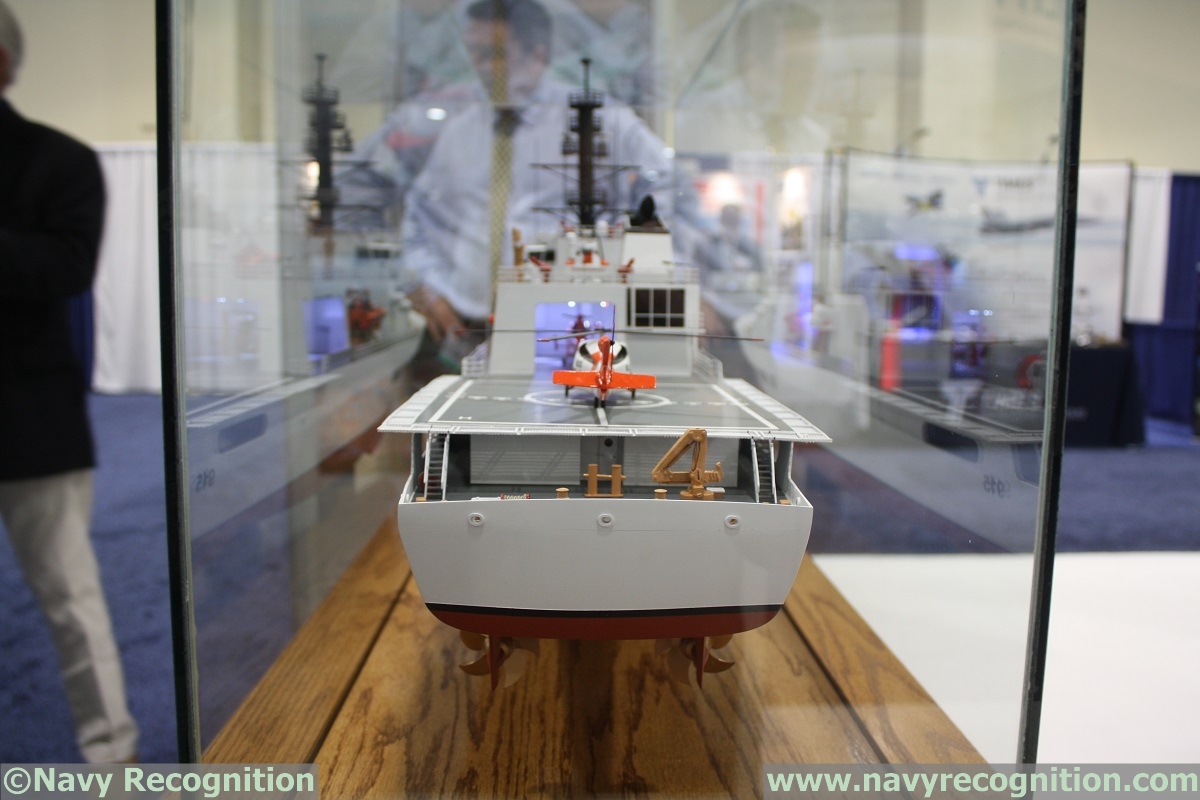
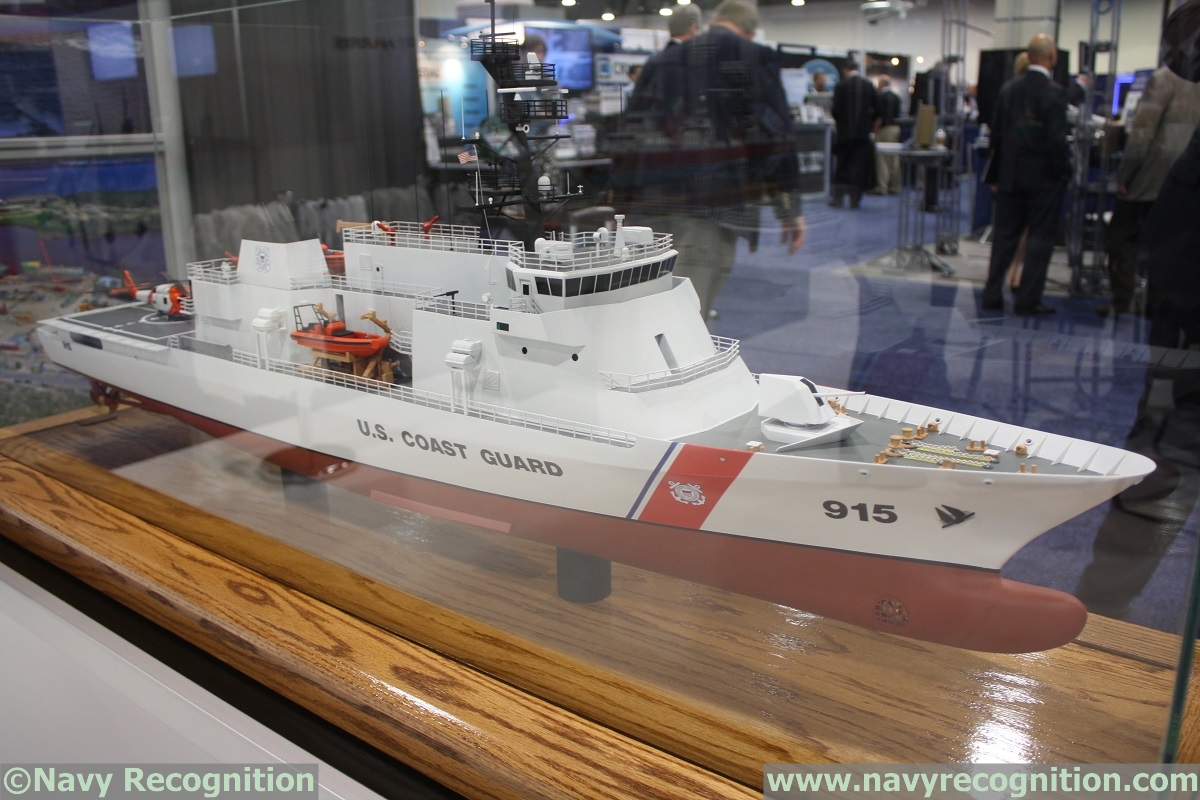
IMG_4134

All photos credit Navy Recognition

Recently found a brochure for Eastern’s OPC reportedly from last year’s Sea, Air, Space Conference. Credit FCNoVA from this discussion group. We have discussed this class before and here, the comments may still be of interest.

Relative to the question does the design meet the “objective” criteria or only the minimums it looks like relatively good news, meeting or exceeding the objectives in terms of endurance, speed, aviation facilities, and accommodations. I presume since this design meets most of the objective criteria, the other two designs will also similarly exceed the minimums. I will provide some of the information provided in the brochure and then provide my comments.

You can read the brochure here: http://www.mnvdet.com/Other/Eastern%20OPC%20Scan.pdf

DIMENSIONS:
Length overall: 328ft
Length between perpendiculars: 297ft
Beam overall: 52ft
Beam waterline: 48.67ft
Depth: 24.5ft
Draft: 16.1ft

Commentary: Compared to the Treasury Class (327 ft) cutters, this is, of course only one foot longer, but the beam and draft are both substantially greater, greater in fact than the beam and draft of the 378s, so we can expect the full load displacement to be considerably greater than the 327s’ approximately 2500 tons, and close to the over 3,000 ton full load displacement of the 378s. Unless the vertical weight distribution is messed up, these are likely to be good riding, very seaworthy ships, a notable improvement on the 270s and 210s.

Accommodations:
126 total
20 commissioned officers
12 CPOs
94 E-6 and below
Also included are a 466 sq ft physical fitness area, a 20 seat training room, and a 48 seat crew’s lounge.

Commentary: Note these are the accommodations, not the expected crew which will be 15 officers, 89 enlisted, and detachments totalling 12 for a total of 116. The Coast Guard is avoiding the mistake made on the Littoral Combat Ship of assuming a small crew, limiting accommodations, and then finding they need a larger crew than the ship was designed for.

Performance:
Range 9,500 nmi @ 14 knots
Sustained speed: 24 knots
Sprint speed: 26 knots.

Commentary: This is an area I was afraid we would see the design compromised. For similar speeds, this range is comparable to the that of the 378s. At speeds above 18 knots, its all diesel power plant will give it greater range than the 378s.

Main Propulsion/Auxiliary Prop and thruster/Electrical:

Main Prop: Two 12,204 HP MAN geared diesels
Ship Service Generators: 4,1044 kW
Auxiliary Prop/thruster: 750 kW, 1005 HP

Commentary: I interpret this to mean four generators of 1044 kW or 4,176kW total. That is a lot of power generation potential. By comparison a 378’s total capacity is 1500 kW, the 270s have 1425 kW. This suggest that the ship will have a hybrid power plant with the generators used for driving electric cruise motors. Running only three generators, one could probably supply routine electrical requirements and the other two could propel the ship. Two generators would supply the equivalent of approximately 2800 HP, this might be enough to drive the ship at 14 knots. Certainly three generators supplying 4200 HP would be more than enough. This will allow the ship to cruise with the Main Diesel Engines shut down.

The combined horsepower of the main diesels, 24,408 HP is more power than the diesel engines of the National Security Cutters which we know provide a high cruising speed, and it is about three and a half times the power of those on the 378s or the 270s.

The thruster is apparently of the drop down trainable type, allowing it to be used as an emergency or loiter propulsion system. The available power is relatively high meaning the ship could probably make seven or eight knots on the thruster alone.

I expect what we will see is two main engine spaces, each with one main diesel and one or two generators. Hopefully the main spaces will be separated by more than a single bulkhead, perhaps by the engineering control room, so that damage at a single point cannot effect both engine rooms. Hopefully also, at least one generator will be outside the two main machinery spaces. If so, these ships will have extraordinary main propulsion redundancy with at least three different spaces and five different systems capable of moving the ship–two MDE, two motors on the main shafts, and the bow thruster.

Construction: Steel Hull with an Aluminum Superstructure. Commentary: No surprise, although I would have liked to see steel superstructure, but it is a reasonable compromise.
IMG_4132

Aviation Facilities:

Hangar: H-65/H-60R+UAS/UAV
Flight Deck: 3725 square feet

Commentary: Good news that the hangar will be large enough to accommodate both a Navy MH-60R and a UAS although I am a bit concerned that since the Navy has moved to a larger airframe for their Firescout, there is a chance that the UAS may not include the latest version of what is likely to become a standard system.

Apparently the Flight Deck is at least as large and probably larger than that of the 378s.

IMG_4129

Weapons:

57mm Mk110 mod X
Electro-Optic Sensor System
25mm Mk38 mod2
two .50 cal. ROSAM (stabilized mount) plus two .50 cal. in soft mounts
ESM system
Mk53 mod X ASCM decoy system

Commentary: No surprise in what was mentioned. The radar fire control system that was included in previous specifications was not mentioned. This may have been simply an omission, but the Electro-Optic System might also serve as a firecontrol system, although it would be decidedly inferior to a radar system against surface targets in low visibility and against air targets in all situations. Consequently I am a bit concerned that this system has been compromised in the interest of simplifying the design.

The excess generator capacity may make these ships suitable for use of energy intensive weapons that may be developed in the future.

Another Deepwater Horizon in Our Future

According to a report by the U.S Chemical Safety and Hazard Investigation Board as reported by gCaptain, the problems that caused the Deepwater Horizon disaster have gone unresolved.

“Industry practice and federal safety rules currently in place in the Gulf may not prevent another catastrophic spill, according to the report. U.S. regulations fall short of standards used for drilling off the coasts of Norway, Australia and the U.K., which require more rigorous, regular and independent safety-equipment checks, the agency said.”

The copyrighted Bloomberg story also reports government and industry reaction.

The CSB draft report can be found here.

Chinese Drift Net F/V Seized in the North Pacific

CCGD17 is reporting an unusual fisheries case.

This seizure was a result of an international effort. The F/V was spotted by a Canadian CP-140 (similar to a P-3) and boarded by a team from Morgenthau assisted by two Chinese agents, 625 miles East of Tokyo (Japan was also listed as a participant in the operation). After violations were discovered, the vessel was detained and custody subsequently transferred to a Chinese Coast Guard cutter.

I can’t help but be curious what will happen to the vessel, its owners and crew, when the Chinese government seems to condone and even encourage violation of international fisheries norms elsewhere.

Canadian SAR Aircraft, C-27J a Leading Contender

DehavillandCC-115Buffalo01
442 Transport and Rescue Squadron De Havilland Canada DHC-5 Buffalo (CC-115)

Canada’s military seems to be having a lot of trouble with their procurement, new naval helicopter, new patrol vessels, and new SAR aircraft All have taken much longer than expected.

DefenseIndustryDaily reviews the status of their program to replace their existing SAR aircraft which are now overworked DHC-5 (CC-115) Buffalo on the West Coast and CC-130E/H Hercules on the East Coast, in the works since 2008.

According to the report, the C-27 appears to be the most likely choice, other contenders include the HC-144’s big brother the EADS-CASA C295, the C-130J, the Bombardier DASH-8, the DHC-5NG Buffalo being resurrected by Viking Air Ltd., and the Bell V-22.