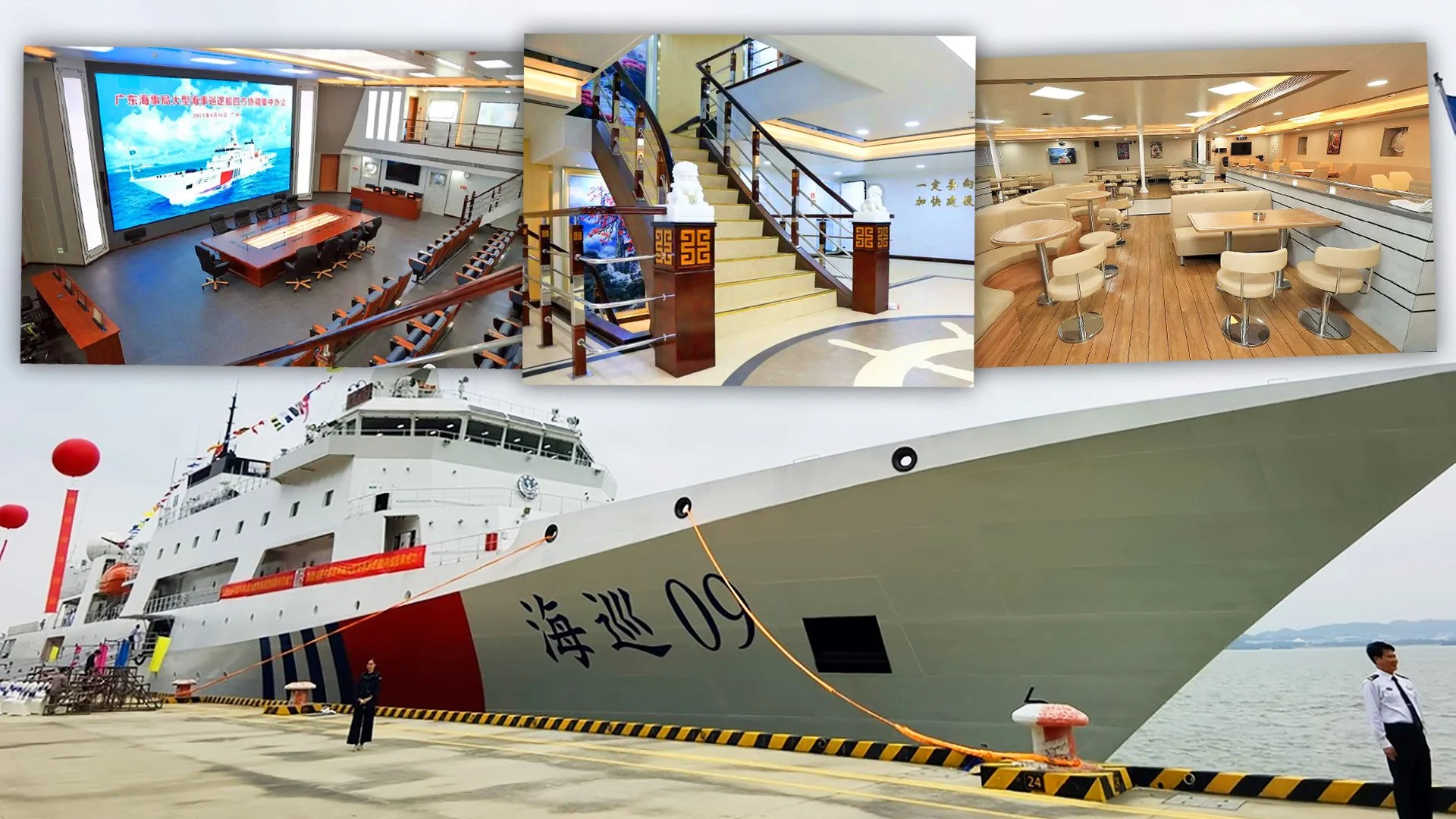
This came out in 2021. I missed it at the time, but it is still interesting. Have not heard any reports of the utilization of this massive ship since it was completed.
There is plenty of speculation within the post as to how the ship will be used. Note this is not China Coast Guard. The China Maritime Safety Administration was the only one of China’s five agencies with Coast Guard like missions that was not consolidated into the China Coast Guard.
Just a short video, made at least a couple of years ago, but particularly wanted to feature the “cable deck,” time 1:27 to 1:45, where you see mooring and anchoring gear conspicuously missing from the foc’sle. Keeping this gear inside the ship is critical to keeping it operational in the Arctic environment.
A total of eight ships of the class are planned, six for the Canadian Navy and two for their Coast Guard. Navy or Coast Guard, these “Arctic Offshore Patrol Ships” (AOPS) essentially perform what we view as Coast Guard missions. They are 6,615 ton ships, 340 feet (103.6 meters) in length. Four diesel generators provide power to two electric motors that provide 12,000 HP for a 17 knot max speed. Range is 6,800 nautical miles at 14 knots. The crew is 65 with accommodations for 87. The gun seen in the video is a weatherized version of the 25mm Mk38. They are Polar Class 5.
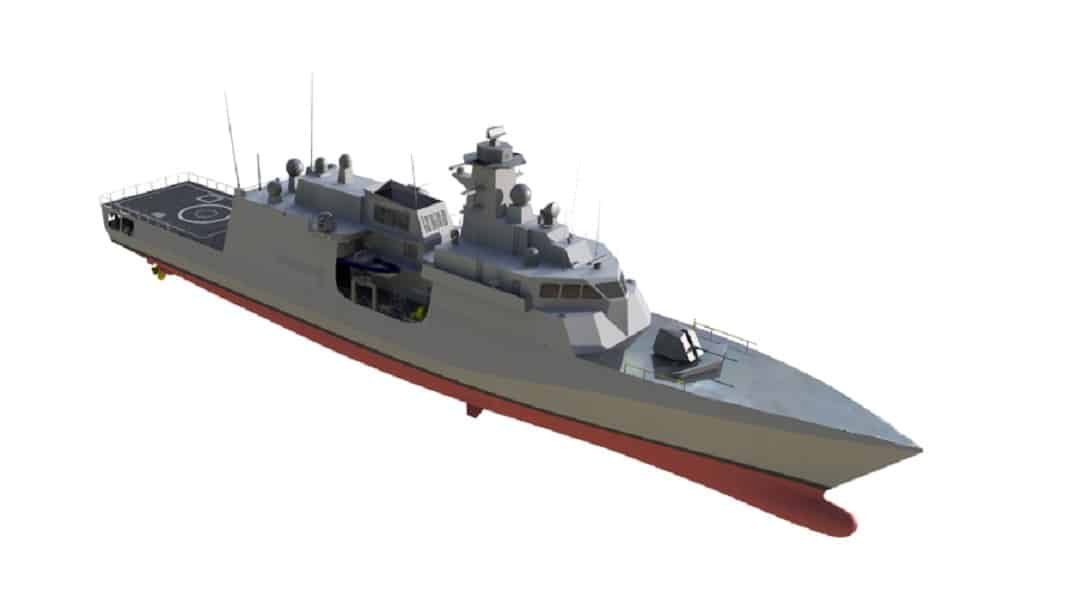
As part of the Italian Navy OPV (Offshore Patrol Vessel) acquisition programme Orizzonte Sistemi Navali (OSN), the joint venture between Fincantieri and Leonardo… has signed a contract with the Italian Secretariat General of Defence and National Armaments Directorate for the construction of three next generation patrol vessels, with the options for a further three units and infrastructural upgrades required for the naval bases in Augusta, Cagliari and Messina, where the vessels will be based.
Fincantieri is the parent company of the Marinette based shipyard that has been building Freedom class LCS and will be building the US Navy’s new frigates. That shipyard also built USCGC Mackinaw, the 16 Juniper class WLBs, and the 14 Keeper class WLMs.
I am a little surprised by this. It had been reported that the six ships of the Sirio class and Cassiopea class would be replaced by 3,000 ton units of the European Patrol Corvette(EPC) program. This “PPX” program would be the third Italian Navy “patrol” vessel class being built concurrently along with the EPC and the Thaon di Revel class (also known as PPA for ‘Pattugliatore Polivalente d’Altura – Multipurpose Offshore Patrol Vessel’).
The description looks like a pretty typical modern, medium size OPV with an approximate length of 312′ (95 meters), a displacement of 2,300 tons and accommodations for 97. It appears the probable armament is a 76mm gun and a pair of 20 to 30mm mounts (probably the new Lionfish 30mm). That is a size the US Coast Guard might consider for operating in Atlantic Area, if we wanted to increase the total number of larger patrol cutters above the 36 currently planned.
No information was provided about the speed or range. Italian Navy ships tend to have relatively short range because they are designed to operate in the Mediterranean. I would guess range will be about 4,000 miles at about 14 knots. Speed will probably be about 24 knots.
Wanted to pass along the video above, if for no other reason, for the scenes of the Danish Patrol Frigate HDMS Triton operating in the ice. Notice her ground tackle (equipment used to anchor the ship) is not exposed on the foc’sle, where it would be quickly encrusted with ice. It is well below the main deck.
Triton’s routine peacetime missions and those of her Thetis class sister ships are much the same as US Coast Guard cutters. They do SAR, fisheries, marine environmental protection, and support scientific research. They are ice strengthened and can reportedly operate in 31 inches (80 cm) of ice. They use the STANFLEX modular weapon system, with one slot forward and two slots aft, allowing rapid addition or change out of weapon systems. They have a hull mounted sonar, torpedo tubes, and can support a MH-60R ASW helicopter. They are 3,500 tons full load and 112.3 m (368 ft 5 in) in length with a speed of 22 knots and a range of 8,700 nautical miles at 15 knots and a 60 day endurance. My Combat Fleets of the world reported that they had seven crews to operate the four ships. Perhaps surprisingly, they have only a single shaft, but it is probably well out of the way of ice. The ships of the class are all over 30 years old and the Danes have probably started thinking about replacement.
The Royal Danish Navy (RDN) Thetis-class patrol ship HDMS Triton is pictured operating a Seahawk helicopter during Canada’s Operation ‘Nanook’ exercise in the Arctic in 2022. One element of RDN Arctic capability development is to improve tactical datalinks between the Seahawks and their host frigates and patrol ships. (Canadian Armed Forces)
The Turkish Navy’s first-ever offshore patrol vessel (OPV), the Hisar-class project’s lead ship was spotted at the Istanbul Naval Shipyard. The future TCG Akhisar (P-1220) is ready for launch.
The Hisar-class OPV is being built using the “fitted for but not with” concept, which allows for the integration of newly developed indigenous weapon and sensor systems. The OPV, which can accommodate a total of 104 people, will have a range of 4500 nautical miles with its CODELOD (COmbined Diesel-eLectric Or Diesel) main propulsion system.
Depending on how it is equipped, these could also fill the role of a corvette or light frigate.
Developed as a variant of the MİLGEM-class corvettes, the Hisar class OPV has been redesigned with a different main propulsion system and a different structural and general layout concept, allowing it to be built in a shorter time and at a lower cost.
I have come to see ships of about 2500 tons, 100 meter (328′) in length, and 25 knots as something of an ideal modern OPV. This is very close to that. Personnel accommodations allow a reasonable crew size and range is adequate. Its CODELOD (COmbined Diesel-eLectric Or Diesel) main propulsion system sounds like current best practices. It has a helicopter deck and hangar. What is not clear, is how good the accommodations for boat launch and recovery are–critical because boats are a primary tool for OPV missions, and if it can also accommodate a UAS system in addition to the helicopter. This is rapidly becoming a highly desirable capability.
“Normally when a navy acquires a new ship, they want it to be as capable as possible. Not so the Royal Australian Navy, which has down-designed the Arafura class Offshore Patrol Vessels (OPVs) so that they can no longer support the weight of a helicopter on the large rear deck.”
The article goes on to criticize this and other decisions regarding the ship, but there may be method to this madness.
I would assume the Australian Navy is putting some thought into these decisions and it may be related to my observations in a post only two days ago, “When is a Flight Deck Not a Flight Deck?”
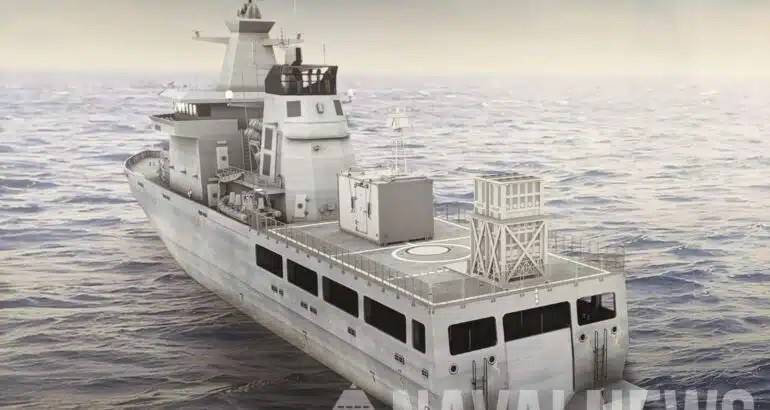
The intention may be to save topside weight so that an additional load or loads, heavier than an 11 ton helicopter, can be placed high on the ship.
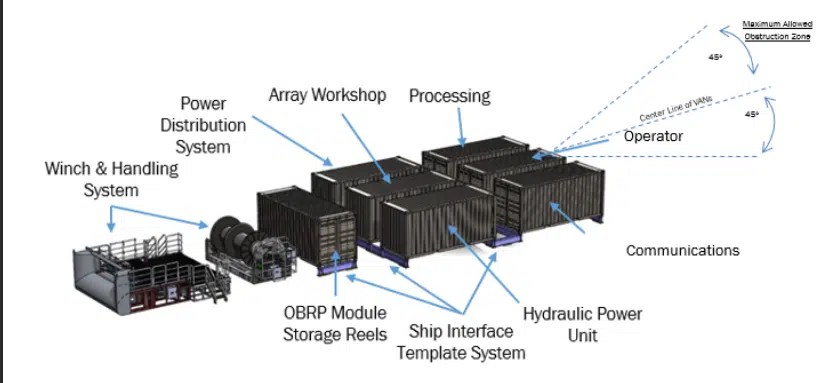
A helicopter deck must be very strong everywhere, because it may be required to take high dynamic loads concentrated on just a few square inches, that may occur unpredictably, almost anywhere on the deck. By contrast even a large load like SURTASS-E, that spreads the load over a much larger area, requires less deck strength.
SURTASS-E. (U.S Department of Defense)
It may be that the Australian Navy has decided to use the “flight deck” as a mission load area where they anticipate placing heavy loads. The weight savings from weakening the flight deck may also permit additional topside weight for other systems, like weapons, if it is not required for loads on the flight deck.
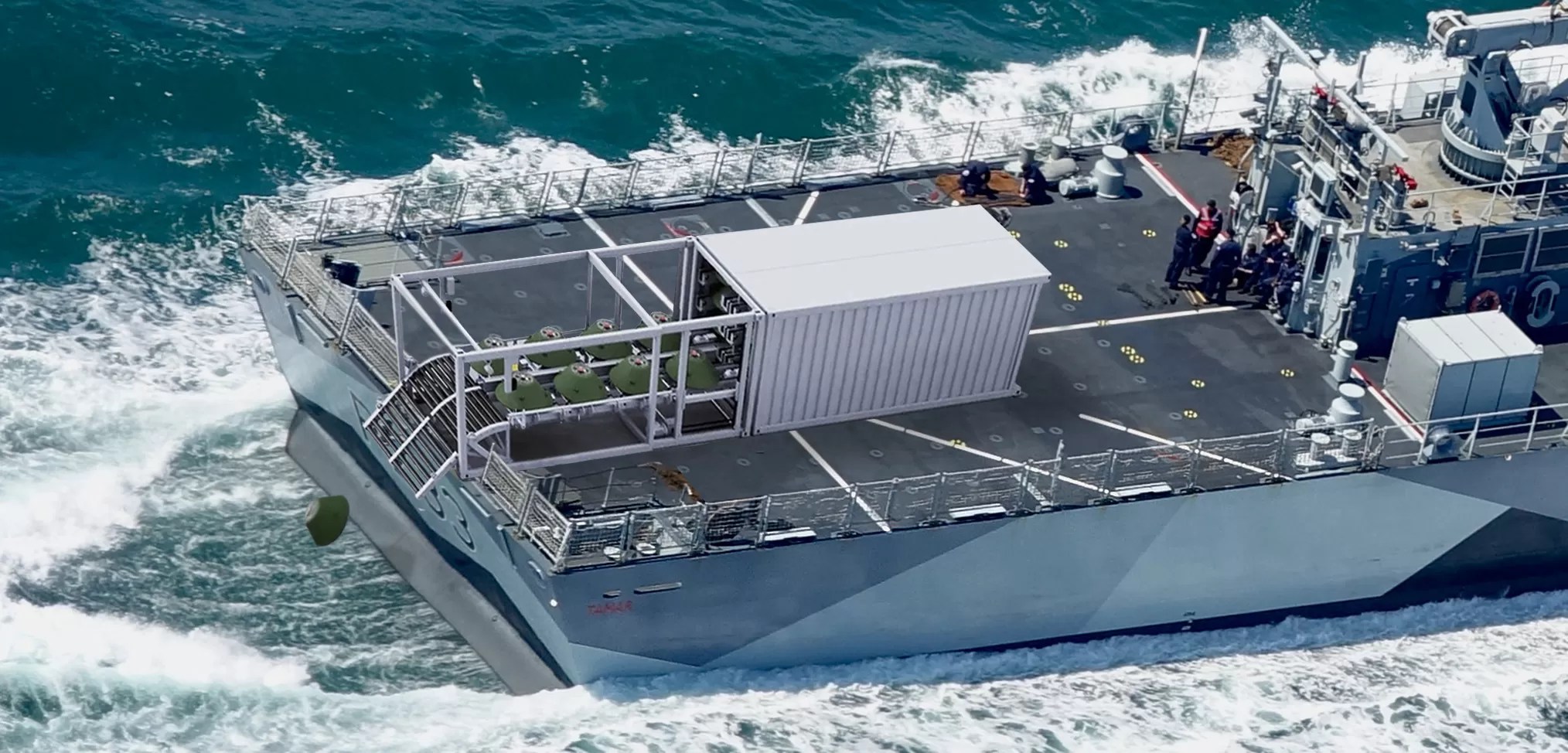
Containerized minelaying system on a River Batch 2 Offshore Patrol Vessel
It has been said that aircraft carriers are the ultimate modular warships because their primary weapons (aircraft) are interchangeable.
A flight deck on an Offshore Patrol Vessel (OPV) certainly offers a degree of aviation options. General purpose, cargo, ASW, and ASuW helicopters and a range of Unmanned Air Systems, but it appears our allies, the UK and particularly Australia may be looking at other ways to use this large open space.
Royal Navy:
Navy Lookout had a post that talked about restoring a naval mining capability in the Royal Navy. There was no specific reference to using flight decks or to Offshore Patrol Vessels.
The RN does not need dedicated minelaying vessels. The SSNs have a theoretical minelaying capability but XLUUVs are a much lower risk and stealthier solution for covert and sensitive missions. Where stealth is less important, containerised minelaying solutions are being developed that can be secured to the deck and dispense mines over the stern. (emphasis applied–Chuck)
But the photo, above, definitely got my attention. There we see an SH Defence “CUBE” containerized mine laying system developed by RWM Italia S.p,A. (Rheinmetall). on the flight deck of a River Batch 2 Offshore Patrol Vessel (HMS TAMAR).
Australian Navy:
Australia is planning to produce up to 14 flight deck equipped Arafura class OPVs including two intended specifically for Mine Counter Measures (MCM). These ships were always intended to accept containerized mission loads. It appears they are now planning what these ships will do in wartime.
As noted in the Navy Lookout, Australia is planning to buy and produce large numbers of mines. Naval News reports,
“Australia is set to accelerate the procurement of sea mines as part of Project SEA 2000…The decision to rapidly procure the capability, reportedly from a European supplier, will deliver a ‘significant’ deterrent effect according to Defence…it’s understood that the government has budgeted approximately $500 million to 1 billion Australian dollars for the acquisition…the weapons being brought are smart mines, able to disseminate between civilian vessels and a variety of military targets, allowing a strategic anchorage to be denied to hostile forces, all the while preserving access for aligned vessels. (emphasis applied–Chuck)
This all points to large numbers of mines being used in defensive fields. Such minefields will almost certainly be laid by surface vessels. Australia does have some civilian crewed support ships that might be used for mine laying, but as the Arafura class comes online, they will be the most likely surface minelayers.
SURTASS-E is expected to provide long range detection and cuing for tactical weapons, against both diesel- and nuclear-powered submarines. Again, the Arafura class seems a likely host, because the system is intended for military crew manning and, unlike the civilian manned National Support Squadron ships, these ships are armed and have communication systems that include tactical data link.
Now About the Coast Guard:
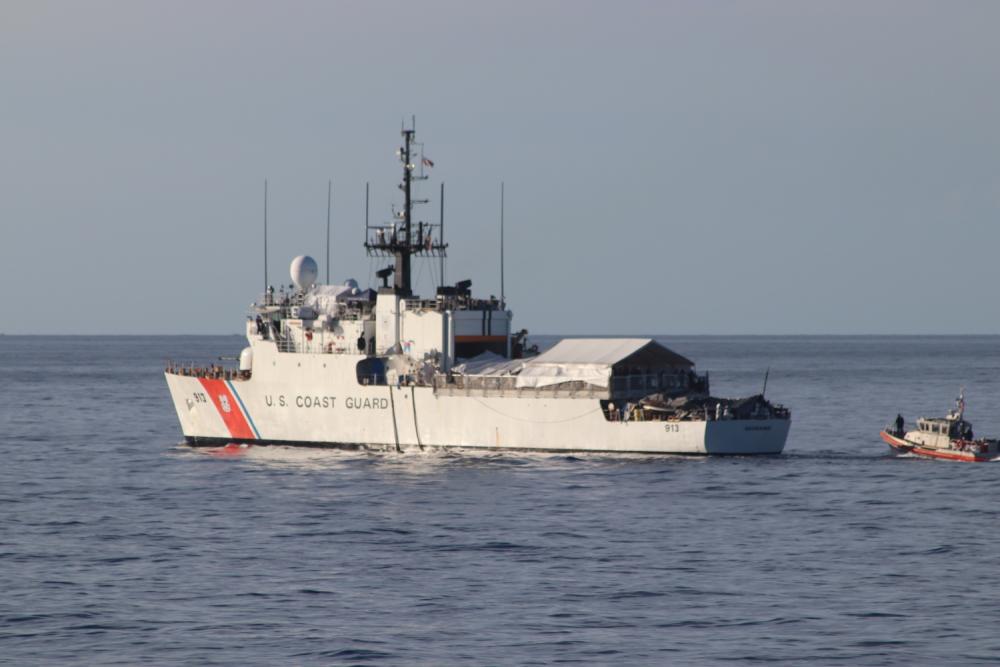
Using a flight deck for non-aviation purposes is not a foreign idea to the Coast Guard. They do it all the time to provide a holding area for migrants.
USCGC Mohawk’s (WMEC 913) crew patrols the South Florida Straits during Operation Vigilant Sentry, Jan. 5, 2023. Mohawk’s crew patrolled the Florida Straits and Caribbean Sea in support of Homeland Security Task Force—Southeast and Operation Vigilant Sentry in the Coast Guard Seventh District’s area of operations for a 46-day patrol. (U.S. Coast Guard photo by USCGC Legare (WMEC 912)
“UK-based anti-submarine warfare (ASW) solutions provider SEA has been awarded a contract to supply two of its innovative ASW systems, KraitSense, to a South-East Asian Navy for a new offshore patrol vessel (OPV) programme.”
It these systems perform reasonably well; they would be an attractive mobilization option for giving OPVs an ASW role. Even if not equipped with ASW weapons, adding sensors that can be coordinated with other surface and air weapons carriers would be helpful.
The SE Asian Customer?
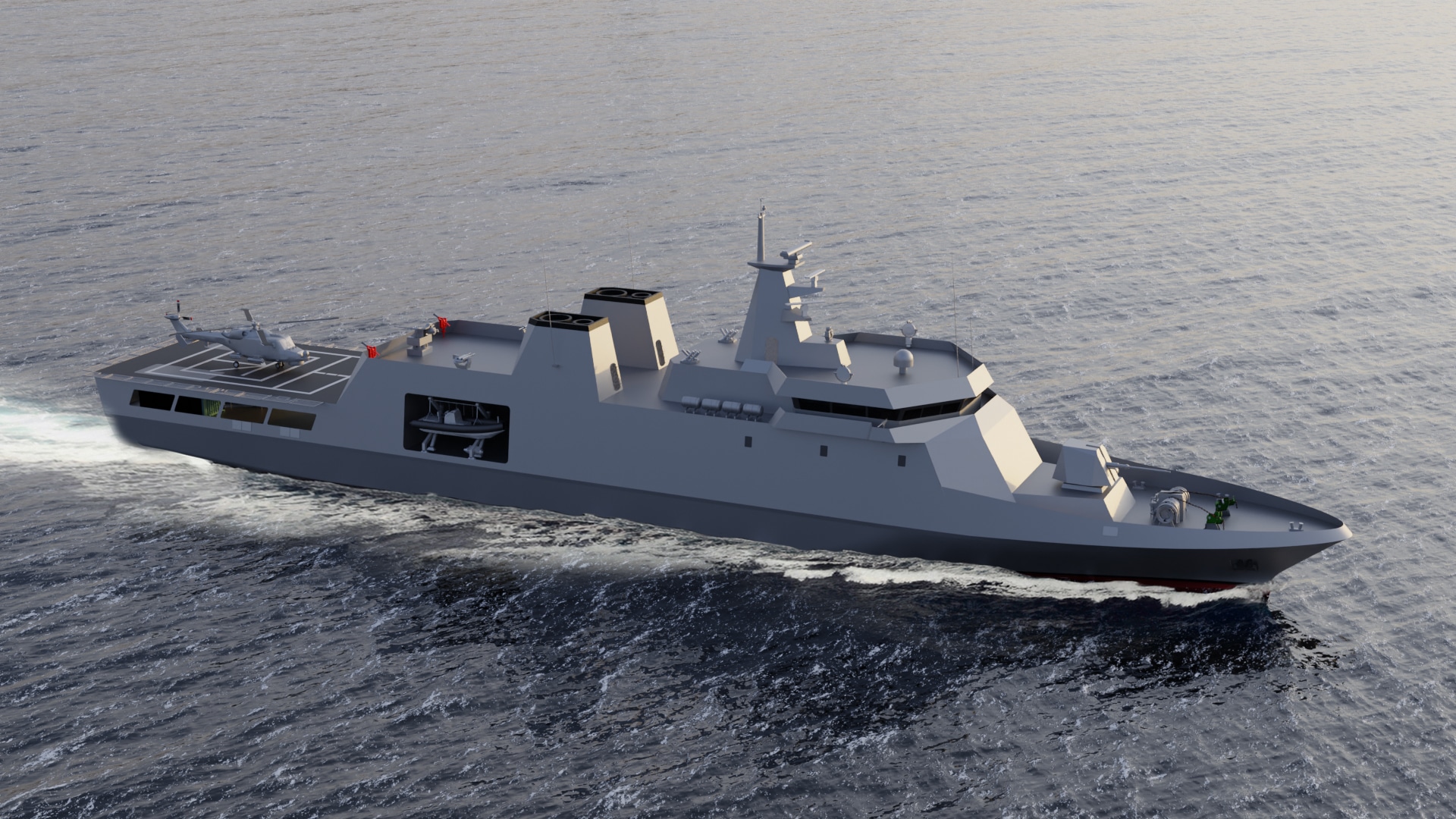
Artist impression of the future Philippine Navy OPV to be constructed by HHI. HHI image.
Who is the SE Asian country with, “With a vast coastline and high number of islands within their jurisdiction…” Think the Philippines may be most likely.
Hyundai Heavy Industries (HHI) is building six offshore patrol vessels (OPV) for the Philippine Navy (not their Coast Guard). At about 2400 tons, 94.4 meters (309 ft 9 in) in length, with a speed of 22 knots, they are pretty typical medium sized OPVs, except for one thing, Wikipedia reports that their armament, in addition to 76 and 30 mm guns, includes two sets of triple lightweight anti-submarine torpedo tubes. There is no indication of an ASW sensors. It is reported to have spaces for Multi-Mission Containerized Modules. The flight deck and hangar are sufficient for support of an ASW helicopter and/or UAS.
But the post also discussed another program, a new class of smaller amphibious warships, expected to enter service from the early 2030s, that will also fill the role of Offshore Patrol Vessels.
Captain Van der Kamp also outlined the RNLN’s evolving thinking on a replacement amphibious shipping capability, dubbed LPX…these new ships are also expected to assume the patrol and surveillance tasks currently performed by the navy’s four Holland class patrol vessels…“We would combine these amphibious ships with the function of a patrol vessel to do Coastguard patrols in the Caribbean and counter-drugs operations in the Caribbean.”
The four Holland class OPVs were commissioned 2012 to 2013, so in the early 2030s they will be at the most 23 years old. These ships are similar in size, speed, capabilities, and mission to the OPCs. They have frequently conducted drug interaction missions in the Caribbean with US Coast Guard Law Enforcement Detachments embarked and at least on one occasion using a USCG helicopter.
The other two ships being replaced, HNLMS Rotterdam and HNLMS Johan de Witt. are older, commissioned in 1998 and 2007. They have a combined capability to land about 1200 Marines. I presume the cumulative capability of the new ships will be similar. Each of them can also carry up to 32 tanks, but the Netherlands Marine Corps does not have any tanks, nor do they have organic heavy artillery. Their only armored vehicles are much smaller, so perhaps the replacement ships will not need the capability to handle tanks.
Why is the Netherlands Navy choosing to do this?
Going from six ships to perhaps only four is likely to decrease the total crew requirements.
It may be that the landing ships are considered better able to meet the disaster response component that has been one of the OPVs’ missions.
The Netherlands Navy may not see any wartime role for the OPVs, or at least no role the new LPX could not also do.
Nevertheless, it seems the changes is rooted in changes in the Marine Corps concept of operation. “…leaner and smaller units that would unload further away from land.”
It may be significant that the new ships are referred to as LPX not LPDX. That may mean that they would not have a well deck. It might be thought they are paralleling US Marine Corp thinking that resulted in the Marines shedding their tanks and heavy artillery and the formation of a Littoral Regiment and a program to build relatively small Landing Ship, Mediums. On the other hand, given the way the Netherlands Marine Corps names their units, “Raiding Section,” “Raiding Troop,” and “Raiding Squadron,” they obviously see themselves as a raiding organization more akin to the British Royal Marine Commandos of WWII than to the US Marine Corps that seized and held islands in the Pacific. They do have a long and continuing association with the Royal Marines. In any case they are and probably will remain essentially light infantry.
If the new ships are to replace the four OPVs, then I would presume they would still need at least four ships. If they were following the USMC example, they may build a larger number of smaller ships, but I don’t think that will be the case. If they are to “…unload further away from land,” they are going to be very different from the beachable LSMs envisioned by the US Marines. The British developed LCVP Mk5c used by the Netherlands Marine Corps are big boats, 15.7 m (51 ft 6 in) in length and displacing 24 tons. If they are to be swung from davits, it will not be from a small ship.
I would not be surprised if the LPX program came out as four ships that look a lot like slightly larger Danish Absalon class (which can reportedly transport a company-sized landing force of some 200 soldiers with vehicles). Four ships that could each transport 300 Marines, each equipped with four LCVPs (or its replacement), a pair of “FRISC”(Fast Raiding, Interception and Special forces Craft) RHIB, with hangar space for a couple of helicopters, could replicate the transport capacity of the two LPDs in a more flexible, distributed, and perhaps more survivable force package. The resulting ships would effectively be modern high-speed transports (APD/LPR).
Tailored to the needs of the Royal Canadian Navy’s future fleet, Vigilance strikes the balance between flexibility, adaptability, and size, while maintaining the life-cycle cost advantages VARD’s naval designs are known for. The vessel has been conceived for high-tempo sovereignty missions and engineered for global deployment and forward basing abroad.
There is not really a lot of information here.
They are to replace the Kingston Class Maritime Coastal Defence Vessels, which have been used to do drug interdiction in the Caribbean with USCG Law Enforcement teams doing the boardings. It is a class of twelve ships so there may be that many replacements, but also possibly fewer.
USCGC Escanaba (WMEC 907) and USCGC Richard Snyder (WPC 1127) practice maneuvering with the Royal Canadian Navy’s Kingston Class Maritime Coastal Defence Vessel HMCS Goose Bay (MM 707) in the Davis Strait on Aug. 13, 2021. (Photo courtesy Royal Canadian Navy)
There is no indication of size but there is a clue in the identification of the rendering that accompanied the post, “VARD-7-075-Vigilance-Offshore-Patrol-Vessel-770×410.jpg”. Using VARD’s naming convention this is a “7 series” ship meaning “Naval and Security” that is about 75 meters (246 feet) long. Given the intention to employ them “forward basing abroad,” particularly as a Pacific nation, limiting the size to only 75 meters may be unwisely parsimonious. A larger ship would be both more capable in adverse weather conditions and more adaptable to future requirements. The Kingston class are only 55.31 m (181 ft 6 in) overall, so 75 meters would be an upgrade, but it is still a very small OPV, particularly if it is to operate helicopters. It would be similar in size to Malta’s P71 or the Danish Knud Rasmussen class.
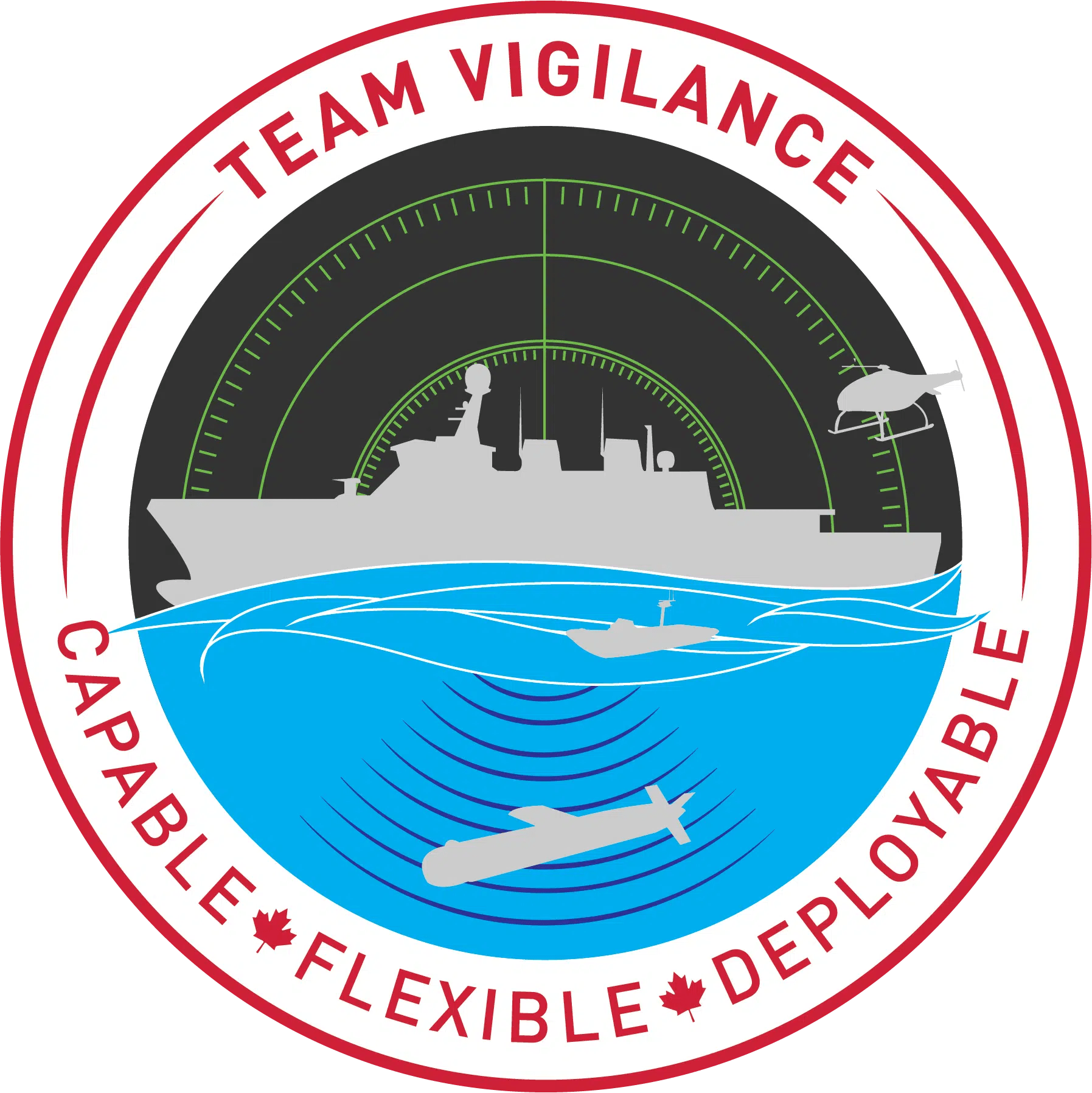
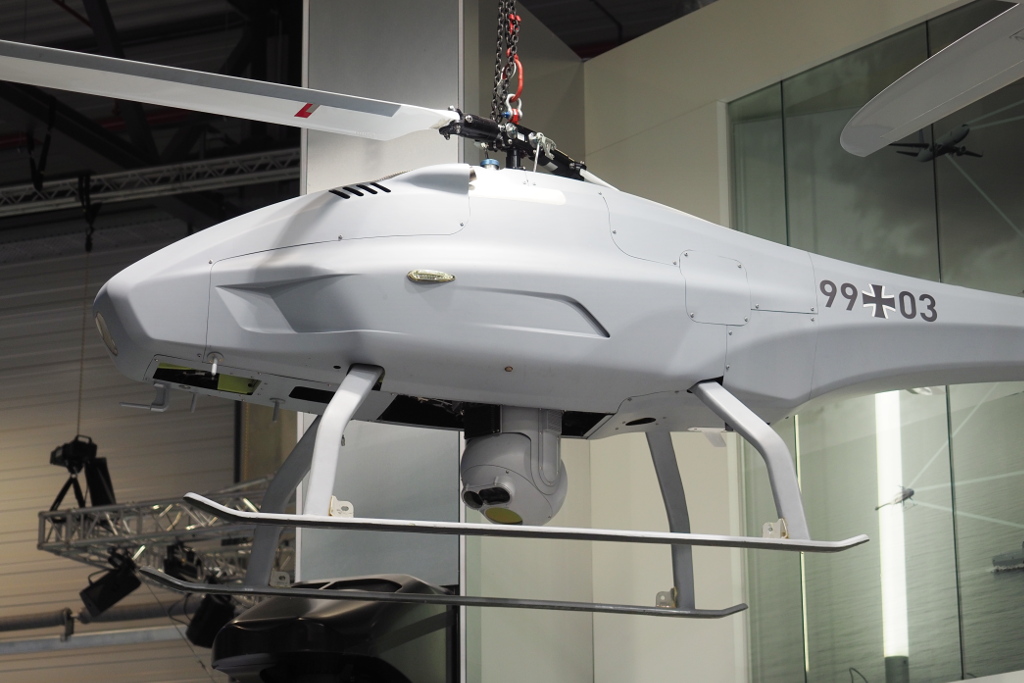
If the ship is in fact 75 meters in length, then the flight deck seen in the fendering does appear relatively short for landing a helicopter, especially since Canada’s Navy and Air Force do not operate any small helicopters that might be operated from the ships. The logo that accompanies the post may suggest that the flight deck is for unmanned air systems rather than helicopters. The UAS in the logo appears to be the Swedish built UMS Skeldar V-200, known as CU-176 Gargoyle in Canadian Service. This UAS is also in service with the Belgian, German, Netherlands, and Spanish Navies.
UAV SKELDAR V-200 in German service, tail marking 99+03, at ILA Berlin Airshow 2022. Photo credit: Boevaya mashina.
The gun seen in the rendering suggest a 30mm Mk38 Mod4. In view of the fact the Arctic Offshore Patrol Ship is armed only with a 25mm Mk38 Mod2/3 that would to conform to past policies. The same gun is expected to be on the new Canadian frigate.
Looking at VARD’s design catalog, I see some resemblance to their 72 meter and 85 meter designs.
Video below added as late addition, thanks to Dave.






 Chuck Hill's CG Blog