Chuck Hill's CG Blog

Chuck Hill's CG Blog

“While Eastern Shipbuilding Thrives, New Coast Guard Cutter Lags Behind” –Forbes

Eastern Shipbuilding Group, Inc. photo

Forbes reports,

The U.S. Coast Guard’s “highest investment priority,” the $17.6 billion Offshore Patrol Cutter (OPC) program, faces additional delay. After blowing through a contractual delivery date of June 2023, governmental auditors are already suggesting that the new delivery estimate of late 2024, coming as Panama City-based OPC shipbuilder Eastern Shipbuilding Group inks an array of new commercial and governmental contracts, is optimistic.

The Coast Guard, in an emailed statement, now estimates that Eastern Shipbuilding Group will deliver the future Coast Guard Cutter Argus, the first of the Coast Guard’s much-needed OPCs, by September 30, 2024. The revised delivery target for the 360-foot vessel comes almost six years after the yard first cut steel for Argus back in January 2019.

There is a lot of additional analysis in the post.

As you may remember, Austal was awarded a contract in June 2022 that included options to build up to eleven OPCs, while Eastern’s contract for up to nine OPCs was truncated at four ships.

Thanks to Robert Cullison for bringing this to my attention.

How Bofors 57 mm Mk3/Mk110 Naval Gun Reload Works –Video

Thought this video was interesting enough to pass along.

This makes it clear why the nominal “220 round per minute” rate of fire for the 57mm Mk110 is only good for short periods. There can be up to 120 rounds on the mount but there may be interruptions to reload after 20 or fewer rounds. Frequently different types of ammunition are loaded in the left and right sides of the mount ammunition feed system, so there may be only 60 or fewer rounds of a particular ammunition type on the mount.

The linked information above includes a note for the 57mm Bofors 57 Mk2 which appears to share the same reload mechanism as the Bofors 57mm Mk3 (Mk 110 in US service) “Time to reload 120 rounds: 2 minutes”. It appears reloading the two 20 round ready service cassettes that move with the gun requires the gun to at or near maximum elevation. It is not clear if partially filled ready service cassettes can be topped off, I would hope that would be the case. The time to elevate, reload and return to firing position could be critical. Hopefully you will not wait until all 120 rounds on the mount are expended before reloading.

Thanks to Lee for bringing this to my attention.

New Units for Alaska, the Haley, and Nome

Northeast Russia and Alaska. Photo: Shutterstock

One of our readers sent me an article from the Alaska Beacon about the need for additional housing for the military that includes some insight into the Coast Guard’s future in Alaska.

The information about the Coast Guard is toward the end of the article. This seems to be confirmation that the two FRCs in Ketchikan will be joined by four more, two in Kodiak and one each in Sitka and Seward, and that their additional supporting infrastructure is being provided.

We already knew the third and fourth OPCs, Ingham (917) and Rush (918), will be going to Kodiak.

What About USCGC Alex Haley?:

The crew of the USCGC Alex Haley (WMEC 39) transfers custody of the detained fishing vessel Run Da to a People’s Republic of China Coast Guard patrol vessel in the Sea of Japan, June 21, 2018. The Alex Haley and PRC Coast Guard crews detained the Run Da suspected of illegal high seas drift net fishing. U.S. Coast Guard photo. Petty Officer 1st Class William Colclough

The Alex Haley is currently homeported in Kodiak. When I saw that two OPCs were to be homeported in Kodiak, my first assumption was that they would replace the Haley as well as USCGC Douglas Munro also based there, but perhaps that assumption was unwarranted.

Alex Haley is nominally a medium endurance cutter, but with a 10,000 nautical mile range and a 3,484 tons full load displacement, she is more of a high endurance cutter with the crew of a 270 foot WMEC.

She is an old ship, having been originally commissioned in 1971, but still younger than any of the 210 and considerably more capable. She is well suited to the Alaskan environment, so I don’t see her being moved outside the 17th District (Alaska). She is simple, meaning she is relatively easy to maintain, but with twin shafts and four engines, she also has redundancy.

She was extensively renovated, and her engines replaced before she was recommissioned into the Coast Guard in 1999, more than eight years after the last 270 was commissioned.

The second OPC to be based in Kodiak probably will not arrive before 2028. The last 210 will probably not be decommissioned until about 2033.

If the intention is to ultimately have three OPCs in Kodiak, as I believe may be the case, there is a good possibility that the Haley could hang on until that ship arrives.

What about Nome?:

USCGC Alex Haley moored in Nome, AK.

There is also mention of the planned port expansion in Nome with a suggestion that the Coast Guard may have units there.

One tight spot may be Nome, where there are plans to expand the city port into a deepwater, Arctic-service port which Moore called a “fantastic opportunity” for Coast Guard operations.

I don’t think we will see either large patrol cutters (unless it is the Alex Haley) or FRCs based there, but moving one of the Juniper class seagoing buoy tenders there, with its light icebreaking capability might make sense. I suppose a medium icebreaker might be a possibility, but that is a very long shot.

There will probably be a seasonal air detachment stationed in Nome.

Thanks to Paul for bringing this to my attention.

“Shipbuilder Austal executives accused of inflating earnings” –MSN

Future USCGC Pickering (Image: Austal USA)

MSN reports,

“Three current and former former executives of a shipbuilder that constructs vessels for the U.S. Navy have been indicted on accounting fraud charges accusing them of falsely inflating the company’s reported earnings, federal prosecutors said.”

Austal also has the second phase contract to build Offshore Patrol Cutters. Their alleged actions, which were reputedly intended to mislead shareholders and investors, even if proven, don’t necessarily affect the shipbuilder’s pricing or product, but the report goes on to note,

The U.S. Securities and Exchange Commission said in a news release that the three “engaged in a scheme to artificially reduce the cost estimates to complete certain shipbuilding projects for the U.S. Navy by tens of millions of dollars.”

Could they mislead shareholders and investors without also falsifying publicly available contract information?

“Austal USA Taps Fairbanks Morse Defense to Equip OPC WMSM-919” –Marine Link

Future USCGC Pickering (Image: Austal USA)

Marine Link reports,

Fairbanks Morse Defense (FMD)…which has been expanding its offering as single-source maritime defense contractor, said its cross-company package for WMSM-919 includes two main propulsion diesel engines through Fairbanks Morse Defense, a hangar door and stores elevator through Federal Equipment Company (FEC), reverse osmosis system through Maxim Watermakers, two all-electric davits through Welin Lambie, and various electrical components (cable trays, light supports, piping supports, down commers, stuffing tubes, etc.) through Research, Tool & Die (RT&D).

Not unexpected, but good to see movement on the project, plus, it is a good excuse to publish the graphic.

Looking closely at the graphic, on the fantail, I see two buff-colored pieces that look like the lifting equipment. I am curious about what they are for?


“New Sonar For Navy Frigates Could Turn Any Ship into Submarine Hunter, Maker Says” –Defense One

Combined Active Passive Towed Array Sonar, CAPTAS-4 in operation from a French Frigate. There are also smaller/lighter versions of the sonar. 

Defense One reports on a presentation at Surface Navy Association,

 “At the Surface Navy Association conference in Arlington, Virginia, this week, the company showed off a video of the technology being installed on a commercial ship within 48 hours, turning the vessel into an anti-submarine “asset,” Bock said.”

While mounting the sonar on merchant ships might be useful, wouldn’t it make sense to mount it first on Coast Guard National Security or Offshore Patrol Cutters that could also host an anti-submarine helicopter and are already equipped with Navy compatible secure communications?

On a cutter or a merchant ship there is the question of who would man it? Every year trained personnel, including sonar technicians and ASW helicopter flight crews, leave the active-duty Navy and become part of the Reserve. Upon mobilization, they can be recalled to active duty to man these systems.

Austal–OPC, EMS, and Saildrone

Above is a video of interviews with representatives of Austal Shipbuilding in regard to the Offshore Patrol Cutter (OPC) and the Expeditionary Medical Ship (EMS).

There isn’t much new here about the OPC, but there is an opportunity to get a good look at a model of the ship. Looking at the Mk38, mount atop the hangar, it appears the field of fire and, perhaps more importantly, field of view for its optics are severely limited. (Using the 30mm Mk38 Mod4 with its separately located optics might improve this situation.) It is also not clear where the .50 caliber remote weapon stations (and their associated optics) will be located since the model only includes crew served .50 mounts. Presumably at least one and probably both will be forward, below the bridge and above and behind the 57mm Mk 110 gun mount.

The EMS is a ship the Coast Guard is likely to work with during disaster response operations and possibly during capacity building efforts. Operating Coast Guard helicopters from these ships during a natural disaster would seem a natural partnership.

This video was included in a Naval News report, “Austal Diversifies Revenue Base, Announces New Contracts.” Perhaps also of interest to the Coast Guard, included in the report was the statement that Austal was now “…the exclusive manufacturer of Saildrone, Inc.’s wind and solar-powered Surveyor USV…”, a system the Coast Guard has extensively tested.

“SEWIP Roll-Out Continues To US Fleet / Northop Grumman Tests Ultra-Lite Electronic Attack System” –Naval News

Cropped version focusing on the AN/SLQ-32(V)6 suite, USS Porter (DDG-78). Photo by Johan Fredriksson CC-BY-SA

Naval News provides an update on Electronic Warfare (EW) modernization. The paragraph of particular interest to the Coast Guard is below.

A compact SEWIP Lite variant, known as AN/SLQ-32C(V)6, has been developed for smaller ships. Initial deliveries of this scaled version – designed to provide early detection, signal analysis and threat warning for small ships – are supporting the US Coast Guard Heritage class Offshore Patrol Cutter program and the navy’s Littoral Combat Ship.

There is a second Naval News report that may be related, “Northop Grumman Tests Ultra-Lite Electronic Attack System,”

The Ultra-Lite EA System is a scaled-down, onboard EA system for anti-ship missile defense for smaller ships.

Presumably, those smaller ships are again the Heritage (Argus) class Offshore Patrol Cutters and the Navy’s Littoral Combat Ships.

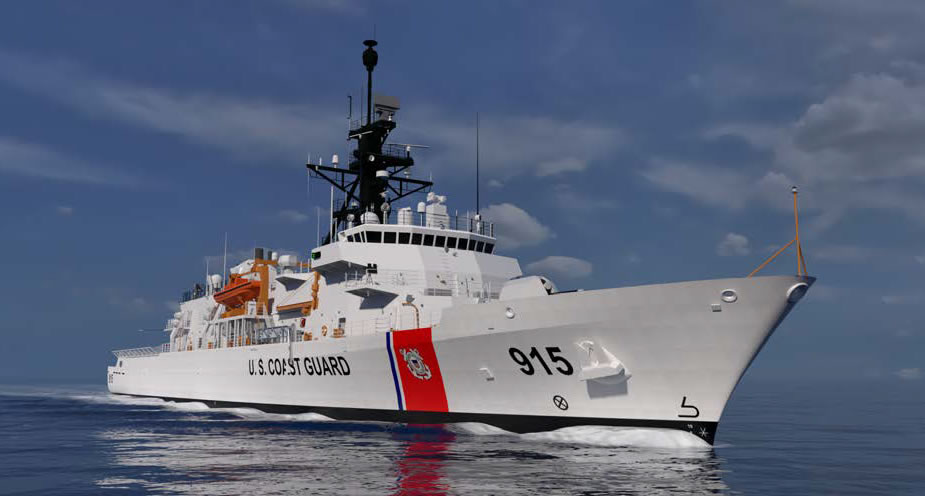
OPC #1 and #2 May Be Delayed

Artists rendering from Eastern Shipbuilding Group

Two articles report that additional delays to both the future USCGC Argus and USCGC Chase appear likely.

The Marine Log article refers to the Forbes article but appears focused on drive shaft irregularities,

“We received shafting for OPC Hulls 1 and 2 that were not in compliance with the NAVSEA requirements called for in the OPC vessel specifications. These two sets of shafting were delivered to our facility with signed and stamped certificates of approval from the American Bureau of Shipping (ABS), the U.S. Government-mandated certification authority for the OPC Program, certifying that they were in physical compliance with the ABS approved design artifacts,” said Eastern Shipbuilding Group President Joey D’Isernia. “We later discovered that both shipsets of shafting were non-compliant due to having out of tolerance physical dimensions. This issue was discovered during shaft installation on OPC Hull 1. The Coast Guard, Rolls-Royce [the supplier of the shafts] , and ABS were made aware of the problem immediately and they each had on-site representatives overseeing shaft installation. We are working closely with ABS, Rolls-Royce, and the USCG to resolve this issue as soon as possible. In the meantime, we are coordinating with the Coast Guard to advance post launch production and test activities to be completed prior to launch, in order to mitigate delivery schedule impacts and launch the ship at an even greater level of completion.”

The Forbes article is a more comprehensive look at Eastern progress, or lack there of,  on the project. Its worth reading both.

“Stage 2 of the Coast Guard offshore patrol cutter moves forward” –CG HQ News Release

Artists rendering from Eastern Shipbuilding Group

Below is a news release. Just minutes before I saw this, I recieved an email from Jessica Ditto, Eastern’s VP, Communications

As you might have seen, ESG is going to the Court of Federal Claims (COFC) to challenge the OPC stage II award decision. COFC is not an appeal, but a new proceeding that allows ESG to seek the disclosure materials that have been withheld by the government in the GAO protest. Here is our statement:

“The federal procurement process is designed to be fair and transparent. Ordinarily, the government discloses reasonable justification for its award decisions to the attorneys representing the parties in a protest. The government has declined to voluntarily disclose the information that might offer that justification. As a result, we are seeking the information and justification through a different legal pathway,” said Joey D’Isernia, President of Eastern Shipbuilding Group, Inc.

News Release

U.S. Coast Guard Headquarters
Contact: Headquarters Public Affairs

Stage 2 of the Coast Guard offshore patrol cutter moves forward

WASHINGTON — The Coast Guard today issued a notice to Austal USA, the offshore patrol cutter (OPC) Stage 2 contractor, to proceed on detail design work to support future production of OPCs. The Coast Guard issued the notice following the withdrawal of an award protest filed in July with the Government Accountability Office by an unsuccessful Stage 2 offeror.

The Coast Guard on June 30, 2022, awarded a fixed-price incentive (firm target) contract through a full and open competition to Austal USA to produce up to 11 offshore patrol cutters. The initial award is valued at $208.26 million and supports detail design and long lead-time material for the fifth OPC, with options for production of up to 11 OPCs in total. The contract has a potential value of up to $3.33 billion if all options are exercised.

The Coast Guard’s requirements for OPC Stage 2 detail design and production were developed to maintain commonality with earlier OPCs in critical areas such as the hull and propulsion systems, but provide flexibility to propose and implement new design elements that benefit lifecycle cost, production and operational efficiency and performance.

The 25-ship OPC program of record complements the capabilities of the service’s national security cutters, fast response cutters and polar security cutters as an essential element of the Department of Homeland Security’s layered maritime security strategy. The OPC will meet the service’s long-term need for cutters capable of deploying independently or as part of task groups and is essential to stopping smugglers at sea, interdicting undocumented non-citizens, rescuing mariners, enforcing fisheries laws, responding to disasters and protecting ports.

For more information: Offshore Patrol Cutter Program page.