“HII AWARDED $244 MILLION CONTRACT TO INTEGRATE MINOTAUR SOFTWARE PRODUCTS INTO MARITIME PLATFORMS” –HII News Release

New Minotaur operator workstations are being installed on all HC-144Bs. Minotaur provides dramatically improved data fusion and integrates installed sensors and radar. U.S. Coast Guard photo by Aviation Engineering Warrant Officer 3 Randy Jopp.

Below is a news release from HII (Huntington Ingalls). Minotaur is being installed on all USCG fixed wing search aircraft (C-130J, C-27J, and C-144). This seems to say cutters, as well as Navy floating units and Marine units, are also being fitted with elements of the system. 


HII AWARDED $244 MILLION CONTRACT TO INTEGRATE MINOTAUR SOFTWARE PRODUCTS INTO MARITIME PLATFORMS

Contract Extends HII’s ISR Mission Support Across Domains

MCLEAN, Va., (Oct. 17, 2023) — HII (NYSE: HII) announced today that its Mission Technologies division was awarded a $244 million task order to integrate Minotaur software products into maritime platforms for the U.S. Navy, U.S. Marine Corps and U.S. Coast Guard.

HII was awarded this contract under the Department of Defense (DoD) Information Analysis Center’s (IAC) multiple-award contract (MAC) vehicle.  IAC MAC task orders are awarded by the U.S. Air Force’s 774th Enterprise Sourcing Squadron to develop and create new knowledge for the enhancement of the Defense Technical Information Center repository and the research and development and science and technology community.

Under the Naval Air Systems Command task order, HII will perform research, development, test and evaluation to facilitate the integration of Minotaur Family of Services products into the services’ maritime platforms to meet intelligence, surveillance and reconnaissance warfighting requirements.

Minotaur products support the warfighter by enhancing sensor performance and presenting data from multiple types of sensors, including radar and C5ISR equipment, into a single common operating picture and transmitting that data to other platforms and units during operations.

HII has been the first and only industry prime developer of Minotaur since the program was first awarded to industry in 2020.

The contract has a five-year period of performance, with work conducted at contractor facilities in various U.S. locations.

“HII has been at the forefront of Minotaur software development for nearly a decade,” said Andy Green, executive vice president of HII and president of Mission Technologies. “It’s a privilege to continue this mission-critical work and to concurrently deliver the advantage to three branches of the Armed Forces.”

“We are pleased that the Navy has selected this proven technology to meet the combined requirements of next-generation Navy, Marine Corps and Coast Guard ISR platforms,” said Todd Gentry, president of Mission Technologies’ C5ISR business group. “We have assembled an outstanding team and look forward to expanding our longstanding partnership with the Navy and supporting the tri-service maritime strategy.”

C5ISR
Find more information about HII’s C5ISR capabilities.

NOTE

The DoD IAC, sponsored by the Defense Technical Information Center, provides technical data management and research support for DoD and federal government users. Established in 1946, the IAC program serves the DoD science and technology and acquisition communities to drive innovation and technological developments by enhancing collaboration through integrated scientific and technical information development and dissemination for the DoD and broader science and technology community.

This material is based upon work supported by the DoD Information Analysis Center Program (DoD IAC), sponsored by the DTIC under Contract No. FA807523F0049.

Approved for Public Release, Distribution Unlimited. Any opinions, findings and conclusions or recommendations expressed in this material are those of the author(s) and do not necessarily reflect the views of the DoD.

About HII

HII is a global, all-domain defense provider. HII’s mission is to deliver the world’s most powerful ships and all-domain solutions in service of the nation, creating the advantage for our customers to protect peace and freedom around the world.

As the nation’s largest military shipbuilder, and with a more than 135-year history of advancing U.S. national security, HII delivers critical capabilities extending from ships to unmanned systems, cyber, ISR, AI/ML and synthetic training. Headquartered in Virginia, HII’s workforce is 44,000 strong. For more information, visit:

FarSounder 3D Forward Looking Sonar

Below is a heavily edited news release. I have no personal knowledge of the product, so this is not an endorsement, but if it does what is says, it sounds very useful.

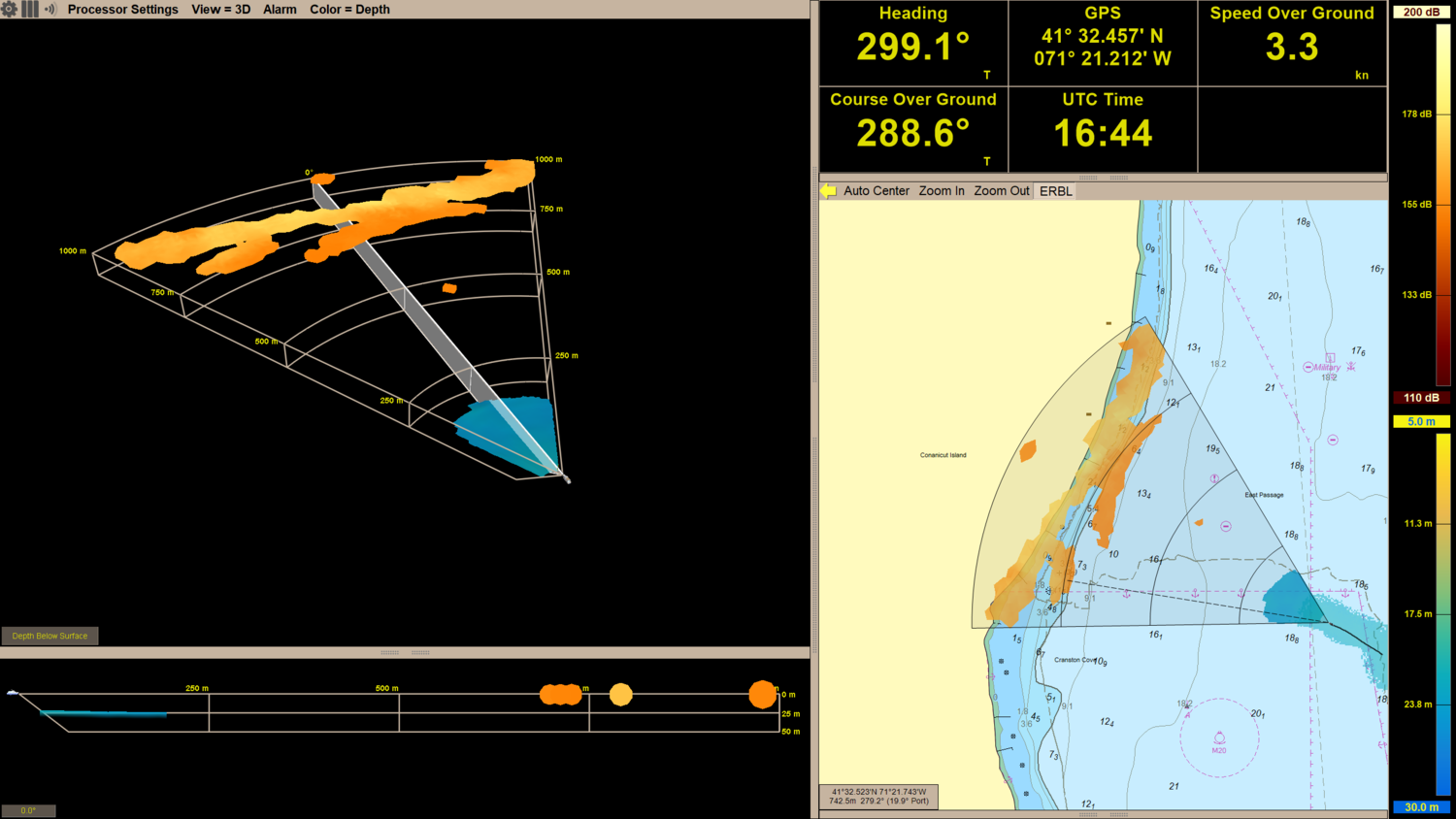
In a near shore SAR case, how close can you get in shallow water? After a natural disaster, are there unknown obstructions? Can you leave the channel to avoid a collision or get to a distressed vessel faster?

We have talked about FarSounder before. They make three different models,

  • Argos 350, range 350 meters at speeds up to 18 knots, for vessels as small as 14 meters (about 45 feet, e.g. the size of a response boat, medium).
  • Argus 500, range 500 meters at speeds up to 20 knots
  • Argus 1000, range 1000 meters at speeds up to 25 knots

There is a retractable version of Argus 1000 available for icebreakers.

I have sonar on my car now, so shouldn’t I have it on my boat?

October 18, 2023
Warwick, RI USA


For immediate release:

NSSLGlobal expands product portfolio with FarSounder’s innovative 3D Forward Looking Sonar

FarSounder and NSSLGlobal have joined forces to introduce FarSounder’s Argos product line to their defense, commercial, and leisure clients. These innovative Forward Looking Sonars (FLS) are used for safe navigation and obstacle avoidance. FarSounder’s technology is renowned in the cruise and leisure markets and is increasingly being adopted in both the Scientific/Exploration and Defence sectors both of which are moving towards Unmanned Surface Vessels (USV).

Vessels are often operating in more challenging environments such as higher latitudes where there may be ice, poorlyFarSounder/NSSL Global chartered areas, or austere ports. This unique patented technology paints a clear picture of what lies ahead underwater of the vessel, reducing the likelihood of collisions, which in turn prevents costly damage to property, the environment, and marine and human lives alike.

NSSLGlobal’s customers will benefit from FarSounder’s technology, which is the only product capable of generating a true, 3-dimensional image ahead of a vessel at navigationally significant ranges at each ping of the sonar. FarSounder’s most recent addition is the Argos 350 Forward Looking Sonar system which is the ideal solution for USVs and mid-sized vessels ranging from 18 – 40+ meters.

For more information, visit http://www.farsounder.com

“MSI Defence Systems to supply MK 48 Mod 2 EOS to US Navy & US Coast Guard” –Navy Recognition

MK48 Mod2 EOS MSI-DS Electro-Optical Sight System. (Picture source: MSI Defence Systems)

Navy Recognition reports,

According to information published by the US DoD on September 29, 2023, MSI-Defence Systems has been granted a contract worth $29,263,267 for the supply of the MK 48 Mod 2 Electro-Optical Sight (EOS).

This electro-optic system is associated with the 30mm Mk38 Mod4 gun weapon system.

30mm Mk38 Mod4

As far as we know, the first Coast Guard ships to get the Mk38 Mod 4 will be the Polar Security Cutters. I am hoping we will see the weapon on some of the Offshore Patrol Cutters.

I found it interesting that this contract provides not only for the Navy and Coast Guard but also the Military Sealift Command, because, currently, none of their ships have installed weapon systems.

“This initiative is in line with the enhancement of the MK 38 Mod 4 Machine Gun System, which will benefit the Navy, Coast Guard, and Military Sealift Command.”

“Coast Guard begins production phase of medium endurance cutter service life extension program” –CG-9

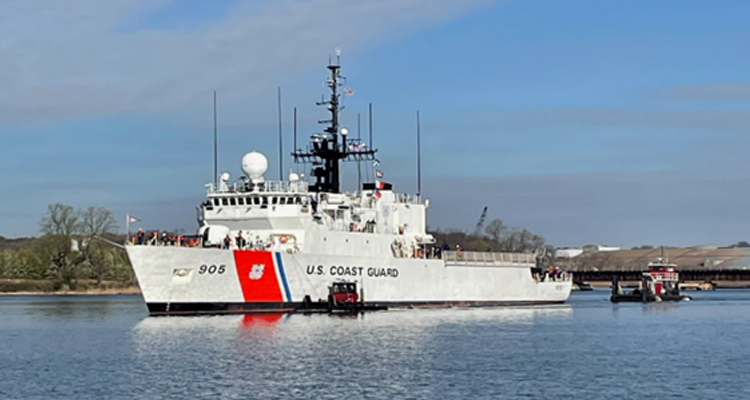
Coast Guard Cutter Spencer approaches the pier at Coast Guard Yard in Baltimore. Service life extension program work on the medium endurance cutter will last 15 months. U.S. Coast Guard photo.

Below is a release from the Acquisitions Directorate, CG-9.

I would note that all six ships getting this service life extension are “B class” 270s, built by Robert Derecktor Shipyard, Middletown, RI, numbers 905, 907, 908, 909, 911, and 912. Unlike the first four “A class,” these have a stronger flight deck, capable of supporting H-60s.

This release clarifies a lot about the SLEP program, but there are still some unknowns.

Reportedly the 76mm Mk75 gun and presumably the associated Mk92 firecontrol system will be removed. A Mk38 gun mount would presumably replace the 76mm, but it is not clear if any additional radar would be added to replace the air search and approach control functions that were provided by the Mk92. “Harriet Lane served as the gun weapons system prototype,” but I have not seen any post conversion photos of Harriet Lane that might show us the new sensor/weapon combination. Harriet Lane is expected to change homeports from Norfolk to Honolulu early in FY2024. Harriet Lane is an “A class” 270.

I also wonder if the SLQ-32 electronic warfare systems will be retained? Will the gun be the same 25 mm we have on the Webber class, or will at least some get the 30mm Mk38 mod4?


Coast Guard begins production phase of medium endurance cutter service life extension program

July 14, 2023

The service life extension program (SLEP) for the 270-foot Famous-class medium endurance cutters (MECs) moved to the production phase July 1 with the start of industrial work on Coast Guard Cutter Spencer.

Four main areas are being addressed during this SLEP, encompassing electrical, weapons system, engine and structural areas. Coast Guard Cutters Seneca and Harriet Lane served as prototypes for the electrical and structural work; Harriet Lane served as the gun weapons system prototype. Work on Seneca ran from July 2021 to March 2022; Harriet Lane work began March 2022 and is scheduled to be completed in August 2023.

Spencer will be the first hull to receive all major work items, including new main diesel engines. The work is scheduled to last 15 months.

SLEP work on the 270-foot MECs is planned through spring 2028 on five additional hulls: Legare, Campbell, Forward, Escanaba and Tahoma. The work involves targeted system replacement to address system reliability, supportability and obsolescence. SLEP work is completed at Coast Guard Yard concurrently with regular maintenance activities to achieve overall schedule and cost savings. The work will facilitate continued MEC operations during the service’s transition to the future offshore patrol cutter class.

In-Service Vessel Sustainment is the Coast Guard’s strategic class-by-class evaluation of its vessels to determine what major maintenance and upgrades are necessary for them to reach or extend their service lives.

For more information: In-Service Vessel Sustainment Program page

“JUST IN: Marine Corps Ramps Up Production of Remote Weapon Stations” –National Defense/ Maybe Something the Coast Guard Could Use

National Defense reports,

The Marine Corps is preparing for the transition to full-rate production of the Marine Air Defense Integrated System Remote Weapon Station, according to a July 10 press release from manufacturer Kongsberg.

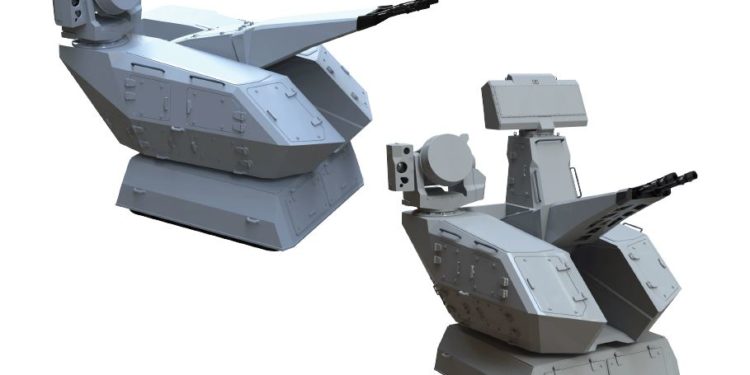
The Marine Air Defense Integrated System Remote Weapon Station, otherwise known as MADIS RWS, is a critical system in the Marine Corps Ground-Based Air Defense portfolio, which provides protection from drones with increased lethality against evolving threats.

Since this is a Marine system, built to be exposed to salt air and sea spray, there is no reason it could not also be a naval mount.

Currently no Coast Guard ships seem to have an effective hard kill system to use against Unmanned Air Systems.

The Marines seem to think they have an effective system.

It looks like a version of the MADIS system could be a very useful addition to some Coast Guard Cutters. The Navy might even want a few, including perhaps for the protection of Military Sealift Command Ships.

The war in Ukraine is showing us how useful and potentially dangerous even small Unmanned Surface and Air systems can be. The threat is not limited to Ukraine or Southwest Asia.

The MADIS system and its Remote Weapon Station is light enough to be used on virtually anything the Coast Guard calls a cutter. In addition to defense against UAS, this system could provide basic air defense against other potential threats and defense against swarming small craft.

The Webber Class:

We have already seen the sensors used in the MADIS system on the Webber class WPCs in PATFORSWA, but even those cutters don’t have an effective, installed hard kill system.

The addition of the MADIS remote weapon station to PATFORSWA FRCs would not only allow the cutters to engage UAS but would also provide them with protection against various air threats.

While perhaps less urgent, mounting the system on all Webber class would allow them to offer this protection to other potential targets.

Offshore Patrol Cutter port quarter

The Offshore Patrol Cutter (OPC): 

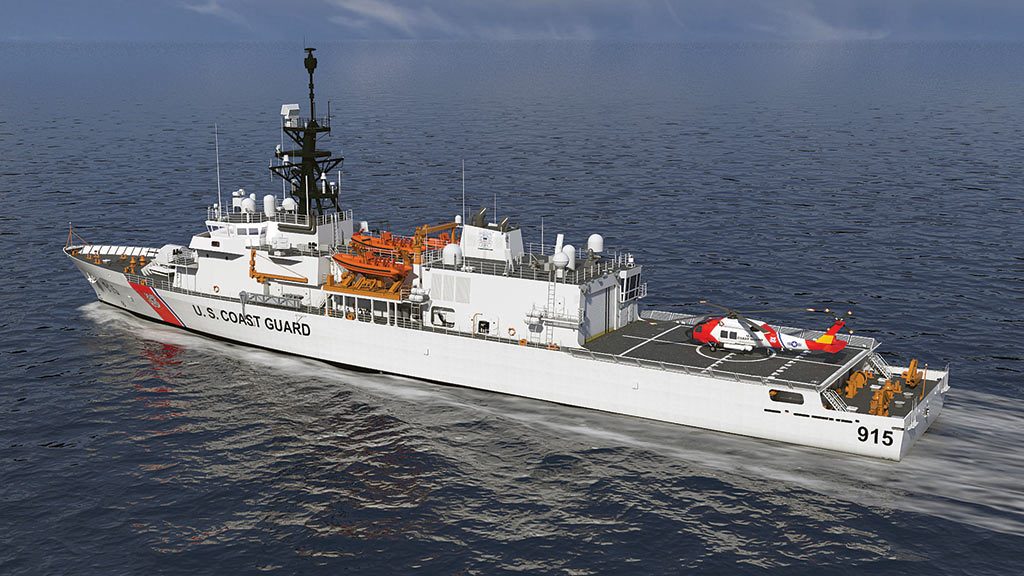
There are two troubling issues with the OPC with regard to their armament.

  • Aside from the .50 calibers, on most bearings, there is only one weapon that can bear on a target. The lack of redundancy is a serious weakness.
  • Protection against even the most basic air threats, including UAS, is weak at best.

I have always been a bit concerned that the arc of fire for the single 25mm Mk38 Mod3 gun is severely limited. It’s mounted on top of the hangar, but what appear to be satcom antennas on either side may limit the firing arc to less than 180 degrees.

Replacing the Mk38 mount, the two .50 caliber in remote weapon stations, and the crew served .50 caliber guns with three properly sited MADIS style remote weapon stations (RWS), would ensure redundant coverage of 360 degrees, provide a more robust air defense (including against cruise missiles), and reduce the number of different weapon systems that need to be maintained.

The National Security Cutters (NSC):

The NSCs are nominally better armed than the OPCs because they have a 20mm Phalanx rather than a 25 Mk38. They would certainly be better off if a pair of the MADIS RWS replaced the .50 caliber crew served weapons. The additional visual sensors might also be useful. It might even be preferable to replace the Phalanx with a third RWS.

Polar Security Cutter and Others: 

The remote weapon system does not necessarily require the air search radar system. This system is light and compact enough to arm virtually any cutter from patrol boats to icebreakers including buoy tenders that do occasionally do law enforcement and would benefit from the electro-optics that are part of the Remote Weapon Station.

Other Considerations: 

Other Remote Weapon Station combinations might be preferable. I would like to see a more powerful gun than the M230 combined with Hellfire or APKWS in addition to Stinger, but this is in the Navy’s system now and provides a unique combination of capabilities. Training and maintenance course should become available.

The gun in the remote weapon system, the XM914E1 30mm that fires the 30x113mm does have a lower muzzle velocity (805 m/s (2,641 ft/s)) than the 25mm M242 (1,100 m/s (3,600 ft/s)) but the 30mm has a higher rate and airburst ammunition not currently available for US 25mm guns. The 25mm might be a better anti-surface weapon but not by much and the air burst ammunition and particularly the Stinger make me strongly favor the MADIS system.

From Back Left: 40mm grenade casing, 30x173mm (A-10/M44), 30x113mm (M230), 25x137mm (M242/Mk38 gun mount), 20x103mm (Phalanx), 50 BMG
300Blackout (typical rifle round), 9mmx19 (typical pistol round)

The air search radars used with the MADIS system would provide redundancy for air search and helicopter approach control. It could also be used to support UAS operations. Reportedly the radar has a range of up to 30km and an instrumented range of 50km at altitudes from 30ft to 30,000 feet.

Stinger may be an old system, but it has a proven capability. It is likely to be replaced with a new and even better system in the near future.

Naval News at DIMDEX2022

Naval News provides a review of some of the presentations made at the very first DIMDEX show in Qatar. Day One above.

Day Two looks at the Pakistani naval defense plans and industry and at a compact combined active/passive variable depth sonar and towed array system from Finland’s Patria.

There is also this video of ships that attended the show.

Naval News also provided this post about a new class of cutter sized (3,000 ton) corvettes for the Pakistani Navy, based on Turkey’s MILGEM project Ada class corvettes and Istanbul class frigates.  These are significant both because of the growth of Turkey’s defense industry and because most of Pakistan’s recent naval acquisition have been from China. Significantly none of the planned systems are Chinese except the helicopter. Here are some links to information about the weapons to be mounted on the corvette:

ASELSAN GOKDENIZ twin 35mm CIWS

A Chinese Haifan II helicopter from the missile frigate ‘Zhoushan’ leaves the flight deck of HMS Cornwall. Members of the Chinese Public Liberation Army Navy (PLAN) were visiting the Type 22 frigate to discuss anti-piracy operations in the Gulf of Aden. Organization: Royal Navy Object Name: FB09002219

Naval News Coverage of Defence and Security Equipment International (DSEI), Sept. 14-17. 2021

Below I have provided the Naval News coverage of DSEI 2021. There are a few segments in particular that may be of interest.

In the Day 1 coverage:

  • 07:25 – VARD 7 115 Next Generation OPV. I think you can see the similarity to the Offshore Patrol Cutter design which is a VARD 7 110.
  • 10:09 – OMT’s MPV-80/12:52 – SH Defence “The Cube” modular mission module. The Danes have been making modular naval systems for decades and this is modularity on steroids. “The Cube” is a proposed system of standard container-sized modules. The MPV-80 is a modular OPV with 32 positions for “The Cube” modules.  

In the Day 3 coverage:

  • 00:47 – Royal Navy’s NavyPODS is another container-sized module proposal. Sounds like the Royal Navy may be considering using these on their River Class Offshore Patrol Vessels. 
  • 06:46 – AEUK SeaSense variable depth sonar. This is another ASW sensor that could be deployed on very small vessels. 
  • 07:27 – BAE Systems Bofors 40Mk4 naval gun system. This would make a good choice to arm smaller cutters or for use as a secondary on larger cutters. Right now, it’s not in the USN inventory and there is no integral fire control system, so. at least an Electro-Optic system would be required. The ammunition uses the same 3P fuse used on the 57mm Mk110 gun. For decades the Italians used 40mm guns for their CIWS. Most recently they have been using 76mm guns. The Royal Navy has recently adopted this mount to use as a secondary weapon and CIWS on the Type 31 class frigate

In the Day 4 coverage:

  • 04:55 – MSI Defence Ltd Seahawk 30mm naval gun system. We talked about this gun mount earlier, since it appears it will be the USN Mk38 Mod4. It is the reason I posted this video earlier. 

Day 1 at DSEI 2021 in London, UK. We focused on new anti-ship missiles, the Sea Breaker by Rafael, the Sea Serpent by IAI and Thales UK. We then take a look at two new OPV designs: The VARD 7 115 NGOPV and the MPV 80 by OMT. We then discuss with SH Defence about “The Cube” modular mission module.

  • 00:50 – Rafael’s Sea Breaker
  • 05:03 – IAI’s Sea Serpent
  • 07:25 – VARD 7 115 Next Generation OPV
  • 10:09 – OMT’s MPV-80
  • 12:52 – SH Defence “The Cube” modular mission module.

Day 2 at DSEI 2021 in London, UK. We focused on Naval Strike Missile (NSM) with Raytheon, the new Quadome 3D radar by Hensoldt, UAS integration with Thales and the MMCM program with Thales.

  • 00:15 – Intro
  • 00:53 – Raytheon’s NSM for SSGW
  • 04:12 – Hensoldt launches new Quadome 3D radar
  • 05:30 – Thales’ Unmanned wide area surveillance
  • 07:28 – Thales MMCM program

Day 3 at DSEI 2021 in London, UK. We talked to the Royal Navy about their NavyPODS concept. We then focused on mine warfare, talking to Patria and its acoustic sweep, and Atlas Elektronik UK (AEUK) ARCIMS and its payloads. We then talked to BAE Systems Bofors to get an update on the 40Mk4 naval gun program and learn about the T-650 heavy lift UAS which can carry a lightweight torpedo.

  • 00:12 – Introduction
  • 00:47 – Royal Navy’s NavyPODS
  • 02:53 – Patria’s acoustic sweep
  • 05:17 – Atlas Elektronik UK ARCIMS
  • 06:46 – AEUK SeaSense variable depth sonar
  • 07:27 – BAE Systems Bofors 40Mk4 naval gun system
  • 09:16 – BAE Systems T-650 heavy lift UAS

Final day at DSEI 2021 in London, UK. Naval News’ Editor-in-Chief, Xavier Vavasseur, takes you around the show floor and comments some of the new systems on display. We start with MBDA who was showcasing its future missile concepts (related to FCASW) as well as current portfolio of anti-ship missiles (SPEAR, SPEAR EW, Exocet, Marte, Sea Venom and Maritime Brimstone) and naval air defense solutions (Dragonfire, Aster B1 NT and CAMM / Sea Ceptor). We then take a close look at a scale model of the XLUUV on the TKMS stand and the MSI Defence Systems’ Seahawk 30mm naval gun system which was recently selected by the US Navy. Finally we talked to IAI’s Malcolm McKenzie to learn more details about Sea Serpent.

  • 00:47 – MBDA concept missiles for FCASW
  • 01:34 – MBDA SPEAR and SPEAR EW
  • 01:57 – MBDA Exocet MM40 Block 3C
  • 02:22 – MBDA Marte ER
  • 02:38 – MBDA Sea Venom
  • 02:48 – MBDA Maritime Brimstone
  • 03:08 – MBDA Dragonfire laser weapon system
  • 03:20 – MBDA Aster 30 B1 NT
  • 03:25 – MBDA CAMM / Sea Ceptor
  • 03:45 – TKMS XLUUV
  • 04:55 – MSI Defence Ltd Seahawk 30mm naval gun system
  • 05:26 – IAI Sea Serpent anti-ship missile


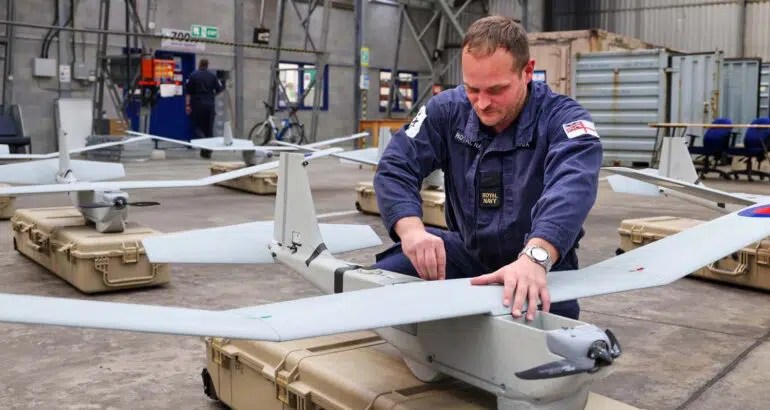
Two About Puma sUAS

Royal Navy Photo

Naval News reports on the Royal Navy’s increasing use of the Puma small Unmanned Air System (sUAS).

And we have this from Seapower, regarding a new night time imaging system.

The Puma is a system the Coast Guard has experimented with more than once, and the Canadians have also adopted it. My last look at this small UAS with comments on its suitability and links to previous posts here.

“U.S. Warships Have This Seldom Discussed But Very Powerful Optical Targeting System” –The Drive

USCGC Hamilton with its EOSS (Electro Optic Sensor System) atop its bridge. 

The Drive/The War Zone has a post regarding the Mk20 Mod1 Electro Optic Sensor System (EOSS) that is equipping National Security Cutters and Offshore Patrol Cutters in addition to the Navy’s newest destroyers and the new FFG. The post is in the form of an interview with a company rep.

We have talked about this system before here.

For such an inconspicuous system, it looks to be extremely useful. Other than using it as a firecontrol for ASuW and AAW, this system can be used for:

  • Location and tracking a man overboard
  • Channel position and navigation
  • Detection and identification including looking for the IR signature of low profile vessels
  • Naval gunfire support
  • Safety check-sight
  • Battle Damage Assessment

These will definitely be used on the Offshore Patrol Cutter. The earlier Mk20 Mod0 version was in the Draft Technical Package back in 2012.

“L3 Harris will continue to support MK 20 electro-optical sensor systems for US Navy ships” and Coast Guard Cutters

L3 Harris Mk20 mod1 Electro Optic Sensor System. (Picture source Navy Recognition)

A quick nod to an often overlooked system on the NSC and I think the OPC.

Navy Recognition reports a contract award to L3Harris.

The MK20 Mod 1 has three primary functions – EOSS/GWS integration, automatic target detection and tracking, and day/night video surveillance. These functions effectively support multiple mission requirements for full-spectrum surface detection, identification, surveillance, and target assessment. The MK20 Mod 1 supports operations including anti-surface and anti-air warfare, spotting and damage assessment, target detection and identification, naval gun fire support, safety check-sight, location/track of man overboard, and channel position and navigation.